Tag Archives: God

Mad At God

Mad at God

And Asa did that which was good and right in the eyes of the LORD his God (2 Chronicles 14:2)

Have you ever been mad at God or do you know someone who is, or has at some time been mad at God? People get mad at God for various reasons, all of which are unjustified, but more on that later. Some are angry at God, and therefore doubt His existence, because they see evil in the world, and they hold God responsible for allowing it to go on. They reason that either God does not exist, or if He does exist, He is either indifferent to evil or impotent to do anything about it. Others are angry with God because at some point God did not answer a specific request in the specific way they requested. Some are mad at God because after years of faithful service God disciplines them for some sin they commit.

That was the case with Asa, the fourth king of Judah since David. David was not perfect, but he had a heart that sought after God.[1] Solomon started out strong seeking wisdom from God rather than riches,[2] but in the end his weakness for women sucked him into paganism and idolatry.[3] Rehoboam listened to his friends rather than the advice of the old men, and his lack of wisdom divided the kingdom.[4] “And he did evil, because he prepared not his heart to seek the LORD” (2 Chronicles 12:14). What was that evil?

And Judah did evil in the sight of the LORD, and they provoked him to jealousy with their sins which they had committed, above all that their fathers had done. For they also built them high places, and images, and groves, on every high hill, and under every green tree. And there were also sodomites in the land: and they did according to all the abominations of the nations which the LORD cast out before the children of Israel. (1 Kings 14:22-24)

Abijah, Asa’s father, only ruled for three years. Even though God had given him victory over Israel (the northern kingdom),[5] Abijah followed in the godless steps of his father. “And he walked in all the sins of his father, which he had done before him: and his heart was not perfect with the LORD his God, as the heart of David his father” (1 Kings 15:3).

Asa followed the example of his great-grandfather, David, rather than in the steps of his father and grandfather. He “did that which was right in the eyes of the LORD, as did David his father” (1 Kings 15:11). Consider some of Asa’s accomplishments:

  • He took away the sodomites out of the land, and removed all the idols that his fathers had made (1 Kings 15:12; 2 Chronicles 14:3)
  • And also Maachah his mother, even her he removed from being queen, because she had made an idol in a grove; and Asa destroyed her idol, and burnt it by the brook Kidron. (1 Kings 15:13; 2 Chronicles 15:16)
  • And commanded Judah to seek the LORD God of their fathers, and to do the law and the commandment. (2 Chronicles 14:4)
  • And they entered into a covenant to seek the LORD God of their fathers with all their heart and with all their soul; That whosoever would not seek the LORD God of Israel should be put to death, whether small or great, whether man or woman. (2 Chronicles 15:12-13)
  • But the high places were not taken away out of Israel: nevertheless the heart of Asa was perfect all his days. (2 Chronicles 15:17, emphasis mine)

One might think that Asa was a pretty good king. In fact, the Bible records that He “did that which was right in the eyes of the LORD.” Asa probably felt pretty sure of his standing before God, and there he failed. “When pride cometh, then cometh shame” (Proverbs 11:2). “Pride goeth before destruction, and an haughty spirit before a fall (Proverbs 16:18).

Syria had been menacing Israel up north and Asa, wishing to stave off any trouble took it upon himself to take some of the Temple treasure and give it to Benhadad, king of Syria, to buy him off.[6]  It was not so much the misuse of the Temple treasure that angered God, but the fact that Asa failed to consult God first. “Because thou hast relied on the king of Syria, and not relied on the LORD thy God, therefore is the host of the king of Syria escaped out of thine hand.” (2 Chronicles 16:7, emphasis mine). God reminded him, “Were not the Ethiopians and the Lubims a huge host, with very many chariots and horsemen? yet, because thou didst rely on the LORD, he delivered them into thine hand” (2 Chronicles 16:8, emphasis mine). Then God gives Asa a lesson in Theology 101: “For the eyes of the LORD run to and fro throughout the whole earth, to shew himself strong in the behalf of them whose heart is perfect toward him” (2 Chronicles 16:9). The consequence of that lesson was this: “Herein thou hast done foolishly: therefore from henceforth thou shalt have wars.”

“Then Asa was wroth with the seer, and put him in a prison house; for he was in a rage with him because of this thing. And Asa oppressed some of the people the same time” (2 Chronicles 16:9). Asa was angry at God and rather than accept responsibility for his actions, he took his anger out on the messenger and anyone else who might be around. But God did not abandon Asa. He afflicted him with a disease of the feet that “was exceeding great” (2 Chronicles 16:13). The disease was likely intended to bring Asa to his knees in repentance, but instead “he sought not to the LORD, but to the physicians.”

So died Asa – a good king even in the sight of the Lord, but his pride and lack of repentance in the end destroyed the fellowship he had with the God he loved and the God that loved him.

It is understandable to get mad at God sometimes. It’s okay. He has big shoulders, and He can take it. He understands our heart. But God is God, and we very rarely understand what He is doing in our lives. We need to understand and accept that everything that He does is right. He is never wrong, and He is never unjust. We, as His children, need to trust that He is working everything for good in our lives (Romans 8:28). So, the next time you find yourself mad at God, talk to Him about it, and even if He doesn’t give you the answer you want to hear, keep in mind that He is God, and you are not.

NOTES:


[1] See: 1 Samuel 13:14; Acts 13:22

[2] See: 2 Chronicles 1:11; 2 Kings 4:29-30

[3] See: 1 Kings 11:3-11

[4] See: 2 Kings 12:1-19

[5] See: 2 Chronicles 13:3-20; 2 Kings 15:4-5

[6]  See: 2 Chronicles 16:1-6; 1 Kings 15:16-22

Comments Off on Mad At God

Filed under Bible, Christianity, Religion, Theology

Cain’s Wife

Cain and Abel, ivory panel from the cathedral of Salerno, ca. 1084. Image source: https://commons.wikimedia.org/wiki/File:Ivory_Cain_Abel_Louvre_AO4052.jpg

Cain and Abel, ivory panel from the cathedral of Salerno, ca. 1084. Image source: https://commons.wikimedia.org/wiki/File:Ivory_Cain_Abel_Louvre_AO4052.jpg

And Cain went out from the presence of the LORD, and dwelt in the land of Nod, on the east of Eden. And Cain knew his wife; and she conceived, and bare Enoch … (Genesis 4:16-17)

The question of Cain’s wife comes up often with both serious students of the Bible and skeptics. The low hanging fruit tempts the skeptic to ridicule the Bible for the omission of important details. After all, the Bible only speaks of Cain and Abel; no others siblings are mentioned. If the skeptic adheres to evolutionary/atheistic thinking, he may use this to support his perspective by claiming there were many hominids around before the mythical first couple came around. Cain must have gotten his wife from one of the many available to him.

The Bible student may find himself without a defense because the skeptic is clearly correct – there are no other people mentioned at this point. Genesis 4 records the first family, which includes Adam, Eve, Cain and Abel; no others are mentioned. So where did Cain get his wife? Is the skeptic correct?

This can pose a serious problem even to a seminary trained “professional” because there seems to be no clear-cut answer. But here I want to direct my attention directly to those who claim to believe in the infallibility and inerrancy of Scripture. If you are reading this now, and have doubts about the veracity of the Bible, you are welcome to check it out now.

If we believe that the Bible is the inspired Word of God, that it is without error and it is true in every respect – infallible, than we must accept it for what it says – period. Starting from the beginning, God created one man and one woman (Genesis 1:26-27; Genesis 2:7, 21-22). That was all; no other “hominid kind” were created. “And God blessed them, and God said unto them, Be fruitful, and multiply” (Genesis 1:28). In Genesis 4:1 Cain is born and in the next verse we are introduced to Abel. “And in process of time it came to pass” (Genesis 4:3) that a long period of time transpires and the boys are fully grown. The Bible gives no indication as to how much time elapsed between the first and second sentence of verse 2. Seth, the son to replace the murdered Abel, is born 130 years from Adam’s creation (Genesis 5:3), which means Cain and Abel could have been anywhere from around 30 to 129 years old. That said, “the days of Adam after he had begotten Seth were eight hundred years: and he begat sons and daughters” (Genesis 5:4, emphasis mine). It seems unlikely that in that span of time between the birth of Abel and the birth of Seth, Adam and Eve abstained from procreative activity. It is quite likely that they had a plethora of boys and girls – one every two to three years is not unreasonable.

At this point, the serious student of the Bible must conclude that Cain’s wife was one of his sisters. Did I hear a collective “Yuck!” out there? Suddenly someone recalls the biblical prohibition against marrying a close relative (Leviticus 18:6-20), so Cain cannot take a sister for his wife because that is prohibited by God’s Law. Here, science can aid our understanding of Scripture.

Let us first examine the time frame between creation and the time the Law was given to Moses. From Creation to the Flood was about 1656 years (Genesis 5). From the Flood to birth of Abraham was another 290 years (Genesis 11)[1]. From the birth of Abraham (Abram) until Israel went into Egypt was another 218, and Israel was in Egypt 430 before the Exodus and then another 40 years of wandering in the wilderness. So, from Creation to the Law was between 2594 years and 2604 years. This means that marrying within the family was not legally prohibited and Cain could indeed marry his sister. Remember that Abraham, Isaac and Jacob all three married close relatives.

Now, for Cain to marry his sister presented no biological problem either, because Adam and Eve were created perfectly – their DNA was perfect. Harmful mutations had not corrupted their DNA, so close family marriages did not present a problem.[2] It took about 2600 years before the genetic load became significant enough for God to intervene by giving the prohibition not to marry a close relative.

Where did Cain get his wife? From his parents; he married his sister. This posed no problem biblically or biologically.

Notes:


[1] James J.S. Johnson, “How Young Is the Earth? Applying Simple Math to Data Provided in Genesis,” http://www.icr.org/article/how-young-earth-applying-simple-math-data-provided/, accessed July 17, 2015.

[2] Ken Ham, “Cain’s Wife: It Really Does Matter!” http://www.icr.org/article/cains-wife-it-really-does-matter, accessed July 17, 2015.

1 Comment

Filed under Apologetics, Bible, Evolution, Origins, Poetry, Religion, Science, Theology

The Rainbow

I do set my bow in the cloud, and it shall be for a token of a covenant between me and the earth.  (Genesis 9:13)

From the beginning of time Satan has attempted to pervert everything that God created and called “very good” (Genesis 1:31). A prime example is revealed in last week’s ruling by the Supreme Court of the United States that homosexual cohabitation should be regarded as “marriage” and protected as a legal right under the Constitution of the United States. Such a ruling stains the bounds of reason considering that the same protection finds no haven in the Constitution for heterosexual unions. The lack of understanding demonstrated by five out of the nine justices illuminates the depths of depravity to which our nation has declined. The court’s decision prompted exhibitions of jubilation from what used to be the White House (now bathed in the colors of the rainbow) down to the streets of America. Local news media fight to maintain objectivity in reporting the atrocity as the grins on news anchors’ faces betray their accord with the order.

Regardless of the decision handed down by these black-robed oligarchs, “marriage” was defined by God at Creation. “So God created man in his own image, in the image of God created he him; male and female created he them” (Genesis 1:27). Out of the side of man, God created the woman (Genesis 2:21) “And the rib, which the LORD God had taken from man, made he a woman, and brought her unto the man” (Genesis 2:22, emphasis mine). In doing so, God effectively performed the first marriage ceremony. Marriage is not a human institution, it is a Divine institution, so much so that the relationship between Christ and His church is described as a marriage (Matthew 22:2-14; John 3:29; Ephesians 5:23; Revelation 18:23; Revelation 19:7). So, aside from the lawlessness of this act by this Supreme Court, it is the height of arrogance for mere man to redefine what God has already established. But, that is nothing new!

So, what does this have to do with the rainbow, you might ask. The rainbow has been adopted by the sodomites as a symbol of their perverted cause. Like the devil, who I imagine is reveling in his presumed victory; they have taken a sign of God’s promise not to destroy the earth by water again, and have used it as a banner to flaunt the kind of perversion that brought about God’s wrath in the first place (Genesis 6:5; Genesis 19:1-9).  Franklin Graham, son of famed evangelist Billy Graham and founder of Samaritan’s Purse, said, “God is the one who gave the rainbow, and it was associated with His judgment. God sent a flood to wipe out the entire world because mankind had become so wicked and violent.”[1]

Note that God identifies the rainbow as His bow: “I do set my bow in the cloud” (Genesis 9:13, emphasis mine). Indeed, the rainbow in the Bible is always associated with the throne of God. The prophet Ezekiel’s description of God’s throne (Ezekiel 1) defies human explanation, but one of the features is the rainbow that surrounds the throne.

And above the firmament that was over their heads was the likeness of a throne, as the appearance of a sapphire stone: and upon the likeness of the throne was the likeness as the appearance of a man above upon it. And I saw as the colour of amber, as the appearance of fire round about within it, from the appearance of his loins even upward, and from the appearance of his loins even downward, I saw as it were the appearance of fire, and it had brightness round about. As the appearance of the bow that is in the cloud in the day of rain, so was the appearance of the brightness round about. This was the appearance of the likeness of the glory of the LORD. And when I saw it, I fell upon my face, and I heard a voice of one that spake. (Ezekiel 1:26-28, emphasis mine)

A similar description of the rainbow surrounding God’s throne appears again in Revelation.

And immediately I was in the spirit: and, behold, a throne was set in heaven, and one sat on the throne. And he that sat was to look upon like a jasper and a sardine stone: and there was a rainbow round about the throne, in sight like unto an emerald. (Revelation 4:2-3, emphasis mine)

And I saw another mighty angel come down from heaven, clothed with a cloud: and a rainbow was upon his head, and his face was as it were the sun, and his feet as pillars of fire: (Revelation 10:1, emphasis mine)

God’s throne is also his “judgment seat.” The Greek word translated “judgment seat” is bēma, and it is translated as throne in Acts 12:21, “And upon a set day Herod, arrayed in royal apparel, sat upon his throne, and made an oration unto them” (emphasis mine). This brings us back around to the rainbow surrounding the throne of God from where He sits in judgment.  “But why dost thou judge thy brother? or why dost thou set at nought thy brother? for we shall all stand before the judgment seat of Christ” (Romans 14:10). “For we must all appear before the judgment seat of Christ; that every one may receive the things done in his body, according to that he hath done, whether it be good or bad” (2 Corinthians 5:10).

The poor misguided souls who celebrate their perversion beneath the colors of the rainbow call down upon themselves the judgment of God. The foolhardy President of the United States who bathes the People’s House in the colors of the rainbow in celebration of the Supreme Court’s foolish ruling unwittingly calls God’s judgment down upon our nation. This may well be the final nail in the coffin that America has built for itself

I see dark days ahead for our nation, but if you are a born-again follower of the King of Kings and Lord of Lords, a brighter day is coming, and it may come sooner than you think. In the meantime, Jesus said, “Occupy till I come” (Luke 19:13). “Ye are the light of the world. A city that is set on an hill cannot be hid … Let your light so shine before men, that they may see your good works, and glorify your Father which is in heaven” (Matthew 5:14, 16). This is not the time for passivity.

Notes:


[1] World News Daily, “Franklin Graham: ‘Gay’ Rainbow Ends Badly,” http://www.wnd.com/2015/07/franklin-graham-gay-rainbow-ends-badly/, accessed July 2, 2015.

4 Comments

Filed under Apologetics, Bible, Christianity, Creation, Current Events, End Times, Evangelism, Gospel, Heaven, Politics, Religion, Second Coming of Christ, Theology

When Faith Makes No Sense

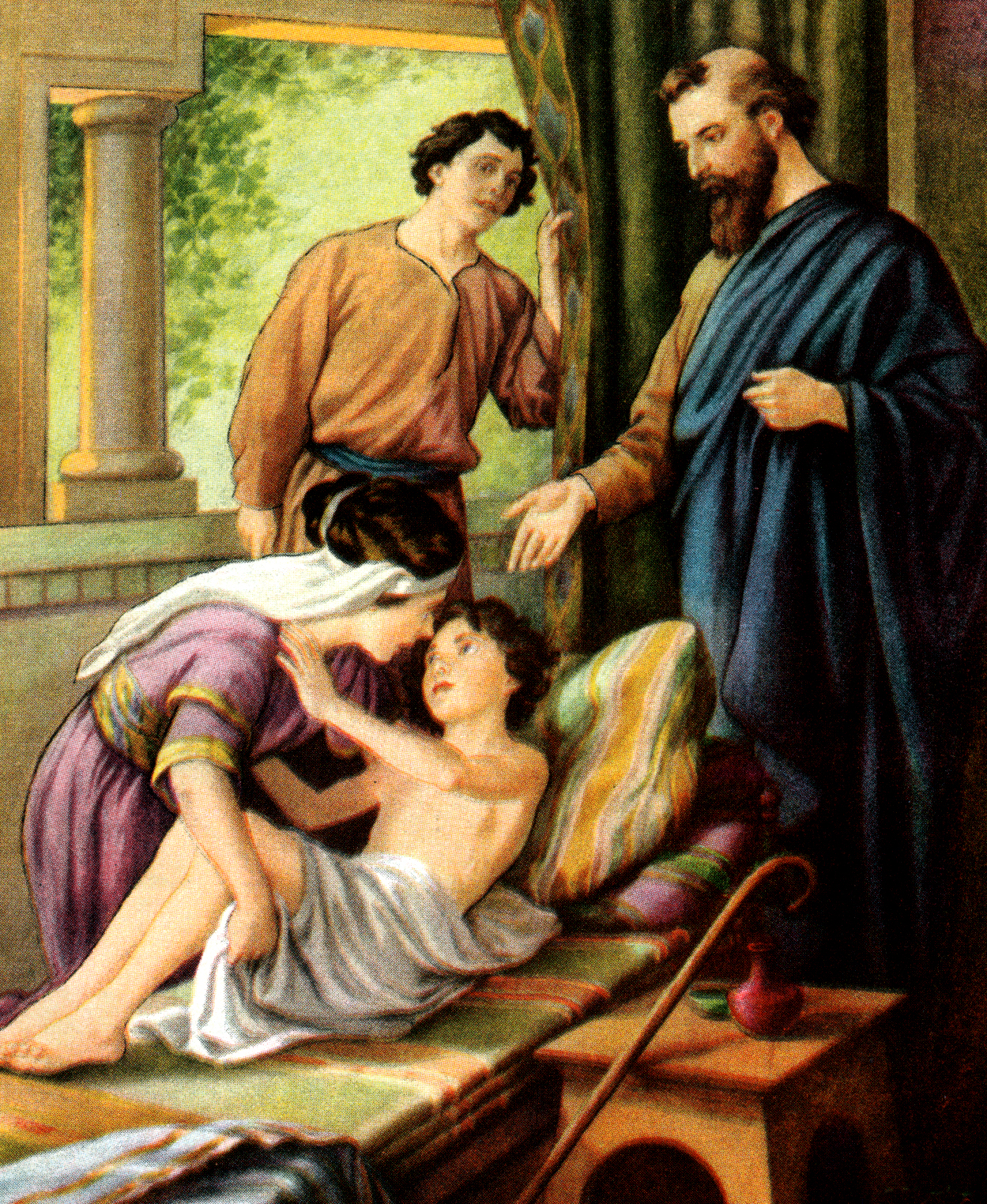
Elisha heals the child.

Behold, his soul which is lifted up is not upright in him: but the just shall live by his faith.  (Habakkuk 2:4)

Those who subject themselves to circumstances criticize those who live by faith, assuming a false pride in their own determination to react to whatever life may throw their way. Their pride forces them to deny that, for the most part, circumstances usually fail to land in their favor, and when circumstances favor them, they behave as if they had something to do with it.

On Father’s Day I wrote about my Dad, and how I learned to trust in God from him. The writer of the book of Hebrews says, “Now faith is the substance of things hoped for, the evidence of things not seen” (Hebrews 11:1). The Greek word translated “substance” is hupostasis, a compound word meaning “under” (hupo) “support” (stasis). “Stasis” in English is a state of equilibrium where things are consistent and unchanging. Faith, then, is immovable, and it is not “blind.” It is the “evidence of things not seen.” The Greek word translated “evidence” is elegchos meaning “proof.”

Well, how can one prove what cannot be seen? One way is experience. As I tried to relate in last week’s article, God showed Himself faithful in providing for our family in times of serious need.

In reading my Bible this past week, I once again came upon the account of the Shunammite in 2 Kings 4:8-37. According to the account, Elisha the prophet often passed through the town of Shunem on his way to and from Mt. Carmel. A certain woman there (we are not told her name) would invite him to stay in her home and would prepare a meal for him. Recognizing that he as “a man of God,” she suggested to her husband that they should build a room for the prophet to stay in as he traveled back and forth. This they did and Elisha, wishing to repay the kindness, asked what he could do for her. She refused to make a request, but Elisha still wished to bless her in some way. He consulted with his assistant, Gehazi, to see if there was any need that might be met. Gehazi noticed that the couple had no children, so Elisha had Gehazi called her. “And he said, About this season, according to the time of life, thou shalt embrace a son” (2 Kings 4:16). Now, the Bible says that she was a “great woman” (v. 8). The Hebrew word there is gâdôl which can also be translated “older.” On top of that, Gehazi, reported that “her husband is old” (v. 14) – Hebrew word zâqên meaning “elderly.” Not surprisingly, she responded, “Nay, my lord, thou man of God, do not lie unto thine handmaid” (v. 16). Despite her misgivings, her faith was rewarded, and she delivered a boy the following year as promised by the prophet.

Life continued as normal for the family of three, and then one day as the boy, now a young teenager, helped his father in the field, he started complaining of a headache (v. 19) and was taken home to his mother. As she cared for him, the boy eventually died the same day (v. 20). The narrative gives no sign of panic on her part. Instead, she carried him up to the prophet’s chamber and laid him on the prophet’s bed (v. 21). Then she made arrangements to go get Elisha. Even though her son was dead, she knew that the prophet could make things right; “And she said, It shall be well” (v. 23). Elisha recognized her as she approached his abode at Mr. Carmel, and dispatched Gehazi inquire as to her wellbeing. To all of his questions she replied, “It is well” (v. 26), but when she came to Elisha, her desperation came through. “And when she came to the man of God to the hill, she caught him by the feet: but Gehazi came near to thrust her away. And the man of God said, Let her alone; for her soul is vexed within her: and the LORD hath hid it from me, and hath not told me. Then she said, Did I desire a son of my lord? did I not say, Do not deceive me?” (2 Kings 4:27-28, emphasis mine). She had not abandoned hope. Her faith was intact. Her question was not one of doubt, but rather one of reminder that a promise had been made by the man of God, speaking for God, and God is faithful to His promise.

Elisha dispatched Gehazi with his staff and with instructions to place the staff on the boy’s body. The commentator, Matthew Henry, suggests that “He wished to teach the Shunammite, who obviously placed too great dependence upon him, a memorable lesson to look to God. By sending his servant forward to lay his staff on the child, he raised [the Shunammite’s] expectations, but, at the same time, taught her that his own help was unavailing.” Laying the staff on the boy’s body had no effect. When Elisha and the Shunammite woman arrived, the boy was still dead (v.32). What follows has been interpreted by some as mouth-to-mouth resuscitation, but that is a silly notion considering that the boy had been in that condition for at least 24 hours and perhaps more. The Bible says that Elisha “went up, and lay upon the child, and put his mouth upon his mouth, and his eyes upon his eyes, and his hands upon his hands: and he stretched himself upon the child; and the flesh of the child waxed warm. Then he returned, and walked in the house to and fro; and went up, and stretched himself upon him: and the child sneezed seven times, and the child opened his eyes” (2 Kings 4:34-35). Anyone knowing CPR knows that, given the condition described in the Bible, CPR would have been ineffective. The Bible definitively states that they boy was dead (vv. 20, 32). The boy was resurrected, not resuscitated and the Shunammite woman’s faith was confirmed.

This is not the last we hear about this woman. In 2 Kings 8:1-6 she reappears. This time Elisha warns her of a seven-year famine coming to the land where she lived. He instructs her simply to leave that place and “and sojourn wheresoever thou canst sojourn. And the woman arose, and did after the saying of the man of God: and she went with her household, and sojourned in the land of the Philistines seven years.” (2 Kings 8:1-2). At the end of seven years she returned to find that apparently her land had been unlawfully taken. She took her complaint before the king of Israel, and it happened that Gehazi was conversing with the king relating the account of the Shunammite’s son when the woman came before the king. “And when the king asked the woman, she told him. So the king appointed unto her a certain officer, saying, Restore all that was hers, and all the fruits of the field since the day that she left the land, even until now” (2 Kings 8:6).

In both of these instances, the Shunammite woman had no way of knowing what the future held, but she trusted in the unseen evidence of God’s Word for her provision.  Some may read this biblical account and say, “That’s just a Bible story,” but I have witnessed God’s hand in and throughout all of my life and in the life of my family as I was growing up. One somewhat recent confirmation happened about 24 years ago when my wife June and I purchased our first home together. We did not have a lot of money to put down on a home, and I had a bankruptcy on my record resulting from a divorce; so our options were very limited. We started looking at HUD repossessions, and to make a long story short, bid on a house which was outside of our desired price range. As a result, we made a low offer, and, to our amazement, God gave us the house with the low bid. We scheduled to close on the house on August 15, 1991, and on August 8, 1991, I was laid off from my job. June and I were faced with a faith challenge. Should we back out of the deal? That was a viable and honorable option. Or, should we trust in God’s provision? We decided that since God worked it out for us to win the bid, surely He would provide for the rest of it. We went through with the closure. The house needed some work – part of the deal included the “as is” condition of the house. We had to be out of our apartment by September 1, so I had plenty of free time to get the house ready. In the mean time I made one phone call that landed me a job in Dallas starting the first of September. We completed the work needed on the house, moved in, and I started work right after that. Friends, I do not believe in luck. That was all God.

I realize that the faith examples I have given here may seem a little on the materialistic side. They are not. These are all “needs” that God has met. Jesus said, “Therefore I say unto you, Take no thought for your life, what ye shall eat, or what ye shall drink; nor yet for your body, what ye shall put on. Is not the life more than meat, and the body than raiment? Behold the fowls of the air: for they sow not, neither do they reap, nor gather into barns; yet your heavenly Father feedeth them. Are ye not much better than they?” (Matthew 6:25-26). God cares about our every need, and as we learn to trust Him in the little things, He will prove Himself faithful in the greater things. And if He provides our material needs, how much more will He provide for our spiritual needs! And if He is faithful to His promise for our material well being, how much more will He be faithful to keep all of His Word?

Faith is the evidence of things unseen. Even when faith makes no sense, we can trust God because He has a proven track record – He has always been faithful.

2 Comments

Filed under Apologetics, Bible, Christianity, Religion, Resurrection, Theology

The Curse of Death

And as it is appointed unto men once to die, but after this the judgment (Hebrews 9:27)

And as it is appointed unto men once to die, but after this the judgment (Hebrews 9:27)

But of the tree of the knowledge of good and evil, thou shalt not eat of it: for in the day that thou eatest thereof thou shalt surely die.  (Genesis 2:17)

This week a young man, who labeled himself an agnostic, wrote in with a very good question concerning the curse of death. His question was posed as follows:

Genesis 2:17 says, “in the day that thou eatest thereof, thou shalt surely die.” Assuming that day equals 24 hours (big assumption, but Gen 2 is still part of the creation account) then the death must be spiritual or non-literal, since Adam lived to be 930 years – Gen 5:5. If the death resulting from sin is not literal, what is the relationship between sin and physical death? Is there any relation at all? Could physical death have occurred before sin? If sin and physical death are not related, why would Jesus have to rise from the dead? Is a bodily resurrection necessary for salvation? Why? Does any of the apostle Paul’s teaching of Christ conflict with a spiritual interpretation of death and sin? (I Cor 15:12-22)

Alternately, if the term “day” in Genesis 2:17 is not 24 hours, but instead an unspecified length of time equalling [sic] at least 930 years, most of the same questions about the relationship between sin and physical death would still apply.

His question is a very good one, and one of the key points in our biblical apologetics. The “death” described in Genesis 2:17 must be taken in context with the entire account of creation and the Fall, and in light of the rest of Scripture. Genesis 1 and 2 both narrate the creation account. Genesis 1:1-2:4 is God’s account of creation, and it gives a broad overview of the creation week. (For more details, see the notes on Genesis 1 and Genesis 2:1-4). Genesis 2:5 begins Adam’s account, and the focus is on Day Six and the creation of man. Allow me to regress and point out that chapter and verse divisions are not inspired. The original text was a continual reading with no breaks. This can sometimes be an obstacle, if one does not recognize that fact.

Another point that needs to be clarified is that the 24-hour day is not an “assumption” as he suggests. The Hebrew word used is yom, and it almost always means a normal 24-hour day in the Bible. When it is not a 24-hour day, such as in the “day of the Lord” (yom laYahweh) it is referring to a specific time, but never an extended period of time. Furthermore, God clearly defines the meaning of “day” with the phrase “evening and morning were the nth day” (Genesis 1:5, 8, 13, 19, 23).

At the end of the sixth day, God declared His creation not only “good” as in the previous five days, but “very good” (Genesis 1:31). Keep in mind that this assessment comes from an ultimately perfect being. So, if death existed before the fall, can death be considered a very good thing? If we say death is good, then how can death be a curse? And if death cannot be a curse, then why should Jesus die to pay the curse (the wages) of sin? If death was just a “spiritual” death, then, again, why should Jesus die a “physical” death to atone for a “spiritual” death? That really does throw a huge wrench in the works of the Gospel.

But “physical” death is NOT good. The Bible calls death the “enemy” (1 Corinthians 15:26). In the end, “death and hell (Greek hades “the grave”)” are cast into “the lake of fire” (Revelation 20:14). So, physical death cannot be part of a “very good” creation, if the Creator counts it as an enemy and something to be abolished. When God issued the command “thou shalt not eat of it: for in the day that thou eatest thereof thou shalt surely die” (Genesis 2:17), He was speaking of physical death. “Spiritual” death, i.e., separation from God, was a necessary consequence of that disobedience because He is the source of life (Job 33:4; Psalm 36:9; John 1:4; 5:26; 6:48; 10:28; 11:25; 14:6, et al). So, the death was both physical and spiritual. To further emphasize the point, Adam and Eve, since they had never experienced or observed death (keeping in mind that this all occurred shortly after creation – probably within a week or so), God (in the form of the pre-incarnate Christ – my opinion) sacrificed two (or more) innocent animals (probably sheep) in order to “cover” (atone for) their sin (Genesis 3:21). This was the first physical death of anything to this point, but on the spiritual side, man had already lost that intimate relationship with their Creator (Genesis 3:8).

This young man observed that Adam lived 930 years and concludes that the death curse must not have been physical but only spiritual, because they did not die immediately. One needs only to read Chapter 5 of Genesis and count how often the phrase “and he died” is repeated. Adam and Eve did not die instantly when they ate of the fruit, but they initiated the dying process. The phrase “you shall surely die” (Hebrew: mot tamot) would be better translated “dying you shall die.” Furthermore, the couple was denied access to the “tree of life” (Genesis 3:22) because apparently it had properties that would extend their life forever. The fact that they lived the long ages that they did is attributable to near perfect DNA (with the exception of the death mutation), and a near perfect environment. You may want to note the steady decline in longevity following the Global flood (Genesis 11:11-32).

Paul’s argument in 1 Corinthians 15:12-22 confirms that the curse of death is both physical and spiritual – physical in that our bodies degenerate to the point that they cease to function (we die), and spiritual in that our sin separates us from God (as physical death separates our spirit from our body). Jesus was sinless, like the first lambs sacrificed for Adam and Eve. Paul tells us that the “wages of sin is death” (Romans 6:23); here we are speaking of that spiritual death that separates us from God. Jesus’ death on the cross was the only sacrifice suitable to pay that debt of sin that separates us from God for all of mankind. “For it is not possible that the blood of bulls and of goats should take away sins” (Hebrews 10:4). Then when He rose again, He conquered the curse of physical death so that we can have eternal life. The choice, however, remains with us. From beginning to end, God has provided the way to restore that broken relationship and to enjoy eternal life with our Creator. We can either accept His offer, or reject it. “He came unto his own [not only the Jews, but mankind in general], and his own received him not. But as many as received him, to them gave he power to become the sons of God, even to them that believe on his name” (John 1:11-12).

3 Comments

Filed under Apologetics, Bible, Christianity, Creation, Death, Evangelism, Gospel, Origins, Religion, Salvation, Theology