Tag Archives: God

Jesus Said It

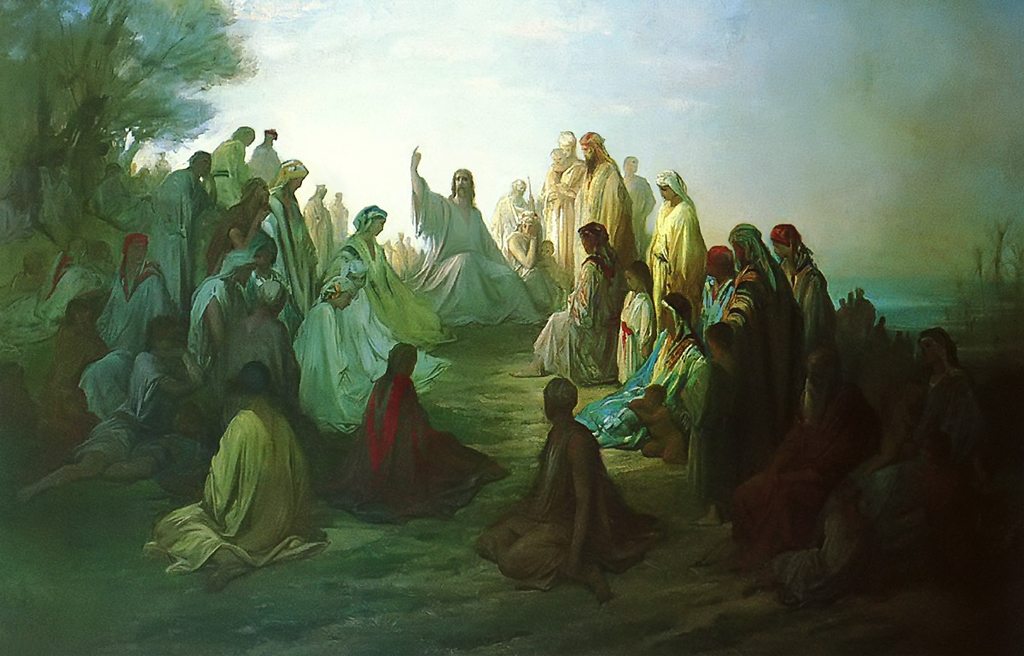
Jesus Preaching the Sermon on the Mount - Gustave Dore

                 Jesus Preaching the Sermon on the Mount – Gustave Dore

Heaven and earth shall pass away, but my words shall not pass away.   (Matthew 24:35)

The general conception of Jesus, if He is thought of at all, is that He was a nice guy, a good teacher, and perhaps a miracle worker. A lot of what He said are words to live by, like, “all things whatsoever ye would that men should do to you, do ye even so to them” (Matthew 7:12), and “Judge not, that ye be not judged” (Matthew 7:1 – taken out of context, a great verse for Christian bashing). There is no doubt that Jesus taught many things that benefit when applied to every-day life. Those kinds of teachings find general acceptance by all, but Jesus also said many things that many in this politically correct culture would find offensive.

Jesus said, “Repent: for the kingdom of heaven is at hand.” Repent? Many today who, like Donald Trump, believe they have done nothing from which to repent. The Bible says, “For all have sinned, and come short of the glory of God” (Romans 3:23), and “the soul that sinneth, it shall die” (Ezekiel 18:4, 20). Jesus said, “Repent”!

Jesus said, “Ye have heard that it was said by them of old time, Thou shalt not commit adultery: But I say unto you, That whosoever looketh on a woman to lust after her hath committed adultery with her already in his heart” (Matthew 5:27-28). What man alive can claim innocence of that sin? These days, the same could be said of woman. Along with that He said, “whosoever shall put away his wife, saving for the cause of fornication, causeth her to commit adultery: and whosoever shall marry her that is divorced committeth adultery” (Matthew 5:32). With today’s high rate of easy divorce, to how many does this apply? Speaking of adultery, Jesus said marriage is between one man and one woman: “But from the beginning of the creation God made them male and female. For this cause shall a man leave his father and mother, and cleave to his wife; And they twain shall be one flesh: so then they are no more twain, but one flesh. What therefore God hath joined together, let not man put asunder” (Mark 10:6-9, emphasis mine) – so much for same-sex unions.

Many think of Jesus as peaceful and gentle, but Jesus said, “Think not that I am come to send peace on earth: I came not to send peace, but a sword” (Matthew 10:34). Why is that? To His followers Jesus said, “And ye shall be hated of all men for my name’s sake” (Matthew 10:22, emphasis mine). “If the world hate you, ye know that it hated me before it hated you” (John 15:18).  Jesus said, “And a man’s foes shall be they of his own household” (Matthew 10:36).  “And the brother shall deliver up the brother to death, and the father the child: and the children shall rise up against their parents, and cause them to be put to death” (Matthew 10:21).  Jesus said, “For I am come to set a man at variance against his father, and the daughter against her mother, and the daughter in law against her mother in law” (Matthew 10:35); so “He that loveth father or mother more than me is not worthy of me: and he that loveth son or daughter more than me is not worthy of me. And he that taketh not his cross, and followeth after me, is not worthy of me.” (Matthew 10:37-38). However, He offers this promise: “he that loseth his life for my sake shall find it” (Matthew 10:39).

Jesus wants total allegiance; He wants first place in our lives. The reward is eternal life, but it is not without cost. Some will protest, and rightfully so, “Salvation is a free gift. It cannot be earned, Ephesians 2:8-9!” True. The “wages of sin” (Romans 3:23) were paid by Christ on the cross, but along with accepting the free gift comes the responsibility that goes with it. The Christian life is not one of ease, a life of “do as you please,” but the Christian has the promise of the Savior who says “my yoke is easy, and my burden is light” (Matthew 11:30) because He becomes your “yoke partner.”

Jesus said that the Global Flood was real: “But as the days of Noe were, so shall also the coming of the Son of man be. For as in the days that were before the flood they were eating and drinking, marrying and giving in marriage, until the day that Noe entered into the ark, And knew not until the flood came, and took them all away; so shall also the coming of the Son of man be (Matthew 24:37-39). Jesus said that the Jonah “fish story” was true: “For as Jonas was three days and three nights in the whale’s belly; so shall the Son of man be three days and three nights in the heart of the earth” (Matthew 12:40). He said this in foretelling of His own death, burial, and resurrection which He fulfilled at His crucifixion.

Jesus said hell is real. He spoke of those within the church – “tares” – that by all appearances look like genuine Christians, but are not. Of these He said, “As therefore the tares are gathered and burned in the fire; so shall it be in the end of this world. The Son of man shall send forth his angels, and they shall gather out of his kingdom all things that offend, and them which do iniquity; And shall cast them into a furnace of fire: there shall be wailing and gnashing of teeth” (Matthew 13:40-42, emphasis mine). He spoke of the kingdom of heaven being like a net cast into the sea (the “sea” is often used as a metaphor for “the people” of the world) and gathered in by the angels who separate the good from the bad. “So shall it be at the end of the world: the angels shall come forth, and sever the wicked from among the just, And shall cast them into the furnace of fire: there shall be wailing and gnashing of teeth” (Matthew 13:49-50, emphasis mine).  Jesus said that if your hand, foot, or eye causes you to sin, you should get rid of them, for it is better to enter into heaven maimed than to be whole and “to go into hell, into the fire that never shall be quenched: Where their worm dieth not, and the fire is not quenched” (Mark 9:43-48, emphasis mine). Notice that Jesus stressed the eternality of hell; “never” means NEVER.  Jesus spoke of hell as a real place. He told the true account of a rich man and a poor beggar who both died and stepped into eternity (Luke 16:19-31).  The rich man ended up in hell, “And in hell he lift up his eyes, being in torments” (Luke 16:23, emphasis mine). Hell is real. Jesus said it.

Just as hell is real, Jesus said heaven is real. “Let not your heart be troubled: ye believe in God, believe also in me. In my Father’s house are many mansions: if it were not so, I would have told you. I go to prepare a place for you. And if I go and prepare a place for you, I will come again, and receive you unto myself; that where I am, there ye may be also” (John 14:1-3, emphasis mine). That place has dimensions: “And the city lieth foursquare, and the length is as large as the breadth: and he measured the city with the reed, twelve thousand furlongs. The length and the breadth and the height of it are equal” (Revelation 21:16).  A furlong is 660 feet. Twelve-thousand furlongs would be 7.92 million feet, and divided by 5280 feet (i.e. one mile), that is equal to 1500 miles. That is about the distance from Dallas, TX to New York, NY. Now imagine that in the size of a cube. It is not a small place! And that is just the “New Jerusalem.” There is no telling just how large the rest of heaven is, but with all that space, it is a very exclusive place. Jesus said, “Enter ye in at the strait [narrow/tight] gate: for wide is the gate, and broad is the way, that leadeth to destruction, and many there be which go in thereat: Because strait is the gate, and narrow is the way, which leadeth unto life, and few there be that find it” (Matthew 7:13-14, emphasis mine).

Many today appeal to the “love” of Jesus suggesting that a “loving God” would not send anyone to hell. Even the Pope has boarded that band wagon claiming that all roads lead to God. Those who appeal to a loving God are partially correct; God sends no one to hell. They end up there by their own choice. Those who claim John 3:16 fail to read any further. Two verses down, John 3:18 says, “He that believeth on him is not condemned: but he that believeth not is condemned already, because he hath not believed in the name of the only begotten Son of God” (emphasis mine). In my Bible, those words are written in red; Jesus said it.  God is not swayed by popular consensus. Jesus said, “I am the way, the truth, and the life: no man cometh unto the Father, but by me” (John 14:6, emphasis mine). There is no other way. Jesus said it.

Jesus taught many good lessons that when taken to heart prove beneficial to our day-to-day lives. But He also taught some very hard lessons that, when ignored, lead to eternal damnation. It’s tough to hear, but Jesus said it.

If you are unsure of your eternal destination, you alone can do something about it. “Ask, and it shall be given you; seek, and ye shall find; knock, and it shall be opened unto you: For every one that asketh receiveth; and he that seeketh findeth; and to him that knocketh it shall be opened” (Matthew 7:7-8). Jesus said it.
4 Comments

Filed under Apologetics, Christianity, Evangelism, Gospel, Heaven, Hell, Religion, Salvation, Theology

The Theocracy Fallacy

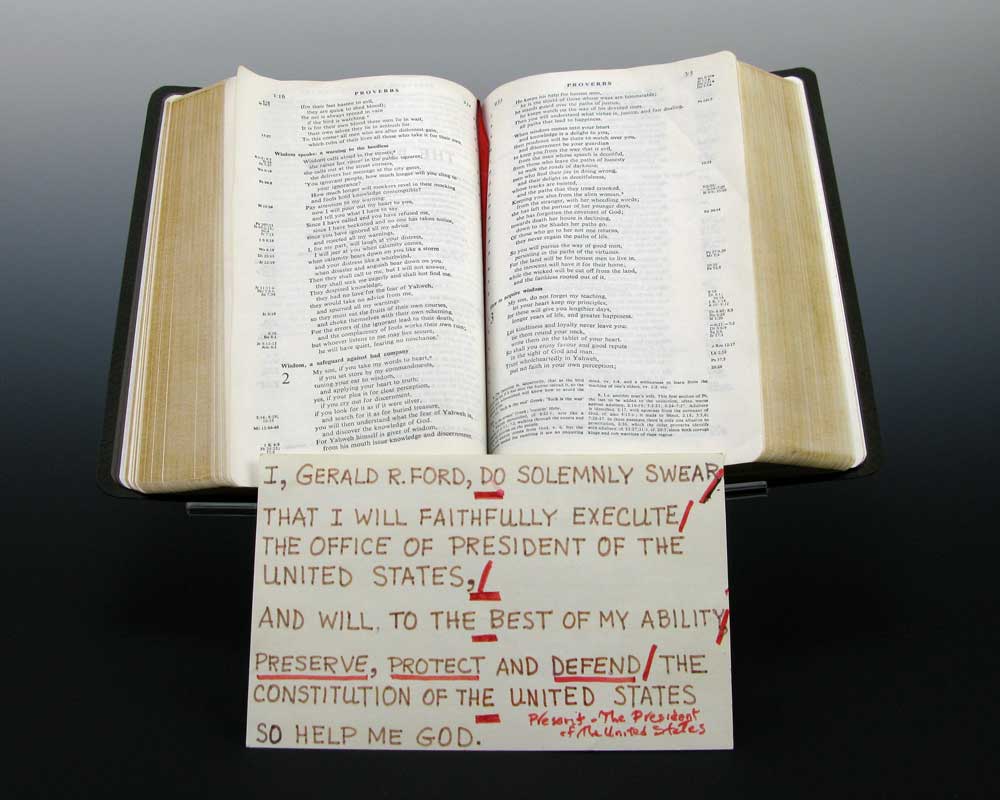
Bible and Cue Card Used by Gerald R. Ford When He Took the Oath of Office

Bible and Cue Card Used by Gerald R. Ford When He Took the Oath of Office

And she brought forth a man child, who was to rule all nations with a rod of iron: and her child was caught up unto God, and to his throne.   (Revelation 12:5)

Recently the liberal news media bushwhacked presidential candidate Dr. Ben Carson for his statement that a Muslim should not serve as President of the United States. The statement found great support among conservatives, but left-leaning Democrats and Republicans were self-righteously offended by his remarks. Attempting to do some damage control without really backing down, Carson explained that someone who would place Sharia Law above the Constitution of the United States cannot honestly swear to uphold and defend the Constitution. Carson rightly pointed out that Islam is a theocracy – god rule. A true follower of Islam cannot separate his religion from his politics; they are one and the same. The Muslim holy book and other Muslim sacred writings call for strict adherence to Islamic law. (“Islam” means “submission.”) Therefore, if a faithful Muslim were to become President of the United States, “he” (because a Muslim woman would not be permitted to hold such an office) would have to, out of obligation to his religion, invoke Sharia Law when it came in conflict with the Constitution.

In his defense, Carson qualified his stance by saying that he could indeed vote for a Muslim as President, if that Muslim denounced Sharia Law and swore to uphold the Constitution in all cases. (Of course, the Qur’an encourages Muslims to lie to “infidels,” so their integrity would be questionable.) Furthermore, said Carson, he would not vote for a Christian, if that Christian advocated for a Christian theocracy. Our nation is and always has been a nation of laws, and the Constitution is the law of the land.

I fully understand and agree with Dr. Carson’s stance. What I believe is missing here is a clear understanding of what a theocracy is. According to Dictionary.Com, a theocracy is “a form of government in which God or a deity is recognized as the supreme civil ruler, the God’s or deity’s laws being interpreted by the ecclesiastical authorities.” The problem with that definition is in the word “recognized” and in the phrase “laws being interpreted by the ecclesiastical authorities.” That renders the definition false because it is humanistic in nature. First of all, the deity has to be “recognized” by man as the “supreme civil ruler” which means that ultimately it is man that is defining the laws of the god. Secondly, the laws are interpreted by men who are either appointed by men or self-appointed as “ecclesiastical authorities.” Ultimately the “theocracy” becomes an “androcracy” – a rule by men, so the “god-rule” goes out the window.

When God brought the children of Israel into the Promised Land, they had no king other than God. God gave His law to Moses and set up a system of priests and judges to administer His law. Not long after they settled in the land, reliance on God and His law fell by the wayside and “every man did that which was right in his own eyes” (Judges 17:6; Judges 21:25). Therein lays the problem with a theocracy – man.

A true theocracy is absolute rule by God. Until Christ returns to set up His kingdom on earth, any man-initiated theocracy is doomed to fail. When Christ returns as King of Kings and Lord of Lords, His rule will be absolute. Speaking of Christ, the Messiah, the Lord says, “Thou shalt break them with a rod of iron; thou shalt dash them in pieces like a potter’s vessel” (Psalm 2:9). When He returns, He will share His administration with His saints “And [they] shall rule them with a rod of iron; as the vessels of a potter shall they be broken to shivers: even as I received of my Father” (Revelation 2:27). There will be no question of authority because His eternal law will not be violated. “And out of his mouth goeth a sharp sword, that with it he should smite the nations: and he shall rule them with a rod of iron: and he treadeth the winepress of the fierceness and wrath of Almighty God” (Revelation 19:15).  The “sharp sword” from His mouth is the Word of God: “For the word of God is quick [i.e., “alive”], and powerful, and sharper than any twoedged sword, piercing even to the dividing asunder of soul and spirit, and of the joints and marrow, and is a discerner of the thoughts and intents of the heart” (Hebrews 4:12).

Until Jesus returns, no true theocracy can exist. Any so called theocracy devised by fallen man is thereby flawed. Dr. Ben Carson is right. Anyone adhering to any human defined theocracy is unfit to hold the office of President of the United States. As it stands, the U.S. Constitution, because of its foundation on God’s Law, must be upheld as the supreme law of the land.

4 Comments

Filed under Apologetics, Current Events, End Times, Philosophy, Politics, Religion, Second Coming of Christ, Theology

This Generation

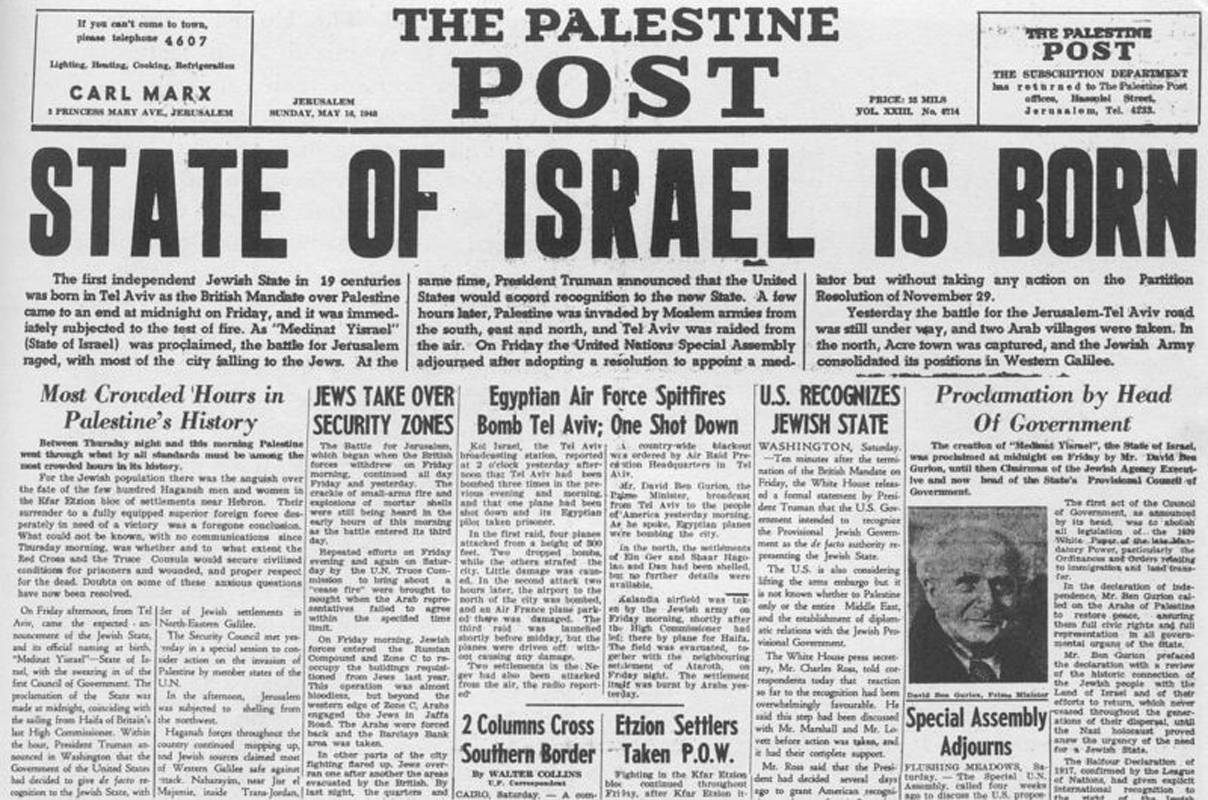
israel-born-in-a-day

Verily I say unto you, This generation shall not pass, till all these things be fulfilled.   (Matthew 24:34)

The cross loomed menacingly just days away. Jesus’ mind was already on that fateful day as He traversed the crowded streets of Jerusalem. As His disciples marveled at the grand architecture of Herod’s Temple, Jesus’ thoughts were on the future of His impending death and beyond.  “See ye not all these things? verily I say unto you, There shall not be left here one stone upon another, that shall not be thrown down” (Matthew 24:2). This prediction literally came to pass just 40 years after His crucifixion when the Roman general Titus razed Jerusalem in 70 AD and leveled the Jewish Temple. Not a single stone of that edifice remains. For those who unknowingly point to the Wailing Wall that stands next to the Muslim Dome of the Rock, I must point out that the Wailing Wall is the remains of the Roman Antonia Fortress that surrounded the Temple and was not actually a part of the Temple.

That remark gave pause for thought, and when they arrived at the Mount of Olives, the disciples naturally wanted to know, “Tell us, when shall these things be? and what shall be the sign of thy coming, and of the end of the world?” (Matthew 24:3). As we assess that state of our world, the same question comes to mind. In response to the disciples’ question, Jesus launched into his “Olivet Discourse” where He spoke of the rise of false Christs, wars and rumors of wars, the increase of iniquity, the demise of love, and the rise of the Antichrist (the “abomination of desolation”).

Jesus described the “Great Tribulation” as a period of seven years that will precede His return. This period was predicted by the Prophet Daniel (Daniel 9:24-27) and detailed in Revelation 6-19. However, the timing is not provided and that is what the disciples and we want to know. Jesus did not provide that information either. “But of that day and hour knoweth no man, no, not the angels of heaven, but my Father only” (Matthew 24:36). He did, however, give us a hint:

Now learn a parable of the fig tree; When his branch is yet tender, and putteth forth leaves, ye know that summer is nigh: So likewise ye, when ye shall see all these things, know that it is near, even at the doors. Verily I say unto you, This generation shall not pass, till all these things be fulfilled. (Matthew 24:32-34, emphasis mine)

 The fig tree has often been seen as a symbol of the nation of Israel. Jesus uses this symbol to indicate the proximity of the time. When the fig tree, i.e., Israel, is tender and begins to bud, we know that summer, i.e., the time of His return, is near. After the destruction of Jerusalem in 70 AD, the nation of Israel ceased to exist until May 14, 1948 when the “fig tree” budded and the nation was reborn. “This generation shall not pass, till all these things be fulfilled.” Jesus was not referring to the disciple’s generation, because even though they witnessed the destruction of the Temple, Jerusalem and the nation of Israel, they did not see the return of Christ as reigning King. They did see Him after He rose from the grave, but then He returned to heaven (Acts 1:9). Jesus referred to the generation that would see the rebirth of Israel.

            The question remains, how long is a generation? It could be 100 years when we consider that Abraham was 100 years old when Isaac was born (Genesis 21:5). It could also be the span of Abraham’s life, 175 years (Genesis 25:7). But the answer is more basic than that. Jesus was not giving a definite number of years. Recall that He said that no one except the Father knows the time or the hour. Instead, Jesus said that the generation that witnessed the rebirth of Israel will also see His return. The generation born in 1948 is now 67 years old, and most of them are still going strong. If we consider the “Greatest Generation” that fought in World War II, many of them are still living, but they are declining in number – that narrows the time even more.

Either way the time is drawing very close for the Lord’s return. Before He does, there precedes seven horrible years of Great Tribulation that will engulf the entire world. I am concerned for friends and loved ones that will live though that dreadful time. While there will still be opportunity turn to Christ during that time, the decision will be costly. For those of us who have placed our trust in Christ, our Lord will come for us sometime before that dreadful day – maybe today. This Generation, the one in which we live, will see the return of Christ. Are you ready?

10 Comments

Filed under Apologetics, Christianity, End Times, Evangelism, Gospel, Religion, Salvation, Second Coming of Christ

I Know Whom I Have Believed

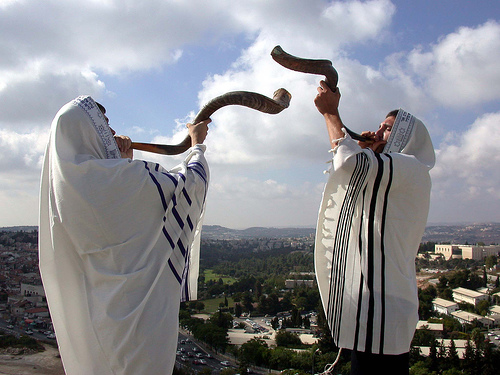
Trumpets

For yet a little while, and the wicked shall not be: yea, thou shalt diligently consider his place, and it shall not be. (Psalm 37:10)

These are exciting times in which we live. The world’s attention is focused to the time around mid-September.  End-times Bible prophets point to the Jewish Fall Feasts (more accurately, the Feasts of the Lord), and note that this year’s feasts are more significant than any others in the past. Jonathan Cahn, author of The Harbinger, recently released his latest book, The Mystery of the Shamitah, where he meticulously points out that in recent US history, Shamitahs have resulted in economic collapse demonstrated by huge drops in the stock market.

The Shamitah is the seven-year cycle assigned by God (Leviticus 25:4) where the Jews were required to leave the land fallow for the entire year to give it a rest – a Sabbath for the land. The Jews failed to keep the Shamitahs for 490 years (7 years x 70 Shamitahs) resulting in their 70 year Babylonian captivity (2 Chronicles 36:21; Jeremiah 25:11-12), one year for each Shamitah they failed to keep. You will need to get Cahn’s book for specific details, but in short, he suggests that God’s laws have transferred to the US because of how our nation was founded – “One nation under God.” Our nation is now reaping the consequences for our rejection of God. Cahn observes that every great economic collapse that America has experienced has fallen at the conclusion of a Shamitah year.

This year (2015) the Shamitah concludes on September 13. If the cycle keeps true to the pattern, the United States will experience a great economic collapse on September 14. This is due to the fact that September 13 falls on a Sunday when the stock market is closed. I noticed this past week that the stock market took a huge hit dropping over 500 points and making Wall Street very nervous. This seven-year cycle has not escaped many economists; however they cannot explain why this happens.

Another interesting event in September is that of Rosh Hashanah (the Feast of Trumpets), which signals the Jewish New Year. This event occurs on September 14. It also signals the beginning of the Jubilee year (Leviticus 25:8). After seven Shamitahs (7×7 or 49 years), the following year was special Shamitah called the Jubilee making a 50-year cycle. At this time all debts were cancelled, all properties were returned to the original owners and all accounts were zeroed. What is significant about this coming Jubilee is that it will be the 70th Jubilee since the law was given 3500 years ago. More could be said on this, but I recommend getting the book God’s Final Jubilee by Dan Goodwin.

These are significant events on God’s calendar (which, by the way, does not follow our solar calendar). But even in the secular world, this coming September seems to hold the promise of “something big” happening. As stated earlier, economists are aware of the 7-year cycle, and even though they do not understand it nor can they explain it, they predict an economic collapse this fall, sometime in September or October. The Pope plans to address Congress on September 24. This will be the first time a Pope has ever addressed the US Congress. This follows immediately after Yom Kippur (the Day of Atonement). Sukkot (the Feast of Tabernacles or Booths) begins on Sunday just three days later.

What does this all mean? I do not know, but it is interesting that all these events are converging from the middle to the end of September. Perhaps this is the year that the Lord will call His bride home. That is my earnest hope at least, but I am not packing my bags and heading to the hills. Jesus gave us all our assignments before He left, and He said, “Occupy till I come” (Luke 19:13). Ever since the turn of the 21st century (perhaps even before that), every time this season rolls around, I start looking toward the eastern sky listening for the call of that last trumpet. So far, I have been disappointed, but not despondent. This is God’s plan, and He is in full control. I know that the call will not come until His time is right. Whenever that happens, I am ready!

One of my favorite hymns says:

     I know not why God’s wondrous grace

To me He hath made known,

Nor why, unworthy, Christ in love

Redeemed me for His own.

     I know not how this saving faith

To me He did impart,

Nor how believing in His Word

Wrought peace within my heart.

          I know not how the Spirit moves

Convicting men of sin,

Revealing Jesus thro’ the Word,

Creating faith in him.

     (I know not what of good or ill

May be reserved for me,

Of weary ways or golden days,

Before His face I see.)

     I know not when my Lord may come,

At night or noonday fair,

Nor if I walk the vale with Him,

Or meet Him in the air.

     Refrain:

But “I know Whom I have believed,

And am persuaded that He is able

To keep that which I’ve committed

Unto Him against that day.” [1] (2 Timothy 1:12)

I look forward to September 2015 in anticipation of our Lord’s return. If it doesn’t happen, that just means that we have more work to do. There is also the possibility that I may die before He returns. Either way, I will be with Him. As the last verse of the hymn says, “I know not when my Lord may come, at night or noonday fair, nor if I walk the vale with Him, or meet Him in the air.” The point is, I know in whom I have believed, and I am fully trusting in His sovereign will. How about you? Are you ready for His return?

Notes:


[1] Daniel W. Whittle, “I Know Whom I Have Believed,” Published 1883.

6 Comments

Filed under Current Events, End Times, Evangelism, Gospel, Heaven, Religion, Second Coming of Christ, Theology

Is Salem Jerusalem?

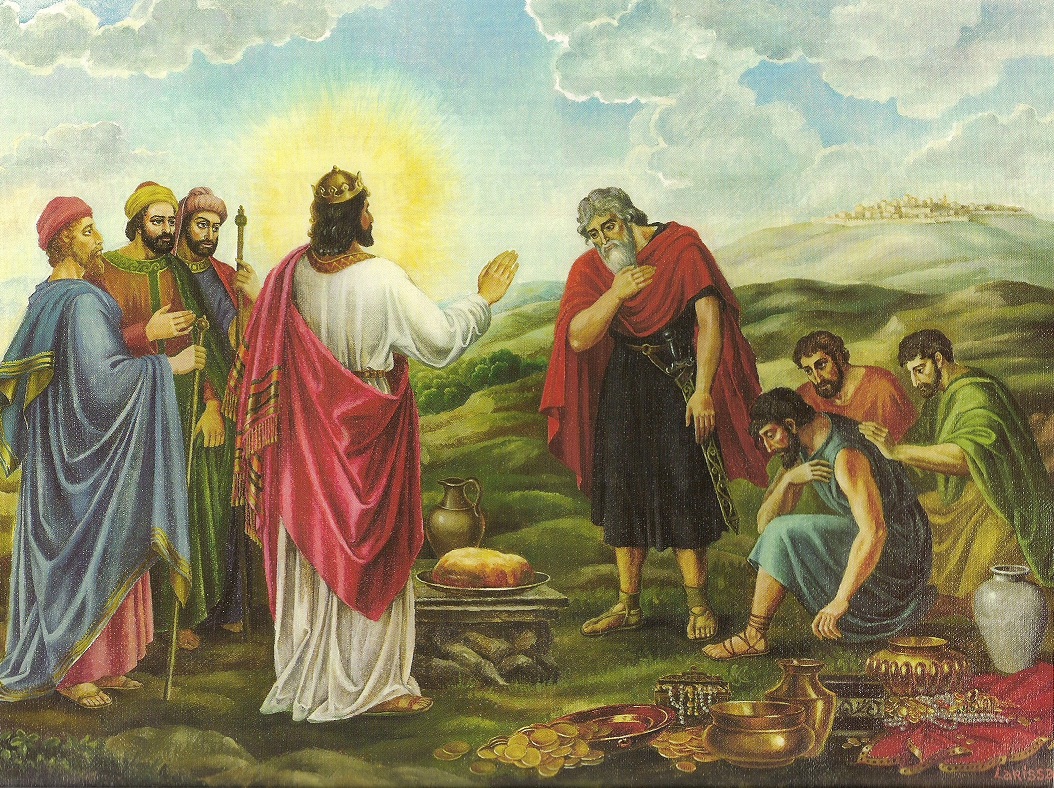
Melchizedek_Abraham

And Melchizedek king of Salem brought forth bread and wine: and he was the priest of the most high God. (Genesis 14:18)

Melchizedek is one of the most mysterious characters recorded in the Bible. He makes his debut in Genesis 14, and the totality of information provided about him is encapsulated within three brief verses (Genesis 14:18-20). It is interesting that the “Book of Beginnings,” which meticulously records all the “begets” of who’s who of important personages of early history, completely ignores the lineage of this apparently most significant person. The New Testament letter to the Hebrews does no better at identifying the parentage of this mysterious figure. Of Melchizedek, the writer of the book of Hebrew writes: “Without father, without mother, without descent, having neither beginning of days, nor end of life; but made like unto the Son of God; abideth a priest continually” (Hebrews 7:3, emphasis mine).

Some believe that Melchizedek was a real person, king of the city-state of Salem. However, Salem is only associated with Melchizedek in the Bible.[1],[2] Nowhere is it listed with the other cities in Canaan, and it is given no significance other than its association with Melchizedek. Some have suggested that Salem was the former name of Jerusalem. They attribute this to clay tablets found at the Tell el Amarna site, dated at 1400 B.C., identifying Urusalim as an early name for Jerusalem. They conclude that “Salem” is just an abbreviated form of Urusalim, and is therefore the same as Jerusalem.

I see several problems with that conclusion. First of all, the date of the Tell el Amarna tablets is about 800 years after Abraham’s encounter with Melchizedek. Israel’s entry into Canaan and the period of the Judges occurred around 1400 B.C. At that time, Jerusalem was known by that name (Jerusalem) and also by the name of Jebus.[3] The Bible identifies Jebus as the city of the Jebusites, and the Jebusites dwelt in the land at the time of Abraham (Genesis 15:18-21). It seems unlikely that the Holy Spirit would refer to the city of Melchizedek as Salem, if He was referring to Jebus (or Jerusalem), and if in fact, Jerusalem existed at that time.

Another problem arises when God commands Abraham to sacrifice Isaac (Genesis 22). God instructed Abraham, “And he said, Take now thy son, thine only son Isaac, whom thou lovest, and get thee into the land of Moriah; and offer him there for a burnt offering upon one of the mountains which I will tell thee of” (Genesis 22:2, emphasis mine). It is widely accepted by Jews, Christians and Muslims, that the place where Abraham offered up his son (Muslims say it was Ishmael) was on Mount Moriah, the place currently occupied by the Dome of the Rock in Jerusalem. If Salem were the same place as Jerusalem, why then did God not clearly say, “Go up to Salem and sacrifice Isaac there”? A close inspection of the text gives the impression that the place to where Abraham was directed was uninhabited.  Note that God directs Abraham to “one of the mountains which I will tell thee.” This was a private matter among God, Abraham and Isaac. It seems unlikely that God would direct Abraham to a population center.

Is Salem Jerusalem? I think not. Jebus, a.k.a. Jerusalem, probably did not exist during Abraham’s lifetime. This would be consistent with the dates of the archaeological finds. So, if Salem is not Jerusalem, then what happened to Melchizedek’s city-state? The validity of the question relies on whether Melchizedek was a flesh-and-blood human being, and whether Salem was a physical place.

I contend that Melchizedek was a Theophany – a preincarnate manifestation of the Lord Jesus Christ. I arrive at this conclusion from the description provided in Genesis 14:18-20 and Hebrews 7:1-4.  As noted earlier, he is described as having no parentage, no beginning, and no end. Only God claims those qualifications. Furthermore, the book of Hebrews notes that he blesses Abraham, and the greater always blesses the lesser. Finally, Abraham offers a tithe (a tenth) of the spoils to Melchizedek. Everywhere else in Scripture, tithes are always associated with service to God, never to men.

His name is more of a title. Melchizedek is a combination of two Hebrew words: melek (king) and tsedeq (righteousness). Combined they render “King of Righteousness” or “Righteous King.” And he is the King of Shalem (peace). His full title could then be rendered as “Righteous King of Peace.” Who does that sound like?

Salem is not Jerusalem. Salem is not a physical place. And Melchizedek is none other than the Lord Jesus Christ, our King of Peace.

Notes:


[1]  See: Genesis 14:18; Hebrews 7:1-2

[2]  Psalm 76:2 associates Salem with Zion – the dwelling place of God.

[3]  See: Judges 19:10-11; 1 Chronicles 11:4-5

2 Comments

Filed under Apologetics, Bible, Religion, Theology