Tag Archives: Gospel of Matthew

Top Priority

treasure

For where your treasure is, there will your heart be also. (Matthew 6:21)

But seek ye first the kingdom of God, and his righteousness; and all these things shall be added unto you. (Matthew 6:33)

A “Christian” young man once lamented the exhortation to holy living by exclaiming, “Do you expect me to become a monk!” Sadly, that is not an uncommon sentiment. Such a sentiment coming from an unbeliever is understandable, but too many Christians these days harbor the same sentiments. The call to holiness[1] is prevalent throughout Scripture, yet many Christians try to hide behind “grace” claiming that we are no longer under the Law.[2] Somehow the world has taught Christians that living a life dedicated, in all things, to the service of Christ denies them of the benefits that only the world can give. But is that true?

Our verse above is taken from Jesus’ Sermon on the Mount (Matthew 5-7). In this portion of the sermon, Jesus begins by calling attention to worldly “treasures”: “Lay not up for yourselves treasures upon earth, where moth and rust doth corrupt, and where thieves break through and steal” (Matthew 6:19). Here Jesus points out an undeniable fact that everyone understands: “things” do not last. There exists an unrelenting physical law which dictates that everything degenerates, wears out, or slows down. It is the inescapable Second Law of Thermodynamics.

65 T-Bird_SM

1965 Ford Thunderbird

My brother recently tempted me with the opportunity to purchase of a 1965 Ford Thunderbird – a beautiful automobile. For an antique of that type, the price was reasonable, and not outside my ability to purchase it. My brother mentioned that it had “some rust,” a couple of the electric widows were not operating properly, and the paint job was poorly done, but still, it was worth the money. As I battled the temptation, I considered the “little rust” that has the potential to spread like cancer. It would have to be cut out and replaced with “healthy” metal. Then it would need to be repainted. It needs some upholstery work. The windows need new motors. Many “minor” things are needed to make the car “right.” Then, after all that expense, I would end up with an old car that is still wearing out as parts for it become rarer. “Things” just do not last. Jesus says, “Don’t invest in things that will just wear out in the end.” Instead He says, “But lay up for yourselves treasures in heaven, where neither moth nor rust doth corrupt, and where thieves do not break through nor steal: For where your treasure is, there will your heart be also” (Matthew 6:20-21). What do you treasure?

Jesus goes on to talk about real needs: food, clothing, shelter (Matthew 6:25-30), and He emphasizes that “your heavenly Father” knows that you need all these things (v. 32). Just as the Father feeds the birds of the air and clothes the fields with flamboyant colors, He will provide for all your needs. After all, “Are ye not much better than they?” (Matthew 6:26). The birds of the air, and the lilies of the fields were not created in the image of God, but you were (Genesis 1:26). “Therefore take no thought, saying, What shall we eat? or, What shall we drink? or, Wherewithal shall we be clothed? (For after all these things do the Gentiles seek:) for your heavenly Father knoweth that ye have need of all these things” (Matthew 6:31-32). The Greek word translated as “thought” is merimnaō and it means to be “anxious,” and it carries the idea of being overly concerned about these things which are under God’s divine control.

An old hymn that my mother used to sing to us comes to mind. The third verse of that hymn says:

All you may need He will provide,
God will take care of you;
Nothing you ask will be denied,
God will take care of you.[3]

God will take care of you. He has promised to provide for all your needs (not necessarily your desire for a 1965 T-Bird). With your needs met, what should be your priority? “But seek ye first the kingdom of God, and his righteousness; and all these things shall be added unto you” (Matthew 6:33). Top priority is the kingdom of God.

This is the first place this phrase appears in Scripture. If the search for the kingdom of God is to be foremost, we should have an idea of what that is. The next occurrence of this phrase takes place after Jesus has been accused by the Pharisees of casting out demons by the power of Satan. Jesus asserts that He casts out demons by the “Spirit of God” testifying to the presence of the kingdom of God (Matthew 12:28). The “Spirit of God” indwells every believer (Romans 8:9-11; 1 Corinthians 3:16) so that we should strive to “walk not after the flesh [i.e., the desires of this world], but after the Spirit” (Romans 8:1, 4). “So then they that are in the flesh cannot please God” (Romans 8:8). But Christians can suppress the Holy Spirit (the Spirit of God) in their lives (1 Thessalonians 5:19). So, in seeking the kingdom of God, we need to continually turn over control to the Holy Spirit in our lives (Ephesians 5:18) so that through His power we can cast out the demons in our own lives.

The “kingdom of God” is synonymous with the “kingdom of heaven” and both terms seem to be used interchangeably in the New Testament. The kingdom of heaven seems more often to refer to the realm of the elect, i.e., the children of God (Luke 20:34-36, John 1:12), the saved (John 3:17), the church (Acts 2:47), etc. To that end our top priority is to expand the kingdom of God. “For whosoever shall call upon the name of the Lord shall be saved. How then shall they call on him in whom they have not believed? and how shall they believe in him of whom they have not heard? and how shall they hear without a preacher? And how shall they preach, except they be sent? as it is written, How beautiful are the feet of them that preach the gospel of peace, and bring glad tidings of good things!” (Romans 10:13-15). As we draw upon the power of the Holy Spirit, we each in our own way and as the Spirit leads can share the good news of God’s love. “For I am not ashamed of the gospel of Christ: for it is the power of God unto salvation to every one that believeth; to the Jew first, and also to the Greek” (Romans 1:16). The message is simple:

  1. We are all sinners (Romans 3:10, 23)
  2. We are all condemned to “eternal” death (Romans 6:23)
  3. God offers eternal life which we cannot earn (Romans 6:23, Ephesians 2:8-9)
  4. God’s offer is in spite of our sinfulness (Romans 5:8)
  5. Our only requirement is to believe and accept (Romans 10:9-10; John 1:12)

The other priority we should seek, according to our verse, is “His righteousness.” Note that it’s His righteousness, not our own. Because of our sin nature, our righteousness could never measure up to God’s standard of righteousness (Romans 3:23; Isaiah 64:6). It is Jesus’ righteousness we seek, “Whom God hath set forth to be a propitiation through faith in his blood, to declare his righteousness for the remission of sins that are past, through the forbearance of God; To declare, I say, at this time his righteousness: that he might be just, and the justifier of him which believeth in Jesus” (Romans 3:25-26, emphasis mine). The Greek word translated “propitiation” is hilastērion, and it is “an expiatory (place or thing), that is, (concretely) an atoning victim.”[4] In other words, Jesus, the sinless Son of God, offered Himself and His righteousness as the one and only atoning sacrifice worthy of acceptance by God and sufficient to cover (the meaning of “atone”) our sin and make us acceptable to Holy God. Notice that it comes by or “through faith in His blood.” When we receive Jesus as our Savior “through faith in His blood,” i.e. His sacrifice, we are “dressed in His righteousness.” The heavenly scene in Revelation says, “And white robes were given unto every one of them” (Revelation 6:11). Later the source of their whiteness is described: “And he said to me, These are they which came out of great tribulation, and have washed their robes, and made them white in the blood of the Lamb” (Revelation 7:14, emphasis mine). So, our entry into heaven is not gained through our own righteousness, but through His righteousness.

Our top priority then should be to “seek first the kingdom of God and His righteousness,” then all “these things” will be added. In fact, when your first priority is right, the stuff the world offers will seem worthless. It will no longer have same appeal to you. Top priority: God’s Kingdom and His righteousness.

NOTES:


[1] Be Ye Holy

[2] Is the Law Sin?

[3] “God Will Take Care of You” – Civilla D. Martin: http://library.timelesstruths.org/music/God_Will_Take_Care_of_You/

[4] Strong’s G2435

Comments Off on Top Priority

Filed under Christianity, Evangelism, Gospel, Religion, Salvation

Everyone’s A Slave

No man can serve two masters: for either he will hate the one, and love the other; or else he will hold to the one, and despise the other. Ye cannot serve God and mammon. (Matthew 6:24)

In America, at least for the moment, we consider ourselves to be a free people. After all, we have the Declaration of Independence and the Bill of Rights – the first ten amendments to the United States Constitution. While this may be true in a temporal, earthly sense, it is not so in an eternal, ethereal sense. We are all slaves to something.

Jesus simplifies the slave masters down to two in our verse above. “Ye cannot serve God and mammon.” Mammon was the Aramaic term meaning “riches” or “money,” but the term can be broadened to all the trappings of this world. Anything that demands your time and your devotion is your master. “Know ye not, that to whom ye yield yourselves servants to obey, his servants ye are to whom ye obey; whether of sin unto death, or of obedience unto righteousness?” (Romans 6:16, emphasis added). Many, including Christians, deny that they are slaves to “sin” (i.e., Mammon), but they are self-deceived. This is very easy to prove. It always comes to a choice between the things of God or the things of this world. When confronted with the choice between going to church or Bible study (group or personal) and your favorite diversion, e.g., watching your favorite sports game, watching a favorite TV show or going to a movie, going fishing, boating, or camping, taking the kids to their soccer game, or dance recital, which one comes out on top? None of the things that I listed are necessarily sinful, except when given a superior position to the things of God. Of course, I could have listed really “sinful” choices, but Paul’s exhortation was given to Christians not to “heathen.” If Christians can be enslaved by the things of this world, how much more the non-Christian who is without the power of the Holy Spirit!

The Christian should be guided by a different standard. Paul says that the Christian, “Being then made free from sin, ye became the servants [slaves] of righteousness” (Romans 6:18). Being a “slave of righteousness” (i.e., slaves of God) for the Christian should not be a difficult task. If it is, that one should reevaluate his standing before God. Jesus said, “Take my yoke upon you, and learn of me; for I am meek and lowly in heart: and ye shall find rest unto your souls. For my yoke is easy, and my burden is light” (Matthew 11:29-30). Strange that Jesus should use a yoke as an illustration. Certainly the reader has seen pictures of yoke of oxen pulling a plow or a cart. The yoke that binds the two oxen together for the purpose of pulling a heavy load does not look “easy.” In training oxen to pull a load, a young, inexperienced ox is yoked to an older, experienced ox. The young ox will fight the load, but gradually learns from the older. In the interim, the older ox bears most of the load while the younger is learning. Jesus assures us that “[His] yoke is easy and [His] burden is light” because He “was in all points tempted like as we are, yet without sin” (Hebrews 4:15). He bears the greater load, and as we learn from Him, our load becomes easier to bear; but He must be the Master.

Everyone is a slave to something. You have the choice of who will be master of your life.

2 Comments

Filed under Christianity, Evangelism, Gospel, Religion, Salvation, Theology

Near Death

DIGITAL CAMERA

“Beloved, now are we the sons of God, and it doth not yet appear what we shall be: but we know that, when he shall appear, we shall be like him; for we shall see him as he is.” (1 John 3:2)

There seems to be an increased interest in the paranormal these days: crop circles, UFOs, alien abductions, zombies, vampires, etc. Included in these are the reports of “near-death” experiences. This seems particularly to have piqued an interest among Christians due to the Christian predisposition to think about the afterlife, particularly heaven. A new “Christian” movie that has added fuel to this fire takes its title from a book by the same name: Heaven Is For Real by Todd Burpo. This is supposedly a factual account of a little boy who dies in a hospital operating room and goes to heaven and returns to report all kinds of amazing things about his experience there.

A Christian lady concerned about what to make of this phenomenon told me about a nurse friend who told her about near death experiences she has witnessed. “I feel very uncomfortable about this,” she said to me. “It does not seem Scriptural…doesn’t seem to match with what Jesus has taught about death. And so, I’m wondering if these sorts of things are considered ‘false prophets doing great wonders to seduce even the elect.’”

She continued, “Surely it is tempting to hear ‘proof’ that such beauty exists…even to believe that, yes, heaven exists, and Jesus is waiting with outstretched arms when we die. Surely some people might become believers upon hearing such tales…at least, folks that would believe ‘we go to a place of great beauty, bright light, where Jesus is’ when we die. It’s such a comforting picture. But is it Scriptural? Are we to believe in these things?”

I assured her that I share her skepticism about these near death experience reports. Obviously, we cannot judge what another person experiences because only they are privy to that information. The same goes for judging another person’s salvation – only God (and the individual) truly knows the condition of the heart. So, when someone reports a near death experience, we have to take them at their word, because only they and God know what they experienced.

But going back to our example of salvation, we can pretty well guess the state of a person’s salvation because of the kinds of “fruit” they bear. Granted, a person may be putting on a good front leading us to think they are saved – in fact, they may even be fooling themselves – but they are not truly saved. Or the opposite may be true. The person may truly be saved, but are presently living in a temporary “back-slidden” state. Again, only God knows for sure, but we can certainly judge their “acts” and know if those acts, or fruits, are genuine – at least outwardly.

Coming back around to our near death question, except for a very small number of cases, most of these experiences report the very same thing regardless of the spiritual condition of the individual. There have been a few reports of individuals experiencing hell, and they are very thankful that they were “brought back,” but this is the exception rather than the norm.

I viewed a video on the topic recently[1]. For some time now neurologists have been studying near death experiences and to date they have no explanation for this phenomenon. It seems that the only thing they have been able to confirm is that when a patient is clinically dead, all brain activity ceases. They have been unable to determine at what point the patient has the “out-of-body” experience. Is it just before they die or is it when they are revived? They do not know. Yet the patients all seem to report similar experiences: a feeling of warmth, peace, acceptance and unconditional love. So, if all of these “good” experiences are true, regardless of the spiritual state of the individual, that might lead one to conclude that everyone goes to heaven – except for really, really bad people. The question then is how does that line up with what the Bible says?

There are several accounts of resuscitations[2] in the Bible where people died and were brought back to life: the raising of the widow’s son (1 Kings 17:22); the raising of the Shunammite woman’s son (2 Kings 4:33-36); the man raised at Elisha’s tomb (2 Kings 13:21); the raising of Jairus’ daughter (Matthew 9:25); saints raised at the death of Christ (Matthew 27:52); raising of the widow’s son (Luke 7:15); the raising of Lazarus (John 11:43-44); raising of Tabitha by Peter (Acts 9:40-41); and the raising of Eutychus by Paul (Acts 20:9-12). With all of these examples, there exists no record about what the individuals experienced during their time of death. In every instance, the Bible is silent.

There is one instance where one died and then returned to tell about it. That was Paul in Acts 14:19-20. He later relates his experience in 2 Corinthians 12:2-7:

I knew a man in Christ above fourteen years ago, … such an one caught up to the third heaven. And I knew such a man … How that he was caught up into paradise, and heard unspeakable words, which it is not lawful for a man to utter. (vv. 2-4)

So, Paul experienced something, but he was not allowed to speak about it. This evidence from Scripture calls into question all the reports we are hearing today. Is it possible that there is a hidden agenda there? – one that says, “What you believe makes no difference. If you are a reasonably good person, you will go to heaven.” That is the devil’s oldest lie: “Yea, hath God said …? … Ye shall not surely die” (Genesis 1:3, 4).

Jesus spoke more about hell than He spoke of heaven. In Luke 16:19-31, He relays the account of a rich man who died and woke up in Hades and likewise, poor, sickly Lazarus died “and was carried by the angels into Abraham’s bosom” (v. 22). Here we are given a peek into the afterlife from which no one returns (generally speaking). Two very different places are depicted and two very different experiences are presented. Jesus related this “story” as an actual account. Considering His divine nature, He had firsthand knowledge of this event, which clearly shows us that not everyone goes to the same place or experiences the same thing. Something else worth noting in this account is that nowhere does Jesus describe the rich man as being a particularly (what we would consider) a “bad” person. From Jesus’ account, we gather that the rich man was self-absorbed, narcissistic, self-centered, selfish, and unconcerned with the plight of the poor beggar that sat at his gate, but it’s not as if he were a mass murderer, or anything like that. He may have been a good father, husband and provider. He was evidently concerned about his loved ones (vv. 27-28). Had we known him, we probably would not have considered him to be a bad person. Those who mourned him at his funeral probably thought he ascended to “Abraham’s bosom,” but that certainly was not the case.

So, the bottom line is that we cannot know with certainty what these people have experienced, but we are right to employ a healthy dose of skepticism. There is no biblical basis for these reports, and science offers no satisfactory explanations. The fact that most experiences reported are positive contradicts Jesus’ very words that “strait is the gate, and narrow is the way, which leadeth unto life, and few there be that find it” (Matthew 7:14). The truth is that most people will NOT have a good experience. If these experiences are genuine, we should expect more bad experiences than good, but that is not what is being reported.

Of greater importance to anyone reading these words is the assurance and security of a place prepared for you by the Savior. He says:

Let not your heart be troubled: ye believe in God, believe also in me. In my Father’s house are many mansions: if it were not so, I would have told you. I go to prepare a place for you. And if I go and prepare a place for you, I will come again, and receive you unto myself; that where I am, there ye may be also. (John 14:1-3)

God promises: “And ye shall seek me, and find me, when ye shall search for me with all your heart” (Jeremiah 29:13). Jesus adds to that: “I am the way, the truth, and the life: no man cometh unto the Father, but by me” (John 14:6). “Seek ye the LORD while he may be found, call ye upon him while he is near” (Isaiah 55:6).

NOTES:


[1] Documentary: “The Day I Died” http://topdocumentaryfilms.com/day-i-died/

[2] Note that resuscitation is not the same as resurrection. In the former case, the individual eventually dies again. In the latter case, the individual remains alive for ever. Jesus is the “first fruits” of the resurrection (1 Corinthians 15:20, 23). Because He lives, we can be assured of eternal life.

1 Comment

Filed under Apologetics, Christianity, Current Events, Death, End Times, Evangelism, Gospel, Heaven, Hell, Religion, Salvation, Science, Uncategorized

The Rising Debt

US Debt Clock as of 5:15 PM, EST, October 6, 2013

US Debt Clock as of 5:15 PM, EST, October 6, 2013

… forgive us our debts, as we forgive our debtors. (Matthew 6:12)

Our national debt is currently at $16.9 Trillion, and rising at the rate of approximately $21,412 per second. This is an incomprehensible figure, especially considering that the median household income is about $50,000 per year. That is equal to about 2.5 seconds on the national debt clock. We hear those trillion dollar figures being thrown around as if nothing by the liberal media and left-wing politicians on a daily basis, and most listeners (if they are even listening) have no concept of the implications of such a horrific burden on our people and future generations. Those who are paying attention are screaming, “Stop! You’re going the wrong way! Stop!” But no one seems to be listening. It would be nice if someone with a heavily reinforced check book would come along and say, “Here, let me take care of that for you.”

As great as the national debt is, there is a debt that we owe that is far greater than that. It is the debt of sin that every individual owes for offending Holy God. Indeed, if we could imagine the most righteous person imaginable, if that person had told the smallest “white lie,” that sin alone would far exceed the level of the national debt. In fact, as one 19th Century pastor, William Elbert Munsey, put it, when we offend an infinitely Holy God, we have offended Him infinitely, so that our debt is equally infinite.

Many ignorantly justify their own righteousness by comparing themselves to someone who is more sinful. For instance, a mass murderer might say, “Yes, I killed six people, but I’m not as bad as Hitler; he killed over six million!” That is an extreme example, I know, but it makes the point. Those who judge themselves by those who are greater sinners than themselves hold a false sense of security that when they stand before God, their good will outweigh the bad, and they will qualify for entry into heaven. Nothing could be further from the truth. John says of the end of the age, at the great white throne judgment, “And I saw the dead, small and great, stand before God; and the books were opened: and another book was opened, which is the book of life: and the dead were judged out of those things which were written in the books, according to their works. And the sea gave up the dead which were in it; and death and hell delivered up the dead which were in them: and they were judged every man according to their worksAnd whosoever was not found written in the book of life was cast into the lake of fire” (Revelation 20:12-13, 15). Very simply, if your name is not written in the book of life, then you will be judged “according to your works” as recorded in the “books.” One of those “books,” I believe, is the Bible, the Word of God, which is the standard by which we are all measured. According to this passage, those whose names are not written in the book of life have the record of their works measured by the standard of God’s Word, and apparently, no one meets the Standard. “As it is written, There is none righteous, no, not one … For all have sinned, and come short of the glory of God” (Romans 3:10, 23).

The good news is that someone with unlimited resources has stepped up and said, “Here, let me take care of that for you.” His name is Jesus Christ. “Surely he hath borne our griefs, and carried our sorrows: yet we did esteem him stricken, smitten of God, and afflicted. But he was wounded for our transgressions, he was bruised for our iniquities: the chastisement of our peace was upon him; and with his stripes we are healed. All we like sheep have gone astray; we have turned every one to his own way; and the LORD hath laid on him the iniquity of us all” (Isaiah 53:4-6). This offer comes to us at no cost to us. It is a free gift that cannot be earned, bought or repaid (Ephesians 2:8-9). As with any gift, it must be accepted, and no one is under any obligation to take it. Why would anyone reject such a gift? “But as many as received him, to them gave he power to become the sons of God, even to them that believe on his name” (John 1:12).

If you cannot pay off the national debt, what makes you think you can pay off your personal sin debt to God? He will pay it off for you, if you will let Him. If your name is not written in the book of life, or if you are unsure of where you stand, you need to:

  1. Repent of your sins (Mark 1:15; Luke 13:3, 5; Acts 2:38; Acts 3:19; Acts 8:22)
  2. Believe, i.e., put your faith and trust, in Him (John 3:16-18; John 3:36; John 8:24; John 20:30-31; Romans 10:9; Hebrews 11:6; 1 John 3:23; 1 John 5:13)
  3. Ask forgiveness for your sin and receive His salvation (Matthew 7:7; Matthew 21:22; Romans 5:17; Ephesians 2:8; Hebrews 9:15; 1 John 1:9)
  4. Baptism should follow as it is an outward and visible profession of faith in, obedience to, and identification with Christ as Lord (Acts 2:38)
  5. Join the fellowship of a Bible believing church (Hebrews 10:23-25)

The debt is paid in full. All that remains is for you to accept the free gift that is offered by the One to whom the debt is owed and the only One that has the authority to cancel the debt. The choice is yours.

Comments Off on The Rising Debt

Filed under Christianity, Current Events, Evangelism, Gospel, Religion, Salvation, Theology

Tares Among the Wheat

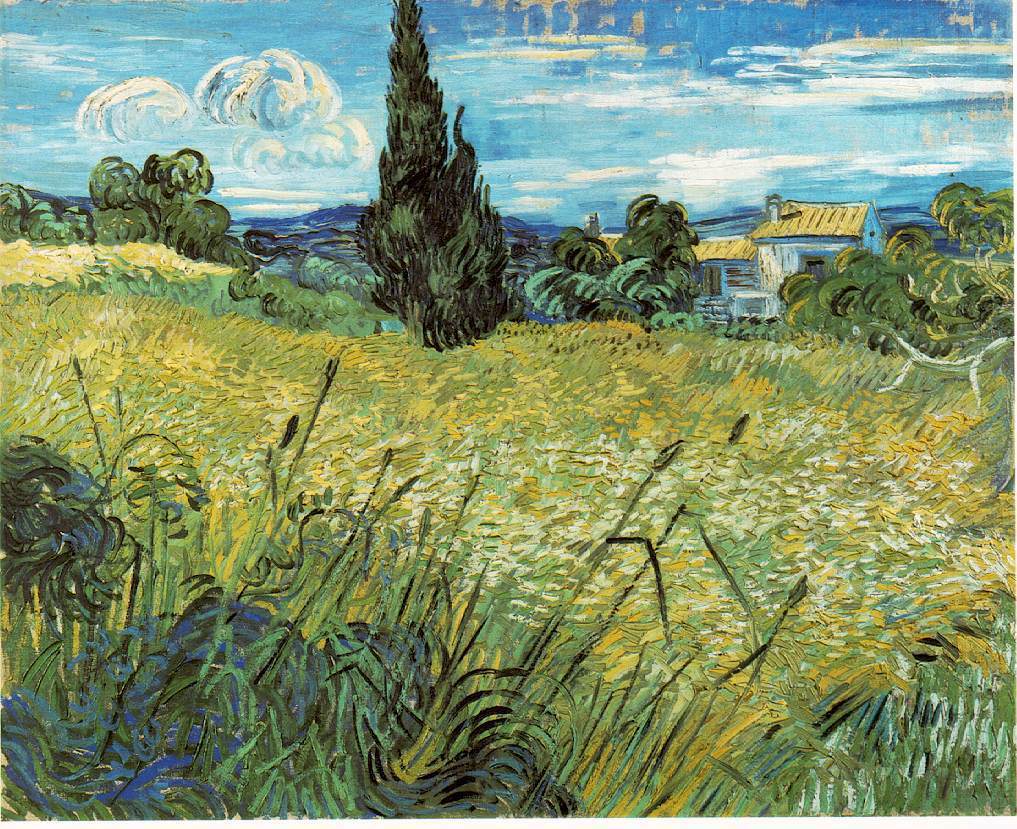
Green Wheat Fields With Cyprus – Vincent Van Gogh (1890)

But while men slept, his enemy came and sowed tares among the wheat, and went his way. (Matthew 13:25)

Before I cranked up the lawnmower Saturday morning, I noticed that some bad grass had come up in my backyard, and it was going to seed. As much as I dreaded that task, I knew I would have to pull it all up by hand otherwise I would risk scattering bad seed all over my yard and making matters worse. Through the pain of my aching back, I recalled Jesus’ “Kingdom Parable” about the tares among wheat found in Matthew 13:24-30; 36-43.

In this parable, Jesus likens Himself to the landowner who sowed good seed into His field – i.e., the world (vv. 24, 37-38). The “good seed” which He sowed are the children of the Kingdom – i.e., true believers in Christ (vv. 24, 38). “But while men slept” … Jesus defined all the players in the parable except for these. Who are these men who fell asleep on the job? Since there is no special definition for these men, it seems that these “men” are the “good seed” that was planted in the field. These did what good seed is supposed to do: receive nourishment, grow and produce fruit. But in doing what good seed is supposed to do, it took no notice of the enemy (Satan) that came in and sowed tare seeds into the field (vv. 25, 39). These too grew up together with the wheat and were indistinguishable from the wheat. As the time of harvest approached, the distinction became obvious, and the harvesters (the angels) wanted to rip up the tares (v. 28), but the landowner, not wanting to upset the good wheat, instructed that both be allowed to grow together until the harvest (vv. 29-30).

There are tares among us. They dress Christian. They speak Christian. They, by almost any means, look Christian, but they “are the children of the wicked one” (v. 38). Perhaps “outsiders” can spot them easier than those on the “inside.” Perhaps that is why many want nothing to do with the church because, they say, “The church is full of hypocrites!” No, the church is full of tares! Jesus says, “Let both grow together until the harvest: and in the time of harvest I will say to the reapers, Gather ye together first the tares, and bind them in bundles to burn them: but gather the wheat into my barn” (v. 30).

So, what are we to do about all of this? A good self-examination would be a good place to begin. “He that saith he abideth in him ought himself also so to walk, even as he walked” (1 John 2:6). Don’t act like tares. Peter reminds us that this present world is going up in smoke, and he exhorts us: “Seeing then thatall these things shall be dissolved, what manner of persons ought ye to be in all holy conversation and godliness, Looking for and hasting unto the coming of the day of God, wherein the heavens being on fire shall be dissolved, and the elements shall melt with fervent heat? Nevertheless we, according to his promise, look for new heavens and a new earth, wherein dwelleth righteousness” (2 Peter 3:11-13, emphasis added). Yes, there are tares among the wheat. Don’t be a tare!

Comments Off on Tares Among the Wheat

Filed under Apologetics, Christianity, Current Events, End Times, Gospel, Religion, Salvation, Theology