Tag Archives: Holy Spirit

Jesus’ Seven Discourses in John (2)

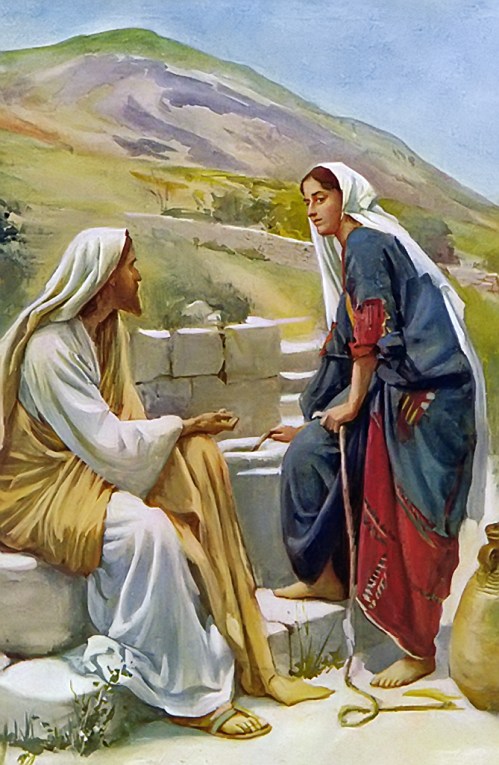
john4_13_jesusandwomanofsamaria

But whosoever drinketh of the water that I shall give him shall never thirst; but the water that I shall give him shall be in him a well of water springing up into everlasting life. (John 4:14)

The time Jesus spent in Jerusalem to celebrate the spring feasts (John 2:13-22) increased Jesus’ notoriety among the common people, but negatively drew the attention of the Jewish religious leaders. “When therefore the Lord knew how the Pharisees had heard that Jesus made and baptized more disciples than John … He left Judaea, and departed again into Galilee” (John 4:1, 3). Obviously, Jesus threatened the status quo, but now was not the time for confrontation.

Jesus took the most direct route to Galilee – directly north through Samaria. Samaritans and Jews shared a mutual animosity toward one another. The Jews considered the Samaritans illegitimate inhabitants of the land. “The term ‘Kuthim’ applied by Jews to the Samaritans had clear pejorative connotations, implying that they were interlopers brought in from Kutha in Mesopotamia and rejecting their claim of descent from the ancient Tribes of Israel.”[1] However, “The Samaritans called themselves – ‘the sons of Israel’ and ‘the keepers’ (shomrim) … The Samaritan Israelites were the faithful remnant of the Northern tribes – the keepers of the ancient faith.”[2] The hatred between the two groups was so great that Jews preferred to take the long way around when traveling north to Galilee. “Strict Jews, like the Pharisees, disliked the Samaritans so intensely that they avoided the territory as much as possible. Their route from Jerusalem to Galilee lay through the region beyond the Jordan.”[3] The route forced them to cross the River Jordan to the east bank, and take a northerly route to circumvent Samaria. Once past the northern boundary of Samaria, they would then cross back over to the west bank of the Jordan.

John indicates some sense of urgency in Jesus’ choice of this route. “And he must needs go through Samaria” (John 4:4, emphasis mine). Jesus never did anything without reason and without purpose. So, it seems that this shortcut was planned with this encounter in mind. He had a “divine appointment,” and He planned to keep it. Upon arriving at the city of Sychar, formerly known as Shechem, John provides for us a glimpse of Jesus’ humanity. “Now Jacob’s well was there. Jesus therefore, being wearied with his journey, sat thus on the well: and it was about the sixth hour” (John 4:6, emphasis mine). If Jesus were only God, He would not have tired, but being fully man also, He grew tired of the long walk and needed to stop and rest, but more than that, He had an appointment to keep.

John records the time of day as noon: “it was about the sixth hour,” and “There cometh a woman of Samaria to draw water” (John 4:7). Many point to the noon hour as evidence that the woman was one of ill repute, and came at that hour to avoid the scorn of the “decent” ladies that came for water in the early hours. However, Eli Lizorkin-Eyzenbert suggests that may be an incorrect assumption.[4] Eyzenbert points to the fact that we often do “regular things during unusual hours,” so the fact that she came at this hour proves nothing. He also points out that the noon hour was not necessarily the hottest time of the day. Recall that Jesus departed Jerusalem immediately following the Passover. It was still early spring at this time; noon would not have been the hottest time of the day. Eyzenbert also questions how a woman of such ill repute could cause an entire village of conservative Samaritans to drop whatever they were doing to go investigate her claim. Perhaps her five former husbands all died. It happens.

Jesus’ approach was direct. “Jesus saith unto her, Give me to drink: (John 4:7, emphasis mine). “That he [sic] should ask a woman for water is perhaps not so surprising, since it was women who generally drew water.”[5] There was also the fact that women at that time accepted their role as subservient to men. The request did not surprise her; it was the requester that gave her pause. “Then saith the woman of Samaria unto him, How is it that thou, being a Jew, askest drink of me, which am a woman of Samaria? for the Jews have no dealings with the Samaritans” (John 4:9, emphasis mine).

As usual, Jesus got right to the heart of the matter. “Jesus answered and said unto her, If thou knewest the gift of God, and who it is that saith to thee, Give me to drink; thou wouldest have asked of him, and he would have given thee living water” (John 4:10). At Jesus’ encounter with Nicodemus, John records “For God so loved the world that he gave his only begotten son,” (John 3:16, emphasis mine). Of course, she did not recognize the “gift of God” sitting before her. To her, He was simply a thirsty Jew needing a drink of water with no way of getting water for Himself, much less getting water for her.

Like Nicodemus, her mind focused on earthly, material things, while Jesus spoke of otherworldly, heavenly things. “The woman saith unto him, Sir, thou hast nothing to draw with, and the well is deep: from whence then hast thou that living water? Art thou greater than our father Jacob, which gave us the well, and drank thereof himself, and his children, and his cattle?” (John 4:11-12, emphasis mine). However, Jesus’ statement was meant to draw her attention heavenward, and away from the earthly.

With her curiosity piqued, Jesus pressed ahead. “Jesus answered and said unto her, Whosoever drinketh of this water shall thirst again: But whosoever drinketh of the water that I shall give him shall never thirst; but the water that I shall give him shall be in him a well of water springing up into everlasting life” (John 4:13-14, emphasis mine). Experientially, she could attest to the recurring need for water. After all, that was the purpose of her daily trek to the water well. But what was this perpetual source of water offering everlasting life? Still thinking in earthly terms, “The woman saith unto him, Sir, give me this water, that I thirst not, neither come hither to draw” (John 4:15).

Jesus accomplished His goal of capturing her attention, but He needed to narrow her focus. Rather than answer her directly, “Jesus saith unto her, Go, call thy husband, and come hither” (John 4:16). As God in the flesh, He knew this woman intimately, so her answer did not surprise Him. “The woman answered and said, I have no husband” (John 4:17). Jesus knew that.  “Jesus said unto her, Thou hast well said, I have no husband: For thou hast had five husbands; and he whom thou now hast is not thy husband: in that saidst thou truly” (John 4:17b-18). Note that Jesus did not chide her for her immoral lifestyle. Unlike the woman caught in adultery to whom Jesus admonished, “go, and sin no more” (John 8:11), Jesus offered no words of reprimand to the Samaritan woman. As I suggested earlier, perhaps her first five husbands died, and the man with whom she lived was just a gracious benefactor. We do not know. Perhaps her promiscuousness is only a product of our sullied minds. At any rate, Jesus exposed a truth about her life that no stranger could have known.

The woman became uneasy and wished to change the subject. Surmising that Jesus was “a prophet,” a reasonable diversion would be change the topic to religion. “Our fathers worshipped in this mountain; and ye say, that in Jerusalem is the place where men ought to worship” (John 4:20). Jesus, not prone to political correctness, shocked her with His response. “Jesus saith unto her, Woman, believe me, the hour cometh, when ye shall neither in this mountain, nor yet at Jerusalem, worship the Father. Ye worship ye know not what: we know what we worship: for salvation is of the Jews. But the hour cometh, and now is, when the true worshippers shall worship the Father in spirit and in truth: for the Father seeketh such to worship him. God is a Spirit: and they that worship him must worship him in spirit and in truth” (John 4:21-24, emphasis mine).

‘Ye’ (plural), Samaritans do not know what you worship” Jesus told her flatly. The Jews had the correct understanding of the Torah even though they failed in its application. By stating that “salvation is of the Jews,” Jesus did not mean that only Jews could be saved, but rather that they were the source through which salvation should come. Jesus’ genealogies recorded by Matthew and Luke (Matthew 1:1-17; Luke 3:23-38) show the O.T. lineage of the promised Messiah from the tribe of Judah (the Jews) and the kingly line of David. “Salvation is of the Jews.” Furthermore, the worship of God cannot be confined to any one place. “God is Spirit.” God is “omnipresent.” Following Jesus’ ascension into heaven, He sent the Holy Spirit to indwell every believer, so that “where two or three are gathered together in my name, there am I in the midst of them” (Matthew 18:20), and the location is irrelevant.  Therein is the “fountain of living water” for which the woman longed.

The light started to come on. “The woman saith unto him, I know that Messias cometh, which is called Christ: when he is come, he will tell us all things” (John 4:25). She knew of the coming Messiah, the Christ, and apparently she accepted that He was of the Jews. “Jesus saith unto her, I that speak unto thee am he” (John 4:26, emphasis mine). She found for what she thirsted and believed. The news was too good to keep to herself. “The woman then left her waterpot, and went her way into the city, and saith to the men, Come, see a man, which told me all things that ever I did: is not this the Christ?” (John 4:28-29). John points out that she ran off without her water pot. She came to get water that quenches thirst temporarily and left with the water of everlasting life.

“Then they went out of the city, and came unto him” (John 4:30).  It is worth noting that the men responded immediately. Had the woman been of immoral character, it is doubtful they would have heeded her invitation. They came because of her witness, but then believed because they heard for themselves. “And many of the Samaritans of that city believed on him for the saying of the woman, which testified, He told me all that ever I did. So when the Samaritans were come unto him, they besought him that he would tarry with them: and he abode there two days. And many more believed because of his own word; And said unto the woman, Now we believe, not because of thy saying: for we have heard him ourselves, and know that this is indeed the Christ, the Saviour of the world” (John 4:39-42, emphasis mine).

Oh, that our witness could bring others to the feet of Jesus that they might say, “Now we believe, not because of what you said, but because we have heard Him ourselves.”

Notes:


[1]  https://en.wikipedia.org/wiki/Samaritans, accessed January 25, 2017.

[2]  Eli Lizorkin-Eyzenbert, The Jewish Gospel of John: Discovering Jesus, King of All Israel, (Tel Aviv, Israel, Jewish Studies for Christians, 2015), 46.

[3]  Leon Morris, The New International Commentary on the New Testament: The Gospel According to John, Revised, (Grand Rapids, MI, Wm. B. Eerdmans Publishing Co., 1995), 226.

[4]  Eyzenbert, 48-49.

[5]  Morris, 229.
Comments Off on Jesus’ Seven Discourses in John (2)

Filed under Apologetics, Bible, Christianity, Evangelism, Gospel, Religion, Salvation, Theology

Jesus’ Seven Discourses in John (1)

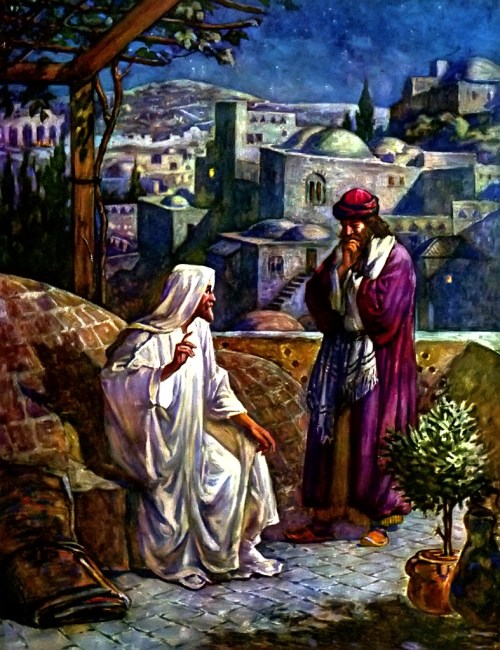
john3_1_jesusandnicodemus

Jesus answered and said unto him, Verily, verily, I say unto thee, Except a man be born again, he cannot see the kingdom of God.(John 3:3)

                   This passage, recorded in John 3:1-21, is the first of seven discourses spoken by Jesus and recorded by John. Certainly Jesus preached many more sermons than the seven recorded by John, but these seven, as least for John, uniquely demonstrated the deity of Jesus. Indeed, John records, “And many other signs truly did Jesus in the presence of his disciples, which are not written in this book: But these are written, that ye might believe that Jesus is the Christ, the Son of God; and that believing ye might have life through his name” (John 20:30-31, emphasis mine).

                   The passage opens with the introduction to the audience – one man, Nicodemus, “a man of the Pharisees … a ruler of the Jews” (John 3:1). His name means “conqueror of the people”[1] or “victorious among his people.”[2] Given the strength of his name, it seems strange that “The same came to Jesus by night” (John 3:2). At a glance, it seems as though Nicodemus came by stealth to avoid detection by those more adamantly opposed to Jesus, but that is not the case. “The Pharisee may have chosen this time in order to be sure of an uninterrupted and leisurely interview. During the day, Jesus would be busy and there would be crowds (crowds of common people!). Not so at night. Then there could be a long, private discussion.”[3]

                   At this point in his Gospel, John had not detailed many of Jesus’ miracles or any of His teachings. Certainly, turning water into wine (John 2:1-12) rates highly as the first of His seven signs. From there, Jesus celebrated the first Passover of His ministry by turning over the tables of the moneychangers at the Temple (John 2:13-22). His action drew fire from the “Jews” who challenged Him: “What sign shewest thou unto us, seeing that thou doest these things?” (John 2:18). Apparently, Jesus made Himself known during this time, although John provides little detail. “Now when he was in Jerusalem at the passover, in the feast day, many believed in his name, when they saw the miracles which he did” (John 2:23).

                   So, it seems that Nicodemus had at least heard of Jesus. Perhaps he witnessed the miracles of Jesus, and heard Him teach. Now he comes to Jesus by night for a private meeting. “Rabbi, we know that thou art a teacher come from God: for no man can do these miracles that thou doest, except God be with him” (John 3:2). Nicodemus addresses Jesus with the sincere title of respect. “Rabbi” acknowledged Jesus as “Master,” that is to say, “Master Teacher.” What little he knew of Jesus instructed him that He was more than an ordinary man. Jesus, he concluded, came “from God” because “no man can do these miracles … except God be with him.”

                   Nicodemus assessed correctly, but Jesus was not interested confirming what He knew to be fact. Nicodemus was not unlike the other “Jews” in many respects. “But Jesus did not commit himself unto them, because he knew all men, And needed not that any should testify of man: for he knew what was in man” (John 2:24-25, emphasis mine). Instead, He went right to the heart of the matter. “Jesus answered and said unto him, Verily, verily, I say unto thee, Except a man be born again, he cannot see the kingdom of God” (John 3:3, emphasis mine). “Again” is a poor translation of the Greek anōthen, which means “from above.” Being “born from above” is in keeping with what John penned in the prologue to his Gospel. “But as many as received him, to them gave he power to become the sons of God, even to them that believe on his name: Which were born, not of blood, nor of the will of the flesh, nor of the will of man, but of God” (John 1:12-13, emphasis mine). Nicodemus clearly understood the term “born,” genneithei, in the normal sense of procreation (John 3:4), but he missed the spiritual aspect of Jesus’ message.

                   To clear up the confusion, Jesus affirms John’s statement in the opening chapter. “Jesus answered, Verily, verily, I say unto thee, Except a man be born of water and of the Spirit, he cannot enter into the kingdom of God. That which is born of the flesh is flesh; and that which is born of the Spirit is spirit” (John 3:5-6). Jesus prefaces His statement with “verily, verily,” i.e. “truly, truly.” Coming from God incarnate, this makes the statement immutable – it is unchangeable. Rebirth is not a matter of external changes, but rather it is a transformation from within, and accomplished “from above” through the saturation of the Holy Spirit. “That which is born of the flesh is flesh; and that which is born of the Spirit is spirit” (John 3:6). We are all born of flesh. That is by design. The spirit of man died at the Garden of Eden (Genesis 3), and thus we are excluded from “the kingdom of God.” Only the rebirth of our spirit can fit us for heaven.

                   The “teacher of Israel” failed to grasp the lesson the Master taught. This called for further instruction. “Verily, verily, I say unto thee, We speak that we do know, and testify that we have seen; and ye receive not our witness. If I have told you earthly things, and ye believe not, how shall ye believe, if I tell you of heavenly things?” (John 3:11-12, emphasis mine). Jesus addresses Nicodemus (thee). “We speak that we do know.” Some commentators suggest that Jesus refers to Himself and His disciples. However, at this point in His ministry, His disciples were novices; there was little that they “did know.” Indeed, His disciples did not receive “full knowledge” until after His resurrection, and the arrival of the Holy Spirit (Acts 2). Therefore, I believe the “we” Jesus refers to is the Trinity. I conclude that from His statement in the next verse: “And no man hath ascended up to heaven, but he that came down from heaven, even the Son of man which is in heaven” (John 3:13). He, the Son of Man, has direct knowledge “from heaven,” from the Creator Himself (John 1:1-3). When Jesus said, “ye receive not our witness,” the “ye” in the KJV indicates that the Greek, second person personal pronoun is plural. Jesus did not single out Nicodemus; He referred to all the “Jews,” i.e., the religious establishment to whom Jesus later referred to as “blind guides” (Matthew 23:16, 24).

                   The rebirth is simple; Jesus explained. “And as Moses lifted up the serpent in the wilderness, even so must the Son of man be lifted up: That whosoever believeth in him should not perish, but have eternal life” (John 3:14-15). Jesus referred to Jewish history recorded in Scripture, the Torah to be precise. Numbers 21:4-9 records the time when the children of Israel wandering in the wilderness complained against God and Moses for the free food God provided daily. “And the LORD sent fiery serpents among the people, and they bit the people; and much people of Israel died” (Numbers 21:6). The Hebrew word translated as “fiery” is śârâph, which means, “burning.” The same Hebrew word (seraphim) is applied to the angelic creatures witnessed by Isaiah in his vision of God on His throne (Isaiah 6:2, 6). In the case of the Hebrew Children, it referred to the burning bite inflicted by the venomous snakes. It may also imply the copper color of the serpents. We derive this from the instructions given to Moses. “And the LORD said unto Moses, Make thee a fiery serpent, and set it upon a pole: and it shall come to pass, that every one that is bitten, when he looketh upon it, shall live. And Moses made a serpent of brass, and put it upon a pole, and it came to pass, that if a serpent had bitten any man, when he beheld the serpent of brass, he lived.” (Numbers 21:8-9, emphasis mine). The Hebrew word translated as “brass” is nechôsheth, which means “copper.”

                   The act of looking upon the bronze snake on the pole when bitten included recognition of the sin that brought about the snake bite, and the faith to believe that simply looking upon the likeness of the serpent on the pole would result in healing and preservation of life. In the same way, Jesus compared the simplicity of the rebirth. “And as Moses lifted up the serpent in the wilderness, even so must the Son of man be lifted up: That whosoever believeth in him should not perish, but have eternal life” (John 3:14-15, emphasis mine). Once again, this reaffirms John’s assertion, “But as many as received him, to them gave he power to become the sons of God, even to them that believe on his name” (John 1:12, emphasis mine).

                   If one has a red-letter edition Bible, verses 16-21 are attributed to Jesus. However, man, not God, inspires red letters. While many Bible scholars agree that Jesus spoke these words, to me this seems that John added his commentary to expand on what Jesus said. It seems redundant that Jesus would say, “That whosoever believeth on him should not perish, but have eternal life (v. 15), and then repeat “that whosoever believeth in him should not perish, but have everlasting life” (v. 16) in the next sentence. Regardless, the Holy Spirit, inspired these words through John’s pen, so they remain God’s Word whether they were spoken directly by Jesus, or whether John, through the Holy Spirit, expounded on Jesus’ words.

                   The teaching is clear. “That old serpent, called the Devil, and Satan” (Revelation 12:9) inflicted a deadly bite on mankind in the Garden of Eden (Genesis 3) from which there is no cure.  “For the wages of sin is death…” (Romans 6:23). “For God so loved the world, that he gave his only begotten Son, that whosoever believeth in him should not perish, but have everlasting life” (John 3:16). Death is antithetical to God who is life (John 1:4; 14:6). Simultaneously, God is holy and cannot tolerate sin. Yet, He loves His creation too much to allow it to “perish,” i.e., die, with no hope for reconciliation.  So, “He gave.” His gift stemmed not from man’s merit, but from His love. “For by grace are ye saved through faith; and that not of yourselves: it is the gift of God: Not of works, lest any man should boast” (Ephesians 2:8-9, emphasis mine). “He gave His only begotten Son.” The burden of sin was too great for any man to bear, so God Himself took on the insurmountable debt of man’s sin. “And the Word [who was God] was made flesh, and dwelt among us, (and we beheld his glory, the glory as of the only begotten of the Father,) full of grace and truth” (John 1:14). God became man so “that whosoever believeth in him should not perish, but have everlasting life.” The Greek word translated “perish” is apótai meaning “to destroy fully.”  The verb is in the aorist tense indicating that it occurred in the past and its effects continue into the present. It is in the middle voice indicating that the subject is acting on itself, and it is in the subjunctive mood meaning that the action is contingent, probable and eventual. That all means that man in the past brought eventual death and destruction upon himself contingent on what he does with the gift God offers.

                   As in the beginning, it comes down to two choices: the tree of life or the tree of death, aka the tree of the knowledge of good and evil. For the children of Israel in the wilderness it was to look upon the bronze serpent and live, or doubt and die. We all have the curse of death upon us. “For all have sinned, and come short of the glory of God” (Romans 3:23).  We also have a choice. “Whosoever believeth in him should not perish, but have everlasting life” (John 3:16). The other choice is unbelief. “He that believeth on him is not condemned: but he that believeth not is condemned already, because he hath not believed in the name of the only begotten Son of God” (John 3:18, emphasis mine). We are “condemned already” because, to begin with, we are all born of the flesh, but not of the Spirit. Then, we are “condemned already” when we reject the gift of salvation God freely offers.

                   “For God sent not his Son into the world to condemn the world; but that the world through him might be saved” (John 3:17).  The condemnation was accomplished at the Fall. God’s solution was to take on human flesh to pay the “wages of sin.”  He paid the debt with His own innocent blood. “For if the blood of bulls and of goats … sanctifieth to the purifying of the flesh: How much more shall the blood of Christ, who through the eternal Spirit offered himself without spot to God, purge your conscience from dead works to serve the living God? (Hebrews 9:13-14, emphasis mine). He did all the work. The choice to believe  or not believe is ours.

                   Nicodemus took Jesus’ words to heart. In the end, he came to His defense. At the Feast of Tabernacles when the Jews wanted to arrest Jesus, Nicodemus spoke up for him. “Nicodemus saith unto them, … Doth our law judge any man, before it hear him, and know what he doeth?” (John 7:50-51). After they crucified Him, Nicodemus accompanied Joseph of Arimathaea in the burial of Jesus, without regard to his Pharisaical reputation (John 19:38-40). He made the choice to believe. We have the same choice.

Notes:


[1]  Eli Lizorkin-Eyzenbert, The Jewish Gospel of John: Discovering Jesus, King of All Israel, (Tel Aviv, Israel, Jewish Studies for Christians, 2015), 32-33.

[2]  Definition from Strong’s Hebrew and Greek Dictionaries.

[3]  Leon Morris, The New International Commentary on the New Testament: The Gospel According to John, Revised, (Grand Rapids, MI, Wm. B. Eerdmans Publishing Co., 1995), 187.

Comments Off on Jesus’ Seven Discourses in John (1)

Filed under Apologetics, Bible, Christianity, Death, Evangelism, Gospel, Religion, Salvation, Theology

Burden of a Prophet

Prophet

Before I formed thee in the belly I knew thee; and before thou camest forth out of the womb I sanctified thee, and I ordained thee a prophet unto the nations. (Jeremiah 1:5)

As I look back on my recent posts, I think, “Man! Some of that is pretty depressing stuff! I should write something more uplifting, and fun.” I titled my blog, “Ernie’s Musings” because I write about things that engage my thoughts. Lately, the things happening around our nation and the world, and the upcoming presidential election weigh heavily on my mind. Honestly, I find it difficult, if not altogether impossible, to look on the bright side. This stems from the fact that I have a phlegmatic personality with leanings to melancholic and choleric. No sanguine bone exists in my body, and I find those with that personality to be rather annoying. However, God has a sense of humor, and He surrounds me with sanguine friends in order to keep me on an even keel.

Along with my serious nature, God gave me the gift of prophecy (Romans 12:5-8; 1 Corinthians 12:8-11; Ephesians 4:8-11). I say that with all humility, not that I “think more highly of myself than I ought to think” (Romans 12:3). This is not something that I dreamed up on my own. Many churches that strive to get members involved in the ministries of the church – and do it right – give a “spiritual gifts assessment” in order to properly “fit” the member in an area for which he/she is spiritually gifted. I have taken at least three such assessments, and I consistently score highly in prophecy, teaching, discernment, and encouragement. The confirmation for my statement comes from external and independent sources, so this is not my own fabrication.

I am a prophet, not a “seer” or fortuneteller. As with prophets of old, I can only say what God reveals. The prophets of old heard directly from God and repeated the message, “Thus saith the Lord,” and they recorded that message in Scripture. Nothing has been, or can be, added to the written Word of God. Thus saith the Lord, “Ye shall not add unto the word which I command you, neither shall ye diminish ought from it, that ye may keep the commandments of the LORD your God which I command you” (Deuteronomy 4:2). The New Testament repeats, “For I testify unto every man that heareth the words of the prophecy of this book, If any man shall add unto these things, God shall add unto him the plagues that are written in this book” (Revelation 22:18).

God’s revelation to us is complete and permanent. Jesus affirmed this fact when He said, “For verily I say unto you, Till heaven and earth pass, one jot or one tittle shall in no wise pass from the law, till all be fulfilled. (Matthew 5:18). Therefore, when I speak or write, I only say what God has already revealed in His Word. I have no new material. You will not hear me say, “I heard a new word from the Lord,” and then present something that does not already appear in Scripture. I take seriously James’ admonition, “My brethren, be not many masters, knowing that we shall receive the greater condemnation” (James 3:1). The Greek word translated “masters” is didaskalos, and it means “instructor” or “teacher.” God does not take kindly to those who misuse or abuse His Word and claim to speak for Him. God instructed the people to stone false prophets (Deuteronomy 13:1-5).

As a prophet, I must speak God’s Word. I am compelled to do so. In the words of Jeremiah the prophet, “But his word was in mine heart as a burning fire shut up in my bones, and I was weary with forbearing, and I could not stay” (Jeremiah 20:9). The Hebrew word translated “forbearing” is kûl, and it means to “hold in.” The prophet is saying that withholding (holding in) the Word of God is tiring, and he cannot hold it in. He must let it out. In a note on this verse, Henry M. Morris says:

The Word of God simply cannot be quenched for one who truly loves God and understands what God’s Word has done for him and what it means for the world. Even though that man is the object of reproach and derision because of it (20:8), he must proclaim it to others in whatever way he can.[1]

I kind of feel like that. David, the psalmist, expressed a similar sentiment. “My heart was hot within me, while I was musing the fire burned: then spake I with my tongue” (Psalm 39:3). The problem with speaking what God has put in my heart is that people will often not like what I have to say. I have learned to expect this. In Jeremiah’s case, he said, “O LORD, thou hast deceived me, and I was deceived: thou art stronger than I, and hast prevailed: I am in derision daily, every one mocketh me. For since I spake, I cried out, I cried violence and spoil; because the word of the LORD was made a reproach unto me, and a derision, daily” (Jeremiah 20:7-8, emphasis mine). The word “deceived” is an unfortunate translation in the KJV.[2] God deceives no one. It is Satan who is the “father of lies” (John 8:44). The Hebrew word used there is pâthâh, and it means rather “to entice.” God places a burden on the heart of a prophet and entices him, or calls him to deliver that message.

For a modern prophet like myself, God lets me see the condition of the world around me through the lens of His Holy Word; that goes with the gift of discernment that He gave me along with prophecy. The message is not new. This same message has been proclaimed through the ages. God does not change. God’s Word does not change. When I look at the world around me, I do not like what I see. When I see the condition of our nation, I do not like what I see. Then I read God’s Word, and I see the problem. Others may see the same problems I see and shake their heads and go on about their business, but I cannot do that. God, the Holy Spirit that resides in me (and all of God’s children), compels me to speak out, and I must. God has not given me a pulpit from which to preach, but He has given me a blog, and so I write. It is the burden of a prophet that God has given me.

I admit that my message may not be popular, and it may even be offensive at times. Sometimes, even I do not like what I have to say, and I would rather keep it to myself. However, the burden weighs on my heart and mind, and I am compelled to express it. When I consider the message, I look for ways to soften it, but given the conditions, I find that difficult. In those same spiritual gift assessments, I consistently score poorly in the “gift of mercy,” so it is difficult for me to make the message “kinder.”

God also made me an “encourager.” As bleak as my messages may be sometimes, I find hope in God’s sovereignty, in His faithfulness, and in His promise. I know our Lord’s return is very near, and although the world around us grows darker by the day, we have the promise of His coming. No matter what the political climate or social morass, our God reigns, and He cares for the welfare of His children. Until He comes, He will provide for us, pilot us, and protect us. So if my message seems gloomy at times, remember that is just the burden of this prophet, but along with the message, there is hope.

Notes:


[1]  Henry M. Morris, The Henry Morris Study Bible, (Green Forest, AR: Master Books, 2012), 1114.

[2]  Many other modern translations also mistranslate this word. However it is correctly translated in others like the Young’s Literal Translation (YLT) translates as “enticed”, New Living Translation (NLT) translates as “misled,” New English Translation (NET) translates as “coerced,” New American Bible-Revised (NABRE) translates as “seduced,” and the Common English Bible (CEB) translates as “enticed.”

Comments Off on Burden of a Prophet

Filed under Apologetics, Christianity, Current Events, End Times, Gospel, Random Musings, Religion, Second Coming of Christ, Theology

All Things Work Together For Good

Everything will be alright

And we know that all things work together for good to them that love God, to them who are the called according to his purpose. (Romans 8:28)

Were you to ask me what my all-time favorite verse of the Bible is, without hesitation I would say Romans 8:28.  I favor many verses for various reasons, for example, Genesis 1:1 is foundational: “In the beginning God created the heaven[s] and the earth.” God as Creator settles a lot of unanswered and unanswerable questions. Along with that is John 1:1-3, “In the beginning was the Word, and the Word was with God, and the Word was God. The same was in the beginning with God. All things were made by him; and without him was not any thing made that was made” reveals that Jesus Christ is the Creator, who “was made flesh, and dwelt among us” (John 1:14). It was He who, “being found in fashion as a man, he humbled himself, and became obedient unto death, even the death of the cross” (Philippians 2:8) because, “God so loved the world, that he gave his only begotten Son, that whosoever believeth in him should not perish, but have everlasting life” (John 3:16). I take comfort from knowing that, “The LORD is my shepherd, I shall not want” (Psalm 23:1). He will meet my every need.

Sometimes, everyone comes to a point in life, maybe more than once in a lifetime, when we feel abandoned by our Shepherd, and we feel that our needs are not being met. In those times, I take refuge in the assurance of Romans 8:28, but it can easily be misunderstood to mean that everything will always be good. That has certainly not been my life experience. To properly understand the significance of this verse, we must see it in its context and examine it in its original language, Greek.

In context, Paul is addressing a group of Christians in Rome. He assures them that for those who have placed their trust in Christ, there is “no condemnation to them which are in Christ Jesus, who walk not after the flesh, but after the Spirit” (Romans 8:1). Those who “are in Christ Jesus” manifest that fact in the way they conduct their lives, i.e. “who walk not after the flesh, but after the Spirit,” and he explains what that means in the succeeding verses. Those who walk (conduct their life) after (according to the leading of) the Spirit have the Spirit of God dwelling (residing) in them (v. 9). Let that thought sink in and penetrate your heart. If you are a child of God, you have His Spirit taking up residence in you! Because that is true, “The Spirit itself beareth witness with our spirit, that we are the children of God” (v. 16). If you are truly God’s child, you should never have a doubt about that. If you do, the Holy Spirit is there to reassure you of that fact. Now, if you never get that reassurance, you need to reexamine your status before God and get that settled. God will let you know whether you are His or not; He does not want you to be deceived.

Another benefit of being a child of God, is that you share the same inheritance with Christ (v. 17). All the unimaginable glory of heaven belongs to God’s children for eternity! The condition (“if so be that we suffer with him”) means we “who walk not after the flesh, but after the Spirit” (v. 1). Here in America, we have not experienced persecution like many of our brothers and sisters in other parts of the world, but we should not get too comfortable in that thought. Persecution may yet come. Jesus said, “If the world hate you, ye know that it hated me before it hated you. If ye were of the world, the world would love his own: but because ye are not of the world, but I have chosen you out of the world, therefore the world hateth you” (John 15:18-19, emphasis mine). Unless you have just not been paying attention, there is a growing animosity toward Christians in this nation. Have you sensed it? Have you been rejected by friends or family because of your faith in Christ? Have you suffered with Him and because of Him? Take heart, such suffering is only temporary for God’s children, but the payoff is out of this world (v. 18)!

God’s Spirit in us also helps us in our weakness. When we stray and “walk after the flesh,” the Spirit is there to remind us and bring us back in line. Also, when our heart is burdened to the point that we cannot express what is in our heart so that “we know not what we should pray for as we ought: but the Spirit itself maketh intercession for us with groanings which cannot be uttered” (v.26). Because God’s Spirit indwells us, He knows us intimately, better than we know ourselves, and He gives expression to the Father of what is on our hearts.

Verse 29 tells us that God, in His foreknowledge, predetermined (predestined) that His children would be conformed – molded into – to the image of His Son. That is God’s purpose for our lives. We are not completely passive in this process, but as we make ourselves available and malleable to the Holy Spirit’s leading in our life, God, not we, shapes us into the form of Jesus Christ to minister to the world around us, and yes, even to suffer for Him.

It is in this context we read, “And we know that all things work together for good to them that love God, to them who are the called according to his purpose” (v. 28). The Greek syntax places the words of greatest significance at the beginning of the sentence, and those of secondary significance at the end of the sentence. The strict translation of the Greek text is: “We know, moreover, that to those [who are] loving God, all things work together for good, to those according to [His] purpose called [are] being.” First, we who are His children know. This is not up for debate. It is firm. It is assured, and this we know because the Spirit informs us. We are those “who are loving God” consistently. For us, “all things” – the Greek panta is all inclusive – work together for our “good” (Greek: agathon, meaning benefit). This does not say that everything that happens to us will be “good.” Just look around. We see our brothers and sisters suffering with cancer or other illnesses. We see them losing employment or in financial difficulty. We see them struggle with familial difficulties or other relationship problems. Perhaps we experience those things ourselves. No one can say these things are “good.” But the promise of this verse is that God will use those trials for our benefit. God blesses us with many good things, but often, when things go well, we forget the source of those blessings. Sadly, it is the trials that come into our lives that draw us closer to God. Those are the times of our greatest benefit, and God uses those times to help conform us into the image of His Son. Remember, our inheritance is not in this world but with Christ.

God uses ALL things – good and bad – to work for good for His children. This promise does not apply generally to all people. This promise is specifically for God’s people – those “who are called according to His purpose” – that of being conformed to the image of His Son.

When I experience trials in my life, Romans 8:28 gives me the assurance that God works all things for my benefit, and I trust Him for that. Paul ends this chapter in Romans by asking, “If God be for us, who can be against us? … Who shall separate us from the love of Christ? shall tribulation, or distress, or persecution, or famine, or nakedness, or peril, or sword?” (vv. 31, 35). His answer, “Nay, in all these things we are more than conquerors through him that loved us … [nothing] shall be able to separate us from the love of God, which is in Christ Jesus our Lord” (vv. 37, 39). No, all of these things work together for our good – our benefit.

3 Comments

Filed under Apologetics, Christianity, Evangelism, Gospel, Religion, Theology

Good For Who?

Set Apart

For I am the LORD your God: ye shall therefore sanctify yourselves, and ye shall be holy; for I am holy: neither shall ye defile yourselves with any manner of creeping thing that creepeth upon the earth.  (Leviticus 11:44)

We are right in the middle of the Lenten Season observed by many mainline Protestant denominations and different varieties of Catholic churches (Roman, Greek, Russian, etc.). Beginning with Ash Wednesday (this year observed on February 10, 2016), the faithful observe 40 days of “fasting” in preparation for Easter. (I prefer calling it Resurrection Sunday.) Celebrants observe the season by giving up something “sacrificial” for Lent. The sacrifice could be anything like giving up TV, Snickers candy bars, eating meat on Fridays, not going to movies or anything equally superfluous, but prior to the season of deprivation, celebrants indulge in a day of depravation known as Fat Tuesday. They stoke up on enough indulgence to last through the 40 days of deprivation.

If it sounds as if I am making light of the observance, please understand that I know many who are sincere in the practice, and that is admirable; however, there are more who observe the season by rote without taking into account the significance. However my theme here is not about Lent, but rather it is about holiness. Would it not be better to live a godly lifestyle consistently as a matter of practice rather than trying to force upon oneself a token meaningless act that, if kept, lasts for a short time and then is forgotten? Indeed, God would have us conduct ourselves in holiness all the time.

I have addressed this topic in the past perhaps because the older I get, the more I recognize my own deficiency in this area. I also see the growing invasion of “worldliness” spreading in our churches, including our more “conservative” evangelical churches. I attribute much of this to a general lack of biblical literacy, especially with regard to Old Testament teaching regarding the Mosaic Law.[1] To many modern Christians, only the New Testament applies to us because we are living under “Grace,” not under the “Law.”[2] That, I believe, comes from a misunderstanding of both Grace and Law.

I recently read through the book of Leviticus, and it once again became apparent to me that many of the laws given had no other purpose than to distinguish the “people of God” from the goyim (Gentiles/nations) among whom they lived. The phrase “be holy” is repeated some 29 times in the Pentateuch, and whether applied to objects used in worship or to the people themselves, it means to set that thing apart for a special and unique purpose. Our leading verse instructs the people to “sanctify yourselves,” i.e. consecrate or set yourselves apart. Where the implements of worship were concerned, they were not to be used for common purposes. Every object used in the Tabernacle (and later in the Temple) was dedicated only for the purpose it was designed. If a platter held the showbread, it could not be used for any other purpose. It was “holy” – dedicated, consecrated, sanctified, set apart for one purpose only.

The people likewise were to be set apart. “Ye shall be holy: for I the LORD your God am holy” (Leviticus 19:2, emphasis mine). For what were they to be holy? “And ye shall be unto me a kingdom of priests, and an holy nation” (Exodus 19:6, emphasis mine). God’s purpose for His people has not changed in that regard. Note John’s description of the risen Christ in his address to the churches: “Unto him [the Lord Jesus Christ] that loved us, and washed us from our sins in his own blood, And hath made us kings and priests unto God and his Father; to him be glory and dominion for ever and ever. Amen (Revelation 1:5b-6).  Just like the nation of Israel, the Church of Christ (not the denomination that takes that name) is to be holy – set apart – to be a kingdom of priests to the world around us.[3]

As kings and priests, we should exemplify the Law of God. We do not obey the Law in order to obtain our position as kings and priests, but because we have obtained that position through Grace. In order to obey the Law, we must first know and understand the Law, and that understanding comes from studying the Law that God gave to Israel in the Old Testament. Granted, much of particulars, such as dress code and dietary laws do not apply to us, but the principle of distinctiveness from the “world” remains.

One example that came to mind was the prohibition from wine that was given to the priests. “And the LORD spake unto Aaron, saying, Do not drink wine nor strong drink, thou, nor thy sons with thee, when ye go into the tabernacle of the congregation, lest ye die: it shall be a statute for ever throughout your generations: And that ye may put difference between holy and unholy, and between unclean and clean” (Leviticus 10:8-10, emphasis mine). Notice that the prohibition was limited to their going into the Tabernacle (later that applied to the Temple). Now consider what Paul said to the Corinthian Church: “Know ye not that ye are the temple of God, and that the Spirit of God dwelleth in you? If any man defile the temple of God, him shall God destroy; for the temple of God is holy, which temple ye are” (1 Corinthians 3:16-17, emphasis mine). Not only are we kings and priests, but we are also the Temple of the Holy Spirit, so with regard to “wine and strong drink” Christians should abstain. Yet there are many Christians that will excuse themselves from this prohibition by saying that the Bible only condemns drunkenness and not simply the occasional glass of wine or just one brewski. Well then, what about the fact that we are kings and priests and that we are the Temple of God? We are to be “holy” in all things. “Be ye holy” was not only meant for the Israelites; it applies to us as well. “But as he which hath called you is holy, so be ye holy in all manner of conversation; Because it is written, Be ye holy; for I am holy” (1 Peter 1:15-16, emphasis mine). That archaic word “conversation” refers to one’s life-conduct; so in every manner in which we conduct our lives, we should be holy.

More examples could be cited. What about the prohibition against tattoos (Leviticus 19:28)? Yet we have many Christians following the pattern of the world rather than being distinct from the world. But the point here is not so much about following an arbitrary set of rules, but following the One who put those rules in place. Over 73 times in the Pentateuch God emphasizes “I AM the LORD.” Forty-five (45) of those (62%, almost 2/3) appear in the book of Leviticus. Might God be trying to tell us something – “Do what I say because I AM the Lord!”

In closing, let me stress that this is meant for God’s people. One does not have to keep the Law to become a child of God. But as any good son desires to please his father, should not God’s children desire to please their Heavenly Father? And how does one do that? One does it by following His laws. He gave them to us as a pattern for our life conduct. Can we do that perfectly? I know I can’t, but that does not mean I don’t try. Nor should it be something over which we fret, because He has given us His Holy Spirit to help our weakness. “I am crucified with Christ: nevertheless I live; yet not I, but Christ liveth in me: and the life which I now live in the flesh I live by the faith of the Son of God, who loved me, and gave himself for me” (Galatians 2:20, emphasis mine). The faith “of the Son of God” is our source of strength. We live holy lives for Him and by Him.

Notes:


[1]  See “Is the Law Sin?” https://erniecarrasco.com/2014/06/08/is-the-law-sin/

[2]  See “God’s Laws” https://erniecarrasco.com/2016/01/10/gods-laws/

[3]  See “Kings and Priests” https://erniecarrasco.com/2015/09/06/kings-and-priests/

1 Comment

Filed under Apologetics, Bible, Christianity, Easter, Religion, Theology