Tag Archives: Imago Dei

Jesus’ Seven Discourses in John (3)

john5_19-40-authority-of-jesus

Verily, verily, I say unto you, He that heareth my word, and believeth on him that sent me, hath everlasting life, and shall not come into condemnation; but is passed from death unto life. (John 5:24)

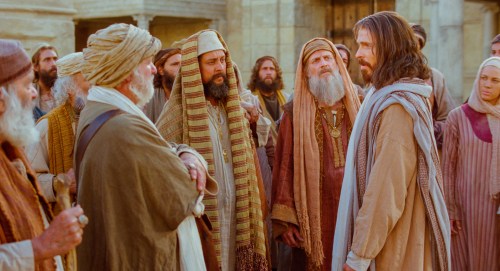
As Jesus returned to Jerusalem for the celebration of Purim,[1] Chapter Five opens with the account of the invalid by the Pool of Bethesda who Jesus healed. The healing once again stirred up the “Jews” who concerned themselves more with His breaking of the of the Sabbath than with the man’s welfare. The miraculous healing of the lifelong invalid demonstrated Jesus’ divine nature, and “Therefore the Son of man is Lord also of the Sabbath” (Mark 2:28; Luke 6:5). “And therefore did the Jews persecute Jesus, and sought to slay him, because he had done these things on the sabbath day” (John 5:16). Unwilling to let an opportunity slip away, Jesus took time to instruct them on the source of His authority.

“Then answered Jesus and said unto them, Verily, verily, I say unto you, The Son can do nothing of himself, but what he seeth the Father do: for what things soever he doeth, these also doeth the Son likewise” (John 5:19, emphasis mine).Christians often get accused of believing in three gods because we hold a Trinitarian view of God stating that we believe in One God manifested in three persons, Father, Son and Holy Spirit. God’s triune nature challenges the limits of our finite minds, and no definition devised by man can fully describe that nature. A weak comparison might be made from the nature of man considering that man was created in the image of God (Genesis 1:27). Like God, man possesses a triune nature composed of mind, body, spirit. The mind controls man’s activities. The body carries out the mind’s commands, and the spirit energizes and motivates man’s activities. Although often thought of as separate entities, the mind, body, and spirit must exist in unison for man to exist.

Knowing that Jesus, the Son, is fully God in every way, His statement sounds strange to our ears. He seems to say that the Father is a different person, separate and apart from Him. After all, when describing our own actions, we would not say something like, “the body can do nothing of itself but what it sees the mind do,” even though, in a certain sense, that is an accurate description of all our actions (unless we have some sort of neurological disorder that causes our body to act contrary to the mind’s control).

However, Jesus’ explanation required a third person description because to the Jews, God was wholly spirit and transcendent. They could not conceive of God in human form or that God could have a human “son” – a confusion that continues on to this day. “Therefore the Jews sought the more to kill him, because he not only had broken the sabbath, but said also that God was his Father, making himself equal with God” (John 5:18, emphasis mine). The Father, like our mind, determines what actions He wants to carry out, and the Son, like our body, carries out the will of the Father.“I can of mine own self do nothing: as I hear, I judge: and my judgment is just; because I seek not mine own will, but the will of the Father which hath sent me” (John 5:30, emphasis mine).“The conclusion from our Lord’s argument is: If I have broken the Sabbath, so has God also; for I can do nothing but what I see him doing. He is ever governing and preserving; I am ever employed in saving.”[2]

Additionally, life comes from God. “For as the Father raiseth up the dead, and quickeneth them; even so the Son quickeneth whom he will” (John 5:21). The word “quicken” is an archaic English word meaning, “to make alive.” The O.T. records at least two instances in which the Father raised the dead: the widow’s son through Elijah (1 Kings 22:17) and the Shunamite’s son through Elisha (2 Kings 4:32-35). The Son also raised the dead: the ruler’s daughter (Mark 5:35-42), the widow’s son at Nain (Luke 7:11-15), and Lazarus, at Bethany (John 11:14-44).“Here our Lord points out his sovereign power and independence; he gives life according to his own will – not being obliged to supplicate for the power by which it was done, as the prophets did; his own will being absolute and sufficient in every case.”[3] Jesus maintains this authority for all time. “Marvel not at this: for the hour is coming, in the which all that are in the graves shall hear his voice, And shall come forth; they that have done good, unto the resurrection of life; and they that have done evil, unto the resurrection of damnation” (John 5:28-29, emphasis mine). Jesus’ promise was meant for the near and distant future. “And the graves were opened; and many bodies of the saints which slept arose, And came out of the graves after his resurrection, and went into the holy city, and appeared unto many” (Matthew 27:52-53, emphasis mine). There is still a time yet to come. “For the Lord himself shall descend from heaven with a shout, with the voice of the archangel, and with the trump of God: and the dead in Christ shall rise first: Then we which are alive and remain shall be caught up together with them in the clouds, to meet the Lord in the air: and so shall we ever be with the Lord” (1 Thessalonians 4:16-17, emphasis mine).

There is yet one final resurrection. You do not want to be part of that resurrection. “And I saw the dead, small and great, stand before God; and the books were opened: and another book was opened, which is the book of life: and the dead were judged out of those things which were written in the books, according to their works. And the sea gave up the dead which were in it; and death and hell [i.e. the grave] delivered up the dead which were in them: and they were judged every man according to their works” (Revelation 20:12-13, emphasis mine). Jesus, as God, has the power to give eternal life, but you obtain it in this life.

Jesus judges based on how man treats Him. “For the Father judgeth no man, but hath committed all judgment unto the Son: That all men should honour the Son, even as they honour the Father. He that honoureth not the Son honoureth not the Father which hath sent him” (John 5:22-23, emphasis mine). What we do with Jesus in this life determines the outcome of our eternal life. “For as the Father hath life in himself; so hath he given to the Son to have life in himself; And hath given him authority to execute judgment also, because he is the Son of man” (John 5:26-27, emphasis mine). God put on human flesh (John 1:14) so that man could relate to Him. “He is the Son of man.” “No man hath seen God at any time; the only begotten Son, which is in the bosom of the Father, he hath declared [i.e. explained, demonstrated, exegeted]him” to us (John 1:18, emphasis mine). We cannot know God the Father better than how we know God the Son. Therefore, when we reject the Son, we reject the Father; consequently, we reject eternal life.

Jesus now gets to the heart of the matter. “Verily, verily, I say unto you, He that heareth my word, and believeth on him that sent me, hath everlasting life, and shall not come into condemnation; but is passed from death unto life. Verily, verily, I say unto you, The hour is coming, and now is, when the dead shall hear the voice of the Son of God: and they that hear shall live”  (John 5:24-25, emphasis mine). The “dead” Jesus refers to here are those who are “dead in their sins.” “Even when we were dead in sins, hath quickened [i.e. made alive] us together with Christ, (by grace ye are saved;)” (Ephesians 2:5)

The Jews needed proof.“By what authority doest thou these things?and who gave thee this authority?” (Matthew 21:23).  They may not have verbalized those sentiments at this time, but they must have been thinking them. “If I bear witness of myself, my witness is not true. There is another that beareth witness of me; and I know that the witness which he witnesseth of me is true” (John 5:31-32,). The law required the testimony of at least two witnesses to prove a matter (Deuteronomy 17:6; 19:15).  Jesus offered up John the Baptist as a witness, but the Jews rejected John’s message (John 5:33-35). Even so, Jesus offered a greater witness – His own works. “But I have greater witness than that of John: for the works which the Father hath given me to finish, the same works that I do, bear witness of me, that the Father hath sent me” (John 5:36, emphasis mine). In addition, the Father bore witness of Him through the works that He performed (John 5:37-38). Nicodemus attested to this: “Rabbi, we know that thou art a teacher come from God: for no man can do these miracles that thou doest, except God be with him” (John 3:2, emphasis mine). Furthermore, the Scriptures testified concerning Him. “Search the scriptures; for in them ye think ye have eternal life: and they are they which testify of me” (John 5:39, emphasis mine).

What more proof is needed? Jesus is Lord over the Sabbath. Jesus is Lord over Creation. He is the Lord and giver of life. “For the wrath of God is revealed from heaven against all ungodliness and unrighteousness of men, who hold the truth in unrighteousness; Because that which may be known of God is manifest in them; for God hath shewed it unto them. For the invisible things of him from the creation of the world are clearly seen, being understood by the things that are made, even his eternal power and Godhead; so that they are without excuse” (Romans 1:18-20, emphasis mine). Creation itself gives sufficient testimony to remove any excuse not to believe; but God provided a greater witness through the Son of God, Son of Man Who, if rejected,will judge the unbeliever guilty without excuse.

Notes:


[1]  “Jesus Seven Signs in John (3)” https://erniecarrasco.com/2016/11/06/jesus-seven-signs-in-john-3/

[2]Adam Clark’s Commentary on the Bible Note on John 5:19.

[3]Ibid, on John 5:21.

Comments Off on Jesus’ Seven Discourses in John (3)

Filed under Christianity, Death, Evangelism, Gospel, Religion, Resurrection, Salvation, Second Coming of Christ, Theology

Alpha And Omega

Alpha Omega Bible

I am Alpha and Omega, the beginning and the ending, saith the Lord, which is, and which was, and which is to come, the Almighty.  (Revelation 1:8)

These words recorded by the Apostle John, the one “whom Jesus loved” (John 13:23; 20:2; 21:7, 20), introduce the One who would “reveal” the details of the final events of world history. At this time, John was an old man probably in his nineties, exiled on the island of Patmos “for the word of God, and for the testimony of Jesus Christ” (Revelation 1:9). It was Sunday, “the Lord’s Day,” and John was “in the Spirit” (Revelation 1:10).  John does not say, but I imagine that he was reading and meditating on Daniel’s prophecy and praying. John earned the nickname “Camel Knees” (so I am told) for the calluses he developed from hours on his knees in prayer. While in that posture, “a great voice, as of a trumpet” interrupted his meditation, and the resurrected Lord introduced Himself as “Alpha and Omega, the first and the last” (Revelation 1:10-11).

John recognized Him, although he had never seen Him like this before – “clothed with a garment down to the foot, and girt about the paps with a golden girdle. His head and his hairs were white like wool, as white as snow; and his eyes were as a flame of fire; And his feet like unto fine brass, as if they burned in a furnace; and his voice as the sound of many waters” (Revelation 1:13-15). John, in the company of Peter and James, witnessed Jesus transfigured on the mountain (Luke 9:28-36) in the days of Jesus’ short ministry on earth. That experience left the disciples awestruck, but it was nothing compared to this appearance.

Alpha, the first letter in the Greek alphabet, represents the beginning of the Word. In his Gospel, John wrote, “In the beginning was the Word, and the Word was with God, and the Word was God. The same was in the beginning with God. All things were made by him; and without him was not any thing made that was made” (John 1:1-3, emphasis mine). The Word of God, the Holy Bible, opens with the same phrase: “In the beginning God created the heaven and the earth” (Genesis 1:1, emphasis mine). God, the “uni-plural” Elohim, created the universe – all things – through His spoken Word: “And God said, Let there be light: and there was light. And God saw the light, that it was good: and God divided the light from the darkness” (Genesis 1:3-4, emphasis mine). John says, “In him [the Word] was life; and the life was the light of men. And the light shineth in darkness; and the darkness comprehended it not” (John 1:4-5, emphasis mine).

The Alpha of the Bible goes on to describe the six-day creation acts of God. On the sixth day, the Elohim created all the land-dwelling animals, and at last, He created man. “And God said, Let us make man in our image, after our likeness: and let them have dominion over the fish of the sea, and over the fowl of the air, and over the cattle, and over all the earth, and over every creeping thing that creepeth upon the earth. So God created man in his own image, in the image of God created he him; male and female created he them” (Genesis 1:26-27, emphasis mine). The switch between the plural (us/our) and the singular (his/he) provides the first insight (in English) to the triune nature of God, which is developed later in Scripture. However, in the original language of Hebrew, that insight appears in the very first verse. God (Elohim) is the plural form of the noun for god (el); however, the verb “created” (bara) appears in the singular form, which under other circumstances would be a grammatical booboo in Hebrew.

So, God creates man in His own image, which among other things, implies that man too is triune in nature. One aspect of that triune nature involves the physical form that animates and transports “the soul” of man. “And the LORD God formed man of the dust of the ground, and breathed into his nostrils the breath of life; and man became a living soul” (Genesis 2:7, emphasis mine). What physical shape would reflect “the image of God”? The Hebrew word translated “formed,” yâtsar, describes the work of a potter molding and shaping a lump of clay into a useful vessel. The Word, by whom “all things were made,” molded and shaped the kind of body He would one day inhabit. “And the Word was made flesh, and dwelt among us, (and we beheld his glory, the glory as of the only begotten of the Father,) full of grace and truth” (John 1:14, emphasis mine).

God took His image bearer “And the LORD God planted a garden eastward in Eden; and there he put the man whom he had formed” (Genesis 2:8). There God provided for man’s every need. The Garden of Eden provided an abundance of food and water (Genesis 2:9-10) with a perfect climate (Genesis 2:5-6). Best of all, sickness and death did not exist. God gave His stamp of approval on His perfect creation. “And God saw every thing that he had made, and, behold, it was very good. And the evening and the morning were the sixth day” (Genesis 1:31, emphasis mine). Death could not exist in a “very good” creation because the Bible says that death is “the last enemy” (1 Corinthians 15:26).

God and His image enjoyed intimate fellowship as God walked “in the garden in the cool of the day” (Genesis 3:8). However, love coerced is not love. Love must be a willful choice, and God allowed for the choice. “And the LORD God commanded the man, saying, Of every tree of the garden thou mayest freely eat: But of the tree of the knowledge of good and evil, thou shalt not eat of it: for in the day that thou eatest thereof [dying] thou shalt surely die” (Genesis 2:16-17, emphasis mine). Death did not exist in the Garden of Eden, but the potential did exist. Man had the choice, and man made the wrong choice. “And when the woman saw that the tree was good for food, and that it was pleasant to the eyes, and a tree to be desired to make one wise, she took of the fruit thereof, and did eat, and gave also unto her husband with her; and he did eat” (Genesis 3:6, emphasis mine). Man made the choice, and death entered God’s perfect creation.

The remainder of the Bible tells the story of God’s work in restoring fellowship with His fallen and dying creation. Only the blood of a perfect and innocent victim could make amends or reparation for the perpetual infraction. “For the life of the flesh is in the blood: and I have given it to you upon the altar to make an atonement for your souls: for it is the blood that maketh an atonement for the soul” (Leviticus 17:11, emphasis mine). The blood of animals fell short of the requirement because it was man, not animals, that sinned. “For it is not possible that the blood of bulls and of goats should take away sins” (Hebrews 10:4). The atoning blood-sacrifice must be that of a perfect, innocent man; nothing less would do. However, no man fit the bill, for “As it is written, There is none righteous, no, not one” (Romans 3:10). No human solution could be found. Therefore, “the Word was made flesh, and dwelt among us” (John 1:14, emphasis mine). “But [the Word] made himself of no reputation, and took upon him the form of a servant, and was made in the likeness of men: And being found in fashion as a man, he humbled himself, and became obedient unto death, even the death of the cross” (Philippians 2:7-8, emphasis mine). “But this man [the Word], after he had offered one sacrifice for sins for ever, sat down on the right hand of God” (Hebrews 10:12, emphasis mine). The debt is paid in full, and God offers the pardon as a gift to whoever will accept it. A choice must still be made – accept the gift or reject it. Love is not coerced.

Omega is the final letter in the Greek alphabet. Just as Alpha opens the book with God’s perfect image bearers in the pristine Garden of Eden, Omega closes the final book in a new heaven and new earth (Revelation 21:1) – Eden restored. There, the fellowship between Creator and creature is renewed (Revelation 21:3). Death and the grave no longer exist (Revelation 20:14), neither do tears, sorrow or pain (Revelation 21:4). The Tree of Life is there (Revelation 22:2), but not the Tree of the Knowledge of Good and Evil. The residents of the new heaven and new earth chose God’s free pardon during their time on earth. They chose to love God of their own volition; therefore there is no longer any curse, nor the option to choose evil (Revelation 22:3), “and they shall see His face” (Revelation 22 4) – the One who started it all. “I am Alpha and Omega, the beginning and the end, the first and the last” (Revelation 22:13).

2 Comments

Filed under Bible, Christianity, Creation, End Times, Evangelism, Gospel, Heaven, Origins, Religion, Salvation, Theology

The True Moral Fallacy of #justiceforHarambe – Fall on Grace Fall on Grace

And surely your blood of your lives will I require; at the hand of every beast will I require it, and at the hand of man; at the hand of every man’s brother will I require the life of man. Whoso sheddeth man’s blood, by man shall his blood be shed: for in the image of God made he man. (Genesis 9:5-6)

Equating animals to humans is the logical result of evolutionary thinking. If we all evolved from the same source, then all creatures are equally amoral, and there should be no outrage over a human killing an ape to save a human. But there is outrage, and the humans are held to a higher standard. Why? As you point out so clearly, it is because humans are created in God’s image, and we have His innate moral standard, but the ape does not. Furthermore, God’s moral standard does hold human life as more valuable than animal life. (See Genesis 9:5-6 above) Human life is to be preserved above all others. By the way, that would include “unborn” human life.

Source: The True Moral Fallacy of #justiceforHarambe – Fall on Grace Fall on Grace

Comments Off on The True Moral Fallacy of #justiceforHarambe – Fall on Grace Fall on Grace

Filed under Apologetics, Christianity, Creation, Current Events, Evolution, Origins, Pro-life, Theology

No Accident


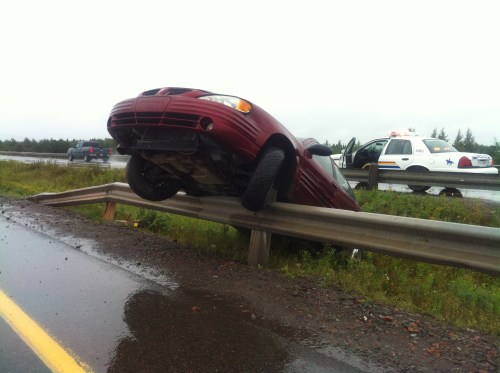
CAUSE: Hydroplaning. EFFECT: Wreck. No Accident!

CAUSE: Hydroplaning. EFFECT: Wreck. No Accident!

All things were made by him; and without him was not any thing made that was made. (John 1:3)

Commuting to work on the rain-drenched LBJ Freeway in Dallas, Texas this past week, I was at once amused and terrified at the maneuvers made by some crazy drivers obviously unaware of the hazardous road conditions. It reminded me of something that my old Driver’s Ed teacher repeated often a hundred years ago, “Accidents don’t happen; they are caused.” Apparently the crazies on LBJ never took driving lessons from my old Driver’s Ed teacher.

The truth of the adage obeys the very basic law of physics, that of cause and effect. Simply stated, everything that happens, i.e. every “effect,” has a cause. On the highway, this basic law expresses itself through Newton’s three Laws of Motion: (1) Inertia – an object in motion tends to stay in motion unless some external force acts upon it, (2) Acceleration – when a force acts on a mass (object) to produce motion, and (3) Reaction – for every action, there is an equal and opposite reaction. These three laws are expressions of the primary law of cause and effect. There is a series of cause-and-effect scenarios that propel a vehicle down the road at high rates of speed. Friction is a stabilizing force acting upon the tires of a car to counter the inertia that would maintain the car’s high rate of speed. However, on a wet, rainy day, friction yields to a phenomenon known as hydroplaning. This “cause” creates a thin barrier of water between the surface of the road and the tires, which effectively negates the force of friction on the tires. The tires lose contact with the road surface and now skim along on a slippery sheet of water. Inertia now controls the forward motion of the vehicle, and the incognizant operator unwittingly presumes he is in full control until he has to make a quick lane change or a sudden stop. It takes little imagination to visualize the “effects” that may result. The frequent “mishaps” witnessed on the highway are “incidents” not “accidents.” The majority of the time, the main cause of these incidents is the loose nut behind the wheel. Lesson: be aware of road conditions!

Forgive the defensive driving lesson, but the point was to illustrate the law of cause and effect. Nothing that exists just happens. There are no accidents. This simple and common fact is overlooked or ignored by naturalists/evolutionists/atheists when dealing with the matter of origins. What caused the universe? The Big Bang they say. What caused the Big Bang? They say that an infinitesimal “singularity” rapidly expanded and produced all that there is. Even though no one existed to witness or record this great event, they (the “theoretical” physicists) can tell us what happened one second after the Big Bang, one minute after, five minutes after, and so on. So, from where did this singularity come? What caused the singularity? What made it expand? “We don’t know,” they admit, “but we are still working on it.” This is what is passed off as science today.

Everything must have a cause, but cause-and-effect can only be taken back so far. Eventually, we must arrive at the cause that caused all other causes, and this cause cannot itself be caused. “Science” has no explanation for this, therefore hypotheses abound. In desperation, absurdities, like the “multiverse” hypothesis, arise to account for what cannot be proven in this universe. Since it cannot be proven in this universe, it must be true in another. The problem is that this universe is the only universe to which we have access to do science. There remains this nagging requirement for science called observation, and we cannot observe other universes, if indeed they do exist. Ours is the only universe we can observe. Our science is limited to what we can observe in this universe.

That brings us back to question of origins. How did our universe come to be? If nothing else, the Big Bang asserts that our universe must have had a beginning. But what caused it all? Reason demands that the original cause cannot itself have a cause. Our universe is no accident.

Where science fails us, the Bible provides a reasonable answer. Naturalists automatically reject this notion; however they offer nothing in its place that makes more sense. “In the beginning God …” (Genesis 1:1). Time, “the beginning,” was caused by God. The reader will note that nothing is presented before God, the Cause. God is the “uncaused Cause,” and the Scripture’s presentation of nothing prior to God expresses His eternal nature, His infiniteness. His eternal existence is the only reasonable and logical response to an infinite series of causes and effects. God is no accident. He is and always has been and ever will be. He is the eternal “I AM THAT I AM” (Exodus 3:14). John identifies Jesus as the eternal Creator (John 1:1-3), and later records the Lord’s self-identification as the Eternal One: “I am Alpha and Omega, the beginning and the end” (Revelation 1:18; 21:6), “I am Alpha and Omega, the first and the last” (Revelation 1:11), “I am Alpha and Omega, the beginning and the end, the first and the last” (Revelation 22:13). He is the One, the initial Cause that started it all. Before Him nothing else existed.

Our universe is no accident; it had a cause – God the Creator. Our world, our earth, is no accident; it had a cause – God the Creator. You and I are no accidents. We have a Creator that fashioned us in His own image (Genesis 1:27), and loved us enough to give us the choice to accept or reject Him. Either choice produces eternal effects. If we choose to reject Him, that decision is eternal. If we choose to accept Him, that decision is eternal. The choice is no accident.

2 Comments

Filed under Apologetics, Atheism, Bible, Christianity, Creation, Evangelism, Evolution, Gospel, Origins, Philosophy, Religion, Science, Theology

Work

Work-needed

But Jesus answered them, My Father worketh hitherto, and I work. (John 5:17)

According to the U.S. Bureau of Labor and Statistics, the current unemployment rate as of this writing is 5.0%. On the surface, that looks pretty good, but when one considers that the unemployment rate rose to over 10% in late 2008 and remained there for almost four years before starting to drop; and that many that lost jobs then, and since then, remain unemployed and off the unemployment rolls, the current report is deceptive. The current statistic draws from a smaller pool of workers. With fewer jobs to go around, companies maintain minimum staffing simply to survive. Not to mention, Obama Care encourages employment of part-time help rather than hiring full-time employees to avoid paying health benefits. As a result, fewer workers are being laid off, so the unemployment number looks better than the actual unemployment. Sources differ, but the actual unemployment rate is somewhere between 40% and 60% meaning that at least half of the country is out of work.

The scarcity of work not only serves to stagnate the economy, but it potentially promotes an increase in crime and civil unrest. Having been created in the image of God (Genesis 1:26-27), humans need to work. Jesus made the point in John 5:17 (above) that God works, and He (Jesus) works. It follows, then that we, His creatures, must work; it comes with being created in the image of God.

So, what happens when we don’t work? A line in an old song says, “busy hands are happy hands; hands that can’t go wrong.” An old saying says, “An idle mind is the devil’s workshop.” God set the pattern for work in six days of Creation. “And on the seventh day God ended his work which he had made; and he rested on the seventh day from all his work which he had made” (Genesis 2:2). Later He would codify that pattern into law. “Six days shalt thou labour, and do all thy work: But the seventh day is the sabbath of the LORD thy God: in it thou shalt not do any work … For in six days the LORD made heaven and earth, the sea, and all that in them is, and rested the seventh day: wherefore the LORD blessed the sabbath day, and hallowed it” (Exodus 20:9-11). The command was repeated again: “Six days may work be done; but in the seventh is the sabbath of rest, holy to the LORD” (Exodus 31:15), and again: “Six days thou shalt labour, and do all thy work: But the seventh day is the sabbath of the LORD thy God: in it thou shalt not do any work” (Deuteronomy 5:13-14). The pattern was established from the beginning. The place where God placed man in the beginning was not a place of leisure. “And the LORD God took the man, and put him into the garden of Eden to dress it and to keep it” (Genesis 2:15).

Work is something God created for man’s benefit. God could have called the entire creation into existence in a nanosecond, but He “worked” in six days to set the pattern for us. Have you ever wondered why the 7-day week is ubiquitous in all the earth? Nowhere on earth is there a four-day week or a ten-day week. All across the earth, the world observes a seven-day week.

Work is God’s gift to us. Yes, work can become “laborious” because of the Fall (Genesis 3:17-19), but it remains in us to work because of the image of God which we carry. The psalmist, Moses, said, “Let thy work appear unto thy servants, and thy glory unto their children. And let the beauty of the LORD our God be upon us: and establish thou the work of our hands upon us; yea, the work of our hands establish thou it” (Psalm 90:16-17). We reflect the image of God through our work. Knowing that should encourage us to do our work with excellence. Modernizing Paul’s words he exhorts us: “[Employees], obey in all things your [employers] according to the flesh; not [only when they are watching you], as [flatterers]; but in singleness of heart, fearing God: And whatsoever ye do, do it heartily, as to the Lord, and not unto men; Knowing that of the Lord ye shall receive the reward of the inheritance: for ye serve the Lord Christ (Colossians 3:22-24).

Since work is something that God does which He imparted to His image bearers, is it any wonder there is so much unrest when there is no work to be had? It would be good, if our policy makers understood that.

1 Comment

Filed under Christianity, Creation, Current Events, Religion, Theology