Tag Archives: Jesus

Charlie Promoted

Precious in the sight of the LORD is the death of his saints. (Psalm 116:15)

I did not know Charlie Kirk outside of his public persona. But one thing I knew about him is that his faith in Christ was real; it was genuine, and it was strong. How could I know that? We both have the same Holy Spirit dwelling in us that enables us to recognize those who are genuinely members of God’s family. Charlie Kirk was my brother.

This past Wednesday, September 10, 2025, I received a post on my Telegram app from Amir Tsarfati (Behold Israel) informing us that Charlie had been shot. That post was quickly followed by a graphic video showing Charlie’s neck being struck by the assassin’s bullet. A crimson fountain burst forth. Charlie slumped back in his chair and fell to the floor. I knew instantly that he would not survive in spite of the following reports saying that he was in critical condition. I knew that despite all the heroic efforts to save his life, he would not survive that shot. The bullet severed his carotid artery and probably his spinal cord. There was no way he could survive that shot. Sadly, I was right.

As I said, I did not know Charlie Kirk personally. He was a distant public figure that I admired for all the things for which he stood. So, I cannot explain the pain in my heart at the loss of this stranger’s life. As I continued to watch news reports (on the Fox News Channel), my throat tightened, my tears flowed, and my heart ached for the loss of this wonderful human being. “Why?” I asked myself. He is nothing to me. But that’s not true. He means a lot to me. He is my brother. He is part of my family – the family of God. That’s why I hurt.

Then the question that comes to all of us at one time or another: why did God allow this to happen to a young man who is arguably a mighty tool in God’s hand for the cause of Christ? Why didn’t God deflect the bullet? He could have. Why did God allow this deranged gunman, Tyler Robinson, to take the life of this young, godly man and leave his beautiful young bride, Erika Kirk, a widow and his two young children fatherless? Why? In times like these, I always lean on my anchor verse: “And we know that all things work together for good to them that love God, to them who are the called according to his purpose” (Romans 8:28). Erika cited that verse also.

What good can come of this senseless murder? Perhaps God is giving us a preview of things to come. Will we go forward with boldness or cower back and deny Christ? Perhaps God gave us an example of a courageous Christian for us to follow. Can we say with the Apostle Paul and with Saint Charlie Kirk, “For I am not ashamed of the gospel of Christ: for it is the power of God unto salvation to everyone that believeth …” (Romans 1:16). We may never know this side of Glory. One thing we can know for certain is that God knows exactly what He is doing, and He has a purpose in all that He does and all that He allows. Nothing catches Him by surprise. We just need to trust Him, as Erika does.

It is Friday night as I write this, and I just finished watching a brokenhearted but courageous young widow give a wonderful tribute to the love of her life, who is in the arms of his Savior, Jesus. You can watch her remarks here.

Reader, if you don’t know Charlie’s Savior, please read my page on Securing Eternal Life.

2 Comments

Filed under Christianity, Current Events, Religion, Theology

Shiloh

The sceptre shall not depart from Judah, nor a lawgiver from between his feet, until Shiloh come; and unto him shall the gathering of the people be. (Genesis 49:10)

My daily Bible readings brought me to the Book of Joshua this week. Joshua is the first of the “historical” books of the Bible. It records the entry of the Israelites into the Promised Land and the conquest of the lands promised to them by God.[1] Once the Israelites conquered most of the land – because they never completely conquered all of the land God promised them – they permanently set up the Tabernacle – the portable dwelling place of God – in Shiloh.[2]

The name, Shiloh, rang a bell. I remembered that the first mention of the name appeared back in Genesis where Jacob (Israel) blessed his sons. To Judah, he said, “Judah, thou art he whom thy brethren shall praise: thy hand shall be in the neck of thine enemies; thy father’s children shall bow down before thee. Judah is a lion’s whelp: from the prey, my son, thou art gone up: he stooped down, he couched as a lion, and as an old lion; who shall rouse him up? The sceptre shall not depart from Judah, nor a lawgiver from between his feet, until Shiloh come; and unto him shall the gathering of the people be” (Genesis 49:8-10, emphasis mine). Here we understand that “Shiloh” is a person, specifically the coming Messiah – “and unto him shall the gathering of the people be.” “Shiloh” (שִׁילֹה), Strong’s H7886, is defined as “he whose it is, that which belongs to him, tranquillity [sic].”[3]

However, Shiloh in the Book of Joshua, is a place, not a person. Here, Strong’s assigns a different number and definition. “Shiloh” (שִׁילֹה), Strong’s H7887, is defined as “a place of rest.” Notice that both Hebrew spellings are exactly the same. So, why the difference in definitions?

The third definition in H7886 is “tranquility,” and the first definition in H7887 is “a place of rest.” It seems clear to me that “tranquility” and “rest” ultimately define the word.

In Genesis, Shiloh is He to Whom it belongs, unto Whom the gathering of the people shall be – the Messiah, Jesus the Christ. The Prophet Isaiah predicted, “For unto us a child is born, unto us a son is given: and the government shall be upon his shoulder: and his name shall be called Wonderful, Counsellor, The mighty God, The everlasting Father, The Prince of Peace. Of the increase of his government and peace there shall be no end, upon the throne of David, and upon his kingdom, to order it, and to establish it with judgment and with justice from henceforth even for ever. The zeal of the LORD of hosts will perform this” (Isaiah 9:6-7, emphasis mine).

Prince of Peace fits the idea of “tranquility” and “a place of rest” – Shiloh. Those of us who have placed our faith in the finished work of Christ (a.k.a. Messiah) find our “peace” and “rest” in the assurance that soon, either by death or by Rapture, we will enter that eternal place of rest in His presence forever. I am ready. Are you?

Reader, if you want to know that kind of peace, I encourage you to read my page on “Securing Eternal Life.”

Notes:


[1]  Joshua 1:1-3; 21:43

[2]  Joshua 18:1

[3]  Brown-Driver-Briggs’ Hebrew Definitions, (Published in 1906; public domain).

4 Comments

Filed under Apologetics, Bible, Theology

All In the Details

For thou shalt worship no other god: for the LORD, whose name is Jealous, is a jealous God: (Exodus 34:14)

Once again I have taken up the challenge to read through the entire Bible. I am using a chronological reading plan on a new, unmarked Bible. I like the chronological system because it helps me keep the historical events (especially through the historical books) in logical order.

My reading, so far, has taken me into the books of Exodus and Leviticus. The first twenty chapters of Exodus are interesting because they detail how God delivered the children of Israel out of Egyptian captivity with His awesome power demonstrated through miraculous plagues specifically aimed at all the Egyptian gods. The tenth and final plague was the death of the firstborn of all the Egyptians both children and cattle. However, the children of Israel were saved by the faith-act of painting their door frames with the blood of a sacrificial lamb.[1] After that, the Egyptians were more than happy to let God’s people go, and they even sent them away with treasures. By the time the children arrived at the Red Sea, Pharaoh changed his mind and he assembled his army to go after them. Trapped between the sea and Egypt’s army, God parted the waters of the Red Sea for the Israelites to cross over on dry land, while placing Himself as a pillar of fire between the Egyptian army and the children of Israel. Once the Israelites were across, God removed Himself so that Pharaoh’s troops could follow in pursuit. When the Egyptians were all in the middle of the Red Sea, God closed the waters in on them and drowned the entire army.[2]

God provided food and water for His people until they arrived at Mount Sinai. There God gave the Ten Commandments in the hearing of all the people. God’s voice terrified the people, and they begged Moses not to let God speak to them but that he intercede for them.[3] They promised they would do everything that God commanded. Not long after that, Moses went up into the mountain to receive the rest of God’s instructions and commandments. He was up on the mountain for forty days and forty nights, and when he descended, he found the people partying in “worship” to a golden calf they had made.[4]

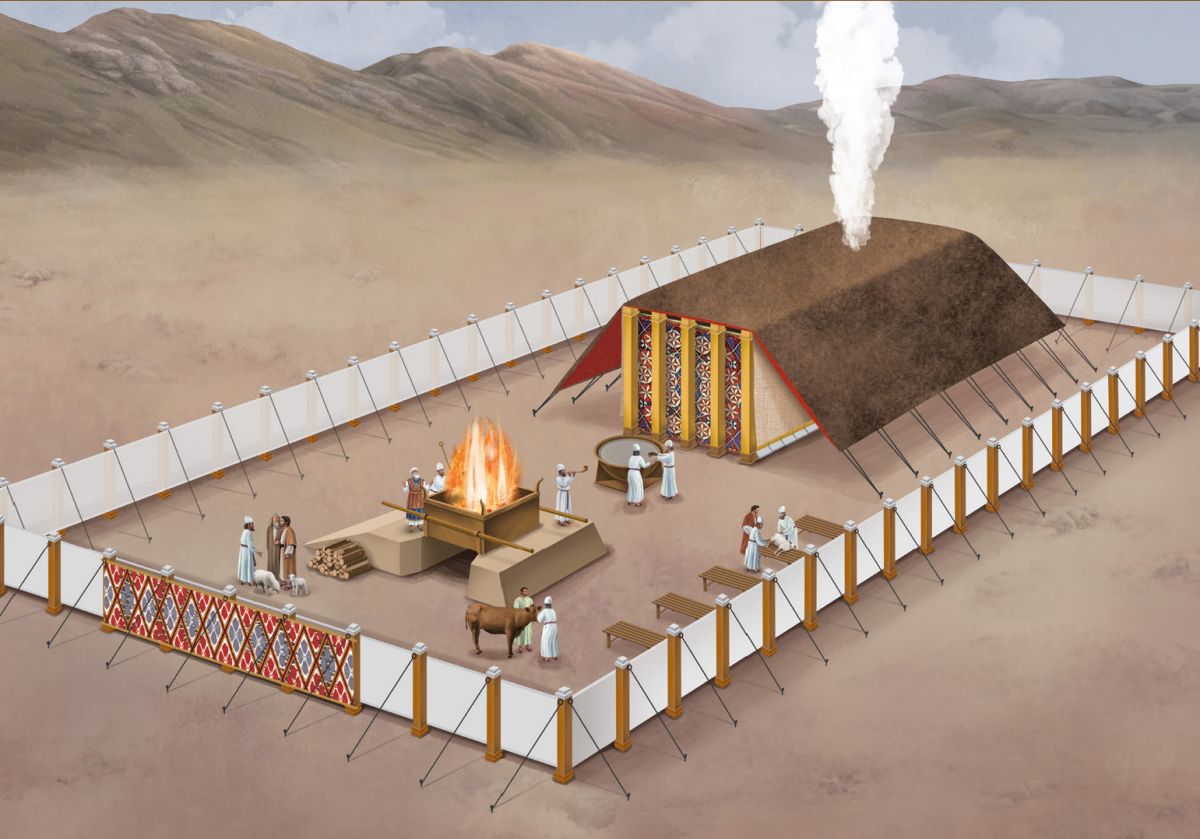
While Moses was up on the mountain, God gave him very specific commandments besides the initial ten. Besides the laws and commandments, God gave very detailed instructions on the construction of the Tabernacle and all implements and furnishings for use in the Tabernacle. These included the golden menorah, the altar of incense, the table of showbread, the Ark of the Covenant, the altar of burnt offering, etc. God specified the materials to be used in making the curtains inside the Tabernacle and the materials to be used in the construction of the outer court, down to how many rings were needed to hang the outer curtain. God gave the dimensions of every single item; no detail is omitted. Then God gave directions for the proper attire for the high priest and the other assistant priests.

The reading becomes very tedious at this point, and it continues on to Leviticus. One might wonder why God includes such minutia in the pages of Scripture. For those of us who are under grace, such detail has little meaning. We have no Tabernacle or Temple as described in which to worship. We do not offer animal sacrifices for every infraction we might commit. Our once-for-all sacrifice was that of Jesus on the cross.[5] We have no need for priests dressed in special apparel to offer sacrifices on our behalf or pray for the forgiveness of our sins. Jesus intercedes for us to the Father in heaven.[6] So, why should God include all those dry details for us to read? I could be wrong, but if you are like me, when you come to these pages, you skip right over them in order to get to the good stuff.

Well, I have not skipped these pages, and I have concluded that the reason God gave us all these minute details is precisely so that we understand that He takes the way we worship very seriously. As a matter of fact, at the end of Leviticus 9 and the beginning of Leviticus 10, He proves just how seriously He takes the way we worship. At this time, the Tabernacle had just been erected, and Aaron and his sons were consecrated as priests to minister before the LORD. They had done everything exactly as God had directed. “And Moses and Aaron went into the tabernacle of the congregation, and came out, and blessed the people: and the glory of the LORD appeared unto all the people. And there came a fire out from before the LORD, and consumed upon the altar the burnt offering and the fat: which when all the people saw, they shouted, and fell on their faces” (Leviticus 9:23-24, emphasis mine). This was God’s way of saying, “Good job!”

That was good, but what came next was shocking. “And Nadab and Abihu, the sons of Aaron, took either of them his censer, and put fire therein, and put incense thereon, and offered strange fire before the LORD, which he commanded them not. And there went out fire from the LORD, and devoured them, and they died before the LORD” (Leviticus 10:1-2, emphasis mine). What! After God gives them an “atta boy,” He kills them for offering “strange fire.” What is all that about?

God had given very specific instructions on the making of the incense which was to be burned on the altar of incense that stood before the holy of holies inside the Tabernacle. That special incense was not to be used for any other purpose. Duplicating the formula for personal use incurred capital punishment. The continuous burning of the incense before the holy of holies (where God’s presence resided) represented the prayers of the people going before the Lord. Furthermore, the incense could only be ignited by coals from the altar of burnt sacrifices that stood outside of the tabernacle. In this case, God had just ignited the burnt offering with His own fire from above.

These two clowns did not think it was such a big deal to get fire from somewhere else. After all, fire is just fire. Right? It was a big deal for God, and He struck them dead on the spot. This is really not much different than Cain’s offering.[7] Cain brought an offering that was not what God required, and God “had not respect” for Cain’s offering.

God takes the way we worship Him seriously. On this side of the cross, we are not obligated to follow any set of rigid “religious” rituals in order to come into the presence of God. However, too often we take our worship of God much too casually. It’s just something we do. It becomes habit; we do it without giving it a second thought. Mostly when we think about “worship,” we think about attending a “worship service” inside a church building. We sing worship songs and listen to a sermon, and then go home to watch a game on TV or go out for lunch.

Actually, worship is so much more than that. The Apostle Paul exhorts us, “I beseech you therefore, brethren, by the mercies of God, that ye present your bodies a living sacrifice, holy, acceptable unto God, which is your reasonable service. And be not conformed to this world: but be ye transformed by the renewing of your mind, that ye may prove what is that good, and acceptable, and perfect, will of God” (Romans 12:1-2, emphasis mine). The way we conduct our lives from day to day, moment by moment is our “reasonable service” (i.e., “logical worship”). How casually do you conduct your life without giving a second thought to how you are presenting your life to God? God may not strike you dead like Nadab and Abihu, but He does take it seriously.

So, how can we be a pleasing sacrifice to God? Well, for the Christian, that is easy because you have a big advantage. “Know ye not that ye are the temple of God, and that the Spirit of God dwelleth in you?” (1 Corinthians 3:16). You have the Spirit of God in you. So, each morning, when you awake, thank the Lord for a new day, and dedicate the day to Him and all that you do, do for His honor and glory. I promise you will falter and stumble, but you will instantly recognize your fault, you will ask forgiveness, and you will continue on. Paul says, “Pray without ceasing” (1 Thessalonians 5:17). Well, if you are down on your knees constantly praying, you would never get anything done! That is not what Paul is intending. What he means is that you need to be in a constant attitude of prayer. Talk to God about everything you are doing or plan on doing. He, because His dwelling place is in you, is your best and constant friend. But don’t take that for granted. He is God and you should never forget that. He takes your worship seriously and so should you.

Reader, if this made little sense to you, it is because, while you may know “about” God, you really do not know God. If you would like to know Him, I would encourage you to read my page on “Securing Eternal Life.”

Notes:

[1]  Exodus 12

[2]  Exodus 13

[3]  Exodus 20

[4]  Exodus 32

[5]  Hebrews 10:6-10

[6]  1 Timothy 2:5; Hebrews 12:24

[7]  Genesis 4:3-6

1 Comment

Filed under Bible, Christianity, Religion, Theology, Worship

Here Comes 2025!

But seek ye first the kingdom of God, and his righteousness; and all these things shall be added unto you. Take therefore no thought for the morrow: for the morrow shall take thought for the things of itself. Sufficient unto the day is the evil thereof. (Matthew 6:33-34)

As I write this, the clock rapidly ticks away the seconds to wind down the year 2024 and zoom into the new year, 2025. When I think of the passage of time, I often contemplate the illusiveness of “the present.” Think about it. Everything we do, every thought we think is instantly in the past the moment we act or think about it. Then, our next move is in the immediate future, which soon becomes our past. The actual “present” is but a nanosecond as we travel through time. We are constantly moving toward the future. What we do in the present, however brief that may be, ultimately affects the future.

Our ultimate future lies in eternity. We have no idea how time will work in eternity. We know God is eternal, without beginning and without end. He is not confined by time. To God, all time is present. However, we, His creation, were created in time, “In the beginning …” (Genesis 1:1), and we exist in time. Will we experience time in eternity as we do here on earth? I do not know. When my mother went to be with the Lord 22 years ago, one of the last things I said to her was, “Mom, don’t worry. When you get to heaven, you will look back and see that we are right behind you.” I do not know for certain, but it seems to me that time, even though for us it will still exist, will somehow be irrelevant; it will all be “now.”

Meanwhile, here we are. The present is determined by how we prepared for the future in the past, however recent or long ago the past was. Jesus offered good advice for preparing for the future. In the negative, He said, “Therefore I say unto you, Take no thought for your life, what ye shall eat, or what ye shall drink; nor yet for your body, what ye shall put on. Is not the life more than meat, and the body than raiment? … Therefore take no thought, saying, What shall we eat? or, What shall we drink? or, Wherewithal shall we be clothed?” (Matthew 6:25, 31). We cannot control what the future will bring. It certainly makes sense to prepare for the unknown, but even then, the future often brings the unexpected. Therefore, Jesus encourages us not to fret over those things. More important than the immediate future is what lies beyond – eternity. Rather than worry about things over which we have no control, Jesus encourages us to “Seek first the kingdom of God and His righteousness” – i.e., those things which are eternal value. Then He promises, “all these things” – i.e., food, clothing, housing, etc. – will be added unto you, “for your heavenly Father knoweth that ye have need of all these things” (Matthew 6:32). God will provide for your needs if you will trust Him.

The year 2024, arguably, has not been a good year. The new year, 2025, promises to be better, or we may look back and remember the good ol’ days of 2024. Donald J. Trump promises to “Make America Great Again.” However, Trump’s enemies want to do all that is in their power to thwart all of his efforts. Will they succeed or will Trump achieve his goals? The world is in turmoil. Russia and Ukraine are at war. The Middle East is a seething caldron of unrest; the puzzle pieces of the prophesied war of Ezekiel 38-39 seem to be falling into place. China boasts that it will take Taiwan and no one can stop it. Violence and rioting plague all of Europe and other places around the world. Will Trump’s presidency make the difference that will bring peace to the world? I have my doubts, but we can hope. The future is unknown except to God, and He ultimately controls the outcome. Therefore, Jesus said, “Take therefore no thought for the morrow: for the morrow shall take thought for the things of itself. Sufficient unto the day is the evil thereof” (Matthew 6:34). Whatever 2025 brings, those who trust in the Lord will enjoy peace and security in Him. “It is better to trust in the LORD than to put confidence in man. It is better to trust in the LORD than to put confidence in princes” (Psalm 118:8-9).

The best resolution for 2025 is to prepare for eternity. If you feel insecure about what the future has in store, I would encourage you to place your trust in Christ. Read my page on “Securing Eternal Life.”

Happy New Year!

3 Comments

Filed under Current Events, Holidays, New Year's Day, Theology

Christian, Vote!

Submit yourselves to every ordinance of man for the Lord’s sake: whether it be to the king, as supreme; Or unto governors, as unto them that are sent by him for the punishment of evildoers, and for the praise of them that do well. For so is the will of God, that with well doing ye may put to silence the ignorance of foolish men: As free, and not using your liberty for a cloke of maliciousness, but as the servants of God. (1 Peter 2:13-16)

Ye are the salt of the earth: but if the salt have lost his savour, wherewith shall it be salted? it is thenceforth good for nothing, but to be cast out, and to be trodden under foot of men. (Matthew 5:13)

I try to focus this blog on biblical and theological topics, but sometimes, it is necessary to call attention to current topics of an urgent nature. As you can see by the title of this article, I want to address Christians in this matter of exercising our right to vote in America, while we still have the freedom to do so.  I particularly want to address those Christians who, in frustration with politics, have decided not to vote. 

Christians should understand the concept of “stewardship.” However, most Christians think stewardship only refers to money and giving to the church. That is certainly part of it, however, it involves more than that. The Christian must understand that nothing in his control really belongs to him. It all belongs to God and He has put it under the individual’s control to “manage” – that’s what stewardship is – “management.”

So, what does that have to do with voting? Simple, God has placed you in a nation that is governed, not by a king or despot. We live in a “republic” governed by a written document – the Constitution – that gives “we the people” the right to rule over our own affairs through elected representatives. As Christians, then, it is our duty and responsibility to exercise that right as stewards of the nation God has given us.

Jesus called us to be salt and light in our world. Salt flavors and preserves. Light dispels darkness. As Christians, we are to make a difference in our world. Do what is right and trust the results to God. You will get no argument from me; both sides have their flaws. However, there is one side that is completely godless and opposed to everything God calls good. I do not need to name that party; you should know it well if you have paid attention. That party has removed God from its platform. It mocks Christians and Christian values. It supports the murder of the unborn. It worships nature rather than worshiping the Creator. It embraces and exalts deviant sexual lifestyles and encourages others to do the same (Romans 1:32). Any thoughtful, God-fearing, Christian steward of God should avoid at all costs voting for anyone running for any office that represents you in any way that displays a “D” after their name.

Christian, you need to vote. If you do not vote for the alternative just because you do not like his personality, you are in effect voting for the godless one with a “D” after their name. At the same time, you are neglecting the stewardship that God has given you.

Let a man so account of us, as of the ministers of Christ, and stewards of the mysteries of God. Moreover it is required in stewards, that a man be found faithful. (1 Corinthians 4:1-2)

As every man hath received the gift, even so minister the same one to another, as good stewards of the manifold grace of God. (1 Peter 4:10)

2 Comments

Filed under Apologetics, Christianity, Politics