
Tag Archives: Jesus

Eternal Hell

But he that shall blaspheme against the Holy Ghost hath never forgiveness, but is in danger of eternal damnation: (Mark 3:29)

Hell seldom comes up as a topic of interest. The notion of hell congers up unpleasant images of souls tortured by unquenchable flames and taunted by merciless devils with pitchforks. Heaven makes a more pleasant topic of conversation. I cannot wait to get there!

So, when a social media contact posted his take on a less-than-eternal nature of hell, I could not help (against my better judgment) to try and briefly correct his erroneous conclusions. I tried to keep it brief, but after his second response, I thought it best to conclude the discussion, and take Paul’s advice to “strive not about words to no profit, but to the subverting of the hearers” (2 Timothy 2:14). These kinds of discussions usually remain unresolved and provide a poor witness to bystanders. (On social media, one can never tell who is “listening.”)

Anyway, this gentleman (I’ll call him Aloysius (“famous warrior”) or Al for short) has apparently labored intensely on the subject of hell and arrived at the conclusion that hell is not eternal. He based his conclusion on the Hebrew word ‛ôlâm and the Greek word aiōnios, both of which are often translated as “forever” or “everlasting.” Al correctly pointed out that both of these words have several shades of meaning. Depending on the context, ‛ôlâm can mean “concealed, vanishing point, eternity, always, or perpetual,” according to Strong’s. Brown-Driver-Briggs’ defines it as “long duration, antiquity, forever, ever, everlasting, evermore, or perpetual.” As for  aiōnios, Strong’s defines it as “perpetual, eternal, everlasting, or forever.” Thayer’s Greek Definitions renders it, “without beginning, without end, never to cease, everlasting.”

Al failed to see the inconsistency in his argument. He defined ‛ôlâm and aiōnios as “eternal” when applied to God or heaven, but temporal when applied to hell. He did not reject the concept of hell, just the idea of an eternal hell. I did not pursue the question as to how he arrived at that conclusion, but perhaps his revulsion to the notion of an eternal damnation conflicted with his idea of a loving God. I understand why someone would feel that way, but we are not in a place to make that decision for God.

The Bible clearly teaches that heaven and hell are real places and they are eternal. All humans will end up in one place or the other for eternity. One verse from Jesus’ own lips easily exposes the contradiction in Al’s argument. In His discourse concerning the separation of the sheep and the goats,[1] Jesus sums up the destiny of both. “And these [goats] shall go away into everlasting punishment: but the righteous [sheep] into life eternal” (Matthew 25:46, emphasis mine). In this verse, aiōnios defines the duration of “punishment” (i.e., hell) and “life.” Seeing that the same word is applied to both, they must mean the same thing. If hell is not eternal then neither is life (i.e., heaven). If heaven is eternal, then so must be hell. Keep in mind that this verse is in the same context, so the word cannot have different meanings.

Related to aiōnios is the Greek word aiōn, which means “an age, perpetuity, continuing, or everlasting.” This word is often translated as “for ever” in the King James Version (KJV). When rendered as such, aiōn is usually preceded by the preposition eis, which means “to or into.” Together, eis aiōn could be translated “into the ages,” “into perpetuity,” or “to eternity.”

The Book of the Revelation explains the eternal nature of hell. In the Fourteenth Chapter, those that take the Mark of the Beast are condemned to eternal hell.[2] “And the smoke of their torment ascendeth up for ever and ever: and they have no rest day nor night, who worship the beast and his image, and whosoever receiveth the mark of his name” (Revelation 14:11, emphasis mine). The repletion is emphatic, εις αιωνας αιωνων – “into the ages of the ages.” Satan, the Beast (Antichrist), and the False Prophet earn the same reward. “And the devil that deceived them was cast into the lake of fire and brimstone, where the beast and the false prophet are, and shall be tormented day and night for ever and ever” (Revelation 20:10, emphasis mine). Again, the eternal nature of hell is described: εις αιωνας αιωνων – “into the ages of the ages.” Then those who reject Christ will be judged at the Great White Throne.[3] “And whosoever was not found written in the book of life was cast into the lake of fire” (Revelation 20:15, emphasis mine).

I understand Al’s desire that hell be temporary. That those who go there stay just long enough to pay their debt and get vaporized. I do not cherish the thought of anyone going to that place even for one minute. The Bible tells us that “God is love,”[4] and that “The Lord is not slack concerning his promise, as some men count slackness; but is longsuffering to us-ward, not willing that any should perish, but that all should come to repentance” (2 Peter 3:9, emphasis mine). However, God is eternal – without beginning and without end. Therefore, when we offend the eternal God, we offend Him eternally, and the punishment, therefore, must be of eternal consequences.

The Bible says that we have all offended God. “As it is written, There is none righteous, no, not one … For all have sinned, and come short of the glory of God” (Romans 3:10, 23). However, “For God so loved the world, that he gave his only begotten Son, that whosoever believeth in him should not perish, but have everlasting life” (John 3:16, emphasis mine). The eternal God took on human flesh[5] and shed His precious, perfect blood to cover our sins. His sacrifice provides for us the eternal atonement, covering, to satisfy our eternal offense against Eternal God. But we have the choice to believe or disbelieve, to accept or reject. “For whosoever shall call upon the name of the Lord shall be saved” (Romans 10:13).

Al is wrong. Hell is eternal. Please do not go there. Read my page on “Securing Eternal Life.”
Notes:


[1]  Matthew 25:31-46

[2]  Revelation 14:9-11

[3]  Revelation 20:11-15

[4]  1 John 4:8

[5]  John 1:14; Philippians 2:5-11

3 Comments

Filed under Apologetics, Bible, Christianity, Death, Gospel, Heaven, Hell

Victorious Entrance

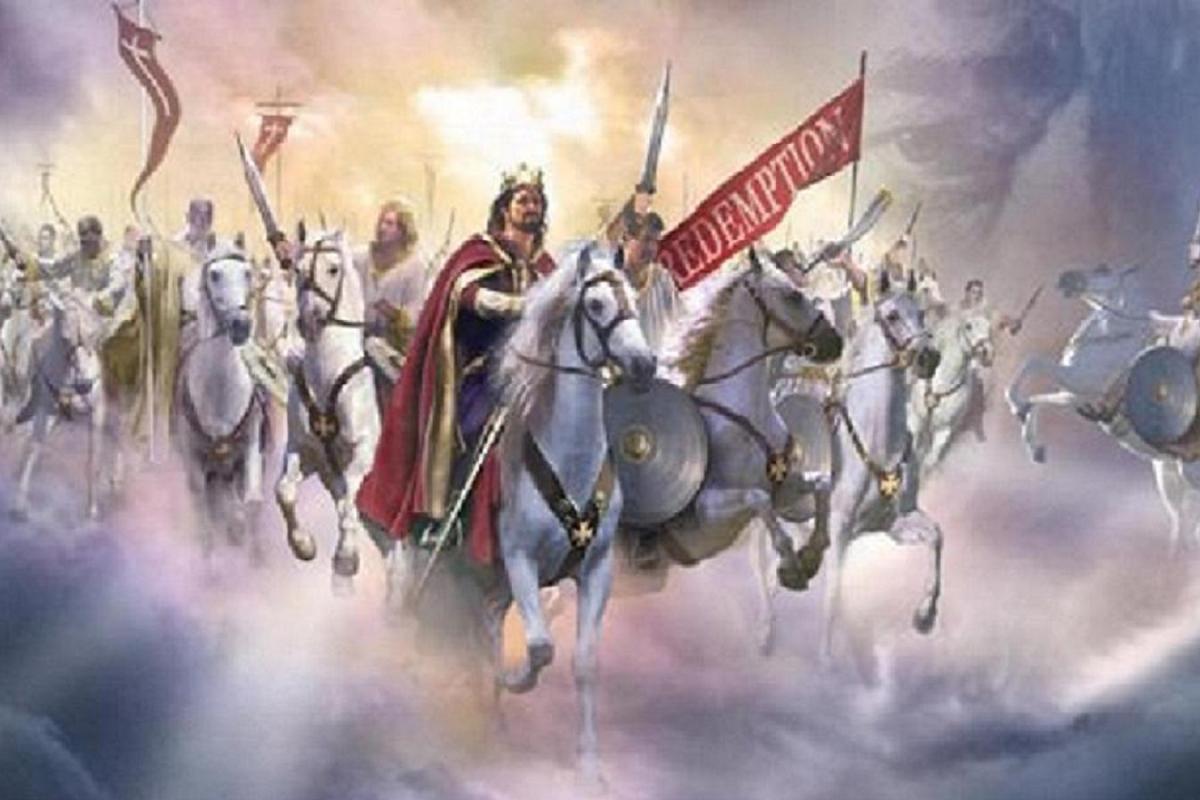
And I saw heaven opened, and behold a white horse; and he that sat upon him was called Faithful and True, and in righteousness he doth judge and make war. His eyes were as a flame of fire, and on his head were many crowns; and he had a name written, that no man knew, but he himself. And he was clothed with a vesture dipped in blood: and his name is called The Word of God. And the armies which were in heaven followed him upon white horses, clothed in fine linen, white and clean. And out of his mouth goeth a sharp sword, that with it he should smite the nations: and he shall rule them with a rod of iron: and he treadeth the winepress of the fierceness and wrath of Almighty God. And he hath on his vesture and on his thigh a name written, KING OF KINGS, AND LORD OF LORDS. (Revelation 19:11-16)

This Sunday, March 28, celebrates Palm Sunday when we commemorate Jesus’ entry into Jerusalem in the final week of His earthly ministry. We term this event as the “Triumphal Entry,” but in many respects, the term is a misnomer.

Daniel predicted the event to the very day of its occurrence. “Seventy weeks [70 x 7 years, or 490 years] are determined upon thy people [Israel or the Jews] and upon thy holy city [Jerusalem], to finish the transgression, and to make an end of sins, and to make reconciliation for iniquity, and to bring in everlasting righteousness [beginning with the Millennial reign of Messiah], and to seal up the vision and prophecy, and to anoint the most Holy [Messiah]. Know therefore and understand, that from the going forth of the commandment to restore and to build Jerusalem [decreed by Artaxerxes Longimanus, 444 BC] unto the Messiah the Prince shall be seven weeks [7 x 7 or 49 years], and [plus] threescore and two weeks [62 x 7 or 434 years; 49 + 434 = 483 years]: the street shall be built again, and the wall, even in troublous times. And after threescore and two weeks shall Messiah be cut off, but not for himself: and the people of the prince that shall come shall destroy the city and the sanctuary; and the end thereof shall be with a flood, and unto the end of the war desolations are determined” (Daniel 9:24-26, emphasis mine). Daniel divides the 490 years (70 weeks) into three segments of 49, 434, and 7 years. The first segment began when Artaxerxes Longimanus issued the fourth decree to rebuild Jerusalem with its walls in 444 BC, and ended in 395 BC when the project was completed – 49 years.[1] The next segment encompassed the 400+ “silent years” until Jesus, Messiah, entered into Jerusalem. Four hundred eighty three (483) years were fulfilled at that time and the final segment of seven years remains to be fulfilled. At the end of the 483 years, to the very day, Jesus, Messiah, was “cut off” at the cross.

The prophet, Zechariah, predicted that the Messiah would present Himself riding on a donkey. “Rejoice greatly, O daughter of Zion; shout, O daughter of Jerusalem: behold, thy King cometh unto thee: he is just, and having salvation; lowly, and riding upon an ass, and upon a colt the foal of an ass” (Zechariah 9:9, emphasis mine). All four Gospel writers record this event from their unique perspectives.[2] Most Bibles that use sub-title divisions of chapters title this event as the “Triumphal Entry.” However, Jesus did not enter Jerusalem as conquering king. He presented Himself as the Melek Shâlêm, the King of Peace. A conquering king would have presented himself with great pomp and ceremony,[3] riding on a white charger followed by his conquering armies, parading the spoils of his conquests.

Jesus entered humbly as the King of Peace. His week would end with a tortuous, humiliating death on a Roman cross. From a human perspective, that hardly qualifies as a triumph. However, the following Sunday, the earth shook[4] as Jesus ripped apart the chains of death and conquered man’s final enemy.[5] “O death, where is thy sting? O grave, where is thy victory? The sting of death is sin; and the strength of sin is the law. But thanks be to God, which giveth us the victory through our Lord Jesus Christ” (1 Corinthians 15:55-57). Yet, we still die physically, but our spirit lives on. “We are confident, I say, and willing rather to be absent from the body, and to be present with the Lord” (2 Corinthians 5:8). One day, even physical death will be lost even to the memory. “And death and hell were cast into the lake of fire. This is the second death” (Revelation 20:14). Our present bodies (whether alive or dead) will be transformed into eternal bodies like the body of the resurrected Christ. “Now this I say, brethren, that flesh and blood cannot inherit the kingdom of God; neither doth corruption inherit incorruption. Behold, I shew you a mystery; We shall not all sleep, but we shall all be changed, In a moment, in the twinkling of an eye, at the last trump: for the trumpet shall sound, and the dead shall be raised incorruptible, and we [who are living at the time] shall be changed. For this corruptible must put on incorruption, and this mortal must put on immortality” (1 Corinthians 15:50-53, emphasis mine).

Jesus conquered death at His resurrection, but He has yet to enter Jerusalem in triumph. Our starting verse above, Revelation 19:11-16, describes His real Triumphal Entry. He will enter Jerusalem from His departure point on the Mount of Olives riding on a white horse – not a donkey this time. He will be followed by His heavenly hosts (angelic armies) and by the spoils of His victory, His saints, all riding white horses and dressed in white robes – no weapons in hand. When His foot touches Earth, the Mount of Olives will split in two,[6] half to the north and half to the south. From there He will travel north to the Jezreel Valley, for the Battle of Armageddon. That too is a misnomer, because it will be no battle at all. “And out of his mouth goeth a sharp sword, that with it he should smite the nations: and he shall rule them with a rod of iron: and he treadeth the winepress of the fierceness and wrath of Almighty God” (Revelation 19:15, emphasis mine). That “sword” out of His mouth is His Word. He will speak and the “battle” will be over. “And the LORD shall be king over all the earth: in that day shall there be one LORD, and his name one” (Zechariah 14:9).

Now, that is a Triumphal Entry!

The current events of our world signal that the time of Jesus’ Victorious Entrance is soon approaching. He will come for His Bride, the Church, at any moment; although we do not know when. However, if the signs indicate that His return is near, that means the catching up of His Bride is even closer. Soon after that, Daniel’s final week, the last seven years known as the Tribulation, will begin. Those who are not snatched away by Jesus will remain on earth to suffer through the judgments of God like at no other time in world history. If you are not sure where you stand with Jesus, you can escape that awful time by putting your trust in Him as your Savior. Read my page on “Securing Eternal Life.”

Notes:


[1]  John F Walvoord and Roy B. Zuck, The Bible Knowledge Commentary- Old Testament, (SP Publications, 1985), p.1363.

[2]  Matthew 21:1-11; Mark 11:1-11; Luke 19:28-44; John 12:12-19

[3]  “The Triumphal Entry,” — https://erniecarrasco.com/2019/04/14/the-triumphal-entry/

[4]  Matthew 28:2

[5]  1 Corinthians 15:26

[6]  Zechariah 14:4

Comments Off on Victorious Entrance

Filed under Apologetics, Bible, Christianity, Current Events, Death, Easter, End Times, Evangelism, Gospel, Heaven, Hell, Holidays, Resurrection, Salvation, Second Coming of Christ, Theology

Peace

These things I have spoken unto you, that in me ye might have peace. In the world ye shall have tribulation: but be of good cheer; I have overcome the world. (John 16:33)

What images enter your mind’s eye when you hear the word “peace”? Do you picture cloudless blue skies over a quiet deserted palm-lined tropical beach disturbed only by the lapping of the rising tide, the whisper of the ocean breeze, and the occasional caw of a soaring seagull? Or, do you imagine a silent stony perch atop a tall Rocky Mountain overlooking a thick pine and aspen forest below alternately lighted and shaded by passing puffy clouds? Is your idea of peace a serene humble home on five or ten acres of land far, far away from the rush and bustle of urban life? Do you think of a world without crime, without war, without pestilence and hunger, and without hate?

All those visions of peace exist only in the imagination, and if by experience, they are only temporary. The quiet beach will soon fill with noisy sunbathers. The silent mountain scene gets interrupted by an unpredicted thunderstorm. The endless chores disturb the serene little farm house. As for peace in the world, you can forget that.

As Jesus faced the cross, He tried to prepare His disciples for what lay ahead. “Peace I leave with you, my peace I give unto you: not as the world giveth, give I unto you. Let not your heart be troubled, neither let it be afraid” (John 14:27). He offered His peace, unlike the peace that the world can give. We personally enjoy quiet peaceful moments in this life, but they are temporary and fleeting. The world knows no peace. The interval between World War I, “the war to end all wars,” lasted less than 21 years before World War II flared up. Since then the United States prosecuted wars in Korea, Viet Nam, Iraq, Afghanistan, along with several “peace-keeping” skirmishes here and there. Meanwhile, the Middle East experiences fighting periodically and consistently throughout the Muslim world. If that were not enough, rioting breaks out in almost every country all the time. Now the entire world lives in fear of a man-made global pandemic. The world knows no peace.

Yet Jesus said, “My peace I give unto you.” To whom was this gift directed? Jesus addressed a very specific audience, His disciples. His peace is not for the world. It is for His disciples only. On that night, He spoke only to the twelve, but He intends all of His disciples to have the gift, that means you and me if we are truly His disciples – believers, followers of Jesus. In His high-priestly prayer He said, “I pray for them: I pray not for the world, but for them which thou hast given me; for they are thine” (John 17:9, emphasis mine). Then, so as not to exclude those that would follow, He said, “Neither pray I for these alone, but for them also which shall believe on me through their word” (John 17:20, emphasis mine).

The peace Jesus gives silences the most tempestuous storms of life, allays the deepest fear, and quiets the troubled mind. His supernatural peace confounds any false peace the world can offer. “These things I have spoken unto you, that in me ye might have peace. In the world ye shall have tribulation: but be of good cheer; I have overcome the world” (John 16:33, emphasis mine). His peace does not exempt us from the affliction, pressure, persecution, tribulation, or trouble that comes as part and parcel with life in this world. Indeed, He requested, “I pray not that thou shouldest take them out of the world, but that thou shouldest keep them from the evil [one]” (John 17:15, emphasis mine). Our peace comes from knowing that “[We] are not of the world, even as I am not of the world” (John 17:16). “For our [citizenship] is in heaven; from whence also we look for the Saviour, the Lord Jesus Christ” (Philippians 3:20).

The world labors in vain for peace. The world alters language to stifle hate. The world blames the weather for rioting in the streets, so it implements draconian measures to curtail carbon emissions. The world cries, “Peace, peace; when there is no peace” (Jeremiah 6:14; 8:11). The world knows no peace, but the believer in Jesus can know peace. As the axiom makes clear, “No Jesus, no peace; know Jesus, know peace.” One day soon, the world will know peace, but not now.

Every true believer, every Christian should know peace. If not, there can only be two reasons that a Christian does not have peace. Either they have not been “born again” and do not know Jesus personally, or they have momentarily taken their eyes off of Him like Peter did when he tried to walk on the water (Matthew 14:22-32). If you do not know Jesus, but you want to know peace, see my page on “Securing Eternal Life.”

2 Comments

Filed under Apologetics, Christianity, Current Events, Evangelism, Gospel, Religion, Salvation, Second Coming of Christ, Theology

Strange Christmas

But when the fulness of the time was come, God sent forth his Son, made of a woman, made under the law, (Galatians 4:4)

The year 2020 has been a historic year to say the least. It started with my retirement at the end of December 2019 and quickly followed by minor knee surgery on my left knee just three days after. Being new to retirement, I found it challenging to find what to do with all my spare time. I filled some of my time with volunteering opportunities at church and at the ICR Discovery Center for Science and Earth History. Of course, that occupied only part of my time. I also spent many hours, three to six hours a day, studying Scripture, something I enjoy the more I do it.

It was nice to have control of my own time and spend it at my own discretion. Then COVID-19 hit and everything changed, not just for me, but for everyone on Earth. I will spare all the details. I am certain that anyone reading this had similar experiences with masks, social distancing, restrictions on large gatherings, church shut-downs, etc. The year 2020 has been, in many respects, the worst year in the threescore and ten years of my life. Personally, I believe that what we experienced this year, especially with the draconian governmental intrusion into our lives, portends to the seven-year Tribulation prophesied in Scripture and the soon coming of our Lord Jesus Christ. That, in turn, gives me hope that the Rapture of the Church can happen at any moment now. That gives me joy and hope in spite of all this stink going on in our nation and the world.

The year 2020 quickly comes to a close, and we now come to Christmas. But like the rest of 2020, Christmas this year is very strange. My church just opened back up at the beginning of December, but with so many restrictions that it does not even “feel” like church. Attendees must wait to be ushered into a socially distanced place, wear masks during the worship portion of the service, and then wait to be ushered out at the end of the service. Any “fellowshipping” must be done outside of the building and hugs and handshakes are strongly discouraged. We normally put on a Christmas program at this season with choir and orchestra, which usually packs out the sanctuary. This year, we had a socially-distanced ensemble and a guest singer. The music was nice, but it lacked the pizzazz of past Christmas programs. Of course, the audience was at one-third of normal due to all the restrictions, and I missed the “feeling” of the event. I normally sing in the choir, but we could not do that because of COVID-19.

Christmas Eve service will be even stranger. This year it will be “virtual.” Our pastor will bring a Christmas message and we will observe the Lord’s Supper “online.” I do not mean to criticize. I am only stating reality. I know our church staff is trying to make the best of a stinky situation, but for all their effort, it is still a very strange Christmas.

For many years I have bemoaned the inflated sentimentality attached to the season. (You can read my past articles on the topic.) In the first place, it is highly unlikely that Jesus was born in December. In the second place, the overt commercialization of the season detracts from any significance of its true meaning. And in third place, the sentimentality attached to it makes it more about us, and it does about Him.

Our tree is up, the nativity is on the mantle, and Christmas lights illuminate our front yard, and it still feels like a very strange Christmas. What is not strange or unchanged is God’s love and gift to us in taking “upon him the form of a servant and was made in the likeness of men” (Philippians 2:7) “that whosoever believeth in him should not perish, but have everlasting life” (John 3:16). When you think about it, that in itself is strange. However, it is God’s plan, and it is in effect regardless of circumstances. Maybe it’s good that this is such a strange Christmas after all.

Merry Christmas!

2 Comments

Filed under Christianity, Christmas, Gospel, Salvation, Second Coming of Christ, Theology

When the Lord Returns

Let your loins be girded about, and your lights burning; (Luke 12:35)

I am currently reading the Gospel of Luke in my personal Bible study, and, as often happens when I read my Bible, something caught my attention that I had not seen before. In Luke Chapter 12, Jesus had finished telling the parable of the rich fool[1] who had a bumper crop and started planning about what he would do with his newly acquired wealth. That night, God called him to account. “But God said unto him, Thou fool, this night thy soul shall be required of thee: then whose shall those things be, which thou hast provided?” (Luke 12:20). Jesus’ point was that earthly riches do not amount to much in light of eternity. He said, “So is he [a fool] that layeth up treasure for himself, and is not rich toward God” (Luke 12:21). He went on to teach regarding the futility of worrying about the things of this world because God knows our needs, and He will provide for all our needs (not necessarily our “wants”). The ravens do not sow, reap, or store up food, yet God feeds them.[2] The lilies of the fields neither toil nor spin, yet God clothes the earth more beautifully than Solomon’s apparel.[3] So, Jesus taught, we should not overly concern ourselves with food or clothing because God will provide for our needs. Instead, He said, “But rather seek ye the kingdom of God; and all these things shall be added unto you … For where your treasure is, there will your heart be also” (Luke 12:31, 34)

With that in mind, since this life and this world does not last, He went on to encourage His listeners to be ready for His Second Coming. (I am not sure if His audience caught the significance of His message, but looking back, it should be clear to us.) “Let your loins be girded about, and your lights burning” (Luke 12:35). Having your “loins girded” is an expression that meant to prepare oneself for work, and one only lights a lamp when it gets dark. So the idea is that we should be on the alert and watching. We are to watch and work as we “seek the kingdom of God.”

He went on to amplify His meaning. “And ye yourselves like unto men that wait for their lord, when he will return from the wedding; that when he cometh and knocketh, they may open unto him immediately” (Luke 12:36, emphasis mine). I highlighted in bold italics what I missed before. Jesus spoke in the form of a parable which His audience, His disciples, and His apostles would not have clearly understood at that time. He often used the example of a landowner – a lord or master – leaving on a long journey and leaving the care of his properties in the hands of stewards, i.e., “servants.”[4] All of these parables convey the idea that the Lord will leave – which Jesus did in His ascension – and will return at some undetermined time. In the meantime, His servants continue to conduct His business – in our case that of proclaiming the Gospel – until He returns.

What popped out at me in this passage is the phrase “when he will return from the wedding.” What relevance does a wedding have with the main point of the story? Note also the definite article. It is not just “a” wedding; it is the wedding. The significance is subtle and easy to miss, but indeed it carries great relevance to Christians living in this day.

Before Jesus went to the cross, He told His apostles, “Let not your heart be troubled: ye believe in God, believe also in me. In my Father’s house are many mansions: if it were not so, I would have told you. I go to prepare a place for you. And if I go and prepare a place for you, I will come again, and receive you unto myself; that where I am, there ye may be also” (John 14:1-3, emphasis mine). When His apostles heard this, they caught the imagery of a Galilean wedding. When a man proposed marriage to a young woman, if she accepted the proposal, he would leave to build a house for her. Once the father of the groom inspected and approved the house, he would give his son permission to go get his bride. The wedding would take place and the wedding feast that followed would last for seven days.

Likewise, Jesus, the Bridegroom, is betrothed to His Bride, the Church. His Bride is made up of those who have accepted His proposal.[5] Now He is gone preparing a place for His Bride, and when the Father approves of the house,[6] He will come to get His Bride and take her to the home He has prepared for her. The wedding feast[7] will last one week (seven years).[8] At the end of the seven years, Jesus will return with His Bride to reclaim His kingdom on earth.

The audience that heard the parable was Jewish, and they probably missed the significance of the lord returning from the wedding. Weddings were frequent and common events in those days as they are today. Jews then and now, for the most part, missed the Messiah. Yet Jesus admonishes these who fail to recognize Him to have their “loins girded” and their “lamps burning” in preparation for their Lord’s return from the “wedding.”

After Jesus snatches away His Bride and the seven-year wedding feast begins, those who remain on the earth will experience the seven-year Tribulation. During that time, many Jews will recognize the Messiah they missed and 144,000 of them will preach the Gospel message around the world.[9] Many Jews as well as Gentiles will be saved by their message. It is these whom Jesus admonishes to work, watch, and be ready for His coming. “Blessed are those servants, whom the lord when he cometh shall find watching: verily I say unto you, that he shall gird himself, and make them to sit down to meat, and will come forth and serve them. And if he shall come in the second watch, or come in the third watch, and find them so, blessed are those servants” (Luke 12:37-38).

“The Lord is not slack concerning his promise, as some men count slackness; but is longsuffering to us-ward, not willing that any should perish, but that all should come to repentance” (2 Peter 3:9, emphasis mine). Even after the Rapture of the Church, even in the midst of the Great Tribulation, God is “not willing that any should perish.” Sadly, for many, that time will be the final opportunity for salvation but at such a high cost. Reader, if you do not know the Savior, please do not wait until the last moment. Accept the Bridegroom’s proposal today. Find my page on “Securing Eternal Life” and prepare to enjoy the wedding feast rather than work in the time of Great Tribulation.

Notes:


[1]  Luke 12:16-20

[2]  Luke 12:22-24

[3]  Luke 12:27-28

[4]  Matthew 21:33-41; 25:14-30; Mark 13:32-37Luke 19:11-27

[5]  John 3:16; Acts 16:31; Romans 10:9-10; et al.

[6]  Matthew 24:36

[7]  Revelation 19:6-9

[8]  Daniel 9:27

[9]  Revelation 7:1-8; 14:1-5

Comments Off on When the Lord Returns

Filed under Christianity, End Times, Evangelism, Gospel, Salvation, Second Coming of Christ, Theology