Tag Archives: Jesus

Still Listening Again

Behold, I shew you a mystery; We shall not all sleep, but we shall all be changed, In a moment, in the twinkling of an eye, at the last trump: for the trumpet shall sound, and the dead shall be raised incorruptible, and we shall be changed (1 Corinthians 15:51-52).

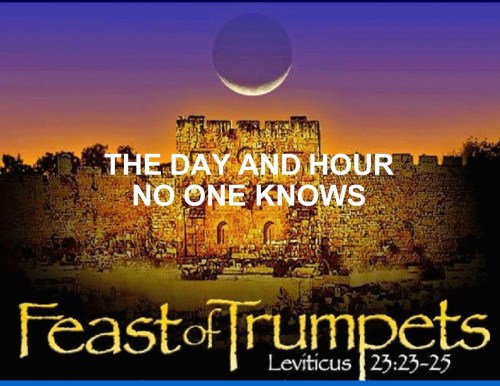
Every year for at least the last decade – ever since I learned about the Feasts of the Lord[1] – around this time of year, I start getting a little anxious with excitement wondering if this will be the year that Jesus will call His bride home.[2], [3], [4], [5], [6] This Monday, September 10, the Feast of Trumpets comes around again. For those of us who look forward to the Rapture of the Church, this is a “high watch” day. The reason for this, as I have explained in the past, is because this is the next Feast not fulfilled by Jesus’ First Advent. Therefore, it stands to reason that Rosh Hashanah (the Feast of Trumpets) would be a good time for Jesus to summon His Bride, the Church, home. Every year as I have waited, the day has come and gone, and we are still here. You might think that eventually I would experience “Rapture Fatigue” and give up on the whole idea. However, I still have oil in my lamp and even some extra! (Matthew 25:4)

Some will criticize and remind us that Jesus said, “But of that day and hour knoweth no man, no, not the angels of heaven, but my Father only” (Matthew 24:36). The Rapture is imminent. It could happen at any time, and we ought always to be ready. Nothing prophetically remains unfulfilled for this event to take place. Israel celebrated her 70th rebirthday this past May. We live in the generation that witnessed the “fig tree” bud (Matthew 24:32-33). This year wraps up the 70th Year of Jubilee since Moses gave the ordinance 3500 years ago. Israel is the focal point of end-times prophecy, so our attention must focus on current events in the Middle East. The stage is being set for what “prophecy watchers” call the “Ezekiel 38-39 War.” At the time of this writing, Russia, Turkey, and Iran are meeting concerning their involvement in Syria. Damascus almost resembles the ruinous heap described in Isaiah 17:1.

Will these things happen before or after the Rapture? We cannot tell. No man knows the day or the hour, but we sense that the time is near. Will the Rapture take place at the Feast of Trumpets? Perhaps. The Feast of Trumpets is celebrated over two days because it is based on the verified appearance of the new moon. Since the exact time of the appearance cannot be accurately predicted, the Feast of Trumpets is known as the feast of which “no man knows the day or the hour.” This year the watch is set for Monday and Tuesday, September 10 & 11 beginning at sundown on Sunday, September 9 (the date of this posting).

Will Jesus call for His Bride in the coming weeks? I do not know, but I hope so, and I am ready! How about you? If you are unsure, read my pages on “Securing Eternal Life” and on “Heaven.”

Notes:


[1]  “Rosh HaShanah” https://erniecarrasco.com/2016/10/03/rosh-hashanah/

[2]  “Still Waiting!” – https://erniecarrasco.com/2017/09/24/still-waiting/

[3]  “Now’s A Good Time!” https://erniecarrasco.com/2017/09/17/nows-a-good-time/

[4]  “Coming Soon!” https://erniecarrasco.com/2017/07/09/coming-soon/

[5]  “Rosh HaShanah”  https://erniecarrasco.com/2016/10/03/rosh-hashanah/

[6]  “Still Listening” https://erniecarrasco.com/2015/09/20/still-listening/

3 Comments

Filed under Apologetics, Christianity, Current Events, End Times, Evangelism, Gospel, Religion, Second Coming of Christ, Theology

Merit-Based Salvation

For God shall bring every work into judgment, with every secret thing, whether it be good, or whether it be evil. (Ecclesiastes 12:14)

There exists a common misconception among non-Christians and, sadly, even among some Christians, that when it comes time to meet our Maker that we can gain entrance into the celestial realm based on our merits. As our lead verse suggests, “God shall bring every work into judgment … whether it be good, or whether it be evil.” If challenged, those who hold that view almost always see themselves as better than most. They may admit to “small” sins like telling a “white lie” now and then, stealing a pack of gum, failing to correct a cashier when given too much change, or something equally innocuous. By their estimation, their “good” works will outweigh their “evil” works on the cosmic scales, and God will say, “Good enough!”

To some extent, it seems that the Bible teaches merit-based salvation. Our lead verse teaches that God looks at every work, both good and evil. Superficially, one may get the impression that He weighs the two – good on one side, evil on the other. First Peter 1:17 says that “the Father, who without respect of persons judgeth according to every man’s work…” (emphasis mine). Indeed, at the end of time when Christ’s millennial reign on earth has ended, a scene unfolds where all who ever lived appear before the judgment seat of Christ. “And the sea gave up the dead which were in it; and death and hell delivered up the dead which were in them: and they were judged every man according to their works” (Revelation 20:13).

It indeed appears that people will be judged according to their works. Should this be cause for hope for those counting on their own goodness? Taking a closer look at our leading verse, note that God scrutinizes “every work” and determines whether it is good or evil based on His standard of goodness. God made man in His image (Genesis 1:27), and for that reason, God deemed man “very good” (Genesis 1:31), but man messed that up in the Garden of Eden (Genesis 3). Beginning with fig leaves (Genesis 3:7), man’s attempt at covering up his sin always falls short of the perfection he possessed before the Fall. Only perfection qualifies for entry into the presence of God. “And there shall in no wise enter into it any thing that defileth, neither whatsoever worketh abomination, or maketh a lie: but they which are written in the Lamb’s book of life” (Revelation 21:27, emphasis mine). Interestingly, I cannot find the word “sin” in the book of Revelation, but there are several synonyms: anything that defiles, whatever works abomination or makes a lie. All of that is sin, so whether one has a little sin or a lot of sin, one is disqualified from entering heaven.

The Great White Throne Judgment scene in Revelation sees “books” opened, and the “dead” judged by the content of the books “according to their works” (Revelation 20:12). Evidently, there are “ledger books” recording both the good and evil deeds of every person that has ever lived. Since NOTHING that defiles “shall in no wise enter,” no one qualifies. “As it is written, There is none righteous, no, not one … For all have sinned, and come short of the glory of God” (Romans 3:10, 23). However, “The Lord is not slack concerning his promise, as some men count slackness; but is longsuffering to us-ward, not willing that any should perish, but that all should come to repentance” (2 Peter 3:9). There the guilty sinner stands before the Righteous Judge, “and another book was opened, which is the book of life … And whosoever was not found written in the book of life was cast into the lake of fire” (Revelation 20:15).

Reader, is your name written in the Book of Life? Do not think you are good enough – that your sins are minor compared to someone else. Only perfection gains entry into heaven and no one qualifies. However, there is a way. Please read my page on “Securing Eternal Life.”

Comments Off on Merit-Based Salvation

Filed under Apologetics, Christianity, Evangelism, Gospel, Religion, Salvation, Theology

Being Gods

Jesus answered them, Is it not written in your law, I said, Ye are gods?       (John 10:34)

When Satan met Eve in the Garden of Eden, he charged that by His prohibition against eating the fruit of the tree of knowledge of good and evil, God denied Adam and Eve of something good. “For God doth know that in the day ye eat thereof, then your eyes shall be opened, and ye shall be as gods, knowing good and evil” (Genesis 3:5, emphasis mine).

Being gods remains mankind’s greatest desire. We all want to have complete, unfettered control of our lives with no one telling us what to do; and we want, as much as possible, to exert influence and control over others. The latter becomes more apparent daily as we witness the radical left’s efforts to alter the course of our nation. The strong desire to force upon our society their radical agenda manifests itself in unprecedented violence across our land. They want to be the gods that dictate what we all should do.

However, this is not a new phenomenon. History records the rise and fall of numerous demagogues. Bringing it closer to home, we might be tempted to deflect the guilt to them and deny that we harbor the same desire to make our own rules and impose them on others. We all like being gods to one extent or another.

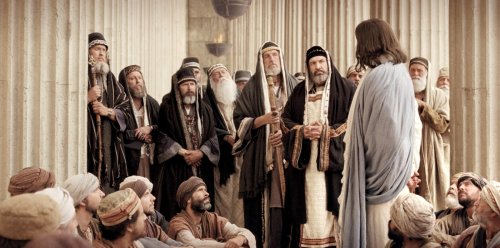
In Jesus’ day, the religious leaders wanted to be gods, although they would never admit to that. They were the keepers of God’s law, and from their self-perceived superior position, they sought to impose their perception of God’s law on others. They enjoyed their position of control. They were being gods without knowing it. However, they met their match with Jesus. Him they could not control, so they sought to destroy Him.

It was the winter before His crucifixion around the time of Hanukkah (John 10:22). The Jewish religious leaders surrounded Jesus with the hope of finding something with which to accuse Him of a capital offense. “Then came the Jews round about him, and said unto him, How long dost thou make us to doubt? If thou be the Christ, tell us plainly” (John 10:24). Jesus referred to His countless miracles, of which no doubt they were familiar, in His defense. Nevertheless, the clear evidence escaped these “blind guides” (Matthew 23:16, 24). Their incapacity to perceive the truth centered on the question of ownership. They were not Jesus’ sheep (John 10:26-27); they were their own “gods;” therefore they could not recognize His authority or submit to His direction.

Since the clear evidence eluded them, Jesus plainly told them what they wanted to hear, “I and [the][1] Father are one” (John 10:30). That was plain enough. Jesus made it clear that not only is He equal to God (the Father), He is the same as the Father. The message came through loud and clear. “Then the Jews took up stones again to stone him” (John 10:31). They got what they were after. He deserved to be stoned “for blasphemy; and because that thou, being a man, makest thyself God” (John 10:33).

Jesus then quoted from Psalm 82, “Is it not written in your law, I said, Ye are gods?” (John 10:34). The psalm begins with this declaration: “God standeth in the congregation of the mighty; he judgeth among the gods” (Psalm 82:1). Considering the parallelism of Hebrew poetry, “the mighty” and “the gods” are the same.[2] To “the mighty” and “the gods” God challenges, “How long will ye judge unjustly, and accept the persons of the wicked?” (Psalm 82:2). Then He charges, “Defend the poor and fatherless: do justice to the afflicted and needy. Deliver the poor and needy: rid them out of the hand of the wicked” (Psalm 82:3-4). These mighty gods are none other than the leaders of the people – ordinary men in extraordinary positions of power and authority. Yet, according to the psalm, they are ignorant of God’s laws and supplant them with laws of their own devices, so that “all the foundations of the earth are out of course” (Psalm 82:5). To these demigods, God says, “I have said, Ye are gods; and all of you are children of the most High. But ye shall die like men, and fall like one of the princes” (Psalm 8:6-7). God confers the appellation of “gods” on these rulers in that they are “children” of God. As such, they are God’s representatives on the earth, “princes” to carry out God’s will on earth. However, they are not more special than other men. They will die just like every other man.

The psalm ends with a cry for God to, “Arise, O God, judge the earth: for thou shalt inherit all nations” (Psalm 82:8). In the end, the One true God will reign over all the earth, and here He was standing before the Jewish leaders. God accused of blasphemy by the little gods.

Solomon rightly lamented, “The thing that hath been, it is that which shall be; and that which is done is that which shall be done: and there is no new thing under the sun” (Ecclesiastes 1:9, emphasis mine). We still try to be our own gods – set our own rules and impose our will on others. Since the Garden of Eden, we continue being gods, even if only in our minds. The sooner we learn to let God be God, the sooner we can enjoy the peace and rest that only God can give. To all who are tired of being gods, Jesus says, “Come unto me, all ye that labour [at being gods] and are heavy laden, and I will give you rest” (Matthew 11:28).

Notes:


[1]  The KJV inserts “my” in italics where the Greek text (Textus Receptus) used the definite article “the” before “Father.”  εγω και ο πατηρ εν εσμεν

[2]  Michael S. Heiser, in his book The Unseen Realm, suggests that the elohim (gods) in this psalm refers to the “congregation” of the bene elohim (sons of God) that make up the council of God.  These include both God’s angels and Satan’s angels as seen in Job 1. That idea is not implausible, however, based on Jesus’ reference to it, it can also apply to mankind.

1 Comment

Filed under Apologetics, Christianity, Gospel, Religion, Satan

Only Eight Saved

Noah, a Preacher of Righteousness

For Christ also hath once suffered for sins, the just for the unjust, that he might bring us to God, being put to death in the flesh, but quickened by the Spirit: By which also he went and preached unto the spirits in prison; Which sometime were disobedient, when once the longsuffering of God waited in the days of Noah, while the ark was a preparing, wherein few, that is, eight souls were saved by water. (1 Peter 3:18-20)

One of the many attributes of God is that He is longsuffering. The English word first appears in Exodus. “And the LORD passed by before him, and proclaimed, The LORD, The LORD God, merciful and gracious, longsuffering, and abundant in goodness and truth, Keeping mercy for thousands, forgiving iniquity and transgression and sin, and that will by no means clear the guilty; visiting the iniquity of the fathers upon the children, and upon the children’s children, unto the third and to the fourth generation (Exodus 34:6-7). The word “longsuffering” translates two Hebrew words: ‘ârêk meaning long or patient and ‘aph meaning nose or nostril, hence the face. Together they picture the face of God as He patiently looks on His wayward children. The word appears three other times in the Old Testament: Numbers 14:18; Psalm 86:15; Jeremiah 15:15.

In the New Testament, “longsuffering” appears 13 times. It appears first in Romans 2:4, “Or despisest thou the riches of his goodness and forbearance and longsuffering; not knowing that the goodness of God leadeth thee to repentance?” In the New Testament, “longsuffering” translates the Greek compound word, makrothumiamakrós meaning “long” and thymós meaning “passion, anger.” Together they render “long-passion,” i.e., waiting a long time before expressing anger.

God’s longsuffering can be misconstrued as indulgence, leniency, or indifference. On the extreme side, some interpret God’s apparent laxness in punishing evil to mean that God does not exist. However, that is not what the Bible teaches. “The Lord is not slack concerning his promise, as some men count slackness; but is longsuffering to us-ward, not willing that any should perish, but that all should come to repentance” (2 Peter 3:9). God patiently waits a long time giving sinners sufficient opportunity to repent. He does this for individuals and for mankind in general.

Not long after God created Adam and Eve and placed them in the Garden of Eden, the couple disobeyed God’s only command, which brought death – separation between God, the Creator, and man, the creature – to all their posterity (Genesis 3). Adam and Eve had many sons and daughters (Genesis 5:4). Cain was born first (Genesis 4:1), and Abel came sometime after (Genesis 4:2). As the narrative unfolds, we learn that Cain rebelled in his offering to God, while Abel sacrificed according to God’s prescription. God accepted Abel’s sacrifice and rejected Cain’s, and this incited Cain to jealousy and anger. Eventually, Cain murdered his brother, and God banished him from the rest of the family. [1] Cain’s progeny followed their father’s rebellious attitude to the point that murder was a bragging right. “And Lamech said unto his wives, Adah and Zillah, Hear my voice; ye wives of Lamech, hearken unto my speech: for I have slain a man to my wounding, and a young man to my hurt. If Cain shall be avenged sevenfold, truly Lamech seventy and sevenfold” (Genesis 4:23-24).

God’s longsuffering produced in Adam and Eve a son in the place of godly Abel. “And Adam knew his wife again; and she bare a son, and called his name Seth: For God, said she, hath appointed me another seed instead of Abel, whom Cain slew” (Genesis 4:25). Over the next 1500 years or so, the human population of earth exploded and became perverse. “And GOD saw that the wickedness of man was great in the earth and that every imagination of the thoughts of his heart was only evil continually. And it repented the LORD that he had made man on the earth, and it grieved him at his heart” (Genesis 6:5-6). Even God’s longsuffering has its limits.

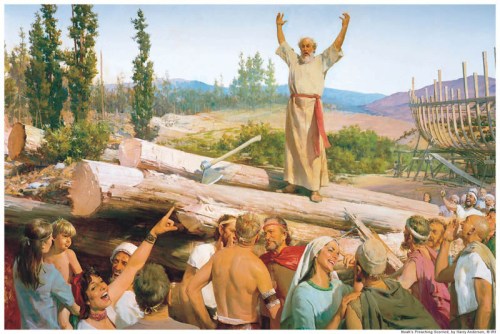
Seth’s line, however, remained pure to the end. “And the LORD said, I will destroy man whom I have created from the face of the earth; both man, and beast, and the creeping thing, and the fowls of the air; for it repenteth me that I have made them. But Noah found grace in the eyes of the LORD” (Genesis 6:7-8). God instructed Noah to build a massive barge, 450’ x 75’ x 45’,[2] large enough to carry all who would be saved. It took Noah less than 100 years to complete his task.[3] In that time, Noah did all that he could to warn the people of the coming Flood. Peter describes Noah as “a preacher of righteousness” (2 Peter 2:5) demonstrating God’s longsuffering in providing a warning to an ungodly world.

The Ark had sufficient space to save many besides Noah and his family. The “kinds”[4] of animals onboard probably took up less than half of the available space. At one time, I calculated that the Ark could have carried more than 2400 human passengers,[5] yet only eight were saved. I wonder whether God would have sent the Flood if 2400 had listened to Noah’s preaching and repented. It reminds me of Abraham interceding for Sodom and Gomorrah (Genesis 18:23-33). He pleaded for 50, then 45, then 40, 30, 20, and finally 10. God, “not willing that any should perish,” would spare the cities for ten righteous people. Alas, only Lot, his wife, and two daughters were the only ones saved, and even they were dragged out by the angels (Genesis 19:16).

The Old Testament is a history of God’s longsuffering. The book of Judges, in particular, ends with the sad refrain, “In those days there was no king in Israel: every man did that which was right in his own eyes” (Judges 21:25, emphasis mine). Two thousand years from Abraham, Messiah came as promised and His own rejected Him (John 1:11). Jesus died on a Roman cross to pay our sin debt. They buried Him in a borrowed tomb, and He rose again on the third day. Forty days later, He ascended to His throne in heaven of which He said, “In my Father’s house are many mansions: if it were not so, I would have told you. I go to prepare a place for you. And if I go and prepare a place for you, I will come again, and receive you unto myself; that where I am, there ye may be also” (John 14:2-3).

It has been more than 2000 years – six millennia since the Creation. God is longsuffering, not willing that any should perish, but the time of the Sabbath rest is drawing near. There is a limit to God’s longsuffering. The voices of the prophets sound from every corner of the world. God is not willing that any should perish. The old hymn says, “There’s room at the cross for you,” but just as only eight were saved in the Ark, and only four saved from Sodom and Gomorrah, only a few will be saved from the wrath that is coming. Jesus said, “Because strait is the gate, and narrow is the way, which leadeth unto life, and few there be that find it” (Matthew 7:14, emphasis mine). Don’t miss the boat. Jesus will come very soon. Don’t get left behind. If you have not given your life to Him, read my page on “Securing Eternal Life.”

Notes:


[1]  Genesis 4:1-16

[2]  Genesis 6:15 – 300 cubits x 50 cubits x 30 cubits. The dimensions are calculated based on an 18” cubit.

[3]  Noah’s sons were born when he was 500 years old (Genesis 5:32), and they entered the completed Ark when Noah was 600 years old (Genesis 7:11). We are not given Noah’s age at the time God gave him the task to build the Ark, but we can infer that it was after his sons were old enough to help.

[4]  The biblical “kinds” equates to taxonomical “families” in modern terms. The Ark did not carry every species of air-breathing land animals. It only carried the basic families from which all other variations would derive.

[5]  The Ark’s passenger capacity is based on 2/3 of the total available square footage (96,750 sq. ft.) of the Ark or 64,500 sq. ft.  Taking 25% of the remaining space for stores leaves 48,375 sq. ft. for passengers.  Allowing 80 sq. ft. per a family of four, or 20 sq. ft. per person (the average size of an 8×10 2-man prison cell), and dividing 48,375 by 80 yields about 605 living spaces.  At 4 people per space, that comes to 2420 total passengers.  More could have been accommodated if needed.

3 Comments

Filed under Apologetics, Christianity, Creation, End Times, Evangelism, Gospel, Salvation, Second Coming of Christ, Theology

O Beautiful!

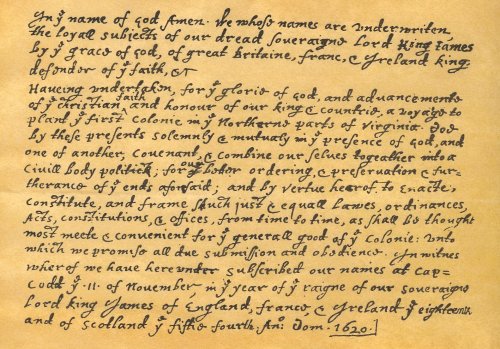
Mayflower Compact, Signed November 11, 1620

Blessed is the nation whose God is the LORD; and the people whom he hath chosen for his own inheritance. (Psalm 33:12)

President Obama insulted American Christians when he proclaimed to the world that America was not a Christian nation. He went on to announce that America was just as much of a Muslim, Hindu, Buddhist or any other religion of your choice nation. Christians rightly protested (without violence or destruction of public and private property) that America was indeed a Christian nation as enshrined in our founding documents.

Before setting foot on their “promised land” on November 11, 1620, the Pilgrims covenanted together “for the glory of God and the advancement of the Christian faith” to “combine” themselves “together into a civil body politic.” The Mayflower Compact later influenced the freedom pact declaring our nation’s independence on July 4, 1776, assuming “among the Powers of the Earth, the separate and equal Station to which the Laws of Nature and of Nature’s God entitle them.” The declaration went on to assert, “We hold these Truths to be self-evident, that all Men are created equal, and they are endowed by their Creator with certain unalienable Rights, that among these are Life, Liberty, and the Pursuit of Happiness.” After a long list of grievances, they made their appeal “to the Supreme Judge of the World” declaring their “firm Reliance on the Protection of divine Providence,” i.e., God.

The reliance on Divine Providence prompted the founders to include in the Bill of Rights of the US Constitution, the First Amendment protecting freedom of religion. “Congress shall make no law respecting an establishment of religion, or prohibiting the free exercise thereof.” The amendment also guaranteed freedom of speech, freedom of the press and “the right of the people to peaceably assemble, and to petition the Government for a redress of grievances.” This First Amendment (and the Second that secures it) is under assault on many fronts. A plain reading of the text makes it clear that the government cannot impose one religion over another. At the same time, the government cannot prohibit the free practice of a citizen’s religion. Conspicuously, no restrictions exist on the exercise of religious practice – no restriction for the free practice in public, public schools, public buildings, public events, or any other such restrictions. However, put up a Nativity Scene in the public square, or the Ten Commandments at the county courthouse or on the wall of a public school, or offer a prayer at the start of a high school sports activity, and the ACLU will be out in full force looking for someone to sue. On what grounds? The ACLU will argue that such religious activity violates the “separation of church and state,” a phrase found nowhere in the Constitution. With the aid of unscrupulous judges, the ACLU intimidates victims without the resources to fight the litigation so that they give up without a fight. Slowly, the ACLU has eroded away the concept of religious liberty.

Now, legislation in various states, California in particular, slowly chips away at what remains of the First Amendment by declaring that any denunciation of sodomites is “hate speech” and therefore illegal. That destroys free speech. It destroys freedom of the press, which might even make the Bible illegal because it has much to say about deviant sex acts. It could follow that the freedom to peaceably assemble in a church that teaches against sodomy will be declared illegal, and forget about petitioning the government over such a grievance. There goes the First Amendment. Without the Second Amendment, which is systematically being picked apart, how can the First Amendment be defended?

Barack Obama was right. Whatever America used to be, it is no longer a Christian nation. I hear many Christians express optimism that we can turn around this nation. Many hope for national revival (2 Chronicles 7:14 – taken way out of context). I must admit, I do not share that optimism. That ship has sailed. America is no longer a Christian nation, and it will never again be a Christian nation. Christians – genuine, born-again, Bible-believing, evangelical Christians – in America are rapidly becoming the “remnant.” We can voice our complaints until our tonsils bleed, and nothing will change, except perhaps for the worst.

I do not mean to be a Gloomy Gus, nor do I want to be a Pollyanna. I want to be realistic, and I want to be biblical. While the Bible teaches that we are to submit to our governing authorities (Romans 13:1-8) and that we should pray our leaders (1 Timothy 2:1-4), we must recognize that our primary citizenship is not of this world, but the kingdom of Jesus Christ. “For our [citizenship] is in heaven; from whence also we look for the Saviour, the Lord Jesus Christ” (Philippians 3:20). In His high priestly prayer, Jesus affirmed, “They are not of the world, even as I am not of the world” (John 17:16). While America is not “the beautiful,” innocent virgin she once was, we who have placed our trust in Christ, are children of the King, (John 1:12) and citizens of His realm. While we remain and while He delays His return, we must turn our focus and our efforts to His Kingdom. The things of this earth, including America the Beautiful, are passing away (1 John 2:17), but His Kingdom will last forever (Luke 1:33). “When ye shall see these things come to pass, know that it is nigh, even at the doors” (Mark 13:29).

O, Beautiful! I lament your demise, but I rejoice knowing that the Lord will soon return, and He will truly make America great again – better than ever! Not only America, but His reign on earth will make the whole earth better than before. Come quickly, Lord Jesus!

1 Comment

Filed under Apologetics, Christianity, Current Events, End Times, Holidays, Politics, Religion, Second Coming of Christ