Tag Archives: Religion

Near Death

DIGITAL CAMERA

“Beloved, now are we the sons of God, and it doth not yet appear what we shall be: but we know that, when he shall appear, we shall be like him; for we shall see him as he is.” (1 John 3:2)

There seems to be an increased interest in the paranormal these days: crop circles, UFOs, alien abductions, zombies, vampires, etc. Included in these are the reports of “near-death” experiences. This seems particularly to have piqued an interest among Christians due to the Christian predisposition to think about the afterlife, particularly heaven. A new “Christian” movie that has added fuel to this fire takes its title from a book by the same name: Heaven Is For Real by Todd Burpo. This is supposedly a factual account of a little boy who dies in a hospital operating room and goes to heaven and returns to report all kinds of amazing things about his experience there.

A Christian lady concerned about what to make of this phenomenon told me about a nurse friend who told her about near death experiences she has witnessed. “I feel very uncomfortable about this,” she said to me. “It does not seem Scriptural…doesn’t seem to match with what Jesus has taught about death. And so, I’m wondering if these sorts of things are considered ‘false prophets doing great wonders to seduce even the elect.’”

She continued, “Surely it is tempting to hear ‘proof’ that such beauty exists…even to believe that, yes, heaven exists, and Jesus is waiting with outstretched arms when we die. Surely some people might become believers upon hearing such tales…at least, folks that would believe ‘we go to a place of great beauty, bright light, where Jesus is’ when we die. It’s such a comforting picture. But is it Scriptural? Are we to believe in these things?”

I assured her that I share her skepticism about these near death experience reports. Obviously, we cannot judge what another person experiences because only they are privy to that information. The same goes for judging another person’s salvation – only God (and the individual) truly knows the condition of the heart. So, when someone reports a near death experience, we have to take them at their word, because only they and God know what they experienced.

But going back to our example of salvation, we can pretty well guess the state of a person’s salvation because of the kinds of “fruit” they bear. Granted, a person may be putting on a good front leading us to think they are saved – in fact, they may even be fooling themselves – but they are not truly saved. Or the opposite may be true. The person may truly be saved, but are presently living in a temporary “back-slidden” state. Again, only God knows for sure, but we can certainly judge their “acts” and know if those acts, or fruits, are genuine – at least outwardly.

Coming back around to our near death question, except for a very small number of cases, most of these experiences report the very same thing regardless of the spiritual condition of the individual. There have been a few reports of individuals experiencing hell, and they are very thankful that they were “brought back,” but this is the exception rather than the norm.

I viewed a video on the topic recently[1]. For some time now neurologists have been studying near death experiences and to date they have no explanation for this phenomenon. It seems that the only thing they have been able to confirm is that when a patient is clinically dead, all brain activity ceases. They have been unable to determine at what point the patient has the “out-of-body” experience. Is it just before they die or is it when they are revived? They do not know. Yet the patients all seem to report similar experiences: a feeling of warmth, peace, acceptance and unconditional love. So, if all of these “good” experiences are true, regardless of the spiritual state of the individual, that might lead one to conclude that everyone goes to heaven – except for really, really bad people. The question then is how does that line up with what the Bible says?

There are several accounts of resuscitations[2] in the Bible where people died and were brought back to life: the raising of the widow’s son (1 Kings 17:22); the raising of the Shunammite woman’s son (2 Kings 4:33-36); the man raised at Elisha’s tomb (2 Kings 13:21); the raising of Jairus’ daughter (Matthew 9:25); saints raised at the death of Christ (Matthew 27:52); raising of the widow’s son (Luke 7:15); the raising of Lazarus (John 11:43-44); raising of Tabitha by Peter (Acts 9:40-41); and the raising of Eutychus by Paul (Acts 20:9-12). With all of these examples, there exists no record about what the individuals experienced during their time of death. In every instance, the Bible is silent.

There is one instance where one died and then returned to tell about it. That was Paul in Acts 14:19-20. He later relates his experience in 2 Corinthians 12:2-7:

I knew a man in Christ above fourteen years ago, … such an one caught up to the third heaven. And I knew such a man … How that he was caught up into paradise, and heard unspeakable words, which it is not lawful for a man to utter. (vv. 2-4)

So, Paul experienced something, but he was not allowed to speak about it. This evidence from Scripture calls into question all the reports we are hearing today. Is it possible that there is a hidden agenda there? – one that says, “What you believe makes no difference. If you are a reasonably good person, you will go to heaven.” That is the devil’s oldest lie: “Yea, hath God said …? … Ye shall not surely die” (Genesis 1:3, 4).

Jesus spoke more about hell than He spoke of heaven. In Luke 16:19-31, He relays the account of a rich man who died and woke up in Hades and likewise, poor, sickly Lazarus died “and was carried by the angels into Abraham’s bosom” (v. 22). Here we are given a peek into the afterlife from which no one returns (generally speaking). Two very different places are depicted and two very different experiences are presented. Jesus related this “story” as an actual account. Considering His divine nature, He had firsthand knowledge of this event, which clearly shows us that not everyone goes to the same place or experiences the same thing. Something else worth noting in this account is that nowhere does Jesus describe the rich man as being a particularly (what we would consider) a “bad” person. From Jesus’ account, we gather that the rich man was self-absorbed, narcissistic, self-centered, selfish, and unconcerned with the plight of the poor beggar that sat at his gate, but it’s not as if he were a mass murderer, or anything like that. He may have been a good father, husband and provider. He was evidently concerned about his loved ones (vv. 27-28). Had we known him, we probably would not have considered him to be a bad person. Those who mourned him at his funeral probably thought he ascended to “Abraham’s bosom,” but that certainly was not the case.

So, the bottom line is that we cannot know with certainty what these people have experienced, but we are right to employ a healthy dose of skepticism. There is no biblical basis for these reports, and science offers no satisfactory explanations. The fact that most experiences reported are positive contradicts Jesus’ very words that “strait is the gate, and narrow is the way, which leadeth unto life, and few there be that find it” (Matthew 7:14). The truth is that most people will NOT have a good experience. If these experiences are genuine, we should expect more bad experiences than good, but that is not what is being reported.

Of greater importance to anyone reading these words is the assurance and security of a place prepared for you by the Savior. He says:

Let not your heart be troubled: ye believe in God, believe also in me. In my Father’s house are many mansions: if it were not so, I would have told you. I go to prepare a place for you. And if I go and prepare a place for you, I will come again, and receive you unto myself; that where I am, there ye may be also. (John 14:1-3)

God promises: “And ye shall seek me, and find me, when ye shall search for me with all your heart” (Jeremiah 29:13). Jesus adds to that: “I am the way, the truth, and the life: no man cometh unto the Father, but by me” (John 14:6). “Seek ye the LORD while he may be found, call ye upon him while he is near” (Isaiah 55:6).

NOTES:


[1] Documentary: “The Day I Died” http://topdocumentaryfilms.com/day-i-died/

[2] Note that resuscitation is not the same as resurrection. In the former case, the individual eventually dies again. In the latter case, the individual remains alive for ever. Jesus is the “first fruits” of the resurrection (1 Corinthians 15:20, 23). Because He lives, we can be assured of eternal life.


1 Comment

Filed under Apologetics, Christianity, Current Events, Death, End Times, Evangelism, Gospel, Heaven, Hell, Religion, Salvation, Science, Uncategorized

Time for Pride to Grow

“. . . when the morning stars sang together, and all the sons of God shouted for joy?” (Job 38:7)

A common question that arises from time to time is, “When did God make the angels?” A corollary question to that is “Was there enough time for pride to grow in Satan and for the war in Heaven to occur within the first few days?”

In the Job passage quoted above, God is telling Job that the angels were there at the time when He formed the earth. As to whether there was sufficient time for Satan’s pride to grow, we must ask, “How much time does it take for pride to grow?” In our own experience, does it take a long time to develop pride, or does it just seem to flare up unexpectedly? I would say the latter. Pride is one of the most basic sins. Human beings are naturally selfish and self-centered. Recall that very shortly after Creation, Satan was able to tempt Eve with “the pride of life” (1 John 2:16): “ye shall be as gods, knowing good and evil” (Genesis 3:5). It does not take a great amount of time for pride to grow.

The angels probably were created on the first day of the creation week. We cannot be dogmatic about this. The Bible does not specify when the angels were created, but the above passage in Job indicates that they were at least around to see the creation taking place. The angels, therefore, were created before man. Perhaps the reason for not focusing more attention on angels is that the Bible focuses mainly on the relationship between God and man. Angels play a part, but they are not central to God’s redemptive plan. But what does God say about man? “Let us make man in our image, after our likeness: and let them have dominion over the fish of the sea, and over the fowl of the air, and over the cattle, and over all the earth, and over every creeping thing that creepeth upon the earth” (Genesis 1:26, emphasis added). Did God say that about the angels? Did God give dominion over His creation to the angels? Can you see anything there that would give rise to pride and jealousy?

It would not have taken a long time for Satan’s pride to grow. Having been created first and then given lower status than man, Satan said, “I will ascend into heaven, I will exalt my throne above the stars of God: I will sit also upon the mount of the congregation, in the sides of the north: I will ascend above the heights of the clouds; I will be like the most High” (Isaiah 14:13-14, emphasis added). Satan hates man because God has bestowed upon man greater status than the angels. “What is man, that thou art mindful of him? and the son of man, that thou visitest him? For thou hast made him a little lower than the angels, and hast crowned him with glory and honour. Thou madest him to have dominion over the works of thy hands; thou hast put all things under his feet” (Psalm 8:4-6, emphasis added). The English phrase “a little lower than the angels” is not an accurate translation. “Angels” is the Hebrew ‘ĕlôhîym referring to God rather than the normal word for angels mal’âkîm. This is a messianic passage describing the condescension of Christ in taking human form, but this also has a secondary meaning as applied to man. Having been created in the image of his Maker, man holds a higher status than the angels, and this infuriates Satan.

This being the case, Satan most likely rebelled on Day Six of creation or very shortly thereafter. Seeing that man was God’s prized creation, Satan turned his ire toward destroying man. Knowing that man was created in the image of God, he employed that fact to cause man’s demise: “ye shall be as gods” (Genesis 3:5). If one analyses the source of any sin, it all goes back to pride – man wants to be his own god. This has been true from the beginning when Satan witnessed the creation of man, and since the fall of man in the Garden (Genesis 3). It really takes no time for pride to develop. It is nothing that requires any nurturing. On the contrary, it is something must actively be suppressed, and this cannot be done through human strength. It requires the supernatural power that only comes from God through the Holy Spirit. Jesus promised, “ye shall receive power, after that the Holy Ghost is come upon you” (Acts 1:8), and it is in that power alone that pride can be conquered.

1 Comment

Filed under Apologetics, Christianity, Creation, Evolution, Gospel, Origins, Theology

The Fallacy of Time and Chance

Image

In the beginning, God created … (Genesis 1:1)

If you had not eaten in over two weeks and you found a dollar, would you spend it on a burrito (a sure thing) or on a lottery ticket and a chance to win $10 million (not a sure thing)?  If all you have to do is pick five correct non-repeating numbers in no special order, your chance of picking all five correctly is 1 in 71.5 million.  If, on the other hand, the numbers must be in the correct sequence the odds decrease to 1 in 8.6 billion.[1]  With those kinds of odds, I am sure I would buy a burrito rather than a lottery ticket!

The odds for spontaneous generation of life from non-life are greater than that of winning the lottery.  “So even by the wildest ‘guesstimates,’ the universe isn’t old enough or big enough to reach odds like the 1 in 103,000,000 that Huxley, an evolutionist, estimated as the odds against the evolution of the horse.”[2]  With odds like these, one may as well consider evolution a veritable impossibility.

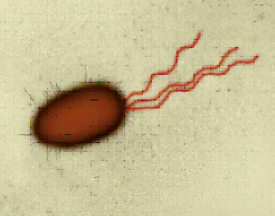
When one considers the irreducible complexity of the simplest single-cell bacteria, the evidence  should suffice to convince even the most recalcitrant skeptic, provided he has not abandoned all reason.  The motility of a bacterium is accomplished by a whip-like tail called a flagellum.   “The flagellum is constructed of 40 proteins, 10 of which are used in other structures in the cell, and 30 of which are unique to the flagellum.  The flagellum will not function unless all 40 proteins are put together the right way … If the flagellum is missing even one protein, it will not function.”[3]  I might also add that if only one protein is out of order, the flagellum will not function.

Image

Like creation, evolution cannot be proven scientifically or mathematically for that matter.  It takes an enormous amount of faith to believe “in the beginning hydrogen.”  Therefore, the only thing we can do is to consider the scientific evidence and see which origins model makes more sense or is more reasonable.

First of all, the universe and all that is in it “looks” designed.  Design demands a Designer.  Consider again the bacterium’s flagellum.


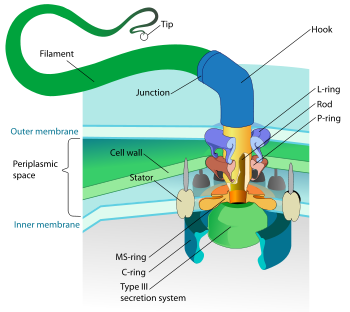
The flagellum has a motor that is about one-tenth of a micron in diameter, and a tail that turns at up to 100,000 rpm and acts as a propeller. The motor can reverse direction within a quarter turn. The electric motor of the flagellum is precisely analogous to our electric motors, but on a fantastically smaller scale, and it functions better than anything we can make.  One of the smallest man-made electric motors is 2 mm in diameter and was invented for use in boring plaque out of coronary arteries.  It involved the work of visionary cardiologists, as well as biomedical engineers.  These scientists, of course, stood on the shoulders of previous electricians, mathematicians, and engineers.

But the bacterial flagellum is 20,000 times smaller than this motor, works better, and turns faster!  The flagellum is fastened securely to the bacterial cell wall and has all the analogous parts of a man-made electric motor: It has a hook, or universal joint; a bushing; a rod (drive shaft); and an electrically-charged rotor and stator.[4]
Image

Intelligent scientists and engineers took years to design a tiny micro-motor that is clunky in comparison to the motor that drives the bacteria’s flagella, and yet we are amazed at the genius of the men that designed it.  But therein lays the answer:  men with intelligence designed it; it did not “evolve” on its own from an assortment of miscellaneous junk parts.  The same is true of the bacterial flagellum; it is of impeccable design, and only a fool will attribute its existence to the “blind watchmaker” of evolution.

From the smallest bacteria to the greatest galaxies, our universe displays incredible design and precision.  Evolution, on the other hand, wants to take credit for all that exists by claiming that 14 billion years ago some nondescript cosmic egg exploded, and that from all of the chaos of that primordial explosion, all that we now see “organized itself” into what we understand our universe to be.  It makes for a nice story, but it lacks substance.  Dr. Henry M. Morris offers five solid reasons why this “big bang” theory is a load of poppycock:

1.        The primordial explosion should have propelled all the matter/energy of the cosmos out radially from its center, and by the principle of conservation of angular momentum, none of it could ever thereafter have acquired any kind of curvilinear motion.  Yet there are all kinds of curving and orbiting motions of the stars and galaxies of the cosmos, a situation that seems quite impossible if the universe began with the big bang.
2.        Sensitive measurements in recent years have increasingly been showing that the background radiation is not homogeneous and isotropic (that is, the same in all directions), as it should be if it had been produced by the big bang, but is “anisotropic” in all directions.
3.        The universe is anything but uniform in large-scale structure, as both the big-bang and steady state theories require, but instead is full of huge agglomerations of matter in some regions and vast empty spaces in others, scattered around the cosmos in far from any uniform manner.  Some astronomers are now trying somehow to justify a primeval lumpy big bang!
4.        In the context of the primeval fireball, it is hard to justify the accumulation of any amount of matter in any one location such as a star.  If the explosion is driving all galaxies apart in the resulting expansion, how could it fail to drive all atoms apart before they came together in galaxies?
5.        The most serious objection comes back again in the second law of thermodynamics.  Explosions produce disorder, not order!  The primordial super explosion surely would have produced absolute chaos and the most utter disorder.  If the universe is indeed a closed system, as evolutionary cosmogonists allege, then how in the name of sense and science could this primeval chaotic disorder have possibly generated the beautifully organized and complexly ordered universe that we now have?  The big-bang idea, viewed in this light is as absurd as the steady state idea. [5]

“In the beginning hydrogen?”  Not hardly.  Order cannot come from disorder.  Life cannot come from non-life.  Evolutionists will attempt to deny, or otherwise skirt the issue, but the fact remains that even in the simplest form of life, all the creature’s parts must be present concurrently or the thing will not live, let alone survive.  Evolution from non-life would require that all the necessary proteins and amino acids come together instantaneously and in the proper configuration in order to produce life.  This has been attempted in the laboratory, and what was touted as a great success (the creation of a few amino acids) was in fact a miserable failure.[6] The resultant “building blocks” of life were the wrong blocks, and they did not fit together in any way to produce life.  Of course, that was conveniently left out of the headlines.

This fact alone should discredit the illusion of evolution, but the averse will adamantly cling to the myth claiming that all life originated from a single source billions of years ago.  Although it has been shown that spontaneous generation is next to impossible, let us assume an original source from which all life sprang.  Surely the fossil record would bear some evidence of transitional forms of one kind of life changing to another.  Without a doubt, several “proofs” have made the headlines only to be exposed as frauds, the lie to be revealed only in the most obscure sections of the printed media.  The fact is that the fossil record is remarkably silent on transitional forms.  Everything in the fossil record appears suddenly and fully formed, but bless their hard little hearts, the evolutionists continue their desperate search.

The Bible says that God created everything: space, time, matter/energy, earth, sky and sea, all plant life, sun, moon and stars, sea animals, land animals and at the top of His creation was man – created in the image of God.  All things were created in six 24-hour days, and at the end of each creation day, God declared His creation “good.”  Then on the final day of creation, He declared His creation “very good” – that is to say, “perfect.”  Declaring that each act of creation was good suggests that there was no need for improvement, i.e. “evolution.”  Plants were to bear seed “after its own kind.”  Animals were to reproduce “after their kind.”  This is what the fossil record bears out.

Neither creation nor evolution can be proven scientifically, but when compared side by side, creation, as recorded in the Bible, makes much more sense.  “In the beginning hydrogen?”  No!  In the beginning God!


[1] Calculation done on WebMath.Com: http://webmath.com/lottery.html

[2] From Answers in Genesis, “The Odds of Evolution,” http://aigbusted.blogspot.com/2007/11/odds-of-evolution_07.html

[3]  The Institute for Creation Research, The Creationist Worldview Program, Module 4, Course 2, Lesson 1, “Is Intelligent Design Unscientific?” Section : “Design: Purposeful Arrangement.”

[4] Ibid.

[5] Morris, Henry M., The Biblical Basis for Modern Science, (Green Forest, AZ, 2008), pp. 132-133.

[6] See article “Evolution Hopes You Don’t Know Chemistry: The Problem with Chirality” by Charles McCombs, Ph.D, http://www.icr.org/article/evolution-hopes-you-dont-know-chemistry-problem-wi/

Comments Off on The Fallacy of Time and Chance

Filed under Atheism, Christianity, Creation, Evolution, Religion