Tag Archives: Religion

Predestination of Purpose

[Christ] In whom also we have obtained an inheritance, being predestinated according to the purpose of him who worketh all things after the counsel of his own will: (Ephesians 1:11)

The debate of predestination or election vs. free will continues through the ages of Christendom without apparent resolution, except in the mind of the one who dogmatically holds one view or the other. I believe the answer is somewhere in the middle,[1] but for now I want to look at the idea of predestination.

I find that when the term predestined (or “predestinated” as rendered in the KJV) appears in the New Testament, it seems to be associated with the Christian’s “conversation” or manner of life. Our beginning verse is a good example: “[Christ] In whom also we have obtained an inheritance, being predestinated according to the purpose of him who worketh all things after the counsel of his own will” (Ephesians 1:11, emphasis mine). Note that the Christian has already obtained an inheritance, i.e., eternal life in accordance with the purpose of the One who works everything according to His will. What is that purpose? “That we should be to the praise of his glory, who first trusted in Christ” (Ephesians 1:12, emphasis mine).

Again, God has “predestinated us unto the adoption of children by Jesus Christ to himself, according to the good pleasure of his will” (Ephesians 1:5, emphasis mine). The “predestination” is that those who are saved will be adopted as “children” of God. “According as he hath chosen us in him before the foundation of the world, that we should be holy and without blame before him in love” (Ephesians 1:4, emphasis mine). God planned from the “foundation of the world” that His adopted children would be blameless before Him through Jesus. The predestination is the plan that God had from beginning for those who would be saved. God does not predestine some to hell and some to heaven. That would contradict the “whosoever will” found in John 3:16 et. al.

Salvation is by grace through faith, as Paul explains. “For by grace are ye saved through faith; and that not of yourselves: it is the gift of God: Not of works, lest any man should boast” (Ephesians 2:8-9, emphasis mine).  Even the faith that it takes to believe is a gift of God that He gives to everyone. We all have the ability to believe. Jesus said, “… If ye had faith as a grain of mustard seed, ye might say unto this sycamine tree, Be thou plucked up by the root, and be thou planted in the sea; and it should obey you” (Luke 17:6, emphasis mine). A mustard seed is a small thing, yet with that small amount, a mountain can move. Believing in Jesus can be a huge mountain for some people, but by exercising the little faith God gives by His grace, it can be moved.

When we exercise that faith, we are transformed – remade. “Therefore if any man be in Christ, he is a new creature: old things are passed away; behold, all things are become new” (2 Corinthians 5:17, emphasis mine). The new creation crafted by Christ becomes a tool for His purpose. “For we are his workmanship, created in Christ Jesus unto good works, which God hath before ordained that we should walk in them” (Ephesians 2:10, emphasis mine). Those good works for which we are created were preordained or predestined from the beginning.

Our post-salvation life is predestined, not our salvation. Our salvation is “foreknown” not predestined. “For whom he did foreknow, he also did predestinate to be conformed to the image of his Son, that he might be the firstborn among many brethren” (Romans 8:29, emphasis mine). We are predestined to be conformed, i.e., “molded.” into the image of Christ, but God foreknows those who will be saved; He does not predestine them for salvation nor damnation.

If you are not sure about your status before God, please visit my page on “Securing Eternal Life.”

Notes:


[1]  “Somewhere in the Middle: – https://erniecarrasco.com/2013/10/20/somewhere-in-the-middle/

3 Comments

Filed under Apologetics, Christianity, Creation, Evangelism, Gospel, Religion, Salvation, Theology

Stop the Nonsense!

And let us consider one another to provoke unto love and to good works: Not forsaking the assembling of ourselves together, as the manner of some is; but exhorting one another: and so much the more, as ye see the day approaching.  (Hebrews 10:24-25)

When Jesus asked His disciples who people said He was, Peter answered, “Thou art the Christ, the Son of the living God” (Matthew 16:16). Of Peter’s confession, Jesus answered, “Upon this rock I will build my church, and the gates of hell shall not prevail against it” (Matthew 16:18). The purpose of gates is to keep out invaders. Therefore, by implication, Jesus portrayed the Church charging the Gates of Hell.

However, that is not the image of the Church we see today. Instead, the Church is fragmented into its individual pieces all cowering in their private shelters fearful of a virus that infects a very low percentage of the population and kills even fewer. The “bread of life” is broken up into crumbs and scattered in hidden places. For now, the Gates of Hell are safe!

I have written on this topic before,[1] [2] so rehashing past articles serves little purpose. However, the Word bears repeating. “Then Peter and the other apostles answered and said, We ought to obey God rather than men” (Acts 5:29, emphasis mine). “And let us consider one another to provoke unto love and to good works: Not forsaking the assembling of ourselves together, as the manner of some is; but exhorting one another: and so much the more, as ye see the day approaching” (Hebrews 10:24-25).

Churches that have shut their doors, mine included, are operating in the “spirit of fear”[3] regardless of the “reasons” given for their capitulation to unlawful edicts and decrees. It is time for the pastors of these cowering churches to grow a backbone, stand up against these unlawful authorities, and reopen the doors of the churches, “For God hath not given us the spirit of fear; but of power, and of love, and of a sound mind” (2 Timothy 1:7, emphasis mine).

Watch and listen to this preacher, ex-Muslim, and fugitive from Iran. He says it better than I can. You may want to start viewing the YouTube video at minute 32:40.

https://www.youtube.com/watch?v=oDpVUCOmXjk

Notes:


[1]  “The Right to Assemble” – https://erniecarrasco.com/2020/06/14/the-right-to-assemble/

[2]  “Higher Powers” – https://erniecarrasco.com/2020/07/19/higher-powers/

[3]  “Living in Fear” – https://erniecarrasco.com/2020/06/28/living-in-fear/

5 Comments

Filed under Apologetics, Christianity, Current Events, End Times, Evangelism, Religion, Second Coming of Christ, Theology, Worship

Looking for Antichrist

Here is wisdom. Let him that hath understanding count the number of the beast: for it is the number of a man; and his number is Six hundred threescore and six. (Revelation 13:18)

For longer than I have studied end-times prophecy (and I by no way count myself as an expert), prophecy watchers have sought to determine the identity of the end-times Antichrist. Our starting verse above suggests that someone with “wisdom” can know the name of the “the beast,” the Antichrist, by calculating the “number of his name” – 666. By assigning numerical values to the letters of the alphabet, some in the past (perhaps even now) have used this “clue” to determine the name of the Antichrist. However, these overlook the fact that the Revelation was written in Koine Greek, and they apply this method to the English alphabet. Hence, several candidates have come and gone: Napoleon, Hitler, and several U.S. Presidents among others.

Personally, I believe that the identity of the Antichrist should be of no concern for Christians for reasons I will discuss later. When the Antichrist arrives on the scene, how will the world recognize him?

The Antichrist appears first in the Book of Daniel where the prophet characterizes him as a “little horn”[1] that rises out of a ten-nation confederacy. Without going into a lengthy explanation, a “horn” symbolizes a “kingdom” or a “king.” That the horn is “little” suggests perhaps a political leader having little authority at first, but then rises to power. Adolf Hitler is a good example of how this can happen. In my opinion, the “little horn” is alive and politically active right not, but because of his “little” position, he does not occupy the limelight. However, according to Daniel, he will arise and assume great power.

The Antichrist next appears in the Book of Daniel where the prophet characterizes him as a “prince.”[2] The Hebrew word translated “prince” is nâgı̂yd, which means “commander” (civil, military, or religious). “And he shall confirm the covenant with many for one week: and in the midst of the week he shall cause the sacrifice and the oblation to cease, and for the overspreading of abominations he shall make it desolate, even until the consummation, and that determined shall be poured upon the desolate” (Daniel 9:27, emphasis mine). The “one week” is a translation of the Hebrew “one seven;” in other words, a group of seven years. This is the final seven years of Daniel’s 70 “weeks” of years determined for Daniel’s people, the Jews[3] that we know as the Tribulation.

According to the prophet, the “prince” will “confirm the covenant” for seven years (one week). This suggests that a covenant (treaty or agreement) already exists that has not been ratified. He does not “make” the covenant, but he makes the covenant effective.

Unless you live under a rock, you should be aware of all the problems with Israel and its Arab neighbors. So persistent are the “wars and rumors of wars”[4] in Israel that the media does not even bother to report on it unless they can somehow vilify Israel. President Donald Trump with the help of his son-in-law, Jared Kushner, has devised the “deal of the century” to bring peace to the Middle East particularly as it involves Israel and the “Palestinians.” However, the plan finds strong resistance from the Palestinians and other Muslim nations.

Could this be the “covenant” that Antichrist will confirm? Who will rise to make the covenant effective? As noted above, the “little horn” will not be known until he comes to power and confirms the covenant with Israel for seven years. If you are around when that happens, you are in for a long, hard seven years, but even then there is hope.

Daniel foretells that Antichrist will break his covenant with Israel after 3½ years by desecrating the Temple. Right now, there is not a Temple in Jerusalem, but the Temple Faithful[5] have everything needed to rebuild the Temple. The original Ark of the Covenant is hidden for now, though they claim to know its location. In order for Antichrist to desecrate the Temple, a Temple must exist. Jesus said, “When ye therefore shall see the abomination of desolation [i.e. the Antichrist], spoken of by Daniel the prophet, stand in the holy place, (whoso readeth, let him understand:) Then let them which be in Judaea flee into the mountains” (Matthew 24:15-16). Perhaps rebuilding the Temple is part of Trump’s Deal of the Century!

The Apostle Paul refers to Antichrist as “that man of sin” and “the son of perdition.”[6] This is the one “Who opposeth and exalteth himself above all that is called God, or that is worshipped; so that he as God sitteth in the temple of God, shewing himself that he is God” (2 Thessalonians 2:4, emphasis mine). Antichrist is an atheist. He opposes everything pertaining to God and even exalts himself above God. Daniel also makes this point. “And the king [i.e. the “little horn”] shall do according to his will; and he shall exalt himself, and magnify himself above every god, and shall speak marvellous things against the God of gods, and shall prosper till the indignation be accomplished: for that that is determined shall be done” (Daniel 11:36, emphasis mine). Worse than being an atheist, Antichrist will actually worship Satan. “But in his estate shall he honour the [g]od of forces: and a god whom his fathers knew not shall he honour with gold, and silver, and with precious stones, and pleasant things” (Daniel 11:38). The “god of forces” is Satan, who controls the powers and principalities who are the demonic realm.

This “spirit of antichrist” prevails in our world today. Humans reject God, and in effect, make themselves gods. The Apostle John, author of the Book of Revelation makes this point: “Who is a liar but he that denieth that Jesus is the Christ? He is antichrist, that denieth the Father and the Son” (1 John 2:22). That applies to many today. “And every spirit that confesseth not that Jesus Christ is come in the flesh is not of God: and this is that spirit of antichrist, whereof ye have heard that it should come; and even now already is it in the world” (1 John 4:3, emphasis mine). “Little children, it is the last time: and as ye have heard that antichrist shall come, even now are there many antichrists; whereby we know that it is the last time” (1 John 2:18, emphasis mine). However, the Antichrist will top them all.

In the Book of Revelation, John describes the Antichrist as a “beast” rising “up out of the sea.”[7] Symbolically, the “sea” refers to the masses of humanity. He receives his power from “the dragon,”[8] i.e., Satan. Apparently, sometime in the first half of the Tribulation[9] he receives a deadly head wound from which he revives.[10] This “miracle” imitates Christ’s resurrection from the dead so that the people of the world “worshipped the dragon that gave power unto the beast: and they worshipped the beast” (Revelation 13:4). After this, he gains power for the remaining 3½ years of the Tribulation. This seems to be the time when he desecrates the Temple. Perhaps after “rising from the dead,” he convinces himself that he is god. “And he opened his mouth in blasphemy against God, to blaspheme his name, and his tabernacle, and them that dwell in heaven” (Revelation 13:6, emphasis mine). “Tabernacle” and “Temple” are synonymous. Further along in the chapter, a “second beast” is described. Prophecy students understand this beast to be the “false prophet” imitating the Holy Spirit. He erects an image of Antichrist and forces all people of the world to worship the image. Some think that the false prophet erects the image in the Temple, which is actually what desecrates the Temple. Note the counterfeit trinity: Satan in the place of God, the Beast in the place of Christ, and the False Prophet (the second beast) in the place of the Holy Spirit.

In brief, this is how Antichrist will be recognized. I do not believe that Christians will be around when Antichrist makes the scene. Paul assures us that the Rapture of the Church will take place before the Antichrist is revealed. He says, “Let no man deceive you by any means: for that day shall not come, except there come a falling away first, and that man of sin be revealed, the son of perdition; (2 Thessalonians 2:3, emphasis mine). That “falling away” is apostasia in the Greek, which refers to a defection or turning away from “the faith.” We see that happing all around us, as churches and denominations reject the teachings of the Bible and substitute entertainment for true worship. I wonder if churches closing out of fear of the Wuhan bug demonstrates a lack of faith for God’s protection and His admonition to “Not forsak[e] the assembling of ourselves together, as the manner of some is; but exhorting one another: and so much the more, as ye see the day approaching” (Hebrews 10:25, emphasis mine).

The “falling away” continues. Paul goes on to say that Antichrist will not show up until the “restrainer” is taken out of the way. “And now ye know what withholdeth that he [the Antichrist] might be revealed in his time” (2 Thessalonians 2:6, emphasis mine). “Withhold” is the Greek word katechō, which means to “hold down fast.” Paul admits that iniquity exists even now, but its full power is restrained until “he who now [katechō] will [restrain], until he be taken out of the way. And then shall that Wicked be revealed” (2 Thessalonians 2:7-8). That “Restrainer” is the Holy Spirit who resides within every true believer that makes up the Church, the Bride of Christ. When the Holy Spirit departs, the Church departs because Jesus promised, “I will not leave you comfortless: I will come to you” (John 14:18). He said, “And I will pray the Father, and he shall give you another Comforter [i.e., the Holy Spirit], that he may abide with you for ever” (John 14:16).

So, don’t waste a lot of time and effort trying to figure out who the Antichrist is. Rather, study the signs of the last days given in the Bible. Pay attention to what is going on in the world around you. Especially, look at what is going on in Israel. The time is very near. And if you are unsure of your position with God, Read my page on “Securing Eternal Life.”

Notes:


[1]  Daniel 7:8

[2]  Daniel 9:26

[3]  Daniel 9:24

[4]  Matthew 24:6

[5]  The Temple Faithful – http://templemountfaithful.org/

[6]  2 Thessalonians 2:3

[7]  Revelation 13:1

[8]  Revelation 13:2

[9]  The Tribulation is detailed in Revelation 6-19

[10]  Revelation 13:3

4 Comments

Filed under Apologetics, Atheism, Bible, Christianity, Current Events, End Times, Evangelism, Politics, Resurrection, Salvation, Satan, Second Coming of Christ, Theology, Worship

How Soon They Forget!

Beware that thou forget not the LORD thy God, in not keeping his commandments, and his judgments, and his statutes, which I command thee this day: (Deuteronomy 8:11)

Forgetfulness gets us in trouble many times, like when you forget some special someone’s birthday or anniversary. Forgetfulness can be annoying, like when you walk into a room and wonder why you entered. Someone once said that “The only thing faster than the speed of thought is the speed of forgetfulness. Good thing we have other people to help us remember.”[1] Some kinds of forgetfulness are worse than others. When you forget a special day, you can always make it up and get forgiveness. When you walk into a room and forget why you entered, you can always walk back out and remember when you get busy doing something else. However, forgetting God and the blessings He has bestowed on us, well, that just makes us ingrates, but worse, it raises up a barrier to our relationship with Him.

Reading through the biblical history of Israel, the characteristic that stands out above all others is forgetfulness, which often manifests in the spirit of ingratitude. When God led them out of Egypt, they soon forgot the hardship of their bondage and started complaining about the manna God provided for them in the desert. After God audibly spoke to them at Mount Sinai and gave them His Ten Commandments, they soon forgot the first one and built a golden calf to worship.

That pattern followed them throughout their history until God finally had enough and sent the Assyrians first to punish Israel (the northern kingdom) then, 100 years later, He sent the Babylonians to punish Judah. The northern kingdom, Israel, was deported to the region that we know today as northeastern Iraq,[2] and they assimilated with the Assyrian culture gaining the moniker of the “Ten Lost Tribes.” Nebuchadnezzar carried off the Jews[3] in three waves, 597 BC, 586 BC, and finally 581 BC, but the Judah Jews retained their identity throughout their captivity (as they have to this day).

The Babylonian captivity for the Jews lasted only 70 years as God had determined for them.[4] Daniel records the Persian conquest of Babylon in 539 BC[5] by Cyrus as predicted by Isaiah the prophet.[6] After conquering Babylon, Cyrus issued a decree[7] that allowed the Jews to return to Judah and rebuild Jerusalem and their Temple. It took the Jews about 23 years to rebuild the Temple razed by Nebuchadnezzar in 586 BC. “And this house was finished on the third day of the month Adar, which was in the sixth year of the reign of Darius the king” (Ezra 6:15).[8]

Fifty-six years (by my calculations) after the completion of the Temple, Ezra, priest and scribe,[9] left Babylon to assess the Temple situation. This was during the seventh year of Artaxerxes I’s (465-425 BC) reign; this would have been around 458 BC. In the interim, between the completion of the Temple and Ezra’s arrival in Jerusalem, the enemies of the Jerusalem Jews had been carrying on a letter-writing campaign with the Persian kings to stop the rebuilding of Jerusalem.[10] Therefore, all building (except for the Temple which was completed) had ceased.

At about this same time, (20th year of Artaxerxes I, 445 BC) Nehemiah heard about the battered condition of Jerusalem and how the city walls were broken down. This caused him great grief and from his position as the “king’s cupbearer,” he requested permission to go to Jerusalem to rebuild the walls. Ezra was already in Jerusalem. So Nehemiah took charge, and against much opposition, rebuilt the walls in just 52 days.[11]

I have a reason for providing all that detail. I began by reciting Israel’s forgetfulness and unfaithfulness to the LORD their God. Finally, after 70 years of captivity, God worked through pagan kings to allow them to return to their homeland. With the blessing of the Persian kings, beginning with Cyrus, God provided the way and the resources for them to rebuild their Temple and the walls of the city in record time. All of this was God’s doing, and God’s hand can be clearly seen over all of it. One would think that after all of that, they would remember their God.

They did, briefly. Once the walls were completed and Ezra had the priests and Levites all organized, they had a dedication for the Temple and the City walls. The scene recorded in Nehemiah 8 and 9 harkens back to a similar gathering when King Josiah read the Book of the Law that had been found in Solomon’s Temple.[12] On this occasion, Ezra stood on a “pulpit” and read Scripture from morning until noon. And the people stood and listened, and the Levites “taught the people” and they “read in the book of the law of God distinctly, and gave the sense, and caused them to understand the reading” (Nehemiah 8:8, emphasis mine). The clarity given to God’s word was necessary because the people had been speaking Aramaic in their captivity and probably lost a lot of their use and understanding of Hebrew – the language of the Scripture.

As a result, there was a great “revival” among the people. They discovered that it displeased God for them to intermarry with pagans, so all those who married pagan wives divorced them. They committed to follow God completely. So, for the twelve years that Nehemiah governed,[13] they were faithful to their commitment. However, Nehemiah had to return to his post at the side of Artaxerxes[14] and was there for “certain days.” In his brief absence, things (spiritually) fell into disarray once again. Eliashib, the priest, arranged an apartment inside the Temple for Tobia the Ammonite, the mortal enemy of Nehemiah, violating the Law of God.[15] Nehemiah observed many Jews violating the Sabbath and foreign merchants peddling their goods inside the city gates on the Sabbath. All these things from which they “repented” were taking place as normal. They also started marrying pagan wives again. How soon they forget!

It is no wonder that God stopped speaking to them after this for the next 400 years. Then Jesus came, and they failed to recognize Him because they forgot what Scripture foretold about Him. We should not be too critical, though. We have the complete canon of God’s Word, and we still forget.

I have stated before, when I read the history of Israel, I see a striking parallel with our nation, the U.S.A. We have forgotten God too, and if God stopped dealing with His “chosen people” what makes us think that we should get preferential treatment? I think we have gone too far in our forgetfulness.

There is hope for the U.S.A., for Israel, and for the whole world. Soon, and very soon, Jesus will return and set up His kingdom on Earth, and all things will be made right. Are you prepared to meet Him? See my page on “Securing Eternal Life.”

Notes:


[1]  Vera Nazarian, The Perpetual Calendar of Inspiration, (Norilana Books, http://www.norilana.com/, 2010).

[2]  2 Kings 17:6

[3]  Name derived from “Judah”

[4]  Jeremiah 25:11-12

[5]  Daniel 5:30

[6]  Isaiah 44:28; 45:1

[7]  Ezra 5:13

[8]  Darius reigned between 522-486 BC

[9]  Ezra 7:6

[10] Ezra 4:8-22 (is a “sample” letter that is out of sequence with the narrative)

[11] Nehemiah 6:15

[12]  “Too Good, Too Late” – https://erniecarrasco.com/2020/05/17/too-good-too-late/

[13]  Nehemiah 5:14-15

[14]  Nehemiah 13:6

[15]  Deuteronomy 23:3

1 Comment

Filed under Bible, Christianity, End Times, Religion, Second Coming of Christ, Theology

Too Good, Too Late

For I will not contend for ever, neither will I be always wroth: for the spirit should fail before me, and the souls which I have made. (Isaiah 57:16)

Of all of God’s attributes, one is that of patience or longsuffering. “The Lord is not slack concerning his promise, as some men count slackness; but is longsuffering to us-ward, not willing that any should perish, but that all should come to repentance” (2 Peter 3:9). God’s patience is infinite, as He is infinite. However, God sets a limit on His patience as our starting verse makes clear; He will not “contend” with us forever. The Hebrew word translated “contend” is rı̂yb and it means “to toss, that is, grapple; to wrangle, that is, hold a controversy; to debate.

The earliest example we find in the Bible appears in the account of the Global Flood.[1] For almost 1600 years following Creation, men grew progressively perverse even though God’s witnesses existed in abundance. Their original father, Adam, lived for more than half of that time.[2] The letter to the Hebrews records that “By faith Enoch was translated that he should not see death; and was not found, because God had translated him: for before his translation he had this testimony, that he pleased God” (Hebrews 11:5, emphasis mine). Jesus’ half-brother, Jude, noted, “And Enoch also, the seventh from Adam, prophesied of these, saying, Behold, the Lord cometh with ten thousands of his saints, To execute judgment upon all, and to convince all that are ungodly among them of all their ungodly deeds which they have ungodly committed, and of all their hard speeches which ungodly sinners have spoken against him” (Jude 1:14-15). Yet, with all these witnesses over the many years, the wickedness of humans only increased. “And GOD saw that the wickedness of man was great in the earth, and that every imagination of the thoughts of his heart was only evil continually. And it repented the LORD that he had made man on the earth, and it grieved him at his heart” (Genesis 6:5-6). God’s patience reached its limit, and He sent the Flood.

However, God’s plan for the redemption of man never deviated. God’s salvation would come through Abraham and through his “seed.”[3] Abraham’s seed went through his son, Isaac, and his grandson, Jacob/Israel. Israel, that is the descendants of Jacob, soon put God’s patience to the test shortly after He rescued them from Egyptian bondage.

Not long after their exit from Egypt, they fell into idolatry by worshipping the golden calf[4] even though God earlier gave them His Ten Commandments. Then, one generation after entering the Promised Land, they fell right back into their old idolatrous ways. God would punish them, they would repent, God forgave and they would do it over again. This remained true throughout their history.

After King Solomon died, his son, Rehoboam failed to keep the nation united and the northern ten tribes seceded and formed their own nation, Israel. The southern kingdom survived with two tribes, Benjamin and Judah and went by the name of the larger tribe, Judah.

Israel immediately fell into idolatry and all her kings “did that which was evil in the sight of the LORD.” God’s patience with Israel reached its limit after 200 years, and the Assyrians under the King Shalmaneser[5] invaded and expatriated the entire population of Israel and deported them to “Halah and in Harbor by the river of Gozan, and the cities of the Medes” (2 Kings 17:6), which is somewhere in present-day northeastern Iraq.

Judah fared somewhat better. Most of her kings “did that which was right in the sight of the LORD;” however, they tolerated idolatry in the land even though they themselves may not have practiced idolatry. It all began with Solomon who actually built temples to the gods of his many wives and even joined them in the practice while maintaining the worship of God. After Solomon, the kingdom of Judah survived for 333 years, about 100 years longer than Israel. Judah had many “good” kings, but the ones that were bad were very bad.

Manasseh probably ranked as the worst of Judah’s bad kings. Not only did he follow “after the abominations of the heathen” but “he reared up altars for Baal,” “worshipped the host of heaven, and served them,” “built altars in the house of the LORD … in the two courts of the house of the LORD,” “he made his son pass through the fire,” and “he set a graven image … that he had made in the house, of which the LORD said to David … I will put my name forever”[6] Manasseh “seduced [Judah] to do more evil than did the nations whom the LORD destroyed before the children of Israel” (2 Kings 21:9).

Judah encountered the limit of God’s patience with Manasseh. “Because Manasseh king of Judah hath done these abominations … Therefore thus saith the LORD God of Israel, Behold, I am bringing such evil upon Jerusalem and Judah, that whosoever heareth of it, both his ears shall tingle. … I will wipe Jerusalem as a man wipeth a dish, wiping it, and turning it upside down. And I will forsake the remnant of mine inheritance, and deliver them into the hand of their enemies; and they shall become a prey and a spoil to all their enemies; Because they have done that which was evil in my sight, and have provoked me to anger, since the day their fathers came forth out of Egypt, even unto this day” (2 Kings 21:11-15, emphasis mine).

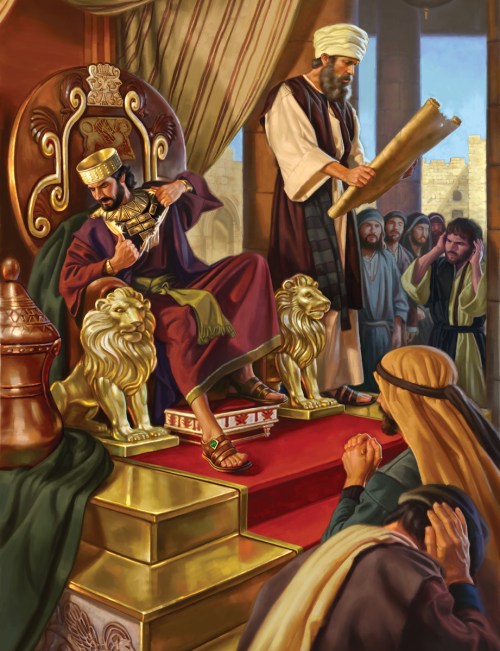
Manasseh’s son, Amon, followed in his father’s footsteps, but his reign lasted only two years. However, his grandson, Josiah, was arguably Judah’s best king ever. He was only eight years old when he took the throne, but he did what his predecessors failed to do. He destroyed all the places of idol worship throughout the land and executed the pagan priests. He renovated and rededicated Solomon’s Temple that had fallen into disrepair and had been desecrated by Manasseh, Ahaz[7], and others. In the process of cleaning up the Temple, Hilkiah, the high priest, discovered “the book of the law in the house of the LORD.”[8] “And it came to pass, when the king had heard the words of the book of the law, that he rent his clothes” (2 Kings 22:11). Of Josiah, Scripture records, “And like unto him was there no king before him, that turned to the LORD with all his heart, and with all his soul, and with all his might, according to all the law of Moses; neither after him arose there any like him” (2 Kings 23:25).

Judah made a great turn-around because of good King Josiah. It was almost too good, but it was too late. “Notwithstanding the LORD turned not from the fierceness of his great wrath, wherewith his anger was kindled against Judah, because of all the provocations that Manasseh had provoked him withal. And the LORD said, I will remove Judah also out of my sight, as I have removed Israel, and will cast off this city Jerusalem which I have chosen, and the house of which I said, My name shall be there” (2 Kings 23:26-27, emphasis mine). About eleven years later, Nebuchadnezzar came and subdued Judah and took her children off to Babylonian captivity. Josiah was too good, too late. God’s plan would not change.

When I read the history of Israel in the Bible I cannot help but draw a parallel between that nation and the United States of America. There are many comparisons that can be drawn. However, there is one major difference that we often overlook. Israel was chosen by God for a specific purpose that is yet to be fulfilled. The United States was not. As we see the “end of days” on the horizon, Israel is very much in the picture; the U.S. is not.

However, there are some similarities, especially in the spiritual sense. Both nations had a strong foundation on the Word of God, and both nations lost their moorings from that foundation. The founding of the U.S. started long before 1776 or the signing of the Constitution in 1787. It began with the arrival of the Pilgrims on Plymouth Rock in November 1620 “for the Glory of God, and Advancement of the Christian Faith.”[9] If the U.S. is chosen by God, it is chosen only because of His people who maintain and uphold the Christian Faith, but those numbers are diminishing. Israel was chosen by God with a non-conditional promise made to Abraham, and regardless of Israel’s lack of loyalty or devotion to God, God will not renege on His promise. The U.S. does not enjoy that kind of commitment from God. We are nothing special.

Truly God has blessed this nation because of His people that inhabit this land and because our nation has, for the most part, obeyed God’s word and maintained that “In God We Trust.” However, over the years, that loyalty to God has waned, and we have allowed pagan gods to influence and even to dominate our government and our society.

After World War II the moral state of our nation took a downward turn. We banned prayer and the Bible from public schools. Then we sanctioned abortions on demand. At first, abortions were limited to the first trimester, but now many states accept infanticide as “a woman’s right.” Homosexuality was once a shameful practice kept “in the closet,” but now every kind of sexual perversion is not only tolerated but encouraged.

The Obama Administration saw the morality of the nation cascade like going over Niagara Falls. The sins of the nation brought with it a sharp decline in the prosperity of the nation. Things looked grim. Then came Donald Trump. Perhaps not the perfect picture of a Christian, but he has done more to promote the Christian Faith than any president before him. He declared Jerusalem the rightful capital of Israel and moved our embassy there. He blessed Israel and God says, “I will bless them that bless thee, and curse him that curseth thee” (Genesis 12:3). President Trump has done more to turn this country around than any previous president.

Then the Wuhan Bug hit. Many economists believe that our country may never recover. This downturn in the economy affects the whole world, not just the U.S. Many of our leaders and leaders of other nations are calling for a one-world government to fix the mess in which we find ourselves. The Bible warned that such would be the end of days. So, for all the good President Trump has done, it may be too good, too late.

Christians everywhere claim 2 Chronicles 7:14 hoping for a turn-around. However, that verse was specifically for Israel. The U.S. is NOT Israel, and we, the Church, are not Israel. When God’s patience reached its limit and Nebuchadnezzar surrounded Jerusalem, Jeremiah prayed fervently for deliverance. God answered, “Then said the LORD unto me, Pray not for this people for their good. When they fast, I will not hear their cry; and when they offer burnt offering and an oblation, I will not accept them: but I will consume them by the sword, and by the famine, and by the pestilence” (Jeremiah 14:11-12, emphasis mine). If that was God’s attitude toward His “chosen people,” why should we expect better? Instead, “I the LORD have spoken it: it shall come to pass, and I will do it; I will not go back, neither will I spare, neither will I repent; according to thy ways, and according to thy doings, shall they judge thee, saith the Lord GOD” (Ezekiel 24:14).

Since the “lockdown” went into effect, I hear that many are “seeking the Lord.” Online Bibles are being downloaded and read. Churches are seeing a rise in “virtual” attendees. I have seen this before – Y2K, 9-11. As soon as the crisis subsides, things go back to “normal” and society continues on its moral decline. I doubt this will be any different. Don’t get me wrong. I rejoice that some are truly turning to the Lord, but Jesus’ Word will not fail. “Because strait is the gate, and narrow is the way, which leadeth unto life, and few there be that find it” (Matthew 7:14, emphasis mine). For all the good President Trump, like Josiah, has done, it may be too good, too late.

Reader, Jesus is coming very soon. Everything that is going on in the world today tells us that His coming is very near. Are you prepared to meet Him? If not, please read my page on “Securing Eternal Life” and settle it once and for all.

Notes:


[1]  Genesis 6-9

[2]  Genesis 5:5

[3]  Genesis 12:3; Galatians 3:16

[4]  Exodus 32

[5]  2 Kings 17:3

[6]  2 Kings 21:1-7

[7]  “Trading Old For New” – https://erniecarrasco.com/2020/05/10/trading-old-for-new/

[8]  2 Kings 22:8

[9]  Mayflower Compact, November 21, 1620

Comments Off on Too Good, Too Late

Filed under Apologetics, Bible, Christianity, Current Events, End Times, Evangelism, Politics, Pro-life, Religion, Second Coming of Christ, Theology, Worship