Tag Archives: The Church

A Thousand Years

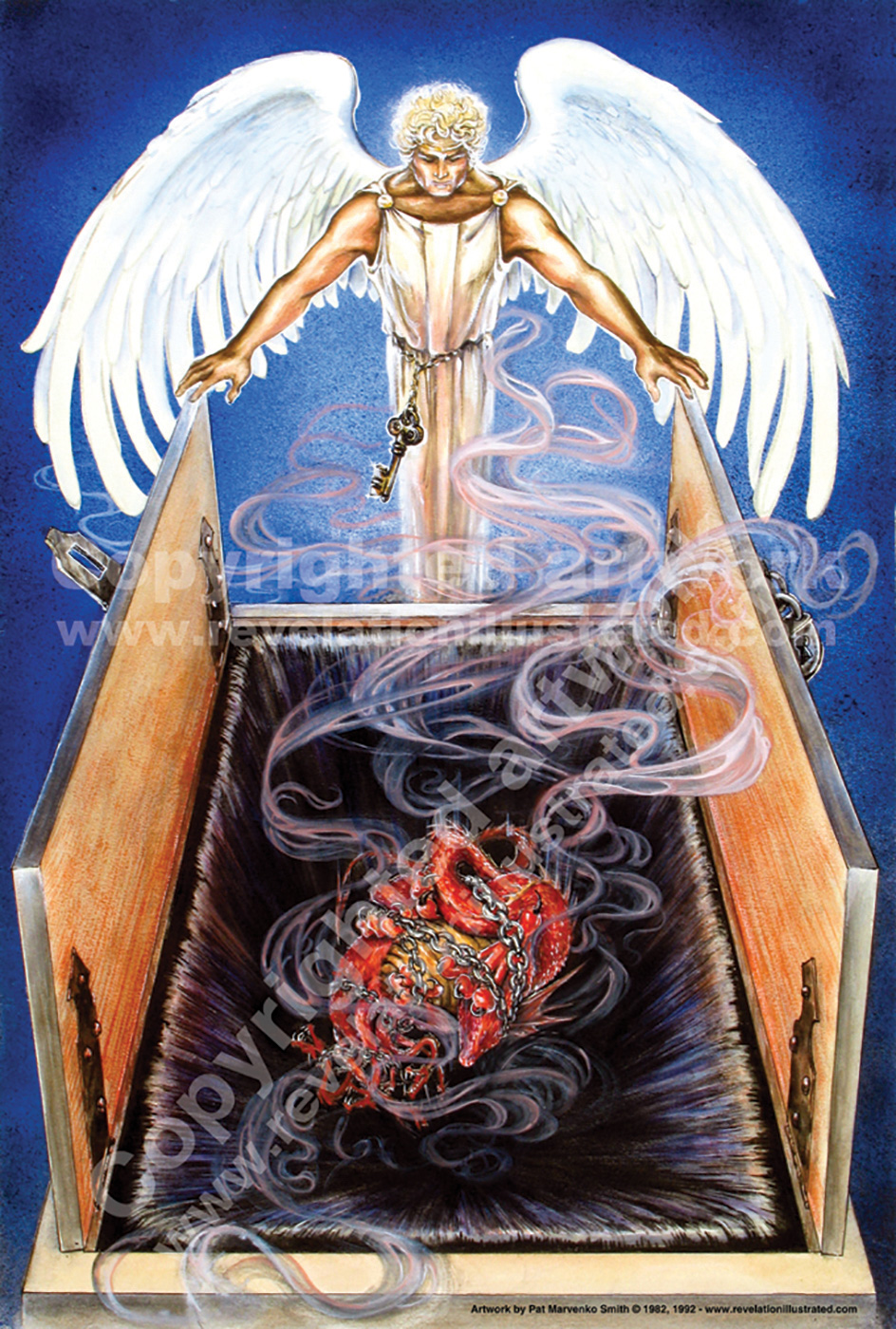
Art used by permission by Pat Marvenko Smith, Copyright 1992.
Click here to visit her “Revelation Illustrated” site.

And I saw an angel come down from heaven, having the key of the bottomless pit and a great chain in his hand. And he laid hold on the dragon, that old serpent, which is the Devil, and Satan, and bound him a thousand years, (Revelation 20:1-2)

When Jesus entered Jerusalem almost 2000 years ago on the back of a donkey’s colt, He presented Himself as melek shâlêm, “King of Peace.” Now, He comes on a white horse as the conquering KING OF KINGS and LORD OF LORDS.[1] In the previous chapter of Revelation, we learned that He comes to rule “with a rod of iron.” Unlike kings that have come before, His rule will be absolute but benevolent, and He will reign on Earth for a thousand years.

The question arises here about the thousand years. Are these literally 1000 years or should it be taken as symbolic of “a long time” or even eternity? Two main viewpoints exist. The premillennial view, in all of its variations, takes the position that the 1000 years should be taken literally. The amillennial view takes the position that the 1000 years should be taken symbolically and allegorically of the eternal reign of Christ.[2] In that view, the millennium symbolizes either the present church age or the eternal state. There are no 1000 years. The “a” prefixed to “millennium” negates the millennium, therefore, there is “no millennium.” Along with that view is the idea that the Church is responsible for preparing the world for Christ’s return. That idea should make one ask, “How well is the Church doing in that regard?”

Without wasting keystrokes, let me just say that the amillennial view is wrong. At the same time, I need to stress that those that hold that view are not lost. One’s eschatological view is not a salvation issue. Faith in CHRIST ALONE is the only requirement for entry into heaven. That said, the amillennial view is wrong for two very fundamental reasons. First of all, as we read Revelation 20:1-7, there is nothing in the text to indicate that the 1000 years should be taken in any other way than literally. Secondly, in the first seven verses of the twentieth chapter, the phrase “a thousand years” is repeated SIX TIMES. When the Bible says something once, it should be taken as fact simply based on the fact that it is God’s Word. When the Bible repeats something twice, it should get our attention. If it repeats something three times, we need to take it very seriously. Here, the Bible repeats “a thousand years” six times. To take it to mean anything other than what it says is poor hermeneutics and just foolishness.

“And I saw an angel come down from heaven, having the key of the bottomless pit and a great chain in his hand. And he laid hold on the dragon, that old serpent, which is the Devil, and Satan, and bound him a thousand years” (Revelation 20:1-2, emphasis mine). At the sounding of the fifth trumpet, we saw an angel (a star) “fall from heaven unto the earth: and to him was given the key of the bottomless pit” (Revelation 9:1, emphasis mine). In my opinion, that angel was a demon who did not have possession of the key to the bottomless pit, but rather that it was “given” to him. Here we have a different angel. This angel does not “fall” out of heaven, but he comes down from heaven. Also, he is not “given” the key to the bottomless pit, but he has possession of it. This angel is probably the one that handed the key over to the demonic angel back in Revelation 9:1. This angel is the keeper of the key. He takes a “great chain” and lays “hold on the dragon, that old serpent, which is the Devil, and Satan” and binds him for a thousand years. Without a doubt, Satan is a powerful creature, but God’s angel has no trouble subduing him. “And cast him into the bottomless pit, and shut him up, and set a seal upon him, that he should deceive the nations no more, till the thousand years should be fulfilled: and after that he must be loosed a little season” (Revelation 20:3, emphasis mine). This is the second time the “thousand years” is mentioned. How long will Satan be bound? – a thousand years!

“And I saw thrones, and they sat upon them, and judgment was given unto them: and I saw the souls of them that were beheaded for the witness of Jesus, and for the word of God, and which had not worshipped the beast, neither his image, neither had received his mark upon their foreheads, or in their hands; and they lived and reigned with Christ a thousand years” (Revelation 20:4, emphasis mine). John mentions two distinct groups here. Those seated on thrones represent the Church (the Bride of Christ) that was raptured before the Tribulation. Those that were “beheaded for the witness of Jesus … which had not worshipped the beast, etc.” are those who were martyred during the Tribulation. Together, they will be involved in the administration of Christ’s reign on Earth. How long will they reign with Christ? – a thousand years!

John does not detail the Millennium. What will the Millennium be like? For that, we need to check with other prophets. One of the reasons the Jews in Jesus’ day missed their promised Messiah was because they were looking for a reigning monarch as described by the prophets. They rejected the prophecies that foretold of His suffering, death on the cross, and His resurrection. However, the Old Testament prophecies are clear on that regard. Of Millennium, Clarence Larkin says, “It is to be regretted … that the world ‘Millennium’ ever supplanted the Biblical word ‘Kingdom,’ for it is this period that Christ taught His Disciples to pray for the petition ‘Thy Kingdom Come.’[3]

In his book, Larkin presents five distinct characteristics of the Millennium.[4] (1) Satan is bound.[5] One advantage people living in the Millennium will have over our “first parents” in the Garden of Eden, is that neither Satan, nor his demons, will be around to tempt people to sin. However, this will only serve to prove that mankind does not need a lot of help or encouragement to rebel against God.[6] With Satan out of the picture, there will be no one around to stir up hate and strife and the world will enjoy true peace; there will be no more wars and there is the promise that men “shall beat their swords into plowshares, and their spears into pruninghooks.”[7]

(2) The revival of Israel. When Larkin wrote his book, the nation of Israel did not exist. At the end of World War I in 1917, efforts were started to establish a “national home for the Jewish people.” The brainchild of British Foreign Secretary, Artur James Balfour, the “Balfour Declaration” set aside the original homeland of the Jews, called Palestine at that time. The fruit of that effort was not realized until May 14, 1948, when Israel was reborn in the Promised Land. Although Israel exists in the present, it is only a partial fulfillment of what was prophesied in the Old Testament. The complete fulfillment will not be realized until the Millennium, but the fact that Israel exists presently lets us know that the fulfillment in full is much closer than we might think. It is no longer the same land that Mark Twain visited in 1867. His impression was that it was a “rocky and bare, repulsive and dreary … landscape … There was hardly a tree or a shrub any where. Even the olive and the cactus, those fast friends of a worthless soil, had almost deserted the country.”[8] He should see it now![9]

(3) There will be changes in the animal kingdom. In God’s original creation, before the Fall, man and animals were herbivorous.[10] There will be complete harmony between mankind and animals and among all the animals.[11] We will not be killing off each other for food.

(4) Human life will be prolonged. We read in the genealogical record[12] before the flood that lifespans averaged over 900 years. In the Millennium, long lifespans will be the norm. The Prophet Isaiah records, “There shall be no more thence an infant of days, nor an old man that hath not filled his days: for the child shall die an hundred years old; but the sinner being an hundred years old shall be accursed” (Isaiah 65:20, emphasis mine). I must emphasize that those who do die are those who came through the Tribulation in their natural bodies. They will have the ability to reproduce and repopulate the earth. Those who do die, in my opinion, will be those who in some way or another violate the absolute law of Christ (i.e., “the sinner”) Who will “rule with a rod of iron.” Lawbreakers (“sinners”) will not be tolerated in the Millenium. Those who return with Christ at His Second Coming, the Raptured saints (the Bride of Christ), and the Tribulation saints, have their glorified bodies[13] that are not subject to disease or death.

(5) There will be a sevenfold increase of light. “Moreover the light of the moon shall be as the light of the sun, and the light of the sun shall be sevenfold, as the light of seven days, in the day that the LORD bindeth up the breach of his people, and healeth the stroke of their wound” (Isaiah 30:26). I am not sure whether this refers to the Millennium or to the New Heaven and New Earth, but Larkin seemed to think it referred to the Millennium. We will know soon.

“But the rest of the dead lived not again until the thousand years were finished. This is the first resurrection” (Revelation 20:5, emphasis mine). We saw the Beast and the False Prophet cast alive into the “lake of fire,”[14] but the armies that followed them “were slain with the sword of him that sat upon the horse, which sword proceeded out of his mouth: and all the fowls were filled with their flesh” (Revelation 19:21). These go to “the grave,” a.k.a., hell, a.k.a., hades, a.k.a., the abode of the dead, a.k.a., “Torments.” Jesus referred to this place when He recounted the death of the rich man and Lazarus.[15] These will be resurrected and face the Great White Throne Judgment[16] at the end of – how many years? – a thousand years.

“Blessed and holy is he that hath part in the first resurrection: on such the second death hath no power, but they shall be priests of God and of Christ, and shall reign with him a thousand years” (Revelation 20:6, emphasis mine). The first resurrection takes place at the Rapture.[17] Those caught up in the Rapture will have their bodies transformed into glorified eternal bodies that will never grow old or experience pain of any sort. “For our [citizenship] is in heaven; from whence also we look for the Saviour, the Lord Jesus Christ: Who shall change our vile body, that it may be fashioned like unto his glorious body, according to the working whereby he is able even to subdue all things unto himself” (Philippians 3:20-21, emphasis mine). I am certain the Tribulation saints will have glorified bodies also, but how they receive their new bodies we are not told. I suspect that they will receive them instantly when they die; however, I am not certain about that. The good news is that “the second death hath no power” over them. The “second death” is an eternity in “the lake of fire.”[18] Instead, they reign with Christ – for how long? – a thousand years!

“And when the thousand years are expired, Satan shall be loosed out of his prison” (Revelation 20:7, emphasis mine). After – how many years? – a thousand years of perfect peace on Earth, Satan is once again loosed on the earth. Why? We will see in my next article – if the Lord wills. Another argument against amillennialism is that the 1000 years has an expiration date; therefore, it cannot be eternal. These verses make it clear that the Lord Jesus Christ will reign as KINGS OF KINGS and LORD OF LORDS for a thousand years.

How about you, reader? Will you experience the thousand-year reign of Christ? If you do not know the Savior, do not wait any longer. The time is short. Please read my page on “Securing Eternal Life.”

Notes:


[1]  Revelation 19:15-16

[2]  What is Amillenialism? Beliefs & Chart (crosswalk.com)

[3]  Clarence Larkin, The Book of Revelation Illustrated, (Rev. Clarence Larkin Estate, Philadelphia, 1919), p. 180.

[4]  Ibid, pp. 188-191

[5]  Revelation 20:1-2

[6]  Revelation 20:7-10

[7]  Micah 4:3-4

[8]  https://blog.nli.org.il/en/mark-twain-in-palestine/

[9]  Psalm 67:6; Isaiah 35:1; 55:13; Joel2:24-26; Amos 9:13
[10]  Genesis 1:29-30

[11]  Isaiah 11:6-9

[12]  Genesis 5

[13]  1 Corinthians 15:51-54

[14]  Revelation 19:20

[15]  Luke 16:19-31

[16]  Revelation 20:11

[17]  1 Corinthians 15:51-54; 1 Thessalonians 4:13-17

[18]  Revelation 20:14

1 Comment

Filed under Apologetics, Bible, Christianity, Current Events, End Times, Eschatology, Rapture, Resurrection, Satan, Second Coming of Christ, Theology

Heavenly Wedding Reception

Let us be glad and rejoice, and give honour to him: for the marriage of the Lamb is come, and his wife hath made herself ready. (Revelation 19:7)

I have never been a bride, so I have no idea how a bride feels when the big day comes, and all her wedding plans come to fruition. She gets to take center stage at the wedding ceremony and later at her reception. It is a day for which she has prepared for months – picking the perfect bridal gown, selecting the perfect colors for her theme, selecting the floral arrangements, picking the perfect venue, choosing her wedding party, etc. It must be exhausting, yet exhilarating when the day finally comes.

Soon, I will experience the greatest wedding ever as part of the Bride that will join her Groom at a heavenly wedding. It will be a wedding unmatched by the grandest royal wedding ever seen on Earth. However, before the party starts, John sets up the scene.

“And after these things I heard a great voice of much people in heaven, saying, Alleluia; Salvation, and glory, and honour, and power, unto the Lord our God: For true and righteous are his judgments: for he hath judged the great whore, which did corrupt the earth with her fornication, and hath avenged the blood of his servants at her hand” (Revelation 19:1-2, emphasis mine). These “people in heaven” are Christians who died in Christ,[1] Christians who did not die but were raptured,[2] and those who missed the Rapture, but came to faith in Christ during the Tribulation and died for their faith.[3] These praise and worship God for His “true and righteous” judgments. All that God does is true and right. All the judgments of the Tribulation had a twofold purpose: (1) to give a final opportunity for people to repent and turn to Christ, and (2) to punish those who continue to reject God’s free offer of salvation. The psalmist put it succinctly when he said, “The LORD is righteous in all his ways, and holy in all his works” (Psalm 145:17). In His righteousness, He avenges the blood of His martyred saints. The Lord says, “To me belongeth vengeance, and recompence; their foot shall slide in due time: for the day of their calamity is at hand, and the things that shall come upon them make haste” (Deuteronomy 32:35). Of the time of Tribulation, Jesus said, “For these be the days of vengeance, that all things which are written may be fulfilled” (Luke 21:22).

“And again they said, Alleluia. And her smoke rose up for ever and ever” (Revelation 19:3). The whole heaven celebrates the demise of the “great whore.”[4] I believe this takes place in the immediate future of the Revelation timeline. At this point, Jesus is ready to return to Earth as King of kings and Lord of lords to destroy Babylon the Great for all eternity. So, the praise of these saints is given in the past tense as if the deed has already taken place.

“And the four and twenty elders and the four beasts fell down and worshipped God that sat on the throne, saying, Amen; Alleluia. And a voice came out of the throne, saying, Praise our God, all ye his servants, and ye that fear him, both small and great” (Revelation 19:4-5). We see the 24 elders[5] and the four beasts[6] once more. As discussed in a previous article,[7] the 24 elders are possibly the patriarchs of the 12 tribes of Israel plus the 12 Apostles, but at any rate, they represent the redeemed of all time. The four beasts represent God’s creation: the wild animal kingdom, domesticated animals, birds, and mankind. These give constant praise to God.

In the first five verses of this nineteenth chapter, we see the word “Alleluia” repeated three times, which seems appropriate for the triune Godhead reflecting His perfection. “Alleluia” is the Greek transliteration of the Hebrew word “hallelujah” which means “praise Yahweh” (the LORD). Interestingly, the word appears nowhere else in Scripture, neither in the OT nor the NT, except here in this chapter of Revelation.[8] There are many references to giving praises to God, however, that particular word is only used here. That makes its significance all the greater! The call to worship is directed to “all ye his servants, and ye that fear him, both small and great.” “Ye” is a plural, second-person pronoun. “All” is all-inclusive. In Texas, we would say, “all y’all” to include everyone and exclude no one. All “His servants” includes all the saints, and all the host of angels of all kinds and stations; all “that fear Him, both small and great.” Imagine the thunderous praise given to the Almighty Creator of Heaven and Earth!

“And I heard as it were the voice of a great multitude, and as the voice of many waters, and as the voice of mighty thunderings, saying, Alleluia: for the Lord God omnipotent reigneth” (Revelation 19:6). Praise the Lord! Alleluia! The Lord – the master, owner, and possessor of Heaven and Earth, the great potentate and sovereign – God – the One and Only true, triune God – omnipotent – almighty, all-powerful – reigns – He has absolute authority and rule over His creation, the universe, and all it contains.

Here comes the Bride! However, before proceeding, I want to share some things about a Jewish wedding, particularly a Galilean wedding, since most of Jesus’ ministry focused in the Galilean region, and all of His disciples were Galileans. Hence, they could relate to His illustrations, where those illustrations make little sense to us who are so far removed. Some of this I learned from a documentary DVD entitled Before the Wrath.[9] During His earthly ministry, Jesus made many references to weddings and marriage. Indeed, His first miracle was to turn water into wine at a wedding in Cana.[10]

In the Galilean custom, there was a betrothal before the marriage. We recall that Jesus’ mother, Mary, was “betrothed” to Joseph. We read in Matthew’s Gospel, “Now the birth of Jesus Christ was on this wise: When as his mother Mary was [betrothed] to Joseph, before they came together, she was found with child of the Holy Ghost. Then Joseph her husband, being a just man, and not willing to make her a publick example, was minded to put her away privily” (Matthew 1:18-19, emphasis mine). The betrothal was a written contractual agreement that was legally binding. Even though the couple lived apart during the betrothal period, they were considered to be married. Mary, coming up pregnant (and not by Joseph) created a serious breach of contract. Mary could be charged with adultery, and, at Joseph’s discretion, could be put to death by stoning.

To affect the betrothal, the prospective groom came to the bride’s father, in the presence of the town’s people as witnesses, and presented the written proposal/marriage contract that both the groom and bride signed. The groom presented a gift, something like a dowry, to the father of the bride. This was not a purchase price for the bride but rather “insurance” in case something happened to the groom before the marriage took place. In such a case, the bride would be taken care of.

Next, the groom offered the bride a cup of wine called the “cup of joy.” At any point in this process, the bride was free to accept or reject the proposal. If she agreed to the proposal, she would drink from the cup. The groom would then take and drink from the cup as well. Then he would say, “I will not drink of this cup again until I drink it anew with you in my father’s house.”

The groom would then return to his father’s house to build a bridal chamber as an addition to his father’s house for his bride. The process took about a year, and it was up to the groom’s father to determine when the room was ready. Ultimately, the father controlled when the wedding would take place. The bride, in the meantime, had her own preparations to make for the wedding. Not only did she have to make her wedding gown, but she needed to start collecting the things she would need to set up housekeeping.

Once the groom completed the bridal chamber and with the father’s approval and at the father’s direction, he would go get his bride. This usually occurred in the middle of the night when the whole town was sleeping. The groom sounded a ram’s horn that alerted the town that he was going for his bride. The whole town joined the parade. The bride had been ready long before this day arrived. She slept in her bridal gown. She kept her lamp full of oil and even kept some extra. Neither she nor the groom knew the day or the hour when this event would take place, but she was ready.

The groomsmen prepared a litter for the bride to sit in as they lifted her off the ground and carried her to the place the groom had prepared for her. This was known as “flying the bride” to the groom’s house. Once at the house, all those that could fit entered the house to celebrate, and they celebrated for seven days (one week). When the house was full, the doors were closed and no one else could enter.

With this understanding, we can clearly see what Jesus taught about His second coming, particularly as it relates to His Bride, the Church. At the Last Supper, Jesus presented His contract to His Bride. “And as they were eating, Jesus took bread, and blessed it, and brake it, and gave it to the disciples, and said, Take, eat; this is my body. And he took the cup, and gave thanks, and gave it to them, saying, Drink ye all of it; For this is my blood of the new testament, which is shed for many for the remission of sins. (Matthew 26:26-28, emphasis mine). The “contract” was signed with His body and blood. He called it “the new testament” or “covenant” or “contract.” The Bride was His disciples and those that would succeed them in faith. They all took the cup and drank of it in acceptance of the covenant. The betrothal was in effect. Jesus then said, “But I say unto you, I will not drink henceforth of this fruit of the vine, until that day when I drink it new with you in my Father’s kingdom” (Matthew 26:29).

Before adjourning from their Passover meal, Jesus prepared His Bride for what would come. “Let not your heart be troubled: ye believe in God, believe also in me. In my Father’s house are many mansions: if it were not so, I would have told you. I go to prepare a place for you. And if I go and prepare a place for you, I will come again, and receive you unto myself; that where I am, there ye may be also” (John 14:1-3, emphasis mine). This is the Groom’s promise that He is going to prepare a place for His Bride, and when the Father gives His approval, the Groom will sound the trumpet and descend to get His Bride, the Church, so that she can spend eternity with Him.

Now, while the Groom is away, the Bride must busy herself in preparation for the marriage. Jesus told a parable[11] about “a certain nobleman” (Himself) going away on a journey to receive a kingdom. Before leaving, He gave His stewards, ten of them, each equal amounts of money to invest in His kingdom. With that, He charged them saying, “Occupy till I come” (Luke 19:13). That is what the Bride is to do while the Groom is away preparing a place for her. There was also the matter of the “gifts” the Groom gives His Bride as “insurance.” That comes in the form of the Holy Spirit,[12] who Paul calls the “seal”[13] or guarantee of the promise.

In the meantime, the Bride awaits the shout, “Behold, the bridegroom cometh; go ye out to meet him” (Matthew 25:6). However, the Bride cannot join her Groom in ordinary clothes, she must be changed. The Apostle Paul provides insight into this transformation. “Behold, I shew you a mystery; We shall not all sleep, but we shall all be changed, In a moment, in the twinkling of an eye, at the last trump: for the trumpet shall sound, and the dead shall be raised incorruptible, and we shall be changed. For this corruptible must put on incorruption, and this mortal must put on immortality. (1 Corinthians 15:51-53, emphasis mine). In another place he says, “For this we say unto you by the word of the Lord, that we which are alive and remain unto the coming of the Lord shall not [go before] them which are asleep. For the Lord himself shall descend from heaven with a shout, with the voice of the archangel, and with the trump of God: and the dead in Christ shall rise first: Then we which are alive and remain shall be caught up together with them in the clouds, to meet the Lord in the air: and so shall we ever be with the Lord” (1 Thessalonians 4:15-17, emphasis mine). Just as the Galilean bride was “flown” to the groom’s house, so will the Bride of Christ be flown to His house.

When that happens, the marriage will take place. “Let us be glad and rejoice, and give honour to him: for the marriage of the Lamb is come, and his wife hath made herself ready” (Revelation 19:7, emphasis mine). John records “the marriage of the Lamb” just prior to Jesus’ return to Earth as King of kings and Lord of lords, but that would seem to make the marriage a rushed affair. Thinking back on the Galilean wedding; the festivities went on for seven days. That would parallel Daniel’s final week[14] – seven years. In the Galilean wedding, the festivities started when the bride entered the groom’s house. For the Church, that begins when the trumpet sounds and Jesus calls “Come up hither” (Revelation 4:1). Then during those seven years, as Bride will be examined, not for punishment, but for rewards. “Wherefore we labour, that, whether present or absent, we may be accepted of him. For we must all appear before the judgment seat of Christ; that every one may receive the things done in his body, according to that he hath done, whether it be good or bad” (2 Corinthians 5:9-10, emphasis mine). “Every man’s work shall be made manifest: for the day shall declare it, because it shall be revealed by fire; and the fire shall try every man’s work of what sort it is. If any man’s work abide which he hath built thereupon, he shall receive a reward. If any man’s work shall be burned, he shall suffer loss: but he himself shall be saved; yet so as by fire” (1 Corinthians 3:13-15, emphasis mine). All this will take place in Heaven during the seven years of Tribulation on Earth.

Therefore, I see John’s report as the culmination of the wedding feast as the Bride prepares to follow her Bridegroom as He receives His kingdom. “And to her was granted that she should be arrayed in fine linen, clean and white: for the fine linen is the righteousness of saints” (Revelation 19:8). Above we considered the “judgment seat of Christ” where our “works” will be evaluated and rewards will be allocated based on how those works survive a “trial by fire.” All who stand before the judgment seat of Christ are saved by the blood of Christ, and nothing can annul that. However, our works here on earth will determine the rewards with which we will be clothed. Will our wedding gown be a nice, plain, unremarkable, white gown or will it be really fancy and decked out with elaborate lace and sparkling jewels? Either way, it is the “whiteness” that really matters.

“And he saith unto me, Write, Blessed are they which are called unto the marriage supper of the Lamb. And he saith unto me, These are the true sayings of God. And I fell at his feet to worship him. And he said unto me, See thou do it not: I am thy fellowservant, and of thy brethren that have the testimony of Jesus: worship God: for the testimony of Jesus is the spirit of prophecy” (Revelation 19:9-10, emphasis mine). “He” is probably the same angel that spoke to John in Revelation 17:1.[15] He makes what is probably one of the greatest understatements thus far: “Blessed are they which are called unto the marriage supper of the Lamb.” Blessed indeed! God has blessed me all my natural life far beyond what I deserve. I cannot begin to imagine the blessing of being in the presence of God, and “These are the true sayings of God.” John is so overwhelmed by what he has witnessed that he falls down to worship the angel. The angel quickly prohibits John from worshiping him. In the OT we often find “the angel of the Lord” accepting worship, which no ordinary angel would ever dare to do. This is how we recognize “the angel of the Lord” as a pre-incarnate manifestation of Jesus. He is God and worthy of worship. Here we are given a solid reason for studying prophecy: “the testimony of Jesus is the spirit of prophecy.” God promises that before He does anything, He will reveal it to His prophets. “Remember the former things of old: for I am God, and there is none else; I am God, and there is none like me, Declaring the end from the beginning, and from ancient times the things that are not yet done, saying, My counsel shall stand, and I will do all my pleasure” (Isaiah 46:9-10). Amen!

How about you, reader? Will you be seated at the marriage supper of the Lamb? If you do not know the Savior, do not wait any longer. The time is short. Please read my page on “Securing Eternal Life.”

Notes:


[1]  1 Thessalonians 4:16

[2]  1 Thessalonians 4:17

[3]  Revelation 6:9; 7:9, 14; 14:1-5

[4]  Revelation 18:1-2

[5]  Revelation 4:4, 10; 5:6, 8, 11,14; 7:11, 13; 11:16; 14:3

[6]  Revelation 4:6, 8; 5:6, 8, 14; 6:1, 6; 7:11; 14:3

[7]  The First Sight | Ernie’s Musings (erniecarrasco.com)

[8]  Revelation 19:1, 3, 4, 6

[9]  Before the Wrath (Official Film)

[10]  John 2:1-11

[11]  Luke 19:11-27

[12]  John 14-16

[13]  2 Corinthians 1:22; Ephesians 1:13; 4:30

[14]  Daniel 9:27

[15]  Beast-Riding Harlot | Ernie’s Musings (erniecarrasco.com)

Comments Off on Heavenly Wedding Reception

Filed under Apologetics, Bible, Christianity, End Times, Eschatology, Heaven, Rapture, Second Coming of Christ, Theology

Parts Is Not Parts

For the body is not one member, but many. (1 Corinthians 12:14)

Back in the ’80s, the Wendy’s ® fast-food chain offered the anti-slogan, “Parts is parts” for their chicken sandwich. The slogan sent the message that all other chicken vendors used chicken parts indiscriminately in their processed chicken sandwiches, while Wendy’s ® only used the very best parts. One commercial had the customer questioning the content of the chicken and the attendant explaining that they used different parts of the chicken, and after all, “parts is parts.”[1]

Obviously, the parts do matter when ordering a chicken sandwich. One expects to get a tender chicken breast fillet in one’s chicken sandwich, and not an amalgamation of assorted chicken parts like the liver, gizzard, heart, skin, eyes, combs, intestines, etc. “Parts is parts,” but not all parts are suitable for consumption – at least, not in our minds.

Paul offered a similar idea in his first epistle to the Corinthians.[2] He compared the Church to our physical bodies. Our bodies are made up of large body parts that are readily observable – head, eyes, ears, nose, mouth, neck, shoulders, arms, hands, fingers, legs, feet, toes, etc. We also have literally trillions of microscopic parts beneath the skin that play major roles in keeping us alive – our cardio-vascular system, respiratory system, digestive system, endocrine system, neurological system, skeletal system, etc. All of these parts serve their own functions and are vital to our lives, even those that are not seen. Paul points out the obvious. We cannot exist as a hand alone, or a foot alone, or an eye alone, or an ear alone. We need all of our parts functioning harmoniously in union performing their individual roles as part of the whole body.

Apparently, from the tone of Paul’s letter, the Corinthians were having trouble in this department (and others as well). The Church functions as one body comprised of many members (parts). He sums this idea up like this, “Now ye are the body of Christ, and members in particular” (1 Corinthians 12:27). Each member of the body is “particular.” “Particular” translates the Greek word, meros, which means “one of the constituent parts of a whole.”[3]

Like the human body, the “Body of Christ,” the Church, has many members and each member serves a unique purpose in the body. We cannot all be preachers. We cannot all teach, or sing, or play musical instruments, but we all have a purpose. There are needed tasks in the church that seem “menial,” but serve a great need in the church – caring for children in the nursery, keeping the morning coffee going before services, greeting people as they come in the door, or just smiling and saying “Hi” to one another. Every member is important to the Body of Christ, and there is not one function that is more or less important than another. “Parts is NOT parts” The parts are all one in Christ, but we all serve our own unique, God-given purpose.

Reader, Jesus is coming soon. Are you prepared to meet Him? If you are not a member of His body, you will miss Him when He comes. Don’t do that! Please read my page on “Securing Eternal Life.”

Notes:


[1]  https://www.youtube.com/watch?v=y_oem9BqUTI

[2]  1 Corinthians 12

[3]  Definition from Thayer’s Greek Definitions, (Published in 1886, 1889; public domain).

Comments Off on Parts Is Not Parts

Filed under Apologetics, Bible, Christianity, Religion, Theology