Tag Archives: theology

Christmas Excitement

Behold, the former things are come to pass, and new things do I declare: before they spring forth I tell you of them. (Isaiah 42:9)

It’s that time of year once more. The places I work and worship sparkle with bright red, green, and gold decorations consistent with the colors of the Christmas season. Long before Thanksgiving Day, merchants displayed all their Christmas wares enticing shoppers to covet without first giving thanks. Television commercials attempt to instill a sense of privation so the viewer feels the need for what they are selling.

GMC™ produces two commercials that really stand out to me. They show a young couple, probably in their late twenties or early thirties, with no children, and a big fancy house. In one of the commercials, the husband buys GMC ™ vehicles for both of them. In the other, the husband gets the wife a puppy, and the wife gets him a big crew-cab pickup. Seriously, how many young people, on the average, have that kind of cash? Most young people that age, if they graduated from a college or university, are saddled with enormous school debt and are doing well to afford payments on a Honda Civic™ much less a $60,000 fully decked out pickup truck!

Regardless of how we feel about the materialism associated with the Christmas season, we cannot get away from the sense of expectation. At church, our choir and orchestra are working hard a polishing up the music for our Christmas concert. It will be wonderful, and we are excited about presenting it. Our church looks forward to our Christmas Eve services and our sharing of the Lord’s Supper, aka communion.

We celebrate the birth of our Savior. Think about what that means. The same God that created heaven and earth and all things, the same God that created human beings in His very image, is the same God that implanted Himself in the womb of a virgin girl to be born like any other human baby, live a sinless life among His creation, and give Himself as a sacrifice for humanity’s sin. That is awesome! That boggles the mind!

We anticipate with excitement the celebration of Christmas, the First Advent, but our celebration should look forward to the Second Advent yet to come. The prophets of old foretold of Jesus’ first coming. Beginning in Genesis, the Bible promises that the “seed of the woman” would crush the head of the serpent, i.e., Satan.[1] Isaiah tells us that the woman would be a virgin.[2] In Genesis, we also learn that He would come from the line of Abraham, Isaac, Jacob, and Judah.[3] Isaiah foretold that Jesus would be in the line of King David[4] and the psalmist concurred.[5] The conniving Balaam unwittingly predicted that a star would announce His coming.[6] Micah pointed to Bethlehem as the place of His birth,[7] and Hosea said He would come up from Egypt.[8] These are just some of the prophecies of His First Advent. Many more prophecies foretold of His life, ministry, death, burial, and resurrection – all with 100% accuracy.

Christmastime should cause excitement as we anticipate His Second Advent. There are more prophecies concerning His second coming than there are for His first coming. Since all prophecies of His first coming came true as predicted, should we not expect the same accuracy of the prophecies predicting His second coming? Celebrating Christmas should excite us knowing that the Baby Jesus is the soon-coming King of Kings and Lord of Lords.

One of the carols we sing at Christmastime is not really a Christmas carol. In fact, “Joy to the World”[9] reminds us that Christ will return to rule the world as king.

Joy to the world the Savior reigns; let men their songs employ; while fields and floods, rocks, hills, and plains repeat their sounding joy.

No more let sins and sorrows grow, nor thorns infest the ground; He comes to make His blessings flow far as the curse is found.

He rules the world with truth and grace, and makes the nations prove the glories of His righteousness, and wonders of His love.

We know historically that did not happen at His first coming. We might spiritualize those sentiments. Certainly, the Savior reigns within the hearts of all believers, albeit not perfectly. Sin and sorrow continue as always and “the curse” goes on unabated. He does not rule the world, and “the nations” care nothing about His glories or righteousness. All of these are attributes of His yet-to-come millennial reign.[10] The prophet Isaiah provides some insight into Jesus’ millennial reign on earth. That will be a time when even the animal kingdom will be at peace.[11] Knowing what is coming should make Christmas even more exciting than all the GMC™ pickups the world can afford!

Notes:


[1]  Genesis 3:15

[2]  Isaiah 7:14

[3]  Genesis 12:3; 26:4; 28:14; 49:10-11

[4]  Isaiah 11:1

[5]  Psalm 132:11

[6]  Numbers 24:17

[7]  Micah 5:2

[8]  Hosea 11:1

[9]  Carol by Isaac Watts, 1718

[10]  Revelation 20:1-7

[11]  Isaiah 11

Comments Off on Christmas Excitement

Filed under Apologetics, Christianity, Christmas, Gospel, Holidays, Salvation, Second Coming of Christ, Theology

Seasons

While the earth remaineth, seedtime and harvest, and cold and heat, and summer and winter, and day and night shall not cease. (Genesis 8:22)

It’s fall. The trees in our front yard are mostly plucked clean of all leaves. Our Red Oak holds tenaciously onto what it has left. That suits me because I like its red leaves on display. However, it’s created a different kind of mess with all the acorns it’s dropped this year—a bumper crop! The neighborhood squirrels will have plenty to last them through the winter.

Our Sycamore creates the biggest mess. It drops branches and seed pods, and it releases huge brownish leaves. Both trees decided to defoliate this week and cover the yard to the point that even our walkways disappeared from view. My daily trips to the mailbox were accompanied by the rhythmic music of swish, swish, swish with the occasional crunch, crunch of acorns under my soles as I plowed my way through a foot or more of dead foliage.

Yesterday, guilt got the best of me. The neighbor west of me gets his yard maintained as part of his rent. My neighbor east of me runs a family business from his house, so he can find time during the week to tend to his yard. So, the yards on either side of my house are free of tree debris. I feel certain that they want me to clean up my yard before my leaves blow into their yards. In order to promote good relations with my neighbors, I filled seven plastic lawn bags with my tree trash. The resulting aches and pains from the effort reminded me that I have fully entered the fall of my life and winter is coming.

Seasons come and go for trees. The spring produces new growth. Some trees put forth beautiful flowers to sweeten the air. Summer comes and their leaves stretch out a canopy to cool the passerby from the heat of the blistering sun. Then fall comes. Photosynthesis stops and the trees show their true colors as they prepare for their winter sleep. Winter comes and the trees display bare skeletons giving the viewer a sense of sadness. But then spring returns and the cycle begins anew.

God promised that as long as Earth remains, the cycle will continue. Climate change scaremongers would have us believe that human beings affect Earth’s climate and that we can control how the climate will react by our actions. Obviously, these people do not know God, are unaware of His omnipotence, and are ignorant of His promise.

I’ve seen satellite images of Earth’s surface. Cities, much less people, cannot be seen from outer space. I’ve looked out of airplane windows; I can make out cities, and roads, but I cannot see people. Human beings are invisible specks on the planet, and these fools think we can control the weather! How arrogant! Climate changes by God’s design. The sun flares up at times making some years hotter. Sometimes the sun is less active and our temperatures are milder. It ebbs and flows, up and down. God made it that way, and He promised that the seasonal cycle will continue as long as Earth lasts. According to the Bible, Earth still has more than 1000 years to go before God destroys it to make it anew (2 Peter 3:10, 12; Revelation 21:1), but in the meantime, seasons will continue according to God’s design. There is no need to worry about climate change. As for me, my approaching winter doesn’t bother me. Soon, I will dwell in eternal spring!

3 Comments

Filed under Creation, End Times, Philosophy, Random Musings, Science, Theology

White As Snow

White As Snow – by Henry M. Morris, Ph.D.*


“I beheld till the thrones were cast down, and the Ancient of days did sit, whose garment was white as snow, and the hair of his head like the pure wool: his throne was like the fiery flame, and his wheels as burning fire.” (Daniel 7:9)

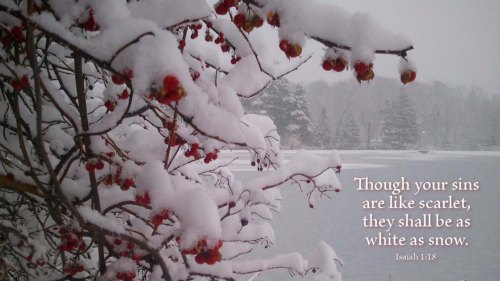
In this amazing vision of the everlasting God on His fiery judgment throne, we find one of the six occurrences in the Bible of the fascinating phrase “white as snow.” As the symbol of holiness, pure white finds its clearest natural expression in the beautiful snow when it has freshly covered the ground.

Twice the phrase is used to describe the cleansing of a guilty sinner by the grace of God. David, after confessing his own sin, prayed: “Have mercy upon me, O God. . . . Wash me throughly from mine iniquity, and cleanse me from my sin. . . . wash me, and I shall be whiter than snow” (Psalm 51:1-2, 7). Then, God promises through His prophet: “Come now, and let us reason together, . . . though your sins be as scarlet, they shall be as white as snow” (Isaiah 1:18). The cleansing blood of Christ, the Lamb of God, is the only substance that can turn blood-red scarlet into snowy white.

When Christ ascended the Mount of Transfiguration, “his raiment became shining, exceeding white as snow” (Mark 9:3), which confirmed to the three disciples that He was the Son of God, even as the voice from heaven had said (Matthew 17:5). At the empty tomb following His resurrection, “the angel of the Lord” also had “raiment white as snow” (Matthew 28:3). Finally, when John saw Christ in His glorified body, he testified that “his head and his hairs were white like wool, as white as snow” (Revelation 1:14).

It is marvelous that the raiment of the angel of God, the transfigured Christ, and the Ancient of days, as well as the head of Christ in His glory, are all described with the same phrase as the soul of one whose sins are forgiven!

*From Days of Praise, December 1, 2019

Comments Off on White As Snow

Filed under Christianity, End Times, Gospel, Religion, Salvation, Second Coming of Christ, Theology

Believe the Bible

For the word of the LORD is right; and all his works are done in truth … By the word of the LORD were the heavens made; and all the host of them by the breath of his mouth. (Psalm 33:4, 6)

My father only completed the third grade in Mexico. He learned to read, write and do simple arithmetic. Education was not greatly valued in his youth. More highly prized were his skills at handling horses and cattle on the family ranch, so his education was good enough to get by. Later in life, he felt called of God to enter the ministry and become a pastor/church planter of Spanish-speaking churches. His third-grade education allowed him to enter the Mexican Bible Institute in San Antonio, TX where, after five years of difficult study, he left without earning his diploma. However, he gained valuable skills in sermon preparation, preaching and pastoring churches. His lack of education did not diminish his love for God’s Word nor discourage him from the constant study of it.

My father taught me many things, but the lesson I treasure most was his love for and trust in God’s Word. He taught me that God’s Word is true in all things and applicable in every situation. Even in those areas of Scripture that are difficult to understand, Dad taught me to trust the Bible simply because it is God’s Word. Dad provided no other apologetic than that.

I grew up with that firmly implanted in my mind, and when confronted with skeptics, my defense defaulted to, “the Bible says.” That answer satisfied me, but it did not impress my challengers. They were convinced that everything started with a Big Bang, that earth formed by itself more than 4.54 billion years ago, and that life sprang up from some mysterious chemical reaction 3.6 – 4.0 billion years ago. That story might make logical sense to some, but it does not line up with the biblical account very well especially when it comes to the topic of the evolution of life. Some “Christian” skeptics suggest that God used evolution to create life over millions of years. My response simply stated that God can do whatever He wants. He could have created slowly over millions or billions of years or He could have created instantly. However, the Bible says He did it in just six 24-hour days.

The arguments have not changed much over the years although the skeptics have gotten more hostile. Even “Christians” come against young-earth creationists charging that a young-earth stance is controversial and divisive. However, today I can offer a better defense besides “the Bible says so,” albeit, that really should be the only defense needed against a “Christian.”

A “mature” gentleman confronted me this week with the “old earth” challenge. He claimed to believe the Bible but he believed the earth was billions of years old, not 6000 years old as young-earth creationists believe. He pointed out that light from distant stars takes billions of years to get to earth and that radiometric dating proves that the earth is old. He excused his disbelief in a literal six 24-hour day creation by stating that we really do not know what the Bible means by “day.”

Given that I was not in an appropriate place to properly respond to his challenge, I gave him some simple answers. A light-year measures distance, not time. Just because a galaxy is 14 billion light-years from earth does not necessarily mean that the light from that galaxy took 14 billion years to arrive at earth. Science has yet to measure the one-way speed of light. For all we know, it could be instantaneous. The Bible also hints that God “gave” the light in place when He created the stars. “And God set [the stars] in the firmament of the heaven to give light upon the earth” (Genesis 1:17, emphasis mine). The Hebrew word translated “set” is nâthan and it means “to give.” Also, the phrase “to give light” is only one word in Hebrew – ‘ôr, i.e., “light.” The verse could be translated, “And God gave them [the stars] in the firmament of the heaven to light upon the earth.” This seems to say that light from distant stars took no time to arrive on earth; it was here from the start.

Then there is the matter of radiometric dating. Besides radiocarbon dating, there are several other methods of radiometric dating none of which are reliable. Dr. Vernon Cupps, a nuclear physicist at the Institute for Creation Research (ICR), recently wrote a book[1] that goes into great detail explaining the fallacies of radiometric dating. Indeed, all radiometric dating methods fail to prove that the earth is billions of years old.

The argument from Scripture that we do not have a clear understanding of what a “day” is in the creation account only betrays a lack of understanding of what Scripture really says. In this, the gentleman alluded to Peter’s statement that to God a day is as a 1000 years and 1000 years is as a day. Peter draws his comparison from the psalm of Moses. [2] In his statement, Peter does not make an equivalence between a day and a year but rather draws a simile. The use of the word “as” makes this clear. Peter’s point is that God is not fettered by time; He is timeless. God created time. He created in six 24-hour days and rested on the seventh for our benefit.[3] Furthermore, the word for day used in the creation account is defined by “evening and morning” and confirmed with the assignment of ordinal numbers to distinguish the days.[4]

I left the man with this final thought. We place too much confidence in scientists who are no more than fallen, fallible human beings rather than trusting God’s Word and believing that God did exactly what He told us He did. God is all-knowing and all-powerful and He can do whatever He chooses to do. He could have created the universe, the earth, and all life on earth over billions of years if He chose to do that, but that is not what He told us in His Word. He could have created everything in an instant if He chose to do that, but that is not what He recorded in His Word. What God tells us is that He created everything in six 24-hour days. It is clearly spelled out in His Word. Believe the Bible!

Notes:


[1]  Vernon R. Cupps, Rethinking Radio Metric Dating: Evidence for a Young Earth from a Nuclear Physicist, (Institute for Creation Research, Dallas, TX, 2019). Available from the ICR online bookstore at http://store.icr.org/.

[2]  2 Peter 3:8; Psalm 90:4

[3]  Exodus 20:10-11

[4]  “A Day Is A Day” – https://erniecarrasco.com/2015/10/25/a-day-is-a-day/

Comments Off on Believe the Bible

Filed under Apologetics, Bible, Christianity, Creation, Evolution, Science, Theology

What the Law Does

Therefore by the deeds of the law there shall no flesh be justified in his sight: for by the law is the knowledge of sin. (Romans 3:20)

Many Christians today adopt the attitude that the Old Testament Law no longer applies because we are not under the Law but under Grace. That is certainly true. However, the fact that we are under Grace does in no way render the Law irrelevant or make it of no effect.

The Law given in the Old Testament accomplished two things. It codified what God expected of His people, Israel, and it provided specific practices for God’s people to follow that set them apart from the pagan nations among whom they lived. They were to be “holy” as their God in heaven is holy, i.e., set apart, consecrated, distinct.

The Law provided a third way for the people to relate to God through the sacrificial system which provided a way to atone for or “cover” the sins of the people. However, the sacrificial system did not provide a permanent solution to the sin problem. Sacrifices were made for all kinds of infractions of the Law, and like sin, they were a perpetual practice. The continual offering of sacrifices illustrated the insufficiency of sacrifices to fully atone for the sin of the people. Even so, the sacrifices required faith in the offering otherwise they became a ritual practice akin to pagan practices. God rejected such sacrifices.

To what purpose is the multitude of your sacrifices unto me? saith the LORD: I am full of the burnt offerings of rams, and the fat of fed beasts; and I delight not in the blood of bullocks, or of lambs, or of he goats. (Isaiah 1:11)

To what purpose cometh there to me incense from Sheba, and the sweet cane from a far country? your burnt offerings are not acceptable, nor your sacrifices sweet unto me. (Jeremiah 6:20)

For it is not possible that the blood of bulls and of goats should take away sins. (Hebrews 10:4)

One thing we learn from the Old Testament is that it is impossible to keep the Law, and that it is insufficient to atone for sin. Our opening verse makes it clear, “by the deeds of the law there shall no flesh be justified in his sight” (Romans 3:20). The only sacrifice sufficient to atone for sin is the one offered by God Himself in the person of Jesus Christ and the blood He shed on the cross. Sin – all sin, for all time – was paid in full when Jesus exclaimed, “It is finished: and he bowed his head, and gave up the ghost” (John 19:30). However, Jesus did not remain dead. On the third day, He rose from the dead and conquered the “last enemy”[1] giving us access to eternal life by the simple act of believing. “And as Moses lifted up the serpent in the wilderness, even so must the Son of man be lifted up: That whosoever believeth in him should not perish, but have eternal life” (John 3:14-15).

Romans 3:23 says that “all have sinned, and come short of the glory of God.” The Old Testament teaches us that we are incapable of keeping God’s Law, therefore we are doomed by that standard. “For the wages of sin is death; but the gift of God is eternal life through Jesus Christ our Lord” (Romans 6:23, emphasis mine). Grace is God’s gift to us. Grace is “unmerited favor.” Grace cannot be earned through any human effort because “by the deeds of the law there shall no flesh be justified in his sight” (Romans 3:20). Grace is a gift, bought and paid for by Jesus’ sacrifice on the cross. “For by grace are ye saved through faith; and that not of yourselves: it is the gift of God: Not of works, lest any man should boast” (Ephesians 2:8-9). As with any gift, it must be accepted before it becomes one’s own possession.

What good, then, is the Old Testament Law, if one cannot gain salvation, i.e., eternal life, by keeping it (not that you could if you tried)? Paul provides the following affirmation: “Therefore we conclude that a man is justified by faith without the deeds of the law” (Romans 3:28). We are declared “just” when we place our “faith” in what Jesus did for us on the cross. That is a “done deal” outside the keeping (“the deeds”) of the law. Then Paul poses and responds to our question. “Do we then make void the law through faith? God forbid: yea, we establish the law” (Romans 3:31). The Greek word translated “establish” is histēmi, and it means “to cause to stand.”

The Law still stands. It is not required to gain eternal life nor is it needed to maintain our salvation. However, it does serve as our guide to holy living which God still requires of His children. “But as he which hath called you is holy, so be ye holy in all manner of conversation; Because it is written, Be ye holy; for I am holy” (1 Peter 1:15-16). Jesus tied our love for Him to the keeping of His commandments.[2] Jesus spoke these words 25-30 years before the first Gospel was written, so His commandments were the same commandments He gave to Moses, which are summarized in two great commandments: love the Lord your God with all your heart, soul, and mind (your whole being), and love your neighbor as yourself.[3]

But what does that look like? Our opening verse tells us: “for by the law is the knowledge of sin” (Romans 3:20). Granted, much of the Mosaic Law had direct application to the culture of that time, however, the principles therein apply to our modern time. Take for instance the laws given to dress. The reason for those laws served to make the children of Israel distinct from the people among whom they lived. God still wants the same for us today. We shouldn’t dress and look like the lost world around us. We should be distinct. We should be holy as our Father in heaven is holy – set apart from the world. Speaking of us, Jesus said, “They are not of the world, even as I am not of the world” (John 17:16). What the law does is show us how not to live like the world.

Notes:


[1]  1 Corinthians 15:26

[2]  John 14:15, 21; 15:10

[3]  Matthew 22:36-40

1 Comment

Filed under Apologetics, Bible, Christianity, Gospel, Religion, Salvation, Theology