Tag Archives: theology

What A Thing!

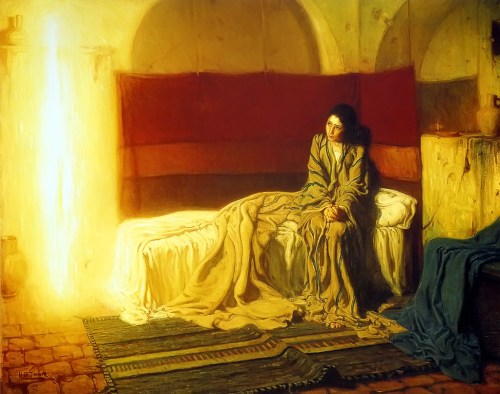
Annunciation by Henry Ossawa Tanner

… Christ Jesus: Who, being in the form of God, thought it not robbery to be equal with God: But made himself of no reputation, and took upon him the form of a servant, and was made in the likeness of men: (Philippians 2:5-7)

The Christmas season is upon us once again, and once more, I sense the dilemma of mixing the commercialization of the season by the world with the celebration of the First Advent. Any Christian well taught in Scripture recognizes that Jesus was not born on December 25, but thanks to the Catholics, we are stuck with that date. Regardless of how one feels about that, it is appropriate to set aside a special time to contemplate the magnitude of the miracle that is the Incarnation[1] – God becoming a man.

Consider our leading verse. No other religion[2] in the world makes the claim that their gods willingly depose themselves of all divine powers to assume the life of a human. Then, to top it off, offer themselves as a blood sacrifice in order to save the lowly human race. However, contemplate seriously the significance of these words of Scripture.

“Christ Jesus” – the anointed Savior (meaning of the name) – “who being in the form of God.” The Greek word translated “form” is morphē, and it means “shape” or “nature.” The Apostle John calls Jesus “the Word.” He wrote, “In the beginning was the Word, and the Word was with God, and the Word was God: (John 1:1, emphasis mine). In the Greek, the phrase “the Word was God” literally reads, “God was the Word” — θεος ην ο λογος. What a thing!

Though He was in every way, in very nature, God, He “Thought it not robbery to be equal with God.” Verse 8 clarifies this phrase when it explains that Jesus “humbled Himself.” He did not regard it robbery to lay aside His Divine nature and assume human form in order to redeem fallen humanity. What a Thing!

“He made Himself of no reputation.” This entire phrase is summed up in one Greek word, εκενωσεν (hekenoōsen), which means, “He emptied Himself” without any sense of deprivation. In exchange, “He took upon Himself the morphē (see above) of a servant” – doulos – a “slave.” He “was made in the likeness of men.” The Greek word translated “likeness” is homoiōma meaning “resemblance.” So, not only did He take on the “nature” of man, He “looked” like any other man. There was no halo around Him to distinguish Him from any other man. Of Him Isaiah the prophet said, “he hath no form nor comeliness; and when we shall see him, there is no beauty that we should desire him” (Isaiah 53:2, emphasis mine). The Hebrew word translated “comeliness” is hâdâr meaning “magnificence,” and “beauty” is the Hebrew word mar-eh’ meaning a “handsome appearance.” So much for those soft-faced images of Jesus, we are so used to seeing! It was not enough that He condescended from His Divine nature to assume the nature of an ordinary, common-looking man, but He took the form of the lowliest kind of man – a slave. Not only did He come as a slave, but He chose a peasant girl for a mother and a stable for His birthplace.[3] What a THING!

The passage goes on to say, “And being found in fashion as a man, he humbled himself, and became obedient unto death, even the death of the cross” (Philippians 2:8, emphasis mine). “Fashion” is the Greek word, schēma and it means the “mode, circumstance, or external condition.” The Bible tells us that “the wages of sin is death” (Romans 6:23). Man must die eternally to pay the penalty for sin. Unless some sinless one can be found to serve as a suitable sacrifice for all of mankind, every one of us must pay “the wages of sin.”[4] Who could qualify as a suitable sacrifice? “As it is written, There is none righteous, no, not one … For all have sinned, and come short of the glory of God” (Romans 3:10, 23). Therefore, God clad Himself in human flesh and took the penalty for universal sin upon Himself. However, His death was not enough. He conquered death when He rose from the grave on the third day. He paid the sin debt that we owe and broke the curse of death[5] with His resurrection. WHAT A THING!

This Christmas, regardless of the commercialization of the season and regardless of the fact that Jesus was not born on December 25, God’s gift of salvation freely offered to all who will accept it, is worthy of commemoration and celebration. “This is a faithful saying, and worthy of all acceptation, that Christ Jesus came into the world to save sinners; of whom I am chief” (1 Timothy 1:15, emphasis mine). WHAT A THING!!

Merry Christmas!

Notes:


[1] “Miracle of the Incarnation” – https://erniecarrasco.com/2012/12/24/miracle-of-the-incarnation/

[2]  “False Religion” – https://erniecarrasco.com/2014/07/27/false-religion/

[3]  “Extreme Measures” – https://erniecarrasco.com/2016/12/11/extreme-measures/

[4]  “Eternal Sacrifice” – https://erniecarrasco.com/2012/09/30/eternal-sacrifice/

[5]  “Why Jesus?” – https://erniecarrasco.com/2015/12/13/why-jesus/
5 Comments

Filed under Apologetics, Bible, Christianity, Christmas, Evangelism, Gospel, Holidays, Religion, Theology

Light From Afar

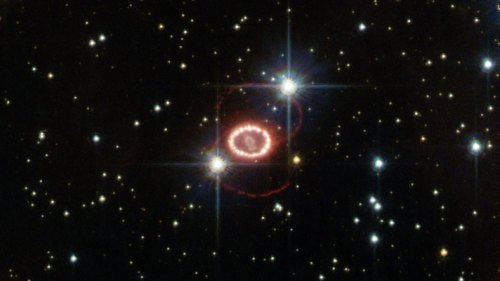
… he made the stars also. (Genesis 1:16)

The question about the age of the universe is certainly a hotly debated question among both young earth and old earth creationists. Young earth creationists affirm and accept the literal account recorded in Genesis.[1] Old earth creationists accept that God is Creator, but they accommodate long ages because they are convinced that “science” has “proven” that the universe is old. They arrive at this conclusion because we see light from stars and galaxies that are billions of lightyears away from us. The “proof” is questionable, but that is a separate matter.

If one considers God’s account of creation recorded in the first chapter of Genesis, one notes that all things, plants, sea creatures, avian life, land creatures and even humans were all created fully mature and immediately able to reproduce (“the seed is in itself”). The earth itself was created, formed, and organized in the first three days of creation (Genesis 1:1-13). The Bible gives no indication that these were long periods of time.[2] When God records the day (Hebrew yom), He uses the word normally understood as a 24-hour day. By assigning an ordinal number to modify the day (first day, second day, third day, etc.), He further qualifies the day as a normal 24-hour day. If that is not enough, He further defines the day by “evening and morning” indicating a normal 24-hour day.

Some may want to argue that, but their argument is against God’s Word, and that is reminiscent of the first words from the tempter’s mouth: “Yea, hath God said…?” (Genesis 3:1).

With all of that in mind, look again at Genesis 1:14-19, Day Four of creation. In God’s account of creation, God created the earth first, then the other heavenly bodies beginning with the sun and moon and finally He “created the stars also” (v. 16). This in itself contradicts the notion of a Big Bang. Verse 15 establishes the purpose for the heavenly bodies: Lit. “to light over the earth.” In the KJV verse 17 reads: “And God set them [the stars] in the firmament of the heaven to give light upon the earth.” The Hebrew word translated “set” is nâthan, which means “to give.” A strict translation of the verse would read: “God gave them in the expanse of the heavens to light over the earth.” As with all of God’s creation, the light of the stars upon the earth was created in place and fully mature. This eliminates any discussion about how long it takes for light from distant stars to arrive on earth. It makes the argument irrelevant. Whatever is now is not what it was in the beginning.

Notes:


[1]  “The Universe is Young” https://erniecarrasco.com/2017/05/21/the-universe-is-young/

[2]  “The Bible Says” https://erniecarrasco.com/2016/04/03/the-bible-says/

1 Comment

Filed under Apologetics, Creation, Origins, Religion, Science

Creation Ex Nihilo

A Picture of Nothing

In the beginning God created the heaven and the earth. (Genesis 1:1)

It seems strange to me when people readily accept the origin of the universe from a Big Bang, yet balk at the suggestion that God created the universe out of nothing – ex nihilo – simply by speaking it into existence. Even Christians who claim to believe that every word of the Bible as inerrant and infallible fall prey to the notion that God somehow initiated and used the Big Bang to create over billions of years of time.

Recently the Institute for Creation Research (ICR) published an article,[1] which raised questions in one reader’s mind. He wrote:

Since God is omnipotent, omniscient, and omnipresent, doesn’t it make more sense to think that either…

  • God first created nothingness?
  • He created time at the same time as nothingness?
  • As He was everything, from within Himself He created everything?

Another question I have regards the space/time/matter continuum. While our human minds at present can’t conceive of the three dimensions going on into infinity in both directions, doesn’t it stand to reason to think that the universe and its three dimensions is endless in both directions?

I am not sure what he meant by his last question. He affirms (at least by our understanding) a three-dimensional universe, but then he questions the three-dimensional universe being infinite (endless) in “both directions.” That suggests only two dimensions. He seems confused, as often happens when we “over think” things that are beyond our understanding.

Our problem in a question like this is that we tend to think of God from our limited human perspective. As theologians like to describe God, He is totally “other,” i.e., He is nothing like us, and we have nothing outside of His Word with which to compare Him. This is why His second commandment prohibits that we make an image of Him (Exodus 20:4). It would be impossible for any image to accurately depict God in His fullness.

When we say God is eternal,[2] we sometimes view “eternity”[3] with some kind of cosmic clock[4] in mind, but that would confine God to time. God is timeless. He has no past, present or future; He simply “is.” That is why when Moses asked His name, He responded, “I AM” (Exodus 3:11). He is the All-Existent One. His omnipresence means more than He is everywhere at all times; it means that He exists IN all times, i.e., He is in our past, present and future all at once. This explains why He knows the future before it happens. This is also why our sin bears eternal consequences. Our sin is an infinite offense to God.

When we understand that, we can look at Genesis 1:1 and see that “In the beginning (time) God created (bara – only used in reference to God creating) the heavens (space) and the earth (matter/energy),” ergo, the universe. God created time. There would be no universe without time – i.e., the space-time continuum to which the writer referred. The universe, like God, is a trinity; time, space and matter/energy must all exist simultaneously for the universe to exist. Remove any one of the three components, and the universe ceases. God created time “in the beginning.”

The Bible does not specifically say that God created out of nothing (“ex nihilo” is the theological term we use to describe God’s creation), but the implication that there was nothing before verse 1 of Genesis is certainly there. When God confronts Job’s questions, He responds, “Where wast thou when I laid the foundations of the earth? declare, if thou hast understanding” (Job 38:4). What are “the foundations of the earth,” if not the basic elements of the universe? Obviously, we have no way of knowing precisely “how” God did it. The Bible encourages us to rest in the fact that God brought it all about “In the beginning.” “The secret things belong unto the LORD our God: but those things which are revealed belong unto us and to our children for ever, that we may do all the words of this law” (Deuteronomy 29:29).

On the final question, the universe is not infinite for the very reason that it was created. Nothing that is created can be infinite. Only God is infinite; everything else is finite.

When we think on that, “What is man, that thou art mindful of him? and the son of man, that thou visitest him?” (Psalm 8:4). Yes, as immeasurably great as God is, He took on human form and condescended to us, His creation, to dwell among us, take on the eternal offense of our sin, and pay for it with His death on the cross so that we might share eternity with Him. After all He has done for us, “How shall we escape, if we neglect so great salvation” (Hebrews 2:3)? Thank God for His infinite love!

Notes:


[1]  “The Universe Out of Nothing” – https://www.icr.org/article/10286

[2]  “The Eternality of God” – https://erniecarrasco.com/2017/06/04/the-eternality-of-god/

[3]  “Time Confusion” – https://erniecarrasco.com/2016/07/31/time-confusion/

[4]  “No Time Like the Present” – https://erniecarrasco.com/2015/01/18/no-time-like-the-present/

2 Comments

Filed under Apologetics, Christianity, Creation, Evolution, Gospel, Origins, Religion, Salvation, Theology

Pre-Flood Fish Food

And God said, Behold, I have given you every herb bearing seed, which is upon the face of all the earth, and every tree, in the which is the fruit of a tree yielding seed; to you it shall be for meat. And to every beast of the earth, and to every fowl of the air, and to every thing that creepeth upon the earth, wherein there is life, I have given every green herb for meat: and it was so. (Genesis 1:29-30)

Our lead verse above often leads to questions about the diet of carnivores prior to the Fall recorded in Genesis 3. Those who raise the question point out that some animals’ teeth are designed for eating plants and others are designed for eating meat. I can answer that question by simply pointing out that my dogs (and probably yours) eat grass, carrots, apples, potatoes, green beans, watermelon, etc. Not only that, but their kibble is made mostly of vegetable products; they do not have to eat meat to survive. In addition, many animals existing today survive on a purely vegetarian diet even though they have sharp meat-eating teeth;[1] for example, panda bears are strict vegetarians, even though they have a mouth full of sharp meat-grinding teeth! Likewise, dinosaurs were all vegetarians before the Fall[2] for the same reason.

Someone recently asked, “What about the sea creatures? Can we assume that there are plants in the oceans? How would that make any sense? What were the sea creatures feeding on if not one another according to the food chain? Doesn’t that represent some kind of death already existing before the fall?”

That is a very good question. The Bible says that when God finished creation, He said it was “very good” (Genesis 1:31). Since the Bible calls death “the enemy” (1 Corinthians 15:26), death cannot be a part of a “very good” creation. Both humans and animals were vegetarian, as pointed out in our verse above. (Genesis 1:29-30); therefore we can safely conclude that applied to sea creatures as well.

We must first define what “life” is. The Bible says that “life is in the blood” (Leviticus 17:11). Therefore, anything that has blood has life. “Life,” according to God’s Word, is not the same as defined by modern science. Modern scientists define life as anything that grows and reproduces, so to modern scientists, plants are “alive,” but that is not what the Bible says. Many creatures grow, reproduce and move freely in the oceans, like plankton. These are considered “motile organisms.” However, they have no blood; therefore, according to the Bible, they do not really have “life.” Whales eat tons of plankton every day and so do other sea creatures. Besides that, many kinds of plants grow in the shallows where sunlight for photosynthesis can still penetrate. Therefore, it should not be difficult to conclude that all sea creatures were vegetarian before the Fall (Genesis 3).

Consider also that the Fall took place probably less than a month after creation – perhaps even within the following week. I say that because Adam and Eve were perfect human specimens, created in the image of God (Genesis 1:26-27). They had absolutely no physical flaws. God gave them instruction to “Be fruitful, and multiply, and [fill] the earth” (Genesis 1:28). Eve did not conceive until after the Fall (Genesis 4:1). Considering that a woman’s menstrual cycle is about 28 days and that Eve was the most beautiful woman in the world – literally – Adam, I am certain, would have gotten busy right away to keep God’s command to “be fruitful and multiply.” Eve, being the perfect example of femininity and physical health should have gotten pregnant right away. Since that did not happen until after the Fall, we must conclude that the Fall occurred before she became pregnant, and therefore less than one month after creation. That should not be too long to survive a vegetarian diet. I could even do that for a month, although, I might not be too much fun to be around!

Aside from the academic exercise of a pre-Fall animal diet is the question of death before sin.[3] If death existed before Adam and Eve disobeyed God by eating from the forbidden tree, then how can death be the logical consequence of sin? Death before sin destroys the whole premise of the Gospel. Therefore, biblical compromises like the Gap Theory,[4] the Day-Age Theory,[5] and Theistic Evolution[6] must be rejected. With all of that, we can conclude that all creatures were vegetarian prior to the Fall.

Notes:


[1]  “Why God Created Large, Sharp Teeth?” – http://www.icr.org/article/why-god-created-large-sharp-teeth

[2]  “How Do the Dinosaurs Fit In?” – http://www.icr.org/article/how-do-dinosaurs-fit-in

[3]  “The Curse of Death” – https://erniecarrasco.com/2015/06/14/the-curse-of-death/

[4]  “No Gap” – https://erniecarrasco.com/2015/10/18/no-gap/

[5]  “A Day Is A Day” – https://erniecarrasco.com/2015/10/25/a-day-is-a-day/

[6]  “The Bible Says” – https://erniecarrasco.com/2016/04/03/the-bible-says/

3 Comments

Filed under Apologetics, Christianity, Creation, Death, Gospel, Origins, Random Musings, Science

Jerusalem

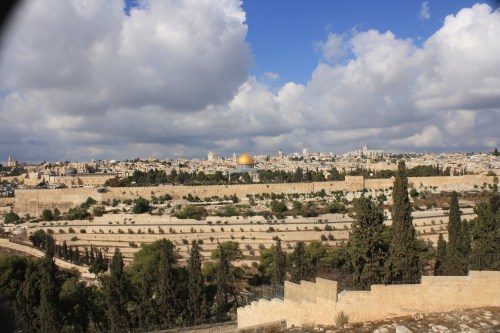
Modern Jerusalem viewed from the Mount of Olives

And unto his son will I give one tribe, that David my servant may have a light alway before me in Jerusalem, the city which I have chosen me to put my name there. (1 Kings 11:36)

Emerging from the tunnel cut through the mountain from Jericho, I caught my first glimpse of the “Eternal City,” Jerusalem. I was completely unprepared for the overwhelming emotional “rush” I would get upon my first view of the city – God’s city. Although Jerusalem is in every way a modern city – nothing like it was in Jesus’ day – building codes imposed on new construction maintain the “old” appearance of the city. That probably contributed to my emotional response.

There are cities in the Middle East more ancient than Jerusalem. Damascus, Syria, for example, is first mentioned in Genesis 14:15.  In this account, a confederation of four kings from the area around Damascus came against the kings of the south, in the area around the Dead Sea. One of those cities was Sodom where Abram’s nephew Lot was living. The invading kings sacked the five cities including Sodom and carried off captives of which Lot was one. Abram mustered up a small army of his own servants, pursued the four kings, rescued Lot, and the other captives, and took back the booty taken by the marauding kings. On his return, he encountered Melchizedek, king of Salem (Genesis 14:17-20). Some have supposed that Salem was the same as Jerusalem, but I disagree for several reasons.[1]

Jerusalem[2] is built on the mountains in the land of Moriah. It was “upon one of the mountains” (Genesis 22:2) there that God instructed Abraham to sacrifice his only son Isaac. It is noteworthy that God did not instruct Abraham to go to Salem, Jerusalem, or Jebus (Judges 19:10-11; 1 Chronicles 11:4-5). Jebus was the “city of the Jebusites” and the Jebusites were in the land when Abram first arrived (Genesis 15:21), and it seems it would have been an excellent landmark if it existed at the time of Abraham. Instead, God instructed Abraham to go the “land of Moriah” and sacrifice Isaac on one of the mountains there. A normal reading of the text leads one to see this place as isolated and uninhabited. However, this would later become the site of Jerusalem, and the particular mountain on which Isaac was offered would become the site of the Temple “in the threshingfloor of Ornan the Jebusite.” (2 Chronicles 3:1). Eventually, God would sacrifice His own Son, on the mountains of Moriah.

This alone makes Jerusalem a special place. Geographically, Jerusalem is located near the center of earth’s total landmass.[3] More than this, God stamped His name on Jerusalem.[4] Jews associate the Hebrew letter “Shin” (ש) with the name of God. They derive this from the “Shama” (meaning “hear”) in Deuteronomy 6:4 – “Hear, O Israel: The LORD our God is one LORD.” Jerusalem – the “Old City” is situated on the mountains of Moriah, which are flanked by two valleys – the Kidron, and Tyropean – with a third, the Hinnom (Gehenna), that runs down the center to join the other two. The topography forms the letter “Shin” the symbol of God’s name. The land of Israel has a similar stamp where the three headwaters of the Jordon River join together to form the letter “Shin.”

The mountains of Moriah are made up of three mountain heads: Ophel, Moriah, and Zion. “Ophel” means “My Fortress” and represents God the Father. “Moriah” means “to see God” or “to be seen of God” and represents God the Son. “Zion” means “the Mark” and represents God the Holy Spirit who is the “seal” or the “mark” of all believers. One mountain range with three heads representing one God in three persons.

Jerusalem, as stated earlier, is the “Eternal City.” When Jesus returns to reign as King of Kings and Lord of Lords, He will come to Jerusalem. “And his feet shall stand in that day upon the mount of Olives, which is before Jerusalem on the east, and the mount of Olives shall cleave in the midst thereof toward the east and toward the west, and there shall be a very great valley; and half of the mountain shall remove toward the north, and half of it toward the south” (Zechariah 14:4, emphasis mine). Jesus will physically reign from His Temple in Jerusalem. A river will flow from his throne here and will run to the east and into the Dead Sea, which will be healed (Ezekiel 47:8-9).

At the end of the 1000-year reign of Christ on earth, God will create a “new heaven and a new earth,” and a “New Jerusalem” will descend from heaven to a recreated earth (Revelation 21:1-2) where those of us who are His children will reign forever with Him. As beautiful as Jerusalem is today, it will not compare to the New Jerusalem where not just God’s name will dwell, but God Himself will dwell with us!

Reader, if you are unsure where you will spend eternity, read my page on Heaven.

Notes:


[1]  “Is Salem Jerusalem?” – https://erniecarrasco.com/2015/08/16/is-salem-jerusalem/

[2]  “Hebrew Word Study – Jerusalem – Part I” – http://livingwordin3d.com/discovery/2016/12/18/hebrew-word-study-jerusalem-part-i/

[3]  “The Center of the Earth” – http://www.icr.org/article/50

[4]  “Jerusalem – I Will Put My Name There – Amazing Revelations” – https://www.youtube.com/watch?v=aZO_eRmR2ho

2 Comments

Filed under Bible, Christianity, End Times, Gospel, Heaven, Religion, Salvation, Second Coming of Christ, Theology