Category Archives: Christianity

The Barley Harvest

Therefore they gathered them together, and filled twelve baskets with the fragments of the five barley loaves, which remained over and above unto them that had eaten. (John 6:13)

On the eve of this posting, May 16, 2021, Jews begin the observance of Shavu’ot, the Feast of Pentecost. The Christian calendar, which does not follow the Jewish calendar, observes Pentecost next Sunday, May 23, 2021.

Pentecost interests me, because of the possible prophetic implications associated with it. I wrote about this topic before, and I believe I gave explanation of its significance in an article titled “Pentecost,”[1] so I will not rehash that material here. Briefly, there are seven Feasts of the Lord,[2] three in the spring (Passover, Unleavened Bread, and First Fruits), three feasts in the fall (Trumpets, Atonement, and Tabernacles) with Pentecost in the middle, separated by a space of time between the others. Pentecost was one of three convocations where all males over the age of 20 were required to attend. The other two times were for the spring and fall feasts.

Pentecost celebrates the barley harvest. Some Bible teachers have mistakenly associated the Feast of First Fruits with the barley harvest, but barley, according to the sources I have checked say that barley does not ripen until around mid May – too late for First Fruits. Again, I explain this in the articles I have cited in the notes below.

Barley is often associated with gentile nations, probably because it is more coarse and less desirable than wheat. Wheat, on the other hand, because it is finer and more desirable represents Israel.

On Pentecost, following Jesus’ resurrection and ascension, The Holy Spirit fell upon the 120 disciples gathered in the upper room.[3] There were in Jerusalem on that day “Jews and proselytes” from many nations present for the required convocation, and they heard the disciples preaching in their own languages. That day, about three thousand souls were saved[4] giving birth to the Church. For this reason, Pentecost is associated with the Church, and because it is separated from the other Jewish feasts, many have seen this as the Feasts of the Lord specifically meant for the Church.

Looking at this prophetically, Jesus fulfilled the first three spring feasts by His death (Passover), His burial (Unleavened Bread – He was sinless), and His resurrection (First Fruits). He then ascended to heaven with the promise to send His Holy Spirit and physically return at some later time. So, the Holy Spirit came at Pentecost and gave birth to the Church. Then there is a long period of time before the fall feasts, which Jesus has yet to fulfill. The long period of time can be likened to the Church Age in which we have lived for the last 1,991 years. At a time known only to God, Jesus will return to earth, possibly on the Feast of Trumpets, fulfill the Atonement, and set up His Tabernacle here on earth. We know this as the “Second Coming.”

Prior to Jesus’ return, the world will experience the full wrath of God for seven years. This is known as the Tribulation. Now (just musing here), there is much support for the crucifixion occurring in 30 A.D. According to the Bible, Creation is about 6000 years old and biblical chronology can be roughly divided into three segments of 2000 years each. We can add the final 2000 years to 30 A.D. and come up with the year 2030. Subtract seven years from that and we arrive at the year 2023 to start the Tribulation.

However, the “wrath” of God is for the “world” not for His Church. The Church will be taken out of the world prior to the start of the Tribulation. “For this we say unto you by the word of the Lord, that we which are alive and remain unto the coming of the Lord shall not prevent them which are asleep. For the Lord himself shall descend from heaven with a shout, with the voice of the archangel, and with the trump of God: and the dead in Christ shall rise first: Then we which are alive and remain shall be caught up together with them in the clouds, to meet the Lord in the air: and so shall we ever be with the Lord” (1 Thessalonians 4:15-17).

We have many “signs” to prepare us for the Second Coming, but we have no signs to prepare the Church for the “catching up,” a.k.a. the “Rapture.” “Behold, I shew you a mystery; We shall not all sleep, but we shall all be changed, In a moment, in the twinkling of an eye, at the last trump: for the trumpet shall sound, and the dead shall be raised incorruptible, and we shall be changed” (1 Corinthians 15:51-52).

The event will be sudden, but it should not be unexpected for the Christian. The “signs” of His Second Coming are everywhere and becoming more pronounced and more frequent. Therefore, we know that His Second Coming is close, and if His Second Coming is close, the Rapture is closer. Jesus said, “All these are the beginning of sorrows … Watch therefore: for ye know not what hour your Lord doth come.” (Matthew 24:8, 42)

Just musing again, if we, the Church, are the barley, and the barley harvest is ready, could this be the day that the Lord harvests us into His barn? Just so you know, the start of the Tribulation does not depend on the Rapture of the Church. The Church could get taken out today and the Tribulation will not begin in earnest until the year 2023. Consider this; our world economy is in freefall. The globalists already have detailed plans for implementing a “one-world” government.[5] Consider the impact of millions of people, especially here in the US, disappearing instantly, all at once, from the face of the earth. Consider the added chaos that would bring to a world already reeling with social, economic and geopolitical trouble. In that event, the one-world system will be put in place and a great one-world leader will arise to bring “peace” to the earth, “And he shall confirm the covenant with many for one week [seven years]” (Daniel 9:27). That will kick off the Tribulation.

The barley harvest is ready. I hope this will be the day, but if not, we must occupy until He comes.[6] Are you ready? If not, please read my page on “Securing Eternal Life.”

Notes:


[1]  “Pentecost” — https://erniecarrasco.com/2017/05/28/pentecost/

[2]  “Rosh HaShanah” — https://erniecarrasco.com/2016/10/03/rosh-hashanah/

[3]  Acts 2:1-13

[4]  Acts 2:41

[5]  World Economic Forum — https://www.weforum.org/

[6]  Luke 19:13

Comments Off on The Barley Harvest

Filed under Apologetics, Christianity, Current Events, End Times, Eschatology, Feasts of the Lord, Heaven, Holy Spirit, Rapture, Resurrection, Salvation, Second Coming of Christ, Theology

God’s Devil

And the LORD said unto Satan, Behold, all that he hath is in thy power; only upon himself put not forth thine hand. So Satan went forth from the presence of the LORD. (Job 1:12)

Satan (the name means “adversary”) appears in many forms in the human imagination. He has been depicted as a grotesque angelic being with a goat’s head and goat’s legs and hooves. The Satanic Temple in Detroit houses an idol by the name of Baphomet that represents their god, Satan. At the other extreme is “Hot Stuff,” a fun-loving comic book character that enjoys playing pranks on people. Either extreme makes Satan an imaginary figure that can easily be dismissed along with any other fairy tale character.

However, Satan is very real. Ask any Satanist. While you are at it, ask the Satanist if Jesus is real. So, why do they worship Satan, rather than Jesus? It is because they have fallen for Satan’s lie that he will overcome the kingdom of Christ. Satan has seduced them with the power he possesses.

Satan does have a lot of power; however, his power is nowhere near the power of God. For example, Satan is not omnipresent like God is. He can only be in one place at one time, which means that we cannot blame the devil for every sin we commit; he is not always around to tempt us. However, he does have millions of demons doing his dirty work for him, but they are limited in their power too. Satan cannot read our minds or our hearts like God can, but he and his demons can observe our actions and listen to what we say. When they see our weaknesses, they know how to attack us.

Satan cannot act on his own initiative. He needs permission from God to carry out his deeds. Reading the first two chapters of the Old Testament Book of Job makes this very clear. It appears that God holds a heavenly council where all His angels, good and bad, come before Him. The psalmist says, “God standeth in the congregation of the mighty; he judgeth among the gods” (Psalm 82:1). The Hebrew word translated “might” is ‘êl which means “god, god-like, mighty one.” This verse shows God standing among “the gods” and judging among them.[1] At the opening of Job’s saga, we find that Job lives in the land of Uz.[2] By God’s standards, Job is a righteous man that shuns evil. God blesses Job with wealth and a large family for whom Job intercedes before God just in case his children have fallen into sin.

The scene then shifts to heaven and God’s council, where all of God’s angels come before Him.[3] Scripture points out that Satan was among them. So God asks Satan to report, and Satan says he has been wandering up and down the earth (remember, he is not omnipresent). The Apostle Peter says that Satan wanders the earth like a ravenous wolf seeking whom he may devour.[4] God then asks Satan if he has taken notice of Job, and God brags on Job. (Would it not be great if God could brag about you?) So Satan points out that Job only worships God because God has blessed him with a good life, a large family, and much wealth. Then Satan suggests that God test Job by taking away all of his blessings. God gives Satan permission to remove all of Job’s blessings, but He prohibits Satan from touching Job’s body.

Satan attacks Job by taking away all of Job’s blessings, but Job remains faithful to God. Next, in Chapter Two, at the following council of God, God asks Satan for a report on Job. Satan, knowing that he failed, suggests that Job remains faithful only because he still has his health. So, God gives Satan permission to touch Job’s body, but he is not allowed to take Job’s life.

The point in all of this is that Satan cannot do anything without God’s consent. At the end of the saga, we learn that Job remained faithful to God, and God restored all that Job lost and much more.[5]

Jesus demonstrated His authority over Satan every time He cast out demons. Luke records one of the most dramatic accounts of a man of the Gadarenes that was possessed by a “legion” of demons.[6] In this account, the demons recognized Jesus from a distance and started crying out begging Jesus not to send them to the abyss (the bottomless pit) before their time. They begged Jesus’ permission to go into a herd of hogs instead, and Jesus gave them permission.

On another occasion, Jesus informed Peter that Satan asked permission to sift him as wheat.[7] At the same time, Jesus assured Peter that He had prayed for him that his faith would not fail. Satan cannot do anything unless God gives him permission.

Satan is real. Satan has a lot of power. Satan can cause us a lot of misery. However, Satan is God’s Devil, and God has him on a short leash – but not for long. Soon, God will unleash Satan to terrorize the entire world, but His own He will spare from the Tribulation to come. For now, the only defense we have against Satan is to remain in the shadow of the Almighty. He hears us when we call out to Him. “Shew thy marvellous lovingkindness, O thou that savest by thy right hand them which put their trust in thee from those that rise up against them. Keep me as the apple of the eye, hide me under the shadow of thy wings, From the wicked that oppress me, from my deadly enemies, who compass me about” (Psalm 17:7-9)

If you are reading this and do not have the assurance of God’s protection on you, please read my page on “Securing Eternal Life.”

Notes:


[1]  I realize this concept may be foreign to most of my readers, but the Bible, when carefully studied does not deny the existence of other gods, but rather it clearly points out that they are “no gods” at all. In other words, even though they do exist and exercise power over humans, they do not approach the power of Yahweh, the God who created them. For an in-depth study on this topic, I recommend Michael S. Heiser’s book, The Unseen Realm.

[2]  Job 1:1

[3]  Job 1:6-12

[4]  1 Peter 5:8

[5]  Job 42:12-17

[6]  Luke 8:26-39

[7]  Luke 22:31-34

Comments Off on God’s Devil

Filed under Apologetics, Bible, Christianity, Satan, Second Coming of Christ, Theology

Son Against Father

The father shall be divided against the son, and the son against the father; the mother against the daughter, and the daughter against the mother; the mother in law against her daughter in law, and the daughter in law against her mother in law. (Luke 12:53)

I celebrated my 71st year of life this past week, and I must admit that it was the worst birthday of my life. It ended with a decision I have mulled over for many years, but only now have I decided to follow through with it. I decided to sever communications between my sons and myself in order to (hopefully) relieve myself of the heartache of strained relationships and the knowledge that my sons are lost and, unless the Lord intervenes, bound for eternal damnation.

Some may criticize my decision and think of me weak as both a father and a Christian for not persevering in prayer for my lost sons. Those that think that may be right; however, I would ask that you not be too quick to judge without knowing that with which I have contended for over 25 years. This was not a snap decision done in a moment of anger, but one that has been carefully weighed over many years. It should also be understood that I am not closed to the possibility of reconciliation later on, if the Lord delays His coming. I have not “disowned” my sons. How could I? They carry my DNA. I have only decided to break off any further contact with them and turn them over to the Lord and let Him deal with them.

I do not want to go into detail as to what brought this to a head. Basically it had to do with a post I made on Facebook with which they vehemently disagreed. They both seized the opportunity to berate, disrespect, and humiliate me on social media. It is not the first time this has occurred, but in past times the offense was easily overlooked considering the source. Not this time.

In the process of making my decision, I remembered our Lord’s account of the Prodigal Son[1] who disrespected his father and separated himself from him. It occurred to me that the father did not chase after the son, but rather waited patiently for the son to “come to himself” and return of his own volition. That is what I have decided to do.

I know many Christian parents these days are experiencing the same thing. We are living in the “last days” as we wait for Jesus’ return to take us home. Jesus predicted this would happen. “Suppose ye that I am come to give peace on earth? I tell you, Nay; but rather division: For from henceforth there shall be five in one house divided, three against two, and two against three. The father shall be divided against the son, and the son against the father; the mother against the daughter, and the daughter against the mother; the mother in law against her daughter in law, and the daughter in law against her mother in law” (Luke 12:51-53). Certainly, many can relate.

Mark records Jesus’ words in the Olivet Discourse like this: “Now the brother shall betray the brother to death, and the father the son; and children shall rise up against their parents, and shall cause them to be put to death. And ye shall be hated of all men for my name’s sake: but he that shall endure unto the end, the same shall be saved” (Mark 13:12-13, emphasis mine). Of course, Jesus referred to the time of Tribulation, but what we see now is the beginning of these things.

The Apostle Paul predicted the general character of people in the last days. “This know also, that in the last days perilous times shall come. For men shall be lovers of their own selves, covetous, boasters, proud, blasphemers, disobedient to parents, unthankful, unholy, Without natural affection, trucebreakers, false accusers, [without self-control], fierce, despisers of those that are good, Traitors, heady, highminded, lovers of pleasures more than lovers of God; Having a form of godliness, but denying the power thereof: from such turn away. For of this sort are they which creep into houses, and lead captive silly women laden with sins, led away with divers lusts, Ever learning, and never able to come to the knowledge of the truth” (2 Timothy 3:1-7, emphasis mine). Those characteristics that I emphasized describe my sons. That last sentence especially fits them to a tee. My oldest son graduated from Southwestern Baptist Theological Seminary with a Masters Degree in Family Counseling, and later declared himself to be an atheist. My youngest son dropped out of high school but is self-educated; he is actually highly intelligent, and he considers himself quite the intellectual. Both of them consider me a rube for taking the Bible seriously and for my faith in God. Although I never push religion on them, they know where I stand and they resent that I will not move from my opinions. Truthfully, I am very flexible in my opinions, but God’s Word is not my opinion, and that is what they do not seem to understand.

As I said, I am not alone in this dilemma – torn between the love of God and the love of children – but I decided long ago to heed the words of Jesus. “And a man’s foes shall be they of his own household. He that loveth father or mother more than me is not worthy of me: and he that loveth son or daughter more than me is not worthy of me. And he that taketh not his cross, and followeth after me, is not worthy of me. He that findeth his life shall lose it: and he that loseth his life for my sake shall find it” (Matthew 10:36-39, emphasis mine). Personally, I prefer to be worthy of Jesus even if it means losing my sons. Sadly, that includes grandchildren too.

The time is short. Jesus may come for His Church – His Bride – at any moment. There is no time or place for divided loyalties. I choose Christ!

Notes:


[1]  Luke 15:11-24

3 Comments

Filed under Apologetics, Bible, Christianity, Current Events, End Times, Second Coming of Christ

Remember

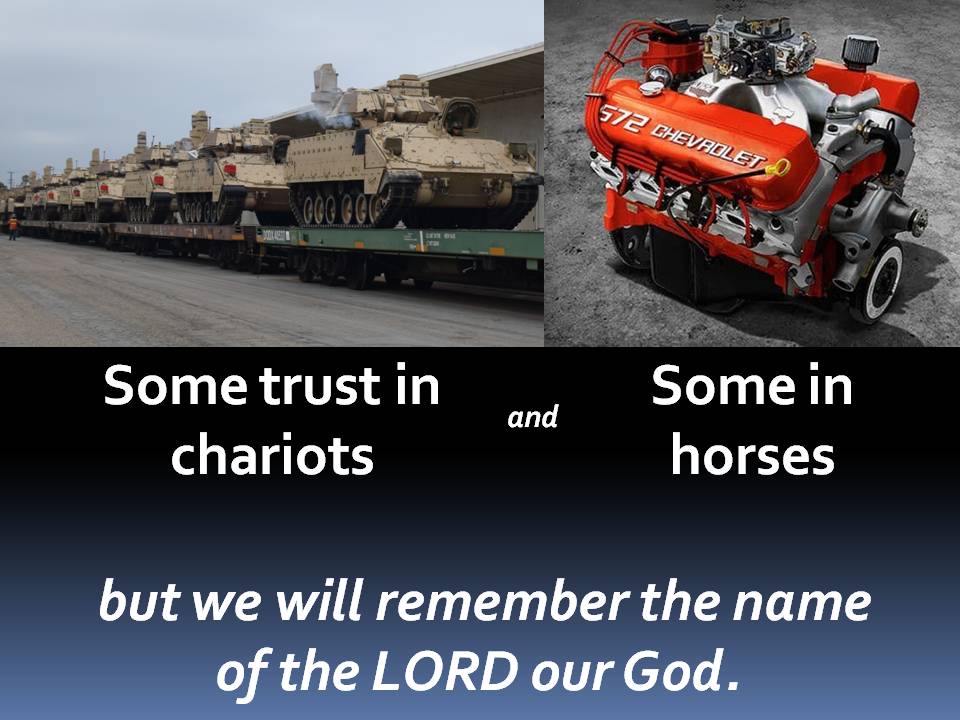
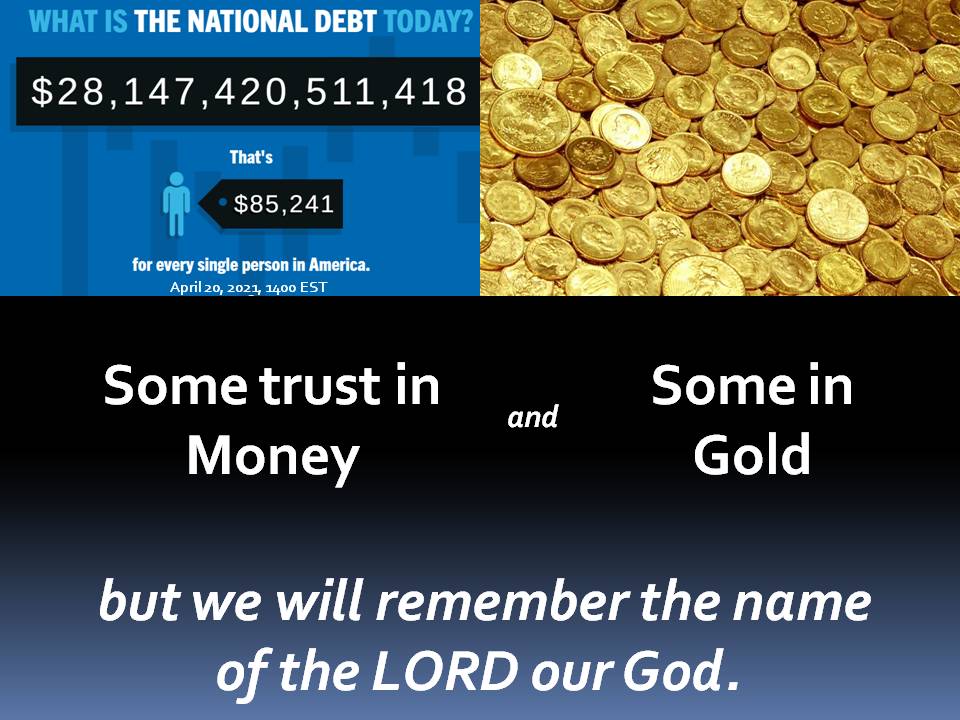
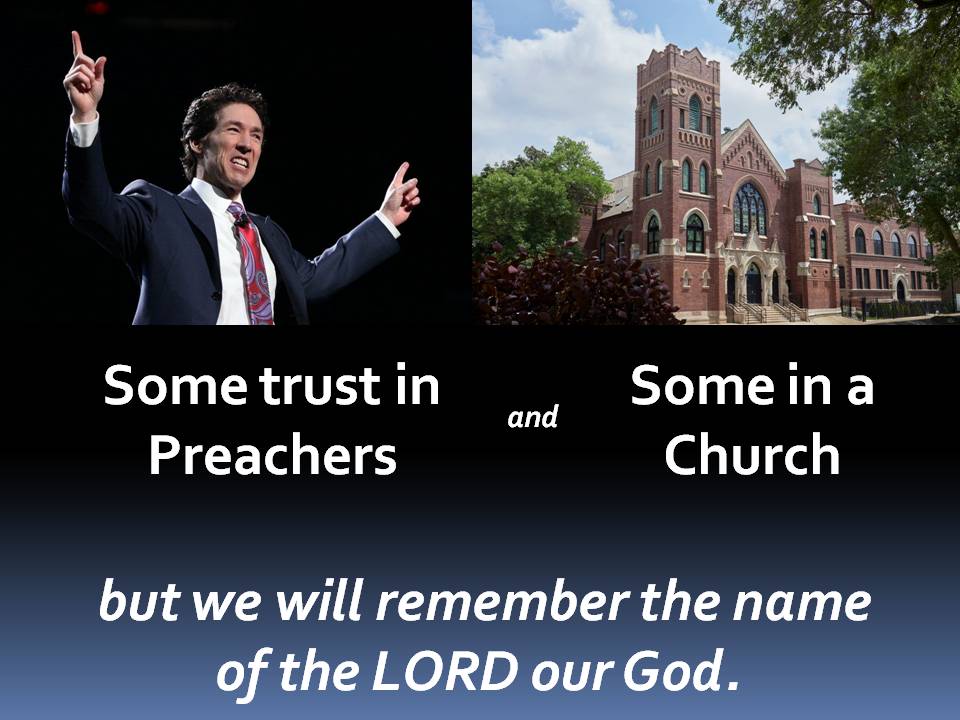
Some trust in chariots, and some in horses: but we will remember the name of the LORD our God. (Psalm 20:7)

The familiar rendition of Psalm 20:7 reads, “Some trust in chariots and some in horses, but we trust in the name of the Lord our God” (emphasis mine) as equivocated by the New International Version (NIV). The first “trust” in the verse does not appear in the original Hebrew, but has been supplied by English translators for ease of reading and understanding. The addition of the word is in keeping with the context of the entire psalm which looks to God for provision, protection and salvation.

The second word rendered “trust” is from the Hebrew root zâkar which means “to remember, recall, or call to mind.” Other versions translate zâkar as “boast, depend, honor, mention, praise, rely, remember, shall call, take pride in, and trust.” The literal translation of zâkar is “to remember.” The Hebrew verb is in the Hiphil imperfect stem, so literally it means “to cause to remember,” but that would give it an awkward rendition in English.

However, we could argue that “trust” is a valid rendering, but only by going through some mental gymnastics. As we go through trials in our lives, God provides, protects, and saves us from harm. We may not sense God’s presence while we are going through our troubles, but when we look back on our lives, we can “see” and “remember” how God’s hand has been upon us to guide, direct, protect, provide, and ultimately, to save us from those times. My favorite Bible verse says, “And we know that all things work together for good to them that love God, to them who are the called according to his purpose” (Romans 8:28). As we “remember” the working of God in our past, we can “trust” Him with whatever we face in the present, and we can “trust” Him with whatever may come to us in the future.

Reader, if you are feeling insecure about your future, please read my page on “Securing Eternal Life.”

Comments Off on Remember

Filed under Apologetics, Bible, Christianity, Random Musings, Theology

Don’t Go There!

And these shall go away into everlasting punishment: but the righteous into life eternal. (Matthew 25:46)

Last week I wrote on the topic of an eternal hell,[1] which was prompted by an article posted on social media by an author who believes that hell is not eternal. The man who wrote the article spent many years researching the topic and has written several books and produced several DVD’s on the matter. He concluded, after years of study, that the Bible does not teach that hell is eternal based on an extensive word study in the original biblical languages that are often translated “forever” or “eternal.” (See last week’s article noted below.)

Hell is not a pleasant topic to discuss. In fact, we probably find it repulsive. However, the Bible does speak of hell as a real place, so it behooves us not to ignore it. In fact, it is said that Jesus spoke more about hell than He did about heaven, so, if we believe the Bible is true then we need to take hell seriously.

The writer, Aloysius or “Al” for short (not his real name), besides pointing out that the Hebrew and Greek words translated as “forever” or “eternal” have different “shades” of meaning so that they can just as easily be translated as “a long time,” based most of his argument on God being so loving that He would not punish sinners for eternity. This concept is known as annihilationism; “the belief that all the wicked will be judged by God and thrown into the lake of fire, where they will cease to exist. Some annihilationists suggest that this will occur instantaneously, while others believe that the unrighteous may experience a brief period of awareness. However, all annihilationists agree that no individual, however wicked, will suffer eternally a conscious existence in hell.”[2]

I was told by one of my readers about a movie on the same topic. The movie is entitled, “Hell and Mr. Fudge,” so I found it on Amazon Prime and watched it. The movie, based on a real character, told about a boy, a preacher’s kid, which grew up to be a preacher himself. As an adolescent, he had a friend who was a “bad boy;” he drank and smoked, rarely went to church, and he was not “saved.” The boy ends up dying in a car accident and the thought of his friend going to hell haunted Fudge for the rest of his life because he could not accept that God would send his friend to hell forever. The story of Fudge’s struggle is very compelling, and I found myself hoping that he would convince me that hell is not eternal. If you have not seen the movie, I would recommend it, but keep up your guard.

Just like Al, Fudge did extensive research in both Old and New Testaments. In one scene, while he was in Bible college, he makes the claim that he was reading Greek since he was six, so he was no slouch as a scholar, but his failure, as I saw it, was that he allowed his emotions to drive his conclusion. In the end, he resolved his dilemma with John 3:16: “For God so loved the world, that he gave his only begotten Son, that whosoever believeth in him should not perish, but have everlasting life” (emphasis mine). “Perish” is the Greek word apollumi meaning “to destroy fully.” “Everlasting life” (life perpetual), zōē aiōnios, employs the word aiōnios, which is applied in the NT to both eternal life and to eternal damnation. However, the confusion results from the frequent use of apollumi to describe the destruction of a soul in hell. That raises the question. What is the need for an eternal (aiōnios) hell, if the destruction (apollumi) of the soul is relatively brief?

Mr. Fudge, for all his scholarship, failed to parse the aorist Greek verb appoletai (perish) and settled for the English future tense. The “aorist tense” of the verb expresses a present action that is continuing. The verb is in the “middle voice” that denotes that the subject is both an agent of an action and somehow concerned with the action. So, whatever is happening to this subject, he is bringing it upon himself. The verb is also in the “subjunctive mood” indicating that the action may or may not occur. In this verse, the person is “perishing” of his own volition, but by believing in the Son, he can obtain eternal life. John 3:16 speaks of eternal life, not the duration of hell. Those who have not believed in the Son are in the process of destroying (perishing) themselves, and unless they change, they will endure hell for eternity.

When I share the Gospel, I do not want to talk about eternal death in hell. I want to invite those who hear to join me in eternal life with Christ. However, just for the sake of argument, let us agree that hell is brief. Let us say that a really bad sinner will be tortured there for just one year and then incinerate and cease to exist. Then let us say that a “good” person, whose only sin was to reject God’s plan of salvation, goes to hell, and his sentence is just one week. Then he is incinerated and ceases to exist. Can anyone seriously say, they would be willing to spend even just one minute in hell just for rejecting Christ? I would not want to, not from how Jesus describes it. Don’t go there!

I really liked Mr. Fudge. He seemed like a really nice and sincere guy. I also have no doubt in my mind that He is a true Christian. His false notion about the temporal duration of hell is not a salvation issue. However, you know people that would rather continue in a sinful lifestyle than to place their life in Jesus’ hands. The notion of a brief stent in hell followed by total annihilation might seem like a good option to someone who enjoys a sinful lifestyle too much. (And who says sinning isn’t fun!) The idea of an eternal existence in that torturous place might be that thing that will change his mind. Mr. Fudge and Al might be really nice guys, excellent scholars, and wonderful Christians, but they are wrong on hell.

Reader, if you are not sure about where you will spend eternity, please read my page on “Securing Eternal Life.”

Notes:


[1]  “Eternal Hell” – https://erniecarrasco.com/2021/04/11/eternal-hell/

[2]  Stanley J. Grenz, David Guretzki, & Cherith Fee Nordling, Pocket Dictionary of Theological Terms, (InterVarsity Press, Downers Grove, 1999), p. 10.

Comments Off on Don’t Go There!

Filed under Apologetics, Bible, Christianity, Death, Evangelism, Heaven, Hell, Salvation, Theology