Category Archives: Christianity

Articles that address Christian living.

The End of 1000 Years

And when the thousand years are expired, Satan shall be loosed out of his prison, (Revelation 20:7)

At the beginning of the Millennium when Jesus comes again, “the dragon, that old serpent, which is the Devil, and Satan” is bound and imprisoned in the “bottomless pit” for a thousand years.[1] At the end of 1000 years (20:7, above), he will be released for “a little season” (20:3), “And shall go out to deceive the nations which are in the four quarters of the earth, Gog and Magog, to gather them together to battle: the number of whom is as the sand of the sea” (Revelation 20:8). Who are these that are deceived? They are not the saints who reign with Christ. The saints – the Bride and the Tribulation saints – have glorified bodies “like unto his glorious body”[2] that are incapable of sin, and they are immune to Satan’s deceptions. The ones who Satan deceives are the progeny of those that survived the Tribulation and entered the Millennium in their natural bodies – some believers and some non-believers – and retained the ability to reproduce. At the end of 1000 years of perfect conditions and “pre-flood” lifespans[3], billions of people will inhabit the earth. These are those who Satan incites to rebel. The “Gog and Magog” mentioned here are not the same to which the Prophet Ezekiel refers;[4] but rather, it is the “spirit” of Gog and Magog that seeks to destroy the people of God.

After 1000 years of perfect peace with Jesus reigning as King of Kings and Lord of Lords, why does God turn Satan loose on Earth again? Adam and Eve lived in a perfect environment with only one prohibition, yet they sinned and rebelled by disobeying God’s only command.[5] That took place probably within the first week following Creation. Now, after the Edenic state of Jesus’ Millennial reign, once again Satan is allowed to test mankind proving the depravity of mankind and the holy righteousness of God. God, speaking through the Prophet Jeremiah, says, “The heart [of mankind] is deceitful above all things, and desperately wicked: who can know it? I the LORD search the heart, I try the reins [i.e., “the seat of emotion and affection”], even to give every man according to his ways, and according to the fruit of his doings” (Jeremiah 17:9-10, emphasis mine). It is a sad but true commentary. People sin because they are sinful even in a perfect environment.

Satan incites a rebellion against Christ and His saints, but the rebellion is short-lived. “And they went up on the breadth of the earth, and compassed the camp of the saints about, and the beloved city: and fire came down from God out of heaven, and devoured them” (Revelation 20:9). God responds instantaneously, decisively, and completely – no more second chances.

“And the devil that deceived them was cast into the lake of fire and brimstone, where the beast and the false prophet are, and shall be tormented day and night for ever and ever. (Revelation 20:10, emphasis mine). There exists a false image of Satan and his demons ruling in hell and torturing its inhabitants. However, Satan and his “angels” will be no better off than any of the other inhabitants of “the lake of fire.” Jesus said that the lake of fire was “prepared for the devil and his angels.”[6] The Beast and the False Prophet are already there waiting for the Dragon,[7] and soon they will be joined by those whose names are not found in the Book of Life.[8]

With Satan permanently disposed of, John’s focus turns to Jesus on His throne. From the text, it is not clear whether His throne is in heaven or on earth where He has reigned for the last thousand years. Since Chapter 19, John has been reporting on events taking place on Earth; therefore, it seems feasible that Jesus’ throne could be the one He occupied in the Holy of Holies of the Millennial Temple as described by the Prophet Ezekiel. However, it could be His heavenly throne, which would have more space for the billions of people that are to be judged.  Its location is irrelevant. Its significance lies in the seriousness of what takes place there.

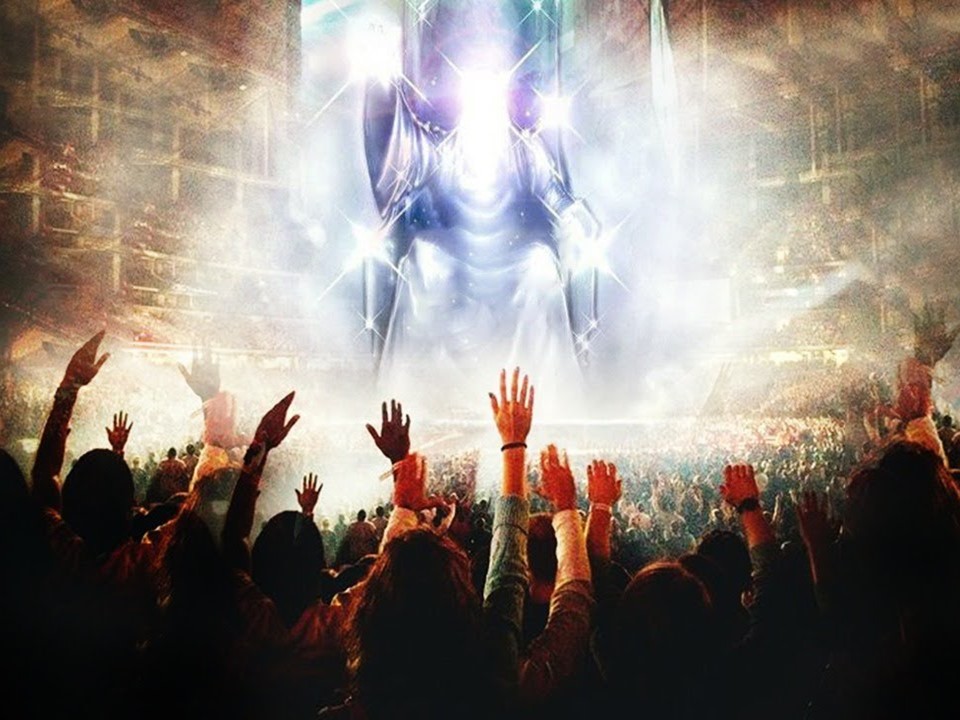
“And I saw a great white throne, and him that sat on it, from whose face the earth and the heaven fled away; and there was found no place for them” (Revelation 20:11). The One on the great white throne is Christ, who is the Word,[9] who shed His blood a ransom for many,[10] and who conquered death and the grave by rising again.[11] He offered Himself for whosoever would accept His free gift of salvation through faith.[12] By His sacrifice, He earned the right to judge those who have despised His free gift of salvation. Now, He sits in the full splendor of His glory that overwhelms earth and heaven.

“And I saw the dead, small and great, stand before God; and the books were opened: and another book was opened, which is the book of life: and the dead were judged out of those things which were written in the books, according to their works” (Revelation 20:12). These are those who have died without Christ from the beginning of time – small and great, peasants and kings, nobodies and celebrities – they all stand before God – Jesus is God.[13] The books were opened. We are not told, but I have concluded that the “books” include the detailed record of the life of every individual of both good and bad deeds, actions, and thoughts. Every person has his or her own complete, detailed biography. Among the books is the Bible, the Word of God, the standard against which each person will be measured. Too many people who even bother to ponder eternity believe that their good deeds will be weighed against their bad deeds, and in their pride, they think that their “good” will outweigh the “bad.” Actually, all of their deeds, good and bad, will be measured against God’s perfect standard, His Word, and only perfection by that standard will pass the test. On that day, the truth of Romans 3:10 will be undeniably evident: “As it is written, There is none righteous, no, not one;” “For all have sinned, and come short of the glory of God” (Romans 3:23).

To be fair, “another book was opened, which is the book of life.” This book records the name of every person who has ever lived. However, only those adopted as children of God[14] remain recorded in the Book of Life; all others are blotted out, i.e., removed. When interceding for the sins of the children of Israel, Moses pleaded, “… unto the LORD, and said, Oh, this people have sinned a great sin, and have made them gods of gold. Yet now, if thou wilt forgive their sin; and if not, blot me, I pray thee, out of thy book which thou hast written” (Exodus 32:31-32, emphasis mine). Moses knew the significance of that book, and he was willing to have his name blotted out of that book in order to preserve his people.

“And the sea gave up the dead which were in it; and death and hell delivered up the dead which were in them: and they were judged every man according to their works” (Revelation 20:13, emphasis mine). Judged “according to their works,” no one will measure up to the perfect standard that Holy God demands.

“And death and hell were cast into the lake of fire. This is the second death” (Revelation 20:14). Death and the grave (i.e., hell, hades, the abode of the dead) cast into the lake of fire signifies that these cease to exist. There will be no death or dying in the lake of fire. Death separates the spirit from the body. When the body ceases to function, the spirit lives on, either in hell (the abode of the dead) or in the presence of the Lord (for the believer). For the believer, Paul says, “We are confident, I say, and willing rather to be absent from the body, and to be present with the Lord” (2 Corinthians 5:8, emphasis mine). Everyone (except those caught up in the Rapture) will experience the first death. Scripture says, “And as it is appointed unto men once to die, but after this the judgment” (Hebrews 9:27). Since God is the Giver of Life, eternal separation from His presence is the ultimate death. Since physical death and the grave are cast into the lake of fire, the “second death” means eternal separation from the One who gives life – alive in one sense without the ability to die, yet dead in the sense of living apart from the One who gives true life. What a horrible thought!

Those being judged at the Great White Throne Judgment are given one more chance. Their “works” measured next to God’s perfect standard fall woefully short. To ensure a fair trial, their names are searched in the Book of Life. However, because they rejected Jesus as their Lord and Savior, their names will have been blotted out of the Book of Life. “And whosoever was not found written in the book of life was cast into the lake of fire” (Revelation 20:15).

How about you, reader? The lake of fire was created for Satan and his angels; it was not meant for you. However, the lake of fire is the destiny of anyone not found in the Book of Life. There is only one way to ensure that your name is written in that book. If you do not know the Savior, do not wait any longer. The time is short. Please read my page on “Securing Eternal Life.”

 Notes:


[1]  Revelation 20:2-3

[2]  Philippians 3:21

[3]  Genesis 5

[4]  Ezekiel 38:2

[5]  Genesis 3

[6]  Matthew 25:41

[7]  Revelation 19:20

[8]  Revelation 20:15

[9]  John 1:1-3,14

[10]  Matthew 20:28; Mark 10:45; 1 Timothy 2:6

[11]  1 Corinthians 15:3-4

[12] John 1:12; 3:16, 18, 36; Romans 10:9-11;13

[13]  John 1:1

[14]  John 1:12

Comments Off on The End of 1000 Years

Filed under Apologetics, Bible, Christianity, End Times, Eschatology, Evangelism, Gospel, Heaven, Hell, Rapture, Resurrection, Salvation, Satan, Second Coming of Christ, Theology

A Thousand Years

Art used by permission by Pat Marvenko Smith, Copyright 1992.
Click here to visit her “Revelation Illustrated” site.

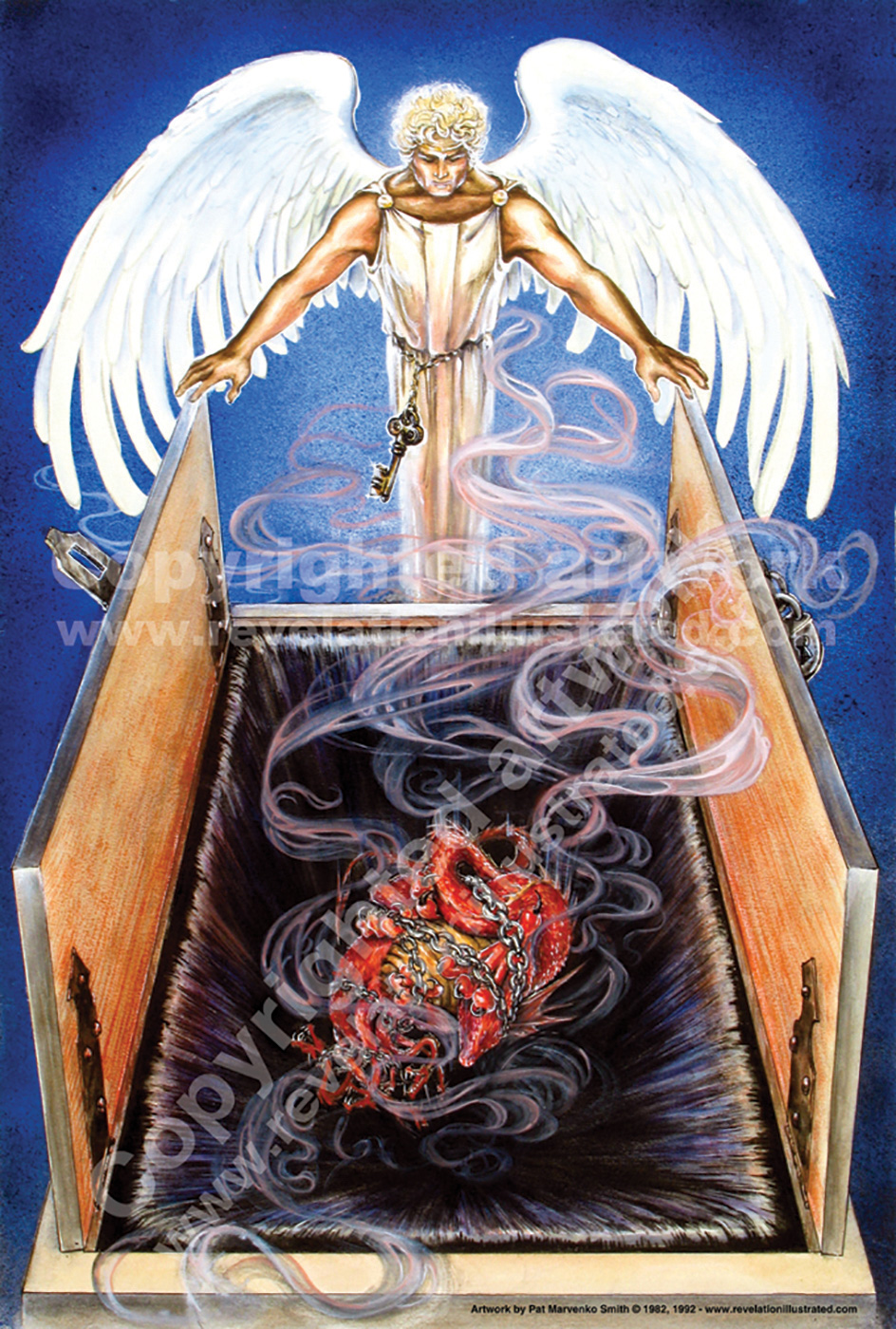
And I saw an angel come down from heaven, having the key of the bottomless pit and a great chain in his hand. And he laid hold on the dragon, that old serpent, which is the Devil, and Satan, and bound him a thousand years, (Revelation 20:1-2)

When Jesus entered Jerusalem almost 2000 years ago on the back of a donkey’s colt, He presented Himself as melek shâlêm, “King of Peace.” Now, He comes on a white horse as the conquering KING OF KINGS and LORD OF LORDS.[1] In the previous chapter of Revelation, we learned that He comes to rule “with a rod of iron.” Unlike kings that have come before, His rule will be absolute but benevolent, and He will reign on Earth for a thousand years.

The question arises here about the thousand years. Are these literally 1000 years or should it be taken as symbolic of “a long time” or even eternity? Two main viewpoints exist. The premillennial view, in all of its variations, takes the position that the 1000 years should be taken literally. The amillennial view takes the position that the 1000 years should be taken symbolically and allegorically of the eternal reign of Christ.[2] In that view, the millennium symbolizes either the present church age or the eternal state. There are no 1000 years. The “a” prefixed to “millennium” negates the millennium, therefore, there is “no millennium.” Along with that view is the idea that the Church is responsible for preparing the world for Christ’s return. That idea should make one ask, “How well is the Church doing in that regard?”

Without wasting keystrokes, let me just say that the amillennial view is wrong. At the same time, I need to stress that those that hold that view are not lost. One’s eschatological view is not a salvation issue. Faith in CHRIST ALONE is the only requirement for entry into heaven. That said, the amillennial view is wrong for two very fundamental reasons. First of all, as we read Revelation 20:1-7, there is nothing in the text to indicate that the 1000 years should be taken in any other way than literally. Secondly, in the first seven verses of the twentieth chapter, the phrase “a thousand years” is repeated SIX TIMES. When the Bible says something once, it should be taken as fact simply based on the fact that it is God’s Word. When the Bible repeats something twice, it should get our attention. If it repeats something three times, we need to take it very seriously. Here, the Bible repeats “a thousand years” six times. To take it to mean anything other than what it says is poor hermeneutics and just foolishness.

“And I saw an angel come down from heaven, having the key of the bottomless pit and a great chain in his hand. And he laid hold on the dragon, that old serpent, which is the Devil, and Satan, and bound him a thousand years” (Revelation 20:1-2, emphasis mine). At the sounding of the fifth trumpet, we saw an angel (a star) “fall from heaven unto the earth: and to him was given the key of the bottomless pit” (Revelation 9:1, emphasis mine). In my opinion, that angel was a demon who did not have possession of the key to the bottomless pit, but rather that it was “given” to him. Here we have a different angel. This angel does not “fall” out of heaven, but he comes down from heaven. Also, he is not “given” the key to the bottomless pit, but he has possession of it. This angel is probably the one that handed the key over to the demonic angel back in Revelation 9:1. This angel is the keeper of the key. He takes a “great chain” and lays “hold on the dragon, that old serpent, which is the Devil, and Satan” and binds him for a thousand years. Without a doubt, Satan is a powerful creature, but God’s angel has no trouble subduing him. “And cast him into the bottomless pit, and shut him up, and set a seal upon him, that he should deceive the nations no more, till the thousand years should be fulfilled: and after that he must be loosed a little season” (Revelation 20:3, emphasis mine). This is the second time the “thousand years” is mentioned. How long will Satan be bound? – a thousand years!

“And I saw thrones, and they sat upon them, and judgment was given unto them: and I saw the souls of them that were beheaded for the witness of Jesus, and for the word of God, and which had not worshipped the beast, neither his image, neither had received his mark upon their foreheads, or in their hands; and they lived and reigned with Christ a thousand years” (Revelation 20:4, emphasis mine). John mentions two distinct groups here. Those seated on thrones represent the Church (the Bride of Christ) that was raptured before the Tribulation. Those that were “beheaded for the witness of Jesus … which had not worshipped the beast, etc.” are those who were martyred during the Tribulation. Together, they will be involved in the administration of Christ’s reign on Earth. How long will they reign with Christ? – a thousand years!

John does not detail the Millennium. What will the Millennium be like? For that, we need to check with other prophets. One of the reasons the Jews in Jesus’ day missed their promised Messiah was because they were looking for a reigning monarch as described by the prophets. They rejected the prophecies that foretold of His suffering, death on the cross, and His resurrection. However, the Old Testament prophecies are clear on that regard. Of Millennium, Clarence Larkin says, “It is to be regretted … that the world ‘Millennium’ ever supplanted the Biblical word ‘Kingdom,’ for it is this period that Christ taught His Disciples to pray for the petition ‘Thy Kingdom Come.’[3]

In his book, Larkin presents five distinct characteristics of the Millennium.[4] (1) Satan is bound.[5] One advantage people living in the Millennium will have over our “first parents” in the Garden of Eden, is that neither Satan, nor his demons, will be around to tempt people to sin. However, this will only serve to prove that mankind does not need a lot of help or encouragement to rebel against God.[6] With Satan out of the picture, there will be no one around to stir up hate and strife and the world will enjoy true peace; there will be no more wars and there is the promise that men “shall beat their swords into plowshares, and their spears into pruninghooks.”[7]

(2) The revival of Israel. When Larkin wrote his book, the nation of Israel did not exist. At the end of World War I in 1917, efforts were started to establish a “national home for the Jewish people.” The brainchild of British Foreign Secretary, Artur James Balfour, the “Balfour Declaration” set aside the original homeland of the Jews, called Palestine at that time. The fruit of that effort was not realized until May 14, 1948, when Israel was reborn in the Promised Land. Although Israel exists in the present, it is only a partial fulfillment of what was prophesied in the Old Testament. The complete fulfillment will not be realized until the Millennium, but the fact that Israel exists presently lets us know that the fulfillment in full is much closer than we might think. It is no longer the same land that Mark Twain visited in 1867. His impression was that it was a “rocky and bare, repulsive and dreary … landscape … There was hardly a tree or a shrub any where. Even the olive and the cactus, those fast friends of a worthless soil, had almost deserted the country.”[8] He should see it now![9]

(3) There will be changes in the animal kingdom. In God’s original creation, before the Fall, man and animals were herbivorous.[10] There will be complete harmony between mankind and animals and among all the animals.[11] We will not be killing off each other for food.

(4) Human life will be prolonged. We read in the genealogical record[12] before the flood that lifespans averaged over 900 years. In the Millennium, long lifespans will be the norm. The Prophet Isaiah records, “There shall be no more thence an infant of days, nor an old man that hath not filled his days: for the child shall die an hundred years old; but the sinner being an hundred years old shall be accursed” (Isaiah 65:20, emphasis mine). I must emphasize that those who do die are those who came through the Tribulation in their natural bodies. They will have the ability to reproduce and repopulate the earth. Those who do die, in my opinion, will be those who in some way or another violate the absolute law of Christ (i.e., “the sinner”) Who will “rule with a rod of iron.” Lawbreakers (“sinners”) will not be tolerated in the Millenium. Those who return with Christ at His Second Coming, the Raptured saints (the Bride of Christ), and the Tribulation saints, have their glorified bodies[13] that are not subject to disease or death.

(5) There will be a sevenfold increase of light. “Moreover the light of the moon shall be as the light of the sun, and the light of the sun shall be sevenfold, as the light of seven days, in the day that the LORD bindeth up the breach of his people, and healeth the stroke of their wound” (Isaiah 30:26). I am not sure whether this refers to the Millennium or to the New Heaven and New Earth, but Larkin seemed to think it referred to the Millennium. We will know soon.

“But the rest of the dead lived not again until the thousand years were finished. This is the first resurrection” (Revelation 20:5, emphasis mine). We saw the Beast and the False Prophet cast alive into the “lake of fire,”[14] but the armies that followed them “were slain with the sword of him that sat upon the horse, which sword proceeded out of his mouth: and all the fowls were filled with their flesh” (Revelation 19:21). These go to “the grave,” a.k.a., hell, a.k.a., hades, a.k.a., the abode of the dead, a.k.a., “Torments.” Jesus referred to this place when He recounted the death of the rich man and Lazarus.[15] These will be resurrected and face the Great White Throne Judgment[16] at the end of – how many years? – a thousand years.

“Blessed and holy is he that hath part in the first resurrection: on such the second death hath no power, but they shall be priests of God and of Christ, and shall reign with him a thousand years” (Revelation 20:6, emphasis mine). The first resurrection takes place at the Rapture.[17] Those caught up in the Rapture will have their bodies transformed into glorified eternal bodies that will never grow old or experience pain of any sort. “For our [citizenship] is in heaven; from whence also we look for the Saviour, the Lord Jesus Christ: Who shall change our vile body, that it may be fashioned like unto his glorious body, according to the working whereby he is able even to subdue all things unto himself” (Philippians 3:20-21, emphasis mine). I am certain the Tribulation saints will have glorified bodies also, but how they receive their new bodies we are not told. I suspect that they will receive them instantly when they die; however, I am not certain about that. The good news is that “the second death hath no power” over them. The “second death” is an eternity in “the lake of fire.”[18] Instead, they reign with Christ – for how long? – a thousand years!

“And when the thousand years are expired, Satan shall be loosed out of his prison” (Revelation 20:7, emphasis mine). After – how many years? – a thousand years of perfect peace on Earth, Satan is once again loosed on the earth. Why? We will see in my next article – if the Lord wills. Another argument against amillennialism is that the 1000 years has an expiration date; therefore, it cannot be eternal. These verses make it clear that the Lord Jesus Christ will reign as KINGS OF KINGS and LORD OF LORDS for a thousand years.

How about you, reader? Will you experience the thousand-year reign of Christ? If you do not know the Savior, do not wait any longer. The time is short. Please read my page on “Securing Eternal Life.”

Notes:


[1]  Revelation 19:15-16

[2]  What is Amillenialism? Beliefs & Chart (crosswalk.com)

[3]  Clarence Larkin, The Book of Revelation Illustrated, (Rev. Clarence Larkin Estate, Philadelphia, 1919), p. 180.

[4]  Ibid, pp. 188-191

[5]  Revelation 20:1-2

[6]  Revelation 20:7-10

[7]  Micah 4:3-4

[8]  https://blog.nli.org.il/en/mark-twain-in-palestine/

[9]  Psalm 67:6; Isaiah 35:1; 55:13; Joel2:24-26; Amos 9:13

[10]  Genesis 1:29-30

[11]  Isaiah 11:6-9

[12]  Genesis 5

[13]  1 Corinthians 15:51-54

[14]  Revelation 19:20

[15]  Luke 16:19-31

[16]  Revelation 20:11

[17]  1 Corinthians 15:51-54; 1 Thessalonians 4:13-17

[18]  Revelation 20:14

1 Comment

Filed under Apologetics, Bible, Christianity, Current Events, End Times, Eschatology, Rapture, Resurrection, Satan, Second Coming of Christ, Theology

The King Is Coming!

Art used by permission by Pat Marvenko Smith, Copyright 1992.
Visit her “Revelation Illustrated” site at https://revelationillustrated.com/

And I saw heaven opened, and behold a white horse; and he that sat upon him was called Faithful and True, and in righteousness he doth judge and make war. (Revelation 19:11)

The heavenly wedding reception is concluded. Now it is time to ride! The next thing John saw is reminiscent of his first sight of heaven. “After this I looked, and, behold, a door was opened in heaven: and the first voice which I heard was as it were of a trumpet talking with me; which said, Come up hither, and I will shew thee things which must be hereafter” (Revelation 4:1, emphasis mine). At that time, he was on the outside looking in. Now he is on the inside looking out. “And I saw heaven opened, and behold a white horse; and he that sat upon him was called Faithful and True, and in righteousness he doth judge and make war (Revelation 19:11, emphasis mine). The door of heaven opens and this time he sees a rider on a white horse. However, this is not the rider on a white horse that he saw at the breaking of the first seal.[1] That rider had a crown (a stephanos not a diadēma) and a bow with no arrows, and he went out “conquering and to conquer.” We identified that rider on a white horse as the Antichrist, the Beast. However, this rider is “called Faithful and True.” He does not break His promises, and there is no falsehood in Him. He judges rightly and He executes judgment, i.e., “war” rightly.

“His eyes were as a flame of fire, and on his head were many crowns; and he had a name written, that no man knew, but he himself” (Revelation 19:12). That His eyes are “a flame of fire,” tells us that His eyes can pierce and penetrate the hardest heart and expose it completely so that nothing is hidden. On His head, He wears many diadēmas, royal crowns. These are the royal crowns of all earthly kings combined and then some, signifying His absolute, universal sovereignty. He has a name known only to Himself. When “the Angel of the Lord” appeared to Samson’s parents, they asked His name. “And the angel of the Lord said unto him, Why askest thou thus after my name, seeing it is secret?” (Judges 13:12, emphasis mine). The Hebrew word translated as “secret” is pil’ı̂y meaning “wonderful, incomprehensible, extraordinary” “Incomprehensible” seems the most fitting here. His name encompasses His essence, all that He is. When Moses asked God’s name, He answered, “I AM THAT I AM … say to the children of Israel, I AM hath sent me unto you” (Exodus 3:14). We will never know the full extent of all that God is, not even though all eternity. His name is too wonderful for us to comprehend.

“And he was clothed with a vesture dipped in blood: and his name is called The Word of God” (Revelation 19:13). The blood on His clothing is not His own, but the blood of His enemies. The Prophet Isaiah foresaw this day. “Who is this that cometh from Edom, with dyed garments from Bozrah? this that is glorious in his apparel, travelling in the greatness of his strength? I that speak in righteousness, mighty to save. Wherefore art thou red in thine apparel, and thy garments like him that treadeth in the winefat? I have trodden the winepress alone; and of the people there was none with me: for I will tread them in mine anger, and trample them in my fury; and their blood shall be sprinkled upon my garments, and I will stain all my raiment. For the day of vengeance is in mine heart, and the year of my redeemed is come” (Isaiah 63:1-4, emphasis mine).

I want to keep my focus on the Book of Revelation and not get too distracted by differing opinions on the logistics of Jesus’ Second Coming. The Prophet Zachariah says that when Jesus returns, His foot will touch down on the Mount of Olives and the mountain will split in two to the north and to the south.[2] Isaiah says He will come from Edom and Bozrah, which is in modern-day Jordan, on the eastern bank of the Jordan River. God’s Word is true and without error, but sometimes we cannot grasp the exactness of God’s plan. These differing prophecies were given to different prophets at different times and there was no collaboration among them, so they become a puzzle for us. So, without giving getting into any controversy, I put forth my opinion (which could be wrong, so do not take it as “gospel”). As I understand, Jesus first touches down at the Mount of Olives, then goes to Edom (Jordan) to take care of business there, and then heads northwest to the Jezreel to finish the battle of Armageddon. The point is that his robes will get bloody, as described.

“And the armies which were in heaven followed him upon white horses, clothed in fine linen, white and clean” (Revelation 19:14). The “armies” of heaven include both His saints – the Bride – and a host of angels. Albert Barnes seems to agree. “The heavenly hosts; particularly, it would seem, the redeemed, as there would be some incongruity in representing the angels as riding in this manner. Doubtless the original of this picture is Isa_63:3; ‘I have trodden the wine-press alone, and of the people there was none with me.’ These hosts of the redeemed on white horses accompany him to be witnesses of his victory, and to participate in the joy of the triumph, not to engage in the work of blood.”[3] The white horses on which we will ride signify the victory which we will share with our King. Our white, clean linen clothing is our bridal gown with which we are dressed. “And to [the Bride] was granted that she should be arrayed in fine linen, clean and white: for the fine linen is the righteousness of saints” (Revelation 19:8). We return with Him, but the fight is all His.

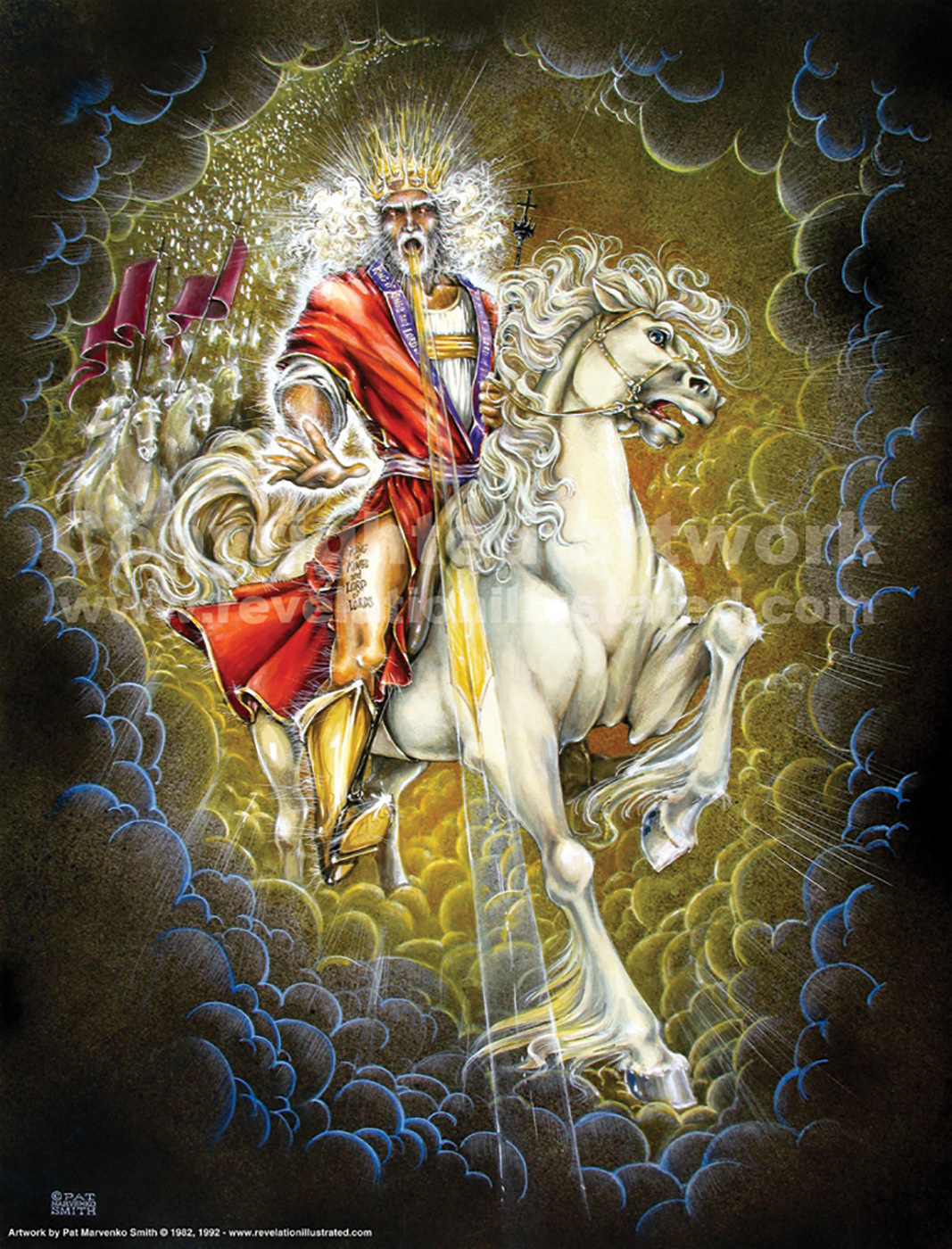
“And out of his mouth goeth a sharp sword, that with it he should smite the nations: and he shall rule them with a rod of iron: and he treadeth the winepress of the fierceness and wrath of Almighty God. And he hath on his vesture and on his thigh a name written, KING OF KINGS, AND LORD OF LORDS” (Revelation 19:15-16, emphasis mine). In the beginning, God (Jesus), created ex-nihilo, out of nothing, with only the command of His Word.[4] He spoke all of His creation (except for man) into being. He said “Let there be…” and there was. The human author of Revelation, John, in his Gospel, identified “the Word” as the Creator. “All things were made by him; and without him was not any thing made that was made” (John 1:3). Later he identifies “the Word” as Jesus. “And the Word was made flesh, and dwelt among us, (and we beheld his glory, the glory as of the only begotten of the Father,) full of grace and truth” (John 1:14). “The Word” is the manifested, incarnate Word of God. All of the written Word of God is wrapped up in the Person of Jesus Christ. “For the word of God is quick [i.e., “living”], and powerful, and sharper than any twoedged sword, piercing even to the dividing asunder of soul and spirit, and of the joints and marrow, and is a discerner of the thoughts and intents of the heart. Neither is there any creature that is not manifest in his sight: but all things are naked and opened unto the eyes of him with whom we have to do” (Hebrews 4:12-13, emphasis mine). We often take verse 12 and apply it to the Bible, which it certainly does apply. However, the following verse makes clear that “the word of God” is a Person and applies masculine pronouns to Him. The Word of God is none other than Jesus. So, here we see “a sharp sword” proceeding from His mouth. That is none other than His spoken Word. When He confronts His enemies, He will speak and they will all die immediately.

He comes to reign over the inhabitants of Earth, and His rule will be absolute. “He shall rule them with a rod of iron.” All those that have taken the mark of the Beast will die. Many who come to faith in Christ after the Rapture and manage to survive the Tribulation will see Christ return and they will enter the Millennial Kingdom in their natural bodies. Perhaps there will be others who did not come to faith in Christ, but neither did they take the mark of the beast. These too will enter the Millennial Kingdom in their natural bodies. Together, they will repopulate the earth (more on that in the next article). These are they that “He shall rule them with a rod of iron.”[5] He comes as “KING OF KINGS, AND LORD OF LORDS,” and of that, there will be no question.

“And I saw an angel standing in the sun; and he cried with a loud voice, saying to all the fowls that fly in the midst of heaven, Come and gather yourselves together unto the supper of the great God; That ye may eat the flesh of kings, and the flesh of captains, and the flesh of mighty men, and the flesh of horses, and of them that sit on them, and the flesh of all men, both free and bond, both small and great” (Revelation 19:17-18). I heard Amir Tsarfati,[6] who is an Israeli citizen and living near the Jezreel Valley (Armageddon), recently comment that he has noticed an increase in the number and variety of birds migrating through the valley. Perhaps God is calling them in preparation for the feast on “the flesh of kings, and the flesh of captains, and the flesh of mighty men, and the flesh of horses, and of them that sit on them, and the flesh of all men, both free and bond, both small and great” who will perish instantly from the “sharp sword” that proceeds from the mouth the “KING OF KINGS, AND LORD OF LORDS.”

“And he gathered them together into a place called in the Hebrew tongue Armageddon” (Revelation 16:16, emphasis mine). “And I saw the beast, and the kings of the earth, and their armies, gathered together to make war against him that sat on the horse, and against his army” (Revelation 19:19, emphasis mine). The “Battle of Armageddon” is a misnomer because it will not be much of a battle at all. The Word will go out of Jesus’ mouth, and instantly, it will all be over.

“And the beast was taken, and with him the false prophet that wrought miracles before him, with which he deceived them that had received the mark of the beast, and them that worshipped his image. These both were cast alive into a lake of fire burning with brimstone” (Revelation 19:20, emphasis mine). The Antichrist and his false prophet get no trial. They are sent directly to the “lake of fire burning with brimstone,” i.e., Hell, for all eternity. What about Satan, the Dragon? We will see in the next chapter.

“And the remnant were slain with the sword of him that sat upon the horse, which sword proceeded out of his mouth: and all the fowls were filled with their flesh” (Revelation 19:21). Just like that, the battle is over and Jesus reigns victoriously. However, that is not the end of the story. The best is yet to come!

How about you, reader? Will you be on the winning side? If you do not know the Savior, do not wait any longer. The time is short. Please read my page on “Securing Eternal Life.”

Notes:


[1]  Revelation 6:1-2

[2]  Zechariah 14:4

[3]  Albert Barnes, Albert Barnes’ Notes on the Bible, (Published in 1847-85; public domain).

[4]  Genesis 1

[5]  Psalm 2:9; Revelation 2:27; 12:5

[6]  Amir Tsarfati – Behold Israel

Comments Off on The King Is Coming!

Filed under Apologetics, Christianity, End Times, Eschatology, Rapture, Satan, Second Coming of Christ, Theology

Heavenly Wedding Reception

Let us be glad and rejoice, and give honour to him: for the marriage of the Lamb is come, and his wife hath made herself ready. (Revelation 19:7)

I have never been a bride, so I have no idea how a bride feels when the big day comes, and all her wedding plans come to fruition. She gets to take center stage at the wedding ceremony and later at her reception. It is a day for which she has prepared for months – picking the perfect bridal gown, selecting the perfect colors for her theme, selecting the floral arrangements, picking the perfect venue, choosing her wedding party, etc. It must be exhausting, yet exhilarating when the day finally comes.

Soon, I will experience the greatest wedding ever as part of the Bride that will join her Groom at a heavenly wedding. It will be a wedding unmatched by the grandest royal wedding ever seen on Earth. However, before the party starts, John sets up the scene.

“And after these things I heard a great voice of much people in heaven, saying, Alleluia; Salvation, and glory, and honour, and power, unto the Lord our God: For true and righteous are his judgments: for he hath judged the great whore, which did corrupt the earth with her fornication, and hath avenged the blood of his servants at her hand” (Revelation 19:1-2, emphasis mine). These “people in heaven” are Christians who died in Christ,[1] Christians who did not die but were raptured,[2] and those who missed the Rapture, but came to faith in Christ during the Tribulation and died for their faith.[3] These praise and worship God for His “true and righteous” judgments. All that God does is true and right. All the judgments of the Tribulation had a twofold purpose: (1) to give a final opportunity for people to repent and turn to Christ, and (2) to punish those who continue to reject God’s free offer of salvation. The psalmist put it succinctly when he said, “The LORD is righteous in all his ways, and holy in all his works” (Psalm 145:17). In His righteousness, He avenges the blood of His martyred saints. The Lord says, “To me belongeth vengeance, and recompence; their foot shall slide in due time: for the day of their calamity is at hand, and the things that shall come upon them make haste” (Deuteronomy 32:35). Of the time of Tribulation, Jesus said, “For these be the days of vengeance, that all things which are written may be fulfilled” (Luke 21:22).

“And again they said, Alleluia. And her smoke rose up for ever and ever” (Revelation 19:3). The whole heaven celebrates the demise of the “great whore.”[4] I believe this takes place in the immediate future of the Revelation timeline. At this point, Jesus is ready to return to Earth as King of kings and Lord of lords to destroy Babylon the Great for all eternity. So, the praise of these saints is given in the past tense as if the deed has already taken place.

“And the four and twenty elders and the four beasts fell down and worshipped God that sat on the throne, saying, Amen; Alleluia. And a voice came out of the throne, saying, Praise our God, all ye his servants, and ye that fear him, both small and great” (Revelation 19:4-5). We see the 24 elders[5] and the four beasts[6] once more. As discussed in a previous article,[7] the 24 elders are possibly the patriarchs of the 12 tribes of Israel plus the 12 Apostles, but at any rate, they represent the redeemed of all time. The four beasts represent God’s creation: the wild animal kingdom, domesticated animals, birds, and mankind. These give constant praise to God.

In the first five verses of this nineteenth chapter, we see the word “Alleluia” repeated three times, which seems appropriate for the triune Godhead reflecting His perfection. “Alleluia” is the Greek transliteration of the Hebrew word “hallelujah” which means “praise Yahweh” (the LORD). Interestingly, the word appears nowhere else in Scripture, neither in the OT nor the NT, except here in this chapter of Revelation.[8] There are many references to giving praises to God, however, that particular word is only used here. That makes its significance all the greater! The call to worship is directed to “all ye his servants, and ye that fear him, both small and great.” “Ye” is a plural, second-person pronoun. “All” is all-inclusive. In Texas, we would say, “all y’all” to include everyone and exclude no one. All “His servants” includes all the saints, and all the host of angels of all kinds and stations; all “that fear Him, both small and great.” Imagine the thunderous praise given to the Almighty Creator of Heaven and Earth!

“And I heard as it were the voice of a great multitude, and as the voice of many waters, and as the voice of mighty thunderings, saying, Alleluia: for the Lord God omnipotent reigneth” (Revelation 19:6). Praise the Lord! Alleluia! The Lord – the master, owner, and possessor of Heaven and Earth, the great potentate and sovereign – God – the One and Only true, triune God – omnipotent – almighty, all-powerful – reigns – He has absolute authority and rule over His creation, the universe, and all it contains.

Here comes the Bride! However, before proceeding, I want to share some things about a Jewish wedding, particularly a Galilean wedding, since most of Jesus’ ministry focused in the Galilean region, and all of His disciples were Galileans. Hence, they could relate to His illustrations, where those illustrations make little sense to us who are so far removed. Some of this I learned from a documentary DVD entitled Before the Wrath.[9] During His earthly ministry, Jesus made many references to weddings and marriage. Indeed, His first miracle was to turn water into wine at a wedding in Cana.[10]

In the Galilean custom, there was a betrothal before the marriage. We recall that Jesus’ mother, Mary, was “betrothed” to Joseph. We read in Matthew’s Gospel, “Now the birth of Jesus Christ was on this wise: When as his mother Mary was [betrothed] to Joseph, before they came together, she was found with child of the Holy Ghost. Then Joseph her husband, being a just man, and not willing to make her a publick example, was minded to put her away privily” (Matthew 1:18-19, emphasis mine). The betrothal was a written contractual agreement that was legally binding. Even though the couple lived apart during the betrothal period, they were considered to be married. Mary, coming up pregnant (and not by Joseph) created a serious breach of contract. Mary could be charged with adultery, and, at Joseph’s discretion, could be put to death by stoning.

To affect the betrothal, the prospective groom came to the bride’s father, in the presence of the town’s people as witnesses, and presented the written proposal/marriage contract that both the groom and bride signed. The groom presented a gift, something like a dowry, to the father of the bride. This was not a purchase price for the bride but rather “insurance” in case something happened to the groom before the marriage took place. In such a case, the bride would be taken care of.

Next, the groom offered the bride a cup of wine called the “cup of joy.” At any point in this process, the bride was free to accept or reject the proposal. If she agreed to the proposal, she would drink from the cup. The groom would then take and drink from the cup as well. Then he would say, “I will not drink of this cup again until I drink it anew with you in my father’s house.”

The groom would then return to his father’s house to build a bridal chamber as an addition to his father’s house for his bride. The process took about a year, and it was up to the groom’s father to determine when the room was ready. Ultimately, the father controlled when the wedding would take place. The bride, in the meantime, had her own preparations to make for the wedding. Not only did she have to make her wedding gown, but she needed to start collecting the things she would need to set up housekeeping.

Once the groom completed the bridal chamber and with the father’s approval and at the father’s direction, he would go get his bride. This usually occurred in the middle of the night when the whole town was sleeping. The groom sounded a ram’s horn that alerted the town that he was going for his bride. The whole town joined the parade. The bride had been ready long before this day arrived. She slept in her bridal gown. She kept her lamp full of oil and even kept some extra. Neither she nor the groom knew the day or the hour when this event would take place, but she was ready.

The groomsmen prepared a litter for the bride to sit in as they lifted her off the ground and carried her to the place the groom had prepared for her. This was known as “flying the bride” to the groom’s house. Once at the house, all those that could fit entered the house to celebrate, and they celebrated for seven days (one week). When the house was full, the doors were closed and no one else could enter.

With this understanding, we can clearly see what Jesus taught about His second coming, particularly as it relates to His Bride, the Church. At the Last Supper, Jesus presented His contract to His Bride. “And as they were eating, Jesus took bread, and blessed it, and brake it, and gave it to the disciples, and said, Take, eat; this is my body. And he took the cup, and gave thanks, and gave it to them, saying, Drink ye all of it; For this is my blood of the new testament, which is shed for many for the remission of sins. (Matthew 26:26-28, emphasis mine). The “contract” was signed with His body and blood. He called it “the new testament” or “covenant” or “contract.” The Bride was His disciples and those that would succeed them in faith. They all took the cup and drank of it in acceptance of the covenant. The betrothal was in effect. Jesus then said, “But I say unto you, I will not drink henceforth of this fruit of the vine, until that day when I drink it new with you in my Father’s kingdom” (Matthew 26:29).

Before adjourning from their Passover meal, Jesus prepared His Bride for what would come. “Let not your heart be troubled: ye believe in God, believe also in me. In my Father’s house are many mansions: if it were not so, I would have told you. I go to prepare a place for you. And if I go and prepare a place for you, I will come again, and receive you unto myself; that where I am, there ye may be also” (John 14:1-3, emphasis mine). This is the Groom’s promise that He is going to prepare a place for His Bride, and when the Father gives His approval, the Groom will sound the trumpet and descend to get His Bride, the Church, so that she can spend eternity with Him.

Now, while the Groom is away, the Bride must busy herself in preparation for the marriage. Jesus told a parable[11] about “a certain nobleman” (Himself) going away on a journey to receive a kingdom. Before leaving, He gave His stewards, ten of them, each equal amounts of money to invest in His kingdom. With that, He charged them saying, “Occupy till I come” (Luke 19:13). That is what the Bride is to do while the Groom is away preparing a place for her. There was also the matter of the “gifts” the Groom gives His Bride as “insurance.” That comes in the form of the Holy Spirit,[12] who Paul calls the “seal”[13] or guarantee of the promise.

In the meantime, the Bride awaits the shout, “Behold, the bridegroom cometh; go ye out to meet him” (Matthew 25:6). However, the Bride cannot join her Groom in ordinary clothes, she must be changed. The Apostle Paul provides insight into this transformation. “Behold, I shew you a mystery; We shall not all sleep, but we shall all be changed, In a moment, in the twinkling of an eye, at the last trump: for the trumpet shall sound, and the dead shall be raised incorruptible, and we shall be changed. For this corruptible must put on incorruption, and this mortal must put on immortality. (1 Corinthians 15:51-53, emphasis mine). In another place he says, “For this we say unto you by the word of the Lord, that we which are alive and remain unto the coming of the Lord shall not [go before] them which are asleep. For the Lord himself shall descend from heaven with a shout, with the voice of the archangel, and with the trump of God: and the dead in Christ shall rise first: Then we which are alive and remain shall be caught up together with them in the clouds, to meet the Lord in the air: and so shall we ever be with the Lord” (1 Thessalonians 4:15-17, emphasis mine). Just as the Galilean bride was “flown” to the groom’s house, so will the Bride of Christ be flown to His house.

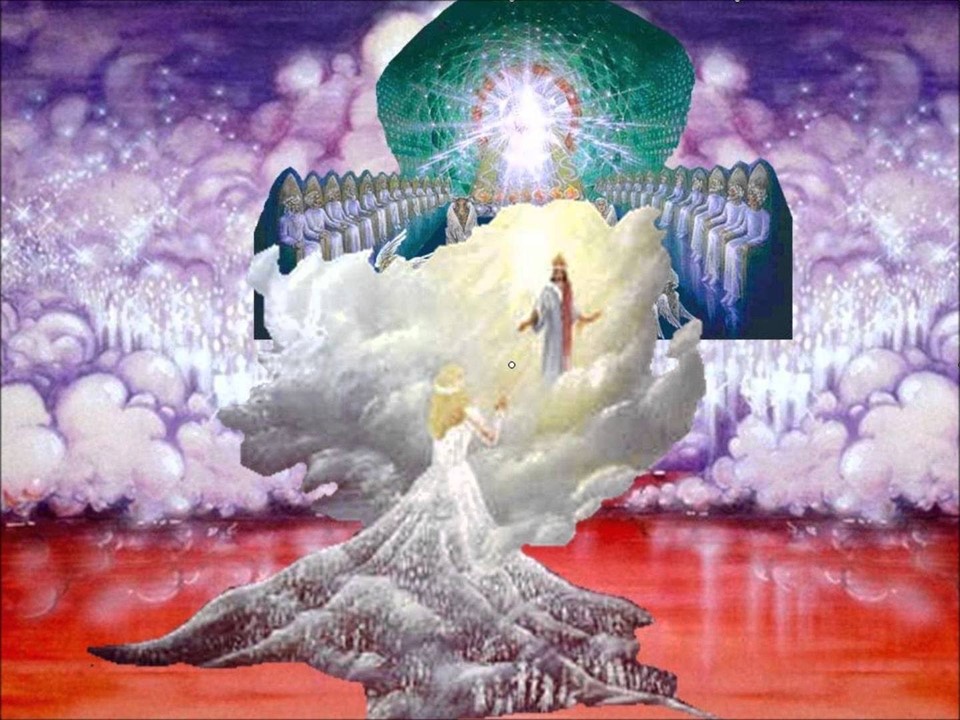
When that happens, the marriage will take place. “Let us be glad and rejoice, and give honour to him: for the marriage of the Lamb is come, and his wife hath made herself ready” (Revelation 19:7, emphasis mine). John records “the marriage of the Lamb” just prior to Jesus’ return to Earth as King of kings and Lord of lords, but that would seem to make the marriage a rushed affair. Thinking back on the Galilean wedding; the festivities went on for seven days. That would parallel Daniel’s final week[14] – seven years. In the Galilean wedding, the festivities started when the bride entered the groom’s house. For the Church, that begins when the trumpet sounds and Jesus calls “Come up hither” (Revelation 4:1). Then during those seven years, as Bride will be examined, not for punishment, but for rewards. “Wherefore we labour, that, whether present or absent, we may be accepted of him. For we must all appear before the judgment seat of Christ; that every one may receive the things done in his body, according to that he hath done, whether it be good or bad” (2 Corinthians 5:9-10, emphasis mine). “Every man’s work shall be made manifest: for the day shall declare it, because it shall be revealed by fire; and the fire shall try every man’s work of what sort it is. If any man’s work abide which he hath built thereupon, he shall receive a reward. If any man’s work shall be burned, he shall suffer loss: but he himself shall be saved; yet so as by fire” (1 Corinthians 3:13-15, emphasis mine). All this will take place in Heaven during the seven years of Tribulation on Earth.

Therefore, I see John’s report as the culmination of the wedding feast as the Bride prepares to follow her Bridegroom as He receives His kingdom. “And to her was granted that she should be arrayed in fine linen, clean and white: for the fine linen is the righteousness of saints” (Revelation 19:8). Above we considered the “judgment seat of Christ” where our “works” will be evaluated and rewards will be allocated based on how those works survive a “trial by fire.” All who stand before the judgment seat of Christ are saved by the blood of Christ, and nothing can annul that. However, our works here on earth will determine the rewards with which we will be clothed. Will our wedding gown be a nice, plain, unremarkable, white gown or will it be really fancy and decked out with elaborate lace and sparkling jewels? Either way, it is the “whiteness” that really matters.

“And he saith unto me, Write, Blessed are they which are called unto the marriage supper of the Lamb. And he saith unto me, These are the true sayings of God. And I fell at his feet to worship him. And he said unto me, See thou do it not: I am thy fellowservant, and of thy brethren that have the testimony of Jesus: worship God: for the testimony of Jesus is the spirit of prophecy” (Revelation 19:9-10, emphasis mine). “He” is probably the same angel that spoke to John in Revelation 17:1.[15] He makes what is probably one of the greatest understatements thus far: “Blessed are they which are called unto the marriage supper of the Lamb.” Blessed indeed! God has blessed me all my natural life far beyond what I deserve. I cannot begin to imagine the blessing of being in the presence of God, and “These are the true sayings of God.” John is so overwhelmed by what he has witnessed that he falls down to worship the angel. The angel quickly prohibits John from worshiping him. In the OT we often find “the angel of the Lord” accepting worship, which no ordinary angel would ever dare to do. This is how we recognize “the angel of the Lord” as a pre-incarnate manifestation of Jesus. He is God and worthy of worship. Here we are given a solid reason for studying prophecy: “the testimony of Jesus is the spirit of prophecy.” God promises that before He does anything, He will reveal it to His prophets. “Remember the former things of old: for I am God, and there is none else; I am God, and there is none like me, Declaring the end from the beginning, and from ancient times the things that are not yet done, saying, My counsel shall stand, and I will do all my pleasure” (Isaiah 46:9-10). Amen!

How about you, reader? Will you be seated at the marriage supper of the Lamb? If you do not know the Savior, do not wait any longer. The time is short. Please read my page on “Securing Eternal Life.”

Notes:


[1]  1 Thessalonians 4:16

[2]  1 Thessalonians 4:17

[3]  Revelation 6:9; 7:9, 14; 14:1-5

[4]  Revelation 18:1-2

[5]  Revelation 4:4, 10; 5:6, 8, 11,14; 7:11, 13; 11:16; 14:3

[6]  Revelation 4:6, 8; 5:6, 8, 14; 6:1, 6; 7:11; 14:3

[7]  The First Sight | Ernie’s Musings (erniecarrasco.com)

[8]  Revelation 19:1, 3, 4, 6

[9]  Before the Wrath (Official Film)

[10]  John 2:1-11

[11]  Luke 19:11-27

[12]  John 14-16

[13]  2 Corinthians 1:22; Ephesians 1:13; 4:30

[14]  Daniel 9:27

[15]  Beast-Riding Harlot | Ernie’s Musings (erniecarrasco.com)

Comments Off on Heavenly Wedding Reception

Filed under Apologetics, Bible, Christianity, End Times, Eschatology, Heaven, Rapture, Second Coming of Christ, Theology

The Collapse of Babylon

And after these things I saw another angel come down from heaven, having great power; and the earth was lightened with his glory. And he cried mightily with a strong voice, saying, Babylon the great is fallen, is fallen, and is become the habitation of devils, and the hold of every foul spirit, and a cage of every unclean and hateful bird. (Revelation 18:1-2)

I must confess a bit of confusion as I consider this next chapter in the Book of Revelation. In the previous chapter, we saw Mystery Babylon, the controlling religious system of the Tribulation period, destroyed by the Antichrist and the world leaders that used her to gain power and control over the people of the earth. “And the ten horns [i.e., the world leaders] which thou sawest upon the beast [the Antichrist], these shall hate the whore, and shall make her desolate and naked, and shall eat her flesh, and burn her with fire” (Revelation 17:16, emphasis mine).

However, we hear “another angel” – possibly the same Gospel angel of Revelation 14:8 – repeating similar words. “And he cried mightily with a strong voice, saying, Babylon the great is fallen, is fallen, and is become the habitation of devils, and the hold of every foul spirit, and a cage of every unclean and hateful bird. For all nations have drunk of the wine of the wrath of her fornication, and the kings of the earth have committed fornication with her, and the merchants of the earth are waxed rich through the abundance of her delicacies” (Revelation 18:2-3, emphasis mine). As we read further, on the surface, it appears as if the descriptions of “Babylon the Great” apply to Mystery Babylon, but she is also called “that great city Babylon, that mighty city!” (18:10). Because of the several references to merchants and commerce, most scholars see this Babylon as the commercial center of the Antichrist’s (the Beast) government. Then there is all the talk about the rulers of the world having “committed fornication with her” (18:3, 9). That is similar language applied to Mystery Babylon in the previous chapter. If this Babylon is just a commercial and political center, then why does the angel urgently call, “Come out of her, my people, that ye be not partakers of her sins, and that ye receive not of her plagues” (18:4)?

Perhaps my confusion finds resolution in amalgamating the two – a religious and commercial/political center. Clarence Larkin says, “If ‘Mystery Babylon’ was destroyed in the previous chapter then she cannot appear in this chapter, and the ‘City’ here described must be a literal city called Babylon…”[1] Most end-times prophecy teachers would agree with that. I can accept that; however, I suggest that the seat of both the “One-World” religious system and the “One-World” ruling system exist together in the same place. The demise of the religious system at the hands of the ruling system would leave a “residue” of the former so that the remaining ruling system (that of the Beast) would retain many of the same attributes; hence, the similar language used in condemnation of the city. Also, the “kings of the earth” and the “merchants” that lament the demise of “that great city” are probably not part of the “ten horns” over which the Beast rules; the cabal of the Beast are the ones that made “her desolate and naked … and burn[ed] her with fire” (Revelation 17:16). So, for the sake of simplicity, let us agree with those who say this Babylon is the commercial and political center of the Beast’s power after Mystery Babylon is removed.

The next question that comes up concerns the city, Babylon. Is the text to be taken literally or symbolically? Does the text refer to the literal Babylon in Iraq, or is it a “code name” for a different city and system? Those who suggest that Babylon is symbolic say that the term was used by the early church as a code name for Rome and the Roman Empire. They will cite Peter’s epistle where he says, “The church that is at Babylon, elected together with you, saluteth you; and so doth Marcus my son” (1 Peter 5:13, emphasis mine). “This epistle was written from Babylon, but scholars are divided as to whether this refers literally to Babylon in Mesopotamia or symbolically to Rome. There is no tradition that Peter went to Babylon, and in his day, it had few inhabitants. On the other hand, tradition consistently indicates that Peter spent the last years of his life in Rome. As a center of idolatry, the term ‘Babylon’ was an appropriate figurative designation for Rome.”[2]

However, that carries with it a certain degree of speculation based on “tradition,” which may or may not be valid. On the other hand, we are looking beyond the time of John, the human author of Revelation, into the end-times. Regardless of whether Peter was referring to actual Babylon or to Rome does not necessarily mean that John was referring to Rome in his account. When we read the text as we should – “if the plain sense makes sense, then look for no other sense or else you will end up in nonsense” – there is no indication that it should be taken in any other way than literally.

Still, some will claim that the original Babylon was destroyed fulfilling OT prophecy. Against Babylon, Isaiah prophesied, “It shall never be inhabited, neither shall it be dwelt in from generation to generation: neither shall the Arabian pitch tent there; neither shall the shepherds make their fold there” (Isaiah 13:20, emphasis mine). Similarly, Jeremiah prophesied, “And they shall not take of thee a stone for a corner, nor a stone for foundations; but thou shalt be desolate for ever, saith the LORD … And Babylon shall become heaps, a dwelling place for dragons, an astonishment, and an hissing, without an inhabitant … Her cities are a desolation, a dry land, and a wilderness, a land wherein no man dwelleth, neither doth any son of man pass thereby.” (Jeremiah 51:26, 37, 43, emphasis mine). The question we must ask is, have these prophecies been fulfilled literally? Frankly, the answer is a resounding NO! So, if they have not been fulfilled, and because the Word of the Lord is true and trustworthy, then they must be yet future.

Larkin gives a detailed history of Babylon beginning with its origins at the Tower of Babel.[3] Nebuchadnezzar made Babylon one of the wonders of the world. It retained its splendor after the conquering by the Persians and later the Greeks. After that, the city degraded but continued to be inhabited even during the time of the early church. Larkin, citing ancient historians, says that “the Jews left from the Captivity still resided there in large numbers, and in A.D. 60 we find the Apostle Peter working among them, for it was from Babylon that Peter wrote his Epistle (1 Pet. 5:13).”[4] The city, albeit no longer “great,” continued to be inhabited.

Larkin continues, “In A.D. 917 Ibu Hankel mentions Babylon as an insignificant village, but still in existence. About A.D. 1100 it seems to have again grown into a town of some importance, for it was then known as the ‘Two Mosques.’ Shortly afterward it was enlarged and fortified and received the name of Hillah, or ‘Rest.’ In A.D. 1898 Hillah contained about 10,000 inhabitants, and was surrounded by fertile lands and abundant date groves stretched along the banks of the Euphrates.”[5] Obviously, the prophecies of Isaiah, Jeremiah, and Revelation concerning the demise of Babylon are yet future, so the modern Babylon (Hillah) is certainly a contender for the one described in this chapter of Revelation.

However, some end-times prophecy students protest that this modern Babylon is too underdeveloped and too insignificant to qualify as the “great city” described in these verses. Currently, the population of Hillah (i.e., Babylon) is around 455,700;[6] that is about the size of Omaha, NE, USA, which is almost twice the size of the state capital, Lincoln. Just how “great” does it need to be for it to be of significant? With the technology we currently have in the world, the Beast could set up his headquarters anywhere and operate without any problems. If he needs a castle, he could have one built in less than a year. There is no reason, logistically or biblically for the Babylon of Revelation not being located in the original site of ancient Babel/Babylon.

“And I heard another voice from heaven, saying, Come out of her, my people, that ye be not partakers of her sins, and that ye receive not of her plagues. For her sins have reached unto heaven, and God hath remembered her iniquities. Reward her even as she rewarded you, and double unto her double according to her works: in the cup which she hath filled fill to her double” (Revelation 18:4-6, emphasis mine). As I noted earlier, I believe Revelation 18 is an amalgamation of Mystery Babylon and political Babylon, the seat of the Beast’s power. As Larkin pointed out, Babylon had a large population of Jews in Peter’s day. In a way, Peter was calling them out at that time to come out of her. During the Tribulation, the false religion of the Beast will be headquartered in the same place as the Beast, in Babylon. The call to “come out of her” is not only a call to leave the false religion, but to flee the city itself because of the coming judgment, but more so to leave the false religion and not be “partakers of her sins.” The sins of the false religion as well as the sins of the city “have reached unto heaven.” The charge seems to carry a double application, which is why I think this chapter applies to both Mystery Babylon and Babylon “the great city.”

“How much she hath glorified herself, and lived deliciously, so much torment and sorrow give her: for she saith in her heart, I sit a queen, and am no widow, and shall see no sorrow. (Revelation 18:7, emphasis mine). Her self-aggrandizement reminds me of the Church of Laodicea.  “Because thou sayest, I am rich, and increased with goods, and have need of nothing; and knowest not that thou art wretched, and miserable, and poor, and blind, and naked” (Revelation 3:17, emphasis mine). Although this aptly applies to Mystery Babylon, we need to keep in mind that the “religion” of the Beast and the Beast are tightly linked.

“Therefore shall her plagues come in one day, death, and mourning, and famine; and she shall be utterly burned with fire: for strong is the Lord God who judgeth her. And the kings of the earth, who have committed fornication and lived deliciously with her, shall bewail her, and lament for her, when they shall see the smoke of her burning, Standing afar off for the fear of her torment, saying, Alas, alas, that great city Babylon, that mighty city! for in one hour is thy judgment come. And the merchants of the earth shall weep and mourn over her; for no man buyeth their merchandise any more” (Revelation 18:8-11, emphasis). While there still remains some hints of Mystery Babylon in these verses, the application is clearly to “that great city Babylon.” Here we see the prophecies of Isaiah and Jeremiah concerning the demise of Babylon fulfilled in full.

Revelation 18:12-14 describe the lost trade for which the merchants of the world mourn. “The merchants of these things, which were made rich by her, shall stand afar off for the fear of her torment, weeping and wailing, And saying, Alas, alas, that great city, that was clothed in fine linen, and purple, and scarlet, and decked with gold, and precious stones, and pearls! For in one hour so great riches is come to nought. And every shipmaster, and all the company in ships, and sailors, and as many as trade by sea, stood afar off, And cried when they saw the smoke of her burning, saying, What city is like unto this great city! And they cast dust on their heads, and cried, weeping and wailing, saying, Alas, alas, that great city, wherein were made rich all that had ships in the sea by reason of her costliness! for in one hour is she made desolate” (Revelation 18:15-19, emphasis mine). We saw Mystery Babylon destroyed by the Beast and his ten horns in the previous chapter, and now her city and her center of influence is laid waste.

“Rejoice over her, thou heaven, and ye holy apostles and prophets; for God hath avenged you on her” (Revelation 18:20). From this time and forevermore, false religion has been removed from the earth. All the false religions spawned from Babylon, that persecuted the saints of God, are crushed into dust. This is cause for great rejoicing in heaven. The only One worthy of worship will now reign on Earth.

“And a mighty angel took up a stone like a great millstone, and cast it into the sea, saying, Thus with violence shall that great city Babylon be thrown down, and shall be found no more at all” (Revelation 18:21). As a millstone cast into the sea suddenly disappears from view leaving only ripples which soon subside, so will be the sudden destruction of Babylon the Great and all she represents without leaving a single ripple.

Next, the true Christ, the Lord of lords and King of kings comes to set up His kingdom on Earth for 1000 years. We will see that in the next chapter.

How about you, reader? Are you prepared to meet the coming King of kings and Lord of lords? If you do not know the Savior, do not wait any longer. The time is short. Please read my page on “Securing Eternal Life.”

Notes:


[1]  Clarence Larkin, The Book of Revelation, Illustrated, (Rev. Clarence Larkin Estate, Philadelphia, 1919), p. 155.

[2]  New American Standard Bible, The Open Bible Expanded Edition, (Thomas Nelson Publishers, Nashville, 1985), p. 1258.

[3]  Genesis 11:1-9

[4]  Larkin, p.157.

[5]  Ibid.

[6]  Hillah – Wikipedia

Comments Off on The Collapse of Babylon

Filed under Apologetics, Bible, Christianity, Current Events, End Times, Eschatology, Rapture, Religion, Satan, Second Coming of Christ, Theology