Category Archives: Current Events

A Day to Give Thanks

horn-of-plenty

In every thing give thanks: for this is the will of God in Christ Jesus concerning you. (1 Thessalonians 5:18)

In the “Jaywalking” segment of the “Tonight Show,” Jay Leno posed some Thanksgiving Day trivia questions to passersby, and the results were humorous and sad at the same time. Here is a sample of questions asked and the responses:

  1. What year was the first Thanks giving? 1966, 1492
  2. Pilgrims are often shown wearing what on their shoes and their hats? Moccasins
  3. What is a male turkey called? Fred, Richard
  4. 280 Million Americans will cook turkey on Thanksgiving. How many Americans are there in our country? 8 Million
  5. Where did the first Pilgrims land? Hawaii, the East Coast
  6. What President declared Thanksgiving a national holiday? Ronald Reagan, Theodore Roosevelt, Benjamin Franklin
  7. How many days did the first Thanksgiving last? Three: one day for breakfast, one day for lunch, and one day for dinner
  8. What is the name of the ship the Pilgrims came over on? the Nina
  9. Where did the Pilgrims come from? Spain

This may be good for a belly laugh, but it is really tragic that Americans today are so ignorant of our nation’s history and traditions. In today’s culture, Thanksgiving Day is just a good excuse to have a day (or two) off of work, indulge in gluttonous behavior, and worship before the luminous god of football followed by the giving of alms to the god of materialism the next day all the while in complete ignorance of the significance of the day.

It does not have to be that way. The psalmist said, “Therefore will I give thanks unto thee, O LORD, among the heathen, and sing praises unto thy name” (Psalm 18:49). The “heathen,” in this case, were the gôyim, Hebrew for the “nations” or the “Gentiles,” and by implication, the “godless.” Our attitude of thanksgiving should be a testimony to those that are without God not just on Thanksgiving Day, but everyday of our lives. In these “last days” we should live in contrast to those who are “lovers of their own selves, covetous, boasters, proud, blasphemers, disobedient to parents, unthankful, unholy (2 Timothy 3:2).

C. S. Lewis once said, “We ought to give thanks for all fortune: if it is ‘good,’ because it is good, if ‘bad’ because it works in us patience, humility and the contempt of this world and the hope of our eternal country.” Paul expressed this same idea when he said, “Not that I speak in respect of want: for I have learned, in whatsoever state I am, therewith to be content. I know both how to be abased, and I know how to abound: every where and in all things I am instructed both to be full and to be hungry, both to abound and to suffer need” (Philippians 4:11-12). We assimilate this attitude when “we know that all things work together for good to them that love God, to them who are the called according to his purpose” (Romans 8:28). “Them who are the called according to His purpose” do not live their lives like the “heathen” who are ungrateful or “unthankful” in their life conduct.

Perhaps the reason the “heathen” are unthankful is because they do not know to whom they should be thankful. That, of course, presupposes that in every other respect they are caring of others beyond themselves. If expressed at all, we often hear such empty platitudes as: I’m thankful for my job; I’m thankful for my family; I’m thankful for good friends, etc. That is fine, but thankful to whom?

When the Pilgrims landed at Plymouth in 1620, they arrived in the face of a harsh New England winter. They were without food and without shelter. Of the 121 souls that departed England to escape religious persecution and “for the Glory of God, and advancements of the Christian faith and honor of our King and Country,” only 47 of the original colonists survived that brutal winter. With the help of neighboring Indian tribes, the colonists learned to cultivate and enjoy the bounty of the land. At the harvest that followed, they celebrated a season of thanksgiving to God for His providence and protection. The third year after having landed, William Bradford officially proclaimed November 29, 1623 a day of thanksgiving.

In as much as the great Father has given us this year an abundant harvest … and in as much as He has protected us from the ravages of the savages, has spared us from pestilence and disease, has granted us freedom to worship God according to the dictates of our own conscience; now I, your magistrate, do proclaim that all ye Pilgrims, with your wives and ye little ones, do gather at ye meeting house on ye hill, between the hours of 9 and 12 in the day time, on Thursday, November ye 29th, of the year of our Lord one thousand six hundred and twenty-three … there to listen to ye pastor and render thanksgiving to ye Almighty God for all His blessings.

Our nation, from its beginning, has always set aside a special day to give thanks to God, but not always on a consistent basis. George Washington declared a national day of thanksgiving on November 26, 1789 with these words:

Whereas it is the duty of all nations to acknowledge the providence of Almighty God, to obey His will, to be grateful for his benefits, and humbly to implore His protection and favor … Now, therefore, I do recommend and assign Thursday, the twenty-sixth day of November next, to be devoted by the people of these United States to the service of that great and glorious Being, who is the beneficent Author of all the good that was, that is or that will be … that we may then unite in most humbly offering our prayers and supplications to the great Lord and Ruler of Nations, and beseech Him to pardon our national and other transgressions …

Would that our current national leaders adopt that attitude!

Finally, Thanksgiving Day was proclaimed an annual national holiday by President Abraham Lincoln in 1863. He said:

No human counsel hath devised, nor hath any mortal hand worked out these great things. They are the gracious gifts of the most high God, who, while dealing with us in anger for our sins, hath nevertheless remembered mercy … I do, therefore, invite my fellow citizens in every part of the United States, and those who are sojourning in foreign lands, to set apart and observe the last Thursday of November next as a day of Thanksgiving and Praise to our beneficent Father who dwelleth in the heavens … [it is] announced in the Holy Scriptures and proven by all history, that those nations are blessed whose God is the Lord … It has seemed fit to me and proper that God should be solemnly, reverently and gratefully acknowledged, as with one heart and one voice, by the whole American people.

This Thanksgiving Day, amid all the festivities and family gatherings, try to devote at least some time to “Sing unto the LORD, O ye saints of his, and give thanks at the remembrance of his holiness” (Psalm 30:4). “Praise God from whom all blessings flow.”


Comments Off on A Day to Give Thanks

Filed under Atheism, Christianity, Current Events, Holidays, Religion, Thanksgiving, Theology

What Do I Say?

USS Sperry (AS-12) 1941 - 1982

USS Sperry (AS-12) 1941 – 1982

For the nation and kingdom that will not serve thee shall perish; yea, those nations shall be utterly wasted. (Isaiah 60:12)

On the way to a coerced bargain safari with my wife, June, I pulled into the local Quick Trip to silence the nagging Low Fuel warning light on our Altima. At the pump, I popped the fuel port cover latch, got out from driver’s seat, and walked back to uncap the fuel fill port. Lost in the mindless routine of inserting the gas card, making the fuel selection, inserting the pump nozzle into the fill port and squeezing the handle to the start the flow of liquid gold, I hardly noticed the black compact sedan that pulled up at the pump behind me.

As I scanned the rows of gas pumps and observed how others practiced a similar routine, I caught him approaching me from my right side. Instantly my internal alarms sounded as the wiry frame came near. His shirt-sleeve shirt exposed tattooed arms without a hint of normal skin tone. Beneath the tattered ball cap flowed long stringy locks of jet-black hair that hung in clumps of greasy strands just past his shoulders. His face was leathery and wrinkled, probably more from years of too much smoking than from age, and the trimmed portion of his scraggly beard looked like it hadn’t met a razor in weeks. His tattered, dirty jeans, wrinkled, untucked, button-down plaid shirt, and muddy work boots gave him the appearance of a homeless man. A woman, that looked old enough to be his mother, got out of the passenger’s side and busied herself looking around the car for the place to put in the gas.

Without pausing one second to help his mother, he walked directly toward me right hand extended. I thought, “Here it comes. This guy is going to hit me up for some gas money, and he’ll have some sob story about his dad suddenly having a stroke, and he has to drive his mother up to Oklahoma City to see him.” As I formulated my response, his hand invaded my personal space, and I took it. He said, “Thank you for your service.”

What? I had forgotten that I was wearing my Navy-blue ball cap with the white and gold fowled anchor and the bold embroidered USN identifying me as a Navy veteran. “Thank you,” I stammered. I couldn’t think of anything else to say. He nodded and turned around and walked back to his car. I’m sure he was a little let down by my lack of enthusiasm. To be sure, the encounter was not what I had expected.

I’m proud of my service for my country. I often wear apparel that displays that pride like that cap. But after I put it on, I never give it a second thought. I am often approached and offered similar sentiments of appreciation for my service, and I am always at a loss for how to respond.

I enlisted in the Navy in 1970, at the height of the Vietnam War, and served on active duty until 1974. Later I served another eight years in the US Naval Reserves. When I first joined, there was a draft, and my number was up. The Army was in bad need of “grunts,” and anti-war sentiment dominated the prevailing national mood. Many young men my age were getting married or going to college to avoid the draft. Others burned their draft cards in protest or ran away to Canada to avoid service. I had no one I wanted to marry at that time, and I was too poor to go to college. The other options of burning my draft card or running away to Canada were unthinkable for me.

I honestly felt that I owed my duty to my country, but at the same time, I wasn’t eager to spill my blood in a war directed by politicians rather than generals – a war that those in charge did not intend to win. That made no sense to me, yet I still felt a strong obligation to serve my country. So, I joined the Navy and fulfilled my obligation. That is what I did. I did my duty. I did what I was supposed to do. I served, and I was proud to serve. I did nothing outstanding or extraordinary. I took an oath to defend the Constitution of the United States against all enemies, foreign and domestic. I executed my responsibilities to my shipmates, to my ship, to the Navy, and to my country. I did my job; that’s all.

So when I am thanked for my service, I really do not know how to respond. I only did what I was supposed to do. Why is that so special? Is it that somewhere along the way we have lost our sense of responsibility, our sense of duty, our sense of honor? I served my country. It was my privilege. It was my duty. Next time I’m thanked for my service, perhaps I will just respond with, “You’re welcome. I just did my job.”

4 Comments

Filed under Current Events, Random Musings

Clothing

Fashion-And-Modern-Youth

Behold, I have caused thine iniquity to pass from thee, and I will clothe thee with change of raiment.   (Zechariah 3:4b)

Someone asked about clothing. How did it develop, and what does the Bible have to say about it? If you consult secular sources, you may learn that “Evidence suggests that human beings may have begun wearing clothing as far back as 100,000 to 500,000 years ago.”[1] Of course, those guesses find their basis in evolutionary thought, which is inconsistent with biblical chronology.  These same sources admit that “It is not known when humans began wearing clothes, but anthropologists believe that animal skins and vegetation were adapted into coverings as protection from cold, heat and rain…”[2] We can agree that clothing has been important in human history from the very beginning.  “The wearing of clothing is exclusively a human characteristic and is a feature of most human societies.”[3] I do not know this for a fact, but I would venture to say all human societies, even the most primitive, wear some type of clothing.

As for what the Bible has to say, Genesis 2:25 tells us that both the man and the woman were naked at the time of their creation. Genesis 3:7-8 tells us that after they sinned, they discovered that they were naked, and were ashamed. Why were they ashamed? I cannot be dogmatic about this, but I think that when they were first created (in the image of God), they had an aura (light) about them. I arrive at this conclusion from examples given in the Bible of individuals, like Moses, acquiring a glow or radiance about them from being in the presence of God. Angels are described as having this glow (Acts 10:30). Jesus had this glow at His transfiguration (Matthew 17:2), and He has it in the descriptions of Him given in Revelation 1:16. So, I believe Adam and Eve had this glow about them, and when they sinned, the light went out, and they saw that they were naked. More than that, they recognized that they had lost something of the image of the One in whose image they were made. They lost their identity with their Creator, and they were afraid (Genesis 3:10).

At the end, God (and I believe this was God in human form – the pre-incarnate Christ) sacrificed innocent animals (probably sheep or goats), and He made clothes to cover the fallen couple. There is an interesting but subtle play on words here with the Hebrew word for skins – ‛ôr. It is pronounced the same as the Hebrew word for light – ‘ôr – but it is spelled differently. The former is spelled with an aleph (א), and the latter is spelled with an ayin, (ע). Before the Fall, they were clothed in light, ‛ôr, and after the Fall they were clothed in skins, ‘ôr. That Jesus shed the blood of innocent animals in order to provide coverings for His fallen creatures, Adam and Eve, speaks of “atonement” – Hebrew kâphar meaning “to cover.” We see in this a representation of the Gospel: Jesus, the innocent Lamb of God, shedding His blood to cover our sins.

Our clothing, then, should serve as a reminder of our sinfulness and of God’s provision for covering that sin. Like the fig leaves Adam and Eve sewed together (Genesis 3:7), our clothing is inadequate to cover our sins. Clothes wear out, they get dirty, or they fall out of fashion. Daily we have to change one outfit for another. However, in heaven, our clothing will not wear out or have to be replaced.[4] “After this I beheld, and, lo, a great multitude, which no man could number, of all nations, and kindreds, and people, and tongues, stood before the throne, and before the Lamb, clothed with white robes, … These are they which came out of great tribulation, and have washed their robes, and made them white in the blood of the Lamb” (Revelation 7:9, 14). I do not know, but I think that our “robes” will be that same “light” which covered Adam and Eve before the Fall.

Do you have your heavenly wardrobe reserved? If you are not sure, here are some other articles that may help answer your questions:

No One Escapes Judgment

You Don’t Go to Hell Because You’re A Sinner

Only One Way In

Notes:


[1]  https://en.wikipedia.org/wiki/History_of_clothing_and_textiles accessed October 9, 2015.

[2]  Ibid.

[3]  Ibid.

[4]  See “Clothing In Heaven” https://erniecarrasco.com/2014/11/30/clothing-in-heaven/

3 Comments

Filed under Apologetics, Christianity, Creation, Current Events, End Times, Gospel, Heaven, Salvation, Second Coming of Christ, Theology

The Theocracy Fallacy

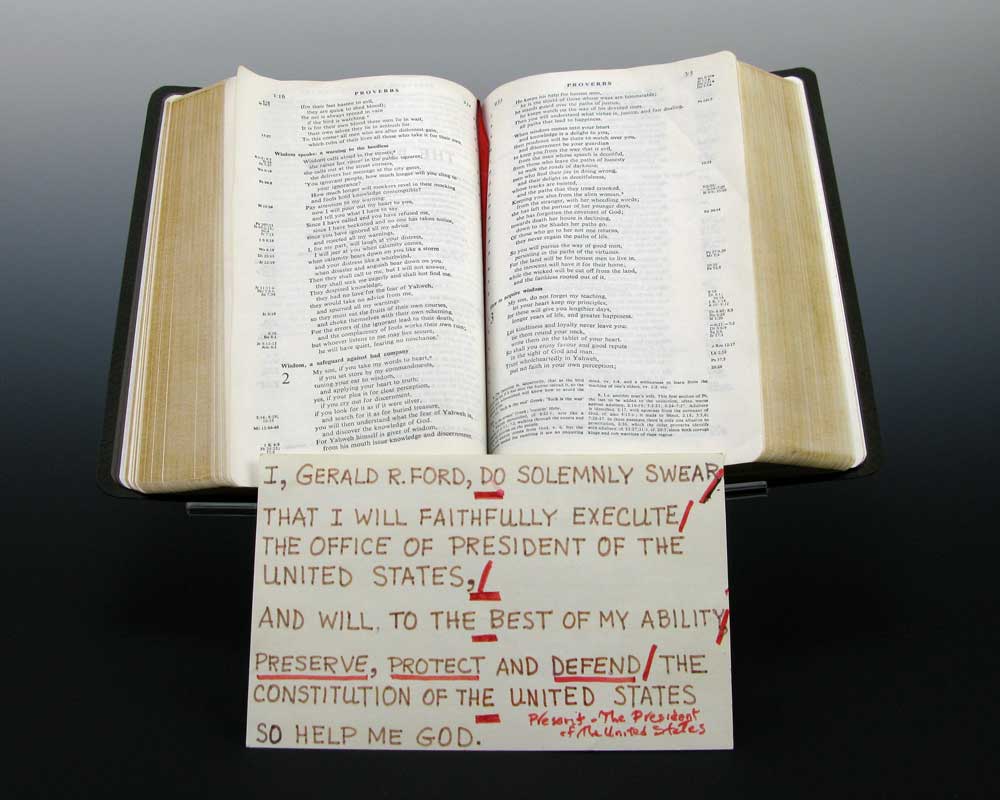
Bible and Cue Card Used by Gerald R. Ford When He Took the Oath of Office

Bible and Cue Card Used by Gerald R. Ford When He Took the Oath of Office

And she brought forth a man child, who was to rule all nations with a rod of iron: and her child was caught up unto God, and to his throne.   (Revelation 12:5)

Recently the liberal news media bushwhacked presidential candidate Dr. Ben Carson for his statement that a Muslim should not serve as President of the United States. The statement found great support among conservatives, but left-leaning Democrats and Republicans were self-righteously offended by his remarks. Attempting to do some damage control without really backing down, Carson explained that someone who would place Sharia Law above the Constitution of the United States cannot honestly swear to uphold and defend the Constitution. Carson rightly pointed out that Islam is a theocracy – god rule. A true follower of Islam cannot separate his religion from his politics; they are one and the same. The Muslim holy book and other Muslim sacred writings call for strict adherence to Islamic law. (“Islam” means “submission.”) Therefore, if a faithful Muslim were to become President of the United States, “he” (because a Muslim woman would not be permitted to hold such an office) would have to, out of obligation to his religion, invoke Sharia Law when it came in conflict with the Constitution.

In his defense, Carson qualified his stance by saying that he could indeed vote for a Muslim as President, if that Muslim denounced Sharia Law and swore to uphold the Constitution in all cases. (Of course, the Qur’an encourages Muslims to lie to “infidels,” so their integrity would be questionable.) Furthermore, said Carson, he would not vote for a Christian, if that Christian advocated for a Christian theocracy. Our nation is and always has been a nation of laws, and the Constitution is the law of the land.

I fully understand and agree with Dr. Carson’s stance. What I believe is missing here is a clear understanding of what a theocracy is. According to Dictionary.Com, a theocracy is “a form of government in which God or a deity is recognized as the supreme civil ruler, the God’s or deity’s laws being interpreted by the ecclesiastical authorities.” The problem with that definition is in the word “recognized” and in the phrase “laws being interpreted by the ecclesiastical authorities.” That renders the definition false because it is humanistic in nature. First of all, the deity has to be “recognized” by man as the “supreme civil ruler” which means that ultimately it is man that is defining the laws of the god. Secondly, the laws are interpreted by men who are either appointed by men or self-appointed as “ecclesiastical authorities.” Ultimately the “theocracy” becomes an “androcracy” – a rule by men, so the “god-rule” goes out the window.

When God brought the children of Israel into the Promised Land, they had no king other than God. God gave His law to Moses and set up a system of priests and judges to administer His law. Not long after they settled in the land, reliance on God and His law fell by the wayside and “every man did that which was right in his own eyes” (Judges 17:6; Judges 21:25). Therein lays the problem with a theocracy – man.

A true theocracy is absolute rule by God. Until Christ returns to set up His kingdom on earth, any man-initiated theocracy is doomed to fail. When Christ returns as King of Kings and Lord of Lords, His rule will be absolute. Speaking of Christ, the Messiah, the Lord says, “Thou shalt break them with a rod of iron; thou shalt dash them in pieces like a potter’s vessel” (Psalm 2:9). When He returns, He will share His administration with His saints “And [they] shall rule them with a rod of iron; as the vessels of a potter shall they be broken to shivers: even as I received of my Father” (Revelation 2:27). There will be no question of authority because His eternal law will not be violated. “And out of his mouth goeth a sharp sword, that with it he should smite the nations: and he shall rule them with a rod of iron: and he treadeth the winepress of the fierceness and wrath of Almighty God” (Revelation 19:15).  The “sharp sword” from His mouth is the Word of God: “For the word of God is quick [i.e., “alive”], and powerful, and sharper than any twoedged sword, piercing even to the dividing asunder of soul and spirit, and of the joints and marrow, and is a discerner of the thoughts and intents of the heart” (Hebrews 4:12).

Until Jesus returns, no true theocracy can exist. Any so called theocracy devised by fallen man is thereby flawed. Dr. Ben Carson is right. Anyone adhering to any human defined theocracy is unfit to hold the office of President of the United States. As it stands, the U.S. Constitution, because of its foundation on God’s Law, must be upheld as the supreme law of the land.

4 Comments

Filed under Apologetics, Current Events, End Times, Philosophy, Politics, Religion, Second Coming of Christ, Theology

Still Listening

hand-to-ear-listening

Knowing this first, that there shall come in the last days scoffers, walking after their own lusts, And saying, Where is the promise of his coming? for since the fathers fell asleep, all things continue as they were from the beginning of the creation.  (2 Peter 3:3-4)

Last week I expressed my hope to hear that Last Trump and be taken to meet my Lord in the clouds. Well, I am still here and so are all my brothers and sisters that would have gone with me. There were no mass disappearances reported as one should expect with the Rapture of the church. We are all still here. In fact, things are pretty much as they were before. The Shemitah came and went and there was no crash in the stock market as some had suggested. No, the world, such as it is, continues as usual.

You might think I would become cynical after getting my hopes up for nothing. For nothing? No, it is not for nothing, and my hope is still as sure as ever. Remember what I said? “For the past 20 years or more, I have anxiously awaited this time of year.” I also said, “The Lord is not obligated to comply with my speculations.” You see, it’s not my speculations or those of anyone else in which I trust. I am fully trusting in the Word of God and in Jesus’ promise that He would come again. The truth is, that He never pinpointed a time when He would return. Instead He said, “But of that day and that hour knoweth no man, no, not the angels which are in heaven, neither the Son, but the Father” (Mark 13:32). So, the truth is that the Rapture of the Church could come at any time. In the meantime, Jesus expects His servants to “Occupy til I come” (Luke 19:13).

Jesus told a parable expressing His expectations upon His return (Luke 19:12-27). The parable is of a “nobleman” (representing Himself) that “went into a far country [His ascension to heaven] to receive for himself a kingdom, and to return (v. 12, emphasis mine). He left 10 servants in charge giving them equal amounts of money with the expectation that they would put it to good use.  Verse 14 says that the “citizens” hated Him and sent Him a message saying that they did not want him ruling over them. The Greek word translated “citizens” is politēs which can also be translated “townsmen.” It occurs to me that these “citizens” represent the “world” and not His “servants.” When He returns with His kingdom, He calls His servants to accounts. The first servant reports that he has multiplied what he was entrusted tenfold. The King rewards him with rulership of ten cities. The second servant reports that he has multiplied what he was entrusted fivefold, and the King rewards him with rulership over five cities. The third servant returns only what was given to him and makes excuses for his lack of productivity. This displeases the King and He takes what was given to the third servant and gives it to the first. The other seven servants are not mentioned, leading one to conclude that they cast their lot with the “citizens” who hate the King. For those the punishment is severe. “But those mine enemies, which would not that I should reign over them, bring hither, and slay them before me” (v. 27). We might also note that the third servant, although he was unprofitable, is not counted as an “enemy” or excluded from the kingdom.

Last week I explained the fall Feasts of the Lord taking place right now. Rosh HaShanah is past. Yom Kippur is still ahead, as is Sukkot.  Many things are still stirring in the world during this month of September. Jesus’ return is imminent. He still may come sometime this month or maybe not. If not, that does not negate His promise to return. The scoffer will say, “Where is the promise of his coming? for since the fathers fell asleep, all things continue as they were from the beginning of the creation” (2 Peter 3:4). They will be counted as the Lord’s “enemies.” But to the faithful servant that continues in the Lord’s work He says, “Blessed is that servant, whom his lord when he cometh shall find so doing. Of a truth I say unto you, that he will make him ruler over all that he hath” (Luke 12:43-44).

So, Jesus did not come at the Feast of Trumpets this time as I had hoped. That only means He still has work for me – for us – to do, but I am still listening for that Last Trump.

Comments Off on Still Listening

Filed under Apologetics, Christianity, Current Events, End Times, Religion, Salvation, Second Coming of Christ