Category Archives: Evangelism

Chose or Chosen? (Rev. 1)

For many are called, but few are chosen. (Matthew 22:14)

Some Christian brothers have strong Calvinist leanings. I accept most of the five points of Calvinism to some degree – Total Depravity, Unconditional Election, Limited Atonement, Irresistible Grace, and Perseverance of the Saints (T.U.L.I.P.) – but I cannot fully embrace U, L, and I. I completely agree with T and P – the Total Depravity of man, and the Perseverance of the Saints, i.e., “once saved, always saved.”

As already noted, the points that give me the most grief are U and L. Unconditional Election says that God predetermined from the beginning of time who would be saved, and by default, who would be damned for eternity. The argument is that God is sovereign, and He can do exactly as He pleases (no argument there). A favorite verse used to make this point is Romans 9:15 “For he saith to Moses, I will have mercy on whom I will have mercy, and I will have compassion on whom I will have compassion.” Here Paul referred to the time when Moses wanted to “see” God’s glory and God responded, “And he said, I will make all my goodness pass before thee, and I will proclaim the name of the LORD before thee; and will be gracious to whom I will be gracious, and will shew mercy on whom I will shew mercy” (Exodus 33:19, emphasis mine). Clearly, God was not speaking in soteriological terms. Indeed, neither was Paul in making the reference to Moses. When taken in context, Paul was referring to God’s sovereignty in determining the course of salvation in general, not in particular.

Limited Atonement builds on Unconditional Election. Limited Atonement says that Jesus died only for those who were unconditionally elected for salvation. That eliminates all the “whosoever” verses beginning with John 3:16 “For God so loved the world, that he gave his only begotten Son, that whosoever believeth in him should not perish, but have everlasting life” (emphasis mine). Since the Bible is always true and does not contradict itself in any way, this verse alone should serve to debunk Limited Atonement.

To a limited degree, I also disagree with Irresistible Grace. That teaches that when the Holy Spirit, Who convicts the individual’s heart of sin (John 16:8) and convinces him of his need for the Savior, calls on the individual’s heart, that call cannot be rejected. The “call” is ubiquitous (Romans 1:20), however, it is felt more strongly in some than it is in others. Thus, it can indeed be resisted, and more resist the call than respond to it (Matthew 7:13-14).

The Bible speaks to both man’s freedom in choosing and God’s work of “election.” I maintain that the answer is “Somewhere in the Middle,” and neither side of the argument can hold his view dogmatically.

The debate continues. I have made my case and the other side made their case. Neither side convinced the other, which is usually the case. However, since this debate keeps coming up, I determined to “Search the Scriptures; for in them ye think ye have eternal life: and they are they which testify of me” (John 5:39). I looked in the New Testament for all the verses I could find related to salvation for the individual. I divided my findings into three categories: (1) Choice/Free Will, (2) Predestination/Election, and (3) verses that can apply to both sides. Here is what I found: for Category 1, there were more than 80 verses; for Category 2, there were 15 verses. Of those, seven, when read in context, suggest that the “predestination” is of “purpose” not of salvation; for Category 3 there were 17. Rather than argue one side or the other, I think it best to allow the Bible to speak for itself, and the reader can decide for himself.

Verses for Category 1: Matthew 7:13-14, 21-24; 10:32-33; 11:28-30; 12:31-32, 50; 16:24-26; 18:3-4, 14; Mark 3:28-29, 35; 8:34-38; 9:37; 10:15; 16:16; Luke 6:47; 9:23-26, 48; 12:8-10; 13:3, 5, 23-24; 17:33; 18:17; John 1:12-13; 3:3, 15-18, 36; 4:14; 5:24; 6:28-29, 35, 40, 45, 47, 51; 10:9-10; 11:25-26; 14:6; 20:29; Acts 2:21, 38; 10:43; Romans 1:16; 3:28; 4:5; 5:6, 8, 12; 10:9-13; 2 Corinthians 5:21; Galatians 1:3-4; 2:16; 3:6-7, 11, 22, 24-27; Ephesians 1:7; 2:4-9; Philippians 2:5-11; Colossians 1:14; 2:13-14; 1 Thessalonians 5:9-10; 1 Timothy 1:15; 2:3-4; 4:10; 2 Timothy 1:9; Titus 2:11; 3:5-7; Hebrews 3:7-8, 15; 7:25; 9:28; 11:6; 1 Peter 2:6; 3:18; 2 Peter 3:9; 1 John 2:2; 5:1, 10-12; Revelation 22:14.

Verses for Category 2: Luke 10:22; John 6:37, 44, 65; 17:24; Romans 8:33;* Ephesians 1:5, 11; 2:10;* Colossians 3:12; 2 Thessalonians 2:13; 2 Timothy 2:10;* Titus 1:1;* 1 Peter 1:2;* 2 John 1:1, 13. The passages marked with an asterisk (*) speak of predestination, but when examined closely, the predestination is a “Predestination of Purpose” not predestination for salvation. In other words, it is the predetermined plan God has for those who are “justified” having placed their faith in the atoning work of Christ on the cross. As I read these passages my conclusion is that those who are “elect” are “elected” by virtue of their faith in Christ for salvation and their “predestination” is to be conformed to the image of Christ.

Verses for Category 3: Matthew 9:13; 10:39; 20:28; 22:14; Luke 5:32; John 7:38-39; 10:27-29; 14:23; Acts 4:12; 15:11; Romans 6:23; 8:1; 2 Corinthians 5:17; Hebrews 4:3; 1 Peter 3:18; 1 John 4:9-10. These verses can apply equally to either Category 1 or 2.

The message of the Gospel is simple. The Lord Jesus Christ left His place in Glory, took on human flesh (John 1:14; Philippians 2:5-11), took the penalty of our sins upon Himself, and shed His own blood on the cross to pay our sin debt. He was buried in a borrowed tomb and rose again on the third day, conquering death and the grave on our behalf to win our salvation (1 Corinthians 15:1-8). He did that for “whosoever” will accept His free, “grace” gift of salvation by faith in His finished work. “For God so loved the world, that he gave his only begotten Son, that whosoever believeth in him should not perish, but have everlasting life” (John 3:16). “Whosoever” accepts His offer by “believing in Him” is “elected” for “everlasting life.” This is the whole message of Christmas.

When one reads the Bible’s plain teaching on the topic of salvation (soteriology), the overwhelming weight of evidence supports the truth that the individual has a choice – to accept or reject – God’s free gift of salvation. So, from where does this doctrine of “election” – that God predetermines who will be saved – come? It does not come from Scripture if one truly believes in “Sola Scriptura.” The question prompted me to blow the dust off of my systematic theology textbook and review the section on soteriology. The authors of my textbook ask, “For whom did Christ die? Did the Father send his [SIC] Son into the world to die for all persons or only for the elect?”[1]

In my reading, I learned that the early church fathers, by and large, did not hold to the doctrine of election, at least not in the way proposed by John Calvin. “The apostolic fathers advanced no single theory of the atonement, but articulated a number of biblical motifs.”[2]

“Irenaeus interpreted Christ’s death as a victory over sin, death and the Devil … Christ conquered Satan, thereby freeing believing (emphasis mine) sinners from his power and giving them eternal life.”[3] Given that believing is a prerequisite for salvation, it makes sense that Jesus died for believers; however, that does not imply election. “Athanasius taught that in order to solve the problem posed by human sin and condemnation God sent the divine Word into the world. In his [SIC] body the Son bore the penalty and paid the debt that sinners owed to God. Thus Christ offered ‘the sacrifice on behalf of all, surrendering his own temple [body] to death in place of all, to settle man’s account with death and free him from the primal transgression’” (emphasis mine).[4]

“Concerning the intent or purpose of the atonement, most patristic authorities held that Christ died for the sins of the world. Athanasius maintained that in the divine scheme of things ‘death there had to be, and death for all, so that the due of all might be paid.’ Cyril of Jerusalem affirmed that ‘Jesus truly suffered for all men.’ While not speaking clearly on the issue, Augustine seemed to suggest that Christ died for the world, although the cross is effectual only for those who believe[5] (emphasis mine).

Later, Anselm of Canterbury (1033-1109) said that “adequate satisfaction [for sin] must come from one who is divine, that is, from God himself [SIC]. On the other hand, satisfaction must be paid by one who genuinely represents humanity … the sinless Jesus Christ voluntarily suffered and died, thereby accruing more merit than needed to pay the debt humanity owed. God accepted the surplus of Christ’s passion, credited it to the account of the sinful race, and thus is disposed to restore fellowship all who trust Christ’s saving provision[6] (emphasis mine). “The English Reformer John Wycliffe also followed the main lines of the Anselmic satisfaction motif.”[7] That further supports the idea that Jesus’ sacrifice on the cross was sufficient for all mankind, but efficient only for those who believe. “Luther taught that Christ in his [SIC] life and death bore the sin, guilt, and punishment of a condemned race … As a result of his [SIC] propitiatory sacrifice, Christ frees trusting souls from the curse of the law; reconciles God and sinners; imparts perfect righteousness; and conquers sin, death and the Devil” (emphasis mine).[8]  

Later came Arminius and Calvin who developed their differing views on the atonement. In opposition to the Calvinist view of Limited Atonement, “Arminian theologians consistently uphold a universal atonement: Christ died for the purpose of providing salvation for the entire world. Thus Arminius succinctly affirmed: ‘Christ died for all men and for every individual.’… The Arminians press their position by asking how persons could be held guilty for refusing to believe what was not intended for them.”[9] In this regard, Arminians hold a more correct view of Christ’s work of atonement in my opinion.   

The authors of my text note that “As for John Calvin, several recent scholars believe that although Calvin held to double predestination he also taught a doctrine of unlimited atonement. In his Institutes Calvin wrote, ‘It is certain that the Lord offers us mercy and the pledge of his [SIC] grace both in his [SIC] Sacred Word and his [SIC] sacraments. But it is understood only by those who take Word and sacraments with sure faith, just as Christ is offered and held forth by the Father to all unto salvation, yet not all acknowledge and receive him.’ [SIC] In his later commentaries, Calvin more clearly postulates an unlimited atonement. With regard to Galatians 5:12 Calvin affirms: ‘God commends to us the salvation of all men without exception, even as Christ suffered for the sins of the whole world’” (emphasis mine).[10] Apparently, John Calvin was not all that “Calvinistic.”

“Scholastic Calvinism, however, narrowed the intent of the atonement and claimed that Christ died solely for the purpose of saving the elect, the exact number of whom are actually brought to salvation. Thus proponents argue that the design of the cross was not merely to provide salvation but to secure the salvation of those persons the Father gave to the Son. Christ allegedly died for all who were related to him [SIC], just as Adam sinned for all who were related to him … God purposed to save some persons and to condemn others, the high Calvinist claims that Christ died solely for those predestined to life”[11]

John Owen, a Puritan held in high regard by many who hold to this view of election, presents what to me is a ridiculous argument for the limited atonement of election. “If Christ dies for all and all are not saved, then Christ died ineffectively, which cannot be. If God loves all and not all are saved, then God loves ineffectually, which also cannot be. Thus Christ did not die for all, and God does not love all people. Says Owen: ‘We deny that all mankind are the object of that love of God which moved him [SIC] to send his [SIC] Son to die.’ God’s love is reflected in his [SIC] will to save the elect the heirs of the covenant of grace, for whose sins Christ made satisfaction on the cross. Owen concludes that if the death of Christ accomplishes all that the Father intended, ‘then died he only for those that are in the event sanctified, purged, redeemed, justified, freed from wrath and death, quickened, saved, etc.’ but that all are not thus sanctified, freed, etc., is most apparent: and, therefore they cannot be said to be the proper object of the death of Christ.’”[12] Owen’s conclusion, I believe, comes not from Scripture, but from his own feeble attempt at logic.

Against Scholastic Calvinism, Moses Amyraut, French theologian, proposed the theory of “hypothetical universalism.” “Amyraut insisted that God willed the salvation of all persons on the condition that they believe … Christ died for all persons sufficiently, but for the elect efficiently. Amyraut’s position was championed by later scholars such as Cameron of the Saumar Academy, Richard Baxter, John Bunyon, Samuel Hipkins, and Heinrich Heppe”[13] (emphasis mine).

I contend that the position of the “hyper-Calvinists” are the ideas of men – albeit well-meaning, godly men – and not necessarily the plain teaching of the Bible. Such a narrow soteriological position cannot be supported by “Sola Scriptura” as I attempted to demonstrate above with my list of biblical references in three categories. I encourage the reader to scrutinize those passages laying aside any preconceived ideas that you have been taught in the past. Allow the Bible to speak for itself without the aid of commentators or scholars of the past. The Word of God is perspicuous and perfectly able to speak for itself without outside influence.

Notes:


[1] Gordon R Lewis and Bruce A Demarest, Integrative Theology, Volume Two, (Zondervan Publishing House, Grand Rapids, Michigan, 1990), p. 372.

[2]  Ibid, p. 378.

[3]  Ibid, p. 373.

[4]  Ibid, p. 379.

[5]  Ibid, p. 380.

[6]  Ibid, p. 375.

[7]  Ibid.

[8]  Ibid, p. 379

[9]  Ibid, p. 376-377.

[10]  Ibid, p. 380.

[11]  Ibid, p. 381.

[12]  Ibid.

[13] Ibid, p.382.

1 Comment

Filed under Apologetics, Bible, Christianity, Evangelism, Gospel, Heaven, Hell, Holy Spirit, Salvation, Theology

Coming Quickly

Behold, I come quickly: blessed is he that keepeth the sayings of the prophecy of this book. (Revelation 22:7)

Have you ever imagined traveling in a time machine and going backward or forward in time to witness what happened in the past, or to see what would happen in the future? I am sure many people have, and several science fiction movies have attempted to portray what that might be like.

Jesus granted John the privilege of actually traveling into the future to record the events that would take place at “the end of days.” Much of what John witnessed seems unpleasant, but the end result climaxes in a completely remade planet and universe – a New Heaven and a New Earth.[1] John then sees an indescribable city descending from heaven to the New Earth with space enough to accommodate the billions of God’s children throughout the ages. The city is the New Jerusalem where God will dwell among His people.

What John witnessed defies any hitherto known reality. John could hardly believe his eyes. It was incredible! It was unbelievable! And when we read John’s attempt at describing it, our mind’s eye cannot visualize it, so we may be tempted to brush it off as fantasy. In anticipation of such an occurrence, his angel tour guide reassures John and encourages him to believe what he sees. “And he said unto me, These sayings are faithful and true: and the Lord God of the holy prophets sent his angel to shew unto his servants the things which must shortly be done” (Revelation 22:6, emphasis mine). It may be too much for our feeble minds to take in, but the guarantee comes directly from God, and we can rest assured that it will all come true because He is faithful to keep His promises.

Then, from some unspecified source, we hear the words of Jesus. “Behold, I come quickly: blessed is he that keepeth the sayings of the prophecy of this book” (Revelation 22:7, emphasis mine). The Greek word translated as “quickly” is tachu from which we get our English word “tachometer.” Since Jesus said this almost 2000 years ago, it makes us wonder, “What is His definition of quickly?” It also gives fodder to the skeptics of whom the Apostle Peter warned. “Knowing this first, that there shall come in the last days scoffers, walking after their own lusts, And saying, Where is the promise of his coming? for since the fathers fell asleep, all things continue as they were from the beginning of the creation” (2 Peter 3:3-4, emphasis mine). Peter also reminded us that God’s timing is not like ours. “But, beloved, be not ignorant of this one thing, that one day is with the Lord as a thousand years, and a thousand years as one day” (2 Peter 3:8, emphasis mine). Peter is not providing a formula by which we can calculate God’s timetable. Rather, he applies simile (“as”) to emphasize that God’s measure of time does not correlate to ours. God is infinite. He is “timeless.” He is not bound by time. His attribute of omnipresence – being everywhere present at all times – also applies to our understanding of time. He exists in the past, present, and future simultaneously, which explains why He can tell the end from the beginning.[2] Considering the word “tachu” with the application of a tachometer, which measures the revolutions per minute (RPM) of an internal combustion engine; the faster the engine turns, the higher the RPMs the tachometer reads. In the same way, as we begin to see the things described in Revelation, they will rapidly increase in number and intensity the nearer we get to execution time. Even now, we see the rapid decline in morality and what used to be the “social norm.” The plans of the globalists – the “One-Worlders” – are being implemented worldwide at this moment. It is happing “quickly,” and this is probably what Jesus meant by the word “tachu.”

Many “Christians” today pay little attention to the Book of Revelation for a variety of reasons; however, Jesus says, “blessed is he that keepeth the sayings of the prophecy of this book.” Sadly, far too many pastors avoid teaching it because they fear that it breeds controversy and contentions. Fear is not of God; it is of Satan whose silencing the Word of God is part of his strategy. If taught rightly, there should be no controversy and those who object are the ones that need to hear it the most. Other pastors will not teach it because they do not understand it themselves. There is only one remedy for that. “Study to shew thyself approved unto God, a workman that needeth not to be ashamed, rightly dividing the word of truth” (2 Timothy 2:15). Still, others think it might incite fear in people for the things that are about to come. Good! If they are lost, fear might be the incentive they need to get saved. If the pre-millennial, pre-tribulational view is taught, Christians have the hope of the Rapture and a greater incentive to share the Gospel with friends and family. The study, preaching, and teaching of this book is a blessing, says Jesus.

“And I John saw these things, and heard them. And when I had heard and seen, I fell down to worship before the feet of the angel which shewed me these things. Then saith he unto me, See thou do it not: for I am thy fellowservant, and of thy brethren the prophets, and of them which keep the sayings of this book: worship God. And he saith unto me, Seal not the sayings of the prophecy of this book: for the time is at hand” (Revelation 22:8-10, emphasis mine). John is so overwhelmed by all that he has seen – the Rapture he experienced, the Great Tribulation, the Millennial Kingdom, the Great White Throne Judgment, the New Heaven, New Earth, and the New Jerusalem – that he falls at the feet of the angel and worships him. Note that the angel refuses the worship and directs the worship to God who alone is worthy of worship. The angel instructs John not to seal up the prophecy, “for the time is at hand.” The Prophet Daniel wanted to understand the prophecies of the end-times given to him, and he was given much different instructions. Daniel says, “And I heard, but I understood not: then said I, O my Lord, what shall be the end of these things? And he said, Go thy way, Daniel: for the words are closed up and sealed till the time of the end” (Daniel 12:8-9, emphasis mine). Daniel was not given the insight to understand the end-times. However, in the end, “the wise shall understand” (Daniel 12:10). Revelation is NOT sealed, and it is written for “the wise” to understand, and now, more than ever, “the time is at hand” for the wise to understand.

“He that is unjust, let him be unjust still: and he which is filthy, let him be filthy still: and he that is righteous, let him be righteous still: and he that is holy, let him be holy still” (Revelation 22:11). At this point in the Revelation, all accounts have been settled. Those that are unjust and filthy have been condemned to the lake of fire for all eternity, and they will continue eternally in the same state in which they were found guilty. The righteous and the holy (by the righteousness imputed on them by Christ) will continue in that same state for eternity.

For those of us living today, Jesus once again speaks. “And, behold, I come quickly; and my reward is with me, to give every man according as his work shall be. I am Alpha and Omega, the beginning and the end, the first and the last” (Revelation 22:12-13, emphasis mine). We see again the Greek word “tachu,” indicating that things are quickly winding up. Jesus comes with His reward in hand to give every person according to their works. For the unrepentant, unbelieving Christ-rejectors, their reward is the lake of fire. “For the wages of sin is death” (Romans 6:23). For those who place their trust in Christ, “the gift of God is eternal life through Jesus Christ our Lord” (Romans 6:23). Jesus claims authority as the great “I AM.”[3]I AM Alpha and Omega, the beginning and the end, the first and the last.” He is the timeless, everlasting God!

Blessed are they that do his commandments, that they may have right to the tree of life, and may enter in through the gates into the city. For without are dogs, and sorcerers, and whoremongers, and murderers, and idolaters, and whosoever loveth and maketh a lie” (Revelation 22:14-15, emphasis mine). This is meant for us today. This is not future; it is now. “Blessed are they that do his commandments.” Jesus said, “If ye love me, keep my commandments” (John 14:15). What are those commandments? “Let not your heart be troubled: ye believe in God, believe also in me” (John 14:1, emphasis mine). “And they said, Believe on the Lord Jesus Christ, and thou shalt be saved, and thy house” (Acts 16:31, emphasis mine). “But as many as received him, to them gave he power to become the sons of God, even to them that believe on his name” (John 1:12, emphasis mine). “Jesus said unto him, Thou shalt love the Lord thy God with all thy heart, and with all thy soul, and with all thy mind. This is the first and great commandment. And the second is like unto it, Thou shalt love thy neighbour as thyself” (Matthew 22:37-39, emphasis mine). Those who keep His commandments are on the “inside” (now) and have the right to the “tree of life” (i.e., eternal life). Those on the outside are the “dogs.” In John’s day, dogs were not the lovable pets that we love and cherish today. In his day, dogs were nasty, filthy, mangy, scavengers kept outside of the house. God regards sinners with the same contempt.  Their sins are listed in the text; however, their main fault is their rejection of Christ and their refusal to obey His commandments. They will remain outcasts forever unless they repent while there is time. “The time is at hand!”

“I Jesus have sent mine angel to testify unto you these things in the churches. I am the root and the offspring of David, and the bright and morning star” (Revelation 22:16, emphasis mine). This message is contemporary. It is relevant for us today. It is meant for the churches, not only for the seven churches that Jesus, through John, addressed but for the churches throughout the Church Age.

“And the Spirit and the bride say, Come. And let him that heareth say, Come. And let him that is athirst come. And whosoever will, let him take the water of life freely” (Revelation 22:17). Here is the invitation. It is the Holy Spirit that speaks to the heart of every person to convict them of sin,[4] to convince them of their need for the Savior.[5] The Bride, the Church, the local body of believers, is the instrument through which the Holy Spirit works. Together they issue the invitation, “Come.” It is not through coercion but through the preaching of the Word of God. “For whosoever shall call upon the name of the Lord shall be saved. How then shall they call on him in whom they have not believed? and how shall they believe in him of whom they have not heard? and how shall they hear without a preacher?” (Romans 10:13-14, emphasis mine). All who respond to the invitation are welcome to partake of “the water of life freely,” i.e., eternal life.

“For I testify unto every man that heareth the words of the prophecy of this book, If any man shall add unto these things, God shall add unto him the plagues that are written in this book: And if any man shall take away from the words of the book of this prophecy, God shall take away his part out of the book of life, and out of the holy city, and from the things which are written in this book” (Revelation 22:18-19, emphasis mine). Anyone (including myself) who handles the Word of God should take this warning very seriously. As humans, we are prone to error, and we can misinterpret Scripture occasionally for any number of reasons: lack of understanding, lack of maturity (spiritual growth – sanctification – is a process), lack of knowledge, etc. Such “mistakes” are understandable and excusable to some extent; they can be corrected. However, this admonition is for those who purposefully tamper with God’s Word in order to have it say what they want it to say. This warning is not only for the Book of Revelation, but it applies to all of Scripture because it is all prophecy, i.e., telling forth the Word of God. The Old Testament has a similar admonition. “Ye shall not add unto the word which I command you, neither shall ye diminish ought from it, that ye may keep the commandments of the LORD your God which I command you” (Deuteronomy 4:2, emphasis mine). Anyone who handles the Word of God – pastors, evangelists, teachers, authors, etc. – needs to take this warning seriously.

“He which testifieth these things saith, Surely I come quickly. Amen. Even so, come, Lord Jesus” (Revelation 22:20, emphasis mine). “He which testifieth” is the Lord Jesus Christ. He reminds us once again that His return is imminent. As we see the events predicted in this prophecy falling into place at an alarming rate, we know that the full force of this prophecy cannot be that far off. For those of us who have placed our faith in Christ, we can say with the Apostle John, “Even so, come, Lord Jesus!” We may even add “quickly.”

“The grace of our Lord Jesus Christ be with you all. Amen” (Revelation 22:21). “Grace” is the free, unmerited, gift of the Lord (Master, Owner, Possessor) Jesus (Yahweh Saves) Christ (Messiah, the Anointed One). That gift is eternal life, not only future, but in this present life. Eternal life, for the believer, starts right now and never ends. This physical, corrupt flesh must be done away with, but our spirit lives forever. The Apostle Paul says, “For this corruptible [flesh] must put on incorruption, and this mortal [flesh] must put on immortality” (1 Corinthians 15:53). He explains how this takes place. “Behold, I shew you a mystery; We shall not all sleep [die], but we shall all be changed, In a moment, in the twinkling of an eye, at the last trump: for the trumpet shall sound, and the dead shall be raised incorruptible, and we shall be changed” (1 Corinthians 15:51-52). So, whether our dead bodies are resurrected and rise from their resting place or our living bodies are instantly changed at the Rapture, they will be renewed to incorruptible bodies suitable to be in the presence of Holy God. That is the “grace of our Lord Jesus Christ” that is with us always.

Amen.” It is the same word in Hebrew and in Greek meaning, “it is true.”

 Reader, Jesus is coming quickly, as He promised. Are you ready to meet Him? If you do not know the Savior, do not wait any longer. The time is short. Please read my page on “Securing Eternal Life.”

Notes:


[1]  A New Creation | Ernie’s Musings (erniecarrasco.com)

[2]  Isaiah 46:9-10

[3]  Exodus 3:14

[4]  John 16:8

[5]  John 16:13

Comments Off on Coming Quickly

Filed under Apologetics, Bible, Christianity, Current Events, Death, Dogs, End Times, Eschatology, Evangelism, Gospel, Heaven, Hell, Rapture, Resurrection, Salvation, Satan, Second Coming of Christ, Theology, Worship

The End of 1000 Years

And when the thousand years are expired, Satan shall be loosed out of his prison, (Revelation 20:7)

At the beginning of the Millennium when Jesus comes again, “the dragon, that old serpent, which is the Devil, and Satan” is bound and imprisoned in the “bottomless pit” for a thousand years.[1] At the end of 1000 years (20:7, above), he will be released for “a little season” (20:3), “And shall go out to deceive the nations which are in the four quarters of the earth, Gog and Magog, to gather them together to battle: the number of whom is as the sand of the sea” (Revelation 20:8). Who are these that are deceived? They are not the saints who reign with Christ. The saints – the Bride and the Tribulation saints – have glorified bodies “like unto his glorious body”[2] that are incapable of sin, and they are immune to Satan’s deceptions. The ones who Satan deceives are the progeny of those that survived the Tribulation and entered the Millennium in their natural bodies – some believers and some non-believers – and retained the ability to reproduce. At the end of 1000 years of perfect conditions and “pre-flood” lifespans[3], billions of people will inhabit the earth. These are those who Satan incites to rebel. The “Gog and Magog” mentioned here are not the same to which the Prophet Ezekiel refers;[4] but rather, it is the “spirit” of Gog and Magog that seeks to destroy the people of God.

After 1000 years of perfect peace with Jesus reigning as King of Kings and Lord of Lords, why does God turn Satan loose on Earth again? Adam and Eve lived in a perfect environment with only one prohibition, yet they sinned and rebelled by disobeying God’s only command.[5] That took place probably within the first week following Creation. Now, after the Edenic state of Jesus’ Millennial reign, once again Satan is allowed to test mankind proving the depravity of mankind and the holy righteousness of God. God, speaking through the Prophet Jeremiah, says, “The heart [of mankind] is deceitful above all things, and desperately wicked: who can know it? I the LORD search the heart, I try the reins [i.e., “the seat of emotion and affection”], even to give every man according to his ways, and according to the fruit of his doings” (Jeremiah 17:9-10, emphasis mine). It is a sad but true commentary. People sin because they are sinful even in a perfect environment.

Satan incites a rebellion against Christ and His saints, but the rebellion is short-lived. “And they went up on the breadth of the earth, and compassed the camp of the saints about, and the beloved city: and fire came down from God out of heaven, and devoured them” (Revelation 20:9). God responds instantaneously, decisively, and completely – no more second chances.

“And the devil that deceived them was cast into the lake of fire and brimstone, where the beast and the false prophet are, and shall be tormented day and night for ever and ever. (Revelation 20:10, emphasis mine). There exists a false image of Satan and his demons ruling in hell and torturing its inhabitants. However, Satan and his “angels” will be no better off than any of the other inhabitants of “the lake of fire.” Jesus said that the lake of fire was “prepared for the devil and his angels.”[6] The Beast and the False Prophet are already there waiting for the Dragon,[7] and soon they will be joined by those whose names are not found in the Book of Life.[8]

With Satan permanently disposed of, John’s focus turns to Jesus on His throne. From the text, it is not clear whether His throne is in heaven or on earth where He has reigned for the last thousand years. Since Chapter 19, John has been reporting on events taking place on Earth; therefore, it seems feasible that Jesus’ throne could be the one He occupied in the Holy of Holies of the Millennial Temple as described by the Prophet Ezekiel. However, it could be His heavenly throne, which would have more space for the billions of people that are to be judged.  Its location is irrelevant. Its significance lies in the seriousness of what takes place there.

“And I saw a great white throne, and him that sat on it, from whose face the earth and the heaven fled away; and there was found no place for them” (Revelation 20:11). The One on the great white throne is Christ, who is the Word,[9] who shed His blood a ransom for many,[10] and who conquered death and the grave by rising again.[11] He offered Himself for whosoever would accept His free gift of salvation through faith.[12] By His sacrifice, He earned the right to judge those who have despised His free gift of salvation. Now, He sits in the full splendor of His glory that overwhelms earth and heaven.

“And I saw the dead, small and great, stand before God; and the books were opened: and another book was opened, which is the book of life: and the dead were judged out of those things which were written in the books, according to their works” (Revelation 20:12). These are those who have died without Christ from the beginning of time – small and great, peasants and kings, nobodies and celebrities – they all stand before God – Jesus is God.[13] The books were opened. We are not told, but I have concluded that the “books” include the detailed record of the life of every individual of both good and bad deeds, actions, and thoughts. Every person has his or her own complete, detailed biography. Among the books is the Bible, the Word of God, the standard against which each person will be measured. Too many people who even bother to ponder eternity believe that their good deeds will be weighed against their bad deeds, and in their pride, they think that their “good” will outweigh the “bad.” Actually, all of their deeds, good and bad, will be measured against God’s perfect standard, His Word, and only perfection by that standard will pass the test. On that day, the truth of Romans 3:10 will be undeniably evident: “As it is written, There is none righteous, no, not one;” “For all have sinned, and come short of the glory of God” (Romans 3:23).

To be fair, “another book was opened, which is the book of life.” This book records the name of every person who has ever lived. However, only those adopted as children of God[14] remain recorded in the Book of Life; all others are blotted out, i.e., removed. When interceding for the sins of the children of Israel, Moses pleaded, “… unto the LORD, and said, Oh, this people have sinned a great sin, and have made them gods of gold. Yet now, if thou wilt forgive their sin; and if not, blot me, I pray thee, out of thy book which thou hast written” (Exodus 32:31-32, emphasis mine). Moses knew the significance of that book, and he was willing to have his name blotted out of that book in order to preserve his people.

“And the sea gave up the dead which were in it; and death and hell delivered up the dead which were in them: and they were judged every man according to their works” (Revelation 20:13, emphasis mine). Judged “according to their works,” no one will measure up to the perfect standard that Holy God demands.

“And death and hell were cast into the lake of fire. This is the second death” (Revelation 20:14). Death and the grave (i.e., hell, hades, the abode of the dead) cast into the lake of fire signifies that these cease to exist. There will be no death or dying in the lake of fire. Death separates the spirit from the body. When the body ceases to function, the spirit lives on, either in hell (the abode of the dead) or in the presence of the Lord (for the believer). For the believer, Paul says, “We are confident, I say, and willing rather to be absent from the body, and to be present with the Lord” (2 Corinthians 5:8, emphasis mine). Everyone (except those caught up in the Rapture) will experience the first death. Scripture says, “And as it is appointed unto men once to die, but after this the judgment” (Hebrews 9:27). Since God is the Giver of Life, eternal separation from His presence is the ultimate death. Since physical death and the grave are cast into the lake of fire, the “second death” means eternal separation from the One who gives life – alive in one sense without the ability to die, yet dead in the sense of living apart from the One who gives true life. What a horrible thought!

Those being judged at the Great White Throne Judgment are given one more chance. Their “works” measured next to God’s perfect standard fall woefully short. To ensure a fair trial, their names are searched in the Book of Life. However, because they rejected Jesus as their Lord and Savior, their names will have been blotted out of the Book of Life. “And whosoever was not found written in the book of life was cast into the lake of fire” (Revelation 20:15).

How about you, reader? The lake of fire was created for Satan and his angels; it was not meant for you. However, the lake of fire is the destiny of anyone not found in the Book of Life. There is only one way to ensure that your name is written in that book. If you do not know the Savior, do not wait any longer. The time is short. Please read my page on “Securing Eternal Life.”

 Notes:


[1]  Revelation 20:2-3

[2]  Philippians 3:21

[3]  Genesis 5

[4]  Ezekiel 38:2

[5]  Genesis 3

[6]  Matthew 25:41

[7]  Revelation 19:20

[8]  Revelation 20:15

[9]  John 1:1-3,14

[10]  Matthew 20:28; Mark 10:45; 1 Timothy 2:6

[11]  1 Corinthians 15:3-4

[12] John 1:12; 3:16, 18, 36; Romans 10:9-11;13

[13]  John 1:1

[14]  John 1:12

Comments Off on The End of 1000 Years

Filed under Apologetics, Bible, Christianity, End Times, Eschatology, Evangelism, Gospel, Heaven, Hell, Rapture, Resurrection, Salvation, Satan, Second Coming of Christ, Theology

Harvest Time

And another angel came out of the temple, crying with a loud voice to him that sat on the cloud, Thrust in thy sickle, and reap: for the time is come for thee to reap; for the harvest of the earth is ripe. (Revelation 14:15)

At this point in the Revelation account, we have come to the last half of the Tribulation. We have seen that in the midst of the terrible judgments coming upon the earth, God in His mercy continues to reach out to a lost and rebellious world by way of the 144,000 witnesses[1], the two Old Testament prophets[2] brought back to earth to testify by way of wonders and miracles so that no one on earth will have an excuse for rejecting God. At the midpoint of the Tribulation, the Antichrist will desecrate the Temple in Jerusalem by claiming to be God and demanding that he be worshiped as God.[3] At this time, the Antichrist is fully possessed by Satan, and God allows him to kill the two prophets, and the 144,000 who, up until this point have been protected by God. In the previous verses, we see the 144,000 in the heavenly Mount Zion with Jesus.[4] However, God continues to show His mercy by sending His angels to proclaim the Gospel[5] all around the earth so that all on earth (who have not yet accepted the “mark of the beast”) will have the opportunity to turn to Christ. Of that time Jesus said, “And this gospel of the kingdom shall be preached in all the world for a witness unto all nations; and then shall the end come” (Matthew 24:14, emphasis mine).

Now we arrive at the final one year and nine months that remain in the Tribulation (as I understand the chronology). John gives us a quick summary previewing what is to come; the details will be revealed in the chapters that follow.

“And I looked, and behold a white cloud, and upon the cloud one sat like unto the Son of man, having on his head a golden crown, and in his hand a sharp sickle” (Revelation 14:14). Undoubtedly, “the Son of man” refers to Jesus, and He wears a golden “stephanos” – a victor’s crown, not a “diadēma” a royal crown. Although the final battle between the forces of Satan and Christ is yet future, the victory is sure, and Jesus is the Victor. He carries a sharp sickle in His hand prepared for the harvest. Larkin points out that “This is not the ‘Harvest of the Church.’ … This is the ‘Harvest’ of the Gentile Nations … The ‘Harvest and Vintage’ are JUDICIAL. That is, they are for the purpose of Judgment. The account here is anticipative.”[6] We can look forward to the details of that judgment when the seven bowls are poured out in Chapter 16.

“And another angel came out of the temple, crying with a loud voice to him that sat on the cloud, Thrust in thy sickle, and reap: for the time is come for thee to reap; for the harvest of the earth is ripe” (Revelation 14:15). Again, this looks forward in anticipation of the end when the final battle takes place at the battle of Armageddon.[7]

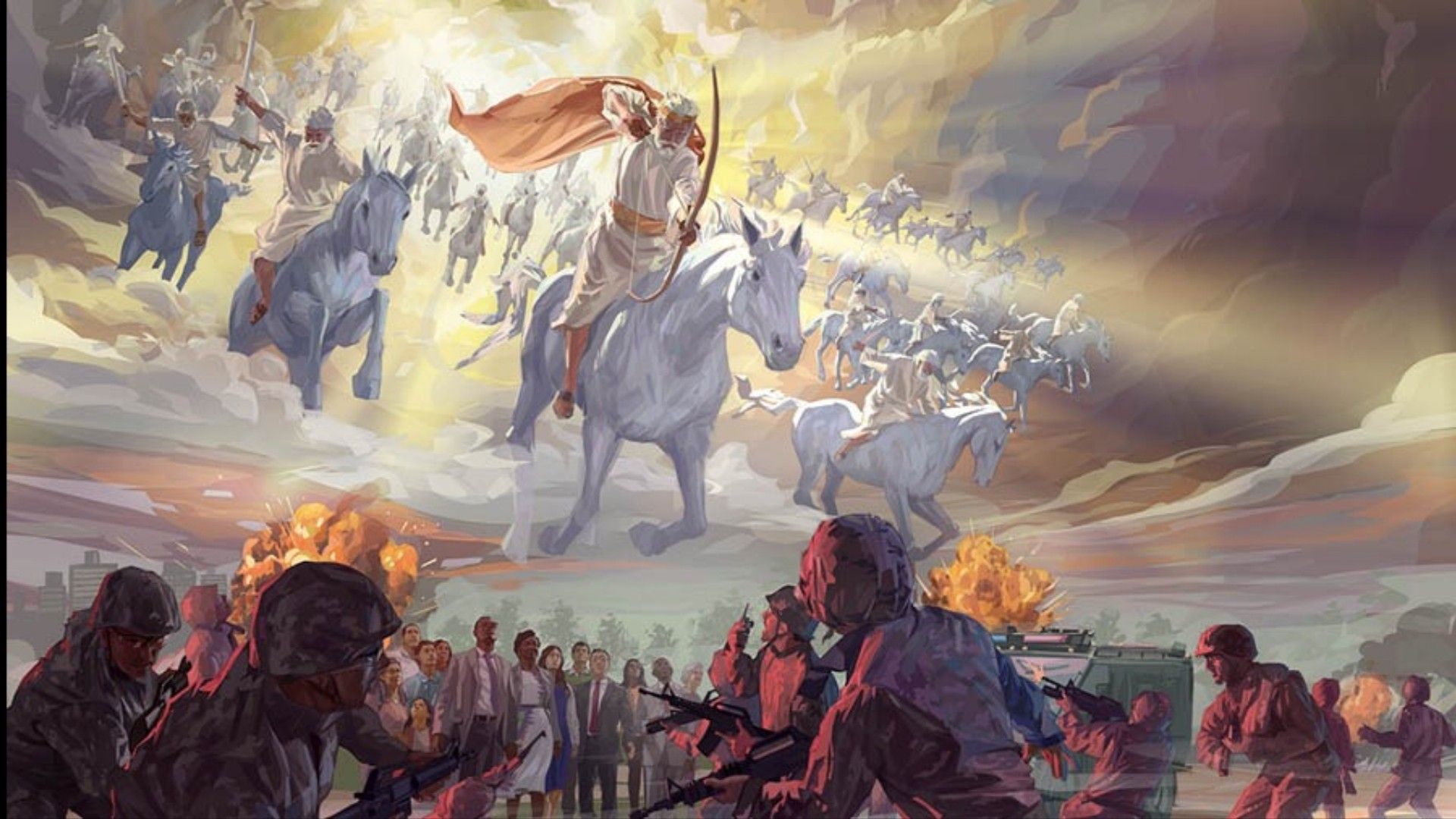
“And he that sat on the cloud thrust in his sickle on the earth; and the earth was reaped. (Revelation 14:16). At that time, He returns to the earth on a white horse followed by His saints on white horses.[8] His sickle will be the “sword,” which is His Word, that proceeds out of His mouth. The battle, if one can call it that, will be no battle at all, for the victory will be decisive and instantaneous.[9]

“And another angel came out of the temple which is in heaven, he also having a sharp sickle. And another angel came out from the altar, which had power over fire; and cried with a loud cry to him that had the sharp sickle, saying, Thrust in thy sharp sickle, and gather the clusters of the vine of the earth; for her grapes are fully ripe. And the angel thrust in his sickle into the earth, and gathered the vine of the earth, and cast it into the great winepress of the wrath of God” (Revelation 14:17-19). There is great excitement in heaven. The end is here and Jesus will soon take His rightful place as King of Kings and Lord of Lords. However, for those with the mark of the beast and those who have rejected God despite all of His efforts and offer of salvation, this is very bad news. On the other hand, for those saints who have managed to survive the seven-year Tribulation, their “blessed hope”[10] is about to be realized.

“And the winepress was trodden without the city, and blood came out of the winepress, even unto the horse bridles, by the space of a thousand and six hundred furlongs” (Revelation 14:20). The “winepress” is “without the city,” i.e., outside of Jerusalem. It is the Jezreel Valley, a.k.a. the Valley of Megiddo, a.k.a. Armageddon. This valley in northern Israel extends from the Mediterranean Sea to the Joran River south of Lake Tiberias (Sea of Galilee). It covers an area of roughly 380 square kilometers or 146.7 square miles. The blood of Jesus’ enemies will fill this “winepress” as high as a horse’s bridle. It is “the fierceness and wrath of Almighty God” (Revelation 19:15).

In a Messianic passage, the Prophet Isaiah sees the coming Lord like this. “Who is this that cometh from Edom, with dyed garments from Bozrah? this that is glorious in his apparel, travelling in the greatness of his strength? I that speak in righteousness, mighty to save. Wherefore art thou red in thine apparel, and thy garments like him that treadeth in the winefat? I have trodden the winepress alone; and of the people there was none with me: for I will tread them in mine anger, and trample them in my fury; and their blood shall be sprinkled upon my garments, and I will stain all my raiment. For the day of vengeance is in mine heart, and the year of my redeemed is come” (Isaiah 63:1-4, emphasis mine). John records it this way. “And he was clothed with a vesture dipped in blood: and his name is called The Word of God” (Revelation 19:13, emphasis mine).

For those who reject Christ, the end will not be nice. That is putting it mildly. Reader, if you do not know the Savior, do not wait any longer. The time is short. Please read my page on “Securing Eternal Life.”

Notes:


[1]  The 144K; Tribulation Witnesses

[2]  The Two Witnesses

[3]  Daniel 9:27; Matthew 24:15; 2 Thessalonians 2:3-4

[4]  Revelation 14:1-5

[5]  Revelation 14:6-13

[6]  Clarence Larkin, The Book of Revelation, Illustrated, (Rev. Clarence Larkin Estate, Philadelphia, 1919), p. 137.

[7]  Revelation 16:16

[8]  Revelation 19:14

[9]  Revelation 19:11-21

[10]  Titus 2:13

Comments Off on Harvest Time

Filed under Apologetics, Bible, Christianity, End Times, Eschatology, Evangelism, Gospel, Rapture, Salvation, Satan, Second Coming of Christ, Theology

The Fullness of Time

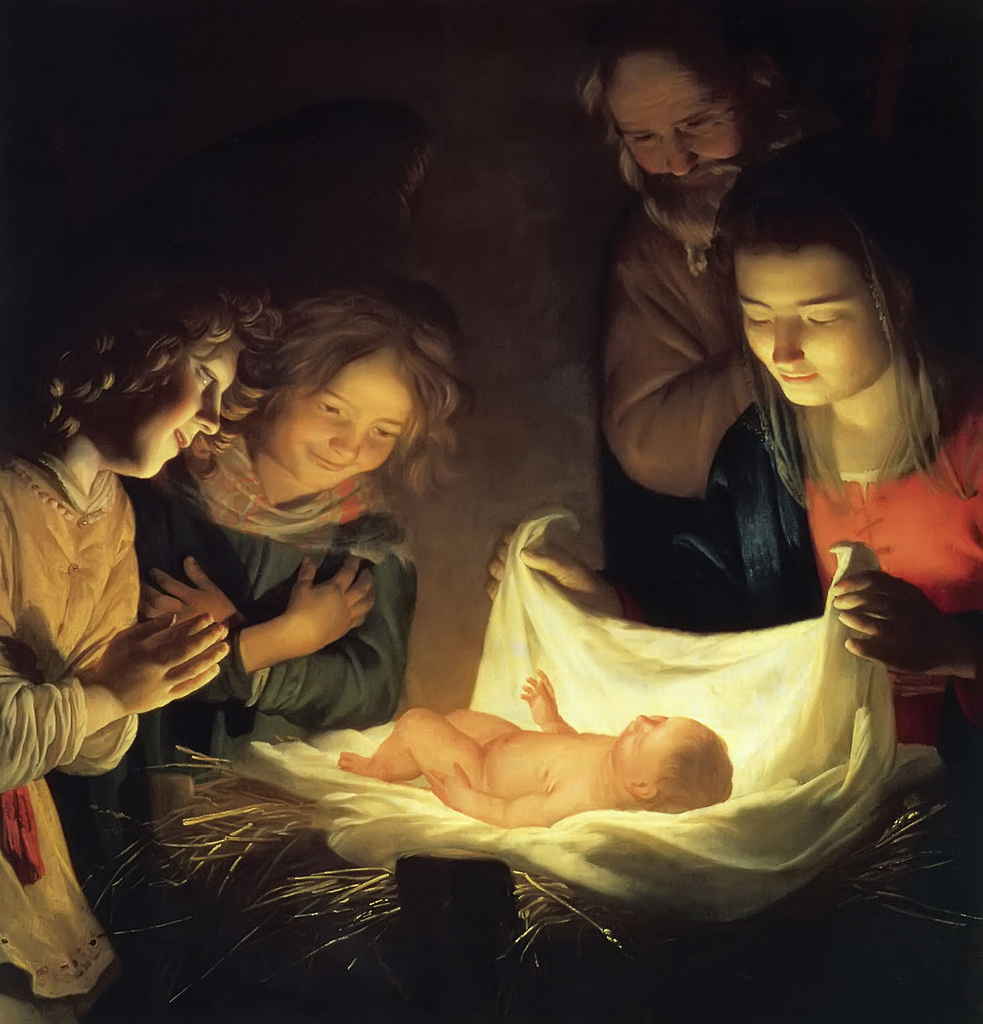
Adoration of the Child

But when the fulness of the time was come, God sent forth his Son, made of a woman, made under the law, To redeem them that were under the law, that we might receive the adoption of sons.  (Galatians 4:4-5)

It’s that time of year again; Christmas is in the air. Regardless of your perception of Christmas – it’s too commercial, it’s under attack, it’s just a pagan celebration dressed up in Christian garb, etc. – it is altogether appropriate that Christians set time aside to commemorate the first advent of our Lord and Savior Jesus Christ.

At this time we remember the miraculous conception and birth of God made man (John 1:14), but too often our focus shifts away from the significance of that event to the sappy sentimentality of the Nativity scene. As sweet as the image of a cuddly infant lying in a feeding trough adored by loving parents and worshipped by shepherds and wise men may be, the fact remains that this baby was God clothed in human flesh. The thought that the Creator condescended to take the form of His fallen creation (Philippians 2:7) to redeem as many as would receive Him (John 1:12), should leave us awestruck.

This was no afterthought on the part of God. In my article, “Why Satan?,” I address the issue of why God allowed sin in the first place, but along with the possibility of sin, God provided a way out (Hebrews 4:3; Revelation 13:8). From the very beginning there was the promise of a Savior (Genesis 3:15). Eve understood this promise, and at the birth of her first-born she rejoiced, “and said, I have gotten a man from the LORD” (Genesis 4:1). The literal translation of the Hebrew actually says “I have gotten a man Yahweh (the Lord).” She believed that she had given birth to the Savior according to the promise of God. But the time was not right. God wanted His creation, man in particular, to “be fruitful and multiply” (Genesis 1:28; 9:1). Abraham “Who against hope believed in hope, that he might become the father of many nations, according to that which was spoken, So shall thy seed be” (Romans 4:18).  That promise was not only for Abraham, “But for us also, to whom it shall be imputed, if we believe on him that raised up Jesus our Lord from the dead; Who was delivered for our offences, and was raised again for our justification” (Romans 4:24-25). For “The Lord is not slack concerning his promise, as some men count slackness; but is longsuffering to us-ward, not willing that any should perish, but that all should come to repentance” (2 Peter 3:9). So, when the time was right, God entered the world He created (John 1:3) as a helpless baby – fully God and fully man – to give up His life to buy back and restore His fallen creation. “For God so loved the world, that he gave his only begotten Son, that whosoever believeth in him should not perish, but have everlasting life” (John 3:16).

Very soon, at the fullness of time, He will return for His own as He promised: “And if I go and prepare a place for you, I will come again, and receive you unto myself; that where I am, there ye may be also” (John 14:3). So, regardless of your perspective on Christmas, as Christians it is a good time to remember that baby in the manger was God who came to die for us that we may live with Him, and soon we will be with Him.

1 Comment

Filed under Apologetics, Christianity, Christmas, Creation, Current Events, End Times, Evangelism, Gospel, Heaven, Religion, Second Coming of Christ, Theology