Category Archives: Evangelism

NOah Sail!

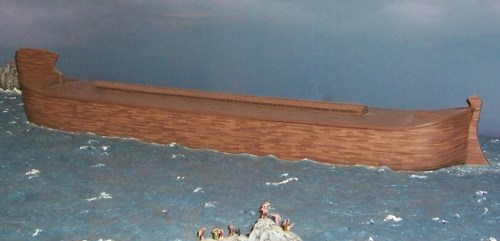
Ark Model Display at the Answers in Genesis Creation Museum

Ark Model Display at Answers in Genesis Creation Museum

Make thee an ark of gopher wood; rooms shalt thou make in the ark, and shalt pitch it within and without with pitch. (Genesis 6:14)

The creation ministry Answers in Genesis opens its long-awaited project the Ark Encounter on July 7, 2016. As implied by the name, the project promises to give visitors an “encounter” with Noah’s Ark. The main attraction is a full-scale model of Noah’s Ark based on the Egyptian Royal cubit of 20.6 inches and making the model an enormous 515 feet long. That is almost the length of 1 ¾ football fields.

The Ark will house many exhibits including life-sized animal models – many animated to be sure – to help visitors experience what life on the Ark might have been like. This will include the storage of food for the crew of eight, plus that of all the animal passengers. It will instruct the visitors on how the care and feeding of so many animals could be accomplished with only eight people onboard.
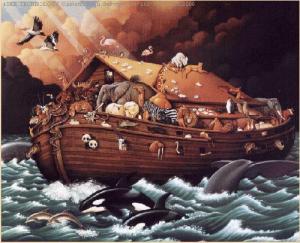
noah-arkThe importance of this attraction lies in the understanding that a large majority of people today reject the Bible as myth due to accounts such as that of the Global Flood recorded in Genesis 6-9. Even many liberal theologians compromise with the secularist in attributing the origin of the account to the Epic of Gilgamesh, or suggest that the Flood was only local and not global as described in Scripture.  Many adults today, if they think of Noah’s Ark at all, remember the stories read to them as children and remember the pictures of a tiny little boat with animals sticking their heads out of different port holes. Or they remember cute little bathtub toys with which they played at bath time. So, the idea of a wooden vessel large enough to house so many animals defies reason. The Ark Encounter will change that thinking, or at least give them something to think about.

I look forward to visiting sometime after it opens, and I would encourage others to plan a trip up to northern Kentucky to experience it for yourself. While there, you can also visit Answers in Genesis Creation Museum. To get the most out of the visit, I would plan for at least three days. It will really be worth your time.
ark sail

The Sail

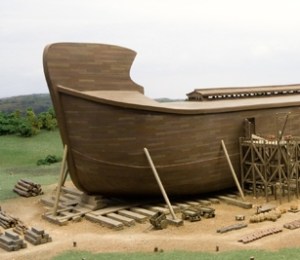
Not to take anything away from this most excellent endeavor by Answers in Genesis, but I do have one small bone to pick with the exterior design of the Ark. The ark replica under construction sports a tall stationary “sail” at the bow of the “ship” and a rudder-like structure, called a skeg, at the stern of the “ship.”

The Skeg

The Skeg

Tim Lovett is the designer of the ark replica. I do not know anything about Mr. Lovett, but according to the cover on his book Noah’s Ark: Thinking Outside the Box, he is a naval expert and a mechanical engineer. Lovett employed sound reasoning in the design of his ark. The “sail” is a wooden superstructure that rises high above the weather deck along the centerline of the ship. I say “ship” because the hull construction of this ark resembles what one would imagine for a modern ship with a tapered prow and stern. Hence the idea of “Thinking Outside the Box.” Prior to Lovett’s ship-like ark, most conventional thought rendered the Ark more box shaped – like a barge – than a navigable ship. Though unconventional, Lovett’s design makes good sense. The design prevents “broaching” i.e. catching a wave broadside. A tsunami-like wave in order of 100 ft or higher (which we would expect from the catastrophe described in the Flood account) could possibly swamp and capsize the vessel. On a navigable ship, an experienced sea captain would turn his ship into the wave to prevent broaching, but the Ark was not a navigable ship. Taking this into consideration, Lovett designed his ark with a sail and skeg that take advantage of the wind that generates the waves (sometimes but not always) and the motion of the wave to turn the ark in the direction of the wave and accomplish something similar to that of the experienced sea captain. It really is a very clever design.

Lovett defends his design by pointing to the ship construction of the ancient Egyptians, Phoenicians, Greeks, Romans, etc., and suggests that pre-Flood people probably possessed similar shipbuilding skills. If that were the case, then Noah probably had access to the same technology, and assuming, as we do, that pre-Flood people were actually of higher intellect than modern man (being that they were genetically closer to the perfectly created man, Adam), then it stands to reason that Noah had the intellect, knowledge and skills to build such a vessel.

There Lovett argues from scriptural silence. The Bible makes absolutely no mention of maritime travel in the pre-Flood world. We can surmise that they were technologically skilled by the descriptions given in Genesis 4:20-22, but the description is rather limited: they kept cattle, made musical instruments, and worked in brass and iron. That is really not up to the standard that we might consider technology today, however, that is not the point of the narrative. These people were not “knuckle draggers;” they were highly intelligent, yet there is nothing said about their abilities to navigate the open seas. Would that not be significant? So, Noah’s shipbuilding skills are merely a product of Lovett’s speculation, and we should leave it at that. There is nothing wrong with that as long as we remember that it is “speculation,” not Bible.

Let us consider what the Bible does say. We know that the human race had become wicked and corrupt (Genesis 6:1-7) to the point that God had no other option than to destroy them all; “But Noah found grace in the eyes of the LORD” (Genesis 6:8). God instructed Noah to build an ark. The Hebrew word translated “ark” is têbâh, and it means “box” – not a “ship” or a “boat.” It is a box.  Further, God instructed Noah what building materials to use: gopher wood and pitch. No one knows what gopher wood is. Some think it is some kind of extinct tree, and some think it may have been a method of construction or a process of laminating wood. We do not know. The point is that Noah knew what it was. “Pitch” is the Hebrew word kôpher which literally means “cover,” the same word that is used for “atonement.” Some have suggested that it was bitumen – a tar – but whatever it was, it was meant to seal the Ark and make it watertight.

Ark Model on Display at the Institute for Creation Research

Ark Model on Display at the Institute for Creation Research

Noah was given the dimensions for the Ark 300 x 50 x 30 cubits (Genesis 6:15), and it was to have three decks and animal pens (Genesis 6:14).  God’s instructions also included a “window” (Genesis 6:16). The Hebrew word translated “window” is tsôhar, which literally means “double light,” and is translated elsewhere in the O.T. as “noon” or “midday.” Considering these details, one would think that something so prominent as a “sail” or a “skeg” would have been noted. But again, this is an argument from silence that does not necessarily negate Noah having added this detail of his own volition. We can infer from Scripture that Noah employed some of his own initiative when, at the end of the Flood, we read, “And it came to pass at the end of forty days, that Noah opened the window of the ark which he had made” (Genesis 8:6, emphasis mine). In this case the Hebrew word translated “window” is challôn, which is always translated as “window” in the O.T. This was something different than the “window” God specified for construction.

So, could the Ark withstand the ravages of the catastrophic global flood without the benefit of a sail and skeg? To answer that question, we must answer some fundamental questions. Who brought the judgment upon the human race (Genesis 6:7)? Who decided to save Noah and his family (Genesis 6:18)? Who gave the order to build the Ark and provided the specifications (Genesis 6:14-16)? Who selected and called the animals to the Ark when it was completed (Genesis 7:7-9)? Who caused the fountains of the deep to burst and for the rain to fall for 40 days and nights (Genesis 7:11-12)? Who caused the waters to continue to rise for 150 days (Genesis 7:24)? The answer to all of those questions is God. It was all God’s doing. The next question to ask is: “What was God’s purpose for the Ark?” “Of fowls after their kind, and of cattle after their kind, of every creeping thing of the earth after his kind, two of every sort shall come unto thee, to keep them alive” (Genesis 6:20, emphasis mine).

Considering that God directly planned, directed, and superintended every detail of this catastrophic event, it stands to reason that (since His plan included preserving life on the Ark) He also kept the Ark safe through the turbulence of the storm.

Noah was instructed to build a big box, not a ship. God did not require him to possess shipbuilding skills, only enough skills to build a watertight box. God would take care of the rest. So, while Tim Lovett’s design is clever, well thought out, and reasonable, it is really unnecessary when God’s plan all along was to preserve life. More than that, a simple box preserved in turbulent waters, glorifies God more than a sleek ship designed by man. A ship designed to resist rough waters glorifies the ingenuity of man; but with a simple box, God gets all the glory.

The Ark is a “type” of Christ. Salvation is through grace; it is not by works of man (Ephesians 2:8-9). Those who place their trust in Christ are saved from the storms of life and preserved to enter into a new heaven and a new earth (Revelation 21:1). It is all God’s doing. The only thing man needs to do is obey God’s call and enter through the only door (John 14:6) to be saved. No clever scheme of man, no matter how refined, can compete with God’s very simple design.

So, if you have an opportunity to visit the Ark Encounter, please do so. It will really be a blessing to you. But when you look at that massive sail and skeg, take it for what it is: a clever product of someone’s imagination. And remember, God does not need our help to accomplish His will.


You might also be interested in reading about the Arm model I built: Building the Ark.

4 Comments

Filed under Apologetics, Christianity, Evangelism, Gospel, Religion, Salvation, Theology

Resurrection

colorful sunset

Jesus answered and said unto them, Destroy this temple, and in three days I will raise it up … When therefore he was risen from the dead, his disciples remembered that he had said this unto them; and they believed the scripture, and the word which Jesus had said. (John 2:20, 22)

Christians today, especially in the Middle East, suffer martyrdom by the hundreds at the hands of brutal ISIS executioners. These undergo a gruesome and horrific death by beheadings or being burned alive. Yet, as ghastly as we may perceive such brutality, the pain and suffering of these victims is short-lived, unlike that experienced by our Lord Jesus Christ on the cross.[1]

On the Lord’s Feast of Passover,[2] Jesus, already physically drained from lack of sleep[3] and subjected to a sham of a trial by the Jewish religious leaders, was brutally beaten and scourged at hands of Roman soldiers, experts at inflicting pain without killing the victim. Then in that depleted condition, He was forced to carry His own cross to the place of execution, and whether it was a fully assembled cross or just the cross beam, for a man in Jesus’ condition at that time was next to impossible – but He did it. Under the weight of that burden, determined to complete His mission, He faced the horror of the cross. God, wrapped up in human flesh, with His host of angelic armies standing at the ready awaiting the command to rain down vengeance upon His tormentors. At the time of His arrest, Peter pulled his sword in His defense, but Jesus stopped him. “Thinkest thou that I cannot now pray to my Father, and he shall presently give me more than twelve legions of angels?” (Matthew 26:53).  Nothing would deter Him from His mission. “[He] made himself of no reputation, and took upon him the form of a servant, and was made in the likeness of men: And being found in fashion as a man, he humbled himself, and became obedient unto death, even the death of the cross” (Philippians 2:7-8).

Determined to give to the very last, He carried Himself up Calvary’s hill, laid Himself down upon the timbers and spread His arms out to receive the nails – our pain, our guilt, our sins. “For [God the Father] hath made him [Jesus] to be sin for us, who knew no sin; that we might be made the righteousness of God in him” (2 Corinthians 5:21). At the last, He gave His life. He did not die. Jesus said, “… I lay down my life, that I might take it again. No man taketh it from me, but I lay it down of myself. I have power to lay it down, and I have power to take it again. This commandment have I received of my Father” (John 10:17-18, emphasis mine). He was not killed. “Jesus, when he had cried again with a loud voice, yielded up the ghost” (Matthew 27:50, emphasis mine). He was not the victim. He was in full control until the very last. John, the beloved disciple, and the only one of the twelve to witness the event said, “When Jesus therefore had received the vinegar, he said, It is finished: and he bowed his head, and gave up the ghost” (John 19:30, emphasis mine). Finished! Paid in full!

That was not the end. On the first day of the week, on that spring Sunday morning, He broke the chains of death and brought sheol’s captives with Him. Matthew records, “And the graves were opened; and many bodies of the saints which slept arose, And came out of the graves after his resurrection, and went into the holy city, and appeared unto many” (Matthew 27:52-53).[4]

His resurrection is key! Had Jesus died and remained in the tomb, we would venerate a martyr, nothing more. His bones would be marked by an ornate shrine. Perhaps followers would make faithful pilgrimages to the site to stand in awe and wonder. If that was the case, our faith’s reward would be death and eternal separation from our Creator with no hope of redemption. “And if Christ be not risen, then is our preaching vain, and your faith is also vain” (1 Corinthians 15:14). “But thanks be to God, which giveth us the victory through our Lord Jesus Christ” (1 Corinthians 15:57).  Because of His resurrection, “Death is swallowed up in victory” (1 Corinthians 15:54). “For if we have been planted together in the likeness of his death, we shall be also in the likeness of his resurrection” (Romans 6:5). So now we can say, “O death, where is thy sting? O grave, where is thy victory?” (1 Corinthians 15:55).

Before going to the cross, Jesus left us with this promise: “Let not your heart be troubled: ye believe in God, believe also in me. In my Father’s house are many mansions: if it were not so, I would have told you. I go to prepare a place for you. And if I go and prepare a place for you, I will come again, and receive you unto myself; that where I am, there ye may be also” (John 14:1-3). His resurrection guarantees the promise. On that day, “the Lord himself shall descend from heaven with a shout, with the voice of the archangel, and with the trump of God: and the dead in Christ shall rise first: Then we which are alive and remain shall be caught up together with them in the clouds, to meet the Lord in the air: and so shall we ever be with the Lord” (1 Thessalonians 4:16-17).

Our Christian brothers and sisters in the Middle East and elsewhere in the world are brutally killed daily by the enemy of God. We can thank God that for many, death is swift; it is nothing like what their Lord and our Lord endured for our sakes. But the guaranteed promise of the resurrection assures us that one day soon, we will be together with Him in His house.

Notes:


[1]  It is said that victims could linger on the cross up to three days until succumbing to dehydration and asphyxia.

[2]  Despite conventional tradition, this even could not have taken place on Friday. Jesus said He would rise in “three days,” not three partial days. Jesus specified “three days and three nights” (Matthew 12:39-40). No matter how one may try to convolute the time to fit a “Good Friday” scenario, one cannot get “three days and three nights” from Friday evening to Sunday morning. Jesus said, “three days and three nights” – 72 hours, nothing less will do!

[3]  Jesus had spent the night in prayer while His disciples slept (Matthew 26:36-46; Mark 14:32-42; Luke 22:39-46) before being betrayed by Judas, arrested and tried.

[4]  Matthew’s recording of this event that seems to coincide with Jesus’ death and the renting of the veil to the Holy of Holies, but a close inspection of the text reveals that this event occurred after the resurrection. See again Matthew 27:52-53.

2 Comments

Filed under Apologetics, Christianity, Easter, Evangelism, Gospel, Religion, Resurrection, Salvation, Theology

Easter’s Wrong!

Shocked

And when he had apprehended him, he put him in prison, and delivered him to four quaternions of soldiers to keep him; intending after Easter to bring him forth to the people. (Acts 12:4)

The two highest church attendance days are Christmas and Easter. Easter probably wins the high attendance day of the two since it always falls on a Sunday. Neither day is historically accurate, but Easter typically comes nearer being right than does Christmas. Both holidays (holy days) come to us thanks to the Roman Catholic Church (RCC) in its attempt to “Christianize” the pagan celebrations of Saturnalia, which celebrated the return of the sun, i.e. the days getting longer, and Ishtar, whose origin is rather convoluted but basically has its source in the ancient fertility goddess of Babylon from whence come the icons of Easter eggs and bunnies.[1]

The pagans celebrated their “Queen of Heaven” on the first day of the week (Sunday) following the first full moon after the vernal equinox. Some form of this religious practice was observed by the Egyptians, Greeks and Romans. By the time the RCC came into power, pagans continued the practice, so, in order to accommodate the pagan population, the Church put a Christian spin on the celebration. There are several parallels that can be made between that pagan religion and what we believe as Christians.[2] Jesus was born of a virgin, He died, He was buried, and He rose again. Superficially, the pagan story sounds familiar, but this should not be surprising since Satan is the ultimate counterfeiter. Jesus said, “He [Satan] was a murderer from the beginning, and abode not in the truth, because there is no truth in him. When he speaketh a lie, he speaketh of his own: for he is a liar, and the father of it” (John 8:44).  Since the celebration of Ishtar fell around the time as the Jewish Passover, and considering the parallels, it was not difficult to remake the pagan celebration into a Christian one. (Oh! Don’t be so shocked! We still do that today. In order to attract the “world” we adopt worldly practices, bring them into the church, and put a Christian face on them. Sometimes “Christian” events look no different than rock concerts. The only differences, if you can hear them, are the words of the songs. And for those of us who love the “old hymns” many of the tunes of those good old hymns originated in pubs and saloons. So, this is not unique to the RCC.)

Despite the title I chose for this article, my purpose here is not necessarily to bash our observance of Easter. (I prefer to call it “Resurrection Day” or “Resurrection Sunday.”) I believe that it is right and proper that we celebrate the Advent of our Lord and His death, burial and resurrection – the resurrection being key. They are highly significant events that altered the course of history and the destiny of man. But if we are going to celebrate these very special days, we should at least try to be “biblical” about it rather than “traditional.” Arguably, Christmas could remain as December 25th. While widely accepted by biblical scholars that the birth of Jesus probably took place around mid-September (more likely around the celebration of the Jewish Feast of Booths or Sukkot), counting back nine months would bring one to around December 25th as the time of conception, which would also be the actual “incarnation” when God came to be “with us” (Emmanuel) as a human embryo.

Easter, however, does not always line up exactly with Passover as is the case this year. Jesus was crucified on Passover. Jesus said, “Ye know that after two days is the feast of the passover, and the Son of man is betrayed to be crucified” (Matthew 26:2, emphasis mine). The Jewish day began at sundown, around 6:00 PM, unlike our western day which begins at midnight. On the afternoon before the Passover, Jesus sent His disciples to make arrangements to celebrate the Passover Seder (Matthew 26:18-19). “Now when the even was come, he sat down with the twelve” (Matthew 26:20, emphasis mine). “When the evening was come,” Passover had begun. After they had  finished the meal, Jesus went with His disciples to the Mount of Olives where He was arrested in the middle of the night – it was still Passover – and illegally tried and sentenced to death by crucifixion (Matthew 26-27, Mark 14-15, Luke 22-23, John 18-19). Jesus died at the ninth hour, 3:00 PM (Matthew 27:46; Mark 15:34; Luke 23:44-46), at the same time that the Passover lamb was being sacrificed at the Temple. It had to be this way in order to fulfill the Law of God given to Moses (Deuteronomy 16:1-6).

So, Jesus died on Passover, at precisely the right time in order to fulfill the Law of God and make a once for all atonement – a covering – for our sins. “For the life of the flesh is in the blood: and I have given it to you upon the altar to make an atonement for your souls: for it is the blood that maketh an atonement for the soul” (Leviticus 17:11, emphasis mine). “And almost all things are by the law purged with blood; and without shedding of blood is no remission [of sins]” (Hebrews 11:28, emphasis mine).

Biblically, then, Easter (Resurrection Day) should be celebrated in association with and very closely linked to the Jewish Passover. “Easter” is nowhere found in the Bible except as mistranslated in our beginning verse above (Acts 12:4). The Greek word translated “Easter” in this verse is pascha, the Greek transliteration of the Hebrew pesach or Passover. Evidently the translators of the King James Bible were taken in by centuries of RCC tradition.

“Easter” is not biblical, and it becomes painfully obvious especially this year. As noted above, Easter is the first Sunday that follows the first full moon after the vernal equinox. This year, the vernal equinox took place on March 19. The first full moon after that will be on March 23, making the 27th Easter Sunday. The problem is that the Jewish calendar is lunar, not solar. Nissan (Abib in the OT) is the first month of the Jewish religious calendar, and Passover is celebrated on Nissan 15. This year, 2016, Nissan 15, Passover, begins on Friday, April 22 at 6:00 PM and goes to 6:00 PM Saturday, April 23. We are celebrating Resurrection Day nearly one month before Passover, and that, to me, just seems wrong. You cannot have “resurrection” before the Passover sacrifice! If we were being biblical instead of traditional, we should be celebrating Resurrection Day on Sunday, April 24. Instead, we will just go with the flow and celebrate it according to the Roman Catholic tradition. This is why, especially this year, Easter’s Wrong.

Notes:


[1]  See “The Pagan Origin of Easter” http://www.lasttrumpetministries.org/tracts/tract1.html

[2]  Ibid.


3 Comments

Filed under Apologetics, Christianity, Easter, Evangelism, Gospel, Religion, Resurrection, Salvation, Satan

Says Who?

After the Flood

Knowing this first, that there shall come in the last days scoffers, walking after their own lusts,   (2 Peter 3:3)

“Scoffers,” as defined by the Apostle Peter in the context of this verse, are those who reject the teaching of Scripture concerning the return of our Lord Jesus Christ, but more generally, scoffers ridicule all teachings of Scripture. Scoffers become, as the Apostle Paul described, “fools” – “Professing themselves to be wise” (Romans 1:22). A “fool,” as defined by the Bible, is one who “hath said in his heart, There is no God” (Psalm 14:1). While the world has always had a good number of “foolish scoffers,” it seems, to me at least, that their ranks have swelled in these “last days,” or perhaps they have just gotten more brazen. The open and unapologetic Christian will sooner or later encounter scoffers that will mock and challenge one’s faith in the Word of God. When that happens, Peter says, “sanctify the Lord God in your hearts: and be ready always to give an answer to every man that asketh you a reason of the hope that is in you with meekness and fear” (1 Peter 3:15, emphasis mine).

Recently I had an electronic exchange with a scoffer pretending to be a Christian. (“Wherefore by their fruits ye shall know them.” Matthew 7:20) This scoffer mocked the account of the Global Flood recorded in Genesis. He questioned the construction of the Ark, the collecting of the animals, the supposition that dinosaurs were carried onboard and the logistics of taking care of the menagerie. He asserted that dinosaurs did not live at the same time as the biblical account of the Flood, then chided that it made “me ashamed that fundamentalist Christianity is part of our culture, that these ‘adults’ actually live in a mass fantasy world, manipulated by others in their own fantasy world, some of whom have PhD after their name” – referring to creation scientists. He continued, “Don’t you realize that the New Testament gives us permission to abandon the fantastic myths of the Old Testament, and that the only teaching of Jesus is compassion, for which we don’t need a Bible, or for that matter, a religion?” (emphasis mine)

Proverbs teaches us to “Answer a fool according to his folly, lest he be wise in his own conceit.” (Proverbs 26:5) I assumed the scoffer to be “Christian” from his suggestion “that the New Testament gives us permission to abandon the fantastic myths of the Old Testament.” Although I found it rather astounding that a “Christian” would only accept less than one-third of the Bible. Obviously, he does not know his Bible very well, which is not something for which to be proud, if one really is a Christian. Consider the following:

In the beginning was the Word, and the Word was with God, and the Word was God. The same was in the beginning with God. All things were made by him; and without him was not any thing made that was made … And the Word was made flesh, and dwelt among us, (John 1:1-3, 14)

Obviously, that is talking about Jesus, but compare that with Genesis 1:1 “In the beginning God created the heaven and the earth.” Here the New Testament (NT) claims that Jesus IS God. That being the case, consider the following:

But from the beginning of the creation God made them [Adam and Eve] male and female. For this cause shall a man leave his father and mother, and cleave to his wife; And they twain shall be one flesh: so then they are no more twain, but one flesh. (Mark 10:6-8, emphasis mine)

For in those days shall be affliction, such as was not from the beginning of the creation which God created unto this time, neither shall be. (Mark 13:19, emphasis mine)

Ye are of your father the devil, and the lusts of your father ye will do. He was a murderer from the beginning, and abode not in the truth, because there is no truth in him. When he speaketh a lie, he speaketh of his own: for he is a liar, and the father of it. (John 8:44, emphasis mine)

In the verse above Jesus was referring to Genesis 3:1-5, “Now the serpent [the devil] was more subtil than any beast of the field which the LORD God had made. And he said unto the woman, Yea, hath God said, Ye shall not eat of every tree of the garden? … And the serpent said unto the woman, Ye shall not surely die” (emphasis mine)

But as the days of Noe [Noah] were, so shall also the coming of the Son of man be. For as in the days that were before the flood they were eating and drinking, marrying and giving in marriage, until the day that Noe entered into the ark, (Matthew 24:37-38, see also Luke 17:26-27, emphasis mine)

Verily I say unto you, It shall be more tolerable for the land of Sodom and Gomorrha in the day of judgment, than for that city. (Matthew 10:15, emphasis mine)

But I say unto you, That it shall be more tolerable for the land of Sodom in the day of judgment, than for thee. (Matthew 11:24, emphasis mine)

And whosoever shall not receive you, nor hear you, when ye depart thence, shake off the dust under your feet for a testimony against them. Verily I say unto you, It shall be more tolerable for Sodom and Gomorrha in the day of judgment, than for that city. (Mark 6:11, emphasis mine)

But the same day that Lot went out of Sodom it rained fire and brimstone from heaven, and destroyed them all. (Luke 17:29, emphasis mine)

For as Jonas [Jonah] was three days and three nights in the whale’s belly; so shall the Son of man be three days and three nights in the heart of the earth. The men of Nineveh shall rise in judgment with this generation, and shall condemn it: because they repented at the preaching of Jonas; and, behold, a greater than Jonas is here. (Matthew 12:40-41, emphasis mine)

Jesus said unto them, Verily, verily, I say unto you, Before Abraham was, I am. (John 8:58, emphasis mine)

By now, it should be obvious to even the most Bible illiterate that Jesus, who is God the Creator, affirmed the “myths” of the Old Testament (OT). Not only that, but being God Himself, He is also Author of those “myths.” The NT says that ALL Scripture is “breathed out” by God.

All scripture is given by inspiration of God, and is profitable for doctrine, for reproof, for correction, for instruction in righteousness (2 Timothy 3:16, emphasis mine)

Knowing this first, that no prophecy of the scripture is of any private interpretation. For the prophecy came not in old time by the will of man: but holy men of God spake as they were moved by the Holy Ghost. (2 Peter 1:20-21, emphasis mine)

The writers of the NT only knew the OT as “Scripture.”  So, how did they view the “myths” of the OT?

And to make all men see what is the fellowship of the mystery, which from the beginning of the world hath been hid in God, who created all things by Jesus Christ: (Ephesians 3:9, emphasis mine)

He that committeth sin is of the devil; for the devil sinneth from the beginning. For this purpose the Son of God was manifested, that he might destroy the works of the devil. (1 John 3:8, referring to Genesis 3:1-5, emphasis mine)

By faith Noah, being warned of God of things not seen as yet, moved with fear, prepared an ark to the saving of his house; by the which he condemned the world, and became heir of the righteousness which is by faith. (Hebrews 11:7, emphasis mine)

Which sometime were disobedient, when once the longsuffering of God waited in the days of Noah, while the ark was a preparing, wherein few, that is, eight souls were saved by water. (1 Peter 3:20, emphasis mine)

And [God] spared not the old world, but saved Noah the eighth person, a preacher of righteousness, bringing in the flood upon the world of the ungodly; And turning the cities of Sodom and Gomorrha into ashes condemned them with an overthrow, making them an ensample unto those that after should live ungodly; (2 Peter 2:5-6, emphasis mine)

Even as Sodom and Gomorrha, and the cities about them in like manner, giving themselves over to fornication, and going after strange flesh, are set forth for an example, suffering the vengeance of eternal fire. (Jude 1:7, emphasis mine)

By faith they [Israel] passed through the Red sea as by dry land: which the Egyptians assaying to do were drowned. By faith the walls of Jericho fell down, after they were compassed about seven days. (Hebrews 11:29-30, emphasis mine)

So, the NT confirms all of these “myths.” What then should we do? Discard the New Testament? If Jesus is who the NT says He is, then the scoffer needs to rethink his prideful arrogance. If all the accounts of the OT are simply myths, then Jesus was either misinformed, which precludes His omniscience, or He was lying. In either case, He would be disqualified as God because God, by definition, is all-knowing, and He cannot lie (Numbers 23:19; Hebrews 6:18)

If the scoffer really is a “Christian,” (which I doubt), he should take into consideration that the NT confirms the OT miraculous accounts. Therefore, at least by NT standards, the OT is true. If the OT is true, then science rightly practiced will validate what it has to say about Creation, the Fall, the Flood, and the division of nations, as well as all other fantastic accounts of the Bible. The Institute for Creation Research does scientific research that confirms what the Bible has to say about creation and other matters of science. The Bible is not a science text book, but when it speaks on scientific matters, it is accurate and trustworthy. The scoffer knows neither the Bible nor science.

3 Comments

Filed under Apologetics, Atheism, Bible, Christianity, Creation, End Times, Evangelism, Gospel, Origins, Religion, Satan, Science, Second Coming of Christ, Theology

Picking A President

Republican-Presidential-Candidates-2016

For the leaders of this people cause them to err; and they that are led of them are destroyed.  (Isaiah 9:16)

I don’t often focus on politics on this blog; politics is not my main objective, but sometimes I just need to get things off my chest. I have no national platform from which to speak. I’ve written no books, or starred on stage or film. I never held public office of any kind or even campaigned for anyone. I am not a well-known preacher of national renown, and the FOX News Channel has never asked me for my two cents worth. But I do have an opinion on the upcoming presidential race for anyone who cares to listen.

To begin, I will not waste time in addressing the godless, socialist Democrat party. Robbing the rich to give to the poor makes a good bedtime story, but it does not work in real life. As Margaret Thatcher famously said, “The problem with socialism is that you eventually run out of other people’s money.” If one is observant, one will note how those pleading the cause of the poor tend to keep their own money to themselves, and their will for the masses does not apply to themselves. As the barnyard animals of Animal Farm said of the pigs in charge, “Some animals are more equal than others.” Democrats also fail to see that killing a baby in the womb is murder, not a woman’s right to choose. So, for this discussion, forget the Democrats!

Republicans fare slightly better in that their rhetoric sounds conservative, but their actions fall woefully short of their talk. For example, they claim to be “Pro-Life” but continue to fund Planned Parenthood.

It is 2016 and once again the time has come to elect a new President of the United States (POTUS). The Republican field of candidates includes a long list of POTUS wannabes, any one of which would be an enormous improvement over the man currently holding the office. But rather than discussing each candidate, I want to focus my attention on the front runners and particularly the front runner, Donald Trump. I also want to approach this from an “evangelical” perspective.

The first appointed Chief Justice of the Supreme Court, John Jay, once said, “Providence [i.e. God] has given to our people the choice of their rulers, and it is the duty, as well as the privilege and interest of our Christian nation to select and prefer Christians for their rulers” (emphasis mine).[1] While the Constitution of the United States guarantees that “no religious test” shall be given for holding a public office, it does not and cannot require individual citizens from applying such a test. Therefore, in accordance with Justice John Jay’s opinion, it becomes incumbent on Christians, evangelicals, to prefer Christians for public office, especially for the office of POTUS. Critics of this perspective will note that we are not electing a pastor, but a president, yet many of the same qualifications should apply. Consider the qualifications for pastor (bishop) given in 2 Timothy 3:1-7 listed here in brief:

  • Blameless, i.e. “not arrested” or “inculpable”
  • Husband of one wife – if a man cannot be faithful to his marital vows, how can we expect him to be faithful to his oath of office?
  • vigilant – circumspect, that is, “watchful, discreet; cautious; prudent”
  • sober – of sound mind; self-controlled
  • Of good behavior – orderly; decorous (characterized by dignified propriety in conduct, manners, appearance, character, etc.)
  • Hospitable – fond of guests. Presidents must entertain foreign dignitaries and constituents
  • apt to teach – this has a broad range of applications
  • not given to wine – not a substance abuser
  • no “striker” – quarrelsome; belligerent; combative
  • not greedy of filthy lucre – the kind of person that can be bought
  • not covetous – seeking personal gain
  • not a novice – no experience
  • must have a good report – i.e. a good reputation

Surely the list above is fitting for anyone aspiring for any position of leadership. Considering the list above, apply that to the top three candidates, Donald Trump, Ted Cruz, and (arguably) Marco Rubio.

Several high-profile evangelical leaders have come out in support of Donald Trump, and it makes me wonder how closely they have evaluated this candidate. Superficially, he seems an unlikely contender for the post. First of all, besides being an immensely successful businessman, he is primarily an entertainer. As an entertainer, he knows how to put on “a show.” As a good entertainer, he knows his audience, he knows what his audience wants to see and hear, and he plays it out for them. As a businessman, he boasts in his ability to “make deals,” and how he is able to get what he wants. In other words, he is a great manipulator; we already have one of those in the Oval Office. Do we really want another with the only exception being that this one comes stamped with an “R” instead of a “D”? Personally, I don’t trust this man, but in all fairness, his record should be scrutinized.

From CNN Politics, “3 questions evangelicals should ask about Donald Trump:” (1) What is known about Trump’s personal life and morality? (2) Where does Trump stand on moral and social policy issues of concern to Christians and to which the Bible speaks to clearly? (3) Are the love of money and pride legitimate issues to weigh when considering support for a presidential candidate? Read the article for the details, but in essence, Trump is not the man evangelicals should aspire to put in the White House.

Consider the first question. Trump has been married three different times to three different women and his divorces were “unbiblical.” His speech betrays questionable moral standards (Matthew 12:34; 15:11, 18). Trump does not feel the need to ask God’s forgiveness (Romans 3:23; 1 John 1:10; 2:4), which should immediately raise a red flag with evangelicals. Considering the second question, Trump claimed to be “pro-choice” at one time. He also favors “gay rights” and same-sex marriage. On the third question, his love of money is obvious as is his pride. One positive aspect of his money lies in his ability to fund his own campaign which presumably frees him from special interests. However, one special interest that supersedes all others is his own. Note how he boasts of the free airtime the media gives him and the personal offence he takes when not “treated nice.” Carefully examining Donald Trump’s history exposes a man who does what is expedient to achieve his goals. He is “A double minded man [that] is unstable in all his ways” (James 1:8).

Marco Rubio seems conservative enough, and in many ways makes for a fine conservative candidate that evangelicals should like. He seems to have very strong moral principles. He has expressed a personal relationship with Christ – an evangelical concept – even though he is a committed Roman Catholic. I have heard (but not confirmed) that he has been attending Southern Baptist services, so it is difficult to discern if his proclamation is genuine or simply meant to gain evangelical favor. (Please forgive my skepticism.) Rubio’s major “chink” is his association with the “Gang of Eight” and their legislation in favor of amnesty for illegal aliens. Rubio consistently affirms that he rejects amnesty of illegal aliens, and his defenders attribute his questionable association with inexperience and being “steamrolled” by the “old bulls” of the Republican Party. I can see that happening, but it also shows inconsistency.

So, unless proven wrong, I wholeheartedly support Ted Cruz[2] in his bid for the presidency. Cruz is the “real deal.”[3] Ted Cruz, although he may not make an issue of it, is a genuine, born-again, Christian.[4] He accepted Christ as his personal Savior at the age of eight and has lived his life in accordance with his commitment to Christ. Cruz has been a staunch defender of the Constitution throughout his career. Trump accuses Cruz of being “mean and nasty,” and that no one likes him. Trump’s exaggeration aside, the establishment Republicans dislike Senator Cruz because he does not make deals, and he fights against his own party to uphold conservative principles going so far as calling Mitch McConnell a liar from the Senate floor[5] for lying about a deal cut on TPA. Truth can sometimes be a nasty thing, and voicing truth to some can seem “mean” and offensive, but Ted Cruz stands for truth even when it costs him popularity. Ted Cruz is involved in politics, but he is not a politian; he is a true statesman. Is that not what we want in a POTUS?

Earlier in this post I listed the requirements for bishop from First Timothy. Review these again and see if Ted Cruz does not fill the bill. Only one perfect man ever walked this earth, and Ted Cruz will tell you that man was Jesus Christ. Ted Cruz is far from perfect, but if you will examine his life, his character and his record, I believe you will find that he is probably the best choice to be our next POTUS. I have provided some resource links in the endnotes below. Please take time to examine them before making your final judgment.

Even if Donald Trump becomes our next Republican Presidential Nominee (heaven forbid), I will vote for him before letting another Democrat take the White House. It is vitally important that evangelical Christians be fully engaged in the democratic process. As John Jay said, “it is the duty, as well as the privilege and interest of our Christian nation to select and prefer Christians for their rulers.” Donald Trump says he is a Presbyterian. I don’t know what that means other than he identifies with one particular denomination. Ted Cruz does not say he is Southern Baptist, but his life and character reflect that he is a committed Christian. We need a true Christian POTUS. Whatever you decide, don’t decide to stay home because you don’t like the choices. We get the government we deserve.

Notes:


[1]  http://www.wnd.com/2015/05/americans-prefer-christians-for-their-rulers/

[2]  https://www.tedcruz.org/issues/

[3]  http://bwcentral.org/2016/01/the-real-ted-cruz/

[4]  https://www.youtube.com/watch?v=3hrms1ACMn0

[5]  https://www.youtube.com/watch?v=eE6HLbaAL0A

4 Comments

Filed under Christianity, Current Events, Evangelism, Politics, Pro-life, Religion