Category Archives: Hell

Come, Harvest Time!

And when the day of Pentecost was fully come, they were all with one accord in one place. (Acts 2:1)

Today, May 20, 2018, celebrates 1988 years since the birth of the Church on Pentecost (provided the Church was born in 30 A.D.). Most modern Christians pay little attention to the day since it is mainly a Jewish observance, and it has never been incorporated into the Christian tradition. However, it might behoove us to give it closer attention. Some end-times prophecy watchers see this Pentecost as a “high watch” day for the Rapture of the Church. I thought the same thing last year and wrote about it, but I was obviously wrong.[1]

This year could be different, but before I continue, I must stress that neither I nor any of those whom I have resourced are setting a date for the Rapture of the Church. Jesus instructed us to “watch” and be ready, and He provided “signs” for which to look. It amazes me how many Christians I know seem to be indifferent about the imminent return of Christ – our “blessed hope” (Titus 2:13). Not me, every day I wake up I am hoping that this will be the day. Yet, while I anxiously await His return, my heart is burdened for those who are lost and will have to go through the horrible 7-year Tribulation that will follow the Rapture. If in that awful time of Tribulation they continue in their rejection of Christ, they will face an eternity in hell. My burden is a thousand times heavier because I have two sons and their wives and my grandchildren that are lost, and it is not as if they have not been taught these things; they simply refuse to believe. Still, I am looking for Jesus to come soon.

So, why this Pentecost? Pentecost is one of the seven Feasts of the Lord.[2] As I have written in the past (See Note 2 below), the Feasts of the Lord are divine appointments for God to keep, and they are prophetic. The first three feasts were fulfilled by Jesus’ first coming: Passover, Unleavened Bread, and First Fruits. The last three will be fulfilled at His second coming: Feast of Trumpets, Day of Atonement, and Feast of Tabernacles. Both the spring and the fall feasts are closely tied together. Pentecost seems to be set apart from the rest. It comes 50 days (almost two months) after the Feast of First Fruits followed by a long space of almost four months before the fall feasts.

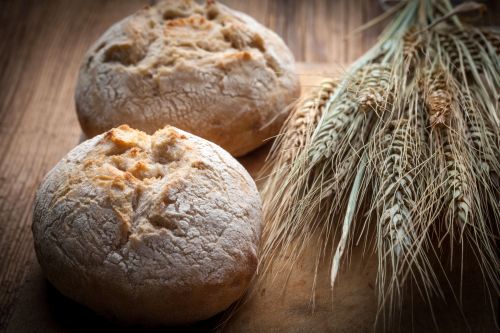
Pentecost celebrates the barley harvest (not wheat) which is representative of the Gentile nations. At Pentecost, the priest offers two loaves of leavened bread – again, leaven representing the Gentile nations. This Feast had a partial fulfillment when the Holy Spirit descended upon the disciples in the upper room giving birth to the church. At that time, the Shekinah Glory of God came upon the disciples in the form of “cloven tongues like as of fire” (Acts 2:3) signifying that God’s presence now resided within His people rather than in the Temple. We are now “the temple of God” (1 Corinthians 3:16).

However, as with most prophecies, Pentecost may still have a second fulfillment yet to come. Just as Pentecost is set apart from the other feast days, so is the church set apart from the feasts that directly relate to the Jews. Furthermore, just as there is a long period between Pentecost and the Feast of Trumpets, so there has been a long period between the birth of the Church and the long-awaited “marriage supper of the Lamb” (Revelation 19:6-10).

The signs indicating our Lord’s soon return are many.[3] Israel just celebrated the 70th anniversary of their rebirth as a nation fulfilling the “dry bones” prophecy of Ezekiel 37.  This is also the 70th Year of Jubilee since the Law was given to Moses. Furthermore, if you can believe biblical chronology, it is the 120th Jubilee from the time of creation (Genesis 6:3) – 120 x 50 = 6000. Put that together with the Revelation 12 sign[4] that appeared on September 23, 2017, the alignment of nations against Israel in preparation for the Ezekiel 38-39 war, the increased violence all over the world, seismic and catastrophic weather activity, and an increase in demonic activity; it becomes very apparent that something big is about to happen.

Could this Sunday, Pentecost be the day that Jesus comes for His Bride? I do not know, nor does anyone else, but the signs make for a good possibility! I am ready! How about you? If the prospect scares you, then perhaps it’s time that you make things right with your Creator. See my page on “Heaven” for help with that.

Here are some good YouTube videos to learn more about the possible Pentecost Rapture:

https://www.youtube.com/watch?v=rxMj20tU_HQ

https://www.youtube.com/watch?v=LVhOm9E1bjw

https://www.youtube.com/watch?v=ig7LXnYOLhc

https://www.youtube.com/watch?v=-CJJYIXAVwA

Notes:


[1]  “Pentecost” – https://erniecarrasco.com/2017/05/28/pentecost/

[2]  “Rosh HaShanah” – https://erniecarrasco.com/2016/10/03/rosh-hashanah/

[3]  “Now’s A Good Time!” – https://erniecarrasco.com/2017/09/17/nows-a-good-time/

[4]  “Coming Soon!” — https://erniecarrasco.com/2017/07/09/coming-soon/
3 Comments

Filed under Apologetics, Christianity, Current Events, End Times, Evangelism, Gospel, Hell, Religion, Salvation, Second Coming of Christ, Theology

The Gates of Hell

The Gates of Hell, Caesarea Philippi

And Simon Peter answered and said, Thou art the Christ, the Son of the living God. (Matthew 16:16)

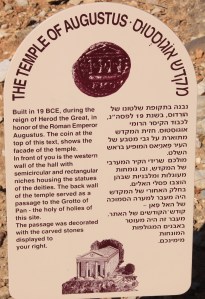
Most of Jesus’ earthly ministry centered around the Sea of Galilee, aka the Sea of Tiberius, with His ministry headquarters at Capernaum. The furthest north He traveled, as recorded in the Gospels, was Caesarea Philippi, an ancient Roman city located at the southwestern base of Mount Hermon. Formerly, it carried the name of Paneas in association with the Greek god Pan. Herod the Great erected a white marble (pagan) temple there in honor of Caesar Augustus in 19 BC. Philip II (the Tetrarch) founded the city of Paneas and renamed it Caesarea in honor of Caesar Augustus in 14 AD.[1]

Ruins of Temple of Augustus, Caesarea Philippi, Israel

Mount Hermon bears the ignominy of being the frequent site of pagan worship.[2] “In the Book of Enoch, Mount Hermon is the place where the Watcher class of fallen angels descended to Earth. They swear upon the mountain that they would take wives among the daughters of men and take mutual imprecation for their sin (Enoch 6).”[3] From a grotto at the foot of Mount Hermon used to issue a spring that has since stopped due to seismic activity.

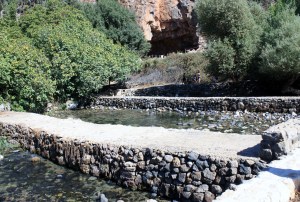
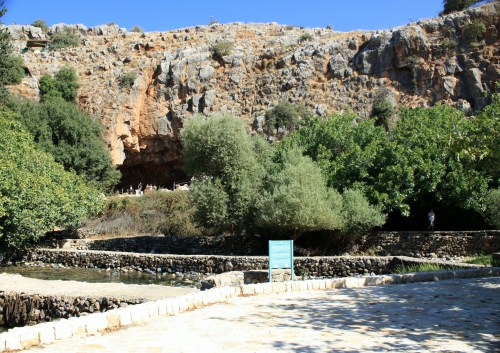
Nahal Senir Spring formerly “Panias” for the Greek god Pan. This spring, one of three headwaters of the Jordan River, used to flow directly from the cave.

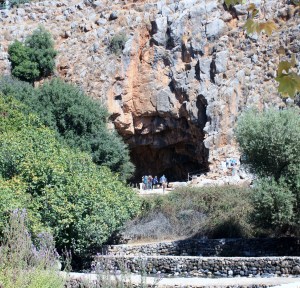
“The pagans of Jesus’ day commonly believed that their fertility gods lived in the underworld during the winter and returned to earth each spring. They saw water as a symbol of the underworld and thought that their gods traveled to and from that world through caves. To the pagan mind, then, the cave and spring water at Caesarea Philippi created a gate to the underworld. They believed that their city was literally at the gates of the underworld—the gates of hell. In order to entice the return of their god, Pan, each year, the people of Caesarea Philippi engaged in horrible deeds, including prostitution and sexual interaction between humans and goats.”[4]

The Gates of Hell, Caesarea Philippi, Israel

It was to this place that Jesus brought His disciples and asked, “Whom do men say that I, the Son of man am?” (Matthew 16:13).  The disciples recited the popular rumors: John the Baptist, Elijah, Jeremiah or one of the prophets. Then, “He saith unto them, But whom say ye that I am?” (Matthew 16:15). Without hesitation, “Simon Peter answered and said, Thou art the Christ, the Son of the living God” (Matthew 16:16). “And Jesus answered and said unto him, Blessed art thou, Simon Barjona: for flesh and blood hath not revealed it unto thee, but my Father which is in heaven. And I say also unto thee, That thou art Peter, and upon this rock I will build my church; and the gates of hell shall not prevail against it” (Matthew 16:17-18, emphasis mine).

Jesus then disclosed details of His coming crucifixion.  “Then Peter took him, and began to rebuke him, saying, Be it far from thee, Lord: this shall not be unto thee” (Matthew 16:22). Jesus, in turn, rebuked Peter in the harshest of terms. “Get thee behind me, Satan: thou art an offence unto me: for thou savourest not the things that be of God, but those that be of men” (Matthew 16:23, emphasis mine). Then to all Jesus counted the cost of discipleship. “If any man will come after me, let him deny himself, and take up his cross, and follow me. For whosoever will save his life shall lose it: and whosoever will lose his life for my sake shall find it” (Matthew 16:24-25, emphasis mine). He closed the discussion with these words. “For the Son of man shall come in the glory of his Father with his angels; and then he shall reward every man according to his works. Verily I say unto you, There be some standing here, which shall not taste of death, till they see the Son of man coming in his kingdom. (Matthew 16:27-28, emphasis mine).

“And after six days Jesus taketh Peter, James, and John his brother, and bringeth them up into an high mountain apart, (Matthew 17:1, emphasis mine). The summit of Mount Hermon is 9,232 ft. (almost two miles) above sea level. From the “gates of hell” to the portal of the Watchers, Jesus ascended with His closest disciples; “And was transfigured before them: and his face did shine as the sun, and his raiment was white as the light. And, behold, there appeared unto them Moses and Elias talking with him” (Matthew 17:2-3.) The disciples were flabbergasted. They did not know how to respond or react to what they were witnessing. “Then answered Peter, and said unto Jesus, Lord, it is good for us to be here: if thou wilt, let us make here three tabernacles; one for thee, and one for Moses, and one for Elias” (Matthew 17:4, emphasis mine). Perhaps because the mountain was littered with all kinds of shrines to pagan gods,

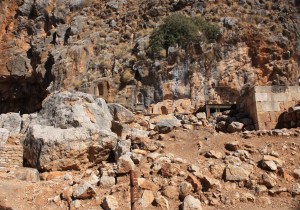
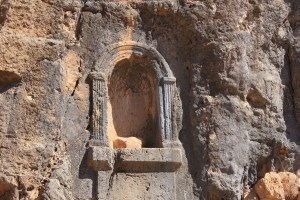
Niches to pagan gods at the Gates of Hell

Peter thought it would be appropriate to build something similar for Jesus, Moses, and Elijah. A voice from heaven quickly put the kibosh on that idea.

A niche for a pagan god

“While he yet spake, behold, a bright cloud overshadowed them: and behold a voice out of the cloud, which said, This is my beloved Son, in whom I am well pleased; hear ye him” (Matthew 17:5).

Gates are defensive barriers designed to keep out the enemy. The gates of hell are no different. Satan is at war against the Kingdom of God, and he erects all kinds of barriers to keep the Kingdom of God from the hearts of those who are perishing. Peter confessed, “Thou art the Christ, the Son of the living God” (Matthew 16:16). Upon that confession – that “rock” – Jesus declared, “I will build my church; and the gates of hell shall not prevail against it” (Matthew 16:18).  All that they had witnessed would not be clear until after Jesus’ resurrection and ascension.  Peter later recalled, “… [we] were eyewitnesses of his majesty. For he received from God the Father honour and glory, when there came such a voice to him from the excellent glory, This is my beloved Son, in whom I am well pleased. And this voice which came from heaven we heard, when we were with him in the holy mount. (2 Peter 1:16-18, emphasis mine).

On the mountain, Jesus received His marching orders, and it was time to storm the gates of hell. Luke records “And it came to pass, when the time was come that he should be received up, he stedfastly set his face to go to Jerusalem” (Luke 9:51, emphasis mine). Jesus tore down the gates with His death, but more so with His resurrection. The gates of hell cannot stop His Church, and we have our orders: “ye shall be witnesses unto me both in Jerusalem, and in all Judaea, and in Samaria, and unto the uttermost part of the earth” (Acts 1:8).  “And Jesus came and touched them, and said, Arise, and be not afraid” (Matthew 17:7, emphasis mine).

Notes:


[1]  Caesarea Philippi – https://en.wikipedia.org/wiki/Caesarea_Philippi

[2]  Temples of Mount Hermon – https://en.wikipedia.org/wiki/Temples_of_Mount_Hermon

[3]  Mount Hermon – https://en.wikipedia.org/wiki/Mount_Hermon

[4]  Ray Vander Laan, That the World May Know, “The Gates of Hell” – https://www.thattheworldmayknow.com/gates-of-hell-article

4 Comments

Filed under Apologetics, Christianity, Evangelism, Geology, Gospel, Hell, Religion, Theology

Jesus’ Brethren

There came then his brethren and his mother, and, standing without, sent unto him, calling him. (Mark 3:31)

One of the tenets of the Roman Catholic Church holds that Mary, the mother of Jesus, remained a perpetual virgin her entire life, but that is not what the Gospels teach. Here in this passage from Mark’s Gospel, as well as in Matthew 12:46-50 and Luke 8:19-21, we see a different story.

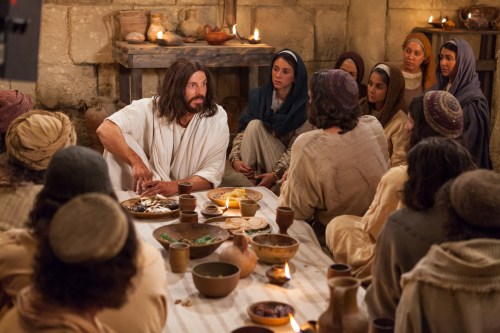
According to Mark, Jesus had just selected His twelve apostles (Mark 3:16-19) and “went into a house” – probably Peter’s house in Capernaum right across the way from the local synagogue. Jesus had just completed a long day of healing the sick and casting out demons, and it was time to sit back and enjoy dinner with His disciples, but “the multitude cometh together again, so that they could not so much as eat bread” (Mark 3:20). Among the crowd were “scribes which came down from Jerusalem” (Mark 3:22) accusing Him of casting out demons by the power of “Beelzebub.”

Jesus exposed the absurdity of their charge. “And he called them unto him, and said unto them in parables, How can Satan cast out Satan? And if a kingdom be divided against itself, that kingdom cannot stand. And if a house be divided against itself, that house cannot stand. And if Satan rise up against himself, and be divided, he cannot stand, but hath an end” (Mark 3:23-26).

Then He made this seemingly unrelated remark. “Verily I say unto you, All sins shall be forgiven unto the sons of men, and blasphemies wherewith soever they shall blaspheme: But he that shall blaspheme against the Holy Ghost hath never forgiveness, but is in danger of eternal damnation” (Mark 3:28-29, emphasis mine). Note that Jesus, as God, spoke by His authority: “Verily [truly] I say unto you.” By leveling the charge that Jesus cast out devils by the power of Satan, the scribes blasphemed against God Incarnate. However, Jesus did not rain down fire on them for their blasphemy; instead, He overlooked it and only pointed out the absurdity of such a charge.

As Trinitarians, we believe in the three-in-one nature of God: God the Father, God the Son and God the Holy Spirit. It stands to reason, then, that blasphemy of one is blasphemy against all.  Then why did Jesus single out blasphemy against the Holy Spirit as the unforgivable sin? It is the role of the Holy Spirit to “reprove the world of sin, and of righteousness, and of judgment” (John 16:8). He is “the Spirit of truth” which “will guide you into all truth, for he shall not speak of himself, but whatsoever he shall hear, that shall he speak: and he will shew you things to come” (John 16:13). Therefore, when the Holy Spirit speaks to a person’s heart and convicts that individual of the truth of the Gospel and his need of the Savior, and that individual rejects the message, he has effectively called the Holy Spirit a liar. That blasphemy cannot be forgiven.

About that time, Mary and her sons showed up from Nazareth. “There came then his brethren and his mother, and, standing without, sent unto him, calling him. And the multitude sat about him, and they said unto him, Behold, thy mother and thy brethren without seek for thee” (Mark 3:31-32, emphasis mine). Apparently, Jesus’ mother and brothers were well-known by the people. Later, when He returned to Nazareth “he taught them in their synagogue, insomuch that they were astonished, and said, Whence hath this man this wisdom, and these mighty works? Is not this the carpenter’s son? is not his mother called Mary? and his brethren, James, and Joses, and Simon, and Judas? And his sisters, are they not all with us? Whence then hath this man all these things?” (Matthew 13:54-56, emphasis mine).

Jesus was “the only begotten Son of God” (John 3:18), but He was not the only child of Mary. Jesus’ response to the notification that His family was calling for Him strikes us as somewhat aloof. “And he answered them, saying, Who is my mother, or my brethren?” (Mark 3:33). This was not the first time Jesus distanced Himself from His earthly family. Luke records the first occasion around the time of Jesus’ bar mitzvah. “And when he was twelve years old, they went up to Jerusalem after the custom of the [Passover] feast” (Luke 2:42). In all of the festivities, the boy Jesus got separated from His parents. They were on their way back to Nazareth a day’s journey before they noticed the missing child. When they returned, they found Him three days later in the Temple discussing Torah and astonishing the doctors of the Law (Luke 2:46-47). Like any worried parents, they laid the guilt trip on Him for worrying them, but Jesus’ response expressed where His true loyalty lay. “And he said unto them, How is it that ye sought me? wist ye not that I must be about my Father’s business?” (Luke 2:49, emphasis mine).

On another occasion at the beginning of His earthly ministry, He was invited to a wedding in Cana. During the festivities, the wine ran out, and Mary came to ask His help. Obviously, she had faith that He would resolve the problem. Jesus’ response to her comes across as rather detached. “Jesus saith unto her, Woman, what have I to do with thee? mine hour is not yet come” (John 2:4). Yet, as any good son, He complied with His mother’s request by turning water into wine.

However, we should not conclude that Jesus held no affection for His earthly family. Indeed, one His final acts from the cross was to see to the care of His mother. “Now there stood by the cross of Jesus his mother, and his mother’s sister, Mary the wife of Cleophas, and Mary Magdalene. When Jesus therefore saw his mother, and the disciple standing by, whom he loved, he saith unto his mother, Woman, behold thy son! Then saith he to the disciple, Behold thy mother! And from that hour that disciple took her unto his own home” (John 19:25-27, emphasis mine). John, the disciple “whom He loved,” was a close relative, probably a cousin, whom Jesus entrusted the care of His mother.

So Jesus’ response to the announcement that His mother and brothers were calling for Him should not be taken as lack of affection for His earthly family. No, Jesus had a greater lesson to teach. “And he answered them, saying, Who is my mother, or my brethren? And he looked round about on them which sat about him, and said, Behold my mother and my brethren!” (Mark 3:33-34, emphasis mine). Not all that sat in that place qualified for the privilege. Among them were those who blasphemed against Him by charging that His power to cast out demons came from Satan. However, many in the crowd did meet the standard as Jesus explained. “For whosoever shall do the will of God, the same is my brother, and my sister, and mother” (Mark 3:35, emphasis mine).

What is that will of God by which we join the family of God? “The Lord is not slack concerning his promise, as some men count slackness; but is longsuffering to us-ward, not willing that any should perish, but that all should come to repentance” (2 Peter 3:9). God’s will is “that all should come to repentance.” “For God so loved the world, that he gave his only begotten Son, that whosoever believeth in him should not perish, but have everlasting life” (John 3:16, emphasis mine). “But as many as received him, to them gave he power to become the sons of God, even to them that believe on his name” (John 1:12, emphasis mine). “For whosoever shall do the will of God, the same is my brother, and my sister, and mother” (Mark 3:35).

2 Comments

Filed under Apologetics, Christianity, Evangelism, Gospel, Hell, Religion, Salvation, Theology

End of the World

Tares – a kind of darnel, resembling wheat

The Son of man shall send forth his angels, and they shall gather out of his kingdom all things that offend, and them which do iniquity; (Matthew 13:41)

In the thirteenth chapter of the Gospel of Matthew, Jesus relates several parables illustrating the “kingdom of heaven.” Beginning with verse 24, He compares the kingdom of heaven to a field that a farmer sowed with wheat (“good seed”). Then at night, while the farmer slept, an enemy came and sowed tares in the same field. The tares to which Jesus referred were probably some kind of darnel that looks much like wheat before it matures. Once it matures the difference becomes obvious.

The farmer’s hired hands detected the tares early on and reported their discovery to the farmer. “So the servants of the householder came and said unto him, Sir, didst not thou sow good seed in thy field? from whence then hath it tares?” (Matthew 13:27). They suggested pulling out the tares to keep the wheat from being stunted. The farmer wisely told the workers to leave them alone lest they accidentally pull up some of the wheat. Once the crop matured, the wheat would be separated from the tares and the tares would be burned.

Jesus compared the field to the world. He, “the Son of Man,” is the field owner that sowed the good seed. One commentator suggested that the “good seed” is the Word of God and the “bad seed” – the tares – is false doctrine sown by Satan, the enemy. There is an element of truth in that interpretation; however, it is not interpretation Jesus gave. Jesus said, “the good seed are the children of the kingdom; but the tares are the children of the wicked one” (Matthew 13:38). The enemy is the devil who sowed the tares – products of his false doctrine no doubt – and the reapers are the angels (Matthew 13:39).

Jesus portrays the image of the world where His “seed” and Satan’s seed exist together.[1] Often, and sadly, they are indistinguishable from one another. Jesus says that “the harvest is the end of the world” (Matthew 13:39). This cannot be the Second Coming of Christ, because when He comes again, He will set up His kingdom on earth (Revelation 19:11-16), and He will reign for 1000 years (Revelation 20:4).

The “end of the world” comes after the 1000-year reign of Christ on earth. “But the rest of the dead [the tares that died prior to Jesus’ Second Coming or were killed in the battle of Armageddon] lived not again until the thousand years were finished. This is the first resurrection” (Revelation 20:5, emphasis mine). “And when the thousand years are expired, Satan shall be loosed out of his prison” (Revelation 20:7, emphasis mine). Satan then incites many on earth to rebel against the rule of Christ, but the insurrection ends quickly (Revelation 20:9).

The tares – “the rest of the dead” – are raised and brought before “a great white throne” (Revelation 20:11) to be judged. Many today hope that on “judgment day” their good deeds will outweigh their bad deeds on the great cosmic scales. Indeed, good and bad will be judged.  “And I saw the dead, small and great, stand before God; and the books were opened: and another book was opened, which is the book of life: and the dead were judged out of those things which were written in the books, according to their works” (Revelation 20:12, emphasis mine). “The books” contain the life record of every individual that ever lived – both good deeds and bad deeds. “The dead,” i.e. the “tares,” are judged by the content of their books. Note that the “good seed,” i.e. the “wheat,” are not being judged. They were “gathered up” before the 1000-year reign and ruled with Christ for the 1000 years (Revelation 20:4).

James says that “whosoever shall keep the whole law, and yet offend in one point, he is guilty of all” (James 2:10). “And the sea gave up the dead which were in it; and death and hell [sheol – “the grave] delivered up the dead which were in them: and they were judged every man according to their works” (Revelation 20:13, emphasis mine). No one will be found guiltless. “For all have sinned, and come short of the glory of God” (Romans 3:23). To be fair, none of us can live up to such strict standards, so “the tares” are given one final test. Their names are checked against the Book of Life,[2] “And whosoever was not found written in the book of life was cast into the lake of fire” (Revelation 20:15, emphasis mine).

That is the end of the world, but it is not the end. “And I saw a new heaven and a new earth: for the first heaven and the first earth were passed away; and there was no more sea. And I John saw the holy city, new Jerusalem, coming down from God out of heaven, prepared as a bride adorned for her husband. And I heard a great voice out of heaven saying, Behold, the tabernacle of God is with men, and he will dwell with them, and they shall be his people, and God himself shall be with them, and be their God. And God shall wipe away all tears from their eyes; and there shall be no more death, neither sorrow, nor crying, neither shall there be any more pain: for the former things are passed away” (Revelation 21:1-4).

Reader, is your name recorded in the Lamb’s Book of Life? Has Satan filled your mind with false teachings and turned you into a tare? While there is breath in your body, you can alter your destiny and secure your name in the Book of Life. Call on Jesus; He alone can save you. “For whosoever shall call upon the name of the Lord shall be saved” (Romans 10:13). For more information, read my page on Heaven from the tab at the top of this page.

Notes:


[1]  “Tares Among the Wheat” – https://erniecarrasco.com/2013/05/19/tares-among-the-wheat/

[2]  “The Book of Life” – https://erniecarrasco.com/2014/02/03/the-book-of-life/

Comments Off on End of the World

Filed under Apologetics, Christianity, End Times, Evangelism, Gospel, Heaven, Hell, Religion, Resurrection, Salvation, Satan, Second Coming of Christ

Tough Love

He that loveth father or mother more than me is not worthy of me: and he that loveth son or daughter more than me is not worthy of me. (Matthew 10:37)

I may be wrong, but I sense that every Christian experiences this dilemma to one degree or another. We have experienced God’s love and grace in a very real sense. We know the Gospel is true, “that Christ Jesus came into the world to save sinners; of whom I am chief” (1 Timothy 1:15). We know that salvation comes through faith in Jesus Christ alone, “for there is none other name under heaven given among men, whereby we must be saved” (Acts 4:12). Jesus himself said, “I am the way, the truth, and the life: no man cometh unto the Father, but by me” (John 14:6).

We know that all other paths lead to an eternal hell, “for wide is the gate, and broad is the way, that leadeth to destruction, and many there be which go in thereat” (Matthew 7:13). We know all of this, and we rest secured in the knowledge “that neither death, nor life, nor angels, nor principalities, nor powers, nor things present, nor things to come, Nor height, nor depth, nor any other creature, shall be able to separate us from the love of God, which is in Christ Jesus our Lord” (Romans 8:38-39).

 That is good for us! However, not everyone we know shares that knowledge and that assurance. In fact, most of the people we know – friends, co-workers, fathers, mothers, sons, daughters, other relatives – travel that “broad way” of life that “leads to destruction.” Sadly, most of them are, by worldly standards, very nice and good people. They do not know about the “tight door” and the “narrow way, which leadeth unto life” (Matthew 7:14). They could find out from us, but we love them too much to tell them! If we tell them, they could be offended, and our relationship with them will suffer. They may stop talking to us. They may hate us and never want to have anything to do with us. In the case of a co-worker, we could lose our job over it. What a terrible loss that would be for us! Instead, we would rather love them right into hell! Does that sound like love to you?

Jesus said, “Whosoever therefore shall be ashamed of me and of my words in this adulterous and sinful generation; of him also shall the Son of man be ashamed, when he cometh in the glory of his Father with the holy angels” (Mark 8:38). So, why do we hesitate to share the Gospel with those whom we love the most? Is it because we love them too much? If that is the case, then according to Jesus, we are not worthy of Him (see our leading verse above). Telling your loved ones about Jesus takes tough love, but guess what? Jesus loves them more than you do. He died to save them too.

Comments Off on Tough Love

Filed under Christianity, Evangelism, Gospel, Heaven, Hell, Religion, Salvation