Category Archives: Religion

End of the World

Tares – a kind of darnel, resembling wheat

The Son of man shall send forth his angels, and they shall gather out of his kingdom all things that offend, and them which do iniquity; (Matthew 13:41)

In the thirteenth chapter of the Gospel of Matthew, Jesus relates several parables illustrating the “kingdom of heaven.” Beginning with verse 24, He compares the kingdom of heaven to a field that a farmer sowed with wheat (“good seed”). Then at night, while the farmer slept, an enemy came and sowed tares in the same field. The tares to which Jesus referred were probably some kind of darnel that looks much like wheat before it matures. Once it matures the difference becomes obvious.

The farmer’s hired hands detected the tares early on and reported their discovery to the farmer. “So the servants of the householder came and said unto him, Sir, didst not thou sow good seed in thy field? from whence then hath it tares?” (Matthew 13:27). They suggested pulling out the tares to keep the wheat from being stunted. The farmer wisely told the workers to leave them alone lest they accidentally pull up some of the wheat. Once the crop matured, the wheat would be separated from the tares and the tares would be burned.

Jesus compared the field to the world. He, “the Son of Man,” is the field owner that sowed the good seed. One commentator suggested that the “good seed” is the Word of God and the “bad seed” – the tares – is false doctrine sown by Satan, the enemy. There is an element of truth in that interpretation; however, it is not interpretation Jesus gave. Jesus said, “the good seed are the children of the kingdom; but the tares are the children of the wicked one” (Matthew 13:38). The enemy is the devil who sowed the tares – products of his false doctrine no doubt – and the reapers are the angels (Matthew 13:39).

Jesus portrays the image of the world where His “seed” and Satan’s seed exist together.[1] Often, and sadly, they are indistinguishable from one another. Jesus says that “the harvest is the end of the world” (Matthew 13:39). This cannot be the Second Coming of Christ, because when He comes again, He will set up His kingdom on earth (Revelation 19:11-16), and He will reign for 1000 years (Revelation 20:4).

The “end of the world” comes after the 1000-year reign of Christ on earth. “But the rest of the dead [the tares that died prior to Jesus’ Second Coming or were killed in the battle of Armageddon] lived not again until the thousand years were finished. This is the first resurrection” (Revelation 20:5, emphasis mine). “And when the thousand years are expired, Satan shall be loosed out of his prison” (Revelation 20:7, emphasis mine). Satan then incites many on earth to rebel against the rule of Christ, but the insurrection ends quickly (Revelation 20:9).

The tares – “the rest of the dead” – are raised and brought before “a great white throne” (Revelation 20:11) to be judged. Many today hope that on “judgment day” their good deeds will outweigh their bad deeds on the great cosmic scales. Indeed, good and bad will be judged.  “And I saw the dead, small and great, stand before God; and the books were opened: and another book was opened, which is the book of life: and the dead were judged out of those things which were written in the books, according to their works” (Revelation 20:12, emphasis mine). “The books” contain the life record of every individual that ever lived – both good deeds and bad deeds. “The dead,” i.e. the “tares,” are judged by the content of their books. Note that the “good seed,” i.e. the “wheat,” are not being judged. They were “gathered up” before the 1000-year reign and ruled with Christ for the 1000 years (Revelation 20:4).

James says that “whosoever shall keep the whole law, and yet offend in one point, he is guilty of all” (James 2:10). “And the sea gave up the dead which were in it; and death and hell [sheol – “the grave] delivered up the dead which were in them: and they were judged every man according to their works” (Revelation 20:13, emphasis mine). No one will be found guiltless. “For all have sinned, and come short of the glory of God” (Romans 3:23). To be fair, none of us can live up to such strict standards, so “the tares” are given one final test. Their names are checked against the Book of Life,[2] “And whosoever was not found written in the book of life was cast into the lake of fire” (Revelation 20:15, emphasis mine).

That is the end of the world, but it is not the end. “And I saw a new heaven and a new earth: for the first heaven and the first earth were passed away; and there was no more sea. And I John saw the holy city, new Jerusalem, coming down from God out of heaven, prepared as a bride adorned for her husband. And I heard a great voice out of heaven saying, Behold, the tabernacle of God is with men, and he will dwell with them, and they shall be his people, and God himself shall be with them, and be their God. And God shall wipe away all tears from their eyes; and there shall be no more death, neither sorrow, nor crying, neither shall there be any more pain: for the former things are passed away” (Revelation 21:1-4).

Reader, is your name recorded in the Lamb’s Book of Life? Has Satan filled your mind with false teachings and turned you into a tare? While there is breath in your body, you can alter your destiny and secure your name in the Book of Life. Call on Jesus; He alone can save you. “For whosoever shall call upon the name of the Lord shall be saved” (Romans 10:13). For more information, read my page on Heaven from the tab at the top of this page.

Notes:


[1]  “Tares Among the Wheat” – https://erniecarrasco.com/2013/05/19/tares-among-the-wheat/

[2]  “The Book of Life” – https://erniecarrasco.com/2014/02/03/the-book-of-life/

Comments Off on End of the World

Filed under Apologetics, Christianity, End Times, Evangelism, Gospel, Heaven, Hell, Religion, Resurrection, Salvation, Satan, Second Coming of Christ

Tough Love

He that loveth father or mother more than me is not worthy of me: and he that loveth son or daughter more than me is not worthy of me. (Matthew 10:37)

I may be wrong, but I sense that every Christian experiences this dilemma to one degree or another. We have experienced God’s love and grace in a very real sense. We know the Gospel is true, “that Christ Jesus came into the world to save sinners; of whom I am chief” (1 Timothy 1:15). We know that salvation comes through faith in Jesus Christ alone, “for there is none other name under heaven given among men, whereby we must be saved” (Acts 4:12). Jesus himself said, “I am the way, the truth, and the life: no man cometh unto the Father, but by me” (John 14:6).

We know that all other paths lead to an eternal hell, “for wide is the gate, and broad is the way, that leadeth to destruction, and many there be which go in thereat” (Matthew 7:13). We know all of this, and we rest secured in the knowledge “that neither death, nor life, nor angels, nor principalities, nor powers, nor things present, nor things to come, Nor height, nor depth, nor any other creature, shall be able to separate us from the love of God, which is in Christ Jesus our Lord” (Romans 8:38-39).

 That is good for us! However, not everyone we know shares that knowledge and that assurance. In fact, most of the people we know – friends, co-workers, fathers, mothers, sons, daughters, other relatives – travel that “broad way” of life that “leads to destruction.” Sadly, most of them are, by worldly standards, very nice and good people. They do not know about the “tight door” and the “narrow way, which leadeth unto life” (Matthew 7:14). They could find out from us, but we love them too much to tell them! If we tell them, they could be offended, and our relationship with them will suffer. They may stop talking to us. They may hate us and never want to have anything to do with us. In the case of a co-worker, we could lose our job over it. What a terrible loss that would be for us! Instead, we would rather love them right into hell! Does that sound like love to you?

Jesus said, “Whosoever therefore shall be ashamed of me and of my words in this adulterous and sinful generation; of him also shall the Son of man be ashamed, when he cometh in the glory of his Father with the holy angels” (Mark 8:38). So, why do we hesitate to share the Gospel with those whom we love the most? Is it because we love them too much? If that is the case, then according to Jesus, we are not worthy of Him (see our leading verse above). Telling your loved ones about Jesus takes tough love, but guess what? Jesus loves them more than you do. He died to save them too.

Comments Off on Tough Love

Filed under Christianity, Evangelism, Gospel, Heaven, Hell, Religion, Salvation

All Things New

And he that sat upon the throne said, Behold, I make all things new. And he said unto me, Write: for these words are true and faithful. (Revelation 21:5)

For me, 2017[1] ends with mixed reviews. Beginning in January, the uncertainty of a Trump presidency offered a sense of cautious optimism. By this time, however, my opinion of President Donald Trump has swung to a strong positive. I still wish he would learn to control what comes out of his mouth. Then again, he is not a “politician,” so he pretty much tells it like it is. I can appreciate that about him. Of course, his lack of political correctness makes his opponents in government and the media dig in their heels even deeper, but with “his pen and his phone,” he managed to undo much of the harm created by the last administration. One has to admire his tenacity! Here are just some of our President’s accomplishments in his first year:

  1. Passing the tax-cut bill (promise kept)
  2. Neil Gorsuch confirmation to the Supreme Court (promise kept)
  3. Roll-back of [many] regulations (promise kept)
  4. Travel Ban [from terrorist spawning countries] (promise kept)
  5. Declaring Jerusalem the capital of Israel (promise kept)
  6. Withdrawal from the Paris climate deal (promise kept)
  7. Pulling out of NAFTA (promise kept)
  8. Roll-back of “some” of Obama’s Cuba policies (promise kept)
  9. Moving to repeal Obama’s net neutrality rules
  10. Fighting and further degrading ISIS (promise kept)[2]

In many ways, our nation improved in 2017. Economically, things are looking up. Companies are beginning to employ more workers due to the reduction in regulations and the prospect of corporate tax cuts. AT&T and others gave substantial year-end bonuses to their employees for the first time in many years. America has regained her status as the leader of the free world and earned back the respect lost by the last administration. However, that has also escalated the tensions with hostile nations like Iran, North Korea, China, and Russia. North Korea has grown more volatile since the days of the last administration. We wonder where that will lead in 2018. Even though America has seen many improvements in 2017, the world remains in a state of unrest as wars and rumors of wars continue to escalate.

Twenty-seventeen brought some disappointments for me. Supposedly, 2017 was the 70th Year of Jubilee[3] since God gave the observance to Moses 3500 years ago. The Jewish year was 5777. The number 10 in the Bible represents completeness, as does the number seven. The number three represents completeness also, but it is usually associated with the triune nature of God. Working together, all these numbers made 2017 significant apocalyptically. The 70th Jubilee is 7 x 10, and the Jewish year included three sevens in a row. Along with that, the U.S. experienced a significant total eclipse[4] all across the continent – a sign for Gentile nations. That was followed by “The Revelation 12 Sign,”[5] which took place on September 23.  Twenty-seventeen was also the 70th anniversary of the United Nations recognizing Israel as a sovereign nation and the 50th anniversary of Israel regaining control of their capital city, Jerusalem, in the 1967 Six-day War. All these things together along with our Lord’s words, “This generation shall not pass, till all these things be fulfilled” (Matthew 24:34), made 2017 an excellent time for our Lord’s return.

I do and have for many years held the opinion that Jesus will come for His Bride, the Church, on or around the Feast of Trumpets, which in 2017 took place on September 23/24. However, those days came and went, and we are all still here. One adamant YouTube advocate for the Revelation 12 Sign was often unfairly accused of being a “date setter” by more conservative end-times prophecy “experts” for suggesting that the Rapture “might” take place on the 23rd. Sadly, when the event did not take place, the young man stopped producing YouTube messages. I sympathize with his disappointment, but I have no doubt that Jesus will return for His Church at the appropriate time. When He does come, I want Him to find me occupied in my Father’s business.

We still look for Christ’s return with great anticipation. Some suggest that 2018 could be the year that Jesus comes for His Church. These revised predictions find their basis on the 70th anniversary of Israel declaring its independence on May 14, 1948.  That is as good as any other prediction considering the fact that Jesus never gave us a definite time.

The key factor in all end-times prophecy is the Nation of Israel. All end-times prophecy centers around Israel. Following the destruction of Jerusalem and the scattering of the Jews in 70 AD, the Nation of Israel ceased to exist, and for 2000 years, the land remained a barren ruin – a Valley of Dry Bones (Ezekiel 37). Then at the turn of the 20th Century, with the Balfour Declaration of 1917, the prophet’s vision was realized. The bones started coming together and then the sinew, the flesh, and the skin until in 1948 the dry bones stood up – a mighty army. Never in world history has a people been utterly disseminated among other nations and managed to maintain their identity and customs – and this for over 2000 years. Even the Hebrew, once considered a dead language, has revived as the national language of Israel. The Nation of Israel is nothing less than a miracle.

The fig tree symbolizes the Nation of Israel. Jesus alluded to the fig tree in His prophetic discourse.  He said that when you see the fig tree (Israel) put forth its leaves, you know that summer is near. “So likewise ye, when ye shall see all these things, know that it is near, even at the doors. Verily I say unto you, This generation shall not pass, till all these things be fulfilled” (Matthew 24:33-34, emphasis mine). The fig tree has not only budded, but it is now in full-bloom and producing fruit! Jesus guaranteed the truth of His statement. “Heaven and earth shall pass away, but my words shall not pass away” (Matthew 24:35). Seventy years – threescore and ten (Psalm 90:10) – qualifies as a generation. The time is near!

Frivolous distractions by the “fake news” and the “selective news” media blind us to the “rumors of wars” stirring in the Middle East. The Prophet Ezekiel spoke of the armies of Magog (Russia), Tubal (Turkey), Persia (Iran), and a few others gathering against Israel in the “last days” (Ezekiel 38-39). We see that happening now, but few are paying attention. God is preparing the scene for the coming of our Lord. Perhaps 2018 will be the year. I hope so. Regardless, our Lord is faithful, and Jesus will come soon. Therefore, “Humble yourselves therefore under the mighty hand of God, that he may exalt you in due time: Casting all your care upon him; for he careth for you” (1 Peter 5:6-7). We can look forward to the New Year knowing that God has all things well under control. I am excited about whatever He has in store for us!

Happy New Year!

Notes:


[1]  “A New Thing” – https://erniecarrasco.com/2017/01/01/a-new-thing/

[2]  From The Hill, “Trump’s Top 10 accomplishments of 2017” – http://thehill.com/homenews/administration/366429-trumps-top-10-accomplishments-of-2017

[3]  “Coming Soon!” – https://erniecarrasco.com/2017/07/09/coming-soon/

[4]  “Now’s A Good Time” – https://erniecarrasco.com/2017/09/17/nows-a-good-time/

[5]  “Coming Soon!” – https://erniecarrasco.com/2017/07/09/coming-soon/

3 Comments

Filed under Christianity, Current Events, End Times, Holidays, New Year's Day, Politics, Religion, Second Coming of Christ

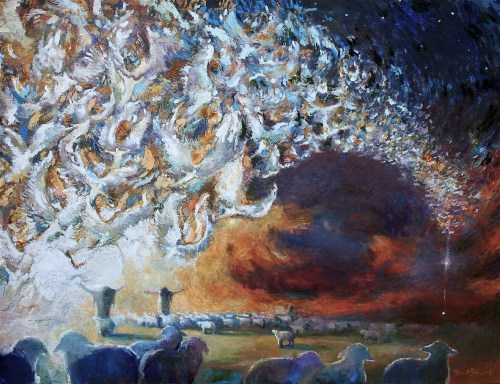
Heavenly Host

And suddenly there was with the angel a multitude of the heavenly host praising God, and saying, Glory to God in the highest, and on earth peace, good will toward men. (Luke 2:13-14)

It was mid-September.[1] The night was warm, and because the first quarter moon had not yet risen, the night sky was velvet black except for the billions of shimmering jewels strewn across the heavens. Several shepherds gathered around the campfire. Their sheep were all accounted for and safe in the stone sheepfold that had probably been built by King David himself. No one knew that for certain, but the shepherds took pride knowing that their hero king had once kept his sheep in these very hills.

The fire was strategically placed in front of the only entrance to the sheepfold[2] and the shepherds made their beds at the entrance to guard against unwanted intruders.[3] They joked and told stories of the recent events around Jerusalem. The population around Jerusalem always more than doubled around this time of year. It was the Feast of Trumpets, followed by the Day of Atonement and then the jubilant celebration of the Feast of Tabernacles. The law demanded that all Jewish males attend the feast and offer sacrifices at the Temple. The shepherds tended the flocks that would be used for sacrifices there.

However, this year the population grew ten times greater, it seemed. The Roman emperor, Caesar Augustus ordered a census of the population and demanded that everyone return to their ancestral homes to be counted. The shepherds did not have to go far. Their ancestors herded sheep on these hills for centuries, but that was not true for many others. It seemed that the whole world had descended upon Jerusalem. Even Bethlehem’s population grew beyond capacity. Out-of-town guests filled every square inch of every home packing people in like clumps of dates on a desert palm.

The shepherds, though, had all the room in the world – fresh late summer breezes, infinite starlit skies spanning the heavens, and room to stretch. The conversation slowly waned until all that could be heard above the whisper of the wind was the occasional bleating of a sheep. Suddenly, an explosion of light brighter than the noonday sun chased away every star in the heavens until only the burst of light remained. Futilely, they shielded their eyes in an effort to identify the source of the light. Vaguely they distinguished the form of a man, but they could not be sure. Gripped with terror, they fell to the ground hiding their faces from the overwhelming radiance.

Then a voice, melodious and soothing in tone like the sound of a spring as it skips its way across its rocky path, stilled their racing hearts. “Fear not,” said the voice. “I bring you good tidings of great joy, which shall be to all people” (Luke 2:10). The gentle voice eased their fear, and while the light maintained its brilliance, it too seemed warm and comforting. “Good tidings”? With all of the trouble in the world, they could certainly use some good news. The news was not for them alone, but for “all people.” So why were they selected as beneficiaries of this good news? They were ready to hear more.

“For unto you is born this day in the city of David a Saviour, which is Christ the Lord. And this shall be a sign unto you; Ye shall find the babe wrapped in swaddling clothes, lying in a manger” (Luke 2:11-12). This was indeed good news! Could this be true? Their long-awaited Messiah born in their hometown – in the birthplace of their hero shepherd King David?

This was too good to be true, but it must be true, otherwise why such a dramatic announcement! “And suddenly there was with the angel a multitude of the heavenly host praising God, and saying, Glory to God in the highest, and on earth peace, good will toward men” (Luke 2:13-14). As if the brilliance of the one angel were not enough, now the sky was filled with a host – thousands upon thousands – of angles echoing back and forth like clarion trumpets sounding a fanfare of an approaching king. The exhilaration transported the shepherds to the very halls of heaven. Then, just as suddenly as they appeared, they vanished. Temporarily blinded by the luminescence of the angelic host, the shepherds stood there dazed struggling to regather their wits and their night vision.

Slowly the stars reappeared in the blackness of the night. On the eastern horizon, the first quarter moon shown a dim reflective light. What now? “And it came to pass, as the angels were gone away from them into heaven, the shepherds said one to another, Let us now go even unto Bethlehem, and see this thing which is come to pass, which the Lord hath made known unto us. And they came with haste, and found Mary, and Joseph, and the babe lying in a manger” (Luke 2:15-16). Glory to God on high, indeed! The heavenly hosts were right. Here in such a lowly estate lay the One – the Prince of Peace – for all mankind, even for lowly shepherds.

Notes:


[1]  Jesus may have been born on Feast of Tabernacles in 5 BC. Herod the Great died in 4 BC. In 5 BC, the Feast of Tabernacles took place between September 11 and September18. This is just speculation on my part based on the Apostle John’s account saying that “The Word became flesh and tabernacled among us” (John 1:14). The Gospels give us no hint as to the exact time that Jesus was born, but given that the shepherds were keeping sheep in the fields near Jerusalem suggests that it was for the purpose of the sacrifices offered on the Day of Atonement that precedes the Feast of Tabernacles.

[2]  John 10:1-10

[3]  John 10:9

2 Comments

Filed under Christianity, Christmas, Holidays, Religion

What’s The Rush!

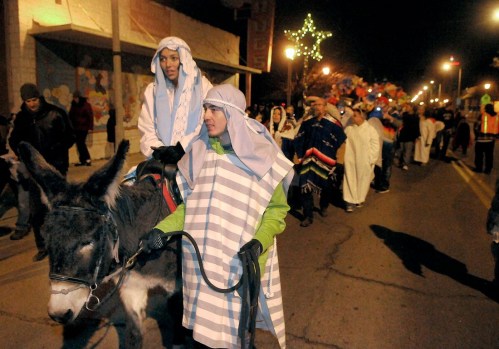
Typical “Las Posadas” Celebration

And so it was, that, while they were there, the days were accomplished that she should be delivered. (Luke 2:6)

Many Christmas traditions come from a fundamental misunderstanding or outright ignorance of Scripture. Such is the case of Joseph and Mary finding nowhere to stay in Bethlehem.

One of my favorite recent movies this time of year is The Nativity Story because it portrays a very realistic account of the birth of Christ, but even it resorts to unfounded tradition in its representation of the account. One of the most flagrant is the final tableau depicting the nativity scene complete with shepherds and wise men together on the night of the birth. It makes a pretty scene, but it is scripturally inaccurate.

Another error I discovered just recently is the scene when the Joseph and Mary arrive in Bethlehem. They arrive just when it starts to get dark. Suddenly, Mary starts having contractions and she pleads with Joseph to quickly find a place because the baby is coming. Frantically, Joseph runs from house to house banging on doors and pleading for someone to give them refuge in their desperate hour of need. No one has room to offer. Finally, one man offers a grotto where he shelters his animals. As the saying goes, “any port in a storm.” They take the offer and Mary gives birth to baby Jesus.

This tradition has been played out through the centuries. In Mexico and other Latin American countries, they observe Las Posadas (“the inns”) where a young girl and boy are selected to play the part of Mary and Joseph. They go from house to house in town followed by all the town’s people seeking refuge. Finally, they get to the last house where they are given posada, and the whole town enjoys a time of celebration.

Such traditions are neither good nor bad in themselves except that they have no basis in Scripture. Dr. Luke gives no indication that Joseph and Mary arrived in Bethlehem on the very night that Jesus was born. He does record that “there was no room for them in the inn” (Luke 2:7), but he gives a reasonable explanation for this.  Caesar Augustus had issued a census requiring everyone to go to his ancestral home of origin to be counted (Luke 2:1-3). Joseph and Mary both were descendants of King David whose birthplace was Bethlehem. Therefore, they were required to travel from Nazareth, their home, to Bethlehem in order to comply with Caesar’s decree. They arrived in Bethlehem. Visitors from all over Judea and Samaria overran the place so that every house in town was full. Joseph and Mary took the only place available – a shelter for animals.

They made the best of their accommodations. “And so it was, that, while they were there, the days were accomplished that she should be delivered” (Luke 2:6, emphasis mine). Luke gives no indication that they were in panic mode as tradition has taught. “Silent Night” makes more sense in a setting of peace rather than desperation. Yes, it was a stable, and yes, baby Jesus’ crib was a feeding trough for animals, but God, not desperation was in control.

After the crowd departed and returned to their homes, Joseph and Mary remained in Bethlehem for some time. With the excess population gone, they were able to find suitable lodging in a house. Matthew records that “wise men from the east” (Matthew 2:1) came in search of “he that is born King of the Jews” (Matthew 2:2).  “And when they were come into the house, they saw the young child with Mary his mother, and fell down, and worshipped him: and when they had opened their treasures, they presented unto him gifts; gold, and frankincense, and myrrh” (Matthew 2:11, emphasis mine). By this time, Jesus was no longer a “babe” (Luke 2:12) but a “young child” under two years of age (Matthew 2:16).

We often attach too much sentimentality to this event that may obscure of the real wonder of God’s entrance into the world of His creation. God became man, to live as a man – from conception to death – so that He could redeem His fallen creation from the curse of death by His own death, burial, and resurrection. Remove all the fluff from Christmas traditions, and what remains is staggeringly awesome!

Comments Off on What’s The Rush!

Filed under Apologetics, Christianity, Christmas, Holidays, Religion, Salvation, Theology