And after threescore and two weeks shall Messiah be cut off, but not for himself: and the people of the prince that shall come shall destroy the city and the sanctuary; and the end thereof shall be with a flood, and unto the end of the war desolations are determined. (Daniel 9:26)
The Sunday before Resurrection Day (I dislike the term “Easter”[1]) is traditionally known as Palm Sunday. This is the day Jesus entered into Jerusalem presenting Himself as the long-awaited Messiah. Daniel predicted this presentation[2] to the exact day, and on the following Wednesday evening[3] (not Friday), Messiah was “cut off.”
The Prophet Zechariah foretold of the presentation like this: “Rejoice greatly, O daughter of Zion; shout, O daughter of Jerusalem: behold, thy King cometh unto thee: he is just, and having salvation; lowly, and riding upon an ass, and upon a colt the foal of an ass” (Zechariah 9:9). All four Gospels record this event (Matthew 21:1-11; Mark 11:1-11; Luke 19:28-44; John 12:12-19).[4] Many Bibles insert the title “The Triumphal Entry” before the passage. As one ponders the events that followed that week ending in His crucifixion, one wonders, “Where is the triumph?” In those days, conquering kings entered the conquered cities on a white steed amidst a grand procession of his conquered armies followed by his conquering troops. Jesus entered His city on a young donkey colt cheered on by humble peasants and followed by His bewildered disciples. Just a few days later the same crowd jeered at Him as He hung dying on a Roman cross while all His disciples, save one, were nowhere to be found.
We count His resurrection three days later as a triumph over death, from which we rest assured that our eternal life with Him is secure. But His entry into Jerusalem that fateful week was no triumph. Jesus Himself wept over the event. “O Jerusalem, Jerusalem, thou that killest the prophets, and stonest them which are sent unto thee, how often would I have gathered thy children together, even as a hen gathereth her chickens under her wings, and ye would not!” (Matthew 23:37)
It is a misnomer to call His presentation on that Sunday a “triumphal entry.” That day yet awaits His return![5]
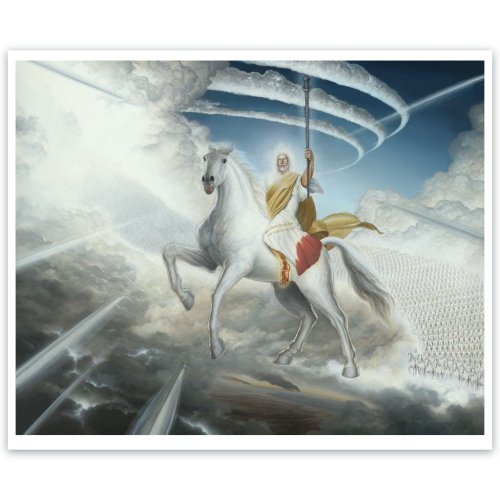
And I saw heaven opened, and behold a white horse; and he that sat upon him was called Faithful and True, and in righteousness he doth judge and make war. His eyes were as a flame of fire, and on his head were many crowns; and he had a name written, that no man knew, but he himself. And he was clothed with a vesture dipped in blood: and his name is called The Word of God. And the armies which were in heaven followed him upon white horses, clothed in fine linen, white and clean. And out of his mouth goeth a sharp sword, that with it he should smite the nations: and he shall rule them with a rod of iron: and he treadeth the winepress of the fierceness and wrath of Almighty God. And he hath on his vesture and on his thigh a name written, KING OF KINGS, AND LORD OF LORDS. (Revelation 19:11-16)
When Jesus returns to reign on earth as King of Kings and Lord of Lords, that will be His Triumphal Entry. On that day, He will enter on a white steed followed by a great host of His followers who will not retreat. “Behold, he cometh with clouds; and every eye shall see him, and they also which pierced him: and all kindreds of the earth shall wail because of him. Even so, Amen” (Revelation 1:7). That day is coming soon. Are you prepared to meet the King of Kings and Lord of Lords? If not read my page “Securing Eternal Life.”
In my Father’s house are many mansions: if it were not so, I would have told you. I go to prepare a place for you. And if I go and prepare a place for you, I will come again, and receive you unto myself; that where I am, there ye may be also. (John 14:2-3)
An old Gospel song that goes by the same title talks about “a mansion just over the hilltop in that bright land where we’ll never grow old.”[1] The singer dreams of having a “gold one that is silver lined.” Does that not seem somewhat esurient to covet the riches of heaven? I admit that the thought did not occur to me until recently.
When I think of a mansion, I imagine the $5 million (or more) homes of the super-rich or the palaces of royalty. Somehow, I do not think that is exactly to what Jesus referred when He spoke the words of our beginning verse above.
Consider this. “Heaven” as described in Revelation 21-22 enjoys a perfect environment much like that of the Garden of Eden[2] that God originally created. So perfect was that environment, that the first couple could run around naked[3] and not worry about getting sunburned, rained on, or frost bitten. Furthermore, all their nutritional needs were provided. It was a perfect place. Their only shelter were the stars above (and oh, how the stars must have sparkled at night in the pollution-free sky!). There was no need for any kind of building for shelter, much less a mansion.
Heaven will be like that, I think. No mansions of gold with silver trim. Before ending His earthly ministry, Jesus promised that in His Father’s house – only ONE house – are many mansions. That word in the Greek is monē, which means “a staying, abiding, dwelling, abode.” If Jesus meant some kind of building, He could have used the word “castle” – Greek parembolē meaning something like a fortress. Or, He could have used the word “palace” – Greek aulē, meaning “a yard (as open to the wind); by implication a mansion: – court, ([sheep-]) fold, hall, palace.”[4] However, Jesus used the word monē promising that we would have a place to stay and He has many places to stay and dwell for those who follow Him.
Sadly, we too often derive our “theology” from the songs we sing rather than from the Word of God. Next time you hear that old Gospel song, put that golden mansion out of your mind and be happy that Jesus has given you a place in His Father’s house.
Reader, if you are unsure of your eternal abode, please read my page on “Securing Eternal Life.” Jesus has a reservation for you in His Father’s house, but you have to take Him up on His invitation.
Notes:
[1] “Mansion Over the Hilltop” by Ira Stanphill, 1949.
Behold, I shew you a mystery; We shall not all sleep, but we shall all be changed, In a moment, in the twinkling of an eye, at the last trump: for the trumpet shall sound, and the dead shall be raised incorruptible, and we shall be changed. (1Corinthians 15:51-52)
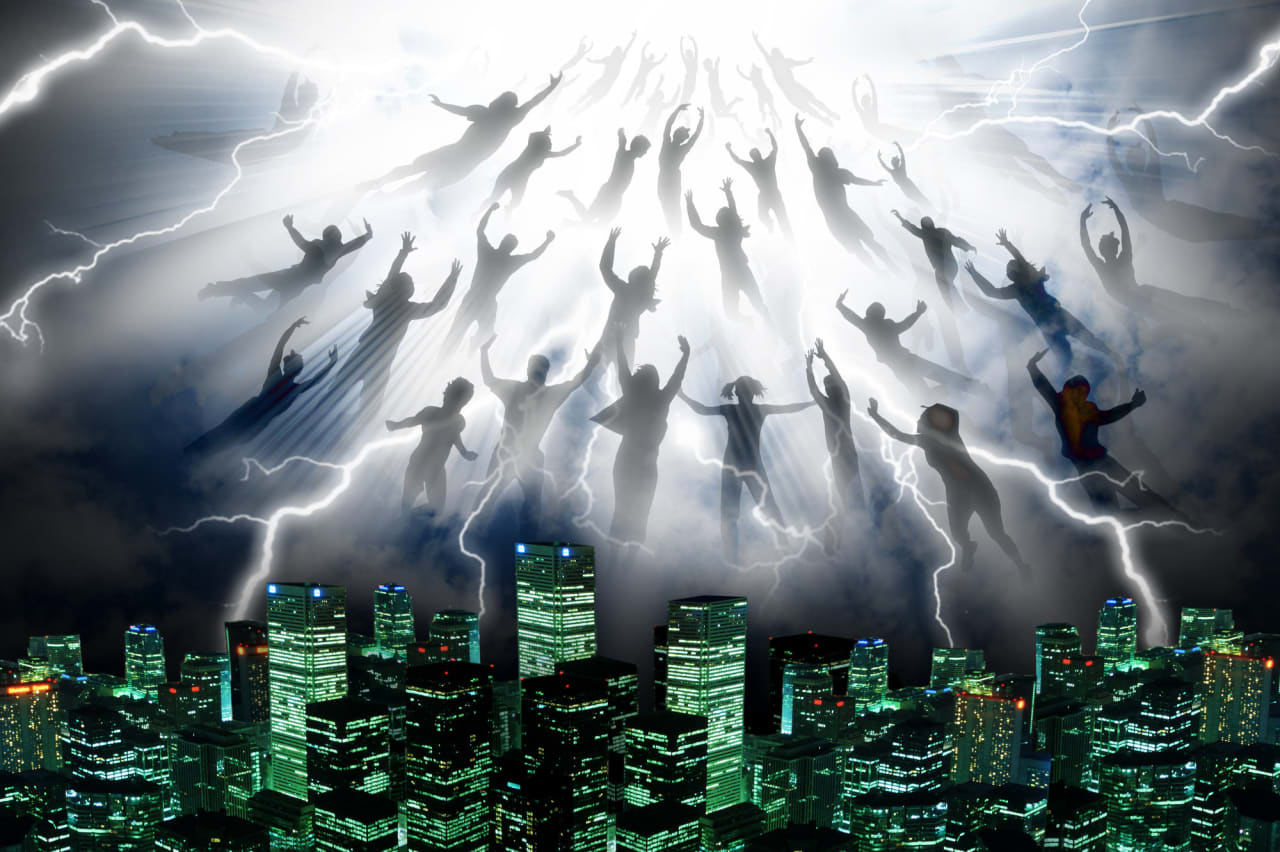
We hear a lot about the Rapture lately, but a lot of confusion exists about what the Rapture is and when it is supposed to take place. Some critics deny the Rapture claiming, that the word “rapture” is not in the Bible. However, the word “Bible” is not in the Bible, nor is the word “Trinity,” yet no Christian would deny these terms. To be clear, while the English word “Rapture” cannot be found in the Bible, its Greek root is. “To the church in Thessalonica, [Paul] wrote: ‘For this we say unto you by the word of the Lord, that we which are alive and remain unto the coming of the Lord shall not prevent [i.e., “go before”] them which are asleep. For the Lord himself shall descend from heaven with a shout, with the voice of the archangel, and with the trump of God: and the dead in Christ shall rise first: Then we which are alive and remain shall be caught up together with them in the clouds, to meet the Lord in the air: and so shall we ever be with the Lord” (1 Thessalonians 4:15-17, emphasis mine). The Greek word translated ‘caught up’ is harpazō, which means ‘to seize, carry off by force’ or ‘to snatch out or away.’ That word is further translated into Latin as rapturo [rapiemur] from which we get our word ‘rapture.’”[1]
Paul also describes the purpose of the Rapture to the Corinthians when he says, “that flesh and blood cannot inherit the kingdom of God; neither doth corruption inherit incorruption” (1 Corinthians 15:50). Our corrupt and sinful bodies cannot enter into heaven; therefore, they must be changed into incorruptible, sinless bodies. “Behold, I shew you a mystery; We shall not all sleep [i.e., “die”], but we shall all be changed, In a moment, in the twinkling of an eye, at the last trump: for the trumpet shall sound, and the dead shall be raised incorruptible, and we shall be changed. For this corruptible must put on incorruption, and this mortal must put on immortality” (1 Corinthians 15:51-53, emphasis mine).
Jesus promised the Rapture. “Let not your heart be troubled: ye believe in God, believe also in me. In my Father’s house are many mansions: if it were not so, I would have told you. I go to prepare a place for you. And if I go and prepare a place for you, I will come again, and receive you unto myself; that where I am, there ye may be also” (John 14:1-3). About 60 years after His ascension, Jesus dictated seven letters to John, the last living of His apostles. The sixth letter was addressed to the Church of Philadelphia to whom Jesus said, “Because thou hast kept the word of my patience, I also will keep thee from the hour of temptation, which shall come upon all the world, to try them that dwell upon the earth” (Revelation 3:10). Many scholars see the seven churches (real churches existing in John’s time) as representative of the characteristics of the Church throughout different epochs in church history. The Philadelphian Church represents the “evangelical” church that sprang up around the end of the 18th century and will continue to the Rapture. The Rapture will fulfill Jesus’ promise to keep them “from the hour of temptation – i.e., trial, testing, tribulation – that is to come upon all the earth”
So, the concept of the Rapture finds solid support in Scripture although some will still try to explain it away.
Some still conflate the Rapture with the Second coming. These are two separate events. The Rapture takes place before the seven-year Tribulation;[2] the Second Coming is when Jesus returns to establish His Kingdom on earth[3] at the end of the Tribulation. At the Rapture, the Church is taken to meet Jesus in the air;[4] at the Second Coming, Jesus will set His feet on Planet Earth.[5]
Many signs accompany the Second Coming: wars, rumors of wars, pestilences, famines, earthquakes, etc.[6] Perhaps the greatest sign of all is the miraculous revival of the nation of Israel as predicted by the Old Testament prophets, but particularly by Ezekiel in his vision of the valley of dry bones.[7] This prophecy came true on May 14, 1948 when Jews from all over the world returned to the land promised to them by God to became a nation once again.
However, there are no signs for the Rapture. About the Rapture, Jesus said. “But of that day and hour knoweth no man, no, not the angels of heaven, but my Father only” (Matthew 24:36). However, as His Second Coming approaches we observe those signs rapidly increasing in frequency and intensity. America is rapidly vanishing from the scene as a superpower. That means that Israel is losing her strongest ally, and she will be left to face her enemies alone. Again, the Prophet Ezekiel predicts an invasion of Israel from a confederation of nations on her northern border.[8] Already, those armies are staging in Syria – Russia, Turkey, Iran and their allies. With the USA out of the way, nothing will stop them from falling into God’s trap. Ezekiel foretells that Israel, left alone, will be defenseless against the invasion; however, God will intervene in such a way that no one, especially Israel, will doubt the power of God.
The Gog of Magog war described above will probably take place after the Rapture, but because we see the stage already being set, we can infer that the Rapture is not too far off. Consider the weakened condition of the USA. Then think about millions of American Christians suddenly vanishing. The majority of Christians are solid citizens who work and pay taxes contributing to the national economy. Think of the impact to the economy when these millions are suddenly gone! Many Christians serve in the military and in police forces. What happens when they disappear? What about healthcare workers, nurses, doctors, medical technicians? With the plandemic already stressing hospital staffing, what happens when many more of these are gone? There are also many solid Christians in positions of leadership at different levels of government. Imagine what will happen when all these people are taken out in the Rapture! Our already weak America will be in total chaos and capable of only making a weak protest, “Art thou come to take a spoil? hast thou gathered thy company to take a prey? to carry away silver and gold, to take away cattle and goods, to take a great spoil?” (Ezekiel 38:13).
We are very near that point now. For many years now I come to this time of year with a heightened sense of expectation. Monday evening, September 6 begins Rosh HaShanah,[9] the Feast of Trumpets.[10] Jesus fulfilled the first four “Feasts of the Lord” – Passover, Unleavened Bread, First Fruits, and Pentecost – at His First Coming. The last three fall feasts have not been fulfilled. The next one is the Feast of Trumpets; therefore, I believe (and I could be wrong) that the Rapture will take place at Rosh HaShanah. At that feast, trumpets were blown calling all the congregation of Israel to assemble. So, it is a “calling in” or a “gathering” of the congregation. Earlier I cited 1 Thessalonians 4:16, where “the trump of God” will sound, and we shall be gathered to Him in the air. The Feast of Trumpets is also known as the feast where “no man knows the day or the hour.” That is because it is based on the first sighting of the new moon; therefore, it is observed over two days because it is not known exactly when the new moon will appear. For those reasons, it makes sense to me that the Rapture can take place during the Feast of Trumpets.
Given the sudden and rapid decline of the USA, the general turmoil around the world, the rise of globalists seeking to rebuild the Tower of Babel (metaphorically speaking), and the increase in end-times signs, I feel this week (Monday evening to Wednesday evening) would be a good time for the Rapture to take place. I am not making any predictions; I am only saying that it seems like a good time for it, in my opinion.
How about you reader? If Jesus were to call His children home, would you be ready? If you are not sure, please read my page on “Securing Eternal Life.”
Yea, though I walk through the valley of the shadow of death, I will fear no evil: for thou art with me; thy rod and thy staff they comfort me. (Psalm 23:4)
Fear paralyzes the fearful, rendering them ineffective in that thing which they fear. Dictionary.com defines fear as “a distressing emotion aroused by impending danger, evil, pain, etc., whether the threat is real or imagined;”[1] (emphasis mine). The fact remains that 10% of most things feared or the things over which we worry never come to pass.
A long list of phobias exists which we could examine: fear of height, fear of flying, fear of germs, fear of needles, etc. However, the most ubiquitous fear held by the majority of people is the fear of dying. One can understand the nature of this fear; it is basically the fear of the unknown. What happens when one dies? Is this life all there is? Is there life after death? Do the dead come back in a different form – reincarnation? Are heaven and hell real? If heaven and hell are real, how does one arrive at one place and not the other? Does dying hurt?
For one who believes the Bible and the God of the Bible, death terminates physical life, but the spiritual essence that energizes the soul (the complete person) transitions on to eternity. The eternal destination depends on the spiritual condition of the soul at the time of death, one is either “saved”[2] or “lost.”[3]
Jesus spoke of two men who met death and ended up in different destinations.[4] Prior to Jesus’ death and resurrection, Jews believed that those who died went to the “abode of the dead” known as Sheol. Sheol had two compartments, one for the unrighteous known as “torments” and one for the righteous known as “Abraham’s bosom” or “paradise.” So the two men died, one was rich and the other a beggar. The rich man ended up in the place of torments not because he was rich, but because he was unrighteous, i.e., “lost.” The poor beggar ended up in Abraham’s bosom not because he suffered poverty, but because he was righteous, i.e. “saved.” After Jesus’ resurrection and ascension, the destination for the “saved” changed to “the presence of the Lord.” The Apostle Paul makes this clear, “We are confident, I say, and willing rather to be absent from the body, and to be present with the Lord” (2 Corinthians 5:8, emphasis mine). The lost still end up in “torments” (“hell”) to await their final destiny in the “lake of fire” that burns forever and ever.[5]
For those who do not have a personal, saving faith in Jesus Christ as their Lord and Savior, death is a legitimate fear indeed. Some may salve their fear by ignoring, or by choosing to believe that death is the end, or by hoping in reincarnation, or by imagining that they will somehow meld into the vast universe, i.e., “become one with the universe.” However, all of these notions only produce doubt, and the fear remains.
The Christian, on the other hand, should not harbor the fear of death. Death, as Paul reminded us, means that we are absent from the body, but we are present with the Lord in the same place where He resides. For the Christian, there should be no fear of death. In another place, Paul reminds us that, for Christians, our “citizenship” (“our conversation”) is not in this world, but in heaven. “For our conversation is in heaven; from whence also we look for the Saviour, the Lord Jesus Christ: Who shall change our vile body, that it may be fashioned like unto his glorious body, according to the working whereby he is able even to subdue all things unto himself” (Philippians 3:20-21, emphasis mine). For the Christian, the “afterlife” promises the possession of a physical body like that of the resurrected Christ in His presence.
I look forward to passing from this rapidly decaying world to be forever in the presence of the One who died in my place to save me from my sin for eternity. I have no fear of death. I realize that while He has me here in this world, I need to serve Him in every task that He lays before me. Then when that day comes, whether by physical death or by translation from this world into His presence in the Rapture, I will enter His courts with joy.
If you fear death or you are insecure about your eternal destiny, please read my page on “Securing Eternal Life.”
Therefore they gathered them together, and filled twelve baskets with the fragments of the five barley loaves, which remained over and above unto them that had eaten. (John 6:13)
On the eve of this posting, May 16, 2021, Jews begin the observance of Shavu’ot, the Feast of Pentecost. The Christian calendar, which does not follow the Jewish calendar, observes Pentecost next Sunday, May 23, 2021.
Pentecost interests me, because of the possible prophetic implications associated with it. I wrote about this topic before, and I believe I gave explanation of its significance in an article titled “Pentecost,”[1] so I will not rehash that material here. Briefly, there are seven Feasts of the Lord,[2] three in the spring (Passover, Unleavened Bread, and First Fruits), three feasts in the fall (Trumpets, Atonement, and Tabernacles) with Pentecost in the middle, separated by a space of time between the others. Pentecost was one of three convocations where all males over the age of 20 were required to attend. The other two times were for the spring and fall feasts.
Pentecost celebrates the barley harvest. Some Bible teachers have mistakenly associated the Feast of First Fruits with the barley harvest, but barley, according to the sources I have checked say that barley does not ripen until around mid May – too late for First Fruits. Again, I explain this in the articles I have cited in the notes below.
Barley is often associated with gentile nations, probably because it is more coarse and less desirable than wheat. Wheat, on the other hand, because it is finer and more desirable represents Israel.
On Pentecost, following Jesus’ resurrection and ascension, The Holy Spirit fell upon the 120 disciples gathered in the upper room.[3] There were in Jerusalem on that day “Jews and proselytes” from many nations present for the required convocation, and they heard the disciples preaching in their own languages. That day, about three thousand souls were saved[4] giving birth to the Church. For this reason, Pentecost is associated with the Church, and because it is separated from the other Jewish feasts, many have seen this as the Feasts of the Lord specifically meant for the Church.
Looking at this prophetically, Jesus fulfilled the first three spring feasts by His death (Passover), His burial (Unleavened Bread – He was sinless), and His resurrection (First Fruits). He then ascended to heaven with the promise to send His Holy Spirit and physically return at some later time. So, the Holy Spirit came at Pentecost and gave birth to the Church. Then there is a long period of time before the fall feasts, which Jesus has yet to fulfill. The long period of time can be likened to the Church Age in which we have lived for the last 1,991 years. At a time known only to God, Jesus will return to earth, possibly on the Feast of Trumpets, fulfill the Atonement, and set up His Tabernacle here on earth. We know this as the “Second Coming.”
Prior to Jesus’ return, the world will experience the full wrath of God for seven years. This is known as the Tribulation. Now (just musing here), there is much support for the crucifixion occurring in 30 A.D. According to the Bible, Creation is about 6000 years old and biblical chronology can be roughly divided into three segments of 2000 years each. We can add the final 2000 years to 30 A.D. and come up with the year 2030. Subtract seven years from that and we arrive at the year 2023 to start the Tribulation.
However, the “wrath” of God is for the “world” not for His Church. The Church will be taken out of the world prior to the start of the Tribulation. “For this we say unto you by the word of the Lord, that we which are alive and remain unto the coming of the Lord shall not prevent them which are asleep. For the Lord himself shall descend from heaven with a shout, with the voice of the archangel, and with the trump of God: and the dead in Christ shall rise first: Then we which are alive and remain shall be caught up together with them in the clouds, to meet the Lord in the air: and so shall we ever be with the Lord” (1 Thessalonians 4:15-17).
We have many “signs” to prepare us for the Second Coming, but we have no signs to prepare the Church for the “catching up,” a.k.a. the “Rapture.” “Behold, I shew you a mystery; We shall not all sleep, but we shall all be changed, In a moment, in the twinkling of an eye, at the last trump: for the trumpet shall sound, and the dead shall be raised incorruptible, and we shall be changed” (1 Corinthians 15:51-52).
The event will be sudden, but it should not be unexpected for the Christian. The “signs” of His Second Coming are everywhere and becoming more pronounced and more frequent. Therefore, we know that His Second Coming is close, and if His Second Coming is close, the Rapture is closer. Jesus said, “All these are the beginning of sorrows … Watch therefore: for ye know not what hour your Lord doth come.” (Matthew 24:8, 42)
Just musing again, if we, the Church, are the barley, and the barley harvest is ready, could this be the day that the Lord harvests us into His barn? Just so you know, the start of the Tribulation does not depend on the Rapture of the Church. The Church could get taken out today and the Tribulation will not begin in earnest until the year 2023. Consider this; our world economy is in freefall. The globalists already have detailed plans for implementing a “one-world” government.[5] Consider the impact of millions of people, especially here in the US, disappearing instantly, all at once, from the face of the earth. Consider the added chaos that would bring to a world already reeling with social, economic and geopolitical trouble. In that event, the one-world system will be put in place and a great one-world leader will arise to bring “peace” to the earth, “And he shall confirm the covenant with many for one week [seven years]” (Daniel 9:27). That will kick off the Tribulation.
The barley harvest is ready. I hope this will be the day, but if not, we must occupy until He comes.[6] Are you ready? If not, please read my page on “Securing Eternal Life.”