Category Archives: Resurrection

Jesus’ Seven Signs in John (7)

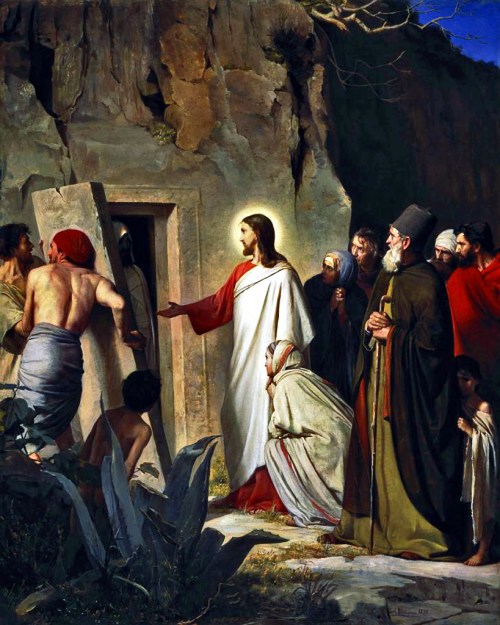
john11_1_raising_lazarus_bloch

Jesus saith unto her, Said I not unto thee, that, if thou wouldest believe, thou shouldest see the glory of God? (John 11:40)

The events surrounding this seventh sign were previously covered in the discussion of Jesus’ fifth I AM statement:[1] “Jesus said unto her, I am the resurrection, and the life: he that believeth in me, though he were dead, yet shall he live: And whosoever liveth and believeth in me shall never die. Believest thou this?” (John 11:25-26, emphasis mine).

Jesus “stedfastly set his face to go to Jerusalem” (Luke 9:51) as He made a stopover in Jericho along the way. The cross loomed ominous – less than two weeks away – when He received word from Bethany, “Lord, behold, he whom thou lovest is sick” (John 11:3). It was Lazarus. The content of the message did not convey the gravity of the matter. “When Jesus heard that, he said, This sickness is not unto death, but for the glory of God, that the Son of God might be glorified thereby” (John 11:4, emphasis mine).

However, it was “unto death,” and the Lord knew it. “When he had heard therefore that he was sick, he abode two days still in the same place where he was” (John 11:6, emphasis). After the two-day delay, Jesus “saith he to his disciples, Let us go into Judaea again … Our friend Lazarus sleepeth; but I go, that I may awake him out of sleep.” (John 11:7, 11). Sleep, for someone who is sick, helps the healing process. The disciples understood this. They also understood that Jesus’ life was in peril in Jerusalem. “His disciples say unto him, Master, the Jews of late sought to stone thee; and goest thou thither again? … Then said his disciples, Lord, if he sleep, he shall do well” (John 11:8, 12, emphasis mine). Jesus completely knew and understood the situation although the euphemism escaped the disciples’ conscious thought, so to clarify, “Then said Jesus unto them plainly, Lazarus is dead” (John 11:14, emphasis mine).

The small village of Bethany was about a day’s walk from Jericho. Lazarus probably died shortly after the messengers departed to Jericho. The travel took a day. Jesus delayed two days before leaving for Bethany and He took another day to arrive – four days total.

When Jesus arrived in Bethany, Martha met Him with the “news” that Lazarus had died (John 11:20). Mary followed Martha. “Then when Mary was come where Jesus was, and saw him, she fell down at his feet, saying unto him, Lord, if thou hadst been here, my brother had not died” (John 11:32). Both Martha and Mary believed that Jesus could heal the sick. They had probably witnessed many of His healing miracles, and perhaps they heard about or witnessed Jesus restoring life to the dead.[2] Those other resurrections Jesus performed involved someone who was dead just a matter of hours. However, it had been FOUR DAYS! They also believed that Jesus could raise the dead “at the resurrection” (John 11:24), but that was future. “Then when Jesus came, he found that he had lain in the grave four days already” (John 11:17, emphasis mine). FOUR DAYS! – “There is a tradition in Judaism (that still exists today), that the soul after death does not immediately depart the deceased, but hovers over the body for a period of three days, during which time resurrection is possible.”[3]

In the minds of Martha and Mary, Lazarus was too far gone for a resurrection now. They were resigned to wait until the resurrection at the end of time.

Jesus asked to see the grave (John 11:34), and to their shock, Jesus asked for the stone to be rolled away from the opening. “Martha, the sister of him that was dead, saith unto him, Lord, by this time he stinketh: for he hath been dead four days” (John 11:39, emphasis mine). What was He doing? Did Jesus want a private viewing? By now, the process of decomposition would have caused the body to reek. Surely, Jesus could not bring life to a decaying body! “Jesus saith unto [Martha], Said I not unto thee, that, if thou wouldest believe, thou shouldest see the glory of God? … And when he thus had spoken, he cried with a loud voice, Lazarus, come forth” (John 11:40, 43). The dead man responded, and though bound in grave clothes, walked out of the cave.

Jesus demonstrated His power over death. He said, “I AM the resurrection and the life” (John 11:25, emphasis mine), and He proved it by giving life to one for whom consensus offered no hope. FOUR DAYS dead and Jesus brought Lazarus back to the land of the living. From the beginning, Jesus knew what He would do. “When Jesus heard that, he said, This sickness is not unto death, but for the glory of God, that the Son of God might be glorified thereby” (John 11:4, emphasis mine). Then before the skeptical crowd that included that included some of His harshest opponents (John 11:45-53) Jesus prayed, “Father, I thank thee that thou hast heard me. And I knew that thou hearest me always: but because of the people which stand by I said it, that they may believe that thou hast sent me” (John 11:41-42, emphasis mine).

Luke relays an account given by Jesus of a rich man that died and went to hell and a beggar by the name of Lazarus (different person) who also died and was carried by the angels to Abraham’s bosom (Luke 16:19-31). The rich man in hell could see Lazarus enjoying paradise with Abraham. After failing get relief for himself, he requested that Lazarus be sent back to the world of the living and evangelize his brothers, for he thought, “if one went unto them from the dead, they will repent” (Luke 16:30). The brothers had the Law and the Prophets, i.e., the Bible. In other words, they had all they needed to avoid the same fate. Abraham’s response settled the matter. “And he said unto him, If they hear not Moses and the prophets, neither will they be persuaded, though one rose from the dead” (Luke 16:31, emphasis mine).  The truth of this assertion could not be better illustrated than in the reaction of the religious leaders that witnessed “one that rose from the dead.” Rather than believe in Jesus, who raised the dead, they sought to kill Him. “Then from that day forth they took counsel together for to put him to death” (John 11:53). Not only that, but now Lazarus was a liability. “But the chief priests consulted that they might put Lazarus also to death; Because that by reason of him many of the Jews went away, and believed on Jesus” (John 12:10-11, emphasis mine).

Truth is offensive. “Jesus saith unto him, I am the way, the truth, and the life: no man cometh unto the Father, but by me” (John 14:6, emphasis mine). Many would rather destroy the Truth than submit to Him, but the Truth will not die. “And the Jews’ passover was nigh at hand: and many went out of the country up to Jerusalem before the passover, to purify themselves” (John 11:55). In a few days, Jesus would be put to death, but after three days, He would do an even greater miracle than raising Lazarus. Jesus Himself would conquer death and rise from the grave. Yet, many are not “persuaded, though one rose from the dead.” – Jesus Himself.

Do you believe? You have the Bible. You have the voices of thousands of “prophets” declaring the Word of the Lord. Jesus is not in the grave. What more do you need? This life you have been given is the only opportunity you will ever have to make that choice. Tomorrow is not guaranteed. “While it is said, To day if ye will hear his voice, harden not your hearts” (Hebrews 3:15). After this life, there are no more chances. Jesus rose from the dead and lives forever to give us eternal life. “Believe on the Lord Jesus Christ, and thou shalt be saved” (Acts 16:31), and you will not end up like the rich man being tortured in the flames (Luke 16:24) with no escape.

 Notes:


[1]  See: https://erniecarrasco.com/2016/10/02/jesus-seven-i-am-statements-in-john-5/

[2]  See Matthew 9:18-26; Mark 5:21-43; Luke 8:40-56; Luke 7:11-16.

[3]  Eli Lizorkin-Eyzenberg, The Jewish Gospel of John: Discovering Jesus, King of All Israel, (Jewish Studies for Christians, Tel Aviv, Israel, 2015), 184.

Comments Off on Jesus’ Seven Signs in John (7)

Filed under Bible, Christianity, Death, Evangelism, Gospel, Heaven, Hell, Religion, Resurrection, Salvation, Theology

Jesus’ Seven ‘I AM’ Statements in John (5)

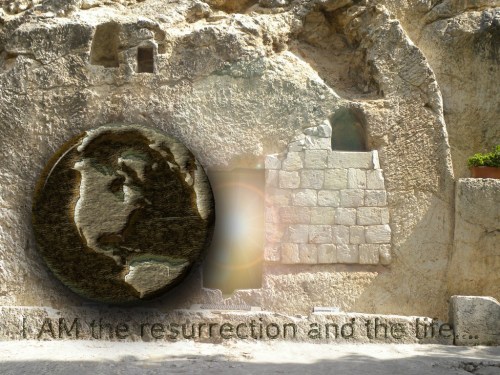
resurrection-and-life

Jesus said unto her, I am the resurrection, and the life… (John 11:25)

“And it came to pass, when the time was come that he should be received up, he stedfastly set his face to go to Jerusalem” (Luke 9:51). Jesus knew that the culmination of His earthly mission had arrived, and He was determined to see it through to the end. His journey up to Jerusalem took Him by way of Jericho where He healed the blind man, Bartimaeus (Luke 18:35-43), and “saved” the publican (tax collector), Zacchaeus (Luke 19:1-10).

While there, possibly in Zaccheaus’ home, Jesus received word that His good friend, Lazarus, had fallen deathly ill. “Therefore his sisters sent unto him, saying, Lord, behold, he whom thou lovest is sick” (John 11:3). Bethany (John 11:1), where Lazarus and his sisters, Mary and Martha, lived, was just up the road from Jericho about a day’s walk. Answering the call would not have distracted Jesus from His determination to face the cross. Bethany was on the way up to Jerusalem, but “When he had heard therefore that he was sick, he abode two days still in the same place where he was” (John 11:6, emphasis mine). That seems like a strange reaction for the compassionate Jesus to take with regard to a “friend.”

“When Jesus heard that, he said, This sickness is not unto death, but for the glory of God, that the Son of God might be glorified thereby” (John 11:4). In reality, Lazarus probably died shortly after the delegation departed Bethany. It took them a day to arrive in Jericho. Jesus remained another two days before making trip up to Bethany, plus the day to travel there – four days. When Jesus arrived in Bethany, He was informed that Lazarus had been dead four days (John 11:39). Did Jesus err in His assessment that “This sickness is not unto death”? No, Jesus, in His omniscience, knew the situation perfectly. The delay would glorify the Son and bring glory to God. John points out that “Jesus loved Martha, and her sister [Mary], and Lazarus” (John 11:5), yet He delayed His departure.

When the day came to depart, Jesus’ disciples, vaguely knowing what awaited Him, tried to dissuade Him from going up to Jerusalem. “His disciples say unto him, Master, the Jews of late sought to stone thee; and goest thou thither again?” (John 11:8), but Jesus knew what He was doing. “Our friend Lazarus sleepeth; but I go, that I may awake him out of sleep” (John 11:11). The disciples took this as a good sign. “Then said Jesus unto them plainly, Lazarus is dead” (John 11:14).

As He approached Bethany, Martha rushed out to meet Him. “Then said Martha unto Jesus, Lord, if thou hadst been here, my brother had not died” (John 11:21, emphasis mine). How many times have similar sentiments been expressed at the death of a loved one? When the Twin Towers fell on September 11, 2001, many demanded to know, “Where was God?” He was where He has always been – on His throne and in command. Even so, Martha expressed remarkable faith. “But I know, that even now, whatsoever thou wilt ask of God, God will give it thee.” (John 11:22, emphasis mine). What could she have been thinking? Did she indeed believe that Jesus could raise her brother from the dead? This would not be something new. Jesus had raised the dead before: a widow’s only son (Luke 7:12-14), Jairus’s daughter (Matthew 9:18-26; Mark 5:22-43; Luke 8:41-56),  and unnamed others. Nevertheless, this was different. Lazarus had been dead four days “when it was believed that resurrection was no longer possible.”[1]

“Jesus saith unto her, Thy brother shall rise again. Martha saith unto him, I know that he shall rise again in the resurrection at the last day” (John 11:23-24). Sure Lazarus would rise again, but not today. After all, he had been dead four days; his spirit had long departed. The resurrections Jesus had performed before where shortly after the victim had died. Common thought was that the person’s spirit lingered around a few days before finally departing. Raising the dead shortly after death was consistent with their tradition, but after three days, the spirit departed, and Lazarus had been dead four days. Sure he’ll rise again – at the resurrection!

I AM the resurrection, and the life” (John 11:25, emphasis mine). Ego Eimi. I, I AM. As explained in recent “I Am” articles,[2] this phrase expresses the deity of Christ. Jesus was saying, “I, Yahweh, am the resurrection and the life.” The Greek word translated “resurrection” is anastasis and it means to “stand up again,” and “life” is the Greek word zōē meaning the very essence of life – that animating energy or force that goes beyond biological function. It is that “breath of life” given to man by God at the moment of creation (Genesis 2:7). That Jesus incorporated both “resurrection” and “life” recalls Ezekiel’s vision of the valley of dry bones (Ezekiel 37). He preached to the dry bones and they came together. Flesh and skin formed upon their frame, but they did not stand until the breath of life came upon them, and they stood up.

Jesus, the Creator (John 1:1-3) not only has the power to create biological life, but He gives the very essence of life. All of it comes from the Great I AM. Because He is “the resurrection and the life,” “he that believeth in me, though he were dead, yet shall he live: And whosoever liveth and believeth in me shall never die. Believest thou this?” (John 11:26, emphasis mine). “Never die?” Jesus here referred to eternal life. We all will die physically as a result of the curse (Genesis 3:19; 1 Corinthians 15:22); however our “life” will continue in one of two destinations, either with God or apart from God. “And death and hell were cast into the lake of fire. This is the second death” (Revelation 20:14, emphasis mine). There are two deaths: one we all experience as physical death; the other death is eternal life in hell, apart from God. Those who believe in the Great I AM, will never experience that second death, i.e. “never die.” “But the fearful, and unbelieving, and the abominable, and murderers, and whoremongers, and sorcerers, and idolaters, and all liars, shall have their part in the lake which burneth with fire and brimstone: which is the second death” (Revelation 21:8, emphasis mine).

Jesus is “the resurrection and the life.” “In him was life; and the life was the light of men …  He was in the world, and the world was made by him, and the world knew him not … But as many as received him, to them gave he power to become the sons of God, even to them that believe on his name” (John 1:4, 10, 12, emphasis mine), and they shall never die.

Notes:


[1]  Eli Lizorkin-Eyzenberg, The Jewish Gospel of John: Discovering Jesus, King of All Israel, (Tel Aviv, Israel, Jewish Studies for Christians, 2015), 190.

[2]  See esp. the 3rd paragraph of https://erniecarrasco.com/2016/08/28/jesus-seven-i-am-statements-in-john-1/

Comments Off on Jesus’ Seven ‘I AM’ Statements in John (5)

Filed under Apologetics, Bible, Christianity, Evangelism, Gospel, Hell, Religion, Resurrection, Salvation

Resurrection

colorful sunset

Jesus answered and said unto them, Destroy this temple, and in three days I will raise it up … When therefore he was risen from the dead, his disciples remembered that he had said this unto them; and they believed the scripture, and the word which Jesus had said. (John 2:20, 22)

Christians today, especially in the Middle East, suffer martyrdom by the hundreds at the hands of brutal ISIS executioners. These undergo a gruesome and horrific death by beheadings or being burned alive. Yet, as ghastly as we may perceive such brutality, the pain and suffering of these victims is short-lived, unlike that experienced by our Lord Jesus Christ on the cross.[1]

On the Lord’s Feast of Passover,[2] Jesus, already physically drained from lack of sleep[3] and subjected to a sham of a trial by the Jewish religious leaders, was brutally beaten and scourged at hands of Roman soldiers, experts at inflicting pain without killing the victim. Then in that depleted condition, He was forced to carry His own cross to the place of execution, and whether it was a fully assembled cross or just the cross beam, for a man in Jesus’ condition at that time was next to impossible – but He did it. Under the weight of that burden, determined to complete His mission, He faced the horror of the cross. God, wrapped up in human flesh, with His host of angelic armies standing at the ready awaiting the command to rain down vengeance upon His tormentors. At the time of His arrest, Peter pulled his sword in His defense, but Jesus stopped him. “Thinkest thou that I cannot now pray to my Father, and he shall presently give me more than twelve legions of angels?” (Matthew 26:53).  Nothing would deter Him from His mission. “[He] made himself of no reputation, and took upon him the form of a servant, and was made in the likeness of men: And being found in fashion as a man, he humbled himself, and became obedient unto death, even the death of the cross” (Philippians 2:7-8).

Determined to give to the very last, He carried Himself up Calvary’s hill, laid Himself down upon the timbers and spread His arms out to receive the nails – our pain, our guilt, our sins. “For [God the Father] hath made him [Jesus] to be sin for us, who knew no sin; that we might be made the righteousness of God in him” (2 Corinthians 5:21). At the last, He gave His life. He did not die. Jesus said, “… I lay down my life, that I might take it again. No man taketh it from me, but I lay it down of myself. I have power to lay it down, and I have power to take it again. This commandment have I received of my Father” (John 10:17-18, emphasis mine). He was not killed. “Jesus, when he had cried again with a loud voice, yielded up the ghost” (Matthew 27:50, emphasis mine). He was not the victim. He was in full control until the very last. John, the beloved disciple, and the only one of the twelve to witness the event said, “When Jesus therefore had received the vinegar, he said, It is finished: and he bowed his head, and gave up the ghost” (John 19:30, emphasis mine). Finished! Paid in full!

That was not the end. On the first day of the week, on that spring Sunday morning, He broke the chains of death and brought sheol’s captives with Him. Matthew records, “And the graves were opened; and many bodies of the saints which slept arose, And came out of the graves after his resurrection, and went into the holy city, and appeared unto many” (Matthew 27:52-53).[4]

His resurrection is key! Had Jesus died and remained in the tomb, we would venerate a martyr, nothing more. His bones would be marked by an ornate shrine. Perhaps followers would make faithful pilgrimages to the site to stand in awe and wonder. If that was the case, our faith’s reward would be death and eternal separation from our Creator with no hope of redemption. “And if Christ be not risen, then is our preaching vain, and your faith is also vain” (1 Corinthians 15:14). “But thanks be to God, which giveth us the victory through our Lord Jesus Christ” (1 Corinthians 15:57).  Because of His resurrection, “Death is swallowed up in victory” (1 Corinthians 15:54). “For if we have been planted together in the likeness of his death, we shall be also in the likeness of his resurrection” (Romans 6:5). So now we can say, “O death, where is thy sting? O grave, where is thy victory?” (1 Corinthians 15:55).

Before going to the cross, Jesus left us with this promise: “Let not your heart be troubled: ye believe in God, believe also in me. In my Father’s house are many mansions: if it were not so, I would have told you. I go to prepare a place for you. And if I go and prepare a place for you, I will come again, and receive you unto myself; that where I am, there ye may be also” (John 14:1-3). His resurrection guarantees the promise. On that day, “the Lord himself shall descend from heaven with a shout, with the voice of the archangel, and with the trump of God: and the dead in Christ shall rise first: Then we which are alive and remain shall be caught up together with them in the clouds, to meet the Lord in the air: and so shall we ever be with the Lord” (1 Thessalonians 4:16-17).

Our Christian brothers and sisters in the Middle East and elsewhere in the world are brutally killed daily by the enemy of God. We can thank God that for many, death is swift; it is nothing like what their Lord and our Lord endured for our sakes. But the guaranteed promise of the resurrection assures us that one day soon, we will be together with Him in His house.

Notes:


[1]  It is said that victims could linger on the cross up to three days until succumbing to dehydration and asphyxia.

[2]  Despite conventional tradition, this even could not have taken place on Friday. Jesus said He would rise in “three days,” not three partial days. Jesus specified “three days and three nights” (Matthew 12:39-40). No matter how one may try to convolute the time to fit a “Good Friday” scenario, one cannot get “three days and three nights” from Friday evening to Sunday morning. Jesus said, “three days and three nights” – 72 hours, nothing less will do!

[3]  Jesus had spent the night in prayer while His disciples slept (Matthew 26:36-46; Mark 14:32-42; Luke 22:39-46) before being betrayed by Judas, arrested and tried.

[4]  Matthew’s recording of this event that seems to coincide with Jesus’ death and the renting of the veil to the Holy of Holies, but a close inspection of the text reveals that this event occurred after the resurrection. See again Matthew 27:52-53.

2 Comments

Filed under Apologetics, Christianity, Easter, Evangelism, Gospel, Religion, Resurrection, Salvation, Theology

Easter’s Wrong!

Shocked

And when he had apprehended him, he put him in prison, and delivered him to four quaternions of soldiers to keep him; intending after Easter to bring him forth to the people. (Acts 12:4)

The two highest church attendance days are Christmas and Easter. Easter probably wins the high attendance day of the two since it always falls on a Sunday. Neither day is historically accurate, but Easter typically comes nearer being right than does Christmas. Both holidays (holy days) come to us thanks to the Roman Catholic Church (RCC) in its attempt to “Christianize” the pagan celebrations of Saturnalia, which celebrated the return of the sun, i.e. the days getting longer, and Ishtar, whose origin is rather convoluted but basically has its source in the ancient fertility goddess of Babylon from whence come the icons of Easter eggs and bunnies.[1]

The pagans celebrated their “Queen of Heaven” on the first day of the week (Sunday) following the first full moon after the vernal equinox. Some form of this religious practice was observed by the Egyptians, Greeks and Romans. By the time the RCC came into power, pagans continued the practice, so, in order to accommodate the pagan population, the Church put a Christian spin on the celebration. There are several parallels that can be made between that pagan religion and what we believe as Christians.[2] Jesus was born of a virgin, He died, He was buried, and He rose again. Superficially, the pagan story sounds familiar, but this should not be surprising since Satan is the ultimate counterfeiter. Jesus said, “He [Satan] was a murderer from the beginning, and abode not in the truth, because there is no truth in him. When he speaketh a lie, he speaketh of his own: for he is a liar, and the father of it” (John 8:44).  Since the celebration of Ishtar fell around the time as the Jewish Passover, and considering the parallels, it was not difficult to remake the pagan celebration into a Christian one. (Oh! Don’t be so shocked! We still do that today. In order to attract the “world” we adopt worldly practices, bring them into the church, and put a Christian face on them. Sometimes “Christian” events look no different than rock concerts. The only differences, if you can hear them, are the words of the songs. And for those of us who love the “old hymns” many of the tunes of those good old hymns originated in pubs and saloons. So, this is not unique to the RCC.)

Despite the title I chose for this article, my purpose here is not necessarily to bash our observance of Easter. (I prefer to call it “Resurrection Day” or “Resurrection Sunday.”) I believe that it is right and proper that we celebrate the Advent of our Lord and His death, burial and resurrection – the resurrection being key. They are highly significant events that altered the course of history and the destiny of man. But if we are going to celebrate these very special days, we should at least try to be “biblical” about it rather than “traditional.” Arguably, Christmas could remain as December 25th. While widely accepted by biblical scholars that the birth of Jesus probably took place around mid-September (more likely around the celebration of the Jewish Feast of Booths or Sukkot), counting back nine months would bring one to around December 25th as the time of conception, which would also be the actual “incarnation” when God came to be “with us” (Emmanuel) as a human embryo.

Easter, however, does not always line up exactly with Passover as is the case this year. Jesus was crucified on Passover. Jesus said, “Ye know that after two days is the feast of the passover, and the Son of man is betrayed to be crucified” (Matthew 26:2, emphasis mine). The Jewish day began at sundown, around 6:00 PM, unlike our western day which begins at midnight. On the afternoon before the Passover, Jesus sent His disciples to make arrangements to celebrate the Passover Seder (Matthew 26:18-19). “Now when the even was come, he sat down with the twelve” (Matthew 26:20, emphasis mine). “When the evening was come,” Passover had begun. After they had  finished the meal, Jesus went with His disciples to the Mount of Olives where He was arrested in the middle of the night – it was still Passover – and illegally tried and sentenced to death by crucifixion (Matthew 26-27, Mark 14-15, Luke 22-23, John 18-19). Jesus died at the ninth hour, 3:00 PM (Matthew 27:46; Mark 15:34; Luke 23:44-46), at the same time that the Passover lamb was being sacrificed at the Temple. It had to be this way in order to fulfill the Law of God given to Moses (Deuteronomy 16:1-6).

So, Jesus died on Passover, at precisely the right time in order to fulfill the Law of God and make a once for all atonement – a covering – for our sins. “For the life of the flesh is in the blood: and I have given it to you upon the altar to make an atonement for your souls: for it is the blood that maketh an atonement for the soul” (Leviticus 17:11, emphasis mine). “And almost all things are by the law purged with blood; and without shedding of blood is no remission [of sins]” (Hebrews 11:28, emphasis mine).

Biblically, then, Easter (Resurrection Day) should be celebrated in association with and very closely linked to the Jewish Passover. “Easter” is nowhere found in the Bible except as mistranslated in our beginning verse above (Acts 12:4). The Greek word translated “Easter” in this verse is pascha, the Greek transliteration of the Hebrew pesach or Passover. Evidently the translators of the King James Bible were taken in by centuries of RCC tradition.

“Easter” is not biblical, and it becomes painfully obvious especially this year. As noted above, Easter is the first Sunday that follows the first full moon after the vernal equinox. This year, the vernal equinox took place on March 19. The first full moon after that will be on March 23, making the 27th Easter Sunday. The problem is that the Jewish calendar is lunar, not solar. Nissan (Abib in the OT) is the first month of the Jewish religious calendar, and Passover is celebrated on Nissan 15. This year, 2016, Nissan 15, Passover, begins on Friday, April 22 at 6:00 PM and goes to 6:00 PM Saturday, April 23. We are celebrating Resurrection Day nearly one month before Passover, and that, to me, just seems wrong. You cannot have “resurrection” before the Passover sacrifice! If we were being biblical instead of traditional, we should be celebrating Resurrection Day on Sunday, April 24. Instead, we will just go with the flow and celebrate it according to the Roman Catholic tradition. This is why, especially this year, Easter’s Wrong.

Notes:


[1]  See “The Pagan Origin of Easter” http://www.lasttrumpetministries.org/tracts/tract1.html

[2]  Ibid.


3 Comments

Filed under Apologetics, Christianity, Easter, Evangelism, Gospel, Religion, Resurrection, Salvation, Satan

The Last Trump

Shophar-739195

Behold, I shew you a mystery; We shall not all sleep, but we shall all be changed, In a moment, in the twinkling of an eye, at the last trump: for the trumpet shall sound, and the dead shall be raised incorruptible, and we shall be changed. (1 Corinthians 15:51-52)

For the past 20 years or more, I have anxiously awaited this time of year. Granted, the Lord is not obligated to comply with my speculations. The times are fully under His sovereign will and control, and I am more than happy to submit to His wisdom and direction. So whatever happens today, tomorrow or in the near future, I am fully trusting that God’s plan will be fulfilled in accordance with His perfect timing to which I am not, nor is anyone else, privy.

The reason for my excitement at this season, is that many years ago I learned that the Feasts of the Lord given to Israel in Exodus were given as a pattern for the future ministry of Christ. The first four feasts came in the spring and were fulfilled by Christ in His flesh. Jesus fulfilled Passover as the Lamb of God on the cross, followed by the Feast of Unleavened Bread. At this feast, all leaven, which represented sin, was to be removed and cast out of the house. Jesus fulfilled this by taking upon Himself our sin and being buried in the earth. Then followed the Feast of First Fruits, which celebrated new life. Jesus fulfilled this feast when He rose from the dead as the “first fruit” of the resurrection. After His resurrection, Jesus walked on the earth for 40 days and ascended into heaven. Ten days later, at the Feast of Pentecost, the Holy Spirit descended upon His followers fulfilling the spring harvest which continues to this day.

Three feasts remain to be fulfilled, and they are the fall feasts. The first is the Feast of Trumpets, or Rosh HaShanah, the beginning of the new civil year. Eight days later Yom Kippur, the Day of Atonement, follows, and then four days after that is Sukkot, or the Feast of Tabernacles (Booths), which is celebrated for eight days. The Feast of Trumpets was a holy convocation or gathering. On the Day of Atonement, sacrifices were offered for the sins of the nation. The high priest first had to offer a sacrifice for his own sins, and then he offered a sacrifice for the sins of the people. He carried the blood of the sacrifice into the temple, and only at this time could he enter into the Holy of Holies that housed the Ark of the Covenant where the presence of the Lord dwelt. As he entered into this most holy place, the chimes on the hem of his robe jingled gaving notice to those without that he was still alive and moving inside. A rope was tied to one of his ankles should the displeasure of the Lord strike him dead. Those outside would not be able to enter the most holy place to extract him, but they could drag him out by the rope. So, in he would go and take the blood of the sacrifice, and there upon the Mercy Seat (the covering of the Ark), he would pour out the blood of the sacrifice. Inside the Ark resided three elements that represented Israel’s sin against God. The tablets of the Ten Commandments represented God’s Law that had been violated. There was a sample of the manna that represented God’s provision that had been rejected. Finally there was Aaron’s staff that had budded representing God’s leadership against which they had rebelled. The contents of the Ark, therefore, represented Israel’s offences against God. These were covered by the sacrificial blood. This was indeed a most solemn and remorseful occasion. Four days later sorrow was followed by a joyous celebration as Israel commemorated their wanderings in the wilderness living in temporary housing – tents, i.e., tabernacles. During this time, God provided food and water for them, and their clothes and shoes did not wear out. More than that, God was always present with them in the form of a cloud by day and a pillar of fire by night. These last three feasts are yet to be fulfilled by the Lord Jesus Christ.

So how is that relevant to us? We are told in the Old Testament, and affirmed in the New Testament, that Christ will return and set up His kingdom on earth for 1000 years. (I have written about this in the past and so have many others, so I will skip the details for now.) Before that happens, seven years of “tribulation” will come upon the earth and mankind (Daniel 9:24-27). According to the pre-tribulation view of end-times, which I loosely hold, Christ will come for His Bride – the Church, the body of all true believers – and take her out of this world to save her from the wrath to come. This is what is known as the Rapture of the church (1 Thessalonians 4:14-18).  This event, we are told, will be preceded “with a shout, with the voice of the archangel, and with the trump of God” (1 Thessalonians 4:16, emphasis mine). Our leading verse says that it will be “at the last trump: for the trumpet shall sound, and the dead shall be raised incorruptible, and we shall be changed” (1 Corinthians 15:52, emphasis mine).

Today, September 13, 2015, is Elul 29 on the Jewish calendar. It is the last day of the Jewish civil year. I understand that every day during the month of Elul, the shofar (the trumpet) is sounded. The following day is Rosh HaShanah (the Feast of Trumpets) when the final trumpet is sounded calling all of Israel to gather at the temple. I believe that for the Church, the Bride of Christ, that will be the call to gather to Him, and thus fulfilling the first of the fall feasts. Tomorrow, September 14, 2015, Tishri 1 on the Jewish calendar, is that day.

There are many reasons to believe that the Rapture will occur tomorrow, although I will not presume upon God and make an emphatic or dogmatic statement. Today (Elul 29) concludes the Sabbatical Year – the Shemitah. Tomorrow, Tishri 1, announces the beginning of the 70th Year of Jubilee since the observance was given to Israel 3500 years ago. Seven, in biblical numerology is the number of completion. Many other “coincidental” events are also converging around this time as recorded in the last post I shared (http://www.ericbarger.com/focused.doom.htm).

I am not saying categorically that the Rapture will take place tomorrow. But I will say this: I will have my ear cocked toward the eastern sky listening for that last trump. I may be disappointed, but never disheartened or discouraged because the Lord promised that He would return (John 14:1-3), and I know that He will when HE is ready. I need to be ready too. Are you?

8 Comments

Filed under Apologetics, Bible, Christianity, Current Events, End Times, Religion, Resurrection, Second Coming of Christ, Theology