Category Archives: Salvation

Not Passed On In The Genes

genetic-battle

And Solomon did evil in the sight of the LORD, and went not fully after the LORD, as did David his father. (1 Kings 11:6)

I have heard the lament of many good Christian parents who did all they knew to do to “bring [their children] up in the nurture and admonition of the Lord” (Ephesians 6:4) only to have them walk away from the faith as adults. This is nothing new, and the Bible offers examples from which we can take comfort.

Israel had no greater king than David. Although the Bible makes no effort to hide David’s imperfections, it does make one claim that defines David’s overall character. David was a man after God’s own heart (Acts 13:22). With all of his flaws, David’s greatest desire was to please God. “As the hart panteth after the water brooks, so panteth my soul after thee, O God. My soul thirsteth for God, for the living God: when shall I come and appear before God?” (Psalm 43:1-3).

One would think that kind of love for God would be reflected in his children, but the record shows that David’s children did not share the same devotion.  Amnon, David’s first-born son by Ahinoam’s (2 Samuel 3:2) loved (actually lusted after) his half-sister Tamar so much that he raped her (2 Samuel 13). Tamar was Absalom’s sister by Maacah. When Absalom (his name means “Father of Peace”) heard of Amnon’s deed, he waited for a time to see if his father, David would take any action. When that did not happen, Absalom acted on his own accord and had his older half-brother murdered. After two years of self-exile, he was allowed to return to Jerusalem, but David refused to see him. This caused Absalom to rebel against his father and incite a coup to overthrow the king. David fled for his life, and the rebellion was finally quelled with the slaying of Absalom, much to David’s regret. All of this illustrates the point that children do not automatically inherit the parent’s zeal for God. Some may blame David for being an inattentive father. Some may attempt to excuse him; after all, he had a kingdom to manage. But the Bible is clear, God holds every individual responsible for his own actions.

Another illustration of this truth shows up in David’s successor, Solomon, supposedly the wisest of all Israel’s kings. But a close inspection of the Biblical record reveals a different story. At the beginning, Solomon started out on the right track. On his ascendancy, David charged his son, “I go the way of all the earth: be thou strong therefore, and shew thyself a man; And keep the charge of the LORD thy God, to walk in his ways, to keep his statutes, and his commandments, and his judgments, and his testimonies, as it is written in the law of Moses, that thou mayest prosper in all that thou doest, and whithersoever thou turnest thyself (1 Kings 2:2-3, emphasis mine). Early in his reign, Solomon honored his father’s admonition. “And Solomon loved the LORD, walking in the statutes of David his father” (1 Kings 3:3) so much so that when God offered him anything he wished, he asked for wisdom to rule God’s people (1 Kings 3:5-13). God granted him not only wisdom, but wealth and fame.

Solomon used his God-given gifts to build the Temple, purportedly the envy of the known world. Solomon built up the kingdom and extended it borders, and God granted him peace throughout his realm. “So king Solomon exceeded all the kings of the earth for riches and for wisdom. And all the earth sought to Solomon, to hear his wisdom, which God had put in his heart” (1 Kings 10:23-24, emphasis mine). However, not long after the Temple construction dust settled, Solomon’s love for God waned, replaced by a love for something else. “But king Solomon loved many strange women, together with the daughter of Pharaoh, women of the Moabites, Ammonites, Edomites, Zidonians, and Hittites; Of the nations concerning which the LORD said unto the children of Israel, Ye shall not go in to them, neither shall they come in unto you: for surely they will turn away your heart after their gods: Solomon clave unto these in love” (1 Kings 11:1-2. emphasis mine). These “strange” women were not of Israelite stock. Solomon violated God’s prohibition against marrying “foreign” women, not because God is “racist,” (He’s not; He created all nations of one blood- Acts 17:26), but for “religious” reasons. These women all worshiped demonic gods, and God knew they would negatively influence His people. “For it came to pass, when Solomon was old, that his wives turned away his heart after other gods: and his heart was not perfect with the LORD his God, as was the heart of David his father. For Solomon went after Ashtoreth the goddess of the Zidonians, and after Milcom the abomination of the Ammonites” (1 Kings 11:4-5). What happened to Solomon? Did he not have a great example in his father David?

Yet, hope remains. Solomon is known for his many proverbs and sayings. It is said that Solomon “spake three thousand proverbs” (1 Kings 4:32), only a fraction of which survived as recorded in the Book of Proverbs. Near the end of his life, perhaps he regained some of his wisdom, which he tried to pass on to the son who would succeed him, Rehoboam. Proverbs 1-9 record Solomon’s words of advice to his son where he admonishes his son to seek “wisdom.” Imagine that! The Biblical record is clear that his son ignored his father’s counsel, which resulted in splitting the kingdom. That Solomon returned to his “first love” at the end of his life comes through in the Book of Ecclesiastes, “probably [written] in his old age, as he was looking back on the happy early years of his reign and regretting his tragic failures in his later years.”[1] The tone seems rather pessimistic, which results from man’s quest to fill one’s life through material and/or sensual means. In the end, Solomon reveals the true source of joy and satisfaction. “Let us hear the conclusion of the whole matter: Fear God, and keep his commandments: for this is the whole duty of man” (Ecclesiastes 12:13).

Having experienced my own children walking away from God, I can only sympathize with those experiencing the same thing.  I can relate to all the second guessing that goes on in the hearts and minds of such parents. They wonder where they failed, where they went wrong, what they could have done differently. Parents, regardless of the heartache we endure over our lost children, we must realize that God does not hold us responsible for the actions of our children after they are on their own.  “The soul that sinneth, it shall die. The son shall not bear the iniquity of the father, neither shall the father bear the iniquity of the son: the righteousness of the righteous shall be upon him, and the wickedness of the wicked shall be upon him” (Ezekiel 18:20, emphasis mine). It works both ways. I have also known many good Christians that had wicked parents. God holds each individual responsible. We can only hope and pray that, like Solomon, one day they will see the vanity of their lives, and return to the God of their fathers. Only God can change the heart. Salvation is not passed on in the genes.

Notes:


[1]  Henry M. Morris, Ph.D., The Henry Morris Study Bible, (Master Books, Green Forest, AR, 2012), 985.

Post Script:

By Dr. James J.S. Johnson

  1. Perfect example in a well-known Christian family, the son of 2 very godly parents, Francis & Edith Schaeffer, is Franky Schaeffer, a vile & blasphemous apostate Christian-hater – total opposite of his parents; in fact, the true “heir” to the Schaeffer ministry is Fran & Edith’s son-in-law, Udo Middelmann  —  see  www.theschaefferfoundation.com/bios_francis_a_schaeffer_foundation.php .
  2. A less famous example is a less-well-known (yet very godly) couple, Ian & Ginny McLaren, whose vile & blasphemous apostate son is emergent-church “prophet” Brian McLaren.
  3. But my 3rd post-script is the reverse – my own father was an apostate clergyman who spent huge amounts of energy denigrating the Holy Bible – yet, by God’s grace, I rejected his blasphemy.

No one can blame their parents, or get into Heaven on their parents’ coattails.  God has no “grandchildren” – He is the Heavenly Father (not grandfather) of the redeemed; Satan is father of the lost.

><> JJSJ
4 Comments

Filed under Apologetics, Christianity, Evangelism, Religion, Salvation, Theology

AMEN!

amen-with-man

And unto the angel of the church of the Laodiceans write; These things saith the Amen, the faithful and true witness, the beginning of the creation of God; (Revelation 3:14)

AMEN! It’s a common interjection often expressed to show agreement or approval and often without knowledge of what the word means. Can I get an AMEN!

The word can be either an interjection, an adverb, or a noun. Dictionary.Com defines it like this: as an interjection, “it is so; so be it (used after a prayer, creed, or other formal statement to express solemn ratification or agreement;” as an adverb, “verily; truly.” and as a noun, “an utterance of the interjection ‘amen.’” The 1828 Noah Webster’s Dictionary defines it as follows:

AMEN‘. This word, with slight differences or orthography, is in all the dialects of the Assyrian stock. As a verb, it signifies to confirm, establish, verify; to trust, or give confidence; as a noun, truth, firmness, trust, confidence; as an adjective, firm, stable. In English, after the oriental manner, it is used at the beginning, but more generally at the end of declarations and prayers, in the sense of, be it firm, be it established.

For the best understanding of the word, we need to look to its origins in the Bible. We find the first use of the word in Numbers 5:22. In context, a woman is brought before the high priest for suspicion of adultery by her husband who has the “spirit of jealousy.” The priest would make a concoction of “holy water” and dust from the floor of the tabernacle, and he would make the woman drink it with the understanding that if she is guilty, the truth will manifest physically in her body. “And this water that causeth the curse shall go into thy bowels, to make thy belly to swell, and thy thigh to rot: And the woman shall say, Amen, amen” (Numbers 5:22, emphasis mine). “Amen,” in English, is a transliteration of the Hebrew ‘âmên (Imagine that!). Strong’s Dictionary defines it thus: “sure; abstractly faithfulness; adverbially truly: – Amen, so be it, truth.” In this case, the woman would be expressing complete agreement with the test as indicated by the repetition of the amen – “so be it, so be it”

Deuteronomy 27 presents a long list of curses for violating the laws of God to which all the people must express agreement with an “Amen.” The next time we find AMEN in the Bible is in 1 Kings 1, where King David establishes his son, Solomon, as his successor. He calls for Zadok the priest, Nathan the prophet and Benaiah the son of Jehoiada, Solomon’s future top military officer, to witness the king’s transfer of power. “And Benaiah the son of Jehoiada answered the king, and said, Amen: the LORD God of my lord the king say so too” (1 Kings 1:36, emphasis mine). In this case Benaiah affirmed the king’s decree: “it is so” or “let it be so.”

First Chronicles 16 records the time when David brought the Ark to Jerusalem (after the incident with Uzzah recorded in 2 Samuel 6). Beginning with verse 8, the account recounts a psalm of David which is later repeated in Psalms 105:1-15; 96:1-13; and 106: 1, 47-48, and ends with: “Blessed be the LORD God of Israel for ever and ever. And all the people said, Amen, and praised the LORD” (1 Chronicles 16:36, emphasis mine). Here, not only do the people agree, but they also affirm the truth of the statement. Their acknowledgement of the truth of the statement prompts them to praise the Lord.

Another example of acknowledging the truth of a statement appears in Nehemiah, the eighth chapter. Historically this took place after the return of the Jews from Babylonian captivity where Nehemiah was tasked with restoring the bulwarks of Jerusalem, while Ezra, the priest, rebuilt the Temple. The walls were completed in the sixth month, and the following month, on Rosh Hashanah, the long neglected Torah was presented to Ezra. “And Ezra opened the book in the sight of all the people; (for he was above all the people;) and when he opened it, all the people stood up: And Ezra blessed the LORD, the great God. And all the people answered, Amen, Amen, with lifting up their hands: and they bowed their heads, and worshipped the LORD with their faces to the ground” (Nehemiah 8:5-6, emphasis mine). Notice that at this point the Torah – “the book of the law of Moses” (v. 1) – had not been read. The double affirmation was to the statement “the LORD, the great God” – Yahweh ha’ĕlôhı̂ym hagâdôl. “Tis true, tis true,” they exclaimed, and with hands lifted “they bowed their heads, and worshipped the LORD with their faces to the ground.” The record states that the people “stood” (v. 5) from morning until midday (v. 3) to listen to the reading. Ezra stood on a platform – a pulpit – and “the Levites, caused the people to understand the law: and the people stood in their place” (Nehemiah 8:7). The returning Jews had been captive in Babylon for 70 years and had for the most part forgotten the Hebrew language. They were more familiar with the language of Babylon – Aramaic. “So they read in the book in the law of God distinctly, and gave the sense, and caused them to understand the reading” (Nehemiah 8:8, emphasis mine). That is something every good Bible teacher must be careful to do. “Study to shew thyself approved unto God, a workman that needeth not to be ashamed, rightly dividing the word of truth” (2 Timothy 2:15).

AMEN appears in only four psalms: Psalm 41:13; 72:19; 89:52; and 106:48. In each psalm, the Amen affirms the eternal nature of God. In the prophets, only Jeremiah uses the word once. In this instance, God promised the return of Judah from Babylonian captivity in two years. “Even the prophet Jeremiah said, Amen: the LORD do so: the LORD perform thy words which thou hast prophesied, to bring again the vessels of the LORD’S house, and all that is carried away captive, from Babylon into this place” (Jeremiah 28:6, emphasis mine). Here “Amen” expresses the desire that God will perform His will – “let it be so.”

The New Testament takes the Hebrew “‘âmên” and transliterates it into the Greek “amēn,” but the meaning is the same. So, we can see that when we say “amen” in English, we are really speaking Hebrew. However, the proper pronunciation sounds more like “ah-men” rather than “ay-men” as pronounced in Texanese.

The King James translators of the New Testament (NT) made a distinction between the interjection (“it is so” or “so be it”) and the adverb (“verily, truly”). The word appears the same in the Greek, but the translators rendered it differently in the NT as either “Amen” or “Verily.” The distinction is especially important when Jesus speaks. Being God, anything Jesus says is truth, but when He takes the extra effort to emphasize a statement with “Verily, verily,” we need to pay extra heed to His words. What does Jesus mean when He says, “For verily I say unto you, Till heaven and earth pass, one jot or one tittle shall in no wise pass from the law, till all be fulfilled” (Matthew 5:18, emphasis mine)? The “jot” is the smallest Hebrew letter yod (י) and the “tittle” is the smallest mark that distinguishes two similar looking letters like the Dalet (ד) and the Resh (ר). To that extent, Jesus says “Truly” He will preserve His Word. Those who like to criticize the Bible and say “this does not belong” or “this must be added” should consider Jesus’ “true” words. The psalmist said, “I will worship toward thy holy temple, and praise thy name for thy lovingkindness and for thy truth: for thou hast magnified thy word above all thy name” (Psalm 138:2, emphasis mine). Since God has such high regard for His Word, how much more should we take care to handle His Word rightly!

When Jesus says “verily” once, it is worthy of close attention, but when He repeats it twice, it is worthy of double attention. It is interesting that in all of the Gospels, only John, who identifies Jesus as the “Word” and as God, records the double stress on “verily.” Twenty-five times John records Jesus saying, “Verily, verily, I say unto you.” A good point to note is that Jesus never said, “Thus saith the Lord.” He spoke by His own authority as the Lord. In response to Nathaniel’s acknowledgment that “thou art the Son of God; thou art the King of Israel” (John 1:49),  Jesus answered, “Verily, verily [Amen, amen], I say unto you, Hereafter ye shall see heaven open, and the angels of God ascending and descending upon the Son of man” (John 1:51, emphasis mine). Commentators vary on what Jesus meant by this statement, but to me it seems that Jesus was talking about His second coming when He will “truly, truly” be the King of Israel.

To Nicodemus, “Jesus answered and said unto him, Verily, verily, I say unto thee, Except a man be born again, he cannot see the kingdom of God” (John 3:3, emphasis mine). To us all, Jesus says, “Verily, verily, I say unto you, He that heareth my word, and believeth on him that sent me, hath everlasting life, and shall not come into condemnation; but is passed from death unto life. Verily, verily, I say unto you, The hour is coming, and now is, when the dead shall hear the voice of the Son of God: and they that hear shall live.” (John 5:24-25, emphasis mine). That makes me want to shout, “Hallelujah! Amen, amen! It’s true; it’s true!” Again Jesus says, “Verily, verily [Truly, truly], I say unto you, He that believeth on me hath everlasting life” (John 6:47, emphasis mine). Yet again Jesus says, “Verily, verily [Amen, amen], I say unto you, If a man keep my saying, he shall never see death” (John 8:51, emphasis mine).

In the final book of the Bible, Jesus refers to Himself as “the Amen, the faithful and true witness, the beginning of the creation of God” (Revelation 3:14, emphasis, mine). He is the final affirmation, the ultimate truth. AMEN!

Comments Off on AMEN!

Filed under Apologetics, Bible, Christianity, Evangelism, Gospel, Religion, Salvation, Theology

NOah Sail!

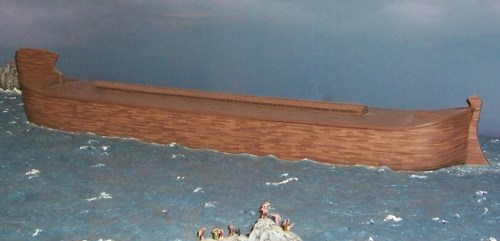
Ark Model Display at the Answers in Genesis Creation Museum

Ark Model Display at Answers in Genesis Creation Museum

Make thee an ark of gopher wood; rooms shalt thou make in the ark, and shalt pitch it within and without with pitch. (Genesis 6:14)

The creation ministry Answers in Genesis opens its long-awaited project the Ark Encounter on July 7, 2016. As implied by the name, the project promises to give visitors an “encounter” with Noah’s Ark. The main attraction is a full-scale model of Noah’s Ark based on the Egyptian Royal cubit of 20.6 inches and making the model an enormous 515 feet long. That is almost the length of 1 ¾ football fields.

The Ark will house many exhibits including life-sized animal models – many animated to be sure – to help visitors experience what life on the Ark might have been like. This will include the storage of food for the crew of eight, plus that of all the animal passengers. It will instruct the visitors on how the care and feeding of so many animals could be accomplished with only eight people onboard.

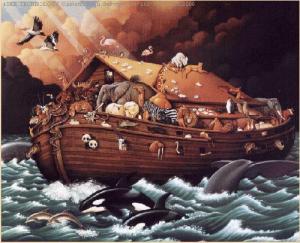
noah-arkThe importance of this attraction lies in the understanding that a large majority of people today reject the Bible as myth due to accounts such as that of the Global Flood recorded in Genesis 6-9. Even many liberal theologians compromise with the secularist in attributing the origin of the account to the Epic of Gilgamesh, or suggest that the Flood was only local and not global as described in Scripture.  Many adults today, if they think of Noah’s Ark at all, remember the stories read to them as children and remember the pictures of a tiny little boat with animals sticking their heads out of different port holes. Or they remember cute little bathtub toys with which they played at bath time. So, the idea of a wooden vessel large enough to house so many animals defies reason. The Ark Encounter will change that thinking, or at least give them something to think about.
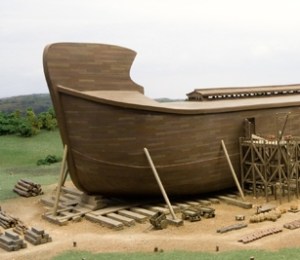
I look forward to visiting sometime after it opens, and I would encourage others to plan a trip up to northern Kentucky to experience it for yourself. While there, you can also visit Answers in Genesis Creation Museum. To get the most out of the visit, I would plan for at least three days. It will really be worth your time.

ark sail

The Sail

Not to take anything away from this most excellent endeavor by Answers in Genesis, but I do have one small bone to pick with the exterior design of the Ark. The ark replica under construction sports a tall stationary “sail” at the bow of the “ship” and a rudder-like structure, called a skeg, at the stern of the “ship.”

The Skeg

The Skeg

Tim Lovett is the designer of the ark replica. I do not know anything about Mr. Lovett, but according to the cover on his book Noah’s Ark: Thinking Outside the Box, he is a naval expert and a mechanical engineer. Lovett employed sound reasoning in the design of his ark. The “sail” is a wooden superstructure that rises high above the weather deck along the centerline of the ship. I say “ship” because the hull construction of this ark resembles what one would imagine for a modern ship with a tapered prow and stern. Hence the idea of “Thinking Outside the Box.” Prior to Lovett’s ship-like ark, most conventional thought rendered the Ark more box shaped – like a barge – than a navigable ship. Though unconventional, Lovett’s design makes good sense. The design prevents “broaching” i.e. catching a wave broadside. A tsunami-like wave in order of 100 ft or higher (which we would expect from the catastrophe described in the Flood account) could possibly swamp and capsize the vessel. On a navigable ship, an experienced sea captain would turn his ship into the wave to prevent broaching, but the Ark was not a navigable ship. Taking this into consideration, Lovett designed his ark with a sail and skeg that take advantage of the wind that generates the waves (sometimes but not always) and the motion of the wave to turn the ark in the direction of the wave and accomplish something similar to that of the experienced sea captain. It really is a very clever design.

Lovett defends his design by pointing to the ship construction of the ancient Egyptians, Phoenicians, Greeks, Romans, etc., and suggests that pre-Flood people probably possessed similar shipbuilding skills. If that were the case, then Noah probably had access to the same technology, and assuming, as we do, that pre-Flood people were actually of higher intellect than modern man (being that they were genetically closer to the perfectly created man, Adam), then it stands to reason that Noah had the intellect, knowledge and skills to build such a vessel.

There Lovett argues from scriptural silence. The Bible makes absolutely no mention of maritime travel in the pre-Flood world. We can surmise that they were technologically skilled by the descriptions given in Genesis 4:20-22, but the description is rather limited: they kept cattle, made musical instruments, and worked in brass and iron. That is really not up to the standard that we might consider technology today, however, that is not the point of the narrative. These people were not “knuckle draggers;” they were highly intelligent, yet there is nothing said about their abilities to navigate the open seas. Would that not be significant? So, Noah’s shipbuilding skills are merely a product of Lovett’s speculation, and we should leave it at that. There is nothing wrong with that as long as we remember that it is “speculation,” not Bible.

Let us consider what the Bible does say. We know that the human race had become wicked and corrupt (Genesis 6:1-7) to the point that God had no other option than to destroy them all; “But Noah found grace in the eyes of the LORD” (Genesis 6:8). God instructed Noah to build an ark. The Hebrew word translated “ark” is têbâh, and it means “box” – not a “ship” or a “boat.” It is a box.  Further, God instructed Noah what building materials to use: gopher wood and pitch. No one knows what gopher wood is. Some think it is some kind of extinct tree, and some think it may have been a method of construction or a process of laminating wood. We do not know. The point is that Noah knew what it was. “Pitch” is the Hebrew word kôpher which literally means “cover,” the same word that is used for “atonement.” Some have suggested that it was bitumen – a tar – but whatever it was, it was meant to seal the Ark and make it watertight.

Ark Model on Display at the Institute for Creation Research

Ark Model on Display at the Institute for Creation Research

Noah was given the dimensions for the Ark 300 x 50 x 30 cubits (Genesis 6:15), and it was to have three decks and animal pens (Genesis 6:14).  God’s instructions also included a “window” (Genesis 6:16). The Hebrew word translated “window” is tsôhar, which literally means “double light,” and is translated elsewhere in the O.T. as “noon” or “midday.” Considering these details, one would think that something so prominent as a “sail” or a “skeg” would have been noted. But again, this is an argument from silence that does not necessarily negate Noah having added this detail of his own volition. We can infer from Scripture that Noah employed some of his own initiative when, at the end of the Flood, we read, “And it came to pass at the end of forty days, that Noah opened the window of the ark which he had made” (Genesis 8:6, emphasis mine). In this case the Hebrew word translated “window” is challôn, which is always translated as “window” in the O.T. This was something different than the “window” God specified for construction.

So, could the Ark withstand the ravages of the catastrophic global flood without the benefit of a sail and skeg? To answer that question, we must answer some fundamental questions. Who brought the judgment upon the human race (Genesis 6:7)? Who decided to save Noah and his family (Genesis 6:18)? Who gave the order to build the Ark and provided the specifications (Genesis 6:14-16)? Who selected and called the animals to the Ark when it was completed (Genesis 7:7-9)? Who caused the fountains of the deep to burst and for the rain to fall for 40 days and nights (Genesis 7:11-12)? Who caused the waters to continue to rise for 150 days (Genesis 7:24)? The answer to all of those questions is God. It was all God’s doing. The next question to ask is: “What was God’s purpose for the Ark?” “Of fowls after their kind, and of cattle after their kind, of every creeping thing of the earth after his kind, two of every sort shall come unto thee, to keep them alive” (Genesis 6:20, emphasis mine).

Considering that God directly planned, directed, and superintended every detail of this catastrophic event, it stands to reason that (since His plan included preserving life on the Ark) He also kept the Ark safe through the turbulence of the storm.

Noah was instructed to build a big box, not a ship. God did not require him to possess shipbuilding skills, only enough skills to build a watertight box. God would take care of the rest. So, while Tim Lovett’s design is clever, well thought out, and reasonable, it is really unnecessary when God’s plan all along was to preserve life. More than that, a simple box preserved in turbulent waters, glorifies God more than a sleek ship designed by man. A ship designed to resist rough waters glorifies the ingenuity of man; but with a simple box, God gets all the glory.

The Ark is a “type” of Christ. Salvation is through grace; it is not by works of man (Ephesians 2:8-9). Those who place their trust in Christ are saved from the storms of life and preserved to enter into a new heaven and a new earth (Revelation 21:1). It is all God’s doing. The only thing man needs to do is obey God’s call and enter through the only door (John 14:6) to be saved. No clever scheme of man, no matter how refined, can compete with God’s very simple design.

So, if you have an opportunity to visit the Ark Encounter, please do so. It will really be a blessing to you. But when you look at that massive sail and skeg, take it for what it is: a clever product of someone’s imagination. And remember, God does not need our help to accomplish His will.

You might also be interested in reading about the Arm model I built: Building the Ark.

4 Comments

Filed under Apologetics, Christianity, Evangelism, Gospel, Religion, Salvation, Theology

Resurrection

colorful sunset

Jesus answered and said unto them, Destroy this temple, and in three days I will raise it up … When therefore he was risen from the dead, his disciples remembered that he had said this unto them; and they believed the scripture, and the word which Jesus had said. (John 2:20, 22)

Christians today, especially in the Middle East, suffer martyrdom by the hundreds at the hands of brutal ISIS executioners. These undergo a gruesome and horrific death by beheadings or being burned alive. Yet, as ghastly as we may perceive such brutality, the pain and suffering of these victims is short-lived, unlike that experienced by our Lord Jesus Christ on the cross.[1]

On the Lord’s Feast of Passover,[2] Jesus, already physically drained from lack of sleep[3] and subjected to a sham of a trial by the Jewish religious leaders, was brutally beaten and scourged at hands of Roman soldiers, experts at inflicting pain without killing the victim. Then in that depleted condition, He was forced to carry His own cross to the place of execution, and whether it was a fully assembled cross or just the cross beam, for a man in Jesus’ condition at that time was next to impossible – but He did it. Under the weight of that burden, determined to complete His mission, He faced the horror of the cross. God, wrapped up in human flesh, with His host of angelic armies standing at the ready awaiting the command to rain down vengeance upon His tormentors. At the time of His arrest, Peter pulled his sword in His defense, but Jesus stopped him. “Thinkest thou that I cannot now pray to my Father, and he shall presently give me more than twelve legions of angels?” (Matthew 26:53).  Nothing would deter Him from His mission. “[He] made himself of no reputation, and took upon him the form of a servant, and was made in the likeness of men: And being found in fashion as a man, he humbled himself, and became obedient unto death, even the death of the cross” (Philippians 2:7-8).

Determined to give to the very last, He carried Himself up Calvary’s hill, laid Himself down upon the timbers and spread His arms out to receive the nails – our pain, our guilt, our sins. “For [God the Father] hath made him [Jesus] to be sin for us, who knew no sin; that we might be made the righteousness of God in him” (2 Corinthians 5:21). At the last, He gave His life. He did not die. Jesus said, “… I lay down my life, that I might take it again. No man taketh it from me, but I lay it down of myself. I have power to lay it down, and I have power to take it again. This commandment have I received of my Father” (John 10:17-18, emphasis mine). He was not killed. “Jesus, when he had cried again with a loud voice, yielded up the ghost” (Matthew 27:50, emphasis mine). He was not the victim. He was in full control until the very last. John, the beloved disciple, and the only one of the twelve to witness the event said, “When Jesus therefore had received the vinegar, he said, It is finished: and he bowed his head, and gave up the ghost” (John 19:30, emphasis mine). Finished! Paid in full!

That was not the end. On the first day of the week, on that spring Sunday morning, He broke the chains of death and brought sheol’s captives with Him. Matthew records, “And the graves were opened; and many bodies of the saints which slept arose, And came out of the graves after his resurrection, and went into the holy city, and appeared unto many” (Matthew 27:52-53).[4]

His resurrection is key! Had Jesus died and remained in the tomb, we would venerate a martyr, nothing more. His bones would be marked by an ornate shrine. Perhaps followers would make faithful pilgrimages to the site to stand in awe and wonder. If that was the case, our faith’s reward would be death and eternal separation from our Creator with no hope of redemption. “And if Christ be not risen, then is our preaching vain, and your faith is also vain” (1 Corinthians 15:14). “But thanks be to God, which giveth us the victory through our Lord Jesus Christ” (1 Corinthians 15:57).  Because of His resurrection, “Death is swallowed up in victory” (1 Corinthians 15:54). “For if we have been planted together in the likeness of his death, we shall be also in the likeness of his resurrection” (Romans 6:5). So now we can say, “O death, where is thy sting? O grave, where is thy victory?” (1 Corinthians 15:55).

Before going to the cross, Jesus left us with this promise: “Let not your heart be troubled: ye believe in God, believe also in me. In my Father’s house are many mansions: if it were not so, I would have told you. I go to prepare a place for you. And if I go and prepare a place for you, I will come again, and receive you unto myself; that where I am, there ye may be also” (John 14:1-3). His resurrection guarantees the promise. On that day, “the Lord himself shall descend from heaven with a shout, with the voice of the archangel, and with the trump of God: and the dead in Christ shall rise first: Then we which are alive and remain shall be caught up together with them in the clouds, to meet the Lord in the air: and so shall we ever be with the Lord” (1 Thessalonians 4:16-17).

Our Christian brothers and sisters in the Middle East and elsewhere in the world are brutally killed daily by the enemy of God. We can thank God that for many, death is swift; it is nothing like what their Lord and our Lord endured for our sakes. But the guaranteed promise of the resurrection assures us that one day soon, we will be together with Him in His house.

Notes:


[1]  It is said that victims could linger on the cross up to three days until succumbing to dehydration and asphyxia.

[2]  Despite conventional tradition, this even could not have taken place on Friday. Jesus said He would rise in “three days,” not three partial days. Jesus specified “three days and three nights” (Matthew 12:39-40). No matter how one may try to convolute the time to fit a “Good Friday” scenario, one cannot get “three days and three nights” from Friday evening to Sunday morning. Jesus said, “three days and three nights” – 72 hours, nothing less will do!

[3]  Jesus had spent the night in prayer while His disciples slept (Matthew 26:36-46; Mark 14:32-42; Luke 22:39-46) before being betrayed by Judas, arrested and tried.

[4]  Matthew’s recording of this event that seems to coincide with Jesus’ death and the renting of the veil to the Holy of Holies, but a close inspection of the text reveals that this event occurred after the resurrection. See again Matthew 27:52-53.

2 Comments

Filed under Apologetics, Christianity, Easter, Evangelism, Gospel, Religion, Resurrection, Salvation, Theology

Easter’s Wrong!

Shocked

And when he had apprehended him, he put him in prison, and delivered him to four quaternions of soldiers to keep him; intending after Easter to bring him forth to the people. (Acts 12:4)

The two highest church attendance days are Christmas and Easter. Easter probably wins the high attendance day of the two since it always falls on a Sunday. Neither day is historically accurate, but Easter typically comes nearer being right than does Christmas. Both holidays (holy days) come to us thanks to the Roman Catholic Church (RCC) in its attempt to “Christianize” the pagan celebrations of Saturnalia, which celebrated the return of the sun, i.e. the days getting longer, and Ishtar, whose origin is rather convoluted but basically has its source in the ancient fertility goddess of Babylon from whence come the icons of Easter eggs and bunnies.[1]

The pagans celebrated their “Queen of Heaven” on the first day of the week (Sunday) following the first full moon after the vernal equinox. Some form of this religious practice was observed by the Egyptians, Greeks and Romans. By the time the RCC came into power, pagans continued the practice, so, in order to accommodate the pagan population, the Church put a Christian spin on the celebration. There are several parallels that can be made between that pagan religion and what we believe as Christians.[2] Jesus was born of a virgin, He died, He was buried, and He rose again. Superficially, the pagan story sounds familiar, but this should not be surprising since Satan is the ultimate counterfeiter. Jesus said, “He [Satan] was a murderer from the beginning, and abode not in the truth, because there is no truth in him. When he speaketh a lie, he speaketh of his own: for he is a liar, and the father of it” (John 8:44).  Since the celebration of Ishtar fell around the time as the Jewish Passover, and considering the parallels, it was not difficult to remake the pagan celebration into a Christian one. (Oh! Don’t be so shocked! We still do that today. In order to attract the “world” we adopt worldly practices, bring them into the church, and put a Christian face on them. Sometimes “Christian” events look no different than rock concerts. The only differences, if you can hear them, are the words of the songs. And for those of us who love the “old hymns” many of the tunes of those good old hymns originated in pubs and saloons. So, this is not unique to the RCC.)

Despite the title I chose for this article, my purpose here is not necessarily to bash our observance of Easter. (I prefer to call it “Resurrection Day” or “Resurrection Sunday.”) I believe that it is right and proper that we celebrate the Advent of our Lord and His death, burial and resurrection – the resurrection being key. They are highly significant events that altered the course of history and the destiny of man. But if we are going to celebrate these very special days, we should at least try to be “biblical” about it rather than “traditional.” Arguably, Christmas could remain as December 25th. While widely accepted by biblical scholars that the birth of Jesus probably took place around mid-September (more likely around the celebration of the Jewish Feast of Booths or Sukkot), counting back nine months would bring one to around December 25th as the time of conception, which would also be the actual “incarnation” when God came to be “with us” (Emmanuel) as a human embryo.

Easter, however, does not always line up exactly with Passover as is the case this year. Jesus was crucified on Passover. Jesus said, “Ye know that after two days is the feast of the passover, and the Son of man is betrayed to be crucified” (Matthew 26:2, emphasis mine). The Jewish day began at sundown, around 6:00 PM, unlike our western day which begins at midnight. On the afternoon before the Passover, Jesus sent His disciples to make arrangements to celebrate the Passover Seder (Matthew 26:18-19). “Now when the even was come, he sat down with the twelve” (Matthew 26:20, emphasis mine). “When the evening was come,” Passover had begun. After they had  finished the meal, Jesus went with His disciples to the Mount of Olives where He was arrested in the middle of the night – it was still Passover – and illegally tried and sentenced to death by crucifixion (Matthew 26-27, Mark 14-15, Luke 22-23, John 18-19). Jesus died at the ninth hour, 3:00 PM (Matthew 27:46; Mark 15:34; Luke 23:44-46), at the same time that the Passover lamb was being sacrificed at the Temple. It had to be this way in order to fulfill the Law of God given to Moses (Deuteronomy 16:1-6).

So, Jesus died on Passover, at precisely the right time in order to fulfill the Law of God and make a once for all atonement – a covering – for our sins. “For the life of the flesh is in the blood: and I have given it to you upon the altar to make an atonement for your souls: for it is the blood that maketh an atonement for the soul” (Leviticus 17:11, emphasis mine). “And almost all things are by the law purged with blood; and without shedding of blood is no remission [of sins]” (Hebrews 11:28, emphasis mine).

Biblically, then, Easter (Resurrection Day) should be celebrated in association with and very closely linked to the Jewish Passover. “Easter” is nowhere found in the Bible except as mistranslated in our beginning verse above (Acts 12:4). The Greek word translated “Easter” in this verse is pascha, the Greek transliteration of the Hebrew pesach or Passover. Evidently the translators of the King James Bible were taken in by centuries of RCC tradition.

“Easter” is not biblical, and it becomes painfully obvious especially this year. As noted above, Easter is the first Sunday that follows the first full moon after the vernal equinox. This year, the vernal equinox took place on March 19. The first full moon after that will be on March 23, making the 27th Easter Sunday. The problem is that the Jewish calendar is lunar, not solar. Nissan (Abib in the OT) is the first month of the Jewish religious calendar, and Passover is celebrated on Nissan 15. This year, 2016, Nissan 15, Passover, begins on Friday, April 22 at 6:00 PM and goes to 6:00 PM Saturday, April 23. We are celebrating Resurrection Day nearly one month before Passover, and that, to me, just seems wrong. You cannot have “resurrection” before the Passover sacrifice! If we were being biblical instead of traditional, we should be celebrating Resurrection Day on Sunday, April 24. Instead, we will just go with the flow and celebrate it according to the Roman Catholic tradition. This is why, especially this year, Easter’s Wrong.

Notes:


[1]  See “The Pagan Origin of Easter” http://www.lasttrumpetministries.org/tracts/tract1.html

[2]  Ibid.


3 Comments

Filed under Apologetics, Christianity, Easter, Evangelism, Gospel, Religion, Resurrection, Salvation, Satan