Category Archives: Salvation

Near Death

DIGITAL CAMERA

“Beloved, now are we the sons of God, and it doth not yet appear what we shall be: but we know that, when he shall appear, we shall be like him; for we shall see him as he is.” (1 John 3:2)

There seems to be an increased interest in the paranormal these days: crop circles, UFOs, alien abductions, zombies, vampires, etc. Included in these are the reports of “near-death” experiences. This seems particularly to have piqued an interest among Christians due to the Christian predisposition to think about the afterlife, particularly heaven. A new “Christian” movie that has added fuel to this fire takes its title from a book by the same name: Heaven Is For Real by Todd Burpo. This is supposedly a factual account of a little boy who dies in a hospital operating room and goes to heaven and returns to report all kinds of amazing things about his experience there.

A Christian lady concerned about what to make of this phenomenon told me about a nurse friend who told her about near death experiences she has witnessed. “I feel very uncomfortable about this,” she said to me. “It does not seem Scriptural…doesn’t seem to match with what Jesus has taught about death. And so, I’m wondering if these sorts of things are considered ‘false prophets doing great wonders to seduce even the elect.’”

She continued, “Surely it is tempting to hear ‘proof’ that such beauty exists…even to believe that, yes, heaven exists, and Jesus is waiting with outstretched arms when we die. Surely some people might become believers upon hearing such tales…at least, folks that would believe ‘we go to a place of great beauty, bright light, where Jesus is’ when we die. It’s such a comforting picture. But is it Scriptural? Are we to believe in these things?”

I assured her that I share her skepticism about these near death experience reports. Obviously, we cannot judge what another person experiences because only they are privy to that information. The same goes for judging another person’s salvation – only God (and the individual) truly knows the condition of the heart. So, when someone reports a near death experience, we have to take them at their word, because only they and God know what they experienced.

But going back to our example of salvation, we can pretty well guess the state of a person’s salvation because of the kinds of “fruit” they bear. Granted, a person may be putting on a good front leading us to think they are saved – in fact, they may even be fooling themselves – but they are not truly saved. Or the opposite may be true. The person may truly be saved, but are presently living in a temporary “back-slidden” state. Again, only God knows for sure, but we can certainly judge their “acts” and know if those acts, or fruits, are genuine – at least outwardly.

Coming back around to our near death question, except for a very small number of cases, most of these experiences report the very same thing regardless of the spiritual condition of the individual. There have been a few reports of individuals experiencing hell, and they are very thankful that they were “brought back,” but this is the exception rather than the norm.

I viewed a video on the topic recently[1]. For some time now neurologists have been studying near death experiences and to date they have no explanation for this phenomenon. It seems that the only thing they have been able to confirm is that when a patient is clinically dead, all brain activity ceases. They have been unable to determine at what point the patient has the “out-of-body” experience. Is it just before they die or is it when they are revived? They do not know. Yet the patients all seem to report similar experiences: a feeling of warmth, peace, acceptance and unconditional love. So, if all of these “good” experiences are true, regardless of the spiritual state of the individual, that might lead one to conclude that everyone goes to heaven – except for really, really bad people. The question then is how does that line up with what the Bible says?

There are several accounts of resuscitations[2] in the Bible where people died and were brought back to life: the raising of the widow’s son (1 Kings 17:22); the raising of the Shunammite woman’s son (2 Kings 4:33-36); the man raised at Elisha’s tomb (2 Kings 13:21); the raising of Jairus’ daughter (Matthew 9:25); saints raised at the death of Christ (Matthew 27:52); raising of the widow’s son (Luke 7:15); the raising of Lazarus (John 11:43-44); raising of Tabitha by Peter (Acts 9:40-41); and the raising of Eutychus by Paul (Acts 20:9-12). With all of these examples, there exists no record about what the individuals experienced during their time of death. In every instance, the Bible is silent.

There is one instance where one died and then returned to tell about it. That was Paul in Acts 14:19-20. He later relates his experience in 2 Corinthians 12:2-7:

I knew a man in Christ above fourteen years ago, … such an one caught up to the third heaven. And I knew such a man … How that he was caught up into paradise, and heard unspeakable words, which it is not lawful for a man to utter. (vv. 2-4)

So, Paul experienced something, but he was not allowed to speak about it. This evidence from Scripture calls into question all the reports we are hearing today. Is it possible that there is a hidden agenda there? – one that says, “What you believe makes no difference. If you are a reasonably good person, you will go to heaven.” That is the devil’s oldest lie: “Yea, hath God said …? … Ye shall not surely die” (Genesis 1:3, 4).

Jesus spoke more about hell than He spoke of heaven. In Luke 16:19-31, He relays the account of a rich man who died and woke up in Hades and likewise, poor, sickly Lazarus died “and was carried by the angels into Abraham’s bosom” (v. 22). Here we are given a peek into the afterlife from which no one returns (generally speaking). Two very different places are depicted and two very different experiences are presented. Jesus related this “story” as an actual account. Considering His divine nature, He had firsthand knowledge of this event, which clearly shows us that not everyone goes to the same place or experiences the same thing. Something else worth noting in this account is that nowhere does Jesus describe the rich man as being a particularly (what we would consider) a “bad” person. From Jesus’ account, we gather that the rich man was self-absorbed, narcissistic, self-centered, selfish, and unconcerned with the plight of the poor beggar that sat at his gate, but it’s not as if he were a mass murderer, or anything like that. He may have been a good father, husband and provider. He was evidently concerned about his loved ones (vv. 27-28). Had we known him, we probably would not have considered him to be a bad person. Those who mourned him at his funeral probably thought he ascended to “Abraham’s bosom,” but that certainly was not the case.

So, the bottom line is that we cannot know with certainty what these people have experienced, but we are right to employ a healthy dose of skepticism. There is no biblical basis for these reports, and science offers no satisfactory explanations. The fact that most experiences reported are positive contradicts Jesus’ very words that “strait is the gate, and narrow is the way, which leadeth unto life, and few there be that find it” (Matthew 7:14). The truth is that most people will NOT have a good experience. If these experiences are genuine, we should expect more bad experiences than good, but that is not what is being reported.

Of greater importance to anyone reading these words is the assurance and security of a place prepared for you by the Savior. He says:

Let not your heart be troubled: ye believe in God, believe also in me. In my Father’s house are many mansions: if it were not so, I would have told you. I go to prepare a place for you. And if I go and prepare a place for you, I will come again, and receive you unto myself; that where I am, there ye may be also. (John 14:1-3)

God promises: “And ye shall seek me, and find me, when ye shall search for me with all your heart” (Jeremiah 29:13). Jesus adds to that: “I am the way, the truth, and the life: no man cometh unto the Father, but by me” (John 14:6). “Seek ye the LORD while he may be found, call ye upon him while he is near” (Isaiah 55:6).

NOTES:


[1] Documentary: “The Day I Died” http://topdocumentaryfilms.com/day-i-died/

[2] Note that resuscitation is not the same as resurrection. In the former case, the individual eventually dies again. In the latter case, the individual remains alive for ever. Jesus is the “first fruits” of the resurrection (1 Corinthians 15:20, 23). Because He lives, we can be assured of eternal life.


1 Comment

Filed under Apologetics, Christianity, Current Events, Death, End Times, Evangelism, Gospel, Heaven, Hell, Religion, Salvation, Science, Uncategorized

You Don’t Go to Hell Because You’re A Sinner

You have a choice!

You have a choice!

“But he that shall blaspheme against the Holy Ghost hath never forgiveness, but is in danger of eternal damnation:” (Mark 3:29)

One of the charges leveled against God by unbelievers is the question of why a loving God would send anyone to hell. A corollary to that questions why God would send sinners to hell since He created them that way in the first place. Unbelievers are not alone in this camp. They are joined by many pseudo Christians, like those in the Emergent Church movement who would do away with the doctrine of hell altogether in their misguided effort to rescue God from such charges, and thus make Him more attractive to the masses.

The truth of the matter is that God sends no one to hell. Hell was not intended for man, but rather it was “prepared for the devil and his angels” (Matthew 25:41). From the beginning of time when man fell, God has always been proactive in the restoration of the broken relationship between God and man.

When man first disobeyed God, God immediately reached out to man in an effort to reconcile the broken relationship. “And the LORD God called unto Adam, and said unto him, Where art thou?” (Genesis 3:9). Does anyone really believe that God did not know where they were? David says, “Whither shall I go from thy spirit? or whither shall I flee from thy presence?” (Psalm 139:7). God knew where they were. He gave them the opportunity to come forward and confess their disobedience, but instead they made excuses: “I was afraid, because I was naked; and I hid myself” (Genesis 3:10). Again God gave opportunity for confession: “And he said, Who told thee that thou wast naked? Hast thou eaten of the tree, whereof I commanded thee that thou shouldest not eat?” (Genesis 3:11). Of course God knew what they had done. He was present when the serpent tempted Eve. In fact, Satan could not have tempted Eve without God’s permission (See Job 1-2). Just in case you are thinking it unfair of God to put Eve through such a test remember that “God is faithful, who will not suffer you to be tempted above that ye are able; but will with the temptation also make a way to escape, that ye may be able to bear it” (1 Corinthians 10:13). Adam and Eve had all of their needs met. They wanted for nothing, yet they chose to disobey. But it was God who opened the door for reconciliation.

From the beginning God initiated the plan to reconcile man to Himself. “I will put enmity between thee and the woman, and between thy seed and her seed; [He] shall bruise thy head, and thou shalt bruise his heel” (Genesis 3:15). God’s solution was to take “upon him the form of a servant, and was made in the likeness of men: And being found in fashion as a man, he humbled himself, and became obedient unto death, even the death of the cross” (Philippians 2:7-8). Such extreme measures were necessary because He is “not willing that any should perish, but that all should come to repentance” (2 Peter 3:9). That being the case, after all that effort on His part, why would He send anyone to hell?

As can be seen by the example in the Garden of Eden (Genesis 3), it was not the sin of disobedience that brought the curse, but lack of contrition on the part of the guilty couple. God gave ample opportunity to confess, assume responsibility, and ask for forgiveness, but instead they offered up excuses. If our sin kept us from being reconciled to God, no one would be saved “For all have sinned and come short of the glory of God” (Romans 3:23). But God has provided the solution to the rift that exists between God and man. Jesus said, “I am the way, the truth, and the life: no man cometh unto the Father, but by me” (John 14:6). For this reason He said, “Verily I say unto you, All sins shall be forgiven unto the sons of men, and blasphemies wherewith soever they shall blaspheme: But he that shall blaspheme against the Holy Ghost hath never forgiveness, but is in danger of eternal damnation” (Mark 3:28-29, emphasis added). To “blaspheme against the Holy Spirit” is nothing more than rejecting the message of salvation that the Holy Spirit brings to every individual.

What is that message? “Believe on the Lord Jesus Christ, and thou shalt be saved” (Acts 16:31). “That if thou shalt confess with thy mouth the Lord Jesus, and shalt believe in thine heart that God hath raised him from the dead, thou shalt be saved. For with the heart man believeth unto righteousness; and with the mouth confession is made unto salvation” (Romans 10:9-10). Reject that message, and it is not God that sends you to hell. At that point, you have rejected God and His offer of reconciliation, so He has no other option but to say, “Depart from me, ye cursed, into everlasting fire, prepared for the devil and his angels” (Matthew 25:41). You don’t go to hell because you’re a sinner, but because you have rejected God’s offer of salvation.

If you are unsure of your eternal state and are still conscious and breathing, there is hope for you. You have two choices: God or no God. Just remember, whatever choice you make, it is for eternity. If you choose God, He says, “Then shall ye call upon me, and ye shall go and pray unto me, and I will hearken unto you. And ye shall seek me, and find me, when ye shall search for me with all your heart” (Jeremiah 29:12-13). Sin won’t keep you out of heaven, but the wrong choice will.

Comments Off on You Don’t Go to Hell Because You’re A Sinner

Filed under Apologetics, Christianity, Evangelism, Gospel, Hell, Origins, Religion, Salvation, Theology

Perhaps This Year!

2014

“Watch therefore, for ye know neither the day nor the hour wherein the Son of man cometh.” (Matthew 25:13)

This past weekend my wife and I had dinner with some good friends from church. A little sign above their kitchen clock caught my eye. It read: “Perhaps Today.” It reminded me that Henry M. Morris, founder of the Institute for Creation Research, kept a similar placard on his desk as a constant reminder that Jesus could return any day. Jesus Himself commanded that we should “watch” for His return. That word in the Greek is grēgoreuō, and it means to “keep awake,” to “be vigilant.”

Jesus issued that exhortation in the context of the Parable of the Ten Virgins (Matthew 25:1-13). Five of the virgins were characterized as “wise” and the other five were “foolish.” All ten virgins fell asleep. Perhaps the expected Bride Groom tarried longer than anticipated, and they all grew weary in waiting. The difference is that the wise virgins were prepared with extra oil for their lamps while the foolish virgins used all they had and made no provision for the unexpected. When the herald announced the coming of the Bride Groom, the wise virgins, prepared with extra oil for their lamps, went on in to be with the Bride Groom while the foolish virgins missed the wedding.

Oil is often used to symbolize the Holy Spirit. We who are “born again” have the advantage of the Holy Spirit residing within us, and, like the wise virgins, we have the provision of the Holy Spirit so that no matter when the Lord returns, we will be prepared. However, just like the wise virgins we can become weary of waiting for the Lord’s return, and we lose focus. We fall asleep often distracted by the cares and worries of this world, and we forget to watch. Sometimes we lament, “How long for His return!” While the foolish, distracted and unconcerned, say, “Where is the promise of his coming? for since the fathers fell asleep, all things continue as they were from the beginning of the creation” (2 Peter 3:4). And so, they have no “oil” for their lamps; they are unprepared.

Our dinner conversation quickly turned to the topic of eschatology, the study of end times. All of us at the table are on “watch” and anxiously await our Lord’s return. Someone brought up the fact that there are four “blood moons” (lunar eclipses) and a solar eclipse expected on significant Jewish feast days in 2014 and 2015. The first will occur on Passover (April 15) 2014 followed by the second on the Feast of Tabernacles (October 8) 2014. The third will occur on Passover (April 4) 2015 followed by the fourth on the Feast of Tabernacles (September 28) 2015. This infrequent sequence of lunar eclipses has historically held great significance for the Jewish people.

For example, when it happened in 1493 and 1494 Jews were expelled from Spain. The blood moons in 1949 and 1950 came right after the nation of Israel was assembled, giving the Jews a homeland for the first time in thousands of years. And in 1967 and 1968 it was linked to the Six-Day War.[1]

In addition to this, a solar eclipse is expected on March 20, 2015. This date equates to Nisan 1 on the Jewish calendar which is New Year’s Day on the Jewish religious calendar. When measured against Scripture, these phenomena should make us pay attention.

When God initiated these feasts (there are seven), He said, “these are My feasts.” “Speak unto the children of Israel, and say unto them, Concerning the feasts of the LORD, which ye shall proclaim to be holy convocations, even these are my feasts” (Leviticus 23:2, emphasis added). Besides the seven, modern Jews celebrate Purim and Chanukah, but these are not “feasts of the LORD.” The Feasts of the Lord is a fascinating study, which I cannot cover in this brief article. They hold great significance as they reveal God in the Person of Jesus Christ and demonstrate His plan for the ages.

The fact that this sequence of blood moons, along with the solar eclipse, looms in our immediate future has many who study eschatology excited for the prospect of Christ’s imminent return. “The sun shall be turned into darkness, and the moon into blood, before the great and the terrible day of the LORD come” (Joel 2:31, emphasis added).

How are you fixed for oil in your lamp? “Ye are the light of the world” (Matthew 5:14). Are you prepared for the Lord’s return? Perhaps this year! Perhaps today!

Comments Off on Perhaps This Year!

Filed under Christianity, Current Events, End Times, Evangelism, Gospel, New Year's Day, Religion, Salvation, Second Coming of Christ, Theology

The Star and the Cross

chasing-star-of-bethlehem-412624

When they saw the star, they rejoiced with exceeding great joy. (Matthew 2:10)

Black was the sky of the oriental night
Bejeweled as an empress displaying her might.
Lost in the tedium of nocturnal watch,
The wisest of wise appraised a new sight.
 
High in the heavens and brighter than most
A dazzling new object had joined the host.
The astrologers pondered and ventured a guess:
“A mighty new monarch this beacon does toast.”
 
Consulting their sources and making their plans
The seekers trekked westward across the hot sands.
They followed the beacon that showed them the way
To the City of David, and the Savior of man.
 
By day and by night they followed the trail
Of their guiding light with much travail,
For a curious sight its beams had revealed
— The form of a cross in full detail.
 
For two years they followed their stellar guide
Until it rested, and shown with pride
O’er a humble house and the family there
Who with the Mighty King did abide.
 
So they offered their gifts, their praise to assign
As the cross and the star continued to shine,
And knowing not why, their burden was lifted;
The child in the house did their sorrow consign.
 
Some thirty years later, on a cross made of wood
The child, now a young man, there hung in the nude,
And the bright Star of Bethlehem continued to blaze,
The King of all kings gave His life to conclude.


1 Comment

Filed under Christianity, Christmas, Evangelism, Gospel, Poetry, Religion, Salvation, Theology

Shepherd of Shepherds

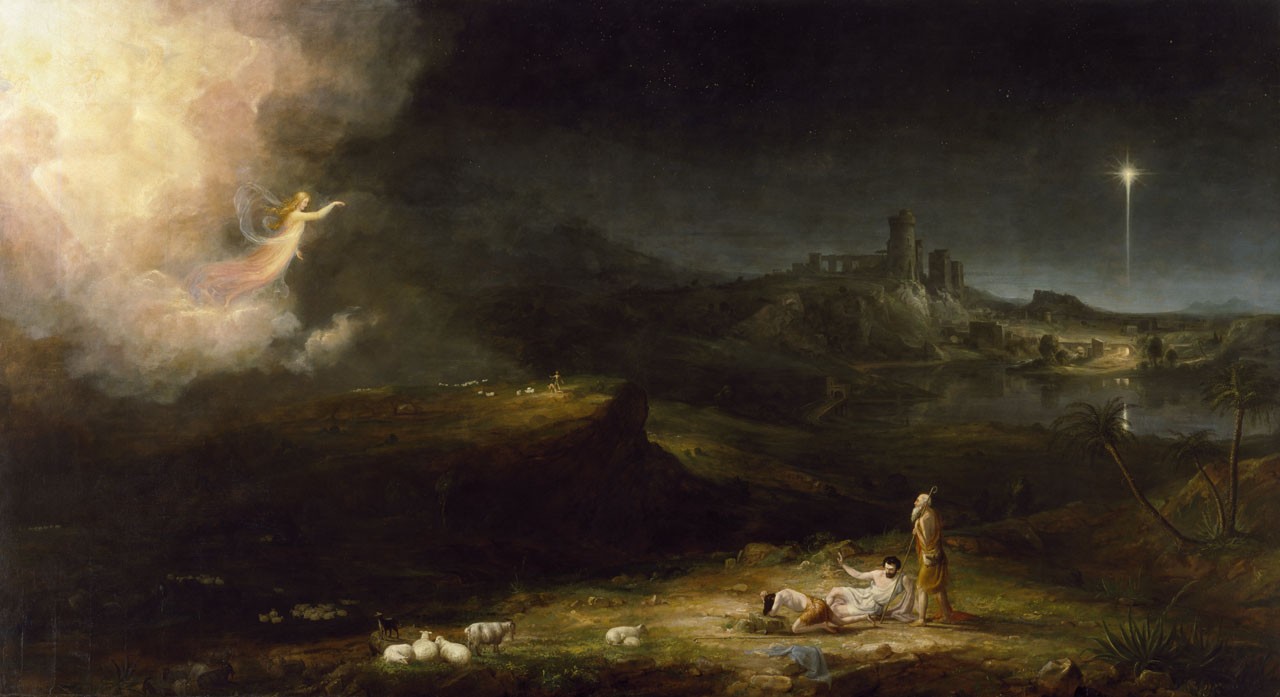
cole-angel-shepherds

“And there were in the same country shepherds abiding in the field, keeping watch over their flock by night.” (Luke 2:8)

One of the best arguments against the birth of Christ having taken place in late December is this fact recorded by Luke in his Gospel. There were shepherds out in the fields watching over their flocks. By late December, there is not sufficient grazing to sustain large flocks of sheep. Jerusalem is near the same latitude as Dallas, Texas where I live. By the middle to the end of November, there is not much left for cattle to graze on, so they need to be fed on hay or “cake.” So it seems very unlikely that shepherds would be out in the fields in the winter time.

The shepherds around Bethlehem generally kept the sheep and goats that were used for sacrifice in the Temple in nearby Jerusalem. Some have suggested that Jesus’ birth was around late September which coincides with the Jewish Fall Feasts: Feast of Trumpets (Rosh Hashanah), Day of Atonement (Yom Kippur) and Feast of Tabernacles (Sukkoths). These were feasts that required all Jewish men to make a pilgrimage to the Temple in Jerusalem. The fact that this requirement happened to coincide with the decree from Caesar Augustus for the census (Luke 2:1) may explain why “there was no room for them in the inn” (Luke 2:7) for the expectant couple. In fact, His birth may have occurred during the Feast of Tabernacles making John’s statement that “the Word was made flesh, and [tabernacled] among us” (John 1:14) even more significant. Interestingly, if one counts back nine months from the end of September, one arrives at a date sometime in late December. It could be that rather than celebrating Christ’s birth on December 25, we are actually celebrating His conception!

Regardless, it was to these simple shepherds that this paramount announcement was delivered. “For unto you is born this day in the city of David a Saviour, which is Christ the Lord” (Luke 2:11). To these shepherds who were known for feeding and protecting their flocks; who sought out the lost sheep, and rescued those that were attacked. It seems appropriate that to these the news of the arrival of the “Shepherd of Israel” should be first delivered. He who would later say, “I am the good shepherd: the good shepherd giveth his life for the sheep” (John 10:11) had come. So without hesitation they said, “Let us now go even unto Bethlehem, and see this thing which is come to pass, which the Lord hath made known unto us” (Luke 2:15). They came “with haste” Luke tells us, “and found Mary, and Joseph, and the [Lamb of God] lying in a manger” (Luke 2:16). His name was Jesus, “for he shall save his people from their sins” (Matthew 1:21). This little Lamb of God, who was to be the Shepherd of shepherds, had finally come to them.


1 Comment

Filed under Apologetics, Christianity, Christmas, Evangelism, Gospel, Religion, Salvation, Theology