Category Archives: Second Coming of Christ

Magog, Tubal, and Persia

Thou shalt ascend and come like a storm, thou shalt be like a cloud to cover the land, thou, and all thy bands, and many people with thee. (Ezekiel 38:9)

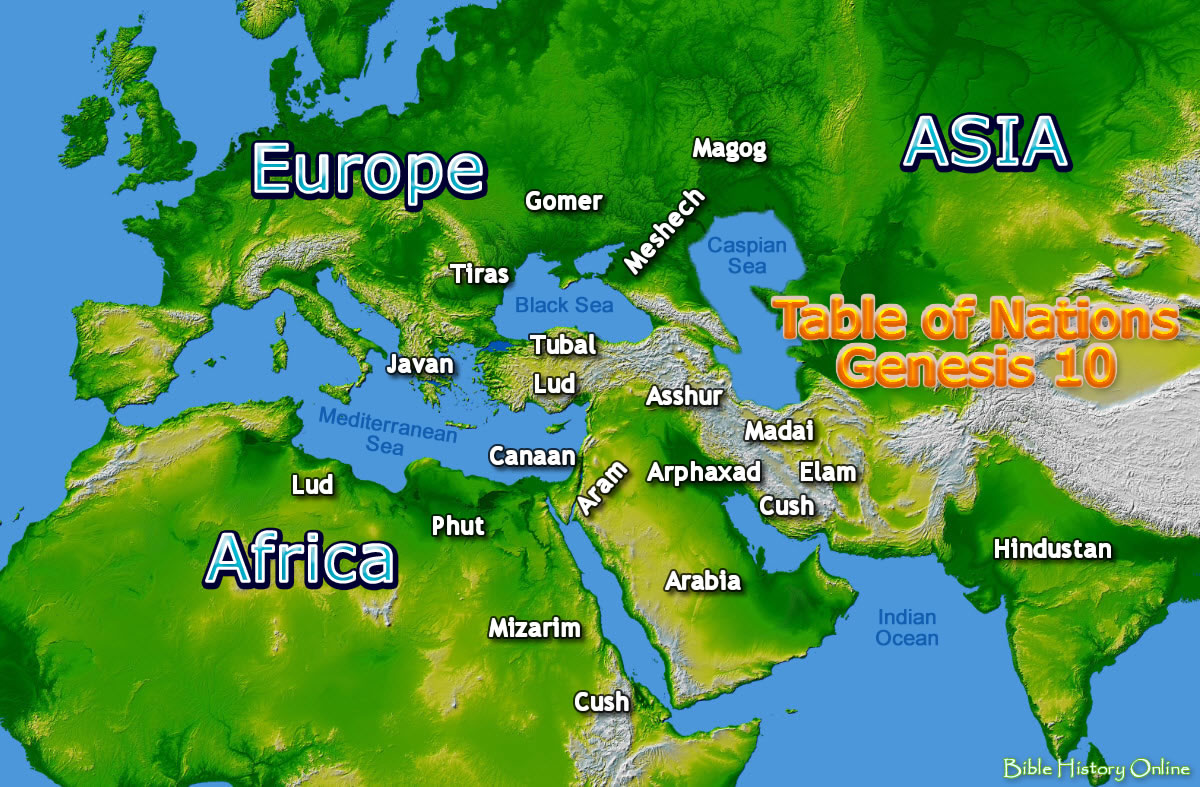
The prophet Ezekiel speaks of a time “in the latter years”[1] when a coalition of nations will come against Israel. The prophecy names the nations by their names assigned at time of the dispersion at the Tower of Babel.[2] The names are listed in the Table of Nations[3] and illustrated in the map above. Since that time, the names of these nations have changed many times over so that we no longer recognize them as those named by the prophet. However, God does not lose track, and He does not forget.

So, as we study Ezekiel’s prophecy in Chapters 38 and 39, it requires that we look at a map depicting where these nations ended up when they were originally dispersed. Let us examine Ezekiel’s list and compare it to the map above. I will emphasis the significant names.

And the word of the LORD came unto me, saying, Son of man, set thy face against Gog, the land of Magog, the chief prince of Meshech and Tubal, and prophesy against him, And say, Thus saith the Lord GOD; Behold, I am against thee, O Gog, the chief prince of Meshech and Tubal: And I will turn thee back, and put hooks into thy jaws, and I will bring thee forth, and all thine army, horses and horsemen, all of them clothed with all sorts of armour, even a great company with bucklers and shields, all of them handling swords: Persia, Ethiopia, and Libya with them; all of them with shield and helmet: Gomer, and all his bands; the house of Togarmah of the north quarters, and all his bands: and many people with thee. (Ezekiel 38:1-6)

Note, first of all, that “Gog” is a person, not a nation. He is a “chief prince” from the nation of Magog. When we look at the map (above), we find that Magog, Meshech, and Gomer are in the region we recognize as Russia.

Tubal we recognize as modern-day Turkey. The “house of Togarmah” (not shown on this map) is also in the “north quarters” of Turkey and also in modern-day Georgia (Russia). Persia was known as Elam prior to Ezekiel’s time, and we find it on the map in the area of modern-day Iran.

Ezekiel lists the lands of Cush and Lud (from Genesis 10) as Ethiopia and Libya. As we look at the map, we observe that Cush is further south than modern-day Ethiopia and corresponds more closely to modern-day Somalia.

It is worth noting that all of these nations are Islamic nations with the exception of Russia, and even Russia has a high Muslim population.

Bringing Ezekiel’s prophecy forward to our day and time, we find that the prophecy speaks of a coalition of three main nations: Russia, Turkey, and Iran with Libya and Somalia in alliance. God says to these nations, “I will turn thee back, and put hooks into thy jaws, and I will bring thee forth” (Ezekiel 38:4, emphasis mine). “Thou shalt ascend and come like a storm, thou shalt be like a cloud to cover the land [Israel], thou, and all thy bands, and many people with thee. Thus saith the Lord GOD; It shall also come to pass, that at the same time shall things come into thy mind, and thou shalt think an evil thought: And thou shalt say, I will go up to the land of unwalled villages; I will go to them that are at rest, that dwell safely, all of them dwelling without walls, and having neither bars nor gates, To take a spoil, and to take a prey; to turn thine hand upon the desolate places that are now inhabited, and upon the people that are gathered out of the nations, which have gotten cattle and goods, that dwell in the midst of the land” (Ezekiel 38:9-12, emphasis mine).

According to Ezekiel’s prophecy, Russia, Turkey, Iran, and their allies will invade Israel “to take spoil and to take prey.” Will this take place before or after the Rapture of the Church? Prophecy experts differ in opinion about this point. However, it appears that the stage is being set for that event.

On Friday of this week, July 22, 2022, the leaders of Russia, Turkey, and Iran met for the purpose of forming an alliance.[4] We have long known of the animosity Iran has toward Israel. Turkey has not necessarily been a friend to Israel. Lately, Russia’s relationship with Israel has cooled over Israel’s support for Ukraine. Additionally, Russia has stopped the migration of Jews from Russia to Israel. To top it off, Israel is on the verge of exporting its natural gas to Europe, which has the potential of cutting into Russia’s profits. The three nations are not happy with Israel and neither are their allies, Libya and Somalia.

It seems that it is only a matter of time before the “Gog of Magog” invasion takes place. Will the Bride of Christ witness this event? I do not know. What I do know is that the invasion will fail.

And it shall come to pass at the same time when Gog shall come against the land of Israel, saith the Lord GOD, that my fury shall come up in my face. For in my jealousy and in the fire of my wrath have I spoken, Surely in that day there shall be a great shaking in the land of Israel; So that the fishes of the sea, and the fowls of the heaven, and the beasts of the field, and all creeping things that creep upon the earth, and all the men that are upon the face of the earth, shall shake at my presence, and the mountains shall be thrown down, and the steep places shall fall, and every wall shall fall to the ground. And I will call for a sword against him throughout all my mountains, saith the Lord GOD: every man’s sword shall be against his brother. And I will plead against him with pestilence and with blood; and I will rain upon him, and upon his bands, and upon the many people that are with him, an overflowing rain, and great hailstones, fire, and brimstone. Thus will I magnify myself, and sanctify myself; and I will be known in the eyes of many nations, and they shall know that I am the LORD. (Ezekiel 38:18-23, emphasis mine)

God will intervene for Israel – not because Israel is a Godly nation, but because God is faithful to His promise. He said He would do it, and He will do it. And His purpose in doing so is so that Israel and all the world will witness Israel’s miraculous deliverance. “Thus will I magnify myself, and sanctify myself; and I will be known in the eyes of many nations, and they shall know that I am the LORD” (Ezekiel 38:23, emphasis mine).

For the Christian, this should be encouraging news. We are seeing prophecy being fulfilled right before our eyes, and that means our Lord’s return to call us home is very near. Are you prepared to meet Him? If you do not know Jesus as your personal Lord and Savior, please read my page on “Securing Eternal Life.”

Notes:


[1]  Ezekiel 38:8

[2]  Genesis 11:1-9

[3]  Genesis 10

[4]  “Russia, Iran, and Turkey Forming a Biblical Alliance” — https://gospelnewsnetwork.org/2022/07/22/russia-iran-and-turkey-forming-a-biblical-alliance/

Comments Off on Magog, Tubal, and Persia

Filed under Apologetics, Bible, Christianity, Current Events, End Times, Eschatology, Rapture, Second Coming of Christ, Theology

Babylon

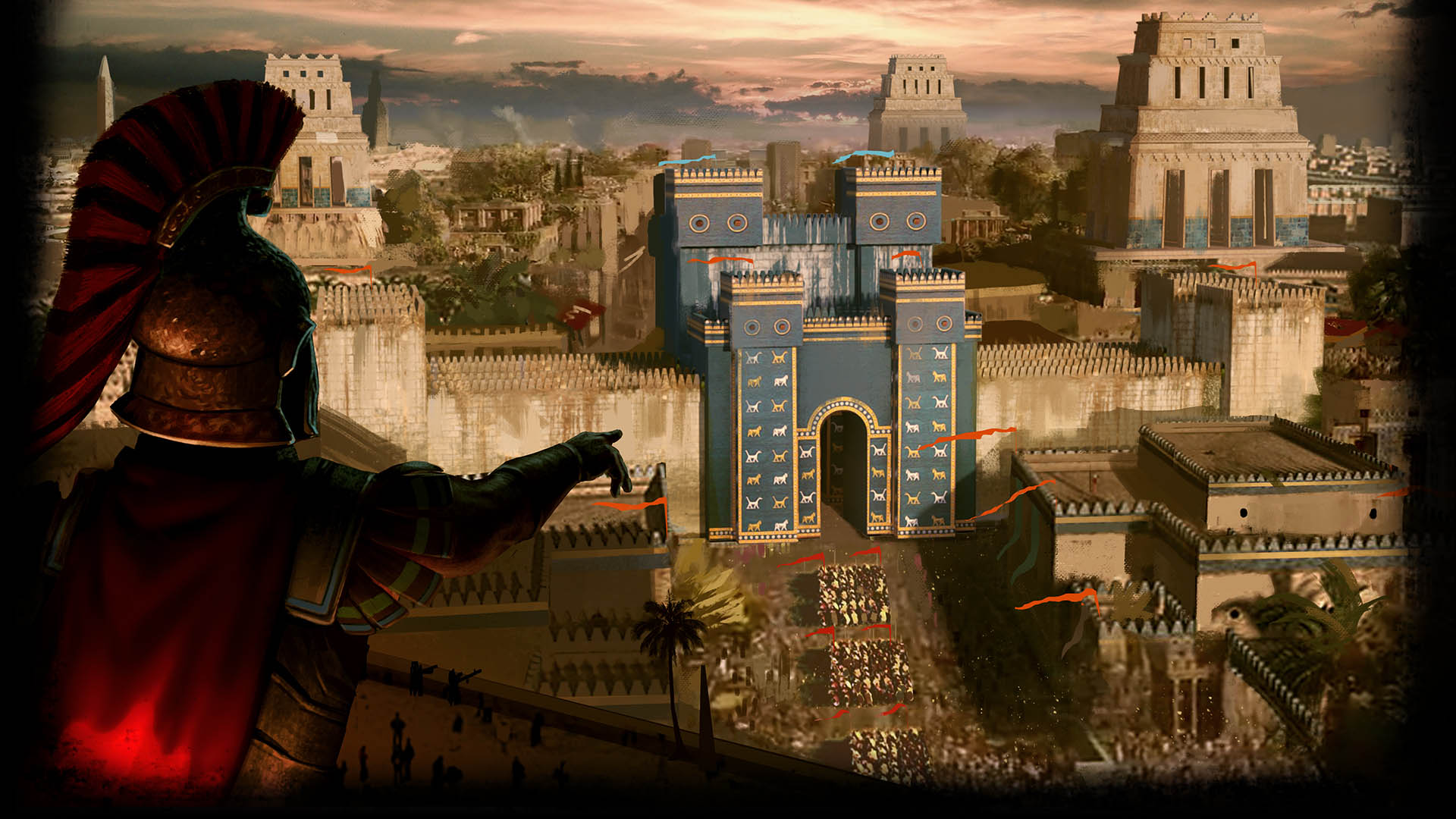
The Ishtar Gate of ancient Babylon

And Babylon, the glory of kingdoms, the beauty of the Chaldees’ excellency, shall be as when God overthrew Sodom and Gomorrah. It shall never be inhabited, neither shall it be dwelt in from generation to generation: neither shall the Arabian pitch tent there; neither shall the shepherds make their fold there. But wild beasts of the desert shall lie there; and their houses shall be full of doleful creatures; and owls shall dwell there, and satyrs shall dance there. And the wild beasts of the islands shall cry in their desolate houses, and dragons in their pleasant palaces: and her time is near to come, and her days shall not be prolonged. (Isaiah 13:19-22)

Babylon appears 294 times in the King James Bible. The first reference can be found in Second Kings. “And the king of Assyria brought men from Babylon, and from Cuthah, and from Ava, and from Hamath, and from Sepharvaim, and placed them in the cities of Samaria instead of the children of Israel: and they possessed Samaria, and dwelt in the cities thereof” (2 Kings 17:24). This citation refers to the time when the Assyrians conquered the northern kingdom of Israel. Babylon had not yet ascended to power. However, the history of Babylon goes all the way back to Genesis after the flood when the people rebelled against God by refusing to “fill the earth” as God had commanded. Instead, they congregated in one place and built a tower to worship the heavens. God overruled their plans, confused their language, and scattered them all over the earth as He willed.[1] “So the LORD scattered them abroad from thence upon the face of all the earth: and they left off to build the city. Therefore is the name of it called Babel; because the LORD did there confound the language of all the earth: and from thence did the LORD scatter them abroad upon the face of all the earth” (Genesis 11:8-9).

“Babylon was initially a minor city-state, and controlled little surrounding territory; its first four Amorite rulers did not assume the title of king. The older and more powerful states of Assyria, Elam, Isin, and Larsa overshadowed Babylon until it became the capital of Hammurabi’s short-lived empire about a century later … After the reign of Hammurabi, the whole of southern Mesopotamia came to be known as Babylonia, whereas the north had already coalesced centuries before into Assyria.”[2] After this, Babylon diminished into a weak city-state until Nebopolassar came into power. “Under Nabopolassar, a previously Chaldean King, Babylon escaped Assyrian rule, and in an alliance with Cyaxares, king of the Medes who was his son in law together with Cimmerians, finally destroyed the Assyrian Empire between 612 BC and 605 BC. Babylon thus became the capital of the Neo-Babylonian (sometimes called the Chaldean) Empire. With the recovery of Babylonian independence, a new era of architectural activity ensued, particularly during the reign of his son Nebuchadnezzar II (604–561 BC).”[3]

As students of the Bible, this last name rings a bell. We are familiar with the biblical accounts of the conquest of Judah and Jerusalem and the demise of the Babylonian Empire by the Medes and the Persians. Prophecies concerning Babylon call for its utter destruction as in our passage above (Isaiah 13:19-22). Consider the following verses from the Prophet Jeremiah.

Because of the wrath of the LORD it shall not be inhabited, but it shall be wholly desolate: every one that goeth by Babylon shall be astonished, and hiss at all her plagues. (Jeremiah 50:13)

As God overthrew Sodom and Gomorrah and the neighbour cities thereof, saith the LORD; so shall no man abide there, neither shall any son of man dwell therein. (Jeremiah 50:40)

And I will render unto Babylon and to all the inhabitants of Chaldea all their evil that they have done in Zion in your sight, saith the LORD. Behold, I am against thee, O destroying mountain, saith the LORD, which destroyest all the earth: and I will stretch out mine hand upon thee, and roll thee down from the rocks, and will make thee a burnt mountain. And they shall not take of thee a stone for a corner, nor a stone for foundations; but thou shalt be desolate for ever, saith the LORD. (Jeremiah 51:24-26)

And Babylon shall become heaps, a dwellingplace for dragons, an astonishment, and an hissing, without an inhabitant. (Jeremiah 51:37)

How is Sheshach taken! and how is the praise of the whole earth surprised! how is Babylon become an astonishment among the nations! The sea is come up upon Babylon: she is covered with the multitude of the waves thereof. Her cities are a desolation, a dry land, and a wilderness, a land wherein no man dwelleth, neither doth any son of man pass thereby. (Jeremiah 51:41-43)

And thou shalt say, Thus shall Babylon sink, and shall not rise from the evil that I will bring upon her: and they shall be weary. Thus far are the words of Jeremiah. (Jeremiah 51:64)

The book of Revelation also speaks of the complete destruction of Babylon. “And the great city was divided into three parts, and the cities of the nations fell: and great Babylon came in remembrance before God, to give unto her the cup of the wine of the fierceness of his wrath” (Revelation 16:19). “And after these things I saw another angel come down from heaven, having great power; and the earth was lightened with his glory. And he cried mightily with a strong voice, saying, Babylon the great is fallen, is fallen, and is become the habitation of devils, and the hold of every foul spirit, and a cage of every unclean and hateful bird.” (Revelation 18:1-2).

Babylon exists today, albeit not as a city of great significance. The rebuilding of the Ishtar Gate and the archeology taking place there make it more of a destination for curiosity seekers. “By 1905, there were several villages in Babylon, one of which was Qwaresh with about 200 households located within the boundaries of the ancient inner city walls. The village grew due to the need for laborers during the German Oriental Society excavations (1899-1917) … On 5 July 2019, the site of Babylon was inscribed as a UNESCO World Heritage Site. Thousands of people reside in Babylon within the perimeter of the ancient outer city walls, and communities in and around them are ‘rapidly developing from compact, dense settlements to sprawling suburbia despite laws restricting constructions’.”[4]

Obviously, the prophecies of the total destruction of Babylon have not come to pass. Since God cannot lie,[5] these prophecies must yet be future. However, there are some end-times prophecy teachers that teach that the Babylon referred to in Revelation is symbolic of false religion that has its roots in Babylon. They also teach that John employed coded language to refer to the Roman Empire as Peter did in his letters. “The church that is at Babylon, elected together with you, saluteth you; and so doth Marcus my son” (1 Peter 5:13). However, there are many that take deference to that saying that Peter was referring to an actual church in literal Babylon.

It’s hard to say. It may be that John was referring to Rome when he referred to Babylon. Christians experienced much persecution under Rome and perhaps this was John’s way of obscuring the meaning in case the letter was intercepted by Roman authorities. That is not beyond possibility. However, there is still the fact that the real, physical Babylon still exists, and it has not been made “a land wherein no man dwelleth, neither doth any son of man pass thereby” (Jeremiah 51:43). It is also not beyond the realm of possibility that Antichrist could indeed set up his headquarters there. There is a population there. There is infrastructure. It does not need to be a “show place” for him to operate from there. For that reason, I lean toward the actual Babylon being the center of Antichrist’s government. That is where false religion started, and that is where it will end when Christ returns. Then all the prophecies of its total destruction will be fulfilled.

Jesus is coming soon, and His reward is with Him. The signs for His appearing are increasing in intensity and frequency. Are you prepared to meet Him? If you do not know Jesus as your personal Lord and Savior, please read my page on “Securing Eternal Life.”

Notes:


[1]  Genesis 11:1-9

[2]  “Babylon” – https://en.wikipedia.org/wiki/Babylon

[3]  Ibid.

[4]  Ibid.

[5]  Numbers 23:19; Titus 1:2

1 Comment

Filed under Apologetics, End Times, Eschatology, Religion, Second Coming of Christ, Theology

When You’re In the Hole, Stop Digging

A wise man feareth, and departeth from evil: but the fool rageth, and is confident. (Proverbs 14:16)

I have heard it said that insanity is repeating the same mistakes and expecting different results. The nation of Judah exemplifies that notion, and I see the same pattern in our nation today.

Toward the end of the sixth century B.C., Judah rebelled against God and followed the gods of the pagan nations around them. Jeremiah prophesied during these final years of the nation and suffered severe persecution because of it. Judah knew the law of God and continued to practice the rituals, but their zeal was for the gods that are “no gods.” “Hath a nation changed their gods, which are yet no gods? but my people have changed their glory for that which doth not profit” (Jeremiah 2:11).

The surrounding nations were faithful to their “gods,” yet Judah, who knew the true God, abandoned Him for the false gods. Not that God can be surprised by the actions of humans, but in human terms, their actions were perplexing. Despite numerous warnings and pleas, Judah refused to repent, until God finally had enough of their unfaithfulness. “How shall I pardon thee for this? thy children have forsaken me, and sworn by them that are no gods: when I had fed them to the full, they then committed adultery, and assembled themselves by troops in the harlots’ houses” (Jeremiah 5:7).

Johoiachin, a.k.a. Coniah,[1]a.k.a. Jeconiah,[2] a.k.a. Jechonias,[3] reigned as the final king of the sovereign nation of Judah. He was the third wicked successor of good king Josiah. By the time of his reign, Judah plunged to the depths of her depravity. To him God instructed Jeremiah to “Take thee a roll of a book, and write therein all the words that I have spoken unto thee against Israel, and against Judah, and against all the nations, from the day I spake unto thee, from the days of Josiah, even unto this day” (Jeremiah 36:2, emphasis mine). God wanted to make clear the warnings He had given in the recent past. This book was the written Word of God. However, rather than heed God’s Word, Johoiachin discarded the Word of God as rubbish to be burned. “And it came to pass, that when Jehudi had read three or four leaves, [Jehoiachin] cut it with the penknife, and cast it into the fire that was on the hearth, until all the roll was consumed in the fire that was on the hearth” (Jeremiah 36:23). The other national leaders in the audience did no better. “Yet they were not afraid, nor rent their garments, neither the king, nor any of his servants that heard all these words” (Jeremiah 36:24). As a result, God allowed the Babylonians to invade and conquer Judah and Jerusalem.[4] This was the first time Nebuchadnezzar took away captives from Jerusalem. The prophet Daniel went into captivity at this time.

In many ways, Nebuchadnezzar showed kindness to Judah by installing Mattaniah, a.k.a. Zedekiah,[5] as king to govern the conquered province. One might think that Judah learned her lesson. “But neither [Zedekiah], nor his servants, nor the people of the land, did hearken unto the words of the LORD, which he spake by the prophet Jeremiah” (Jeremiah 37:2). “And [Zedekiah] did that which was evil in the sight of the LORD, according to all that Jehoiakim had done. For through the anger of the LORD it came to pass in Jerusalem and Judah, until he had cast them out from his presence, that Zedekiah rebelled against the king of Babylon” (2 Kings 24:19-20).[6]

Zedekiah was not alone in his rebellion against God. “Moreover all the chief of the priests, and the people, transgressed very much after all the abominations of the heathen; and polluted the house of the LORD which he had hallowed in Jerusalem. And the LORD God of their fathers sent to them by his messengers, rising up betimes, and sending; because he had compassion on his people, and on his dwelling place” (2 Chronicles 36:14-15, emphasis mine). One of those messengers through whom God showed compassion was Jeremiah. He suffered beatings and imprisonment for speaking God’s Word. Yet the people refused to listen. “But they mocked the messengers of God, and despised his words, and misused his prophets, until the wrath of the LORD arose against his people, till there was no remedy” (2 Chronicles 36:16).

“And it came to pass in the ninth year of his reign, in the tenth month, in the tenth day of the month, that Nebuchadnezzar king of Babylon came, he, and all his host, against Jerusalem, and pitched against it; and they built forts against it round about. And the city was besieged unto the eleventh year of king Zedekiah” (2 Kings 25:1-2). With Jerusalem under siege for more than two years, starvation and sickness plagued the city until they could not withstand the armies of Babylon. Jerusalem fell once again and Zedekiah and many others were taken captive for the second time. This time, Nebuchadnezzar was not so nice. He had Zedekiah’s sons killed as he watched and then had his eyes put out so that was the last thing Zedekiah saw.[7]

Jerusalem and the Temple were burned[8] and the Temple treasures were carried off to Babylon. Even with that, the people remained unrepentant until a third and final invasion took the last of the able-bodied.

Judah fell into a deep hole of depravity, but despite all of God’s pleading through His prophets, Judah just kept digging the hole deeper. It got to the point where God would not even entertain prayers on their behalf. God told Jeremiah to stop praying for these people.[9]

As I contemplate the state of our nation, the USA, and compare it to Judah, I see a perfect parallel, except for one thing. The nation of Israel has the promise of God for her preservation; the USA does not. God gave us a great land, godly founders, and a constitution founded on the Word of God. Throughout the years, God has provided great “prophets” proclaiming the Word of God, and for most of our history, we have listened to those prophets. No more! We have, as a nation, cast aside and trampled the Word of God. We embrace wickedness and call it inclusion. We bow at the altar of Gaia and call it “the Green New Deal.” We celebrate infanticide and call it women’s rights. We idolize celebrities in all their different venues – movies, sports, and even religion – while those that preach and teach the true Word of God are held in contempt. We have dug a deep hole for ourselves, and we only keep digging it deeper. Stop digging!

When Solomon dedicated the first Temple, he prayed that God would bless it. God answered, “If my people, which are called by my name, shall humble themselves, and pray, and seek my face, and turn from their wicked ways; then will I hear from heaven, and will forgive their sin, and will heal their land” (2 Chronicles 7:14); but that promise was for them. Many well-meaning pastors urge their people to pray for our nation and claim this promise in hopes that it will turn around. However, that promise was not made to the USA. If anything, I hear God saying, “pray no more for this people.” The hope for this nation, and the world in general, is for Christ’s return to establish His righteous kingdom on earth. Our prayer, then, should be, “Come quickly, Lord Jesus.”

Jesus is coming soon. The signs for His appearing are increasing in intensity and frequency. Are you prepared to meet Him? If you do not know Jesus as your personal Lord and Savior, please read my page on “Securing Eternal Life.”


Notes:

[1]  Jeremiah 22:24, 28; 37:1

[2]  Jeremiah 24:1

[3]  Matthew 1:11

[4]  2 Kings 24:10-12; Jeremiah 36:29-30

[5]  2 Kings 24:17; Jeremiah 37:1

[6]  2 Chronicles 36:13

[7]  2 Kings 25:3-7

[8]  2 Kings 25:8-10

[9]  Jeremiah 7:16; 11:14; 14:11

1 Comment

Filed under Apologetics, Bible, Christianity, Second Coming of Christ, Theology

The Triumphal Entry

And after threescore and two weeks shall Messiah be cut off, but not for himself: and the people of the prince that shall come shall destroy the city and the sanctuary; and the end thereof shall be with a flood, and unto the end of the war desolations are determined. (Daniel 9:26)

The Sunday before Resurrection Day (I dislike the term “Easter”[1]) is traditionally known as Palm Sunday. This is the day Jesus entered into Jerusalem presenting Himself as the long-awaited Messiah. Daniel predicted this presentation[2] to the exact day, and on the following Wednesday evening[3] (not Friday), Messiah was “cut off.”

The Prophet Zechariah foretold of the presentation like this: “Rejoice greatly, O daughter of Zion; shout, O daughter of Jerusalem: behold, thy King cometh unto thee: he is just, and having salvation; lowly, and riding upon an ass, and upon a colt the foal of an ass” (Zechariah 9:9). All four Gospels record this event (Matthew 21:1-11; Mark 11:1-11; Luke 19:28-44; John 12:12-19).[4] Many Bibles insert the title “The Triumphal Entry” before the passage. As one ponders the events that followed that week ending in His crucifixion, one wonders, “Where is the triumph?” In those days, conquering kings entered the conquered cities on a white steed amidst a grand procession of his conquered armies followed by his conquering troops. Jesus entered His city on a young donkey colt cheered on by humble peasants and followed by His bewildered disciples. Just a few days later the same crowd jeered at Him as He hung dying on a Roman cross while all His disciples, save one, were nowhere to be found.

We count His resurrection three days later as a triumph over death, from which we rest assured that our eternal life with Him is secure. But His entry into Jerusalem that fateful week was no triumph. Jesus Himself wept over the event. “O Jerusalem, Jerusalem, thou that killest the prophets, and stonest them which are sent unto thee, how often would I have gathered thy children together, even as a hen gathereth her chickens under her wings, and ye would not!” (Matthew 23:37)

It is a misnomer to call His presentation on that Sunday a “triumphal entry.” That day yet awaits His return![5]

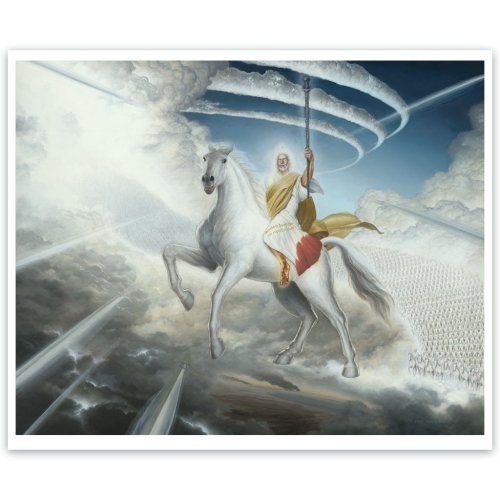
And I saw heaven opened, and behold a white horse; and he that sat upon him was called Faithful and True, and in righteousness he doth judge and make war. His eyes were as a flame of fire, and on his head were many crowns; and he had a name written, that no man knew, but he himself. And he was clothed with a vesture dipped in blood: and his name is called The Word of God. And the armies which were in heaven followed him upon white horses, clothed in fine linen, white and clean. And out of his mouth goeth a sharp sword, that with it he should smite the nations: and he shall rule them with a rod of iron: and he treadeth the winepress of the fierceness and wrath of Almighty God. And he hath on his vesture and on his thigh a name written, KING OF KINGS, AND LORD OF LORDS. (Revelation 19:11-16)

When Jesus returns to reign on earth as King of Kings and Lord of Lords, that will be His Triumphal Entry. On that day, He will enter on a white steed followed by a great host of His followers who will not retreat. “Behold, he cometh with clouds; and every eye shall see him, and they also which pierced him: and all kindreds of the earth shall wail because of him. Even so, Amen” (Revelation 1:7). That day is coming soon. Are you prepared to meet the King of Kings and Lord of Lords? If not read my page “Securing Eternal Life.”

Notes:


[1]  “Easter’s Wrong” – https://erniecarrasco.com/2016/03/20/easters-wrong/

[2]  “Daniel 9:26 Commentary” by Precept Austin – https://www.preceptaustin.org/daniel_926

[3]  “Three Days, Three Nights” – https://erniecarrasco.com/2014/07/13/three-days-three-nights/

[4]  “Jesus’ Last Days” – https://erniecarrasco.com/2018/03/25/jesus-last-days/

[5]  “The King Is Coming!” – https://erniecarrasco.com/2017/04/09/the-king-is-coming/

1 Comment

Filed under Apologetics, Christianity, Easter, End Times, Holidays, Religion, Resurrection, Second Coming of Christ, Theology

An Expected End

For I know the thoughts that I think toward you, saith the LORD, thoughts of peace, and not of evil, to give you an expected end. (Jeremiah 29:11)[1]

Christians often quote the verse above without understanding the context in which it was given. It is one of those feel-good verses that makes us feel special believing that God is looking out for us and only has good things in store for us. While that is certainly true to a great extent – God does care and provide for His own, and I can certainly testify to that in my own life. However, deeper thought should be given to the circumstances surrounding this passage.

The ten northern tribes of Israel were conquered and expatriated by Assyria around 722 B.C., and a short 136 years later, the southern kingdom, comprised of the two remaining tribes, Judah and Benjamin, was taken captive by Babylon. It was during this time that Jeremiah prophesied. Indeed, before the Babylonian conquest, Jeremiah urged Judah to repent of its idolatry and avoid what God determined to bring upon them. So deep had they fallen into sin that God actually instructed Jeremiah to stop praying on their behalf.[2]

God finally had it with His people and He summoned “His servant,” Nebuchadnezzar,[3] to conquer them and take them away captive, which he did in 586 B.C. Nebuchadnezzar took Daniel, the prophet, and his friends,[4] captive in this first of three rounds of deportations.

Early in their captivity there arose false prophets telling the captives that their captivity would not be long and that God soon liberate them. That was not God’s plan, and He instructed Jeremiah to send a letter “unto the residue of the elders which were carried away captives, and to the priests, and to the prophets, and to all the people whom Nebuchadnezzar had carried away captive from Jerusalem to Babylon” (Jeremiah 29:1). In short, the letter instructed the people to settle down and prepare for a long stay – build houses, plant gardens, have children and grandchildren. Their stay would not be permanent, but it would be long – 70 years[5] to be exact. God encouraged them to “seek the peace of the city … and pray unto the LORD for it: for in the peace thereof shall ye have peace” (Jeremiah 29:7).

Surely these were not ideal conditions for God’s people. Psalm 137 records how they felt. “By the rivers of Babylon, there we sat down, yea, we wept, when we remembered Zion. We hanged our harps upon the willows in the midst thereof. For there they that carried us away captive required of us a song; and they that wasted us required of us mirth, saying, Sing us one of the songs of Zion. How shall we sing the LORD’S song in a strange land?” (Psalm 137:1-4).

Under these circumstances, God promised, “For thus saith the LORD, That after seventy years be accomplished at Babylon I will visit you, and perform my good word toward you, in causing you to return to this place. For I know the thoughts that I think toward you, saith the LORD, thoughts of peace, and not of evil, to give you an expected end” (Jeremiah 29:10-11, emphasis mine). God’s “good plan” for them was not immediate. Not until a generation away would God’s plan be realized. In the meantime, they had to endure the captivity, pray for their captors and get by in the best way they could. There was no easy way out.

The phrase, “to give you an expected end,” gives pause for thought. When we consider the rest of Israel’s history, we learn that their relationship with God did not improve that much. Yes, they finally gave up their overt idolatry, but they exchanged it for the idolatry of “religion” and “legalism.” After they returned to their homeland and after they rebuilt their Temple, God stopped talking to them for 400 years until Jesus came. So steeped were they in the practice of their religion and legalism, that they completely missed their promised Messiah. Their rejection of their Savior led to the dissolution of their nation and the dispersing of their people among the nations of the world.

Yet, when the prophets speak of the “expected end” – the Day of the Lord – Israel once again becomes a nation, and they finally recognize their Messiah whom they missed at His first coming. God says, “And I will pour upon the house of David, and upon the inhabitants of Jerusalem, the spirit of grace and of supplications: and they shall look upon me whom they have pierced, and they shall mourn for him, as one mourneth for his only son, and shall be in bitterness for him, as one that is in bitterness for his firstborn” (Zechariah 12:10). This, I believe, is their “expected end” to which God referred in Jeremiah 29:11.

Now, with all this in mind, how does this verse apply to us? In many respects, we as Christians, are living in a kind of Babylon. The world grows continually more wicked every day. As Jesus warned, we live “as in the days of Noah.”[6] He said that we “are not of the world,”[7] yet we are “in the world.”[8] Our citizenship is in heaven.[9] Therefore, we need to conduct our lives in a manner befitting our true Kingdom. We should be good citizens in our current state and pray for our leaders and the welfare of our nation. We may not change the world (indeed, the Bible tells us that we won’t), but we do have an influence on people around us. And, God does know the thoughts and plans He has for us – thoughts of “peace” – the peace that only comes from His Holy Spirit in us. Jesus said, “Peace I leave with you, my peace I give unto you: not as the world giveth, give I unto you. Let not your heart be troubled, neither let it be afraid” (John 14:27). We also have an “expected end” with Him in heaven for all eternity, whether we meet Him in death or in the air.[10]

So, next time you hear Jeremiah 29:11 quoted out of context, think on these things. If you do not know Jesus as your personal Lord and Savior, please read my page on “Securing Eternal Life.”


Notes:

[1]  Many modern translations read, “For I know the plans I have for you, declares the Lord, plans for welfare and not for evil, to give you a future and a hope” (ESV) or “For I know the plans that I have for you,’ declares the Lord, ‘plans for prosperity and not for disaster, to give you a future and a hope” (NASB). The Hebrew word that they translate as “welfare” and “prosperity” is “shâlôm,” which the KJV accurately translates as “peace.” It is no wonder that Christians often misapply this verse.

[2]  Jeremiah 7:16; 11:14; 14:11

[3]  Jeremiah 25:9; 27:6

[4]  Daniel 1:3-6

[5]  Jeremiah 29:10

[6]  Matthew 24:37

[7]  John 17:14

[8]  John 17:15

[9]  Philippians 3:20

[10]  1 Thessalonians 4:16-17

Comments Off on An Expected End

Filed under Apologetics, Bible, Christianity, Religion, Second Coming of Christ, Theology