
Tag Archives: Bible

Three Days, Three Nights

For he taught his disciples, and said unto them, The Son of man is delivered into the hands of men, and they shall kill him; and after that he is killed, he shall rise the third day. (Mark 9:41)

Bible critics often charge the Scripture with error pointing out that Jesus said He would be in the tomb three days and three nights, but the actual time from Friday evening to Sunday morning is less than 36 hours. That would give Him one full day and two full nights in the grave. That is not exactly what He prophesied. So, is the Bible wrong on this account?

First of all, we need to make one thing perfectly clear: Jesus was raised on the “third day” (Acts 10:40) which was the “first day” of the week (Matthew 28:1; Mark 16:2; Luke 24:1; John 20:1). So, Jesus was in the tomb three days; however, the problem comes up in how those days are reckoned.

Secondly, we need to remember that much of our Christian “practice” has come to us by way of almost 2000 years of “tradition.” The birth of Christ being celebrated on December 25 is one such tradition and “Good Friday” being another. Neither have biblical support. The important thing to remember is that Christ was born, He lived, He died and He rose again. Those events are well worthy of memorializing and celebrating even if our dates (and by that I mean the time of year) are in error. Of course, for those of us who really want to go deeper, those questions do matter, and they are important.

Now, the arguments for the crucifixion having occurred on Friday are weak ones, in my opinion. I arrive at that conclusion from what Jesus clearly said in Matthew 12:40 (at least it’s clear to me): “For as Jonas was three days and three nights in the whale’s belly; so shall the Son of man be three days and three nights in the heart of the earth” (emphasis mine). To me that sounds like 72 hours, but bound by the tradition that Jesus was crucified on Friday, many commentators try to make it work by arguing that any part of a day is considered a day. Jesus was buried at the end of the day (before 6 PM) on Friday; that is one day. He was in the tomb all day on Saturday; that is two days. Finally He arose on Sunday morning (after 6 AM); that makes three days. However, even given partial days counting as a whole, there is no way to get three nights out of that.

In the book, Hard Sayings of the Bible (Intervarsity Press, 1996) the writers argue:

[We] know (emphasis mine) that Jesus was not in the tomb more than thirty-six to thirty-eight hours, since he was buried at evening (which began at about 6 p.m.) on Friday and rose by morning (about 6 a.m.) on Sunday. (p. 380)

Note that they “know.” How do they know? They concede that we understand the phrase “three days and three nights” to mean a 72-hour period, but:

[We] know (emphasis mine) that the phrase “three days and three nights” was not a problem for Matthew, for he can use both that and “on the third day” and include no explanation, which he does in other cases where he senses a problem. (pp. 380-381)

The problem with this argument is that the phrase “three days and three nights” and the phrase “on the third day” have different meanings and certainly different connotations. They go on:

In quoting the scriptural phase [Matthew 12:40] Jesus probably (emphasis mine) did not mean that he [sic] would be buried the exact length of time as Jonah was in the fish, but that he [sic] would like Jonah be “buried” for that approximate (emphasis mine) time and then be “raised.” (p. 381)

Now, I have a real problem with second guessing Jesus. Jesus spoke clearly, and even when He spoke in parables to hide His meaning from the Pharisees, He later clarified the meaning for His disciples. Even when He did not explain His sayings to His disciples, the Gospel writers would parenthetically interpret His meaning. For example, when Jesus said, “Destroy this temple, and in three days I will raise it up” (John 2:19), John quickly explains, “But he spake of the temple of his body” (v. 21). There is no such clarification in Matthew 12:40 given by either Jesus or the Gospel writer, Matthew. That leads me to conclude that when Jesus said He would be in the earth “three days, and three nights,” that is exactly what He meant. A Friday burial does not allow for that even if one concedes partial days because this allows for only two nights, which contradicts Jesus’ words. As an aside, note how God defines His creation days in Genesis 1 by “the evening and the morning;” both are necessary to define a complete 24-hour day. Why would Jesus, the Creator (John 1:1-3), redefine His terms on such an important issue without clarifying His meaning, if He meant something other than what He said?

Some argue for Friday because Scripture tells us that Jesus had to be buried quickly because the following day (which started at 6 PM) was a Sabbath (Mark 15:42; Luke 23:54-56; John 19:31). This error comes from the mistaken idea that the Sabbath means the seventh day of the week (Saturday). The fact is that all Jewish feast days are considered Sabbaths (a day of “rest” – the meaning of the word in Hebrew) regardless of the day of the week on which they fall. Christians do not normally pay attention to Jewish feast days, but if they did, they would find that Passover does not always fall on the same day of the week. Furthermore, the day following Passover is the Feast of Unleavened Bread, and that too is considered a Sabbath regardless of the day of the week on which it falls (see Leviticus 23:4-7). So, the fact that they had to quickly bury Jesus because the following day was the Sabbath does not necessarily mean that the following day was Saturday; it could have been Thursday or Friday.

It might be apparent by now that I do not favor a Friday crucifixion and burial. I base my conclusion solely on the words of Jesus and that He meant exactly what He said, i.e., that He would be in the earth (the tomb) three days and three nights. Some reckon this to mean that He was buried on Wednesday and rose on Sunday morning, but this gives four nights and three days if one discounts any part of Wednesday afternoon (3 PM to 6 PM). This is more than 72 hours. However, this discrepancy is resolved when one considers that the first day of the week started after 6 PM on Saturday, so that eliminates Jesus having to spend an extra night in the tomb. I would also be comfortable with a Thursday crucifixion and burial counting the last three hours of Thursday (3 PM to 6 PM) as “a day” with the resurrection taking place on Sunday morning after 6 AM. This will render three days and three nights albeit not exactly 72 hours. Either of these two options are preferable to a Friday crucifixion and burial.
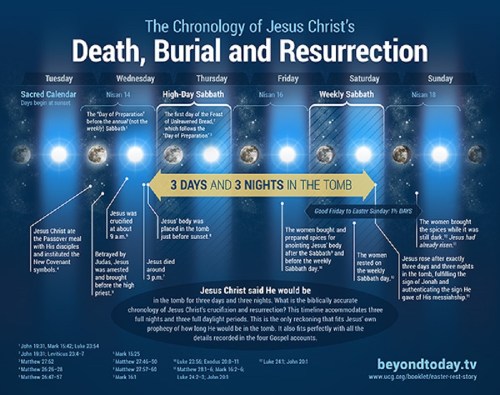
The Bible is not in error because the Bible never specifies the day of the week on which Jesus was crucified. We know that Jesus was crucified on Passover. We know that the following day was “the Day of Preparation” ( Matthew 27:62; Mark 15:42; Luke 23:54; John 19: 42) otherwise known as the Feast of Unleavened Bread – a Sabbath. We also know that Jesus rose on the first day of the week (Matthew 28:1; Mark 16:2; Luke 24:1; John 20:1), and we know He was in the tomb three days. So, counting back three full days from Sunday takes us back to Thursday or Wednesday, but not Friday. So, the Bible is true and the traditions of men are false.

2 Comments

Filed under Apologetics, Christianity, Easter, Evangelism, Gospel, Religion, Resurrection, Salvation, Theology

Knowing the Will of God

Image Credit: Lightstock.com

Image Credit: Lightstock.com

For whosoever shall do the will of God, the same is my brother, and my sister, and mother. (Mark 3:35)

What is God’s will for me? That is a questions many Christians ask. Volumes of books have been written on the topic and yet the question persists. If I had the time or the inclination, I might set out on a project to answer that question from yet another perspective. But the question is not that difficult to resolve. Do you want to know the will of God for your life? Great! Read, better yet, study the Bible. “All scripture is given by inspiration of God, and is profitable for doctrine, for reproof, for correction, for instruction in righteousness: That the man of God may be perfect, throughly furnished unto all good works. (2 Timothy 3:16-17, emphasis added)

God has made His will clearly known from the beginning. To begin with, God gave dominion over all of His creation to man and wanted man to fill the earth (Genesis 1:26-28). For us, that means that God wants man to exercise stewardship of all that He has placed at our disposal, from the individual managing his “personal” possessions to the stewardship of the planet and all its resources by the whole of mankind. It also gives us an inkling of the value God places on human beings.

In Genesis 2, God again makes His will known: “But of the tree of the knowledge of good and evil, thou shalt not eat of it: for in the day that thou eatest thereof thou shalt surely die” (v. 17). This was only one prohibition, but the message was (and is) clear: God expects obedience. Later, God codified His law through the Ten Commandments (Exodus 20:3-17) and the rest of what is known as the Mosaic Law. The first three of the Ten Commandments are of utmost priority: (1) You shall have no other gods before Me. The English word “before” is actually two Hebrew words, ‛al and pânı̂ym meaning “against my face.” In other words, God does not want you putting anything in your life that obstructs your vision of Him. (2) You shall not make for yourself or worship any idols. The list is long, but basically, anything you value more highly than God. (3) You shall not use God’s name carelessly. That includes, but is not limited to, using Gods name as an expletive, using it as a curse, or using in an oath, especially to legitimize a lie. Jesus summed all of the Old Testament Law down to two: (1) Love the LORD your God with all your heart, soul, and mind, and (2) love your neighbor as yourself (Matthew 22:36-40). So, there you have it, God’s will for your life, but there is more.

God’s will is that you deal with integrity in all that you do including in your work. “Servants, be obedient to them that are your masters according to the flesh, with fear and trembling, in singleness of your heart, as unto Christ; Not with eyeservice, as menpleasers; but as the servants of Christ, doing the will of God from the heart” (Ephesians 6:5-6, emphasis added). God’s will for your life is sanctification, i.e., “set apartness” – set apart and distinct from the world. “For this is the will of God, even your sanctification, that ye should abstain from fornication: That every one of you should know how to possess his vessel [i.e., your body] in sanctification and honour; Not in the lust of concupiscence, even as the Gentiles which know not God: That no man go beyond and defraud his brother in any matter: because that the Lord is the avenger of all such, as we also have forewarned you and testified” (1 Thessalonians 4:3-6, emphasis added). This passage specifies sexual purity, but it also addresses defrauding or dealing dishonestly with someone.

God’s will is that you be thankful in all things (1 Thessalonians 5:18). God’s will is that you not lose heart as you await His return (Galatians 6:9; 2 Thessalonians 3:13; Hebrews 10:35-37). God makes no promise that our lives will be free of trouble simply because we follow His will. “Wherefore let them that suffer according to the will of God commit the keeping of their souls to him in well doing, as unto a faithful Creator” (1 Peter 4:19, emphasis added). His will is that we trust our souls – our lives – to Him who is our faithful Creator.

God’s will is for all to be saved. “The Lord is not slack concerning his promise, as some men count slackness; but is longsuffering to us-ward, not willing that any should perish, but that all should come to repentance” (2 Peter 3:9, emphasis added). Of course, not all will be saved. Jesus said, “Not every one that saith unto me, Lord, Lord, shall enter into the kingdom of heaven; but he that doeth the will of my Father which is in heaven” (Matthew 7:21, emphasis added.). That will is that you repent from your sin and accept Jesus as Lord and Savior. At the end of his gospel, John wrote: “But these are written, that ye might believe that Jesus is the Christ, the Son of God; and that believing ye might have life through his name” (John 20:31, emphasis added). That is the will of God.

Oh! Wait! What about my career? What about my mate? What about the school I should attend? What about God’s will in what church I should attend? Well, God does have a will for every one of those things in your life, but you will not find them hidden in some secret code in the Bible, and He probably will not tap you on the shoulder and tell you what choice to make. The answer is in following His will as He has made it known in His Word. When you practice obedience to God’s Word, your “super” natural inclination will be to please and honor God in all that you do. When you are doing that as your standard method of operation, you will find that He will “guide” you in the right direction. Jesus said, “Ye have not chosen me, but I have chosen you, and ordained you, that ye should go and bring forth fruit, and that your fruit should remain: that whatsoever ye shall ask of the Father in my name [according to God’s will], he may give it you” (John 15:16, emphasis added.). If you are following God’s will as revealed in Scripture, you will not be making foolish requests, and He will guide you. Just try it and see. “Without faith, it is impossible to please Him” (Hebrews 11:6)

Comments Off on Knowing the Will of God

Filed under Apologetics, Christianity, Evangelism, Gospel, Prayer, Religion, Salvation, Theology

Don’t Pray For This People!

Therefore pray not thou for this people, neither lift up cry nor prayer for them, neither make intercession to me: for I will not hear thee. (Jeremiah 7:16)

The 238th anniversary of the birth of our nation quickly approaches, and I find my enthusiasm waning as the day draws near. Actually, it has been waning for quite some time now. Please do not misunderstand. I am about as patriotic as the next fellow, perhaps even more than most. Since the Obama Administration ascended to power, I have watched in amazement as the foundations of our nation crumble before our eyes and the Constitution systematically gets dismantled. Obama is not totally to blame. The foundations have been cracking for a long time now – removal of God’s Word and prayer from public schools, the wholesale ejection of God from the public square, the establishment of the Welfare State, the legalization of infanticide (abortion on demand legitimized by the pseudonym of Planned Parenthood and Pro-Choice), the dissolution of the traditional nuclear family (husband, wife, offspring), and the acceptance of homosexual unions as equal to heterosexual marriages. But the downward pull of the vortex has increased with the rise of the current administration.

I find little for which to celebrate. Some would be quick to remind me that we are to pray “For kings, and for all that are in authority; that we may lead a quiet and peaceable life in all godliness and honesty” (1 Timothy 2:2). That is true, and I believe we should, but even God has a limit as indicated by our starting verse. At that time, the people of Judah had fallen into idolatry. Whatever worship they did offer to God was substandard and merely rote ritualism. God was sick of it, and He told Jeremiah, “pray not thou for this people, neither lift up cry nor prayer for them, neither make intercession to me: for I will not hear thee” (Jeremiah 7:16). There comes a time when a people, as a nation, has so hardened their hearts against God that He will not even entertain an intercessory prayer for them. In fact to do so is to pray against God’s will. I think we have reached that point.

How can I be so sure about that? Romans 1:18-32 describes the downward spiral:

  1. They hold God’s truth in unrighteousness (v. 18)
  2. They reject the “clearly seen” natural revelation of God (vv. 19-20)
  3. They knew God but did not glorify Him as God (v. 21)
  4. Consequently their heart is darkened (v. 21)
  5. They profess themselves to be wise and become fools (v. 22, Psalm 14:1)
  6. They create gods of their own imagination (v. 23)
  7. God gives them over to physical perversions (v. 24)
  8. They turn God’s truth into a lie (v.25)
  9. They value the creation more than the Creator (v. 25)
  10. Consequently, God gives them over to sexual perversions – women with women and men with men (v. 26-27)
  11. As an additional consequence, God gives them over to “reprobate mind,” i.e. a mind that cannot think rationally (v. 28)
  12. They decline into a long list of increasing perversions (vv. 29-31)
  13. Finally they take joy in their perversion and encourage others accept their ways (v. 32)

Is that not the state of our nation? Think about our President praising a professional basketball player for “coming out” and expressing his homosexuality. Think about how he has stifled DOMA (the Defense of Marriage Act) and has removed all restrictions from homosexuals serving in the military. Think about the culture of lies he has engendered in his administration: the IRS scandal, the VA scandal, the Benghazi scandal, Fast and Furious, and on and on. Then we have the mainstream media that offers its support with silence and the entertainment industry that sings his praises as though there is something praiseworthy.

This Sunday morning, Todd Starnes, author of God Less America, spoke at our church. He points out many of the same things I have listed here, but he is far more optimistic than I. I do not believe there is any turning back for this nation. Someone will remind me that God said, “If my people, which are called by my name, shall humble themselves, and pray, and seek my face, and turn from their wicked ways; then will I hear from heaven, and will forgive their sin, and will heal their land” (2 Chronicles 7:14). Allow me to point out that the oft quoted verse is taken out of context. It is specific to the Jewish Temple, Jerusalem, and Israel, and it does not have a general application for the Church. The Church is NOT Israel even though some who preach “replacement theology” insist that it is. Let me also point out that God’s people, the Church, possess a heavenly citizenship, not an earthly one (Philippians 3:20 NASB). Our concern should not be for an earthly nation, but for a heavenly one. More often we are exhorted to be law-abiding citizens except for where a human law violates the Law of God (Acts 5:29). There is only one exhortation for us to pray for our leaders (cited above). Beyond that, may God’s “will be done in earth as it is in heaven” (Matthew 6:10). Our nation has been judged. Should we pray for its healing against God’s will? Although it grieves me to say it, I think not.

What then are we to do? We should remain true to the faith. We must be bold in our witness. And we should never put more faith in our government than we do in God. Our citizenship, our loyalty, and our devotion must be to Christ above all else. Jesus Christ is Lord and our King!

For what it’s worth, Happy Independence Day!

2 Comments

Filed under Apologetics, Christianity, Current Events, End Times, Holidays, Politics, Prayer, Religion, Theology

Father

Father

Therefore shall a man leave his father and his mother, and shall cleave unto his wife: and they shall be one flesh.(Genesis 2:24)

From the very beginning, when God created the first couple, the design purposed the propagation of the human race. “And God blessed them, and God said unto them, Be fruitful, and multiply, and replenish the earth, and subdue it” (Genesis 1:28, emphasis added). Note that God did not create Adam and Steve or Bev and Eve. Such a combination would not have yielded the desired effect that God purposed. The family unit and the survival of mankind demanded both a father and a mother.

God, in a very real sense, is the First Father and the Father of the human race – our Father. His love for His children – His creation – is first illustrated in the life of Abraham as he offers his only son in sacrifice to God (Genesis 22:1-18). Abraham was the father of Isaac, Isaac the father of Jacob (Israel), Jacob the father of Judah, Judah the progenitor (father) of David, and David was the progenitor of the Lord Jesus Christ who would be the realization of the sacrifice portrayed by Abraham. The father is an important figure throughout Scripture and throughout history. In fact, God’s first “horizontal” commandment says, “Honour thy father and thy mother: that thy days may be long upon the land which the LORD thy God giveth thee” (Exodus 20:12). Paul repeats this commandment in Ephesians 6:1-3.

Earthly parents are far from perfect, yet we have this assurance of our Heavenly Father, “When my father and my mother forsake me, then the LORD will take me up” (Psalm 27:10). “Like as a father pitieth his children, so the LORD pitieth them that fear him” (Psalm 103:13). Yet even in their imperfection, we are exhorted to listen to the counsel of our fathers: “Hear, ye children, the instruction of a father, and attend to know understanding” (Proverbs 4:1). My father was not perfect, yet “I was my father’s son, tender and only beloved in the sight of my mother” (Proverbs 4:3). My Heavenly Father, encourages, “My son, keep thy father’s commandment, and forsake not the law of thy mother” (Proverbs 6:20). For “what man is there of you, whom if his son ask bread, will he give him a stone? Or if he ask a fish, will he give him a serpent?” (Matthew 7:9-10). Human fathers may not always get it right, but any father who loves his child always has the best in mind for his children.

However, “There is a generation that curseth their father, and doth not bless their mother” (Proverbs 30:11). Indeed, Jesus said, “Think not that I am come to send peace on earth: I came not to send peace, but a sword. For I am come to set a man at variance against his father, and the daughter against her mother, and the daughter in law against her mother in law. And a man’s foes shall be they of his own household” (Matthew 10:34-36, emphasis added). We may be experiencing that very thing now. “This know also, that in the last days perilous times shall come. For men shall be lovers of their own selves, covetous, boasters, proud, blasphemers, disobedient to parents, unthankful, unholy, Without natural affection, trucebreakers, false accusers, incontinent, fierce, despisers of those that are good, Traitors, heady, highminded, lovers of pleasures more than lovers of God” (2 Timothy 3:1-3, emphasis added). This may be demonstrated in open rebellion or in passive aggressive behavior. Either way, the son has departed from the teachings of his father. To a father who loves his son, nothing can cause more heartache than a son who rejects his father’s teaching.

I am eternally grateful for my imperfect father, who despite his imperfections demonstrated (and still demonstrates) unwavering love for me. I learned much from my father – how to drive a car at the age of ten, how to throw a curve ball, how to work hard, how to respect authority, how to love. But the most important thing my father taught me was to love and trust God and to unquestionably trust in God’s Word. Those lessons have never failed me, and they are the lessons I would impart to my sons, who now have children of their own.

My pastor recently, in a Mother’s Day sermon, offered the following illustration. A prison warden thought it would be good to offer all inmates that wanted a Mother’s Day card with free postage to be sent to the prisoner’s mother. Without exception, every single inmate took him up on the offer. The warden was so impressed with the success of the exercise that he thought he would do the same for Father’s Day. To his surprise, not a single inmate took him up on the offer. Fathers are important, but even when our earthly fathers fail us, our Heavenly Father never, never fails us. He is “A father of the fatherless,” (Psalm 68:5).

1 Comment

Filed under Christianity, Creation, Current Events, Origins, Religion, Theology

Is the Law Sin?

The Law

What shall we say then? Is the law sin? (Romans 7:7)

In recent years I have heard Christians reject the Old Testament as if it no longer applies. One young man tattooed the inside of his left arm with: ουδεν αρα νυν κατακριμα τοις εν χριστω ιησου. In case you do not read Koine Greek, it says, “Therefore there is now no condemnation for those who are in Christ Jesus.” (Romans 8:1, NASB). This reading is translated from the liberal Westcott-Hort Greek New Testament. That text omits the phrase: μη κατα σαρκα περιπατουσιν αλλα κατα πνευμα – “who walk not after the flesh, but after the Spirit” (Romans 8:1, KJV). This additional phrase is included in the Textus Receptus Greek New Testament from which the KJV is translated. (Bear with me; there is a point to this.) When I pointed out the biblical prohibition against tattoos (Leviticus 19:28) to this young man, a seminary student at the time, he lashed out at me pointing out that we are not under Law, but under Grace. Then when I pointed out the missing phrase in his tattoo, he lashed out against the King James Bible. Hmm! The missing phrase “who walk not after the flesh, but after the Spirit” suddenly takes on greater significance. Perhaps the compilers of the Westcott-Hort Greek New Testament did not like that phrase either.

So Paul asks an important question: “Is the Law Sin?” Judging from this seminary student’s reaction the answer must be, “Yes!” But what does Paul say? “God forbid. Nay, I had not known sin, but by the law: for I had not known lust, except the law had said, Thou shalt not covet” (Romans 7:7, emphasis added). So, where do we get the idea that we are to disregard the Law contained in the Old Testament? Jesus quoted from the Old Testament exclusively. Of course, that was all that existed at the time, but He never gave any indication that it no longer applied. In like manner, all the New Testament writers referred constantly to the Old Testament and never hinted that it was passé. In writing to Timothy, Paul affirms that “All scripture is given by inspiration of God, and is profitable for doctrine, for reproof, for correction, for instruction in righteousness” (2 Timothy 3:16, emphasis added). When he penned these words, there was no New Testament, only the Old. Instead of rejecting the Law, Paul says that “the law is holy, and the commandment holy, and just, and good” (Romans 7:12).

Salvation does not come through the keeping of the Law. That is impossible. “For whosoever shall keep the whole law, and yet offend in one point, he is guilty of all” (James 2:10). We know that “by grace are ye saved through faith; and that not of yourselves: it is the gift of God: Not of works [of the law], lest any man should boast” (Ephesian 2:8-9, emphasis added). So, does the Law serve any purpose? Paul seems to think so. “Was then that which is good made death unto me? God forbid. But sin, that it might appear sin, working death in me by that which is good; that sin by the commandment might become exceeding sinful” (Romans 7:13, emphasis added). The purpose of the law is to shine a spotlight on what is sin.

The Christian is saved by Grace, not by attempting to keep the Law (which is impossible to do), but the Law should be to the Christian a guide as to what God regards as sinful. God wants His children to be holy – set apart from the world, and the Law guides us to what pleases God. Can we keep the law flawlessly? Probably not, but we have the assurance that “If we confess our sins, he is faithful and just to forgive us our sins, and to cleanse us from all unrighteousness” (1 John 1:9). But how can we confess, if we do not know that we sinned? The Law helps us see that.

That young seminary student thought his tattoo would be a great witnessing tool. I venture to say (although I do not know for sure) that his tattoo has not helped him lead a single person to Christ. Perhaps, if he had taken to heart the omitted qualifying phrase in Romans 8:1 – “who walk not after the flesh, but after the Spirit” – he would not have violated the commandment against tattoos. I do not question the young man’s salvation, and I fully understand his motive however misguided; but when Paul said, “I am made all things to all men, that I might by all means save some” (1 Corinthians 9:22), I doubt that he meant for us to go out and get tattoos in order to win over tattooed people.

Is the Law sin? No, but it serves to show us what sin is and what we should avoid. God does not change (Malachi 3:6), and He has always expected holiness from His people. “But as he which hath called you is holy, so be ye holy in all manner of conversation; Because it is written, Be ye holy; for I am holy” (1 Peter 1:15-16). The Law is not sin; it reveals sin. The Law should be heeded, not disregarded.

3 Comments

Filed under Apologetics, Christianity, Evangelism, Gospel, Religion, Salvation, Theology