Tag Archives: Book of Genesis

Near Death

DIGITAL CAMERA

“Beloved, now are we the sons of God, and it doth not yet appear what we shall be: but we know that, when he shall appear, we shall be like him; for we shall see him as he is.” (1 John 3:2)

There seems to be an increased interest in the paranormal these days: crop circles, UFOs, alien abductions, zombies, vampires, etc. Included in these are the reports of “near-death” experiences. This seems particularly to have piqued an interest among Christians due to the Christian predisposition to think about the afterlife, particularly heaven. A new “Christian” movie that has added fuel to this fire takes its title from a book by the same name: Heaven Is For Real by Todd Burpo. This is supposedly a factual account of a little boy who dies in a hospital operating room and goes to heaven and returns to report all kinds of amazing things about his experience there.

A Christian lady concerned about what to make of this phenomenon told me about a nurse friend who told her about near death experiences she has witnessed. “I feel very uncomfortable about this,” she said to me. “It does not seem Scriptural…doesn’t seem to match with what Jesus has taught about death. And so, I’m wondering if these sorts of things are considered ‘false prophets doing great wonders to seduce even the elect.’”

She continued, “Surely it is tempting to hear ‘proof’ that such beauty exists…even to believe that, yes, heaven exists, and Jesus is waiting with outstretched arms when we die. Surely some people might become believers upon hearing such tales…at least, folks that would believe ‘we go to a place of great beauty, bright light, where Jesus is’ when we die. It’s such a comforting picture. But is it Scriptural? Are we to believe in these things?”

I assured her that I share her skepticism about these near death experience reports. Obviously, we cannot judge what another person experiences because only they are privy to that information. The same goes for judging another person’s salvation – only God (and the individual) truly knows the condition of the heart. So, when someone reports a near death experience, we have to take them at their word, because only they and God know what they experienced.

But going back to our example of salvation, we can pretty well guess the state of a person’s salvation because of the kinds of “fruit” they bear. Granted, a person may be putting on a good front leading us to think they are saved – in fact, they may even be fooling themselves – but they are not truly saved. Or the opposite may be true. The person may truly be saved, but are presently living in a temporary “back-slidden” state. Again, only God knows for sure, but we can certainly judge their “acts” and know if those acts, or fruits, are genuine – at least outwardly.

Coming back around to our near death question, except for a very small number of cases, most of these experiences report the very same thing regardless of the spiritual condition of the individual. There have been a few reports of individuals experiencing hell, and they are very thankful that they were “brought back,” but this is the exception rather than the norm.

I viewed a video on the topic recently[1]. For some time now neurologists have been studying near death experiences and to date they have no explanation for this phenomenon. It seems that the only thing they have been able to confirm is that when a patient is clinically dead, all brain activity ceases. They have been unable to determine at what point the patient has the “out-of-body” experience. Is it just before they die or is it when they are revived? They do not know. Yet the patients all seem to report similar experiences: a feeling of warmth, peace, acceptance and unconditional love. So, if all of these “good” experiences are true, regardless of the spiritual state of the individual, that might lead one to conclude that everyone goes to heaven – except for really, really bad people. The question then is how does that line up with what the Bible says?

There are several accounts of resuscitations[2] in the Bible where people died and were brought back to life: the raising of the widow’s son (1 Kings 17:22); the raising of the Shunammite woman’s son (2 Kings 4:33-36); the man raised at Elisha’s tomb (2 Kings 13:21); the raising of Jairus’ daughter (Matthew 9:25); saints raised at the death of Christ (Matthew 27:52); raising of the widow’s son (Luke 7:15); the raising of Lazarus (John 11:43-44); raising of Tabitha by Peter (Acts 9:40-41); and the raising of Eutychus by Paul (Acts 20:9-12). With all of these examples, there exists no record about what the individuals experienced during their time of death. In every instance, the Bible is silent.

There is one instance where one died and then returned to tell about it. That was Paul in Acts 14:19-20. He later relates his experience in 2 Corinthians 12:2-7:

I knew a man in Christ above fourteen years ago, … such an one caught up to the third heaven. And I knew such a man … How that he was caught up into paradise, and heard unspeakable words, which it is not lawful for a man to utter. (vv. 2-4)

So, Paul experienced something, but he was not allowed to speak about it. This evidence from Scripture calls into question all the reports we are hearing today. Is it possible that there is a hidden agenda there? – one that says, “What you believe makes no difference. If you are a reasonably good person, you will go to heaven.” That is the devil’s oldest lie: “Yea, hath God said …? … Ye shall not surely die” (Genesis 1:3, 4).

Jesus spoke more about hell than He spoke of heaven. In Luke 16:19-31, He relays the account of a rich man who died and woke up in Hades and likewise, poor, sickly Lazarus died “and was carried by the angels into Abraham’s bosom” (v. 22). Here we are given a peek into the afterlife from which no one returns (generally speaking). Two very different places are depicted and two very different experiences are presented. Jesus related this “story” as an actual account. Considering His divine nature, He had firsthand knowledge of this event, which clearly shows us that not everyone goes to the same place or experiences the same thing. Something else worth noting in this account is that nowhere does Jesus describe the rich man as being a particularly (what we would consider) a “bad” person. From Jesus’ account, we gather that the rich man was self-absorbed, narcissistic, self-centered, selfish, and unconcerned with the plight of the poor beggar that sat at his gate, but it’s not as if he were a mass murderer, or anything like that. He may have been a good father, husband and provider. He was evidently concerned about his loved ones (vv. 27-28). Had we known him, we probably would not have considered him to be a bad person. Those who mourned him at his funeral probably thought he ascended to “Abraham’s bosom,” but that certainly was not the case.

So, the bottom line is that we cannot know with certainty what these people have experienced, but we are right to employ a healthy dose of skepticism. There is no biblical basis for these reports, and science offers no satisfactory explanations. The fact that most experiences reported are positive contradicts Jesus’ very words that “strait is the gate, and narrow is the way, which leadeth unto life, and few there be that find it” (Matthew 7:14). The truth is that most people will NOT have a good experience. If these experiences are genuine, we should expect more bad experiences than good, but that is not what is being reported.

Of greater importance to anyone reading these words is the assurance and security of a place prepared for you by the Savior. He says:

Let not your heart be troubled: ye believe in God, believe also in me. In my Father’s house are many mansions: if it were not so, I would have told you. I go to prepare a place for you. And if I go and prepare a place for you, I will come again, and receive you unto myself; that where I am, there ye may be also. (John 14:1-3)

God promises: “And ye shall seek me, and find me, when ye shall search for me with all your heart” (Jeremiah 29:13). Jesus adds to that: “I am the way, the truth, and the life: no man cometh unto the Father, but by me” (John 14:6). “Seek ye the LORD while he may be found, call ye upon him while he is near” (Isaiah 55:6).

NOTES:


[1] Documentary: “The Day I Died” http://topdocumentaryfilms.com/day-i-died/

[2] Note that resuscitation is not the same as resurrection. In the former case, the individual eventually dies again. In the latter case, the individual remains alive for ever. Jesus is the “first fruits” of the resurrection (1 Corinthians 15:20, 23). Because He lives, we can be assured of eternal life.


1 Comment

Filed under Apologetics, Christianity, Current Events, Death, End Times, Evangelism, Gospel, Heaven, Hell, Religion, Salvation, Science, Uncategorized

Time for Pride to Grow

“. . . when the morning stars sang together, and all the sons of God shouted for joy?” (Job 38:7)

A common question that arises from time to time is, “When did God make the angels?” A corollary question to that is “Was there enough time for pride to grow in Satan and for the war in Heaven to occur within the first few days?”

In the Job passage quoted above, God is telling Job that the angels were there at the time when He formed the earth. As to whether there was sufficient time for Satan’s pride to grow, we must ask, “How much time does it take for pride to grow?” In our own experience, does it take a long time to develop pride, or does it just seem to flare up unexpectedly? I would say the latter. Pride is one of the most basic sins. Human beings are naturally selfish and self-centered. Recall that very shortly after Creation, Satan was able to tempt Eve with “the pride of life” (1 John 2:16): “ye shall be as gods, knowing good and evil” (Genesis 3:5). It does not take a great amount of time for pride to grow.

The angels probably were created on the first day of the creation week. We cannot be dogmatic about this. The Bible does not specify when the angels were created, but the above passage in Job indicates that they were at least around to see the creation taking place. The angels, therefore, were created before man. Perhaps the reason for not focusing more attention on angels is that the Bible focuses mainly on the relationship between God and man. Angels play a part, but they are not central to God’s redemptive plan. But what does God say about man? “Let us make man in our image, after our likeness: and let them have dominion over the fish of the sea, and over the fowl of the air, and over the cattle, and over all the earth, and over every creeping thing that creepeth upon the earth” (Genesis 1:26, emphasis added). Did God say that about the angels? Did God give dominion over His creation to the angels? Can you see anything there that would give rise to pride and jealousy?

It would not have taken a long time for Satan’s pride to grow. Having been created first and then given lower status than man, Satan said, “I will ascend into heaven, I will exalt my throne above the stars of God: I will sit also upon the mount of the congregation, in the sides of the north: I will ascend above the heights of the clouds; I will be like the most High” (Isaiah 14:13-14, emphasis added). Satan hates man because God has bestowed upon man greater status than the angels. “What is man, that thou art mindful of him? and the son of man, that thou visitest him? For thou hast made him a little lower than the angels, and hast crowned him with glory and honour. Thou madest him to have dominion over the works of thy hands; thou hast put all things under his feet” (Psalm 8:4-6, emphasis added). The English phrase “a little lower than the angels” is not an accurate translation. “Angels” is the Hebrew ‘ĕlôhîym referring to God rather than the normal word for angels mal’âkîm. This is a messianic passage describing the condescension of Christ in taking human form, but this also has a secondary meaning as applied to man. Having been created in the image of his Maker, man holds a higher status than the angels, and this infuriates Satan.

This being the case, Satan most likely rebelled on Day Six of creation or very shortly thereafter. Seeing that man was God’s prized creation, Satan turned his ire toward destroying man. Knowing that man was created in the image of God, he employed that fact to cause man’s demise: “ye shall be as gods” (Genesis 3:5). If one analyses the source of any sin, it all goes back to pride – man wants to be his own god. This has been true from the beginning when Satan witnessed the creation of man, and since the fall of man in the Garden (Genesis 3). It really takes no time for pride to develop. It is nothing that requires any nurturing. On the contrary, it is something must actively be suppressed, and this cannot be done through human strength. It requires the supernatural power that only comes from God through the Holy Spirit. Jesus promised, “ye shall receive power, after that the Holy Ghost is come upon you” (Acts 1:8), and it is in that power alone that pride can be conquered.

1 Comment

Filed under Apologetics, Christianity, Creation, Evolution, Gospel, Origins, Theology

Only One Way In

Noah's Ark: Entry Door Looking Out (Image Credit: http://asknoah.org/art_gallery2)

Noah’s Ark: Entry Door Looking Out (Image Credit: http://asknoah.org/art_gallery2)

… and the door of the ark shalt thou set in the side thereof … (Genesis 6:16)

Doors are useful things. Doors work two ways: they allow us entry into a variety of enclosures, and they permit us to exit the same. Doors keep us safe inside while keeping unwanted intruders out. Most homes have more than one door for entry and exit. Most vehicles have at least two doors; some have four or five. Airplanes have only one door for boarding, but there are at least four doors for emergency exit. Multiple doors to any enclosure make for ease of movement. You may come in through the front door, and then go out the back door to enjoy your backyard. You would not normally come in the front door, exit again through the front door, and walk all the way around the house to get to your backyard. The more doors you have, the easier it is to go from one place to another. Doors are very useful things!

About 1500 years after God completed His creation (man in particular), the world and mankind had degenerated to the point that it was no longer the “very good” creation that God had initiated. Man had become wicked and “every imagination of the thoughts of his heart was only evil continually” (Genesis 6:5). Things had gotten so wicked that “it grieved [God] at his heart” (Genesis 6:6). This is not difficult to understand especially for us earthly parents who have invested so much of our lives in teaching a child the ways of God. Then when they leave our homes, they turn their backs on everything we stand for, and everything we tried to instill in them. Any parent who has experienced this knows the heartache. Multiply that by billions and that might begin to give a sense for how God felt to see His “very good” creation turned putrid. “And the LORD said, I will destroy man whom I have created from the face of the earth; both man, and beast, and the creeping thing, and the fowls of the air; for it repenteth me that I have made them” (Genesis 6:7).

“But Noah found grace in the eyes of the LORD” (Genesis 6:8). God instructed Noah to build an Ark (Genesis 6:14). The Hebrew word translated “Ark” is têbâh and it literally means a “box.” God gave Noah the specific dimensions for this box (Genesis 6:15), and instructed him to build it with three decks (stories) (Genesis 6:16). He was to make a door – only one door – in the side of the ark – only one way in, and only one way out.

Noah was given 120 years to complete his project (Genesis 6:3). During that time as Noah was working on the Ark, he felt compelled to warn all who would listen about the coming cataclysmic judgment. Peter referred to Noah as “a preacher of righteousness” (2 Peter 2:5). We are not told in Scripture, but surely Noah must have been ridiculed and mocked. “Have you seen what that old fool is building!” many must have scoffed. But Noah was not to be dissuaded from his God-given task. “Thus did Noah; according to all that God commanded him, so did he” (Genesis 6:22).  When the project was complete God called all the animals into the Ark (Genesis 6:20). Noah, his wife, his three sons and their wives went into the Ark (Genesis 7:13), “and the LORD shut him in” (Genesis 7:16). The only way in was now inaccessible. Those remaining outside could no longer enter. For 120 years they were given the opportunity for safe passage, but now it was too late. The only way in was now shut tight, and those inside were saved and safe from the disaster facing those outside. Then the waters came – not only rain, but the very fountains of the deep were broken open (Genesis 7:11). “And all flesh died that moved upon the earth, both of fowl, and of cattle, and of beast, and of every creeping thing that creepeth upon the earth, and every man: All in whose nostrils was the breath of life, of all that was in the dry land, died” (Genesis 7:21-22, emphasis added).

Jesus said, “I am the door: by me if any man enter in, he shall be saved, and shall go in and out, and find pasture” (John 10:9, emphasis added). Later He said, “I am the way, the truth, and the life: no man cometh unto the Father, but by me” (John 14:6, emphasis added).

It is a very popular notion these days to believe that there are many ways into heaven. Even the Roman Catholic Church, who has for centuries staunchly held to the dogma that the only access to heaven is through the sacraments of the Church, has given way to universalism, i.e. that everyone – Muslims, Hindus, Buddhists, yes and even Baptists – will all get to heaven. That is why they say we should strive to all get along together here on earth. This is the idea of many doors into the same place – very convenient! But that has never been the teaching of the Bible.

The Ark had only one way in, but access was available to anyone who would heed the warning. Those that rejected the message were destroyed. As at the time of the flood, where billions died and only eight were saved, we are facing a similar time of trouble. Jesus warned, “Enter ye in at the strait [narrow] gate: for wide is the gate, and broad is the way, that leadeth to destruction, and many there be which go in thereat: Because strait is the gate, and narrow [crowded or afflicted] is the way, which leadeth unto life, and few there be that find it” (Matthew 7:13-14, emphasis added). Today, Jesus would be labeled as intolerant for His teaching. There is no other way. Everyone will NOT go to heaven, but everyone has an equal chance. There is only one way in, and that way is through Jesus Christ. “But as many as received him [Jesus], to them gave he power to become the sons of God, even to them that believe on his name” (John 1:12). The Door will soon be shut forever. Have you found the only One Way in?

Comments Off on Only One Way In

Filed under Apologetics, Christianity, Creation, Current Events, End Times, Evangelism, Gospel, Religion, Salvation, Theology

Not Guilty As Charged

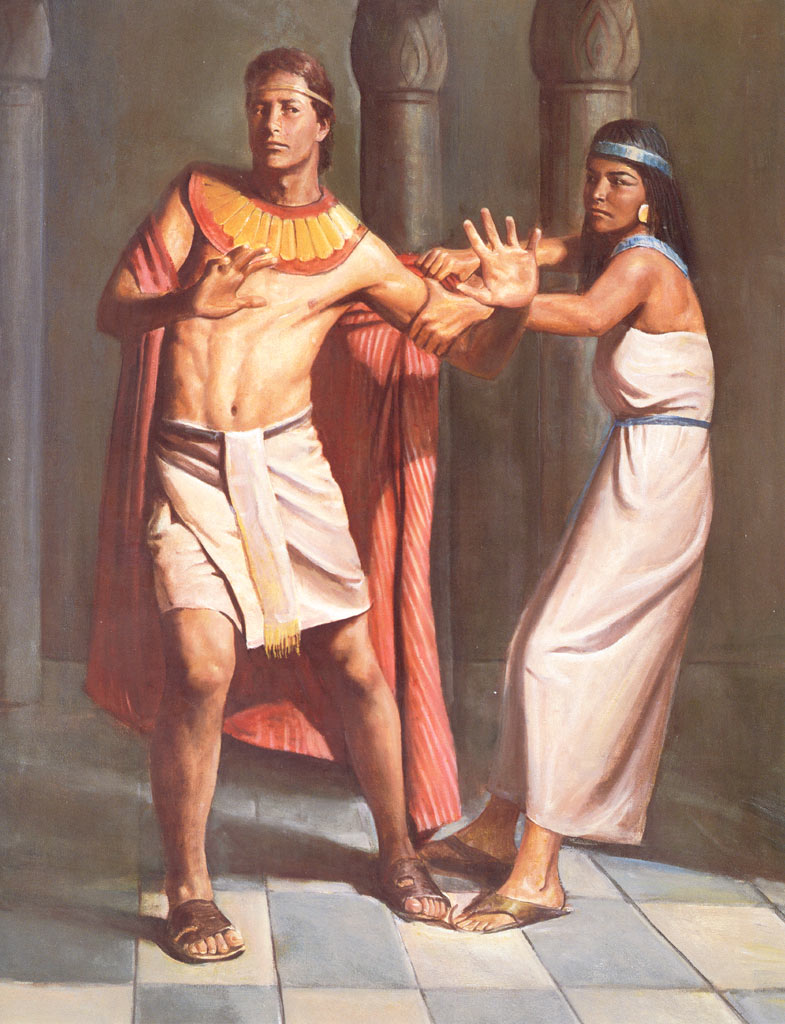
joseph_resist

And Joseph’s master took him, and put him into the prison, a place where the king’s prisoners were bound: and he was there in the prison.  (Genesis 39:20)

Trouble seemed to follow Joseph.  Granted, some of it he brought upon himself, for instance: “And Joseph dreamed a dream, and he told it his brethren: and they hated him yet the more” (Genesis 37:5).  The dream prophesied that Joseph would rule over them and they would bow down to him (Genesis 37:6-7), “And they hated him yet the more for his dreams, and for his words” (Genesis 37:8b).  This was probably not the best way to win friends and influence people!

But not all of Joseph’s problems were self-inflicted.  “Now Israel loved Joseph more than all his children, because he was the son of his old age: and he made him a coat of many colours.  And when his brethren saw that their father loved him more than all his brethren, they hated him, and could not speak peaceably unto him” (Genesis 37:3-4).  Eventually, Jacob’s sons conspired to kill Joseph (Genesis 37:18-20), but Ruben intervened to save him (vv.21-22).  The brothers, then, resorted to plan B, and sold him to a band of Ishmaelites on their way to Egypt.  Joseph was then sold to Potiphar, Pharaoh’s captain of the guard.

Joseph’s managerial capabilities were soon noticed by Potiphar who made him chief steward of his household (Genesis 39:3-4).  The problem was that Potiphar’s wife also took notice of Joseph, but she was not interested in his management skills (v. 7).  Joseph’s integrity was greater than she could overcome, so she trumped up false charges of attempted rape against him (vv. 10-18), and poor Joseph ended up in prison for doing what was right (v 20).  In spite of this setback, Joseph maintained his faith in God and his integrity, and quickly rose to the position of head trustee of the prison (vv. 21-23).

Of course, we know the rest of the story.  Joseph eventually rose to the rank of prime minister of Egypt and because of his position was able to save all of his family.  Joseph endured persecution from his own family and from strangers, and by his faithfulness proved the truth of the Bible:  “And we know that all things work together for good to them that love God, to them who are the called according to his purpose” (Romans 8:28).


2 Comments

Filed under Christianity, Gospel, Religion, Salvation