Tag Archives: Book of Genesis

The Bible Says

The Bible Says

But he answered and said, It is written, Man shall not live by bread alone, but by every word that proceedeth out of the mouth of God. (Matthew 4:4)

I am blessed to have been raised by Christian parents who, not only took me to church every Sunday, but they taught me from God’s Word at home. Dad was not well educated. He was raised on his father’s ranch in Chihuahua, Mexico and only went to school until the third grade where he learned to read, write and do basic arithmetic. That was sufficient at a time and place where hard work was valued above book learning – education extends beyond the confines of a classroom. After he came to the United States and met Mom, God called him into the pastoral ministry, and he spent the rest of his life pastoring small Hispanic congregations, mostly around West Texas. Before entering the ministry, he prepared for five years at the Instituto Biblico Mexicano in San Antonio, Texas that taxed his third-grade education to the limit, but he persevered and completed his training.

My parents, my father in particular, taught me at a very early age that the Bible is the very Word of God. Every word of it is true and trustworthy, even when it comes to things that are hard to believe like the Red Sea parting (Exodus 14:21-31), the walls of Jericho falling (Joshua 6:15-20), or an axe head floating (2 Kings 6:5-7). These things have no natural explanation other than the record in God’s Word. “God is not a man, that he should lie; neither the son of man, that he should repent: hath he said, and shall he not do it? or hath he spoken, and shall he not make it good?” (Numbers 23:19). Therefore, if God says something in His Word, it must be true regardless of our ability to explain it.

However, one does not have to cast off reason and believe the Bible simply because the Bible says so. The Bible contains more than sufficient, historical, scientific, practical, fulfilled prophetic evidence of its accuracy to lend credence to those areas demanding “faith.” Archeologists have time and again confirmed the Bible’s historical account. For example, the Bible was long criticized for recording the existence of the Hittite people until archeological evidence proved the Bible right. To date, archeological digs uncover evidences confirming the historical accuracy of biblical accounts.

Scientifically, although not a text book on science, the Bible accurately records scientific matters. For example, the Bible matter-of-factly records the existence of ocean currents (Psalm 8:8), earth suspended in space (Job 26:7),[1] a spherical earth and expanding universe (Isaiah 40:22), the water cycle (Psalm 135:7), and even Pi (π) rounded to the nearest whole number (1 Kings 7:23). As for practical matters, one need only read and apply the book of Proverbs or Jesus’ Sermon on the Mount (Matthew 5-7) to live a successful life. The Bible accurately records fulfilled prophecies. The prophecies concerning Israel’s captivity in Babylon were pronounced as far back Deuteronomy, prior to their entry into the Promised Land. This same prophecy was repeated by later prophets, and it came to pass. Their return to the land was predicted and it came to pass. The Diaspora was predicted and it came to pass, as was their return once again to the land of Israel which took place on May 14, 1948. All the prophecies of Jesus’ first coming, His death, His burial, and His resurrection were all fulfilled to the letter.

When the Bible is correct in all of these areas, then why should one doubt when miracles are presented? Miracles are acts whose only explanation is that of divine intervention even when those acts defy natural laws. The same God who “cannot lie” (Titus 1:2), and who will do as He says also says, “So shall my word be that goeth forth out of my mouth: it shall not return unto me void, but it shall accomplish that which I please, and it shall prosper in the thing whereto I sent it” (Isaiah 55:11). Jesus concurred with the prophet when He said, “For verily I say unto you, Till heaven and earth pass, one jot or one tittle shall in no wise pass from the law, till all be fulfilled” (Matthew 5:18).

There is a scene in The Lion, the Witch, and the Wardrobe, by C.S. Lewis after Lucy has visited Narnia for the first time and returns to report to her siblings. They would not believe her story. In her defense, Professor Kirke (the old man in whose home the children were staying for protection from German air raids over London in World War II), challenges Lucy’s siblings by asking them if she has ever been known to lie. Since Lucy was not prone to lying, Professor Kirke suggested that perhaps the children should take her at her word. The same can be said about the Bible. Since the Bible can be proven accurate historically, scientifically, practically and prophetically, then perhaps it should be taken for at face value when it speaks of miracles.

This brings me to what perhaps is the greatest miracle of all, next to the incarnation and resurrection of Jesus Christ, i.e. the creation of the universe and all that it contains. This account of creation is found in the first chapter of Genesis, and it is foundational to the rest of Scripture. It is this creation account that I found myself defending against evolution and the Big Bang theory after I left home as a young man. I could not explain a literal six 24-hour day creation other than to stand on “the Bible says.” My conversations usually ended up something like this: “I believe God could have used Big Bang and taken billions of years to create everything, if He chose to. I believe God could have used evolution to create life, if He chose to. But the Bible says that God created everything in only six days. I believe God is great enough to do whatever He chooses to do. He could have created everything in a split second, if wanted; but the Bible says He did it in six days, and that is what I believe.”

I know that answer rings hollow to a hardened evolutionist, but it was good enough for me. I will never take man’s word over God’s Word about anything. Yet, far too many “Christian” leaders waffle as to the veracity of this record. Many, certainly not all, highly trained theologians and pastors wear their Ph.D.s and Th.D.s as a mantle of pride that they dare not tarnish by defending the literal reading of Genesis 1 against “experts” in the sciences. They fear appearing “uneducated” for their inability to explain biblical creation to the satisfaction of the skeptics who relentlessly insist that “science has proven” evolution. So rather than defend the clear reading of Genesis 1, they come up with silly compromises, like the Gap Theory, the Day-Age Theory, or Theistic Evolution to appear “scholarly” in their defenses. In the end, they subjugate God’s Word to man’s word.

Some say such compromises make Scripture, especially where Creation is concerned, more believable/acceptable/palatable to people steeped in evolutionary indoctrination. After all, the teaching of evolution is ubiquitous in the world. Not only is evolution taught as fact (albeit unproven, but that’s a minor matter) in schools beginning at the lowest levels, but it is broadcast on television, the movies, and in print. Take notice when watching or listening to commercials at how many products “evolve.” Missing in these messages is the fact that this is “evolution” guided by “intelligence.” The message that comes across is that “everything evolves.” Learning channels like Discovery, Science, History, etc. often present evolution without question. Considering the constant brainwashing of our society to accept evolution as a “proven” fact, it is no wonder that religious leaders shrink back from defending biblical creation. Well, they ought to grow a backbone!

The Bible says, “In the beginning God created the heaven and the earth” (Genesis 1:1). There in one sentence is the universe: time, space, matter. The Bible says, God created everything there is in six 24-hour days. “For in six days the LORD made heaven and earth, the sea, and all that in them is, and rested the seventh day: wherefore the LORD blessed the sabbath day, and hallowed it” (Exodus 20:11, emphasis mine). He did it in six days rather than a split second in order to set the pattern of a seven-day week for us – work six days, rest one. Furthermore, the “days” in Genesis 1 are normal 24-hour days. The Hebrew word used is yom, and with very few exceptions (clarified by context), it means a normal 24-hour day. God then took extra care to define the “day” as “evening and morning” (Genesis 1:5, 8, 13, 19, 23, 31)[2] to forfend against any notion of undetermined time.

The Bible says that God created plants before animals and even before the sun (Genesis 1:9-13). The Bible says there is no to plant evolution. “And God said, Let the earth bring forth grass, the herb yielding seed, and the fruit tree yielding fruit after his kind, whose seed is in itself, upon the earth: and it was so” (Genesis 1:11, emphasis mine). “After his kind” means no evolution, and the regenerative process resides within the seed (the DNA) of each plant. Some critics point out that plants need the sun for photosynthesis. That is only partially true. Plants need “light.” Light was created on Day One (Genesis 1:3). Even if it can be argued that plants need “sunlight,” surely plants can survive 24 hours without sunlight, which was created the following day.

The Bible says God created the earth before all other celestial objects (Genesis 1:14-19). My scientist friends might challenge me on this point because it cannot be proven “scientifically,” but this tells me that the earth is at or near the center of the universe. This is not to say that I believe in a geocentric solar system where the earth is stationary and the sun, moon and planets revolve around the earth. (I have seen models that show how this is possible; however, I will stick with what my scientists friends say in this regard – all planets, including the earth orbit around the sun.) However, that does not preclude the earth being located somewhere near the center of the universe. It just makes sense because the Bible says so. Also, according to biblical chronology, the earth (and the universe) is only about 6000 years old. The critics challenging this point to light from galaxies billions of light years away. How is it that we can see that light now, if the earth is only 6000 years old? I cannot explain it, but my astrophysicist friend, Dr. Jason Lisle offers a great theory on it that I cannot condense in the space of this article.[3]

The Bible says God created sea creatures (crustaceans, fish, marine mammals, and reptiles) and air creatures (birds, flying mammals, insects, etc.) on Day Five (Genesis 1:20-23). Here again, God created all creatures so that they would reproduce “after his kind.” The Bible says no to evolution. By the way, note that plants came before any kind of animal. Evolutionists teach that everything came from the sea; they have it backward. On Day Six, God created all land creatures that reproduce “after his kind” – no allowances for evolution. Dinosaurs would be included on Day Six of creation. Note also that birds were created before dinosaurs, which contradicts the notion of birds having evolved from dinosaurs.

The Bible says that the last thing that God created on Day Six was mankind. Male and female were both created in the image of God (Genesis 1:26-27). At the end of the day, God assessed His total creation and declared it “very good” (Genesis 1:31). The Bible says that God placed the man and the woman in His special garden east of Eden (Genesis 2:8). There, man had complete freedom. His only prohibition was not to eat of the Tree of the Knowledge of Good and Evil (Genesis 2:17). Having been created in the image of God, man had the free will to obey or disobey God. Man chose to disobey God (Genesis 3:1-7), and through his act of disobedience brought upon himself, his posterity and all of creation the curse of death (Romans 5:12). In His foreknowledge, God had a plan for that eventuality with the promise of a Savior (Genesis 3:15).

In these first three chapters of Genesis, the foundation for the Gospel is set. Without a firm foundation, the entire message of the Gospel crumbles. Those who would insert long ages to the simple reading of Genesis 1, allow for ages of death and misery long before the Fall of man. The Bible says death is the enemy (1 Corinthians 15:26). If that is true, why would God make death the curse, when death had already been around for eons of time? And if death is not the curse, then what does Jesus’ death and resurrection accomplish? If Adam and Eve evolved from some ape-like ancestor (again, death and suffering already exist, and God’s creation is not so “very good”), then Jesus, who Scripture identifies as God (John 1:1-3) was wrong when He said, “But from the beginning of the creation God made them male and female” (Mark 10:6). Can God be wrong?

More can be said on this topic. For now, I think I have gone on long enough. I will end by saying this: there are those who say that the Bible is the inerrant, infallible Word of God, but when it comes to defending the biblical record of creation, they defer to the evolutionists rather that defend God’s Word for what it says from the very beginning. I really don’t care if a pastor can’t give scientific proof that the Genesis record is accurate. Most pastors do not have a background in science; their training is mostly in Bible and church stuff. I get that. But for goodness sakes, if you say you believe that the Bible is true, then preach it like it’s true. Creation took place exactly like God recorded it in Genesis 1; that is the bottom line. Now, if a pastor feels the need to back up that statement with scientific proof, there are scientific organizations like the Institute for Creation Research, Answers in Genesis, Creation Ministries International, the Creation Research Society, and others that uncompromisingly defend the veracity of Scripture with scientific research that confirms the biblical account of creation. There are also organization like Biologos and Reasons to Believe that compromise on the biblical account and attempt to make the Bible “fit” modern science. Avoid such; they are wolves in sheep’s clothing. Stand by what the Bible says!

Notes:


[1]  The book of Job is considered to predate Genesis by almost 500 years or more, and certainly long before man traveled to the moon and visually confirmed that God “hangeth the earth upon nothing.”

[2]  By Jewish reckoning, the day begins in the evening; so from dark to light, and then evening begins a new day.

[3]  Go to http://www.icr.org/home/search/ and search under keyword “distant starlight”

5 Comments

Filed under Apologetics, Bible, Christianity, Creation, Death, Evolution, Gospel, Origins, Religion, Science, Theology

Ready


Are you ready question - vintage wooden letterpress printing blocks, stained by color inks, isolated on white

For yourselves know perfectly that the day of the Lord so cometh as a thief in the night … But ye, brethren, are not in darkness, that that day should overtake you as a thief. (1 Thessalonians 5:2, 4)

What kind of future events fill you with anticipation? You know the feeling. Like the first time that most beautiful, unattainable girl agreed to go out with you. That was one time you took extra time to make sure you smelled good, had every hair in place (I remember I used to have hair!) and your duds were in keeping with the latest style. Remember the feeling in the pit of your stomach, the sweaty palms, and the dry mouth? Remember how you rehearsed in your mind the lines you would say and your concern over making a good impression? How about the time you bought your very first new car? You spent weeks researching all the specifications, options, and colors until you found exactly the one that was perfect for you. You couldn’t wait for the day to go down to the dealer and pick out your baby. Then you sat for hours in the salesman’s office fighting to get the best deal while the salesman ran back and forth to the manager’s office doing the deal dance. Finally you had an agreement, but then you had to qualify for credit. Remember the agony? Would your credit pass? Would that shiny new baby ever be yours?

That is kind of how I feel about the imminent return of Christ. I am sure some of you feel the same way. What is He waiting for? What is taking Him so long? What has to happen before the time is right? The answer to that last question is “nothing.”  Nothing needs to happen next for the Lord Jesus Christ to return for His Bride the, the Church, i.e. the body of true believers in Christ. That is what makes His return “imminent;” it could happen at any moment.

The stage is set. Israel is back in her land (Isaiah 51:11; Jeremiah 30:9-10; Jeremiah 31:7-13; Ezekiel 31:1-14; Zephaniah 3:20). There are wars and rumors of wars in the Middle East (Matthew 24:6). Jerusalem has become “a burdensome stone for all people” (Zechariah 12:3). The depravity of mankind is rapidly increasing. Iniquity abounds, and the love of many waxes cold (Matthew 24:12). The world is “filled with all unrighteousness, fornication, wickedness, covetousness, maliciousness; full of envy, murder, debate, deceit, malignity; whisperers, Back[stabbers], haters of God, despiteful, proud, boasters, inventors of evil things, disobedient to parents, Without understanding, covenant-breakers, without natural affection, implacable, unmerciful: Who knowing the judgment of God, that they which commit such things are worthy of death, not only do the same, but have pleasure in them that do them” (Romans 1:29-32). People are “lovers of their own selves, covetous, boasters, proud, blasphemers, disobedient to parents, unthankful, unholy, Without natural affection, trucebreakers, false accusers, incontinent, fierce, despisers of those that are good, Traitors, heady, high-minded, lovers of pleasures more than lovers of God” (2 Timothy 3:2-4).

Jesus said that the days before His return would be like the days of Noah. So what was going on in the days of Noah? Although Genesis 6:1-5 gives us pause to scratch our heads, it portrays some very unnatural activity taking place. The “sons of God” (bene Elohim) are understood to be angelic beings in other places in the Bible, particularly in the Book of Job. They “came into the daughters of men” (Genesis 6:4). The phrase “came into” implies a sexual union. The objection to this comes from the words of Jesus who said that in heaven we neither “marry, nor are given in marriage, but are as the angels of God” (Matthew 22:30). So, does that mean that angels cannot procreate or that procreation won’t be going on in heaven? Whatever was going on between the “sons of God” and human women was creating a creating a race of giants. The Hebrew word for “giants” there is nephalim, meaning “fallen ones.” God found Noah to be “perfect in his generations” (Genesis 6:9). The Hebrew word translated “perfect” is tâmı̂ym, meaning “entire, without blemish, complete, full, perfect, sound, without spot, undefiled, whole.” In other words, Noah’s generations, i.e. he and his family, had not been contaminated by this mingling by the “sons of God” with the “daughters of men.” Whether by copulation or by some other means, the human genome was compromised. Jesus said the days before His return would be like that. You might ask, how can that be? I don’t want to chase this rabbit right now, but you may want to watch these two online videos to gain some insight: https://prophecywatchers.com/videos/tom-horn-and-joe-ardis-inhuman/ and https://prophecywatchers.com/videos/tom-horn-joe-ardis-inhuman-part-2/. But in short, there are well meaning scientists that are working on human DNA manipulation to “improve” the human race. To hear them talk about it, their goal seams quite noble – engineer humans that require less food to eliminate hunger. But this is very real, and it is taking place right now. Naturally, this kind of thing is always kept from the general public for obvious reasons. So when Jesus said “as the days of Noah” I do not believe He meant things were just going on as normal – marrying and giving in marriage. No, I think He meant more than that.

So, the time is near. Christians do not have to look for the Antichrist to come on the scene because we will not be around when he shows up. In fact, our presence here in the world is the only think keeping him at bay (2 Thessalonians 2:6-8). So Christians should be looking for the Christ not the Antichrist.

I am ready. Are you? Those who love His appearing are promised a special reward – “a crown of righteousness” (2 Timothy 4:8). Of course, being ready does not mean packing your bags and waiting for your ride. Jesus left us work to do (Matthew 28:18-20; Acts 1:8) and He instructed us to “Occupy til I come” (Luke 19:13) especially “as ye see the day approaching” (Hebrews 10:25). “And let us not be weary in well doing: for in due season we shall reap, if we faint not” (Galatians 6:9). Still, I wish He would come already. I am ready!

5 Comments

Filed under Apologetics, Christianity, Current Events, End Times, Evolution, Religion, Science, Second Coming of Christ

A Day Is A Day

Evening and Morning Was One Day

Evening and Morning Was One Day

For a thousand years in thy sight are but as yesterday when it is past, and as a watch in the night. (Psalm 90:4)

In a previous post, No Gap, I discussed the “Gap Theory” compromise of the biblical creation account.  The Gap Theory is only one of several compromises of theistic evolution.[1] Another popular compromise is the “Day-Age Theory.” This offshoot of theistic evolution maintains that God used long ages – billions of years – and evolution to create rather than the six literal days stated in the Bible. The Day-Age Theory attempts to stretch the days in Genesis 1into six long periods of undetermined time. “[The] ‘days’ of creation were interpreted figuratively as the ‘ages’ of geology.”[2]  In order to back up that assertion, the proponents of the Day-Age Theory will cite the psalm above or 2 Peter 3:8: “But, beloved, be not ignorant of this one thing, that one day is with the Lord as a thousand years, and a thousand years as one day.”

Besides the hermeneutical problems with this view, a logical dilemma arises that refutes any form of theistic evolution. To see this, one must have a clear understanding of who God is and what His attributes say about Him. To begin with, God is inconceivably great beyond anything the human mind can imagine. “For my thoughts are not your thoughts, neither are your ways my ways, saith the LORD. For as the heavens are higher than the earth, so are my ways higher than your ways, and my thoughts than your thoughts” (Isaiah 55:8-9, emphasis mine). Considering God’s “thoughts,” one of His attributes is that of omniscience; He is “all-knowing.” Hence, He innately knows all that can be known, and there is nothing He does not know. “Shall any teach God knowledge?” (Job 21:22). “Shall he that contendeth with the Almighty instruct him?” (Job 40:2). “For who hath known the mind of the Lord, that he may instruct him?” (1 Corinthians 2:16). Since that is so, why would God need to take billions of years to create by means of evolution, slowly developing from a single cell one thing, and then the next, and then the next, etc. until in the end He evolved man? That makes God out to be something of a mad scientist experimenting in a laboratory to see what He can come up with next. God does not need to experiment! God has nothing to learn; He has no need to practice. Besides all that, billions of years of evolution also involves billions of years of death. This is contrary to God’s nature. “In him was life; and the life was the light of men” (John 1:4, emphasis mine). God is concerned with life, not death. “The last enemy that shall be destroyed is death” (1 Corinthians 15:26, emphasis mine). If death existed before the completion of creation, God would have erred when He said that it was “very good” (Genesis 1:31). Besides that, death before the fall creates greater theological problems. (I deal with this issue in No Gap.)

In addition we must consider God’s omnipotence; He is “all-powerful.” There is nothing He cannot do. “Is any thing too hard for the LORD?” (Genesis 18:14). “Behold, I am the LORD, the God of all flesh: is there any thing too hard for me?” (Jeremiah 32:27). “With men this is impossible; but with God all things are possible” (Matthew 19:26). “The things which are impossible with men are possible with God” (Luke 18:27). “For with God nothing shall be impossible” (Luke 1:37).

Given that God is all-knowing and all-powerful, i.e., there is nothing impossible for Him, it is not unreasonable to believe the Genesis literal six-day account of creation. In fact, given His omniscience and omnipotence, He could certainly have created in an instant what He took six days to create.

Simple logic with a basic understanding of God’s nature refutes theistic evolution and the Day-Age Theory. Furthermore, these compromises fail when applying proper hermeneutical principals. A plain reading and understanding of the text of Genesis 1, as I explained in No Gap, precludes any possibility of long ages. The Hebrew word, yom, for day can only mean a normal 24-hour day. To further stress this point, God encapsulated the completion each creation day between the boundaries of “evening and morning.” There is no other way to interpret this narrative without pulling in from outside sources information not contained within the text. This system of hermeneutics is known as eisegesis – reading into the text what is not there.

The proponents of the Day-Age Theory in attempting to legitimize their compromise will cite 2 Peter 3:8 and Psalm 90:4, but when properly interpreted, in context, these passages speak of God’s eternal nature and have nothing to do with specifying time limits. God is not bound or limited by time; His transcendent nature places Him outside and inside of time simultaneously. Therefore, one day with Him is like one thousand years and one thousand years is like a day. Peter employs a literary device known as simile; otherwise he would have left off the “like.” Likewise Moses in his psalm says, “For a thousand years in thy sight are but as yesterday when it is past, and as a watch in the night” (Psalm 90:4, emphasis mine). But when God says He completed the work in one day, He means one day. So, why did He take six days to create rather than an instant? He created in six days and rested on the seventh day to set the pattern for our work week – six days of work, one day of rest. Have you noticed that the seven-day week is ubiquitous around the world? Furthermore, He wrote it in stone: “Remember the sabbath day, to keep it holy. Six days shalt thou labour, and do all thy work: But the seventh day is the sabbath of the LORD thy God: in it thou shalt not do any work, thou, nor thy son, nor thy daughter, thy manservant, nor thy maidservant, nor thy cattle, nor thy stranger that is within thy gates: For in six days the LORD made heaven and earth, the sea, and all that in them is, and rested the seventh day: wherefore the LORD blessed the sabbath day, and hallowed it” (Exodus 20:8-11, emphasis mine). The Hebrew word yom for “day” used here in the Fourth Commandment, is the same word yom used in Genesis 1. God was not talking about long ages when He gave this commandment, and He was not talking about long ages when He gave His creation account.

Another argument offered by the compromisers suggests that Genesis uses “poetic” language. This argument falls apart simply by comparing the narrative text of Genesis 1-4 with the literary style of parallelism employed in the Wisdom Books: Job, Psalms, Proverbs, Ecclesiastes and the Song of Songs (Song of Solomon). One does not even need knowledge of Hebrew to see the difference. So, claiming that Genesis 1 employs poetic language is a weak argument in support of a sad compromise.

No long ages fit into the narrative of Genesis 1. The Day-Age Theory compromises and weakens the Word of God. It is a diabolical instrument of Satan to create doubt for God’s Word, and disparage the very character and nature of God. There is no gap in Genesis 1, and there are no long ages. A day is a day, plain and simple.

Notes:


[1]  Henry M. Morris, “Evolution and the Bible,” http://www.icr.org/article/evolution-bible/, accessed 10/23/15.

[2]  Ibid.

4 Comments

Filed under Apologetics, Bible, Christianity, Creation, Death, Evolution, Origins, Religion, Satan

No Gap

earth-implosion

And the earth was without form, and void; and darkness was upon the face of the deep. And the Spirit of God moved upon the face of the waters. (Genesis 1:2)

Ever since Charles Darwin published his On the Origin of Species by Means of Natural Selection or the Preservation of Favored Races in the Struggle for Life, (in which, by the way, he never addresses the main thesis of his book) it seems that Christian theologians have been scrambling to defend the Genesis creation account and allow for millions of years of evolution. Even now with all the great research being done by creation scientists in the fields of biology, cosmology, geology, meteorology, paleontology, physics, and others, and by great organizations like Answers In Genesis, Creation Ministries International, the Creation Research Society, the Institute for Creation Research and others, still we have far too many Christian pastors and theologians that cower at the roar of atheists and evolutionists when it comes to the question of origins. They fear being labeled as ignorant and uneducated and likened to geocentric flat-earthers. Rather than defend the clear teaching of Scripture on this matter, they will either completely capitulate to the evolutionists, or they will find some compromise to accommodate evolutionary concepts. What really frustrates me is when some of these cowards claim to defend the infallible, inerrant, Word of God. If the Word of God is truly infallible and inerrant, then compromise is not an option.

One such compromise is known as the Gap Theory which proposes that there is a “gap” of long ages – billions of years – between the first two verses of Genesis 1. “According to this concept, Genesis 1:1 describes the initial creation of the universe. Following this, the standard events of cosmic evolution took place, which eventually produced our solar system about five billion years ago. Then, on the earth, the various geologic ages followed, as identified by their respective assemblages of fossils (trilobites, dinosaurs, etc.).”[1] Following this, some sort of global cataclysm takes place destroying all life and God must re-create the earth. Thus, Genesis 1:2 is describing the earth “becoming” without form and void. This idea was popularized by the Scofield Bible, and widely accepted for almost a century, but it was due more to fear of ridicule than solid Bible apologetics.

The first problem with this view begins with the first word of the second verse – “And.” We must first keep in mind that the original text did not include chapter and verse divisions. The text was a continuous reading. The “And” at the beginning of verse two is the Hebrew letter waw (pronounced “vav”). In Hebrew grammar, this construct is known as a “waw consecutive” indicating that there is no break between what precedes it and what follows. The text, then, is one continuous thought without any break: “In the beginning God created the heaven and the earth, and the earth was without form, and void.” By the way, punctuation marks were not part of the original Hebrew text; punctuations were added by the translators as they thought proper according to English grammar. The same is true for the remainder of verse two: “and darkness was upon the face of the deep. And the Spirit of God moved upon the face of the waters.” Each of those “ands” is a “waw consecutive” indicating no break in the action. Furthermore, verses 3-5 all begin with a “waw consecutive,” indicating no break in the action from the beginning of verse one to the end of verse five. Simply analyzing the Hebrew grammatical construction of these first five verses of Genesis destroys any notion of “gaps” in the creation account in Genesis. Attempting to insert a gap in the text is simply sloppy hermeneutics.

The second problem presents itself with the final statement in verse five: “And the evening and the morning were the first day.” “Evening and morning” define a normal 24-hour day. In addition, the Hebrew word translated “day” is yom, and it is normally understood to mean a single 24-hour day. Although it is rarely used to indicate an undetermined time as in “the day of the Lord” or “in that day” or “in those days”; it is never used to indicate an indefinite amount of time as in millions of years. There are other options for specifying longer periods of time. For example, in Daniel 9:24, the use of shâbûa‛ meaning “seven” and translated “weeks” in the King James Bible (KJV), is used to indicate a period of seven years. Later, in Daniel 12:7, the use of mô‛êd, meaning “an appointment” or a “fixed season” and translated “time” in the KJV, is used to indicate a year, although “year” in Hebrew is actually shâneh. Hebrew does have a word for an indefinite amount of time; that word is ‛ôlâm, which is often used in the sense of eternity. So, God had other word options to indicate eons of time, yet He chose to use the word for a normal 24-hour day.

Finally, God regards “death” as an enemy. “The last enemy that shall be destroyed is death” (1 Corinthians 15:26, emphasis mine). At the end of the sixth day, God assessed His work, “And God saw every thing that he had made, and, behold, it was very good. And the evening and the morning were the sixth day” (Genesis 1:31, emphasis mine). Think about this: God, who is incapable of any error whatsoever, declares His creation, not just “good,” but “very good.” The Hebrew word for “very” is mǝ‘ôd, and it is an adjective meaning “vehemence” or “vehemently.” That is a very strong word describing God’s assessment of His perfect creation. Now think about this: if God considers death the enemy, why would He allow billions of years of death inserted between Genesis 1:1 and 1:2 and then turn around and exuberantly declare His creation “very good”? That makes no sense! God does not contradict Himself like that. Furthermore, the enemy, death, entered through Adam’s sin (Romans 5:12), and the penalty for sin is death (Romans 6:23). That being true, then how could death have existed before Adam’s sin? And if death existed in “the gap” prior to Adam’s sin, then how could death be “the enemy” and the “penalty” for sin? So, the “Gap Theory” raises some serious theological issues.

If a preacher, pastor, theologian or layman professes to believe in the infallibility and inerrancy of Scripture, it is time to claim ALL of it, stand by ALL of it, defend ALL of it, and stop making excuses and compromising with the secularists that disregard both the Bible and the Creator. There is NO GAP in Genesis. The only gap that exists is the chasm of sin that separates man from God, and that gap cannot be bridged by compromising any part of God’s Word.

Notes:


[1]  Henry M. Morris, “Why the Gap Theory Won’t Work” (http://www.icr.org/article/why-gap-theory-wont-work), accessed October 16, 2015.

12 Comments

Filed under Apologetics, Atheism, Christianity, Creation, Evolution, Gospel, Origins, Religion, Salvation, Theology

Is Salem Jerusalem?

Melchizedek_Abraham

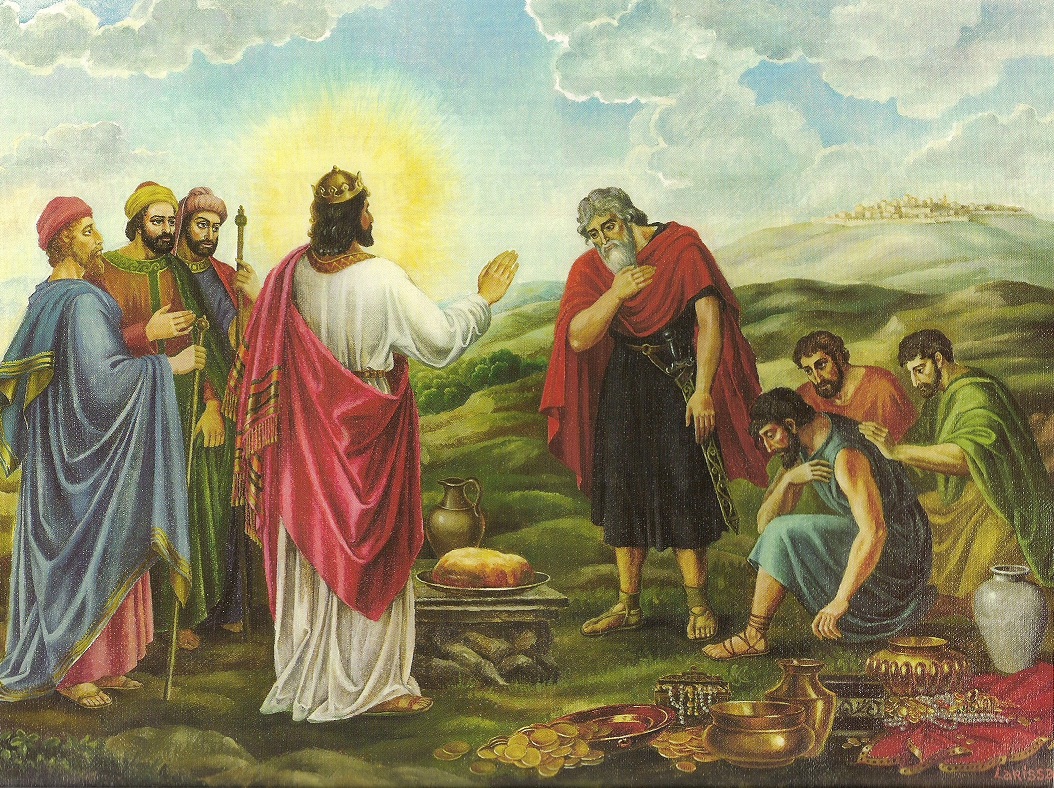
And Melchizedek king of Salem brought forth bread and wine: and he was the priest of the most high God. (Genesis 14:18)

Melchizedek is one of the most mysterious characters recorded in the Bible. He makes his debut in Genesis 14, and the totality of information provided about him is encapsulated within three brief verses (Genesis 14:18-20). It is interesting that the “Book of Beginnings,” which meticulously records all the “begets” of who’s who of important personages of early history, completely ignores the lineage of this apparently most significant person. The New Testament letter to the Hebrews does no better at identifying the parentage of this mysterious figure. Of Melchizedek, the writer of the book of Hebrew writes: “Without father, without mother, without descent, having neither beginning of days, nor end of life; but made like unto the Son of God; abideth a priest continually” (Hebrews 7:3, emphasis mine).

Some believe that Melchizedek was a real person, king of the city-state of Salem. However, Salem is only associated with Melchizedek in the Bible.[1],[2] Nowhere is it listed with the other cities in Canaan, and it is given no significance other than its association with Melchizedek. Some have suggested that Salem was the former name of Jerusalem. They attribute this to clay tablets found at the Tell el Amarna site, dated at 1400 B.C., identifying Urusalim as an early name for Jerusalem. They conclude that “Salem” is just an abbreviated form of Urusalim, and is therefore the same as Jerusalem.

I see several problems with that conclusion. First of all, the date of the Tell el Amarna tablets is about 800 years after Abraham’s encounter with Melchizedek. Israel’s entry into Canaan and the period of the Judges occurred around 1400 B.C. At that time, Jerusalem was known by that name (Jerusalem) and also by the name of Jebus.[3] The Bible identifies Jebus as the city of the Jebusites, and the Jebusites dwelt in the land at the time of Abraham (Genesis 15:18-21). It seems unlikely that the Holy Spirit would refer to the city of Melchizedek as Salem, if He was referring to Jebus (or Jerusalem), and if in fact, Jerusalem existed at that time.

Another problem arises when God commands Abraham to sacrifice Isaac (Genesis 22). God instructed Abraham, “And he said, Take now thy son, thine only son Isaac, whom thou lovest, and get thee into the land of Moriah; and offer him there for a burnt offering upon one of the mountains which I will tell thee of” (Genesis 22:2, emphasis mine). It is widely accepted by Jews, Christians and Muslims, that the place where Abraham offered up his son (Muslims say it was Ishmael) was on Mount Moriah, the place currently occupied by the Dome of the Rock in Jerusalem. If Salem were the same place as Jerusalem, why then did God not clearly say, “Go up to Salem and sacrifice Isaac there”? A close inspection of the text gives the impression that the place to where Abraham was directed was uninhabited.  Note that God directs Abraham to “one of the mountains which I will tell thee.” This was a private matter among God, Abraham and Isaac. It seems unlikely that God would direct Abraham to a population center.

Is Salem Jerusalem? I think not. Jebus, a.k.a. Jerusalem, probably did not exist during Abraham’s lifetime. This would be consistent with the dates of the archaeological finds. So, if Salem is not Jerusalem, then what happened to Melchizedek’s city-state? The validity of the question relies on whether Melchizedek was a flesh-and-blood human being, and whether Salem was a physical place.

I contend that Melchizedek was a Theophany – a preincarnate manifestation of the Lord Jesus Christ. I arrive at this conclusion from the description provided in Genesis 14:18-20 and Hebrews 7:1-4.  As noted earlier, he is described as having no parentage, no beginning, and no end. Only God claims those qualifications. Furthermore, the book of Hebrews notes that he blesses Abraham, and the greater always blesses the lesser. Finally, Abraham offers a tithe (a tenth) of the spoils to Melchizedek. Everywhere else in Scripture, tithes are always associated with service to God, never to men.

His name is more of a title. Melchizedek is a combination of two Hebrew words: melek (king) and tsedeq (righteousness). Combined they render “King of Righteousness” or “Righteous King.” And he is the King of Shalem (peace). His full title could then be rendered as “Righteous King of Peace.” Who does that sound like?

Salem is not Jerusalem. Salem is not a physical place. And Melchizedek is none other than the Lord Jesus Christ, our King of Peace.

Notes:


[1]  See: Genesis 14:18; Hebrews 7:1-2

[2]  Psalm 76:2 associates Salem with Zion – the dwelling place of God.

[3]  See: Judges 19:10-11; 1 Chronicles 11:4-5

2 Comments

Filed under Apologetics, Bible, Religion, Theology