Tag Archives: Book of Genesis

Cain’s Wife

Cain and Abel, ivory panel from the cathedral of Salerno, ca. 1084. Image source: https://commons.wikimedia.org/wiki/File:Ivory_Cain_Abel_Louvre_AO4052.jpg

Cain and Abel, ivory panel from the cathedral of Salerno, ca. 1084. Image source: https://commons.wikimedia.org/wiki/File:Ivory_Cain_Abel_Louvre_AO4052.jpg

And Cain went out from the presence of the LORD, and dwelt in the land of Nod, on the east of Eden. And Cain knew his wife; and she conceived, and bare Enoch … (Genesis 4:16-17)

The question of Cain’s wife comes up often with both serious students of the Bible and skeptics. The low hanging fruit tempts the skeptic to ridicule the Bible for the omission of important details. After all, the Bible only speaks of Cain and Abel; no others siblings are mentioned. If the skeptic adheres to evolutionary/atheistic thinking, he may use this to support his perspective by claiming there were many hominids around before the mythical first couple came around. Cain must have gotten his wife from one of the many available to him.

The Bible student may find himself without a defense because the skeptic is clearly correct – there are no other people mentioned at this point. Genesis 4 records the first family, which includes Adam, Eve, Cain and Abel; no others are mentioned. So where did Cain get his wife? Is the skeptic correct?

This can pose a serious problem even to a seminary trained “professional” because there seems to be no clear-cut answer. But here I want to direct my attention directly to those who claim to believe in the infallibility and inerrancy of Scripture. If you are reading this now, and have doubts about the veracity of the Bible, you are welcome to check it out now.

If we believe that the Bible is the inspired Word of God, that it is without error and it is true in every respect – infallible, than we must accept it for what it says – period. Starting from the beginning, God created one man and one woman (Genesis 1:26-27; Genesis 2:7, 21-22). That was all; no other “hominid kind” were created. “And God blessed them, and God said unto them, Be fruitful, and multiply” (Genesis 1:28). In Genesis 4:1 Cain is born and in the next verse we are introduced to Abel. “And in process of time it came to pass” (Genesis 4:3) that a long period of time transpires and the boys are fully grown. The Bible gives no indication as to how much time elapsed between the first and second sentence of verse 2. Seth, the son to replace the murdered Abel, is born 130 years from Adam’s creation (Genesis 5:3), which means Cain and Abel could have been anywhere from around 30 to 129 years old. That said, “the days of Adam after he had begotten Seth were eight hundred years: and he begat sons and daughters” (Genesis 5:4, emphasis mine). It seems unlikely that in that span of time between the birth of Abel and the birth of Seth, Adam and Eve abstained from procreative activity. It is quite likely that they had a plethora of boys and girls – one every two to three years is not unreasonable.

At this point, the serious student of the Bible must conclude that Cain’s wife was one of his sisters. Did I hear a collective “Yuck!” out there? Suddenly someone recalls the biblical prohibition against marrying a close relative (Leviticus 18:6-20), so Cain cannot take a sister for his wife because that is prohibited by God’s Law. Here, science can aid our understanding of Scripture.

Let us first examine the time frame between creation and the time the Law was given to Moses. From Creation to the Flood was about 1656 years (Genesis 5). From the Flood to birth of Abraham was another 290 years (Genesis 11)[1]. From the birth of Abraham (Abram) until Israel went into Egypt was another 218, and Israel was in Egypt 430 before the Exodus and then another 40 years of wandering in the wilderness. So, from Creation to the Law was between 2594 years and 2604 years. This means that marrying within the family was not legally prohibited and Cain could indeed marry his sister. Remember that Abraham, Isaac and Jacob all three married close relatives.

Now, for Cain to marry his sister presented no biological problem either, because Adam and Eve were created perfectly – their DNA was perfect. Harmful mutations had not corrupted their DNA, so close family marriages did not present a problem.[2] It took about 2600 years before the genetic load became significant enough for God to intervene by giving the prohibition not to marry a close relative.

Where did Cain get his wife? From his parents; he married his sister. This posed no problem biblically or biologically.

Notes:


[1] James J.S. Johnson, “How Young Is the Earth? Applying Simple Math to Data Provided in Genesis,” http://www.icr.org/article/how-young-earth-applying-simple-math-data-provided/, accessed July 17, 2015.

[2] Ken Ham, “Cain’s Wife: It Really Does Matter!” http://www.icr.org/article/cains-wife-it-really-does-matter, accessed July 17, 2015.

1 Comment

Filed under Apologetics, Bible, Evolution, Origins, Poetry, Religion, Science, Theology

The Curse of Death

And as it is appointed unto men once to die, but after this the judgment (Hebrews 9:27)

And as it is appointed unto men once to die, but after this the judgment (Hebrews 9:27)

But of the tree of the knowledge of good and evil, thou shalt not eat of it: for in the day that thou eatest thereof thou shalt surely die.  (Genesis 2:17)

This week a young man, who labeled himself an agnostic, wrote in with a very good question concerning the curse of death. His question was posed as follows:

Genesis 2:17 says, “in the day that thou eatest thereof, thou shalt surely die.” Assuming that day equals 24 hours (big assumption, but Gen 2 is still part of the creation account) then the death must be spiritual or non-literal, since Adam lived to be 930 years – Gen 5:5. If the death resulting from sin is not literal, what is the relationship between sin and physical death? Is there any relation at all? Could physical death have occurred before sin? If sin and physical death are not related, why would Jesus have to rise from the dead? Is a bodily resurrection necessary for salvation? Why? Does any of the apostle Paul’s teaching of Christ conflict with a spiritual interpretation of death and sin? (I Cor 15:12-22)

Alternately, if the term “day” in Genesis 2:17 is not 24 hours, but instead an unspecified length of time equalling [sic] at least 930 years, most of the same questions about the relationship between sin and physical death would still apply.

His question is a very good one, and one of the key points in our biblical apologetics. The “death” described in Genesis 2:17 must be taken in context with the entire account of creation and the Fall, and in light of the rest of Scripture. Genesis 1 and 2 both narrate the creation account. Genesis 1:1-2:4 is God’s account of creation, and it gives a broad overview of the creation week. (For more details, see the notes on Genesis 1 and Genesis 2:1-4). Genesis 2:5 begins Adam’s account, and the focus is on Day Six and the creation of man. Allow me to regress and point out that chapter and verse divisions are not inspired. The original text was a continual reading with no breaks. This can sometimes be an obstacle, if one does not recognize that fact.

Another point that needs to be clarified is that the 24-hour day is not an “assumption” as he suggests. The Hebrew word used is yom, and it almost always means a normal 24-hour day in the Bible. When it is not a 24-hour day, such as in the “day of the Lord” (yom laYahweh) it is referring to a specific time, but never an extended period of time. Furthermore, God clearly defines the meaning of “day” with the phrase “evening and morning were the nth day” (Genesis 1:5, 8, 13, 19, 23).

At the end of the sixth day, God declared His creation not only “good” as in the previous five days, but “very good” (Genesis 1:31). Keep in mind that this assessment comes from an ultimately perfect being. So, if death existed before the fall, can death be considered a very good thing? If we say death is good, then how can death be a curse? And if death cannot be a curse, then why should Jesus die to pay the curse (the wages) of sin? If death was just a “spiritual” death, then, again, why should Jesus die a “physical” death to atone for a “spiritual” death? That really does throw a huge wrench in the works of the Gospel.

But “physical” death is NOT good. The Bible calls death the “enemy” (1 Corinthians 15:26). In the end, “death and hell (Greek hades “the grave”)” are cast into “the lake of fire” (Revelation 20:14). So, physical death cannot be part of a “very good” creation, if the Creator counts it as an enemy and something to be abolished. When God issued the command “thou shalt not eat of it: for in the day that thou eatest thereof thou shalt surely die” (Genesis 2:17), He was speaking of physical death. “Spiritual” death, i.e., separation from God, was a necessary consequence of that disobedience because He is the source of life (Job 33:4; Psalm 36:9; John 1:4; 5:26; 6:48; 10:28; 11:25; 14:6, et al). So, the death was both physical and spiritual. To further emphasize the point, Adam and Eve, since they had never experienced or observed death (keeping in mind that this all occurred shortly after creation – probably within a week or so), God (in the form of the pre-incarnate Christ – my opinion) sacrificed two (or more) innocent animals (probably sheep) in order to “cover” (atone for) their sin (Genesis 3:21). This was the first physical death of anything to this point, but on the spiritual side, man had already lost that intimate relationship with their Creator (Genesis 3:8).

This young man observed that Adam lived 930 years and concludes that the death curse must not have been physical but only spiritual, because they did not die immediately. One needs only to read Chapter 5 of Genesis and count how often the phrase “and he died” is repeated. Adam and Eve did not die instantly when they ate of the fruit, but they initiated the dying process. The phrase “you shall surely die” (Hebrew: mot tamot) would be better translated “dying you shall die.” Furthermore, the couple was denied access to the “tree of life” (Genesis 3:22) because apparently it had properties that would extend their life forever. The fact that they lived the long ages that they did is attributable to near perfect DNA (with the exception of the death mutation), and a near perfect environment. You may want to note the steady decline in longevity following the Global flood (Genesis 11:11-32).

Paul’s argument in 1 Corinthians 15:12-22 confirms that the curse of death is both physical and spiritual – physical in that our bodies degenerate to the point that they cease to function (we die), and spiritual in that our sin separates us from God (as physical death separates our spirit from our body). Jesus was sinless, like the first lambs sacrificed for Adam and Eve. Paul tells us that the “wages of sin is death” (Romans 6:23); here we are speaking of that spiritual death that separates us from God. Jesus’ death on the cross was the only sacrifice suitable to pay that debt of sin that separates us from God for all of mankind. “For it is not possible that the blood of bulls and of goats should take away sins” (Hebrews 10:4). Then when He rose again, He conquered the curse of physical death so that we can have eternal life. The choice, however, remains with us. From beginning to end, God has provided the way to restore that broken relationship and to enjoy eternal life with our Creator. We can either accept His offer, or reject it. “He came unto his own [not only the Jews, but mankind in general], and his own received him not. But as many as received him, to them gave he power to become the sons of God, even to them that believe on his name” (John 1:11-12).

3 Comments

Filed under Apologetics, Bible, Christianity, Creation, Death, Evangelism, Gospel, Origins, Religion, Salvation, Theology

A Special Kind of Stupid

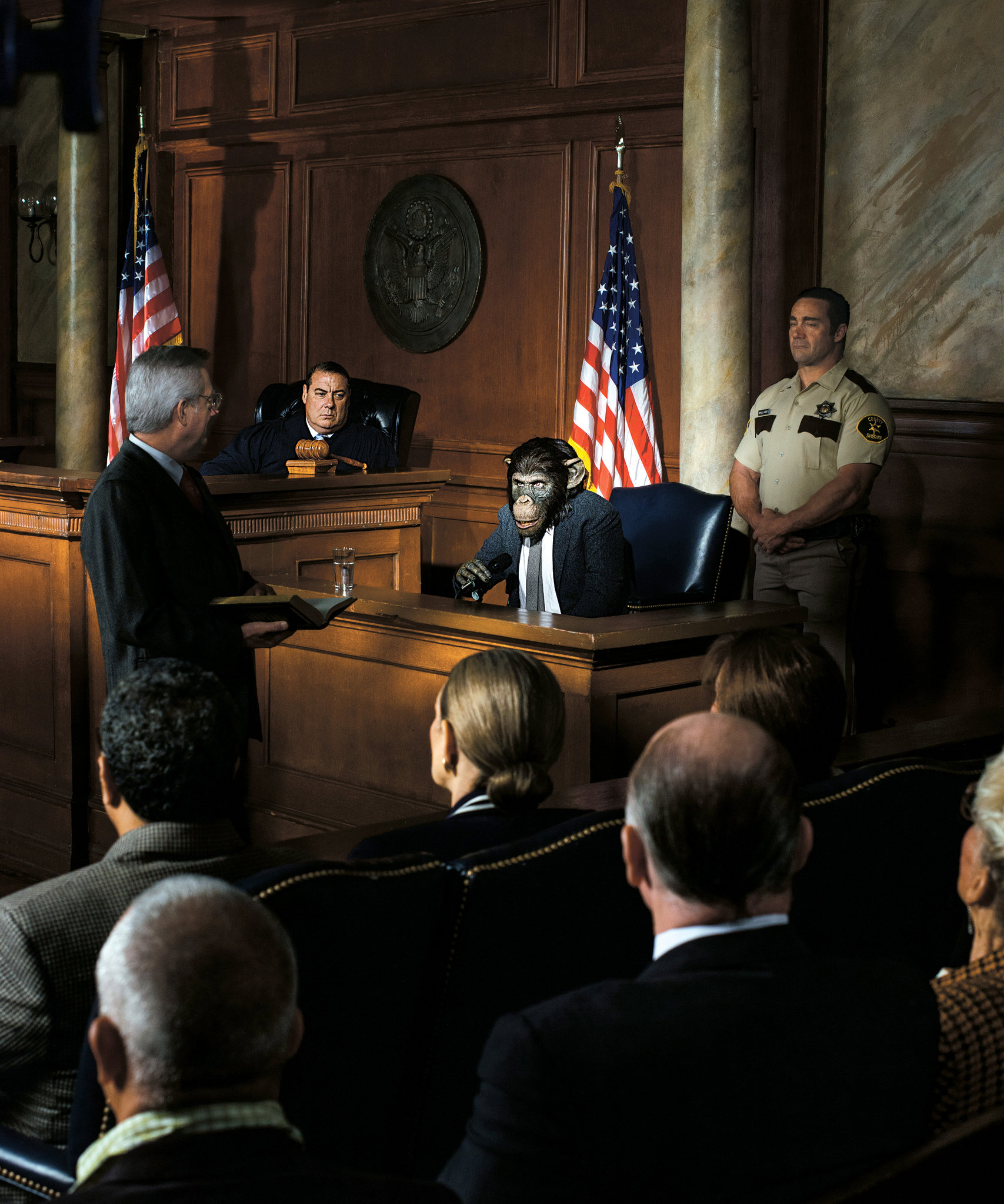
Image Credit: The Greanville Post, http://www.greanvillepost.com/2014/04/29/his-day-in-court-a-chimpanzee-makes-legal-history/

Image Credit: The Greanville Post: “His day in Court—A Chimpanzee Makes Legal History

And God said, Let us make man in our image, after our likeness: and let them have dominion over the fish of the sea, and over the fowl of the air, and over the cattle, and over all the earth, and over every creeping thing that creepeth upon the earth.  (Genesis 1:26)

This week “Two research chimps got their day in court … Steven Wise, an attorney with the Nonhuman Rights Project, told Manhattan Supreme Court Judge Barbara Jaffe that Hercules and Leo, the 8-year-old research chimps at Stony Brook University on Long Island, are ‘autonomous and self-determining beings’ who should be granted a writ of habeas corpus, which would effectively recognize them as legal persons. The chimps, he argued, should be moved from the university to a sanctuary in Florida”[1] (emphasis mine).

Well, what can one expect! For years now evolutionists have been claiming that chimpanzee DNA is 98% the same as that of humans. If that is so, then it stands to reason that they should at least be considered 98% persons. Is that not so? However, the DNA findings exaggerate the similarity in a narrow segment of the genome and deemphasize the vast differences that clearly separate chimps from humans. Biologist Dr. Jeffrey P. Tomkins, Research Associate in Life Sciences for the Institute for Creation Research, researches these claims made by the evolutionists. In comparing 40,000 chimpanzee genomic sequences against the human genome, Tomkins found “that reported levels of human-chimp DNA similarity were significantly lower than commonly reported … For the chimp autosomes, the amount of optimally aligned DNA sequence provided similarities between 66 and 76 percent, depending on the chromosome. Only 69 percent of the chimpanzee X chromosome was similar to human and only 43 percent of the Y chromosome. Genome-wide, only 70% of the chimpanzee DNA was similar to human under the most optimal alignment conditions.”[2] The 28% (give or take) variance may seem small, but in genomics, it is huge. “While, chimpanzees and humans share many localized protein-coding regions of high similarity, the overall extreme discontinuity between the two genomes defies evolutionary timescales and dogmatic presuppositions about a common ancestor.”[3]

I am no scientist, but even without getting into the coded information contained in DNA, the differences between chimps and humans seem obvious to me. To make an evaluation, one needs only to ask a few simple questions.  Aside from some basic similarities like: chimps have hands, humans have hands; chimps have feet, humans have feet (albeit chimps have “thumbs” on their feet and humans have a big toe); chimps have faces, humans have faces; chimps express emotions, humans express emotions; chimps nurture their young; humans nurture their young; chimps live in communities, humans live in communities; chimps communicate (as do most other animals), humans communicate; chimps make “tools,” humans make tools. There may be other similarities, but basically, it ends there. The questions reveal the differences.

Chimpanzees can make simple “tools,” but can they replicate a tool or mass produce it? Do they teach their tool making techniques to others in their community? Do they improve their tools to make them more functional or employ their tools for a variety of different purposes? Chimpanzees can build shelters, but can they build permanent structures? Do they employ aesthetic design in their building efforts or are their shelters simply utilitarian? For that matter, do chips create anything – paintings, sculptures, music, etc.? What is the extent of their creative abilities, if any, and how do they compare to those of humans? Can chimpanzees do even simple math? Do they develop economic systems or practice even the most basic exchange systems? We know that chimps can communicate in some rudimentary ways, but have they developed a language? Do they exchange ideas, and if so, how is that accomplished? Have they ever developed a system of writing, and if they have, do they value it enough to preserve it? Do chimps study chimpanzee anatomy in order to “doctor” on one another? Do they research in order to find cures for chimpanzee diseases? Along the same lines, do chimps study other animals to learn their habits and habitats? Do they observe the stars at night and dream about visiting other worlds? Chimps play, but do they develop games with rules and teach the game to others in order to stimulate healthy competition?

The comparisons are endless, but the more questions one considers, it becomes all the more obvious that chimpanzees fall far short of human achievements and capabilities. Sure chimps have greater strength than humans. They can swing from tree to tree even using their feet to grasp branches; but they do not have the manual dexterity to play a flamenco guitar, harp, piano, or violin; or the grace to match the agility of a gymnast or to dance a ballet or to figure skate.

The evolutionists claim that humans and chimps originated from a common ancestor. If that is the case, then why have chimpanzees not advanced even to the level of the most primitive human tribes? Supposedly they have had the same 100,000 years as humans (according to evolutionists) to evolve beyond their lowly “animal” status. So why are they stuck at the point of their origin? The fact is that they are animals and humans are, well, humans. Chimps were created by the spoken word of God (Genesis 1:24-25); humans were formed (Hebrew yâtsar meaning form or mold) in the image of God (Genesis 2:7; 1:26-27). The difference in creation between beast and man is so distinct, from the Creator’s point of view as recorded in Scripture, that one would really have to be some special kind of stupid to attribute personhood to an animal on par with that of a human being. But, this should really not surprise us. The Bible teaches that those who profess such things have “changed the truth of God into a lie, and worshipped and served the creature more than the Creator, who is blessed for ever” (Romans 1:25, emphasis mine).

So, if these chimps really are “legal persons” – the “autonomous and self-determining beings” their lawyers claim – they should go out and hire their own lawyers!


 Notes:

[1] Krishnadev Calamur, “Research Chimps Get Their Day in Court in New York,” (http://www.npr.org/sections/thetwo-way/2015/05/27/410058029/research-chimps-get-their-day-in-court-in-new-york). Accessed May 28, 2015.

[2] Jeffery Tomkins, “New Research Evaluating Similarities Between Human and Chimpanzee DNA,” (http://www.icr.org/i/pdf/technical/Research-Evaluating-Similarities-Human-Chimp-DNA.pdf). Accessed May 28, 2015.

[3] Ibid.

2 Comments

Filed under Apologetics, Creation, Current Events, Evolution, Origins, Science, Theology

Marring the Image

This photo appeared on my Facebook News Feed. I have no idea who is pictured in this photo.

This photo appeared on my Facebook News Feed. I have no idea who is pictured in this photo.

So God created man in his own image, in the image of God created he him; male and female created he them. (Genesis 1:27)

The image above appeared on my Facebook news feed recently. Naturally, there were many negative comments made about the young man, who I seriously doubt any of the commentators knew personally. What surprised me was what one young (I presume) lady said in his defense. In part she said, “The guy aint [sic] a pedophile, a murderer or a rapist, he has body modifications, so get over it. It is his body, his decision and he is not harming anyone.” How she knows that I haven’t an inkling. My guess is that she knows him as well as the other commentators, but what struck me was her assertion that “it is his body, his decision and he is not harming anyone.” All three points of her assertion are debatable, so let’s begin with that.

“It is his body.” Is it really? The best place to start is at the beginning. On the sixth day of creation, the Triune God (Father, Son, Holy Spirit) said, “Let us make man in our image, after our likeness” (Genesis 1:26).  The Hebrew word translated “image” is tselem and it means an illusion, or resemblance – a representative figure. In other words, we were created to “look” like Him. God has a human body; His name is the Lord Jesus Christ. We were also created in His “likeness.” The Hebrew word translated “likeness” is demûth meaning resemblance or similitude. The commentator Albert Barnes notes that this implies a “‘likeness,’ in any quality.” Adam Clarke said:

The image and likeness must necessarily be intellectual; his mind, his soul, must have been formed after the nature and perfections of his God. The human mind is still endowed with most extraordinary capacities; it was more so when issuing out of the hands of its Creator. God was now producing a spirit, and a spirit, too, formed after the perfections of his own nature. God is the fountain whence this spirit issued, hence the stream must resemble the spring which produced it. God is holy, just, wise, good, and perfect; so must the soul be that sprang from him: there could be in it nothing impure, unjust, ignorant, evil, low, base, mean, or vile. It was created after the image of God … Hence man was wise in his mind, holy in his heart, and righteous in his actions.

So, as I look upon the young man in the picture, I see the image of God albeit marred. We take offense when we see some work of art vandalized. Our sensitivities are bruised when we see graffiti on public structures or buildings. Why? Because deep inside we know that the vandals do not have to right to disfigure the work of another. It is just wrong! In like manner, our bodies are God’s work of art! He created each one individually to bear His resemblance. The psalmist beautifully phrased it this way:

– I will praise thee [God]; for I am fearfully and wonderfully made: marvellous are thy works; and that my soul knoweth right well.

– My substance was not hid from thee, when I was made in secret, and curiously wrought in the lowest parts of the earth.

– Thine eyes did see my substance, yet being unperfect; and in thy book all my members were written, which in continuance were fashioned, when as yet there was none of them. (Psalm 139:14-16)

Can we really say that our body is our own to do with as we wish – that it’s our decision? The Bible teaches otherwise. “What? know ye not that your body is the temple of the Holy Ghost which is in you, which ye have of God, and ye are not your own?” (1 Corinthians 6:19). Some may object, “Paul is addressing Christians.” Yes, and I see many “Christians” following the pattern set by pop culture. Again, I do not know anything about the young man in the picture. For all I know, he may claim to be a Christian. One thing is sure, God knows. The point, whether he is or isn’t a Christian, is that he has taken it upon himself to vandalize the image of God that he bears; he has no “right” to do that. Having been created in the image of God, he has free will to do as he wishes, and he has reasoning abilities to distinguish and decide how to exercise his will. But just as any vandal, he does not have the right to disfigure, damage, or destroy another’s property. God’s creation – all of it – is His property.

Who does it harm? Well, think of the possibilities. First of all, this person obviously has a low regard of his own worth. I am no psychiatrist or psychologist, but it seems obvious to me that he is desperately trying to draw attention to himself. He feels invisible otherwise. No one really sees him, so this is one way to shout, “Here I am! See me?” Someone who has a low regard for his own life will certainly not have a high regard for someone else’s life. The young lady who defended him saying that he is not “a pedophile, a murderer or a rapist,” had nothing on which to base that assessment. A pedophile has no regard for the value of a young child’s life. A murderer has no regard for the life of another human being. A rapist does not value the great worth of a woman. None of these sociopaths value the lives of their victims, and upon close examination, none of them value their own lives.

Someone who is willing to distort and disfigure their own appearance cannot be trusted. Some of the commentators on the Facebook post noted that this young man would have a lot of trouble getting a job. Is it any wonder? Unless one is running a tattoo parlor or a pot house, how many employers would be willing to put a face like that on their business? How many (sober) moms out would entrust a young child to the care of someone that looks like this? Yes, I hear the outcries of the self-righteous saying, “Judge not, that ye be not judged” (Matthew 7:1 taken out of context). The “judging” in this case refers to God’s judgement, which is reserved solely to Him. But God, as part of His image, has given everyone the ability to “judge rightly,” i.e., discern. Further down in that same passage Jesus says, “Give not that which is holy unto the dogs, neither cast ye your pearls before swine, lest they trample them under their feet, and turn again and rend you” (Matthew 7:6). Obviously, one has to exercise a certain amount of “judgement” to discern what is “holy” and who are the “dogs” and what are “pearls” and who are the “swine.” Likewise we, even in our fallen state, have the ability to make certain judgment calls. In teaching about “false prophets” Jesus said, “[By] their fruits ye shall know them” (Matthew 7:20). What is “fruit” but what a tree puts forth that can be seen and tasted. In the winter, when the trees have all lost their leaves, I can’t tell one tree from another; but when the summer comes, and I see the fruit that a tree is bearing, I know what kind of tree it is. Even if I were blind, I would still be able to smell and taste the fruit. People are the same; if they “look” messed up, they probably are, and they have the potential of harming others.

Now, I do not want to cast a broad net. I realize that people make mistakes that they later regret and their lives change, but the outward scars remain. I also realize that there are some people who look really good on the outside, but inwardly they are rotten to the core. A recent case in point were the would-be ISIS terrorists shot down in Garland, Texas by police before they were able to carry out their act of terror. The two men came from Phoenix, Arizona where neighbors in their apartment complex testified that these were two really nice guys. They were friendly toward their neighbors, helpful, hard workers, etc. – certainly not the kind that would attempt to commit such an atrocity. It goes to show that you cannot always judge by what you see; but most of the time you can.

Leaving the judgment of the heart to God, let’s focus back on just the image in the picture. Here is the image of God, distorted, disfigured, damaged and permanently scarred. What would possess someone do that to themselves? May I suggest Satan? Consider that Satan was created as a high-ranking angel, an archangel to be exact. In ranking, he was next to God (See “Why Satan?”). He, along with all the other angels, was created before God created man on Day Six of creation. He observed God’s care in the creation of man. He noted that God created man in His own image — not so the angels including Satan (Lucifer was his name). Lucifer watched as God gave to man dominion over all of His creation (Genesis 1:26-29), and now the angels were to serve man: “Are they not all ministering spirits, sent forth to minister for them who shall be heirs of salvation?” (Hebrews 1:14). Oh! How this must have galled Lucifer! He has hated man ever since, and his goal from the beginning has been to mar the image of God – to destroy that which God most cherishes. When I look on the face of this young man, I see a young man so deceived by Satan that he succumbed to Satan’s bidding to mar the image of God that he carries. This image saddens me deeply. What saddens me more is when I see “Christians” ignorantly fall for the same deception – piercings, tattoos, immodest dress, vulgar language, etc. What kind of “fruit” do they exhibit? Appearances do matter. No one can judge the heart except God, but we are to bear His image and His likeness, and we cannot do that when we follow that pattern of the world that Satan displays as “pop culture.” Whose image shall we bear? Shall we persist on marring the image of God, or shall we remember that we “have put on the new man, which is renewed in knowledge after the image of him that created him” (Colossians 3:10).

3 Comments

Filed under Apologetics, Bible, Christianity, Creation, Current Events, Origins, Religion, Satan, Theology

It’s Settled!

For ever, O LORD, thy word is settled in heaven. (Psalm 119:89)

My dad went to be with the Lord a little more than six months ago. He taught me many things as I was growing up and even into my adult life, but one of the most valuable lessons he taught me was to trust God’s Word in all matters. Even when I can’t make sense of it, God’s Word is true. To the skeptic this may sound as circular reasoning.

Why do you believe in the Bible?

Because it’s true; it’s God’s Word.

How do you know it’s true?

Because it’s the Word of God.

On its face, it may seem like circular reasoning, but it’s really not when one considers the source. Of essence, one must first believe in the existence of an omnipotent, omniscient God and that requires a certain amount of faith however small. “But without faith it is impossible to please him: for he that cometh to God must believe that he is, and that he is a rewarder of them that diligently seek him” (Hebrews 11:6).

God is the Creator of all that exists, therefore all of creation is subject to Him. God created by His spoken Word. “And God said, Let there be light: and there was light … And God said, Let there be a firmament in the midst of the waters … and it was so … And God said, Let the waters under the heaven be gathered together unto one place, and let the dry land appear: and it was so” (Genesis 1:3, 6-7, 9), etc. Everything that exists came about by the spoken Word of God.

After God created man, He placed him in a special garden and gave him only one rule: “of the tree of the knowledge of good and evil, thou shalt not eat of it: for in the day that thou eatest thereof thou shalt surely die” (Genesis 2:17). Man was free to eat the fruit of every tree in the garden except for this one. One would think that such a simple command should have been easy enough to obey considering the abundance of other choices they were given, but remarkably this was the very part of God’s Word that was challenged. “Yea, hath God said, Ye shall not eat of every tree of the garden? … Ye shall not surely die: For God doth know that in the day ye eat thereof, then your eyes shall be opened, and ye shall be as gods, knowing good and evil” (Genesis 3:1, 4-5). Just in case you weren’t paying attention, Satan, the serpent, first called God’s Word into question. Next he claimed God’s Word was a lie, and finally he claimed that God was keeping the couple from something better. From creation to the present, Satan’s strategy remains the same.

The Bible that we currently have was canonized around the fourth century AD, many of the source texts, especially the Old Testament texts, go back thousands of years. For that reason, the skeptics charge that the originals have been corrupted, and since we do not possess the original autographs, we cannot trust our modern Bibles. “Has God really said?” Next they deny the historical and scientific accuracy of the Bible. “God did not create anything; it all started from a Big Bang and after billions of years life emerged from random chemical reactions that evolved over millions of years and eventually resulted in our existence. It was all due to natural processes.” The skeptics can say what they want, but the Bible has NEVER been proven wrong. Finally, following the teachings of the Bible will keep you from being all that you want to be, and from doing whatever you want to do. “What! You don’t want to live your life as a monk (or nun) do you?”

The Bible has withstood all the challenges of the skeptics for centuries. One of the earliest criticisms of the Bible was that it mentioned the nation of the Hittites for which there was no historical record. Then late in the 19th century archeological discoveries revealed that not only did the Hittites exist, but they were a powerful empire. Archeologists continue to discover evidences that confirm the veracity of the Bible. Within the last century, the oldest Hebrew and Greek manuscripts found hidden in the caves of Qumran validate the accuracy of scriptural transmission when compared to the manuscripts previously known. This fact alone testifies to the imperishability of the Word of God: “The grass withereth, the flower fadeth: but the word of our God shall stand for ever.” (Isaiah 40:8).

Jesus said, “Heaven and earth shall pass away, but my words shall not pass away” (Matthew 25:35). He went further to say, “For verily I say unto you, Till heaven and earth pass, one jot or one tittle shall in no wise pass from the law, till all be fulfilled” (Matthew 5:18). What He was saying was that neither the smallest letter nor even the smallest distinguishing nuance of a letter will be lost until all is fulfilled. That is a remarkable claim for any author to make about his book, but Jesus made that claim about His Word. “So shall my word be that goeth forth out of my mouth: it shall not return unto me void, but it shall accomplish that which I please, and it shall prosper in the thing whereto I sent it” (Isaiah 55:11).

So, if God is who He claims to be, then His Word can be trusted completely because He, the Author, says so. I believe the Bible – all of it – because it is God’s Word; and because it is God’s Word, it is true. There is no question. It is settled forever!

14 Comments

Filed under Apologetics, Bible, Christianity, Gospel, Theology