Tag Archives: Christ

Bewildered

This know also, that in the last days perilous times shall come. (2 Timothy 3:1)

This week our nation suffered another horrendous tragedy – the mass murder of students and teachers at Marjory Stoneman Douglas High School in Parkland, Florida. Ironically, the massacre took place on Valentine’s Day, which also happened to be Ash Wednesday. The first question many ask is, “Where was God in all of this?”

The spilled blood on the school hall floors had not yet coagulated before the left-right divide made itself apparent. The “left” immediately took the occasion to irrationally call for more and stricter gun control laws while the “right” rationally points out that gun control laws (of which too many already exist) cannot prevent these kinds of senseless acts of violence. If we remove all guns from society–which is absurd at the onset—those in power – the ruling class elites – will always have guns, and outlaws will always find ways to get them. Those of a mind to kill will kill by any means available: knives, broken bottles, clubs, cars, homemade bombs, etc. More gun control laws will not impede senseless acts of violence.

Guns are not the problem. Wickedness in the heart of man is the problem. Reports say that the shooter, 19-year old Nikolas Cruz, “heard demons” in his head directing him to carry out the heinous act. That, I can believe. The public defender assigned to Cruz, Melisa McNeill, preparing, I am sure, to enter an insanity defense, described Cruz as “a broken person.” That too, I can believe.

The fact remains that we are all broken people. The Bible teaches, “There is none righteous, no, not one … For all have sinned, and come short of the glory of God” (Romans 3:10, 23). Every person alive falls into that category. It’s a wonder that more atrocities like this do not take place; although, arguably, these kinds of incidents are on the rise.

The media fill the airwaves with opinions from the left and the right on how to resolve the problem. Some want to ban all weapons. Others want to arm the teachers. Still, others identify all the symptoms but fail in offering practical solutions.

At the risk of sounding insensitive or naïve, the solution is simple. A well-known and seldom employed axiom states, “Among competing hypotheses, the one with the fewest assumptions should be selected.”[1] How about this one: “Thou shalt not [murder]” (Exodus 20:13). Oh! That’s right! That is one of the Ten Commandments. That is in the Bible. That is not allowed in school. When I went to school, not only was it allowed in school, but it was taught. Not surprisingly, we did not experience school shootings when I went to school.

Do we seriously want to stop the madness? Then ban the ACLU from schools and reinstitute God and biblical morality. It is just that simple. However, we are living “in the last days [where] perilous times shall come” (2 Timothy 3:1) “because iniquity shall abound, the love of many shall wax cold” (Matthew 24:12). Jesus said that the last days would be as the days of Noah. Not only were “they were eating and drinking, marrying and giving in marriage, until the day that Noe entered into the ark, And knew not until the flood came, and took them all away” (Matthew 24:38-39); but “The earth also was corrupt before God, and the earth was filled with violence” (Genesis 6:11, emphasis mine). Is that not what we see?

The solution is simple, but the world is bewildered in finding a solution. This bewilderment is also a sign of the times. Study the following passage:

Because that, when they knew God, they glorified him not as God, neither were thankful; but became vain in their imaginations, and their foolish heart was darkened. Professing themselves to be wise, they became fools, And changed the glory of the uncorruptible God into an image made like to corruptible man, and to birds, and fourfooted beasts, and creeping things. Wherefore God also gave them up to uncleanness through the lusts of their own hearts, to dishonour their own bodies between themselves: Who changed the truth of God into a lie, and worshipped and served the creature more than the Creator, who is blessed for ever. Amen. For this cause God gave them up unto vile affections: for even their women did change the natural use into that which is against nature: And likewise also the men, leaving the natural use of the woman, burned in their lust one toward another; men with men working that which is unseemly, and receiving in themselves that recompence of their error which was meet. And even as they did not like to retain God in their knowledge, God gave them over to a reprobate mind, to do those things which are not convenient; Being filled with all unrighteousness, fornication, wickedness, covetousness, maliciousness; full of envy, murder, debate, deceit, malignity; whisperers, Backbiters, haters of God, despiteful, proud, boasters, inventors of evil things, disobedient to parents, Without understanding, covenantbreakers, without natural affection, implacable, unmerciful: Who knowing the judgment of God, that they which commit such things are worthy of death, not only do the same, but have pleasure in them that do them. (Romans 1:21-32, emphasis mine)

Does that not describe the current state of our world? People are bewildered; their hearts are darkened. They profess themselves to be wise but are fools. They are morally impure, dishonoring their bodies between themselves—women with women and men with men. They do all of this because they have rejected God, and God has given them over to these “vile affections.” Then, because they continue to reject God, He has given them over to “a reprobate mind,” i.e., a mind that has lost the ability to properly reason. Is it any wonder that they are bewildered by this awful problem and cannot see the simple solution?

At the risk of sounding insensitive, as a society that has ejected God from the public square, we, as a nation, have brought this evil upon ourselves. The solution is simple, but until our nation repents and turns back to God, the violence will continue to increase, and none of our God-less solutions will make them go away. We will remain bewildered!

Notes:


[1]  This axiom or principle is known as Occam’s Razor. https://en.wikipedia.org/wiki/Occam%27s_razor
 

1 Comment

Filed under Apologetics, Christianity, Current Events, End Times, Religion, Theology

High Cost of Admission

Then said Jesus unto his disciples, Verily I say unto you, That a rich man shall hardly enter into the kingdom of heaven. (Matthew 19:23)

Another Super Bowl came and went. I did not go, nor did I watch it, but I know the cost of admission was outrageous, even for the cheap seats. I read that the cheapest seats in the upper level, 11 rows from the top in the corner of the end zone, sold for $4900.[1] Undoubtedly, people actually paid the high cost of admission for the “experience,” and I am sure that today they are boasting that it was worth the “sacrifice.” For those willing to shell out that kind of cash, the price of admission was not too high a cost.

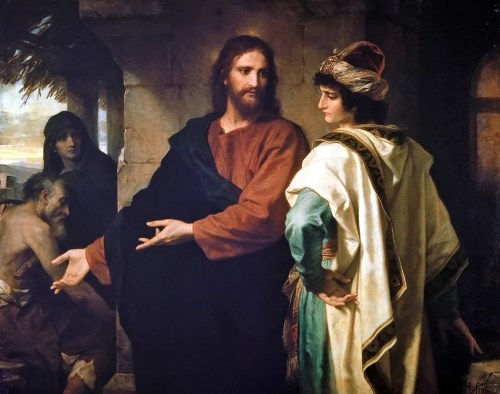
The Gospel writer, Matthew, records an account of “one” who came to Jesus asking about the cost of admission to “eternal life.” One would think the cost would be higher than for tickets to the Super Bowl. This one said, “Good Master, what good thing shall I do, that I may have eternal life?” (Matthew 19:16). By Jesus’ response, it seems the “young man” (v. 20) was insincere in his query. “And he [Jesus] said unto him, Why callest thou me good? there is none good but one, that is, God” (Matthew 19:17a). The young man did not recognize that he was in the presence of God. To him, Jesus was just another teacher (meaning of “Master”) and the attribution of “good” provided the incentive for Jesus to affirm what he thought about himself.

Jesus played along; “if thou wilt enter into life, keep the commandments” (Matthew 19:17b, emphasis mine). Jesus told him what we wanted to hear. Feigning humility, the young man responded coyly, “Which?” (v. 18) pretending that there might be one he missed. Jesus named off a representative list of the Ten Commandments (Matthew 19:18-19), and the young man could no longer contain his self-righteousness. “All these things have I kept from my youth up: what lack I yet?” (Matthew 19:20).

The young man must have thought Jesus would commend him for his righteousness and say, “You’re good to go! You are more than qualified to inherit eternal life.” Instead, “Jesus said unto him, If thou wilt be perfect, go and sell that thou hast, and give to the poor, and thou shalt have treasure in heaven: and come and follow me” (Matthew 19:21). The “follow me” part by itself was doable. If it got too rough, he could always go back to what he did before. However, selling all of his possessions and giving the proceeds to the poor was irreversible. The young man probably inherited all of his wealth and had no idea how to build wealth from scratch. He had probably never worked a day in his life. “Work” was something for peasants, not for him. The price was too high. “But when the young man heard that saying, he went away sorrowful: for he had great possessions.” (Matthew 19:22, emphasis mine).[2]

“Then said Jesus unto his disciples, Verily I say unto you, That a rich man shall hardly enter into the kingdom of heaven” (Matthew 19:23, emphasis mine). The KJV translates the Greek word duskolōs as “hardly,” but what it means is “with great difficulty.” Jesus did not mean that rich people cannot get into heaven. What He did say was that getting into heaven for a rich person is difficult. Why?

Matthew introduced this account with a scene where people (probably mothers) brought their children to Jesus so that He could pray and bless them (Matthew 19:13-15). The disciples rebuked the people for bringing their little urchins to the Lord. “But Jesus said, Suffer little children, and forbid them not, to come unto me: for of such is the kingdom of heaven” (Matthew 19:14, emphasis mine). Mark, in his Gospel (probably Peter’s account), records that Jesus was displeased with the action of His disciples. He further adds, “Verily I say unto you, Whosoever shall not receive the kingdom of God as a little child, he shall not enter therein” (Mark 10:15, emphasis mine). We refer to children as dependents. They are dependent on their parents for food, clothing, shelter, protection, and guidance. They believe what their parents tell them. They trust their parents for everything.

The rich young man was “independent.” His riches provided all that he needed, and, as long as he had his wealth, he was secure. Jesus challenged his source of security. What Jesus basically said was, “I AM all you need. Follow Me.” A child would have followed without question, but this young man chose rather to trust in his many possessions rather than to trust in Jesus. For him, the high cost of admission was too great a price to pay.

“When his disciples heard it, they were exceedingly amazed, saying, Who then can be saved? But Jesus beheld them, and said unto them, With men this is impossible; but with God all things are possible” (Matthew 19:25-26, emphasis mine). The disciples were shocked. If someone who follows all of God’s commandments and has been blessed by God with great wealth cannot be saved, then who can be saved? The lesson is simple. Wealth cannot purchase a ticket to heaven, even if you sell all of your possessions and give the proceeds to the poor. Neither can rigorous religious practice gain one entry into eternal life. However, when one places one’s trust in Jesus with a childlike faith and seeks to follow Him, God gives eternal life. Jesus already paid the high cost of admission.

Reader, in what do you place your trust? Jesus asks that you lay all that aside, and place your trust in Him. If you need help with that, read my page on “Heaven.”

Notes:


[1]  “Super Bowl 2018: How much do tickets cost? Any cheap flights and hotels for Eagles fans?” – http://www.nj.com/eagles/index.ssf/2018/01/super_bowl_tickets_cheap_flights_to_minnesota_eagl.html

[2]  “Too Rich for Heaven: – https://erniecarrasco.com/2015/04/19/too-rich-for-heaven/

4 Comments

Filed under Christianity, Evangelism, Gospel, Heaven, Religion, Salvation

Walking On Water

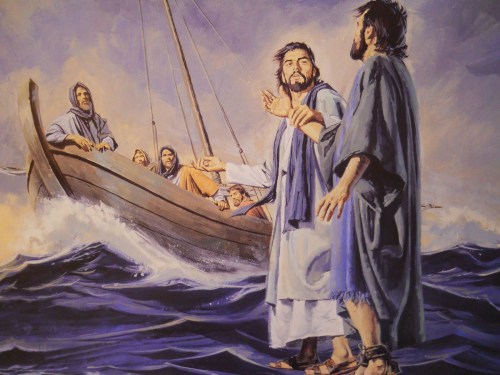
And he said, Come. And when Peter was come down out of the ship, he walked on the water, to go to Jesus. (Matthew 14:29)

One of my favorite accounts recorded in the Gospels is that of Peter walking on water. Everyone knows that Jesus walked on the water, but no one remembers that Peter walked on the water too. Most people focus on the fact that Peter sank. Peter succumbed to the natural laws of physics, but he did walk on water.

The record begins when Jesus fed “about five thousand men, beside women and children” (Matthew 14:21). This He did by multiplying the five barley loaves and two fish (Matthew 14:17). “And they did all eat, and were filled: and they took up of the fragments that remained twelve baskets full” (Matthew 14:20) – one basket full for each of the twelve disciples. The miracle demonstrated Jesus’ power as Creator. The beginning amount of food, if simply broken up into tiny morsels sufficient for each of the over 5000 people, would not have been enough for them all to be “filled” – the Greek word used there is chortazō, which means, “to gorge.”  Jesus created new food out of nothing, and the people were “stuffed.” After the “feast,” Jesus dismissed the crowd and instructed His disciples to get in the boat and go across the Sea of Galilee. Meanwhile, “he went up into a mountain apart to pray: and when the evening was come, he was there alone” (Matthew 14:23).

While Jesus prayed, a storm came up on the lake and caught the disciples in middle of the water fighting for their lives. After a long night of bailing water and manning the oars, the disciples looked across the water and thought they saw a ghost walking in their direction.[1] It was past three o’clock in the morning – the fourth watch. Lack of sleep combined with aching backs and shoulders from fighting the elements contributed to the fear that gripped their hearts at the sight of this phantasm. “They were troubled, saying, It is a spirit; and they cried out for fear” (Matthew 14:26, emphasis mine).

Then came that all too familiar voice, “Be of good cheer; it is I; be not afraid” (Matthew 14:27). Literally, the Greek reads, “Have courage. I AM. Fear not.” The Great I AM who created the laws of physics now subjected them to His will by transforming the surface tension of water into a solid surface for His footsteps. Incredible! The disciples had their doubts.  “And Peter answered him and said, Lord, if it be thou, bid me come unto thee on the water. And he said, Come.” (Matthew 14:28-29a, emphasis mine).

One must really admire the audacity of Peter! Although he could not believe his eyes, he recognized and trusted the voice of the Savior. “And when Peter was come down out of the ship, he walked on the water, to go to Jesus” (Matthew 14:29b). Look closely at what the verse says. Peter got out of the boat, but he did not just stand there holding on to the side. “He walked on the water.” He let go of the boat and started walking “to go to Jesus.” Peter was walking on water! Peter did not perform a miracle. He did not manipulate the laws of physics like Jesus did. He simply trusted in the Word of Jesus. Jesus said, “come,” and that was enough. Way to go, Peter!

However, “when he saw the wind boisterous, he was afraid” (Matthew 14:30). The Greek word translated “boisterous” is ischuros, and it means “forcible, mighty, powerful, strong, or valiant.” We cannot really “see” the wind, but we see its effects. The wind was “forceful.” The waves broke over the bow of the small boat. The sea plunged to a depth of more than 200 feet. A man could easily drown under these circumstances. Peter took his eyes off the One who said, “come,” and he took notice of the elements around him instead. That is when he lost his footing, “and beginning to sink, he cried, saying, Lord, save me. And immediately Jesus stretched forth his hand, and caught him” (Matthew 14:30-31, emphasis mine).  Peter’s head did not go under before Jesus brought him to the surface, “and said unto him, O thou of little faith, wherefore didst thou doubt?” (Matthew 14:31). We should not be too critical of Peter’s “little faith.” Under similar circumstances, we might react the same way.

Like Peter, Jesus calls us to come to Him. The storms of life surround us. Danger lurks everywhere. Some see Jesus as a phantom, a figment of religious imaginations, and though the storms of life are very real, they prefer to take their chances in the boat where it is “safe.” However, the boat guarantees no safety. One big wave can swamp the boat, and life is over. The safest place is out on the water with Jesus. We can walk on water through the storms of life as long as our eyes are fixed on the One who says, “Come,” “and be not faithless, but believing” (John 20:27).

That is not the end of the story. Peter did walk on water again. After Jesus saved him, they walked to the boat together. “And when they were come into the ship, the wind ceased” (Matthew 14:32, emphasis mine). Walking on water with Jesus calms the storms of life.

Notes:


[1]  “Jesus’ Seven Signs in John (5)” – https://erniecarrasco.com/2016/11/20/jesus-seven-signs-in-john-5/

1 Comment

Filed under Apologetics, Christianity, Gospel, Religion, Salvation, Theology

End of the World

Tares – a kind of darnel, resembling wheat

The Son of man shall send forth his angels, and they shall gather out of his kingdom all things that offend, and them which do iniquity; (Matthew 13:41)

In the thirteenth chapter of the Gospel of Matthew, Jesus relates several parables illustrating the “kingdom of heaven.” Beginning with verse 24, He compares the kingdom of heaven to a field that a farmer sowed with wheat (“good seed”). Then at night, while the farmer slept, an enemy came and sowed tares in the same field. The tares to which Jesus referred were probably some kind of darnel that looks much like wheat before it matures. Once it matures the difference becomes obvious.

The farmer’s hired hands detected the tares early on and reported their discovery to the farmer. “So the servants of the householder came and said unto him, Sir, didst not thou sow good seed in thy field? from whence then hath it tares?” (Matthew 13:27). They suggested pulling out the tares to keep the wheat from being stunted. The farmer wisely told the workers to leave them alone lest they accidentally pull up some of the wheat. Once the crop matured, the wheat would be separated from the tares and the tares would be burned.

Jesus compared the field to the world. He, “the Son of Man,” is the field owner that sowed the good seed. One commentator suggested that the “good seed” is the Word of God and the “bad seed” – the tares – is false doctrine sown by Satan, the enemy. There is an element of truth in that interpretation; however, it is not interpretation Jesus gave. Jesus said, “the good seed are the children of the kingdom; but the tares are the children of the wicked one” (Matthew 13:38). The enemy is the devil who sowed the tares – products of his false doctrine no doubt – and the reapers are the angels (Matthew 13:39).

Jesus portrays the image of the world where His “seed” and Satan’s seed exist together.[1] Often, and sadly, they are indistinguishable from one another. Jesus says that “the harvest is the end of the world” (Matthew 13:39). This cannot be the Second Coming of Christ, because when He comes again, He will set up His kingdom on earth (Revelation 19:11-16), and He will reign for 1000 years (Revelation 20:4).

The “end of the world” comes after the 1000-year reign of Christ on earth. “But the rest of the dead [the tares that died prior to Jesus’ Second Coming or were killed in the battle of Armageddon] lived not again until the thousand years were finished. This is the first resurrection” (Revelation 20:5, emphasis mine). “And when the thousand years are expired, Satan shall be loosed out of his prison” (Revelation 20:7, emphasis mine). Satan then incites many on earth to rebel against the rule of Christ, but the insurrection ends quickly (Revelation 20:9).

The tares – “the rest of the dead” – are raised and brought before “a great white throne” (Revelation 20:11) to be judged. Many today hope that on “judgment day” their good deeds will outweigh their bad deeds on the great cosmic scales. Indeed, good and bad will be judged.  “And I saw the dead, small and great, stand before God; and the books were opened: and another book was opened, which is the book of life: and the dead were judged out of those things which were written in the books, according to their works” (Revelation 20:12, emphasis mine). “The books” contain the life record of every individual that ever lived – both good deeds and bad deeds. “The dead,” i.e. the “tares,” are judged by the content of their books. Note that the “good seed,” i.e. the “wheat,” are not being judged. They were “gathered up” before the 1000-year reign and ruled with Christ for the 1000 years (Revelation 20:4).

James says that “whosoever shall keep the whole law, and yet offend in one point, he is guilty of all” (James 2:10). “And the sea gave up the dead which were in it; and death and hell [sheol – “the grave] delivered up the dead which were in them: and they were judged every man according to their works” (Revelation 20:13, emphasis mine). No one will be found guiltless. “For all have sinned, and come short of the glory of God” (Romans 3:23). To be fair, none of us can live up to such strict standards, so “the tares” are given one final test. Their names are checked against the Book of Life,[2] “And whosoever was not found written in the book of life was cast into the lake of fire” (Revelation 20:15, emphasis mine).

That is the end of the world, but it is not the end. “And I saw a new heaven and a new earth: for the first heaven and the first earth were passed away; and there was no more sea. And I John saw the holy city, new Jerusalem, coming down from God out of heaven, prepared as a bride adorned for her husband. And I heard a great voice out of heaven saying, Behold, the tabernacle of God is with men, and he will dwell with them, and they shall be his people, and God himself shall be with them, and be their God. And God shall wipe away all tears from their eyes; and there shall be no more death, neither sorrow, nor crying, neither shall there be any more pain: for the former things are passed away” (Revelation 21:1-4).

Reader, is your name recorded in the Lamb’s Book of Life? Has Satan filled your mind with false teachings and turned you into a tare? While there is breath in your body, you can alter your destiny and secure your name in the Book of Life. Call on Jesus; He alone can save you. “For whosoever shall call upon the name of the Lord shall be saved” (Romans 10:13). For more information, read my page on Heaven from the tab at the top of this page.

Notes:


[1]  “Tares Among the Wheat” – https://erniecarrasco.com/2013/05/19/tares-among-the-wheat/

[2]  “The Book of Life” – https://erniecarrasco.com/2014/02/03/the-book-of-life/

Comments Off on End of the World

Filed under Apologetics, Christianity, End Times, Evangelism, Gospel, Heaven, Hell, Religion, Resurrection, Salvation, Satan, Second Coming of Christ

Tough Love

He that loveth father or mother more than me is not worthy of me: and he that loveth son or daughter more than me is not worthy of me. (Matthew 10:37)

I may be wrong, but I sense that every Christian experiences this dilemma to one degree or another. We have experienced God’s love and grace in a very real sense. We know the Gospel is true, “that Christ Jesus came into the world to save sinners; of whom I am chief” (1 Timothy 1:15). We know that salvation comes through faith in Jesus Christ alone, “for there is none other name under heaven given among men, whereby we must be saved” (Acts 4:12). Jesus himself said, “I am the way, the truth, and the life: no man cometh unto the Father, but by me” (John 14:6).

We know that all other paths lead to an eternal hell, “for wide is the gate, and broad is the way, that leadeth to destruction, and many there be which go in thereat” (Matthew 7:13). We know all of this, and we rest secured in the knowledge “that neither death, nor life, nor angels, nor principalities, nor powers, nor things present, nor things to come, Nor height, nor depth, nor any other creature, shall be able to separate us from the love of God, which is in Christ Jesus our Lord” (Romans 8:38-39).

 That is good for us! However, not everyone we know shares that knowledge and that assurance. In fact, most of the people we know – friends, co-workers, fathers, mothers, sons, daughters, other relatives – travel that “broad way” of life that “leads to destruction.” Sadly, most of them are, by worldly standards, very nice and good people. They do not know about the “tight door” and the “narrow way, which leadeth unto life” (Matthew 7:14). They could find out from us, but we love them too much to tell them! If we tell them, they could be offended, and our relationship with them will suffer. They may stop talking to us. They may hate us and never want to have anything to do with us. In the case of a co-worker, we could lose our job over it. What a terrible loss that would be for us! Instead, we would rather love them right into hell! Does that sound like love to you?

Jesus said, “Whosoever therefore shall be ashamed of me and of my words in this adulterous and sinful generation; of him also shall the Son of man be ashamed, when he cometh in the glory of his Father with the holy angels” (Mark 8:38). So, why do we hesitate to share the Gospel with those whom we love the most? Is it because we love them too much? If that is the case, then according to Jesus, we are not worthy of Him (see our leading verse above). Telling your loved ones about Jesus takes tough love, but guess what? Jesus loves them more than you do. He died to save them too.

Comments Off on Tough Love

Filed under Christianity, Evangelism, Gospel, Heaven, Hell, Religion, Salvation