Tag Archives: End Times

Says Who?

After the Flood

Knowing this first, that there shall come in the last days scoffers, walking after their own lusts,   (2 Peter 3:3)

“Scoffers,” as defined by the Apostle Peter in the context of this verse, are those who reject the teaching of Scripture concerning the return of our Lord Jesus Christ, but more generally, scoffers ridicule all teachings of Scripture. Scoffers become, as the Apostle Paul described, “fools” – “Professing themselves to be wise” (Romans 1:22). A “fool,” as defined by the Bible, is one who “hath said in his heart, There is no God” (Psalm 14:1). While the world has always had a good number of “foolish scoffers,” it seems, to me at least, that their ranks have swelled in these “last days,” or perhaps they have just gotten more brazen. The open and unapologetic Christian will sooner or later encounter scoffers that will mock and challenge one’s faith in the Word of God. When that happens, Peter says, “sanctify the Lord God in your hearts: and be ready always to give an answer to every man that asketh you a reason of the hope that is in you with meekness and fear” (1 Peter 3:15, emphasis mine).

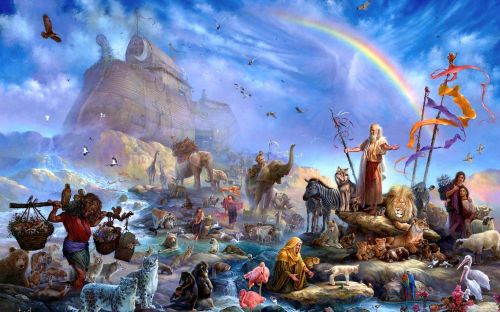
Recently I had an electronic exchange with a scoffer pretending to be a Christian. (“Wherefore by their fruits ye shall know them.” Matthew 7:20) This scoffer mocked the account of the Global Flood recorded in Genesis. He questioned the construction of the Ark, the collecting of the animals, the supposition that dinosaurs were carried onboard and the logistics of taking care of the menagerie. He asserted that dinosaurs did not live at the same time as the biblical account of the Flood, then chided that it made “me ashamed that fundamentalist Christianity is part of our culture, that these ‘adults’ actually live in a mass fantasy world, manipulated by others in their own fantasy world, some of whom have PhD after their name” – referring to creation scientists. He continued, “Don’t you realize that the New Testament gives us permission to abandon the fantastic myths of the Old Testament, and that the only teaching of Jesus is compassion, for which we don’t need a Bible, or for that matter, a religion?” (emphasis mine)

Proverbs teaches us to “Answer a fool according to his folly, lest he be wise in his own conceit.” (Proverbs 26:5) I assumed the scoffer to be “Christian” from his suggestion “that the New Testament gives us permission to abandon the fantastic myths of the Old Testament.” Although I found it rather astounding that a “Christian” would only accept less than one-third of the Bible. Obviously, he does not know his Bible very well, which is not something for which to be proud, if one really is a Christian. Consider the following:

In the beginning was the Word, and the Word was with God, and the Word was God. The same was in the beginning with God. All things were made by him; and without him was not any thing made that was made … And the Word was made flesh, and dwelt among us, (John 1:1-3, 14)

Obviously, that is talking about Jesus, but compare that with Genesis 1:1 “In the beginning God created the heaven and the earth.” Here the New Testament (NT) claims that Jesus IS God. That being the case, consider the following:

But from the beginning of the creation God made them [Adam and Eve] male and female. For this cause shall a man leave his father and mother, and cleave to his wife; And they twain shall be one flesh: so then they are no more twain, but one flesh. (Mark 10:6-8, emphasis mine)

For in those days shall be affliction, such as was not from the beginning of the creation which God created unto this time, neither shall be. (Mark 13:19, emphasis mine)

Ye are of your father the devil, and the lusts of your father ye will do. He was a murderer from the beginning, and abode not in the truth, because there is no truth in him. When he speaketh a lie, he speaketh of his own: for he is a liar, and the father of it. (John 8:44, emphasis mine)

In the verse above Jesus was referring to Genesis 3:1-5, “Now the serpent [the devil] was more subtil than any beast of the field which the LORD God had made. And he said unto the woman, Yea, hath God said, Ye shall not eat of every tree of the garden? … And the serpent said unto the woman, Ye shall not surely die” (emphasis mine)

But as the days of Noe [Noah] were, so shall also the coming of the Son of man be. For as in the days that were before the flood they were eating and drinking, marrying and giving in marriage, until the day that Noe entered into the ark, (Matthew 24:37-38, see also Luke 17:26-27, emphasis mine)

Verily I say unto you, It shall be more tolerable for the land of Sodom and Gomorrha in the day of judgment, than for that city. (Matthew 10:15, emphasis mine)

But I say unto you, That it shall be more tolerable for the land of Sodom in the day of judgment, than for thee. (Matthew 11:24, emphasis mine)

And whosoever shall not receive you, nor hear you, when ye depart thence, shake off the dust under your feet for a testimony against them. Verily I say unto you, It shall be more tolerable for Sodom and Gomorrha in the day of judgment, than for that city. (Mark 6:11, emphasis mine)

But the same day that Lot went out of Sodom it rained fire and brimstone from heaven, and destroyed them all. (Luke 17:29, emphasis mine)

For as Jonas [Jonah] was three days and three nights in the whale’s belly; so shall the Son of man be three days and three nights in the heart of the earth. The men of Nineveh shall rise in judgment with this generation, and shall condemn it: because they repented at the preaching of Jonas; and, behold, a greater than Jonas is here. (Matthew 12:40-41, emphasis mine)

Jesus said unto them, Verily, verily, I say unto you, Before Abraham was, I am. (John 8:58, emphasis mine)

By now, it should be obvious to even the most Bible illiterate that Jesus, who is God the Creator, affirmed the “myths” of the Old Testament (OT). Not only that, but being God Himself, He is also Author of those “myths.” The NT says that ALL Scripture is “breathed out” by God.

All scripture is given by inspiration of God, and is profitable for doctrine, for reproof, for correction, for instruction in righteousness (2 Timothy 3:16, emphasis mine)

Knowing this first, that no prophecy of the scripture is of any private interpretation. For the prophecy came not in old time by the will of man: but holy men of God spake as they were moved by the Holy Ghost. (2 Peter 1:20-21, emphasis mine)

The writers of the NT only knew the OT as “Scripture.”  So, how did they view the “myths” of the OT?

And to make all men see what is the fellowship of the mystery, which from the beginning of the world hath been hid in God, who created all things by Jesus Christ: (Ephesians 3:9, emphasis mine)

He that committeth sin is of the devil; for the devil sinneth from the beginning. For this purpose the Son of God was manifested, that he might destroy the works of the devil. (1 John 3:8, referring to Genesis 3:1-5, emphasis mine)

By faith Noah, being warned of God of things not seen as yet, moved with fear, prepared an ark to the saving of his house; by the which he condemned the world, and became heir of the righteousness which is by faith. (Hebrews 11:7, emphasis mine)

Which sometime were disobedient, when once the longsuffering of God waited in the days of Noah, while the ark was a preparing, wherein few, that is, eight souls were saved by water. (1 Peter 3:20, emphasis mine)

And [God] spared not the old world, but saved Noah the eighth person, a preacher of righteousness, bringing in the flood upon the world of the ungodly; And turning the cities of Sodom and Gomorrha into ashes condemned them with an overthrow, making them an ensample unto those that after should live ungodly; (2 Peter 2:5-6, emphasis mine)

Even as Sodom and Gomorrha, and the cities about them in like manner, giving themselves over to fornication, and going after strange flesh, are set forth for an example, suffering the vengeance of eternal fire. (Jude 1:7, emphasis mine)

By faith they [Israel] passed through the Red sea as by dry land: which the Egyptians assaying to do were drowned. By faith the walls of Jericho fell down, after they were compassed about seven days. (Hebrews 11:29-30, emphasis mine)

So, the NT confirms all of these “myths.” What then should we do? Discard the New Testament? If Jesus is who the NT says He is, then the scoffer needs to rethink his prideful arrogance. If all the accounts of the OT are simply myths, then Jesus was either misinformed, which precludes His omniscience, or He was lying. In either case, He would be disqualified as God because God, by definition, is all-knowing, and He cannot lie (Numbers 23:19; Hebrews 6:18)

If the scoffer really is a “Christian,” (which I doubt), he should take into consideration that the NT confirms the OT miraculous accounts. Therefore, at least by NT standards, the OT is true. If the OT is true, then science rightly practiced will validate what it has to say about Creation, the Fall, the Flood, and the division of nations, as well as all other fantastic accounts of the Bible. The Institute for Creation Research does scientific research that confirms what the Bible has to say about creation and other matters of science. The Bible is not a science text book, but when it speaks on scientific matters, it is accurate and trustworthy. The scoffer knows neither the Bible nor science.


3 Comments

Filed under Apologetics, Atheism, Bible, Christianity, Creation, End Times, Evangelism, Gospel, Origins, Religion, Satan, Science, Second Coming of Christ, Theology

What Next?

Happy-New-Year-2016-Images

Remember the former things of old: for I am God, and there is none else; I am God, and there is none like me, Declaring the end from the beginning, and from ancient times the things that are not yet done, saying, My counsel shall stand, and I will do all my pleasure:  (Isaiah 46:9-10)

The Christmas lights are down. The tree and the ornaments are put away. The year 2015 is history. As I mentioned in my previous post, the year began with great expectations, most of which did not materialize, much to my dismay.  But isn’t that the way it often happens! That aside, I did accomplish some personal goals. I donated[1] my 1/60-scale model of Noah’s Ark[2] to the Institute for Creation Research.  I read the English Standard Version (ESV) Bible through.  My wife and I signed up with a physical trainer in May and stuck with the program. I lost 25 pounds, so far, and gained noticeable strength and endurance, which encouraged my doctor to take me off of my blood pressure meds. We also took a cruise along the northeast coast which granted me a longtime dream of standing on the deck of the USS Constitution, “Old Ironsides” – a wish-come-true for this old Navy boy.

In retrospect, many positive experiences and accomplishments took place in 2015, but my greatest desire did not come to pass – the return of our Lord Jesus Christ. In spite of many positive “signs,” the Lord, in His omniscience, determined that the time was not right. That in itself is a positive thing, especially for those who are lost and in need of the Savior. God in His mercy has delayed His judgment on this world (2 Peter 3:9).

So, what is in store for 2016? What comes next? Will the Lord return in 2016, or will we go to meet Him in death? Will we enjoy good health or will we or one of our loved ones experience serious illness?  Will this be the year that our lost loved ones accept Jesus as their Lord and Savior? Will our national economy implode, or will it take an upswing turn for the better? Who will be voted President, and will he (or she) have a positive influence on the country? Will our nation once more get dragged into an unwanted war?

There are so many questions for which we cannot know the answers! Certainly as we analyze world affairs, the outlook seems grim, and it makes for a good source for depression. Several coping methods can be employed to deal with the unknown and unpredictable. We can isolate and insolate ourselves from negative input. Shut off TV news, turn off the radio, and stop reading newspapers, magazines and social media. Another option is to numb your mind through chemistry, entertainment, pleasure, or other distractions. If you can’t hear it, see it or feel it, it’s not really there. Right? A third option is to face the world head on. Be aware of what is going on around you and in the world. Prepare for adversity but with hope, not paranoia. Rest in the assurance that you are under God’s protection. “And fear not them which kill the body, but are not able to kill the soul: but rather fear him which is able to destroy both soul and body in hell. Are not two sparrows sold for a farthing? and one of them shall not fall on the ground without your Father … Fear ye not therefore, ye are of more value than many sparrows” (Matthew 10:28-29, 31).

What next? There is no way to know what the future holds, so trust Him who holds the future. “Take therefore no thought for the morrow: for the morrow shall take thought for the things of itself. Sufficient unto the day is the evil thereof” (Matthew 6:34). The Lord knows what 2016 will bring. He knows “the end from the beginning,” and we can be sure that He has included us in His plans. Happy 2016!

Notes:


[1]  http://www.icr.org/article/noahs-ark-model

[2]  https://erniecarrasco.com/2015/03/01/building-the-ark/

Comments Off on What Next?

Filed under Christianity, Current Events, End Times, New Year's Day, Religion, Second Coming of Christ, Theology

Almost Gone

new-year-clock

Brethren, I count not myself to have apprehended: but this one thing I do, forgetting those things which are behind, and reaching forth unto those things which are before, I press toward the mark for the prize of the high calling of God in Christ Jesus. (Philippians 3:13-14)

The presents are gone from under the tree. The wrappings, ribbons and bows are all in the trash, and all the guests left days ago. Not many days remain in what’s left of this year, and soon we’ll be singing “Auld Lang Syne.”

The older I get, the quicker the years seem to zoom by. This year is no exception. I must confess that this year has been somewhat of a disappointment to me. You may attribute that to the state of politics, the economy, the rise of terror, the decline of morality in our nation, etc., and while all those things can put a damper on one’s outlook, they really are not the source of my disappointment.

I started this year with the genuine hope that this would be the year that Christ returned, and we, His children, would be taken up in the clouds to meet Him in the air (1 Thessalonians 4:17).  Many of the signs seemed to converge to make a good case for this being the year. First there was the third Blood Moon of the rare tetrad at Passover in April that was preceded by a total solar eclipse in March. Then the fourth Blood Moon of the tetrad appeared during the Feast of Tabernacles in late September. Add to that, the final Blood Moon followed the end of the Shamitah which modern “prophets” saw as a sign of economic collapse, (which did not occur in any way to cause great consternation). To boot, all of this leads to the Year of Jubilee, which began on Rosh Ha-Shanna, September 13.

All this year, I have looked toward the eastern sky and cupped my ear for the sound of the trumpet, and it didn’t come.

Jesus did not come. 😦

I am disappointed, but not disheartened or discouraged. After all, Jesus said, “But of that day and that hour knoweth no man, no, not the angels which are in heaven, neither the Son, but the Father” (Mark 13:32, emphasis mine). The modern day prophets made some good guesses solidly based on Scripture, but they obviously missed it. To their credit, none would dogmatically set a date for Christ’s return, and all offered the disclaimer that God is not bound by their speculations. Still, there was the hope.

Should that hope be abandoned simply because mortal men guessed wrong? As Paul would say, “God forbid!” Jesus promised to return: “Let not your heart be troubled: ye believe in God, believe also in me. In my Father’s house are many mansions: if it were not so, I would have told you. I go to prepare a place for you. And if I go and prepare a place for you, I will come again, and receive you unto myself; that where I am, there ye may be also” (John 14:1-3, emphasis mine). There is absolutely no reason not to believe that He will do as He promised. The Old Testament is full of prophecies foretelling of His first coming, and all were proven true beyond any shadow of doubt. So accurately were those promises fulfilled, that the probability of one man fulfilling just eight of them is a virtual impossibility, yet Jesus fulfilled them all. If Scripture proved true about His first coming, then it will certainly prove true for His second coming.

A few days still remain in 2015. Jesus may return before the clock strikes midnight on December 31st, or He may yet delay. Twenty-Sixteen is the Year of Jubilee and that would be a great time for Christ to return. And what if He does not come in 2016? So what! Jesus promised He will return. In the meantime He said, “It is not for you to know the times or the seasons, which the Father hath put in his own power. But ye shall receive power, after that the Holy Ghost is come upon you: and ye shall be witnesses unto me both in Jerusalem, and in all Judaea, and in Samaria, and unto the uttermost part of the earth” (Acts 1:7-8, emphasis mine). “Go ye therefore, and teach all nations, baptizing them in the name of the Father, and of the Son, and of the Holy Ghost: Teaching them to observe all things whatsoever I have commanded you: and, lo, I am with you alway, even unto the end of the world. Amen” (Matthew 28:19-20, emphasis mine). We must do this because, “The Lord is not slack concerning his promise, as some men count slackness; but is longsuffering to us-ward, not willing that any should perish, but that all should come to repentance” (2 Peter 3:9, emphasis mine). Likewise, we should not be willing that any should perish.

Does this mean I should stop looking and listening? Of course not! “Blessed is he that readeth, and they that hear the words of this prophecy, and keep those things which are written therein: for the time is at hand” (Revelation 1:3, emphasis mine). “Henceforth there is laid up for me a crown of righteousness, which the Lord, the righteous judge, shall give me at that day: and not to me only, but unto all them also that love his appearing” (2 Timothy 4:8). So, no lollygagging! There is work yet to be done! “Blessed is that servant, whom his lord when he cometh shall find so doing” (Matthew 24:46). Perhaps in 2016!

2 Comments

Filed under Apologetics, Christianity, Current Events, End Times, Evangelism, Gospel, New Year's Day, Religion, Salvation, Second Coming of Christ, Theology

A Day Is A Day

Evening and Morning Was One Day

Evening and Morning Was One Day

For a thousand years in thy sight are but as yesterday when it is past, and as a watch in the night. (Psalm 90:4)

In a previous post, No Gap, I discussed the “Gap Theory” compromise of the biblical creation account.  The Gap Theory is only one of several compromises of theistic evolution.[1] Another popular compromise is the “Day-Age Theory.” This offshoot of theistic evolution maintains that God used long ages – billions of years – and evolution to create rather than the six literal days stated in the Bible. The Day-Age Theory attempts to stretch the days in Genesis 1into six long periods of undetermined time. “[The] ‘days’ of creation were interpreted figuratively as the ‘ages’ of geology.”[2]  In order to back up that assertion, the proponents of the Day-Age Theory will cite the psalm above or 2 Peter 3:8: “But, beloved, be not ignorant of this one thing, that one day is with the Lord as a thousand years, and a thousand years as one day.”

Besides the hermeneutical problems with this view, a logical dilemma arises that refutes any form of theistic evolution. To see this, one must have a clear understanding of who God is and what His attributes say about Him. To begin with, God is inconceivably great beyond anything the human mind can imagine. “For my thoughts are not your thoughts, neither are your ways my ways, saith the LORD. For as the heavens are higher than the earth, so are my ways higher than your ways, and my thoughts than your thoughts” (Isaiah 55:8-9, emphasis mine). Considering God’s “thoughts,” one of His attributes is that of omniscience; He is “all-knowing.” Hence, He innately knows all that can be known, and there is nothing He does not know. “Shall any teach God knowledge?” (Job 21:22). “Shall he that contendeth with the Almighty instruct him?” (Job 40:2). “For who hath known the mind of the Lord, that he may instruct him?” (1 Corinthians 2:16). Since that is so, why would God need to take billions of years to create by means of evolution, slowly developing from a single cell one thing, and then the next, and then the next, etc. until in the end He evolved man? That makes God out to be something of a mad scientist experimenting in a laboratory to see what He can come up with next. God does not need to experiment! God has nothing to learn; He has no need to practice. Besides all that, billions of years of evolution also involves billions of years of death. This is contrary to God’s nature. “In him was life; and the life was the light of men” (John 1:4, emphasis mine). God is concerned with life, not death. “The last enemy that shall be destroyed is death” (1 Corinthians 15:26, emphasis mine). If death existed before the completion of creation, God would have erred when He said that it was “very good” (Genesis 1:31). Besides that, death before the fall creates greater theological problems. (I deal with this issue in No Gap.)

In addition we must consider God’s omnipotence; He is “all-powerful.” There is nothing He cannot do. “Is any thing too hard for the LORD?” (Genesis 18:14). “Behold, I am the LORD, the God of all flesh: is there any thing too hard for me?” (Jeremiah 32:27). “With men this is impossible; but with God all things are possible” (Matthew 19:26). “The things which are impossible with men are possible with God” (Luke 18:27). “For with God nothing shall be impossible” (Luke 1:37).

Given that God is all-knowing and all-powerful, i.e., there is nothing impossible for Him, it is not unreasonable to believe the Genesis literal six-day account of creation. In fact, given His omniscience and omnipotence, He could certainly have created in an instant what He took six days to create.

Simple logic with a basic understanding of God’s nature refutes theistic evolution and the Day-Age Theory. Furthermore, these compromises fail when applying proper hermeneutical principals. A plain reading and understanding of the text of Genesis 1, as I explained in No Gap, precludes any possibility of long ages. The Hebrew word, yom, for day can only mean a normal 24-hour day. To further stress this point, God encapsulated the completion each creation day between the boundaries of “evening and morning.” There is no other way to interpret this narrative without pulling in from outside sources information not contained within the text. This system of hermeneutics is known as eisegesis – reading into the text what is not there.

The proponents of the Day-Age Theory in attempting to legitimize their compromise will cite 2 Peter 3:8 and Psalm 90:4, but when properly interpreted, in context, these passages speak of God’s eternal nature and have nothing to do with specifying time limits. God is not bound or limited by time; His transcendent nature places Him outside and inside of time simultaneously. Therefore, one day with Him is like one thousand years and one thousand years is like a day. Peter employs a literary device known as simile; otherwise he would have left off the “like.” Likewise Moses in his psalm says, “For a thousand years in thy sight are but as yesterday when it is past, and as a watch in the night” (Psalm 90:4, emphasis mine). But when God says He completed the work in one day, He means one day. So, why did He take six days to create rather than an instant? He created in six days and rested on the seventh day to set the pattern for our work week – six days of work, one day of rest. Have you noticed that the seven-day week is ubiquitous around the world? Furthermore, He wrote it in stone: “Remember the sabbath day, to keep it holy. Six days shalt thou labour, and do all thy work: But the seventh day is the sabbath of the LORD thy God: in it thou shalt not do any work, thou, nor thy son, nor thy daughter, thy manservant, nor thy maidservant, nor thy cattle, nor thy stranger that is within thy gates: For in six days the LORD made heaven and earth, the sea, and all that in them is, and rested the seventh day: wherefore the LORD blessed the sabbath day, and hallowed it” (Exodus 20:8-11, emphasis mine). The Hebrew word yom for “day” used here in the Fourth Commandment, is the same word yom used in Genesis 1. God was not talking about long ages when He gave this commandment, and He was not talking about long ages when He gave His creation account.

Another argument offered by the compromisers suggests that Genesis uses “poetic” language. This argument falls apart simply by comparing the narrative text of Genesis 1-4 with the literary style of parallelism employed in the Wisdom Books: Job, Psalms, Proverbs, Ecclesiastes and the Song of Songs (Song of Solomon). One does not even need knowledge of Hebrew to see the difference. So, claiming that Genesis 1 employs poetic language is a weak argument in support of a sad compromise.

No long ages fit into the narrative of Genesis 1. The Day-Age Theory compromises and weakens the Word of God. It is a diabolical instrument of Satan to create doubt for God’s Word, and disparage the very character and nature of God. There is no gap in Genesis 1, and there are no long ages. A day is a day, plain and simple.

Notes:


[1]  Henry M. Morris, “Evolution and the Bible,” http://www.icr.org/article/evolution-bible/, accessed 10/23/15.

[2]  Ibid.

4 Comments

Filed under Apologetics, Bible, Christianity, Creation, Death, Evolution, Origins, Religion, Satan

Clothing

Fashion-And-Modern-Youth

Behold, I have caused thine iniquity to pass from thee, and I will clothe thee with change of raiment.   (Zechariah 3:4b)

Someone asked about clothing. How did it develop, and what does the Bible have to say about it? If you consult secular sources, you may learn that “Evidence suggests that human beings may have begun wearing clothing as far back as 100,000 to 500,000 years ago.”[1] Of course, those guesses find their basis in evolutionary thought, which is inconsistent with biblical chronology.  These same sources admit that “It is not known when humans began wearing clothes, but anthropologists believe that animal skins and vegetation were adapted into coverings as protection from cold, heat and rain…”[2] We can agree that clothing has been important in human history from the very beginning.  “The wearing of clothing is exclusively a human characteristic and is a feature of most human societies.”[3] I do not know this for a fact, but I would venture to say all human societies, even the most primitive, wear some type of clothing.

As for what the Bible has to say, Genesis 2:25 tells us that both the man and the woman were naked at the time of their creation. Genesis 3:7-8 tells us that after they sinned, they discovered that they were naked, and were ashamed. Why were they ashamed? I cannot be dogmatic about this, but I think that when they were first created (in the image of God), they had an aura (light) about them. I arrive at this conclusion from examples given in the Bible of individuals, like Moses, acquiring a glow or radiance about them from being in the presence of God. Angels are described as having this glow (Acts 10:30). Jesus had this glow at His transfiguration (Matthew 17:2), and He has it in the descriptions of Him given in Revelation 1:16. So, I believe Adam and Eve had this glow about them, and when they sinned, the light went out, and they saw that they were naked. More than that, they recognized that they had lost something of the image of the One in whose image they were made. They lost their identity with their Creator, and they were afraid (Genesis 3:10).

At the end, God (and I believe this was God in human form – the pre-incarnate Christ) sacrificed innocent animals (probably sheep or goats), and He made clothes to cover the fallen couple. There is an interesting but subtle play on words here with the Hebrew word for skins – ‛ôr. It is pronounced the same as the Hebrew word for light – ‘ôr – but it is spelled differently. The former is spelled with an aleph (א), and the latter is spelled with an ayin, (ע). Before the Fall, they were clothed in light, ‛ôr, and after the Fall they were clothed in skins, ‘ôr. That Jesus shed the blood of innocent animals in order to provide coverings for His fallen creatures, Adam and Eve, speaks of “atonement” – Hebrew kâphar meaning “to cover.” We see in this a representation of the Gospel: Jesus, the innocent Lamb of God, shedding His blood to cover our sins.

Our clothing, then, should serve as a reminder of our sinfulness and of God’s provision for covering that sin. Like the fig leaves Adam and Eve sewed together (Genesis 3:7), our clothing is inadequate to cover our sins. Clothes wear out, they get dirty, or they fall out of fashion. Daily we have to change one outfit for another. However, in heaven, our clothing will not wear out or have to be replaced.[4] “After this I beheld, and, lo, a great multitude, which no man could number, of all nations, and kindreds, and people, and tongues, stood before the throne, and before the Lamb, clothed with white robes, … These are they which came out of great tribulation, and have washed their robes, and made them white in the blood of the Lamb” (Revelation 7:9, 14). I do not know, but I think that our “robes” will be that same “light” which covered Adam and Eve before the Fall.

Do you have your heavenly wardrobe reserved? If you are not sure, here are some other articles that may help answer your questions:

No One Escapes Judgment

You Don’t Go to Hell Because You’re A Sinner

Only One Way In

Notes:


[1]  https://en.wikipedia.org/wiki/History_of_clothing_and_textiles accessed October 9, 2015.

[2]  Ibid.

[3]  Ibid.

[4]  See “Clothing In Heaven” https://erniecarrasco.com/2014/11/30/clothing-in-heaven/

3 Comments

Filed under Apologetics, Christianity, Creation, Current Events, End Times, Gospel, Heaven, Salvation, Second Coming of Christ, Theology