Tag Archives: God

The Man Upstairs

Thou shalt not take the name of the LORD thy God in vain; for the LORD will not hold him guiltless that taketh his name in vain. (Exodus 20:7)

I am certain that every writer experiences “writer’s block” occasionally. For me, it occurs more often than I would like. Most often it happens when I have neglected spending consistent time in the Word. Since this blog is biblically based, it is important that I remain faithful to Bible reading from which I draw my inspiration.

Those who follow this blog know that I post something every Sunday morning. I have no obligation to write. This blog does not contribute to my livelihood in any way, so if the “well is dry” no harm is done if I skip a week or two. However, when I started this blog, I committed to produce something regularly that would benefit the readers. Besides those who subscribe to this blog, I get readers from all over the world, so I take care to rightly divide the Word of truth[1] knowing that I am accountable to God for the way I handle His Word. I am also keenly aware that not everyone that reads my blog is a born-again Christian. So, I do my best and pray that God will use it for His glory.

Anyway, this was one of those weeks, and I kept praying that God would give me something for subject matter. When I find myself in an empty well, God often gives me inspiration from the most unusual sources.

This week I received it from the evening sportscast. I am not at all interested in sports. Oh, I like to watch a good game now and then, but I am not a fanatic about any sport or any team. However, as I sat in front of my TV set with my reheated Tex-Mex leftovers, paying more attention to my refried beans and enchiladas than to the programming, I caught a brief sound bite from the sportscaster that perked up my ears. As I said, I am uninterested in sports so the details eluded me. He mentioned some football player who was traded for a better deal. The sportscaster attributed the player’s windfall to divine intervention from “the big guy upstairs.” Why did he not just say “God”?

I hear similar epithets for God all the time – “the man upstairs,” “the big guy upstairs,” or just “the big guy” (spoken with eyes cast skyward), etc. It always bothers me when I hear this, but it bothers me worse when I hear it from Christians.

What! You’re embarrassed to say, “God”?

I am sure it bothers me more than it bothers God. After all, judgment day is coming, and that matter will be settled when all creation stands before the King of Kings and Lord of Lords.[2] When Isaiah came face to face before God, he fell on his face and cried, “Woe is me! for I am undone; because I am a man of unclean lips, and I dwell in the midst of a people of unclean lips: for mine eyes have seen the King, the LORD of hosts” (Isaiah 6:5).

Perhaps such epithets sprang up from a desire not to violate the third commandment (our verse above)[3] much like Jews avoid pronouncing the name of God, Yahweh. To avoid the infraction, they will say Adoni (“Lord”) or Ha-Shem (“The Name”). However, the intent of the commandment was for us to hold the name of God in reverence and not to cast it about carelessly.

How we use God’s name betrays how we value Him in our heart.[4] The sportscaster could have said that God intervened on behalf of the football player, and it would have been just as demeaning. The reason for this is the assumption that God had anything to do with it in the first place, and the sportscaster’s smirk indicating that he did not believe what he was saying to begin with. (I do not know that for certain as only God knows the heart.)

The practice of using epithets for God violates the third commandment, although not always. Referring to God in any careless way breaks the commandment. Even when one intends to be respectful by not using the name of God, the use of the epithet demeans the name of God. He is not the “man upstairs.” He is not a man at all.[5] He is the Creator of heaven and earth. He is the One who gives life and breath to all.[6] We should never refer to Him lightly or carelessly in our conversation. When we speak His name, it should only be with reverence and in a way that honors and glorifies Him, and we should never be ashamed or embarrassed to say His name. We do this when we testify what great things God has done for us. We do this when we speak of His love for us and for others, how He sent His Son to die on the cross for our sins. This is how we should use God’s name, and use it often. Do not use His name frivolously, and certainly do not demean His great character by calling Him “the man upstairs.”

Notes:


[1]  2 Timothy 2:15

[2]  1 Timothy 6:14-15

[3]  Exodus 20:7

[4]  Note: “God” is what He is, not who He is. His name is Yahweh and He has other names ascribed to Him that tell us something about His nature – like, God Almighty, God of Hosts, LORD Provider, et al.

[5]  John 4:24

[6]  Isaiah 42:5; John 6:33

3 Comments

Filed under Apologetics, Christianity, Gospel, Theology

Homesick

Be ye therefore ready also: for the Son of man cometh at an hour when ye think not. (Luke 12:40)

“Better to be seen than viewed” someone responds when greeted with, “Good to see you!” Sometimes the salutation of “How’re you doing” gets the retort, “Any day above ground is a good day!” Someone else might say, “Better than the alternative!”

Those are funny ways to say that it is good to be alive, but those who make such remarks have not given the “alternative” a lot of thought. In their mind they see death something to delay or avoid altogether. The truth is that no one gets out of this world alive.[1] “And as it is appointed unto men once to die, but after this the judgment” (Hebrews 9:27).

The Christian should welcome death “willing rather to be absent from the body, and to be present with the Lord” (2 Corinthians 5:8). Having circled the sun 69.33 times, the miles have taken their toll, and I feel the aches and pains that accompany the second law of thermodynamics. I have no fear of death, however, the process of dying does not appeal to me. When someone suggests that this life is better than the alternative, I quickly reply, “Oh no it’s not.”

I am homesick for my eternal home. My mother and father and many of my relatives wait for me there. I look forward to seeing friends that have gone ahead of me. I often wonder if I will recognize them. They will all be young – no wrinkles, no gray hair, no bald heads (yay!). “And God shall wipe away all tears from their eyes; and there shall be no more death, neither sorrow, nor crying, neither shall there be any more pain: for the former things are passed away” (Revelation 21:4). I have arthritic knees that prevent me from doing things I used to do; I do not bend as well as I used to. I have carpal tunnel syndrome that makes my hands tingle all the time, and I get these horrible leg cramps that wake me up in the middle of the night. I really look forward to “no more pain.”

Before going to the cross, Jesus promised, “In my Father’s house are many mansions: if it were not so, I would have told you. I go to prepare a place for you” (John 14:2, emphasis mine). From this translation, we get the crazy idea that Jesus will build us all palatial mansions in heaven. Reading this verse brings the words of the old gospel song to mind: “I’ve got a mansion just over the hilltop in that bright land where we’ll never grow old.” However, that minimizes what Jesus has in store for us. The word “mansion” is a poor translation for the Greek word monē which simply means “a staying, abiding, dwelling, abode.” Heaven will be our dwelling place, and from the description I read in the Bible, we will have no need for “shelter” there.

The dwelling place Jesus has prepared for us is the New Jerusalem.[2] The place is illuminated by the presence of God so that “the city had no need of the sun, neither of the moon, to shine in it” (Revelation 21:23). The river of life and the tree of life are there; all our physical needs will be met. “And there shall be no more curse…” (Revelation 22:3). “And there shall be no night there; and they need no candle, neither light of the sun; for the Lord God giveth them light: and they shall reign for ever and ever” (Revelation 22:5). What need is there for any mansion!

No pain. No tears. No sorrow. No death. No curse. No hunger or thirst. No night. No need for shelter in the perfect climate. The best part about heaven, the New Jerusalem, will be to dwell in the presence of our Creator and Savior, the Lord Jesus Christ.

An old friend from my distant past used to say, “Heaven is my home, but I’m not homesick for it yet.” Tommy was at least 15 years older than me when he said this. I have not heard from him in years. It is very possible that Tommy is experiencing heaven now and may be saying, “I am not homesick for heaven anymore.”

The longer I live in this fallen world that grows more wicked every day, the more homesick I get for my forever home. As I see the moral decline and the violence plaguing our land, the more I desire to go home. The signs of the times indicate that Jesus’ return is very near, but whether I cross the veil or meet Him in the air, I long to be home with my Lord. In the meantime, I will occupy until He comes.[3]

This world is not my home I’m just a passing through

My treasures are laid up somewhere beyond the blue

The angels beckon me from heaven’s open door

And I can’t feel at home in this world anymore

Oh lord you know I have no friend like you

If heaven’s not my home then Lord what will I do

The angels beckon me from heaven’s open door

And I can’t feel at home in this world anymore

Just over in gloryland we’ll live eternally

The saints on every hand are shouting victory

Their songs of sweetest praise drift back from heaven’s shore

And I can’t feel at home In this world anymore

Oh lord, you know I have no friend like you

If heaven’s not my home Then Lord what will I do

The angels beckon me From heaven’s open door

And I can’t feel at home In this world anymore[4]

Notes:


[1]  Actually, some will get out of this world alive (1 Corinthians 15:51-55).

[2]  Revelation 21:2, 10-25

[3]  Luke 19:13

[4]  “This World Is Not My Home” – Jim Reeves

2 Comments

Filed under Apologetics, Christianity, Death, End Times, Random Musings, Religion, Resurrection, Salvation, Second Coming of Christ, Theology

The Days of Noah

But as the days of Noe were, so shall also the coming of the Son of man be. (Matthew 24:37)

Last weekend was a sad time in American history. First, a mass murder took place at a Walmart in El Paso, Texas followed by another in Dayton, Ohio. The nation reels in the aftermath of such senseless violence groping for elusive answers to a problem with no apparent solution. The left blames the President claiming that his rhetoric is divisive and that it fans the flames of hatred. Others on the left blame the guns, and they want to ban all scary-looking rifles. Others want to legislate stricter gun laws. Even the President now calls for better background checks for gun purchases. Mr. President, we already have background checks for gun purchases. I had an FBI background check for every firearm I possess. Background checks will not stop wackos from getting their hands on firearms or from committing mass slaughter.

Several have accurately identified the problem as a problem of the heart, however, they fall short of coming up with a solution. As a Christian, I know the solution to the problem in every case. The answer is Jesus indwelling every individual heart, or at the very least, a clear understanding of who God is and every person’s accountability to Him. But that is out of the question. God is off-limits in our schools, our institutions of higher learning, in the public square and in our government. As long as that remains true, there is no solution to the growing violence in our nation.

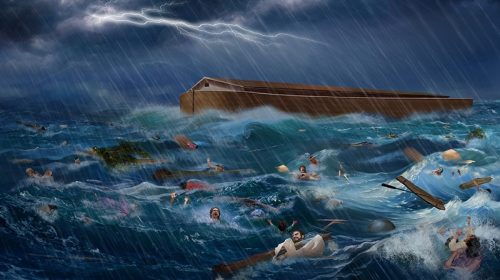
This is a sign of our times. Jesus said that the days nearing His return would be like the days of Noah. What were the days of Noah like? Genesis Chapter Six suggests that fallen angels (sons of God) were somehow “breeding” with human women and producing demigod-like creatures known as the Nephilim (“giants”).[1] Today transhumanists[2] seek to evolve humans to a higher level through gene manipulation. These people, undoubtedly guided by the same “sons of God,” are unwittingly doing the same thing that was going on in Noah’s day.

However, that is not all that took place in Noah’s day. The Bible tells us that people had become exceedingly wicked and violent.[3] Our world grows increasingly evil and violent. The LGBT… movement has forced its way into our society demanding not only tolerance but that we accept their deviance as “normal.” However, that is not enough, they want our children trained at a very early age that such behavior is normal and acceptable. Not only that, but children are encouraged to follow their examples. If this were not bad enough, we have those in our government that promote and encourage this perverse movement, and if we protest, we are the “haters.”

The violence continues. Not only do we have mass shootings, but we are seeing more “peaceful protests” against our elected (Republican) officials that are anything but peaceful. We are living in the “days of Noah,” and Jesus said, “For as in the days that were before the flood they were eating and drinking, marrying and giving in marriage, until the day that Noe entered into the ark, And knew not until the flood came, and took them all away; so shall also the coming of the Son of man be” (Matthew 24:38-39). I have heard many sermons preached on these verses and they all minimize the significance of the text. Yes, Jesus said that the people during this time would be conducting their lives as normal, clueless of the impending doom. What these preachers omit is that in the days of Noah, the world was filled with wickedness and violence with much demonic activity taking place.

We should not be surprised or amazed when we see these things taking place, nor should we think that we can solve the problem through any human measure. The only remedy for our sick world is for Jesus to return to set things right. He is the only answer. He is our only hope. Our days are as the days of Noah. That should alert us to Jesus’ imminent return. The time is right. Are you ready? If not, find out how to get ready by reading my page, “Securing Eternal Life.”

Notes:


[1]  Genesis 6:1-4

[2]  Transhumanism – https://en.wikipedia.org/wiki/Transhumanism

[3]  Genesis 6:5, 11

7 Comments

Filed under Apologetics, Christianity, Current Events, End Times, Second Coming of Christ, Theology

The Gap – Not the Store

In the beginning God created the heaven and the earth. And the earth was without form, and void; and darkness was upon the face of the deep. And the Spirit of God moved upon the face of the waters. (Genesis 1:1-2)

For almost 200 years, well-meaning theologians have attempted to defend the veracity of the Bible against the current scientific discoveries that cast doubt on the truth of God’s word. Rather than taking a firm stand for what the Bible plainly teaches, they try to find ways to reconcile what the Bible says with what scientists say by way of compromises. One such popular compromise is known as the Gap Theory.

Because many theologians have been duped into believing that scientists have proven that the earth is billions of years old (4.5 billion to be precise), they need to find a place in Scripture to account for that vast amount of time. They recognize that biblical chronology only accounts for approximately 6000 years of earth history. They face a dilemma. How do they remain faithful to a literal interpretation of biblical creation and still maintain good rapport with the scientific community? They solve the problem by placing a gap of unknown time between verses one and two of Genesis 1.

However, with what does one fill a gap of billions of years while maintaining some credible ties to Scripture? According to Hugh Ross (who has his own issues with a young earth), “A few Bible scholars of the seventeenth century, wishing to establish the timing of Satan’s fall and the angels’ rebellion, had proposed a narrative gap (hence, a time gap of unspecified duration) between the creation of the universe (“the heavens and the earth” of Genesis 1:1) and the events of the creation week (Genesis 1:3-27) … Eighteenth century advocates of this view placed the gap precisely between Genesis 1:1 and Genesis 1:2, suggesting that Earth began, perhaps eons ago, as the abode of angels who ravaged and ruined it when they fell.”[1]

Genesis 1:1 refers to God’s initial perfect creation. Everything that God made was beautiful, there was no sin anywhere. Verse two, on the other hand, assumes that a great catastrophe occurred that caused the earth to become in a chaotic state through the judgment of God. According to the Gap Theory, the formless and void state, as recorded in Genesis 1:2, is in direct contrast to the perfect initial creation. Something happened between the first two verses of Genesis to cause the earth to become desolate and uninhabitable after having been made perfect. Those holding the Gap Theory contend that this state of ruin could have possibly lasted millions of years … The judgment is usually spoken of as a flood because of the statement of Genesis 1:2 – the earth was covered by water. This judgment is also known as the Luciferic flood named after the angel who became the devil. The cause for the judgment is usually given as the rebellion of Satan or some pre-Adamic race that sinned. All of the inhabitants of the earth were judged by God, leaving behind fossil remains.”[2]

When one reads the text of Genesis 1:1-2 and following verses giving the words their normal meaning in their normal context, it becomes obvious that much imaginative speculation must take place to insert millions or billions of years between verses one and two. From where did these ideas originate?

According to Dr. John D. Morris, “This particular compromise didn’t just appear; it’s been around at least since the early 1800s when old-Earth ideas were floated by James Hutton and Charles Lyell. Many theologians, under the mistaken impression that scientists had proved it, rushed to incorporate an old Earth into Scripture, hoping to maintain credibility with secular scientists”[3]

Sir Charles Lyell (1797-1876) “was a Scottish geologist who demonstrated the power of existing natural causes in explaining Earth history. He is best known as the author of Principles of Geology (1830-33 and later editions), which presented for a wide public audience the idea that the Earth was shaped by the same natural processes still in operation today, operating at similar intensities … The combination of evidence and eloquence in Principles convinced a wide range of readers of the significance of ‘deep time’ for understanding the Earth and environment … Building on the innovative work of James Hutton and his follower John Playfair, Lyell favoured an indefinitely long age for the Earth, despite evidence suggesting an old but finite age.”[4]

Confronted with such “evidence,” theologians quickly came to the Bible’s rescue. “Gap creationism became increasingly attractive near the end of the 18th and first half of the 19th centuries, because the newly established science of geology had determined that the Earth was far older than common interpretations of Genesis and the Bible-based flood geology would allow. Gap creation allowed religious geologists (who composed the majority of the geological community at the time) to reconcile their faith in the Bible with the new authority of science … From 1814, gap creationism was popularized by Thomas Chalmers, who attributed the concept to the 17th-century Dutch Arminian theologian Simon Episcopius.”[5] Chalmers’ “view was popularized by the Plymouth Brethren writer G. H. Pember in his book Earth’s Earliest Ages in 1876.”[6] “It gained widespread attention when a ‘second creative act’ was discussed prominently in the reference notes for Genesis in the influential 1917 Scofield Reference Bible.”[7]

Others came along later like Harry Rimmer (1890-1952). Rimmer “was an American evangelist and creationist. He is most prominent as a defender of creationism in the United States, a fundamentalist leader and writer of anti-evolution publications. He was the founder and President of the Science Research Bureau, Incorporated, a corporation set in Los Angeles, California, whose purpose he established as to prove the veracity of the Bible through studies of biology, paleontology and anthropology.”[8]

Surprisingly, many who profess to defend the inerrancy and infallibility of the Bible still hold to the Gap Theory and an old earth. One that I closely follow for his teachings on end-times prophecy is Gary Stearman of “Prophecy Watchers” based in Norman, Oklahoma.[9] In all other respects, Stearman is an excellent Bible teacher, but in this one area, he stumbles. He is not the only one. Dr. Arnold G. Fruchtenbaum founder of Ariel Ministrires[10] and excellent O.T. scholar says,

I do believe there is a gap of time between verses 1 and 2, but we must be very careful not to ascribe a gap there for the wrong reasons as people have done so often. They have also used it as a convenient place to fit in such things as the geological ages, the fossil record, dinosaur space, and the like. I do not believe the gap allows for dinosaur space because the Bible teaches that there was not any kind of physical death until Adam’s Fall. Rather, the gap is there for only one reason, the fall of Satan that will, in turn, account for the chaos described in verse 2. Hence, the gap need not be very long at all.[11]

Since so many respected theologians defend the Gap Theory, is there any biblical support for their position? As stated before, those who hold to the Gap Theory have been convinced by secular geologists that the earth is billions of years old based on their interpretation of the geologic column, the fossil record, and radiometric dating. Another factor that often comes into play is the distant starlight problem. Faced with these challenges, their inability to respond intellectually, and their strong conviction of the inerrancy and infallibility of God’s Word, they try to accommodate God’s Word to fit what the secular scientists are saying. In a word, they compromise.

Genesis 1 records creation in six 24-hour days and Gap theorists defend this position. However, biblical chronology, beginning with Genesis 5, limits the age of the earth to only about 6000 years. So how does one account for the 4.5 billion year age of the earth that secular scientists claim? Gap theorists found a way to squeeze billions of years between verse one and verse two of Genesis 1.

Genesis 1:2 says, “And the earth was without form, and void…” The Hebrew word translated “was” is hâyâh. Strong’s defines hâyâh as to exist, that is, be or become, come to pass (always emphatic, and not a mere copula or auxiliary). Gap theorists interpret hâyâh as “became;” therefore, “And the earth became formless and void.” Furthermore, the Hebrew words translated “without form and void” are tôhû (to lie waste; a desolation, formlessness, confusion, unreality) and bôhû (emptiness, void, waste, or ruin). According to the Gap Theory, “In the beginning God created the heaven and the earth” (Genesis 1:1), for an unspecified length of time and then the earth became tôhû and bôhû. God created a perfect world, and then the earth became tôhû and bôhû. What happened?

Rather than to simply admit they do not know what happened, they look to Scripture to fill the Gap. Ken Ham quotes, Weston W. Fields in his book, Unformed and Unfilled (page 7), “In the far distant, dateless past God created a perfect heaven and perfect earth. Satan was ruler of the earth, which was peopled by a race of ‘men’ without any souls. Eventually, Satan, who dwelled in a Garden of Eden composed of minerals (Ezekiel 28), rebelled by desiring to become like God (Isaiah 14). Because of Satan’s fall, sin entered the universe and brought on the earth God’s judgment in the form of a flood (indicated by the wafer of 1:2), and then a global ice age when the light and heat from the sun were somehow removed. All the plant, animal, and human fossils upon the earth today date from this ‘Lucifer’s Flood’ and do not bear any genetic relationship with the plants, animals and fossils living upon the earth today.”[12]

They had to fill the gap with something, but all their attempts to reconcile Scripture to science amount to nothing more than conjecture and speculation.  For example, the idea of “soulless men” is inconsistent with God’s character and the notion of “Lucifer’s Flood” finds no biblical support. Their appeal to Scripture with regard to Isaiah 14:12-15 and Ezekiel 28:12-19 does have some merit as they do speak of Satan’s fall. However, neither of these passages gives any hint of time, other than to imply that Satan’s fall occurred early on after Creation. “Thou hast been in Eden the garden of God…” (Ezekiel 28:13) According to Genesis 2:8, God planted the Garden of Eden on Day Six for Adam’s habitation; therefore this cannot refer to some unknown past.

One major hermeneutical problem with the Gap Theory is with the translation of the Hebrew verb hâyâh. “When this word [be] is printed in italics in the common English version, there is no corresponding word in the original text; when it occurs in common type [i.e., not italicized], it is generally the representative of hayah, havah, hava, “to be” in Hebrew.”[13] Sometimes hâyâh is translated “become or became” for ease of reading more than anything else. For example, Genesis 2:7 “And the LORD God formed man of the dust of the ground, and breathed into his nostrils the breath of life; and man became a living soul” (Genesis 2:7). In this case, “became” could just as easily be translated “was” and it would still make perfect sense. As soon as God breathed the breath of life into his nostrils, the man was a living soul. So the Gap theorists do not have a Hebraic leg to stand on in translating hâyâh as “became.”

Another problem with the theory is that the conjunction at the beginning of the sentence (Hebrew vav or waw) is an indication of the continuation of what came before. Had the Author (God) desired to show a break in events, He could have used the conjunction ‘âz (“then”) as in Genesis 4:26, “And to Seth, to him also there was born a son; and he called his name Enos: then began men to call upon the name of the LORD.” The grammar in Genesis 1:2 gives no indication of a break in thought. There is no grammatical “gap.”[14]

Then comes the matter of the earth being “without form and void” – tôhû and bôhû. We have seen that the earth did not “become” tôhû and bôhû, but rather that it “was” tôhû and bôhû. In Verse 1, God created the universe with all its elements: time (the beginning), space (the heavens), and matter/energy (the earth). At this point, the “earth” (matter/energy) was formless and empty. God had not shaped it into anything yet. The second half of Verse 2 informs us that God at this point started shaping the raw materials. We find no hint of destruction and reconstruction in these verses.

In spite of their well-intentioned effort to reconcile the Genesis creation account with modern science, Gap theorists unwittingly create some serious theological problems. First of all, the Gap Theory calls God’s integrity into question. God’s assessment of His finished work would have to be found faulty. “And God saw every thing that he had made, and, behold, it was very good. And the evening and the morning were the sixth day” (Genesis 1:31). Sin, death, and destruction in some unknown past do not qualify as a good creation, much less a “very good” creation.

Secondly, sin did not enter the world through Adam as the Bible claims (Romans 5:12) because it was present at Satan’s fall. Furthermore, death could not be the result of sin if death was already in the world.

Thirdly, the death penalty for (Romans 6:23) sin makes no sense when death preceded Adam’s sin.

Fourthly, if sin and death preceded Adam, then Jesus dying to pay the wages of sin for man seems pointless.

I grew up as a poor preacher’s kid. The greatest lesson my dad ever taught me was that the Bible was true and faithful even when it is difficult to understand. Whether we understand it completely or not, we can trust it to be true. God’s Word does not need to be reconciled to man’s way of thinking. Man’s thinking needs to be reconciled to God’s Word. “For my thoughts are not your thoughts, neither are your ways my ways, saith the LORD. For as the heavens are higher than the earth, so are my ways higher than your ways, and my thoughts than your thoughts” (Isaiah 55:8-9). Later on, the Apostle Paul says something very similar. “Because the foolishness of God is wiser than men; and the weakness of God is stronger than men” (1 Corinthians 1:25). Gap theorists forget this principle; they sway to the “strength” of fallen men rather than hold fast to the “foolishness” of the pure Word of God.

Notes:


[1]  Hugh Ross, “Closing the Gap: A Scientist’s Response to the Gap Theory” – https://www.reasons.org/explore/publications/facts-for-faith/read/facts-for-faith/2001/01/01/closing-the-gap-a-scientist-s-response-to-the-gap-theory

[2]  Don Stewart, “What Is the Gap Theory? (The Ruin and Reconstruction Theory?)” – https://www.blueletterbible.org/faq/don_stewart/don_stewart_654.cfm

[3]  John D. Morris, Ph.D., “How Does Old Earth Thinking Affect One’s View of Scripture’s Reliability?” – https://www.icr.org/article/how-does-old-earth-thinking-affect-ones-view-scrip

[4]  “Charles Lyell” – https://en.wikipedia.org/wiki/Charles_Lyell

[5]  “Gap Creationism” – https://en.wikipedia.org/wiki/Gap_creationism

[6]  Hank Hanegraaff, “The Gap Theory of Genesis 1:2 by Lee Irons” – https://www.oneplace.com/ministries/bible-answer-man/read/articles/the-gap-theory-of-genesis-12-by-lee-irons-16836.html

[7]  “Gap Creationism” – Wikipedia

[8]  “Harry Rimmer” – https://en.wikipedia.org/wiki/Harry_Rimmer

[9]  Gary Stearman, Prophecy Wathers – https://prophecywatchers.com/gary-stearman/

[10]  http://www.Ariel.org/

[11]  Arnold Fructenbaum, “THE SEVEN DAYS OF CREATION: GENESIS 1:1 – 2:3”, p.10, article available in PDF format from the Ariel Ministries website.

[12]  Kenneth Ham, “Closing the Gap” – https://www.icr.org/article/closing-gap

[13]  Robert Young,  Young’s Analytical Concordance to the Bible, (Grand Rapids, Eerdmans Publishing, 1970), 73.

[14]  Ernesto E. Carrasco, “No Gap” – https://erniecarrasco.com/2015/10/18/no-gap/

3 Comments

Filed under Apologetics, Bible, Christianity, Creation, Origins, Religion, Satan, Science, Theology

Making Time Count

So teach us to number our days, that we may apply our hearts unto wisdom. (Psalm 90:12)

On Tuesday of this last week, I completed my 69th lap around the sun. The Sunday before, June and I led the last lesson in the Crown ™ Do Well: The Crown Biblical Financial Study.[1] The lesson was on “Eternity,” and one of the questions we were asked to ponder was this: “Estimate the number of days you have left on earth. How does this impact your thinking?” Wow! That is a sobering thought! Psalm 90:10 brings this thought into sharp focus. “The days of our years are threescore years and ten [70]; and if by reason of strength they be fourscore years [80], yet is their strength labour and sorrow; for it is soon cut off, and we fly away” For me, age 70 looms a mere 366 days (2020 is a leap year). And “if by reason of strength” I reach 80 years, that is only 4020 days away (there are three leap years between 2020-2030). For me, at least, that is not a lot of time. However, no one is guaranteed tomorrow; we are all living on borrowed time.

The same psalm, quoted above, offers a prayer to help us think soberly about the time we are given. “So teach us to number our days, that we may apply our hearts unto wisdom” (Psalm 90:12). Time is a precious asset and to squander it on frivolity[2] is poor stewardship. Frivolity opposes “wisdom.” God gives us all the freedom to “apply our hearts unto wisdom” or to apply our hearts to frivolity. That was heavy food for thought.

Then on Friday, our devotional in Days of Praise: “Redeeming the Time,”[3] by ICR’s founder, Dr. Henry M. Morris brought this thought back to mind. In the devotional, Dr. Morris points out that “time is a very valuable asset, in danger of being lost forever unless it is rescued or redeemed.” It occurs to me that we experience the “present” in nanoseconds.[4] We constantly move from the past into the future, so when we misuse time, that is lost forever. Therefore, the only way to “redeem” time is to redeem it in the “future” toward which we are moving. That requires thought and planning – always.

Dr. Morris further asserts, “If we squander our money or lose our health, there is always the possibility of earning more money or being restored to health, but wasted time is gone forever.”

As I begin my 70th trip around the sun, I want to remember what a precious commodity time is. I what to remember that the time I am given is not mine and it can be taken away from me at any time. Jesus said, “Lay not up for yourselves treasures upon earth, where moth and rust doth corrupt, and where thieves break through and steal: But lay up for yourselves treasures in heaven, where neither moth nor rust doth corrupt, and where thieves do not break through nor steal … But seek ye first the kingdom of God, and his righteousness; and all these things shall be added unto you. (Matthew 6:19-20, 33). My time belongs to God; therefore I want to invest it wisely in His kingdom. “So teach [me] to number [my] days, that [I] may apply [my] heart unto wisdom” (Psalm 90:12).

Notes:


[1]  Crown Financial Ministries website: https://www.crown.org/

[2]  Dictionary.Com definition of : frivolous: https://www.dictionary.com/browse/frivolous

[3]  Henry M. Morris, Ph.D., “Redeeming the Time”: https://www.icr.org/article/11211/

[4]  “No Time Like the Present”: https://erniecarrasco.com/2015/01/18/no-time-like-the-present/

4 Comments

Filed under Christianity, Heaven, Philosophy, Random Musings, Religion, Theology