Tag Archives: Religion and Spirituality

Lawlessness

And because iniquity shall abound, the love of many shall wax cold. (Matthew 24:12)

Anyone that halfway pays attention to the news – even the “lame-stream-media” – can see the unprecedented rise in crime these days. Mobs of black young people ransacking stores and running off with thousands of dollars’ worth of high-end merchandise. (I am not being racist; I am just stating the obvious for anyone paying attention. Security cameras don’t lie and they are not racists.) They get away with it because police are not allowed to stop them and leftist district attorneys refuse to prosecute them.

Many major American cities are infested with homeless people living in tents along major thoroughfares and some in neighborhoods. They use the streets as their toilets and numb themselves with illegal drugs. Rather than enforce no-loitering laws to clean up the streets, many cities dole out sanitary syringes to keep drug abusers from contracting hepatitis. Very compassionate!

Then there is the Black Lives Matter organization (many of whom are self-deprecating white people), which cares little about black lives and looks for any opportunity to riot and burn down private businesses. Who will be the next black man that violently resists arrest and gets himself killed by police to give these thugs an excuse to riot?

Crime is not limited to the “dregs” of our society. Crime exists in the highest levels of our government. There too, depending on the political party affiliation, crime goes unpunished. Without delving into the details, all one needs to do is mention the names – Clinton, Biden, Comey, Fauci, Palosi, Garland, etc. These treasonous lawbreakers make millions of dollars from the positions entrusted to them by American taxpayers, and the law seems to bypass them. In the meantime, the “Injustice Department” persecutes and prosecutes anyone who dares to challenge their status quo.

Quoting Jan Markell of Olive Tree Ministries, “What did you think the end-times would look like?” In the verse above, Jesus responded to His disciples when they asked, “Tell us, when shall these things be? and what shall be the sign of thy coming, and of the end of the world?” (Matthew 24:3). Jesus gave a detailed description of what the end-times would be like just before His return. One of the characteristics He gave was that “iniquity shall abound” (Matthew 24:12). The Greek word translated as “iniquity” is anomia, meaning “no law.” The Strong’s Dictionary defines it as “illegality, that is, violation of law or (generally) wickedness.” We see that everywhere. One does not need to be that old to notice the rapid rise in lawlessness, and it is happening worldwide.

In the same sentence, Jesus said, “the love of many shall wax cold” (Matthew 24:12). Surprisingly, the word Jesus used for “love” is agapē. That is the “unconditional” love given to another, whether deserved or not, and without expectation of reciprocation. Generally speaking, there is near zero of that kind of love being expressed anywhere. Love is certainly waxing cold.

The lack of love manifests in a variety of ways. In his final words to his protégé, Timothy, Paul predicts the loveless character of people in the “last days.”

This know also, that in the last days perilous times shall come. For men shall be lovers of their own selves, covetous, boasters, proud, blasphemers, disobedient to parents, unthankful, unholy, Without natural affection, trucebreakers, false accusers, incontinent, fierce, despisers of those that are good, Traitors, heady, highminded, lovers of pleasures more than lovers of God; Having a form of godliness, but denying the power thereof: from such turn away. (2 Timothy 3:1-5, emphasis mine)           

Let us examine some of these characteristics more closely. “Lovers of their own selves” characterizes egocentrism, self-centeredness, selfishness, etc. Marketers feed into the egocentrism of their target audience with the idea that “it’s all about YOU!” Self-love gives rise to covetousness, which in its essence is a desire for what others possess. Self-love also feeds the desire to “boast” about oneself whether the boast is justified or not. Self-love makes one “proud,” often without basis. Self-lovers are often “blasphemers” in that they attribute any praise they receive, whether from others or by self-delusion, to themselves rather than giving the glory to God. Such blasphemy takes many forms and finds its roots in humanism. Many scientists and those who worship “science” fall prey to that. They reject God and attempt to explain all of Creation by natural means, and attribute all human advances in medicine and technology to the inexhaustible (by their reckoning) abilities of mankind. That is blasphemy!

That they are “disobedient to parents” needs little explanation. One trip to Walmart ™ and watching some parents trying to control unruly children gives ample support for this truth. However, the result of such unruliness in children is the lawlessness of young adults. This is also characterized by “incontinence” (mentioned later on in the list). “Incontinence” here has nothing to do with the inability to control one’s bodily functions. In the King James vernacular, it simply means “lack of self-control.” It is the idea that “if it feels right, do it,” regardless of whether it is unlawful, immoral, or offensive,” and it plays right along with self-love. “To thyself be true” is the mantra. That, by the way, is satanic.

They are “unthankful” because they believe that anything that comes to them is due to them because they are “worth it.” They are “unholy,” the opposite of “holy,” which means to be “set apart” for God’s purposes. The “unholy” have no place for God.

They are “without natural affection.” I used to think this had to do with homosexuality. What it really means is to not have “natural affection.” The three English words translate the single Greek word “astorgos.” “Storgē” in Greek is “familial love” – the love one has for one’s natural family. The “a” prefix negates the word. Therefore, these people have no natural affection or love for their own families. This also springs from self-love.

All of these characteristics are interrelated and they stem from egocentrism. They are “trucebreakers,” i.e., they cannot be trusted to keep their word. They are “false accusers” – we see a lot of that going on with all of the Trump indictments. They are “fierce,” i.e., savage, violent, combative, etc. That they are “Despisers of those that are good” is demonstrated daily against those who are “pro-life,” those who promote heterosexual marriage, those who rightly believe humans do not cause “climate change,” those who stand for Judeo-Christian principles, those who believe and preach the Bible, etc.

They are “traitors;” they cannot be trusted. They are “heady,” i.e., rash, reckless, precipitate (i.e., “rushing headlong or rapidly onward”). They are “high-minded,” i.e., they think too highly of themselves (Romans 12:3), false pride. “Lovers of pleasure more than lovers of God” once again comes back to self-love, selfishness, and egocentrism.

The saddest part of this list suggests that some of these people pretend to be “Christians.” They have “a form of godliness, but denying the power thereof.” Many pulpits across our nation are filled with this kind that speak using “Christian” vocabulary while preaching that not all of the Bible should be taken verbatim. They teach that we should detach ourselves from the Old Testament and that many New Testament teachings, especially those of Paul, were specific to the culture of his time and do not necessarily apply to our day and time – women in the pulpit, for one example.

Jesus said that in the latter days, “… many false prophets shall rise, and shall deceive many. And because iniquity shall abound, the love of many shall wax cold” (Matthew 24:11-12). Do we not see all of this coming to pass before our eyes? If Jesus’ Word is true (and it is), then His return is very near.

I have published an extensive study on the Book of Revelation and the end-times detailing the events that will transpire during the Tribulation. You can find that on my “Revelation” page. Reader, are you ready to meet the coming Lord Jesus at His return? If not, please read my page on “Securing Eternal Life.”

2 Comments

Filed under Apologetics, Bible, Christianity, Current Events, End Times, Eschatology, Gospel, Religion, Second Coming of Christ, Theology

The First Four Trumpets

And the seven angels which had the seven trumpets prepared themselves to sound. (Revelation 8:6)

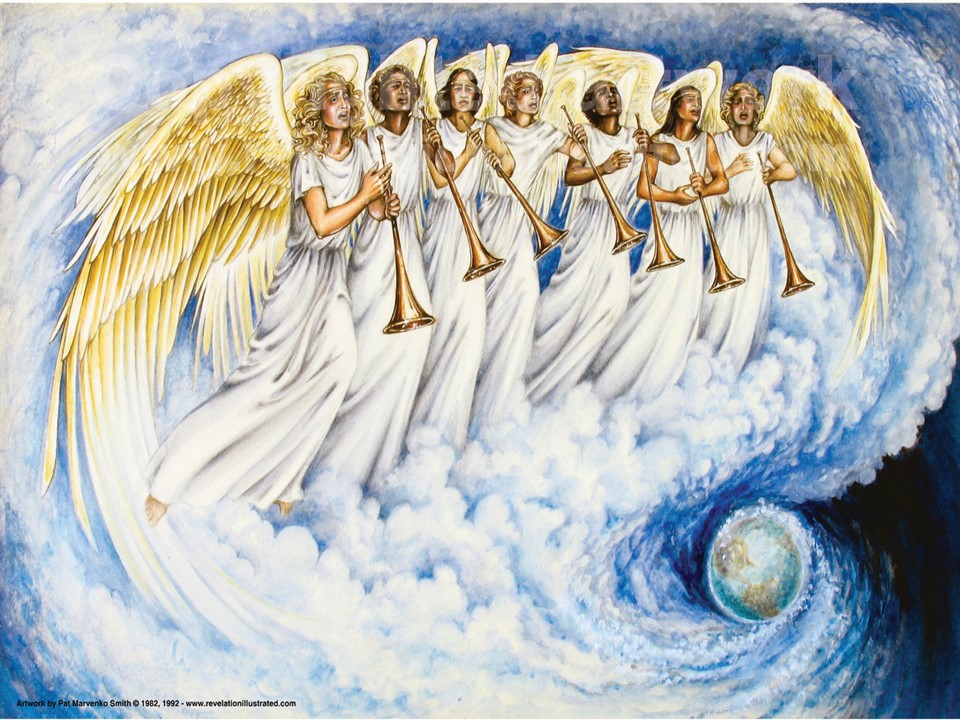
When the seventh seal is open, John sees seven angels to whom seven trumpets are given. The prospect of the judgments yet to come causes silence in heaven for the space of about a half hour, according to John.[1] The preceding six seals brought the initial judgments of the wrath of God and the Lamb, but they are mild compared to what comes next.

The first angel sounded, and there followed hail and fire mingled with blood, and they were cast upon the earth: and the third part of trees was burnt up, and all green grass was burnt up” (Revelation 8:7, emphasis mine). Many students of the Book of Revelation see symbolism throughout the book. While the book does present many objects in the form of symbols, those symbols are usually explained for the understanding of the reader. For example, in the first chapter, John sees Jesus standing in the midst of seven candlesticks (1:13) and holding seven stars in His right hand (1:16). Jesus reveals that “mystery” in verse 20; the candlesticks represent the seven churches to whom the book is addressed, and the seven stars represent the “angels” or “messengers,” i.e., pastors, of the seven churches. The combined symbolism shows Christ abiding in the midst of His churches.

Some symbolism is not explained directly but can be inferred from what we read in other places in Scripture. For example, John describes Jesus clothed with a “garment” down to His feet, and a golden girdle about His chest (1:13). We know from Leviticus that this is priestly apparel. His white hair symbolizes wisdom.[2] Also, when something is to be taken as symbolic, it is almost always preceded with “like” or “as” indicating simile. For example, “his eyes were as a flame of fire” (1:14) does not mean that Jesus had fire coming out of His eyes, rather, the symbolism indicates discernment and omniscience. His feet were “like unto fine brass, as if they burned in a furnace” (1:15) is symbolic of judgment.[3] Clarence Larkin said, “In that day those feet that trod the Via Dolorosa of suffering will be like unto INCANDESCENT BRASS, that shall tread and crush Antichrist and Satan when He comes to ‘Tread the WINE-PRESS of the fierceness and wrath of Almighty God.’ Rev. 19:15.”[4]

Sometimes simile is not indicated, but the symbolism can be discerned from the context and from other references in Scripture. For example, John sees Jesus with a sharp two-edged sword coming from His mouth (1:16). This seems rather strange; however, we see this image again in Revelation 19:15. What can this mean? Well, what normally comes out of a mouth? The most obvious answer is “words.” In his Gospel, John called Jesus, “the Word.” “And the Word was made flesh, and dwelt among us, (and we beheld his glory, the glory as of the only begotten of the Father,) full of grace and truth” (John 1:14, emphasis mine). John says that the Word (Jesus) created everything. “All things were made by him; and without him was not any thing made that was made” (John 1:3). In Genesis, we learn that all of creation (except for that of man) was accomplished through the spoken Word. God said, “Let there be…” and there was. We also know that God has also given us His written Word, the Bible. The entire Psalm 119 speaks about God’s Word. There we find these words: “Thy word have I hid in mine heart, that I might not sin against thee” (Psalm 119:11). The writer of the Book of Hebrews gives us this perception: “For the word of God is quick, and powerful, and sharper than any twoedged sword, piercing even to the dividing asunder of soul and spirit, and of the joints and marrow, and is a discerner of the thoughts and intents of the heart” (Hebrews 4:12). So, by looking at other Scriptures, we can discern that the sword proceeding out of Jesus’ mouth is nothing less than His Word, which when spoken will cut down all of His enemies because it is by His Word that we will all be judged.

So, why have I gone down this long rabbit trail without explaining the judgment of the first trumpet? I did so to show that what is described is NOT symbolic. We must take this verse (and those that follow) literally. The first trumpet sounds and “hail and fire mingled with blood, and they were cast upon the earth” (8:7). There is no symbolism indicated here – no simile. This is a supernatural phenomenon; however, it is not unprecedented. God sent hail mixed with fire on Egypt as the seventh of ten plagues to convince Pharaoh to set the Israelites free.[5] However, this judgment comes with a twist. Blood, not rain like blood, comes mixed with the hail and fire. The fire burns one-third of the earth’s trees and grass. This will be an ecological disaster.

“And the second angel sounded, and as it were a great mountain burning with fire was cast into the sea: and the third part of the sea became blood” (Revelation 8:8, emphasis mine). John sees an enormous object fall out of the sky and into the sea. Notice that John employs simile here – “as it were a great mountain” Surely John had seen meteors before, but this was unlike anything he had ever seen. It looked like a mountain to him, and it was burning. We know that when meteorites enter our atmosphere, the atmospheric friction causes them to ignite. Often, they burn up completely before striking the earth. When they do not incinerate completely, they impact the earth with explosive force (depending on their size). There is a meteor crater in Winslow, AZ that is a mile in diameter, which was created by a relatively small meteor.[6] That is just a pebble compared to what John sees. This is a large asteroid that enters the earth and crashes into the sea. Such an impact will cause huge tsunamis and kill much aquatic life. Anything near the impact site will be wiped out. John says, “And the third part of the creatures which were in the sea, and had life, died; and the third part of the ships were destroyed” (Revelation 8:9).

“And the third angel sounded, and there fell a great star from heaven, burning as it were a lamp, and it fell upon the third part of the rivers, and upon the fountains of waters; And the name of the star is called Wormwood: and the third part of the waters became wormwood; and many men died of the waters, because they were made bitter” (Revelation 8:10-11, emphasis mine). Without a doubt, this assuredly is an asteroid. The Greek word translated as “star” is astēr, and it refers to any luminous celestial object. The idea of an asteroid strike is not a farfetched idea. These free-floating objects in space concern NASA to the point that they actively attempt to identify and track “near-earth objects” (NEOs) whose trajectory intercept Earth’s orbit.[7] Because of their concerns about possible collisions, NASA actively works on “defense” strategies to intercept and redirect asteroids with the potential to strike the earth. Wormwood will escape NASA’s defenses and score a direct hit on the planet. Unlike the “mountain” that hit the sea at the second trumpet, Wormwood hits land, and the fallout poisons one-third of the drinking water on the earth and many die from drinking the water.

“And the fourth angel sounded, and the third part of the sun was smitten, and the third part of the moon, and the third part of the stars; so as the third part of them was darkened, and the day shone not for a third part of it, and the night likewise” (Revelation 8:12, emphasis mine). Again, this is not symbolic. What could cause the dimming by one-third of the light from the sun, moon, and stars? Many possibilities exist. God controls all of the elements, and it is certainly possible that He simply turns down the dimmer switch. However, it makes sense to me that the third trumpet brings the effects of the fourth trumpet. In other words, when that giant asteroid, Wormwood, strikes the earth, the impact will send debris high into the atmosphere, and the wind currents will spread it all over the earth effectively covering the entire planet in a blanket of dust. We know what volcanos do when they erupt. The ash they spew into the air darkens the sun and makes the moon appear blood red, and these are small compared to Wormwood.

John sees another angel. “And I beheld, and heard an angel flying through the midst of heaven, saying with a loud voice, Woe, woe, woe, to the inhabiters of the earth by reason of the other voices of the trumpet of the three angels, which are yet to sound!” (Revelation 8:13, emphasis mine). Things are going to get worse. I am thankful that I will not be around to experience what is coming.

Reader, are you prepared for what is coming to the world? You do not need to go through the Tribulation, God’s wrath, that is coming upon the world. Read my page on “Securing Eternal Life,” and ask Jesus to save you from the wrath to come.

Notes:


[1]  Revelation 8:1-2

[2]  Leviticus 19:32; Proverbs 16:31 – “hoary head” means “white” hair

[3]  J. Vernon McGee, Thru the Bible, Vol. 5 (Thomas Nelson Publishers, Nashville, 1983), p. 895.

[4]  Clarence Larkin, The Book of Revelation Illustrated, (Rev. Clarence Larkin Estate, Philadelphia, 1919), p. 11.

[5]  Exodus 9:13-35

[6]  Meteor Crater | Barringer Space Museum | Winslow, AZ

[7]  NASA Office to Coordinate Asteroid Detection, Hazard Mitigation | NASA

1 Comment

Filed under Apologetics, Bible, Current Events, End Times, Eschatology, Heaven, Rapture, Religion, Second Coming of Christ, Theology

The Seventh Seal

And when he had opened the seventh seal, there was silence in heaven about the space of half an hour. (Revelation 8:1)

How long is half an hour in heaven? Is it the same as half an hour here on Earth? Have you ever experienced half an hour in complete silence? I do not think I ever have; there are always some audible sounds even in the quietest times: the sound of the wind, bird songs, distant traffic sounds, etc. I cannot imagine total silence for even a short time, much less half an hour. I imagine it would be rather unnerving.

The Lamb has opened six seals to this point and unleashed all kinds of havoc around the globe. The white horse introduced the Antichrist. The red horse brings war to the earth. The black horse introduces worldwide economic collapse along with extreme inflation. The pale horse adds death from hunger, disease, and pestilences. The fifth seal introduces us to the Tribulation saints that have been martyred for their faith in Christ. The sixth seal brings down heaven in the way of falling space rocks, the darkening of the sun and moon, and an earthquake that shakes the entire planet. The whole world reels from the judgments that have come upon the planet.

Now, the Lamb opens the seventh seal and there is total silence in heaven for half an hour. All of heaven stands still. As if in shock from the past judgments, those in heaven are awestruck at what is about to come. If you thought the first six seals were bad, you have not seen anything yet. The worst is yet to come.

“And when he had opened the seventh seal, there was silence in heaven about the space of half an hour. And I saw the seven angels which stood before God; and to them were given seven trumpets” (Revelation 8:1-2, emphasis mine). The seven trumpets herald seven more judgments far worse than those seen so far. Arguably, by this time we are at the midpoint of the Tribulation and entering a time of “Great Tribulation.” Of this time, Jesus said, “For then shall be great tribulation, such as was not since the beginning of the world to this time, no, nor ever shall be” (Matthew 24:21, emphasis mine). No wonder the prospect of what comes next causes silence in heaven.

Now John looks “And another angel came and stood at the altar, having a golden censer; and there was given unto him much incense, that he should offer it with the prayers of all saints upon the golden altar which was before the throne. And the smoke of the incense, which came with the prayers of the saints, ascended up before God out of the angel’s hand” (Revelation 8:3-4, emphasis mine). The writer of the book of Hebrews informs us that the Tabernacle, and subsequently the Temple, was constructed after the pattern of that which was in heaven.[1] In the Tabernacle and in the Temple, there was an altar before the Holy of Holies upon which incense was burned continuously. The sweet-smelling smoke of the burning incense represented the prayers of the people going up before God. Here, in the heavenly temple of God, the prayers of the saints constantly rise before the Lord. John does not specify whether the prayers are those of the Tribulation saints who remain on the earth, those of the martyred saints beneath the altar,[2] or the saints of all time. Regardless, it is comforting and encouraging to know that our prayers are constantly before the throne of God. The priest responsible for bringing our prayers before God is none other than Jesus Christ. “For there is one God, and one mediator between God and men, the man Christ Jesus” (1 Timothy 2:5).

In the model prayer, Jesus said, “Thy kingdom come. Thy will be done in earth, as it is in heaven” (Matthew 6:10). That particular prayer is about to be answered in full. “And the angel took the censer, and filled it with fire of the altar, and cast it into the earth: and there were voices, and thunderings, and lightnings, and an earthquake. And the seven angels which had the seven trumpets prepared themselves to sound” (Revelation 8:5-6). Brace yourself for what comes next!

Reader, are you prepared for what is coming to the world? You do not need to go through the Tribulation, God’s wrath, that is coming upon the world. Read my page on “Securing Eternal Life,” and ask Jesus to save you from the wrath to come.

Notes:


[1]  Hebrews 8:5

[2]  Revelation 6:10

Comments Off on The Seventh Seal

Filed under Apologetics, Bible, Christianity, End Times, Eschatology, Heaven, Rapture, Religion, Second Coming of Christ, Theology

The First Sight

Thou art worthy, O Lord, to receive glory and honour and power: for thou hast created all things, and for thy pleasure they are and were created. (Revelation 4:11)


The book of Revelation puzzles many who read it. It seems strange and sometimes bizarre. Many avoid the book because the contents elicit fear about the predictions of things to come. However, the book of Revelation is the only book of the Bible that promises a blessing to those who read, hear, and apply its contents. “Blessed is he that readeth, and they that hear the words of this prophecy, and keep those things which are written therein: for the time is at hand.” (Revelation 1:3).

Revelation opens with the last remaining apostle of Jesus, the Apostle John, “in the Spirit the Lord’s Day.”[1] The Roman government arrested and exiled John to the prison island of Patmos for preaching the disruptive Gospel of Jesus Christ.[2]

The initial recipients of the book were seven churches in Asia Minor: Ephesus, Smyrna, Pergamos, Thyatira, Sardis, Philadelphia, and Laodicea.[3] To these, the risen Christ addresses individual letters.[4] These churches existed in John’s day, but because of the commendations and reproofs Jesus gives to these churches, some have seen in them patterns of each throughout church history.

John then describes his first glimpse of Jesus as though in a vision. This is not the Jesus John remembers during His earthly ministry. This Jesus is awesome to behold. John says, “And I turned to see the voice that spake with me. And being turned, I saw seven golden candlesticks; And in the midst of the seven candlesticks one like unto the Son of man, clothed with a garment down to the foot, and girt about the paps with a golden girdle. His head and his hairs were white like wool, as white as snow; and his eyes were as a flame of fire; And his feet like unto fine brass, as if they burned in a furnace; and his voice as the sound of many waters. And he had in his right hand seven stars: and out of his mouth went a sharp twoedged sword: and his countenance was as the sun shineth in his strength” (Revelation 1:12-16). The dazzling sight caused John to fall at His feet in awestruck fear, but that tender, familiar voice reassured him of the One he loved. “… Fear not; I am the first and the last: I am he that liveth, and was dead; and, behold, I am alive for evermore, Amen; and have the keys of hell and of death” (Revelation 1:17-18).

John saw Jesus in the midst of seven lampstands holding seven stars in His right hand. Jesus explained to him that the seven lampstands represented the seven churches and the seven stars represented the seven angels, i.e., messengers or pastors, of the seven churches.[5] The image reminds us that Jesus dwells among His churches and that He keeps and protects the pastors of His churches in His right hand (a position of power). This should also serve as a warning to pastors. Just as Jesus’ right hand protects His messengers, He also has the power to crush the pastor that fails in his responsibility to Jesus’ Bride, the Church.

As noted earlier, Jesus dictates direct messages to each of the seven churches. Immediately following the last word to the church of Laodicea, John looks up and sees an open door in heaven and hears a sound (Greek: phōnē) like that of a trumpet that said, “Come up hither, and I will shew thee things which must be hereafter. And immediately I was in the spirit: and, behold, a throne was set in heaven, and one sat on the throne” (Revelation 4:1-2, emphasis mine).

Many see the Rapture of the Church in these verses. John is commanded to “come up here” and “immediately” he sees the throne of God for the first time. From this point forward, the Church no longer appears on earth until Christ returns with His saints in Chapter 19.

There are many who teach that the Rapture is not taught in the Bible. They correctly argue that the word “rapture” appears nowhere in the Bible. However, neither do the words bible or trinity, yet no one will argue that these concepts are not taught in the Bible. “Rapture” translates the Greek word harpazō into the Latin raptus meaning “to seize; to catch away or up; to pluck, pull, or take by force”. This is what happened to John. He was on the earth and “immediately” he was caught away into the throne room of God.

Jesus gave us the first promise of the Rapture before going to the cross. He said, “Let not your heart be troubled: ye believe in God, believe also in me. In my Father’s house are many mansions: if it were not so, I would have told you. I go to prepare a place for you. And if I go and prepare a place for you, I will come again, and receive you unto myself; that where I am, there ye may be also” (John 14:1-3, emphasis mine). Paul teaches of the time when the trumpet shall sound and our corrupt bodies will be changed in the twinkling of an eye. The dead in Christ will rise from their graves, and we who are alive will join them to meet Jesus in the air.[6]

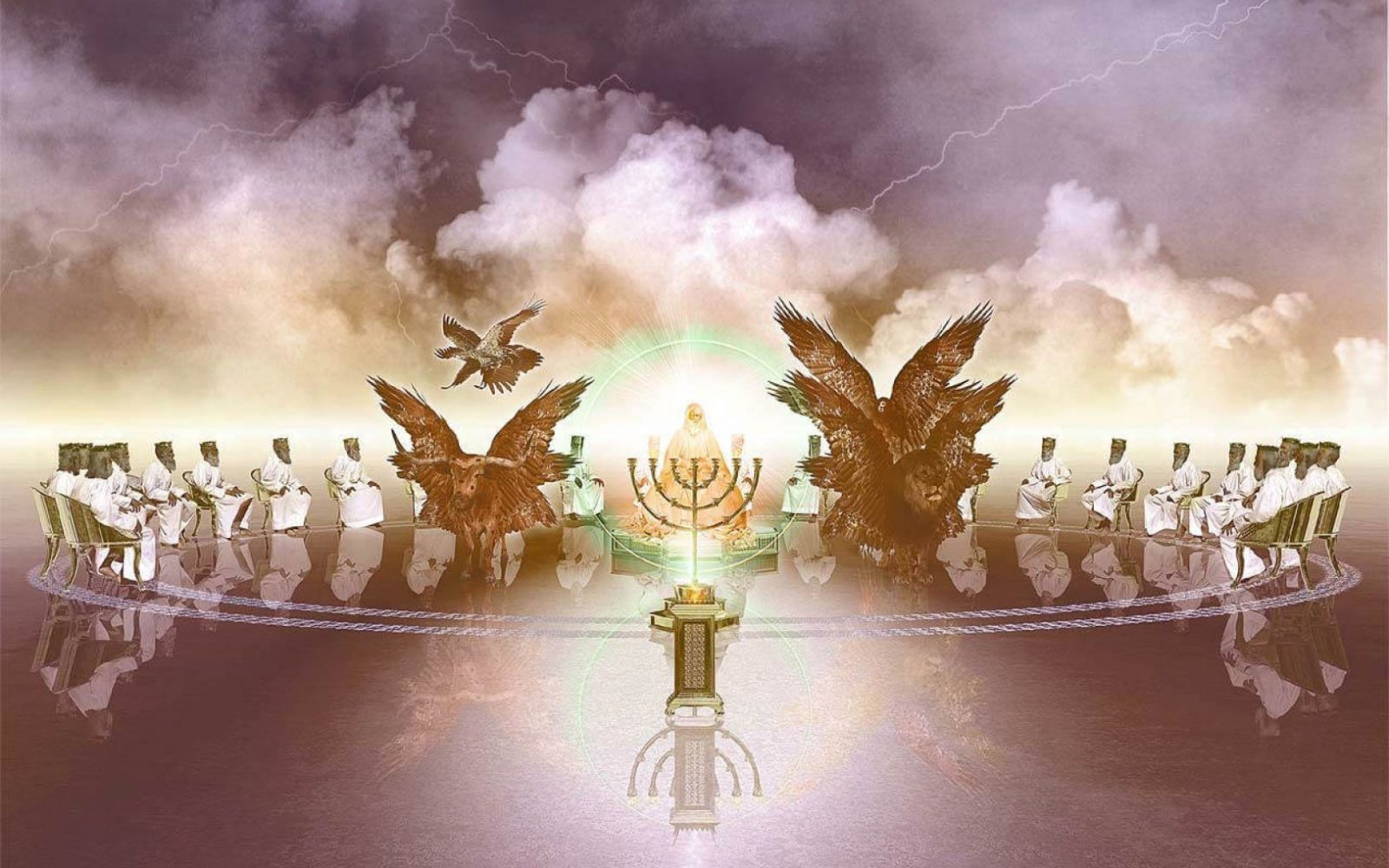
John enters the presence of God and his first sight is the throne of God. The person seated on the throne appears not as a human or any other creature, but rather as a glorious splendor. Of Him, John says, “And he that sat was to look upon like a jasper and a sardine stone: and there was a rainbow round about the throne, in sight like unto an emerald” (Revelation 4:3). The Bible teaches that God has no human form, except in the form of Jesus. Jesus said, “God is a Spirit: and they that worship him must worship him in spirit and in truth” (John 4:24, emphasis mine). John was given a privilege that even Moses (or anyone else for that matter) was denied. Moses, who spoke with God face-to-face as with a friend,[7] wanted to see God in His glory, but God denied his request, “And he said, Thou canst not see my face: for there shall no man see me, and live” (Exodus 33:20, emphasis mine). Yet, somehow John saw God in all of His glory and did not die. In our corrupt human bodies, we cannot withstand the glory of God’s presence. However, at the Rapture, our bodies will be transformed in such a way that we can be in the presence of God in His full glory and not be harmed, just like John.

The scene overwhelmed John. There were lightnings, thunders, and voices. Around the throne of God, John saw 24 thrones upon which seven elders sat wearing white robes and crowns of gold.[8] Some suppose these represent the twelve tribes of Israel and the twelve apostles. Others suggest that they merely represent believers of all the ages. In either case, the white robes represent the righteousness of Christ conferred on them. The golden crowns are stephanos, which are “victors crowns” awarded to them for conquering sin, not through their own righteousness, but through the blood of Christ.

John then sees seven lampstands around the throne defined as the “seven spirits of God” Some suggest that these seven lampstands represent seven attributes of the Holy Spirit as described by the prophet Isaiah. “And the spirit of the LORD shall rest upon him [i.e., Jesus], the spirit of wisdom and understanding, the spirit of counsel and might, the spirit of knowledge and of the fear of the LORD” (Isaiah 11:2, emphasis mine). We know that the Holy Spirit indwells believers and thereby indwells the Church. In the first chapter, John sees Jesus in the midst of seven lampstands, which represent the churches. Now, these same lampstands (i.e., churches) are seen around the throne of God. I see the lampstands representing both the Holy Spirit and the churches wherein the Holy Spirit resides. The attributes described by Isaiah certainly apply as well.

Around the throne is a crystal sea. It is difficult to know what John saw in this. It is all strange and wonderful and beyond words to describe. John could only relate what he saw by his limited earthly vocabulary. But then he sees four strange creatures full of eyes and with six wings each. One “beast” had the head of a lion, the second the head of a calf, the third the head of a man, and the fourth the head of an eagle.[9] The eyes represent the omniscience of God and the four different heads represent all of God’s creatures: wild animals, domestic animals, human beings, and avian life. All of God’s creation never ceasing to praise Him day or night “saying, Holy, holy, holy, Lord God Almighty, which was, and is, and is to come” (Revelation 4:8).

John then observed that when these praised God, the 24 elders prostrate themselves and cast their victor’s crowns before the throne saying, “Thou art worthy, O Lord, to receive glory and honour and power: for thou hast created all things, and for thy pleasure they are and were created” (Revelation 4:11).

With the focus on the throne, John spots something new. “And I saw in the right hand of him that sat on the throne a book written within and on the backside, sealed with seven seals” (Revelation 5:1, emphasis mine). By its description, we know that this “book” is actually a scroll – perhaps parchment – with writing on both sides, rolled up and secured with seven seals. Many suggest that this scroll represents the title dead to the earth and the kingdoms thereof. When God created the earth, He gave dominion over the earth to man whom He created in His image on the sixth day of creation.[10] However, man lost that dominion when he sinned in the Garden of Eden.[11] The dominion of earth transferred to Satan. Paul calls him the “god of this world.”[12] When Satan tempted Jesus, he offered Jesus the kingdoms of this world if He would only bow down and worship him. “And the devil said unto him, All this power will I give thee, and the glory of them: for that is delivered unto me; and to whomsoever I will I give it” (Luke 4:6, emphasis mine). However, his ownership is only temporary.

Then John saw and heard a strong angel proclaim, “Who is worthy to open the book, and to loose the seals thereof?” (Revelation 5:2). And no one in heaven, on earth, or under the earth was found worthy to take the scroll and break the seals. The situation was dire indeed. All of God’s creation hung in the balance and there was no one to come to the rescue. John says, “And I wept much, because no man was found worthy to open and to read the book, neither to look thereon” (Revelation 5:4).

John’s tears were soon assuaged. “And one of the elders saith unto me, Weep not: behold, the Lion of the tribe of Juda, the Root of David, hath prevailed to open the book, and to loose the seven seals thereof,” John says, “And I beheld, and, lo, in the midst of the throne and of the four beasts, and in the midst of the elders, stood a Lamb as it had been slain, having seven horns and seven eyes, which are the seven Spirits of God sent forth into all the earth” (Revelation 5:5-6). John the Baptist saw this Lamb come to him to be baptized in the Jordan and proclaimed, “Behold the Lamb of God, which taketh away the sin of the world” (John 1:29). He was slain on the cross, was buried in a borrowed tomb, and rose again on the third day.[13] Horns represent kingdoms and the Lamb has seven representing completion. All the kingdoms belong to Him. He is “KING OF KINGS, AND LORD OF LORDS” (Revelation 19:16). Seven eyes suggest omniscience with all the attributes of the seven Spirits of God.

Only the Lamb, by virtue of His sacrifice, is worthy to take and open the scroll. “And he came and took the book out of the right hand of him that sat upon the throne” (Revelation 5:7). When the Lamb took the scroll, a great celebration broke out in heaven. The four living creatures and the 24 elders prostrate themselves before the Lamb. “And they sung a new song, saying, Thou art worthy to take the book, and to open the seals thereof: for thou wast slain, and hast redeemed us to God by thy blood out of every kindred, and tongue, and people, and nation; And hast made us unto our God kings and priests: and we shall reign on the earth” (Revelation 5:9-10).

Then the rest of heaven breaks out in praise, “Saying with a loud voice, Worthy is the Lamb that was slain to receive power, and riches, and wisdom, and strength, and honour, and glory, and blessing. And every creature which is in heaven, and on the earth, and under the earth, and such as are in the sea, and all that are in them, heard I saying, Blessing, and honour, and glory, and power, be unto him that sitteth upon the throne, and unto the Lamb for ever and ever” (Revelation 5:12-13).

Worthy indeed! I cannot imagine how John must have felt at the first sight of heaven and the throne of God. I cannot wait to see it for myself!

The 14 chapters that follow bring us back to earth and the events that will transpire during the seven-year Tribulation. The scenes are horrific. However, the Church, the Bride of Christ, will not experience the horrors of the Tribulation. The Church, as we saw will be around the throne of God and not on earth. Will you be there or will you experience the horrors that are coming upon the earth? Your ticket out of here was purchased by Jesus more than 2000 years ago. All you have to do is accept it. Check out my page on “Securing Eternal Life.”

Notes:


[1]  Revelation 1:10

[2]  Revelation 1:9

[3]  Revelation 1:11

[4]  Revelation 2-3

[5]  Revelation 1:20

[6]  1 Corinthians 15:50-53; 1 Thessalonians 4:15-17

[7]  Exodus 33:11

[8]  Revelation 4:4

[9]  Revelation 4:6-8

[10]  Genesis 1:26-28

[11]  Genesis 3

[12]  2 Corinthians 4:4

[13]  1 Corinthians 15:3-4

Comments Off on The First Sight

Filed under Apologetics, Bible, Christianity, End Times, Eschatology, Gospel, Heaven, Holy Spirit, Origins, Rapture, Resurrection, Satan, Second Coming of Christ, Theology, Worship

The LORD Is With Thee

And the angel of the LORD appeared unto [Gideon], and said unto him, The LORD is with thee, thou mighty man of valour. (Judges 6:12)

 The Midianites and the Amalekites had been harassing the Israelites for over seven years. These ancient-day terrorists waited until their crops were harvested, and they would swoop down like locusts and strip the land clean of all that the Israelites had worked for, including their livestock. “[Because] of the Midianites the children of Israel made them the dens which are in the mountains, and caves, and strong holds” (Judges 6:2).

Their affliction resulted from the vicious cycle of disobedience to God, God’s punishment for their disobedience, a cry to God for deliverance, God’s mercy and forgiveness at the hand of a deliverer, followed by a time of peace, and then the cycle started over again. They never learned! So, here they were again. “And the children of Israel did evil in the sight of the LORD: and the LORD delivered them into the hand of Midian seven years” (Judges 6:1).

Gideon, of the tribe of Manasseh, feared the Midianites like the rest of Israel did. He devised a plan to hide his wheat harvest from the raiders by threshing it under a tree near a winepress.[1] Normally, this would have been done in the open on a hard threshing floor.  An animal – an ox, donkey, mule, etc. – walked on the wheat to break the husk surrounding the kernel. Once that was done, the wheat was tossed in the air allowing the wind to carry away the chaff (the husk) leaving the kernel to fall to the ground to be gathered. Gideon’s method involved a lot of extra work, but it would not raise any suspicion from the Midianites.

In this cowering position, “the angel of the LORD appeared unto him, and said unto him, The LORD is with thee, thou mighty man of valour” (Judges 6:12). This was no ordinary angel. Without exception, “the Angel of the LORD” in the Old Testament is the “preincarnate” Christ known as a “theophany” or “Christophany” in theological terms. We know this because the “angel” takes full credit for what God is going to do and accepts sacrifices offered to Him. No ordinary angel does that; instead, they say, “Thus saith the LORD” and give full credit to God.

I can imagine Gideon’s reaction to the Angel addressing him as “thou mighty man of valor.” Here he was hiding in fear of the Midianites. I can see him looking around to see if there was anyone else nearby. Seeing no one else around, I hear him say, “Who? Me? Are you talking to Me?” Gideon must have been incredulous!

Gideon felt, and rightly so, that God had forsaken Israel. He recalled how God had delivered Israel from Egyptian bondage and brought them into the Promised Land by many miracles, but now they were handed over to the Midianites.[2] “And the LORD looked upon him, and said, Go in this thy might, and thou shalt save Israel from the hand of the Midianites: have not I sent thee?” (Judges 6:14). First God calls him a “mighty man of valor,” and now he is told that he – the cowering wheat farmer – will save Israel from the Midianites. Note how the Angel gives the command directly. “Have I not sent thee?” He does not say, “Thus saith the LORD;” He is the LORD.

Like Moses, Gideon offered up excuses as to why he was not the right man for the job. “And he said unto him, Oh my Lord, wherewith shall I save Israel? behold, my family is poor in Manasseh, and I am the least in my father’s house” (Judges 6:15). But Jesus assured him that He was the right man. “And the LORD said unto him, Surely I will be with thee, and thou shalt smite the Midianites as one man” (Judges 6:16). Gideon would not be alone in this effort.

Gideon still needed more proof. So, he brought an offering of a kid (young goat), unleavened bread, and flour and laid it on a rock. The Angel put out His staff and touched the offering, and it was instantly consumed in fire showing that God accepted the offering.[3] At this point, Gideon realized that he was face-to-face with God giving him another reason for fear. He remembered what God said to Moses: “And he said, Thou canst not see my face: for there shall no man see me, and live” (Exodus 33:20). Jesus understood Gideon’s fear. “And the LORD said unto him, Peace be unto thee; fear not: thou shalt not die” (Judges 6:23).

Gideon’s first assignment was to tear down his father’s altar to Baal and replace it with an altar to God. Gideon still had reservations, so he performed the task at night. The following day, the men of the town came looking for Gideon to kill him for destroying the Baal altar. His father, obviously repentant, defended him. “And Joash [Gideon’s father] said unto all that stood against him, Will ye plead for Baal? will ye save him? he that will plead for him, let him be put to death whilst it is yet morning: if he be a god, let him plead for himself, because one hath cast down his altar” (Judges 6:31). This gave Gideon confirmation that God was with him.

“Then all the Midianites and the Amalekites and the children of the east were gathered together, and went over, and pitched in the valley of Jezreel” (Judges 6:33). Gideon’s next assignment was to get rid of Israel’s enemies. Gideon still had reservations and needed further proof. So, he put God to the test. First, he challenged God by laying out a fleece on the ground and asking God to send dew on the fleece only, but leave the ground dry. God answered his request. The next night he did the same but wanted the ground to be wet with dew and the fleece to remain dry. God again answered his request. Gideon was convinced.[4]

Gideon rallied an army of 32,000 men from Manasseh, Asher, Zebulun, and Naphtali.[5] The opposing army boasted at least 135,000 men.[6] Gideon’s army faced four-to-one odds. God wanted all the credit for the victory, so He told Gideon to send all the fearful home. Twenty-two thousand (22,000) left leaving Gideon with only 10,000 men. The odds now were about 14 to 1. God said that was still too many.

There was spring near Gideon’s camp, and God gave a test. Any man who stooped down on hands and knees to drink from the spring was to be sent home. Those who cupped water in their hand and lapped up the water from their hands – showing that they remained vigilant – were kept. Gideon’s army was now down to just 300 men. The odds were now 450 to 1 – better odds for God![7]

Understandably, Gideon had doubts. To assuage his fear, God told Gideon to take his aid, Phurah, and sneak into the Midianite camp at night to spy it out. When he came near one of the tents, he overheard one man tell his companion of his dream. His companion interpreted the dream as an omen that Gideon would attack the camp and destroy them all. Hearing this gave Gideon courage.[8]

Gideon took his 300 men that same night and divided them into three companies surrounding the enemy camp. With rams’ horns, torches, and clay jars, Gideon’s army stood and made a lot of noise. They surprised and startled the enemy to the point of panic, and they turned their swords each against the other.[9] Gideon’s army did nothing to win the battle except make a lot of noise. God won the battle for them.

We often face obstacles, problems, and troubles that seem insurmountable for us. We fear because we know full well that we cannot overcome our trials. They are too big and too difficult for us to conquer. When we do try to fix them ourselves, we usually end up making things worse for ourselves. It is at these times that we need to hear God say, “The LORD is with thee, thou mighty man of valour … Surely I will be with thee.” He does not need our strength to fight our battles. He just needs our faith and trust in Him. “Is any thing too hard for the LORD?” (Genesis 18:14).

Often, we fear the unknown – all the “what-ifs” of life. God is already in our tomorrows, and He has it all under control.[10] Jesus said that He knows His own, and His own know Him.[11] And those who belong to Him have the assurance that “… all things work together for good to them that love God, to them who are the called according to his purpose” (Romans 8:28). The LORD is with thee.

Do you live in fear of what the future holds for you? Do you feel helpless to face all the troubles in your life? Why not let God take control of your life? You will not regret it and retirement is out of this world. Check out my page on “Securing Eternal Life.”

Notes:


[1]  Judges 6:11

[2]  Judges 6:13

[3]  Judges 6:17-21

[4]  Judges 6:36-40

[5]  Judges 6:35; 7:3

[6]  Judges 8:10

[7]  Judges 7:1-8

[8]  Judges 7:9-15

[9]  Judges 7:19-25

[10]  Isaiah 46:9-10

[11]  John 10:14

1 Comment

Filed under Apologetics, Bible, Christianity, Theology