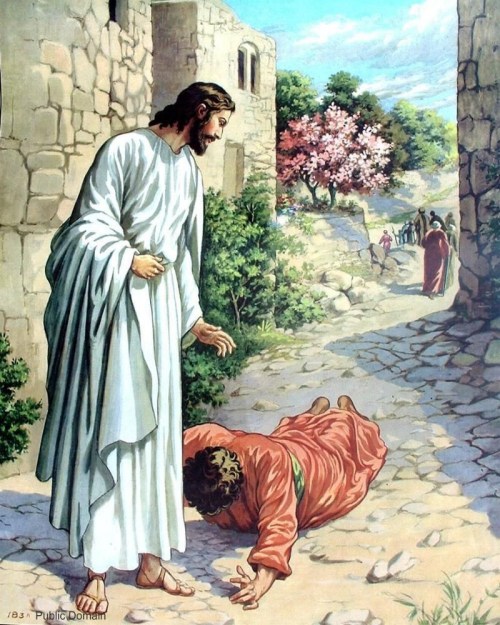
And one of them, when he saw that he was healed, turned back, and with a loud voice glorified God, (Luke 17:15)
Thanksgiving Day is upon us, and I’m sure most of us have plans for food, family, friends, and fellowship. In today’s culture, Thanksgiving Day is just a good excuse to have a day (or two) off work, indulge in gluttonous behavior, and worship before the luminous god of football followed by the giving of alms to the god of materialism the next day, all the while in complete ignorance of the significance of the day.
As I thought about Thanksgiving coming up, the Lord brought to mind the account of Jesus healing the ten lepers. We read about that in Luke 17:11-19:
And it came to pass, as he went to Jerusalem, that he passed through the midst of Samaria and Galilee. And as he entered into a certain village, there met him ten men that were lepers, which stood afar off: And they lifted up their voices, and said, Jesus, Master, have mercy on us. And when he saw them, he said unto them, Go shew yourselves unto the priests. And it came to pass, that, as they went, they were cleansed. And one of them, when he saw that he was healed, turned back, and with a loud voice glorified God, And fell down on his face at his feet, giving him thanks: and he was a Samaritan. And Jesus answering said, Were there not ten cleansed? but where are the nine? There are not found that returned to give glory to God, save this stranger. And he said unto him, Arise, go thy way: thy faith hath made thee whole. (Luke 17:11-19)
Following the “Transfiguration” (Luke 9:28-36), Jesus “stedfastly set His face to go to Jerusalem” (Luke 9:51). Coming down from Caesarea Philippi, Luke records that Jesus “passed through the midst of Samaria and Galilee” (v. 11). He is traveling from the north to the south (toward Jerusalem), which means He must pass through Galilee first before going through Samaria. Why did Luke name Samaria first? I do not know. I could not find one commentator that could tell me, but I suspect the answer is down below. Jesus was on His way to the cross.
As the passage records, ten leprous men met Him, and while remaining at a distance –because their disease was so contagious, they were not allowed to come near other people – they cried out for Jesus to have mercy on them. They addressed Him as “Master” – Greek ἐπιστάτης (epistatēs), from epi, “superimposition, to be over, above,” and histēmi, “to stand” Together the title means “one who stands above” – Master! This is not to be confused with διδάσκαλος (didaskalos) meaning “teacher” (Luke 3:12). Thus, they recognized that Jesus had the power to heal their disease.
When Jesus saw them, “He said unto them, ‘Go show yourselves’” (v.14). Note that Jesus does not touch nor approach them. Why? Jesus had often touched lepers when He healed them, why not today? Jesus was on His way to the Cross. He could not allow Himself to become “unclean.” Note also that His Word was sufficient to heal the lepers – “as they went, they were cleansed.” This healing by His verbal command is a clear demonstration of His deity.
All ten exercised faith in believing His Word that they would be healed, but only one returned to give thanks. “When he saw that he was healed, turned back, and with a loud voice glorified God” (v. 15). “And fell down on his face at his feet, giving him thanks: and he was a Samaritan” (v. 16). He did not simply bow in reverence. He completely prostrated himself, flat with his face to the ground. He placed himself at Jesus’ feet. His attitude was one of complete humility, reverence, worship, and gratitude – “and he was a Samaritan.” That this one was a Samaritan may explain why Luke listed Samaria before Galilee. The implication is that the other nine were Jews.
Jesus seems surprised that only this one returned to give thanks. However, knowing that the Lord knows the hearts of all men, His feigned surprise was likely intended to make a point. Jesus said that “[God] is kind to the unthankful and to the evil” (Luke 6:35).
Thankfulness was not particularly characteristic of the Jews. Consider how often they complained after they were freed from Egypt. Think of how soon they fell into idol worship during the time of the Judges. Consider their presumption on God knowing that they were His people. Their lack of gratitude came as no surprise to Jesus. However, the “stranger” recognized his unworthiness and was grateful for the mercy Jesus bestowed on him.
“And he said unto him, Arise, go thy way: thy faith hath made thee whole” (v.19). The Greek word translated “whole” here is σεσωκεν (sesoken), and it means “has saved.” Literally what Jesus said is, “thy faith hath saved thee.” Obedience (which also required faith) had made him “whole,” i.e., healed him. However, his “faith” in recognizing Jesus as “Master” saved him. He was “whole” not only physically, but spiritually.
Does God Expect Us To Be Thankful?
Leviticus 22:29 And when ye will offer a sacrifice of thanksgiving unto the LORD, offer it at your own will.
Not out of obligation
2 Corinthians 9:7 Every man according as he purposeth in his heart, so let him give; not grudgingly, or of necessity: for God loveth a cheerful giver.
1 Chronicles 16:8Give thanks unto the LORD, call upon his name, make known his deeds among the people.
Can’t do the latter without the former.
1 Chronicles 16:34 O give thanks unto the LORD; for he is good; for his mercy endureth for ever.
Psalm 30:4 Sing unto the LORD, O ye saints of his, and give thanks at the remembrance of his holiness.
Considering God’s holiness and our unworthiness, how can we not be thankful for the love He has shown to us?
Psalm 95:2 Let us come before his presence with thanksgiving, and make a joyful noise unto him with psalms.
Not “come before His presence with prayer requests.” Prayer requests are fine, but let’s first thank Him.
Psalm 100:4 Enter into his gates with thanksgiving, and into his courts with praise: be thankful unto him, and bless his name.
“Bless His name,” i.e., “speak well of His name” What are some attributes of God that come to mind?
Colossians 2:6-7 As ye have therefore received Christ Jesus the Lord, so walk ye in him: (7) Rooted and built up in him, and stablished in the faith, as ye have been taught, abounding therein with thanksgiving.
Philippians 4:6 Be careful for nothing; but in every thing by prayer and supplication with thanksgiving let your requests be made known unto God.
1 Thessalonians 5:18 In every thing give thanks: for this is the will of God in Christ Jesus concerning you.
Consequences of Ingratitude:
Romans 1:21 Because that, when they knew God, they glorified him not as God, neither were thankful; but became vain in their imaginations, and their foolish heart was darkened.
Ingratitude darkens the heart.
2 Timothy 3:1-2, 7-9 This know also, that in the last days perilous times shall come. (2) For men shall be lovers of their own selves, covetous, boasters, proud, blasphemers, disobedient to parents, unthankful, unholy … (7) Ever learning, and never able to come to the knowledge of the truth. (8) Now as Jannes and Jambres withstood Moses, so do these also resist the truth: men of corrupt minds, reprobate concerning the faith. (9) But they shall proceed no further: for their folly shall be manifest unto all men, as theirs also was.
Benefits of Thankfulness:
Psalm 140:13 Surely the righteous shall give thanks unto thy name: the upright shall dwell in thy presence.
We are made “righteous” through Christ. Because of that we have His presence within us.
Jeremiah 30:19 And out of them shall proceed thanksgiving and the voice of them that make merry: and I will multiply them, and they shall not be few; I will also glorify them, and they shall not be small.
In context, this is referring to Israel’s return from Babylonian captivity.
However, the principle applies.
God will bless our thankfulness.
2 Corinthians 4:15 For all things are for your sakes, that the abundant grace might through the thanksgiving of many redound to the glory of God.
“redound” Greek περισσεύω (perisseuō)
to superabound (in quantity or quality), be in excess
God’s grace to us “supper-abounds” through thanksgiving.
2 Corinthians 9:11 Being enriched in every thing to all bountifulness, which causeth through us thanksgiving to God.
Colossians 3:15 And let the peace of God rule in your hearts, to the which also ye are called in one body; and be ye thankful.
1 Timothy 4:1-5 Now the Spirit speaketh expressly, that in the latter times some shall depart from the faith, giving heed to seducing spirits, and doctrines of devils; (2) Speaking lies in hypocrisy; having their conscience seared with a hot iron; (3) Forbidding to marry, and commanding to abstain from meats, which God hath created to be received with thanksgiving of them which believe and know the truth. (4) For every creature of God is good, and nothing to be refused, if it be received with thanksgiving: (5) For it is sanctified by the word of God and prayer.
Conclusion:
Jesus healed ten lepers. Nine of them were of “the chosen.” Their attitude reflected ingratitude for the marvelous work Jesus performed in their lives – almost as if they believed they were entitled to what they received.
One leper – a “stranger,” a Samaritan, clearly an “outsider” due to both his leprosy and his heritage – recognized his own unworthiness and the greatness of the One who healed him; and he returned to give thanks and worship the God who healed him. And he was saved. Let us recognize that we are all lepers and give thanks for all He has done for us.
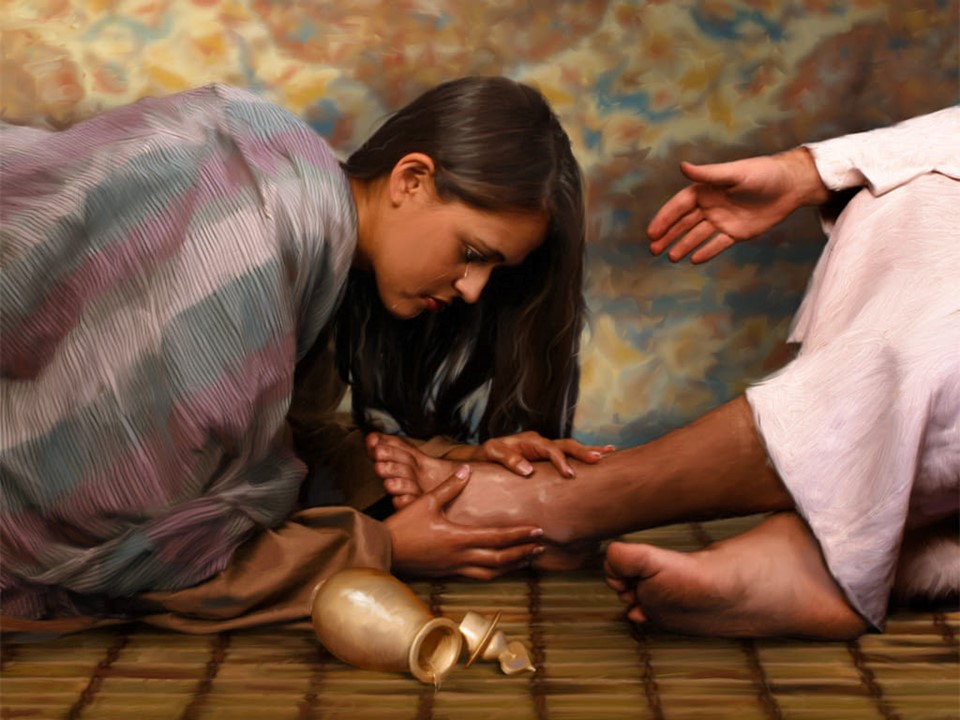
There came unto him a woman having an alabaster box of very precious ointment, and poured it on his head, as he sat at meat. (Matthew 26:7)
In one of my Bible readings this week, I came across an account of a woman anointing Jesus. All four Gospels record such an event. A detached, casual reading of the event can make the reader conclude that all four accounts are the same. Indeed, if we check the cross-references in our Bibles, they all seem to point to the other accounts leading the reader to assume they are all the same account. However, a close and careful examination of the four accounts will reveal a different story.
We have two, arguably three, different accounts of Jesus’ anointing. Luke’s account places the anointing long before the transfiguration while He was still in Capernaum (Luke 7:36-50).
Luke 7:36-39 And one of the Pharisees desired him that he would eat with him. And he went into the Pharisee’s house, and sat down to meat. (37) And, behold, a woman in the city, which was a sinner, when she knew that Jesus sat at meat in the Pharisee’s house, brought an alabaster box of ointment, (38) And stood at his feet behind him weeping, and began to wash his feet with tears, and did wipe them with the hairs of her head, and kissed his feet, and anointed them with the ointment. (39) Now when the Pharisee which had bidden him saw it, he spake within himself, saying, This man, if he were a prophet, would have known who and what manner of woman this is that toucheth him: for she is a sinner.
Matthew 26:6-9 Now when Jesus was in Bethany, in the house of Simon the leper, (7) There came unto him a woman having an alabaster box of very precious ointment, and poured it on his head, as he sat at meat. (8) But when his disciples saw it, they had indignation, saying, To what purpose is this waste? (9) For this ointment might have been sold for much, and given to the poor.
Mark 14:1-5After two days was the feast of the passover, and of unleavened bread … (3) And being in Bethany in the house of Simon the leper, as he sat at meat, there came a woman having an alabaster box of ointment of spikenard very precious; and she brake the box, and poured it on his head. (4) And there were some that had indignation within themselves, and said, Why was this waste of the ointment made? (5) For it might have been sold for more than three hundred pence, and have been given to the poor. And they murmured against her.
John 12:1-6 Then Jesus six days before the passover came to Bethany, where Lazarus was which had been dead, whom he raised from the dead. (2) There they made him a supper; and Martha served: but Lazarus was one of them that sat at the table with him. (3)Then took Mary a pound of ointment of spikenard, very costly, and anointed the feet of Jesus, and wiped his feet with her hair: and the house was filled with the odour of the ointment. (4) Then saith one of his disciples, Judas Iscariot, Simon’s son, which should betray him, (5) Why was not this ointment sold for three hundred pence, and given to the poor? (6) This he said, not that he cared for the poor; but because he was a thief, and had the bag, and bare what was put therein.
Matthew and Mark place the anointing after the Triumphal Entry (Matthew 21:1-11; Mark 11:1-11) and two days before the Passover. John places the anointing the day before the Triumphal Entry (John 12:12). Matthew and Mark place the anointing in the “house of Simon the Leper.” John seems to place the anointing in the house of Lazarus following the raising of Lazarus from the dead. Neither Matthew nor Mark names the woman who anointed Jesus. Had she been Mary, they certainly would have known who she was. John names Lazarus, Martha, and Mary who anointed Jesus. Matthew records that the “disciples” were indignant about the waste. Mark only records that “there were some that had indignation within themselves.” The difference and precision in detail between Matthew and Mark’s account and the account of John are too distinct to be an error in recording. Therefore, these are two separate anointings. Luke’s account came too early to be confused with these that took place just before the crucifixion. Luke records that the anointing took place in the house of a Pharisee named Simon – not a leper – and the woman that anointed Jesus was “a sinner.” Surely, Mary, named by John, would not have been identified as a “sinner.” She is the one that “sat at Jesus’ feet, and heard His word” (Luke 10:39). Also, Luke’s account records nothing said about the cost of the ointment being used.
In all, we have three separate accounts of Jesus being anointed by women. Even though there are some similarities, the differences are too great to conflate them as one or two. The lesson here is to let the Bible speak for itself. The experts, while we can learn much from them, are also fallen men after all; they can make mistakes too.
Matthew and Mark describe the same anointing. John records a second anointing by Mary, Lazarus’ sister (Lazarus whom Jesus raised from the dead, John 11). Both accounts take place before the Passover when Jesus would be crucified. In both instances, Jesus commented that the anointing was for His burial (Matthew 26:12; John 12:7). Jesus knew that the cross lay before Him, and He went willingly to take our sin upon Himself. He paid a debt He did not owe to cancel the debt we could never pay. Reader, our sin debt was paid by Jesus who bought our pardon with His blood. All we have to do is accept that pardon. Have you done that? If not please read my page on “Securing Eternal Life.”
And because iniquity shall abound, the love of many shall wax cold. (Matthew 24:12)
Anyone that halfway pays attention to the news – even the “lame-stream-media” – can see the unprecedented rise in crime these days. Mobs of black young people ransacking stores and running off with thousands of dollars’ worth of high-end merchandise. (I am not being racist; I am just stating the obvious for anyone paying attention. Security cameras don’t lie and they are not racists.) They get away with it because police are not allowed to stop them and leftist district attorneys refuse to prosecute them.
Many major American cities are infested with homeless people living in tents along major thoroughfares and some in neighborhoods. They use the streets as their toilets and numb themselves with illegal drugs. Rather than enforce no-loitering laws to clean up the streets, many cities dole out sanitary syringes to keep drug abusers from contracting hepatitis. Very compassionate!
Then there is the Black Lives Matter organization (many of whom are self-deprecating white people), which cares little about black lives and looks for any opportunity to riot and burn down private businesses. Who will be the next black man that violently resists arrest and gets himself killed by police to give these thugs an excuse to riot?
Crime is not limited to the “dregs” of our society. Crime exists in the highest levels of our government. There too, depending on the political party affiliation, crime goes unpunished. Without delving into the details, all one needs to do is mention the names – Clinton, Biden, Comey, Fauci, Palosi, Garland, etc. These treasonous lawbreakers make millions of dollars from the positions entrusted to them by American taxpayers, and the law seems to bypass them. In the meantime, the “Injustice Department” persecutes and prosecutes anyone who dares to challenge their status quo.
Quoting Jan Markell of Olive Tree Ministries, “What did you think the end-times would look like?” In the verse above, Jesus responded to His disciples when they asked, “Tell us, when shall these things be? and what shall be the sign of thy coming, and of the end of the world?” (Matthew 24:3). Jesus gave a detailed description of what the end-times would be like just before His return. One of the characteristics He gave was that “iniquity shall abound” (Matthew 24:12). The Greek word translated as “iniquity” is anomia, meaning “no law.” The Strong’s Dictionary defines it as “illegality, that is, violation of law or (generally) wickedness.” We see that everywhere. One does not need to be that old to notice the rapid rise in lawlessness, and it is happening worldwide.
In the same sentence, Jesus said, “the love of many shall wax cold” (Matthew 24:12). Surprisingly, the word Jesus used for “love” is agapē. That is the “unconditional” love given to another, whether deserved or not, and without expectation of reciprocation. Generally speaking, there is near zero of that kind of love being expressed anywhere. Love is certainly waxing cold.
The lack of love manifests in a variety of ways. In his final words to his protégé, Timothy, Paul predicts the loveless character of people in the “last days.”
This know also, that in the last days perilous times shall come. For men shall be lovers of their own selves, covetous, boasters, proud, blasphemers, disobedient to parents, unthankful, unholy, Without natural affection, trucebreakers, false accusers, incontinent, fierce, despisers of those that are good, Traitors, heady, highminded, lovers of pleasures more than lovers of God; Having a form of godliness, but denying the power thereof: from such turn away. (2 Timothy 3:1-5, emphasis mine)
Let us examine some of these characteristics more closely. “Lovers of their own selves” characterizes egocentrism, self-centeredness, selfishness, etc. Marketers feed into the egocentrism of their target audience with the idea that “it’s all about YOU!” Self-love gives rise to covetousness, which in its essence is a desire for what others possess. Self-love also feeds the desire to “boast” about oneself whether the boast is justified or not. Self-love makes one “proud,” often without basis. Self-lovers are often “blasphemers” in that they attribute any praise they receive, whether from others or by self-delusion, to themselves rather than giving the glory to God. Such blasphemy takes many forms and finds its roots in humanism. Many scientists and those who worship “science” fall prey to that. They reject God and attempt to explain all of Creation by natural means, and attribute all human advances in medicine and technology to the inexhaustible (by their reckoning) abilities of mankind. That is blasphemy!
That they are “disobedient to parents” needs little explanation. One trip to Walmart ™ and watching some parents trying to control unruly children gives ample support for this truth. However, the result of such unruliness in children is the lawlessness of young adults. This is also characterized by “incontinence” (mentioned later on in the list). “Incontinence” here has nothing to do with the inability to control one’s bodily functions. In the King James vernacular, it simply means “lack of self-control.” It is the idea that “if it feels right, do it,” regardless of whether it is unlawful, immoral, or offensive,” and it plays right along with self-love. “To thyself be true” is the mantra. That, by the way, is satanic.
They are “unthankful” because they believe that anything that comes to them is due to them because they are “worth it.” They are “unholy,” the opposite of “holy,” which means to be “set apart” for God’s purposes. The “unholy” have no place for God.
They are “without natural affection.” I used to think this had to do with homosexuality. What it really means is to not have “natural affection.” The three English words translate the single Greek word “astorgos.” “Storgē” in Greek is “familial love” – the love one has for one’s natural family. The “a” prefix negates the word. Therefore, these people have no natural affection or love for their own families. This also springs from self-love.
All of these characteristics are interrelated and they stem from egocentrism. They are “trucebreakers,” i.e., they cannot be trusted to keep their word. They are “false accusers” – we see a lot of that going on with all of the Trump indictments. They are “fierce,” i.e., savage, violent, combative, etc. That they are “Despisers of those that are good” is demonstrated daily against those who are “pro-life,” those who promote heterosexual marriage, those who rightly believe humans do not cause “climate change,” those who stand for Judeo-Christian principles, those who believe and preach the Bible, etc.
They are “traitors;” they cannot be trusted. They are “heady,” i.e., rash, reckless, precipitate (i.e., “rushing headlong or rapidly onward”). They are “high-minded,” i.e., they think too highly of themselves (Romans 12:3), false pride. “Lovers of pleasure more than lovers of God” once again comes back to self-love, selfishness, and egocentrism.
The saddest part of this list suggests that some of these people pretend to be “Christians.” They have “a form of godliness, but denying the power thereof.” Many pulpits across our nation are filled with this kind that speak using “Christian” vocabulary while preaching that not all of the Bible should be taken verbatim. They teach that we should detach ourselves from the Old Testament and that many New Testament teachings, especially those of Paul, were specific to the culture of his time and do not necessarily apply to our day and time – women in the pulpit, for one example.
Jesus said that in the latter days, “… many false prophets shall rise, and shall deceive many. And because iniquity shall abound, the love of many shall wax cold” (Matthew 24:11-12). Do we not see all of this coming to pass before our eyes? If Jesus’ Word is true (and it is), then His return is very near.
I have published an extensive study on the Book of Revelation and the end-times detailing the events that will transpire during the Tribulation. You can find that on my “Revelation” page. Reader, are you ready to meet the coming Lord Jesus at His return? If not, please read my page on “Securing Eternal Life.”
Behold, I come quickly: blessed is he that keepeth the sayings of the prophecy of this book. (Revelation 22:7)
Have you ever imagined traveling in a time machine and going backward or forward in time to witness what happened in the past, or to see what would happen in the future? I am sure many people have, and several science fiction movies have attempted to portray what that might be like.
Jesus granted John the privilege of actually traveling into the future to record the events that would take place at “the end of days.” Much of what John witnessed seems unpleasant, but the end result climaxes in a completely remade planet and universe – a New Heaven and a New Earth.[1] John then sees an indescribable city descending from heaven to the New Earth with space enough to accommodate the billions of God’s children throughout the ages. The city is the New Jerusalem where God will dwell among His people.
What John witnessed defies any hitherto known reality. John could hardly believe his eyes. It was incredible! It was unbelievable! And when we read John’s attempt at describing it, our mind’s eye cannot visualize it, so we may be tempted to brush it off as fantasy. In anticipation of such an occurrence, his angel tour guide reassures John and encourages him to believe what he sees. “And he said unto me, These sayings are faithful and true: and the Lord God of the holy prophets sent his angel to shew unto his servants the things which must shortly be done” (Revelation 22:6, emphasis mine). It may be too much for our feeble minds to take in, but the guarantee comes directly from God, and we can rest assured that it will all come true because He is faithful to keep His promises.
Then, from some unspecified source, we hear the words of Jesus. “Behold, I come quickly: blessed is he that keepeth the sayings of the prophecy of this book” (Revelation 22:7, emphasis mine). The Greek word translated as “quickly” is tachu from which we get our English word “tachometer.” Since Jesus said this almost 2000 years ago, it makes us wonder, “What is His definition of quickly?” It also gives fodder to the skeptics of whom the Apostle Peter warned. “Knowing this first, that there shall come in the last days scoffers, walking after their own lusts, And saying, Where is the promise of his coming? for since the fathers fell asleep, all things continue as they were from the beginning of the creation” (2 Peter 3:3-4, emphasis mine). Peter also reminded us that God’s timing is not like ours. “But, beloved, be not ignorant of this one thing, that one day is with the Lord as a thousand years, and a thousand years as one day” (2 Peter 3:8, emphasis mine). Peter is not providing a formula by which we can calculate God’s timetable. Rather, he applies simile (“as”) to emphasize that God’s measure of time does not correlate to ours. God is infinite. He is “timeless.” He is not bound by time. His attribute of omnipresence – being everywhere present at all times – also applies to our understanding of time. He exists in the past, present, and future simultaneously, which explains why He can tell the end from the beginning.[2] Considering the word “tachu” with the application of a tachometer, which measures the revolutions per minute (RPM) of an internal combustion engine; the faster the engine turns, the higher the RPMs the tachometer reads. In the same way, as we begin to see the things described in Revelation, they will rapidly increase in number and intensity the nearer we get to execution time. Even now, we see the rapid decline in morality and what used to be the “social norm.” The plans of the globalists – the “One-Worlders” – are being implemented worldwide at this moment. It is happing “quickly,” and this is probably what Jesus meant by the word “tachu.”
Many “Christians” today pay little attention to the Book of Revelation for a variety of reasons; however, Jesus says, “blessed is he that keepeth the sayings of the prophecy of this book.” Sadly, far too many pastors avoid teaching it because they fear that it breeds controversy and contentions. Fear is not of God; it is of Satan whose silencing the Word of God is part of his strategy. If taught rightly, there should be no controversy and those who object are the ones that need to hear it the most. Other pastors will not teach it because they do not understand it themselves. There is only one remedy for that. “Study to shew thyself approved unto God, a workman that needeth not to be ashamed, rightly dividing the word of truth” (2 Timothy 2:15). Still, others think it might incite fear in people for the things that are about to come. Good! If they are lost, fear might be the incentive they need to get saved. If the pre-millennial, pre-tribulational view is taught, Christians have the hope of the Rapture and a greater incentive to share the Gospel with friends and family. The study, preaching, and teaching of this book is a blessing, says Jesus.
“And I John saw these things, and heard them. And when I had heard and seen, I fell down to worship before the feet of the angel which shewed me these things. Then saith he unto me, See thou do it not: for I am thy fellowservant, and of thy brethren the prophets, and of them which keep the sayings of this book: worship God. And he saith unto me, Seal not the sayings of the prophecy of this book: for the time is at hand” (Revelation 22:8-10, emphasis mine). John is so overwhelmed by all that he has seen – the Rapture he experienced, the Great Tribulation, the Millennial Kingdom, the Great White Throne Judgment, the New Heaven, New Earth, and the New Jerusalem – that he falls at the feet of the angel and worships him. Note that the angel refuses the worship and directs the worship to God who alone is worthy of worship. The angel instructs John not to seal up the prophecy, “for the time is at hand.” The Prophet Daniel wanted to understand the prophecies of the end-times given to him, and he was given much different instructions. Daniel says, “And I heard, but I understood not: then said I, O my Lord, what shall be the end of these things? And he said, Go thy way, Daniel: for the words are closed up and sealed till the time of the end” (Daniel 12:8-9, emphasis mine). Daniel was not given the insight to understand the end-times. However, in the end, “the wise shall understand” (Daniel 12:10). Revelation is NOT sealed, and it is written for “the wise” to understand, and now, more than ever, “the time is at hand” for the wise to understand.
“He that is unjust, let him be unjust still: and he which is filthy, let him be filthy still: and he that is righteous, let him be righteous still: and he that is holy, let him be holy still” (Revelation 22:11). At this point in the Revelation, all accounts have been settled. Those that are unjust and filthy have been condemned to the lake of fire for all eternity, and they will continue eternally in the same state in which they were found guilty. The righteous and the holy (by the righteousness imputed on them by Christ) will continue in that same state for eternity.
For those of us living today, Jesus once again speaks. “And, behold, I come quickly; and my reward is with me, to give every man according as his work shall be. I am Alpha and Omega, the beginning and the end, the first and the last” (Revelation 22:12-13, emphasis mine). We see again the Greek word “tachu,” indicating that things are quickly winding up. Jesus comes with His reward in hand to give every person according to their works. For the unrepentant, unbelieving Christ-rejectors, their reward is the lake of fire. “For the wages of sin is death” (Romans 6:23). For those who place their trust in Christ, “the gift of God is eternal life through Jesus Christ our Lord” (Romans 6:23). Jesus claims authority as the great “I AM.”[3] “I AM Alpha and Omega, the beginning and the end, the first and the last.” He is the timeless, everlasting God!
“Blessed are they that do his commandments, that they may have right to the tree of life, and may enter in through the gates into the city. For without are dogs, and sorcerers, and whoremongers, and murderers, and idolaters, and whosoever loveth and maketh a lie” (Revelation 22:14-15, emphasis mine). This is meant for us today. This is not future; it is now. “Blessed are they that do his commandments.” Jesus said, “If ye love me, keep my commandments” (John 14:15). What are those commandments? “Let not your heart be troubled: ye believe in God, believe also in me” (John 14:1, emphasis mine). “And they said, Believe on the Lord Jesus Christ, and thou shalt be saved, and thy house” (Acts 16:31, emphasis mine). “But as many as received him, to them gave he power to become the sons of God, even to them that believe on his name” (John 1:12, emphasis mine). “Jesus said unto him, Thou shalt love the Lord thy God with all thy heart, and with all thy soul, and with all thy mind. This is the first and great commandment. And the second is like unto it, Thou shalt love thy neighbour as thyself” (Matthew 22:37-39, emphasis mine). Those who keep His commandments are on the “inside” (now) and have the right to the “tree of life” (i.e., eternal life). Those on the outside are the “dogs.” In John’s day, dogs were not the lovable pets that we love and cherish today. In his day, dogs were nasty, filthy, mangy, scavengers kept outside of the house. God regards sinners with the same contempt. Their sins are listed in the text; however, their main fault is their rejection of Christ and their refusal to obey His commandments. They will remain outcasts forever unless they repent while there is time. “The time is at hand!”
“I Jesus have sent mine angel to testify unto you these things in the churches. I am the root and the offspring of David, and the bright and morning star” (Revelation 22:16, emphasis mine). This message is contemporary. It is relevant for us today. It is meant for the churches, not only for the seven churches that Jesus, through John, addressed but for the churches throughout the Church Age.
“And the Spirit and the bride say, Come. And let him that heareth say, Come. And let him that is athirst come. And whosoever will, let him take the water of life freely” (Revelation 22:17). Here is the invitation. It is the Holy Spirit that speaks to the heart of every person to convict them of sin,[4] to convince them of their need for the Savior.[5] The Bride, the Church, the local body of believers, is the instrument through which the Holy Spirit works. Together they issue the invitation, “Come.” It is not through coercion but through the preaching of the Word of God. “For whosoever shall call upon the name of the Lord shall be saved. How then shall they call on him in whom they have not believed? and how shall they believe in him of whom they have not heard? and how shall they hear without a preacher?” (Romans 10:13-14, emphasis mine). All who respond to the invitation are welcome to partake of “the water of life freely,” i.e., eternal life.
“For I testify unto every man that heareth the words of the prophecy of this book, If any man shall add unto these things, God shall add unto him the plagues that are written in this book: And if any man shall take away from the words of the book of this prophecy, God shall take away his part out of the book of life, and out of the holy city, and from the things which are written in this book” (Revelation 22:18-19, emphasis mine). Anyone (including myself) who handles the Word of God should take this warning very seriously. As humans, we are prone to error, and we can misinterpret Scripture occasionally for any number of reasons: lack of understanding, lack of maturity (spiritual growth – sanctification – is a process), lack of knowledge, etc. Such “mistakes” are understandable and excusable to some extent; they can be corrected. However, this admonition is for those who purposefully tamper with God’s Word in order to have it say what they want it to say. This warning is not only for the Book of Revelation, but it applies to all of Scripture because it is all prophecy, i.e., telling forth the Word of God. The Old Testament has a similar admonition. “Ye shall not add unto the word which I command you, neither shall ye diminish ought from it, that ye may keep the commandments of the LORD your God which I command you” (Deuteronomy 4:2, emphasis mine). Anyone who handles the Word of God – pastors, evangelists, teachers, authors, etc. – needs to take this warning seriously.
“He which testifieth these things saith, Surely I come quickly. Amen. Even so, come, Lord Jesus” (Revelation 22:20, emphasis mine). “He which testifieth” is the Lord Jesus Christ. He reminds us once again that His return is imminent. As we see the events predicted in this prophecy falling into place at an alarming rate, we know that the full force of this prophecy cannot be that far off. For those of us who have placed our faith in Christ, we can say with the Apostle John, “Even so, come, Lord Jesus!” We may even add “quickly.”
“The grace of our Lord Jesus Christ be with you all. Amen” (Revelation 22:21). “Grace” is the free, unmerited, gift of the Lord (Master, Owner, Possessor) Jesus (Yahweh Saves) Christ (Messiah, the Anointed One). That gift is eternal life, not only future, but in this present life. Eternal life, for the believer, starts right now and never ends. This physical, corrupt flesh must be done away with, but our spirit lives forever. The Apostle Paul says, “For this corruptible [flesh] must put on incorruption, and this mortal [flesh] must put on immortality” (1 Corinthians 15:53). He explains how this takes place. “Behold, I shew you a mystery; We shall not all sleep [die], but we shall all be changed, In a moment, in the twinkling of an eye, at the last trump: for the trumpet shall sound, and the dead shall be raised incorruptible, and we shall be changed” (1 Corinthians 15:51-52). So, whether our dead bodies are resurrected and rise from their resting place or our living bodies are instantly changed at the Rapture, they will be renewed to incorruptible bodies suitable to be in the presence of Holy God. That is the “grace of our Lord Jesus Christ” that is with us always.
“Amen.” It is the same word in Hebrew and in Greek meaning, “it is true.”
Reader, Jesus is coming quickly, as He promised. Are you ready to meet Him? If you do not know the Savior, do not wait any longer. The time is short. Please read my page on “Securing Eternal Life.”
And I saw a new heaven and a new earth: for the first heaven and the first earth were passed away; and there was no more sea. (Revelation 21:1)
With the Great White Throne Judgment[1] out of the way, sin has been purged from the earth. However, the creation was cursed with Adam’s sin, and even with the near Edenic conditions of the Millennial reign of Christ, the planet retains remnants of the curse. God told Adam, “… cursed is the ground for thy sake; in sorrow shalt thou eat of it all the days of thy life; thorns also and thistles shall it bring forth to thee; and thou shalt eat the herb of the field” (Genesis 3:17-18). The purging of the curse will come by fire. The Apostle Peter writes, “But the day of the Lord will come as a thief in the night; in the which the heavens shall pass away with a great noise, and the elements shall melt with fervent heat, the earth also and the works that are therein shall be burned up” (2 Peter 3:10, emphasis mine). Earth, i.e., the planet, will not cease to exist, for God promised that it would exist forever. The psalmist states, “[God] Who laid the foundations of the earth, that it should not be removed for ever” (Psalm 104:5, emphasis mine).
God, speaking through the Prophet Isaiah, says, “For, behold, I create new heavens and a new earth: and the former shall not be remembered, nor come into mind” (Isaiah 65:17, emphasis mine). The Hebrew word translated as “create” is bârâ’, and it is only used when referring to God’s creative power. “In the beginning God created the heaven and the earth” (Genesis 1:1) ex nihilo, out of nothing, with only His spoken word. John witnesses fulfilled prophecy when he reports, “And I saw a new heaven and a new earth: for the first heaven and the first earth were passed away; and there was no more sea” (Revelation 21:1).
However, this time God does not need to create out of nothing. All the raw materials already exist, they only need to be purified by fire and reconstituted. Indeed, John does not see the creation of a new heaven and new earth, but rather a heaven and earth that have been made new, i.e., renovated. What is conspicuous in this New Heaven and New Earth is the absence of a sea. Often in Revelation, the “sea” is used in reference to the masses of people,[2] and sometimes they are those that are “the lost.” Since the lost were sentenced to an eternity in the “lake of fire,” it is possible that “no more sea” refers to these. We see that reaffirmed a few verses down. “But the fearful, and unbelieving, and the abominable, and murderers, and whoremongers, and sorcerers, and idolaters, and all liars, shall have their part in the lake which burneth with fire and brimstone: which is the second death” (Revelation 21:8). However, “the sea” more often refers literally to Earth’s large bodies of water.[3] Here too, the word can be taken literally. That raises the question, how can the earth function without water? I believe Dr. Henry M. Morris, Jr. provided the best explanation.
There will, in fact, be no need for a sea on the new earth. The present sea is needed, as was the original antediluvian sea, as a basic reservoir for the maintenance of the hydrologic cycle and the water-based ecology and physiology of animal and human inhabitants of the earth. In the new earth, however, there will be no animals at all, and presumably all the men and women who live there will have glorified bodies with no more need of water. Their resurrected bodies will be composed, like that of the Lord Jesus, of flesh and bone (Luke 24.39; Philippians 3:21) but apparently with no need of blood (1 Corinthians 15:50) to serve as a cleanser and restorer of the body’s flesh as at present. This, in turn, eliminates the major need for water on the earth (blood is about 90 percent water, and present-day human flesh is about 65 percent water).[4]
For those who might lament the absence of oceans and all the aquatic activities that go along with that, the New Heaven and New Earth will more than make up for the lack of seas. As we consider the features of the New Heaven and New Earth, we need to keep in mind that John was literally at a loss for words to describe what he witnessed. The place is too wonderful to be expressed in human language, so John could only use the words available to him in his time.
The Apostle Paul experienced what he called the “third heaven.” The experience so overwhelmed him that he could not tell whether the experience was actual or a vision. Speaking of himself in the third person, he said, “And I knew such a man, (whether in the body, or out of the body, I cannot tell: God knoweth;) How that he was caught up into paradise, and heard unspeakable words, which it is not lawful for a man to utter” (2 Corinthians 12:3-4, emphasis mine).
“And I John saw the holy city, new Jerusalem, coming down from God out of heaven, prepared as a bride adorned for her husband” (Revelation 21:2). Before going to the cross, Jesus promised, “In my Father’s house are many mansions: if it were not so, I would have told you. I go to prepare a place for you. And if I go and prepare a place for you, I will come again, and receive you unto myself; that where I am, there ye may be also” (John 14:2-3). This is the place of which Jesus spoke. It comes down from heaven to the newly re-created earth, and it is unimaginably beautiful like “a bride adorned for her husband.”
“And I heard a great voice out of heaven saying, Behold, the tabernacle of God is with men, and he will dwell with them, and they shall be his people, and God himself shall be with them, and be their God” (Revelation 21:3). A “tabernacle” is literally a tent designed for portability. However, the deeper meaning is that of a “habitation” or a “dwelling place.” I have always maintained that “Zion” is a name referring to the dwelling place of God. In the Old Testament (OT), Jerusalem is often referred to as Zion, as is the mountain upon which the Temple stood. Hence, when people speak of Zion, they are thinking of either Jerusalem or the Temple. However, the name comes from the fact that God chose that place as His earthly dwelling. “So shall ye know that I am the LORD your God dwelling in Zion, my holy mountain: then shall Jerusalem be holy, and there shall no strangers pass through her any more” (Joel 3:17, emphasis mine). Now, “the New Jerusalem,” the new Zion, descends from heaven where God will dwell among His children.
“And God shall wipe away all tears from their eyes; and there shall be no more death, neither sorrow, nor crying, neither shall there be any more pain: for the former things are passed away” (Revelation 21:4). All the things that cause pain, sorrow, and tears no longer exist. How many of us can recall even one day without experiencing any of these things? I dare say that even if such days come on occasion, they are rare indeed. In the New Jerusalem, such days will be the norm, and all things that cause tears, sorrow, and pain will not even come to mind.
“And he that sat upon the throne said, Behold, I make all things new. And he said unto me, Write: for these words are true and faithful. And he said unto me, It is done. I am Alpha and Omega, the beginning and the end. I will give unto him that is athirst of the fountain of the water of life freely. He that overcometh shall inherit all things; and I will be his God, and he shall be my son. But the fearful, and unbelieving, and the abominable, and murderers, and whoremongers, and sorcerers, and idolaters, and all liars, shall have their part in the lake which burneth with fire and brimstone: which is the second death” (Revelation 21:5-8, emphasis mine).
“He that sat upon the throne” is Jesus. I do not like “red letter” Bibles that supposedly print the words of Jesus in red letters, because that often tends to be subjective based on the editor’s understanding of the text. These verses are a perfect example. I recently bought a new KJV Bible. I bought the Bible online, so I was not able to examine it closely before buying it, and when it arrived, I discovered that it is a red-letter edition. In my new Bible, the words of the person speaking are not in red print indicating that the person speaking is God the Father, not Jesus. However, in my e-Sword ™[5] electronic Bible, the words of the speaker in this passage are in red print, suggesting that it is Jesus speaking. My old KJV Bible is all black lettering. It leaves it to the Holy Spirit working in the reader to make that determination. Anyhow, I long ago determined that the speaker is indeed Jesus. The first indication is that John sees Him sitting upon the throne. Jesus said that “God (the Father) is a Spirit” (John 4:24). The Father does not have a physical form that He can be seen occupying a single place. After that, the speaker says, “Behold, I make all things new.” Jesus is the Creator,[6] and He is the One that promised to prepare a place for us.[7] Then, the speaker identifies Himself as, “the Alpha and Omega, the beginning and the end,” the same title with which Jesus first introduced Himself to John[8] in the Book of Revelation.
Jesus is the Word of God;[9] therefore, the words He speaks “are true and faithful.” God’s Word never fails. To those who “thirst” for life, i.e., eternal life, He will give “of the fountain of the water of life freely.” This could be an actual fountain of water, but it is more likely symbolic of eternal life continually springing forth without end. Jesus made the same claim to the Samaritan woman at the well. “But whosoever drinketh of the water that I shall give him shall never thirst; but the water that I shall give him shall be in him a well of water springing up into everlasting life” (John 4:14, emphasis mine). Those that enter the New Jerusalem are the “overcomers.” They will inherit “all things,” and He will be their God, and they will be His children. The Apostle Paul explains it in legal terms. “And if children, then heirs; heirs of God, and joint-heirs with Christ; if so be that we suffer with him, that we may be also glorified together” (Romans 8:17, emphasis mine). “All things” belong to Him, and as His children, we jointly inherit “all things” with Him. “But the fearful, and unbelieving, and the abominable, and murderers, and whoremongers, and sorcerers, and idolaters, and all liars, shall have their part in the lake which burneth with fire and brimstone: which is the second death” (Revelation 21:8, emphasis mine). No extra commentary is needed here.[10]
Revelation 21:9-21 describes the appearance of the New Jerusalem. I will leave the text of the passage to the reader. The description was clearly beyond John’s language to describe. Its beauty is obviously beyond words. It is not some ethereal, misty, dreamlike apparition. It is a real, physical, three-dimensional place, exceeding the most beautiful city on Earth built by man. The dimensions are given as 12,000 furlongs square or 1500 miles per side. (21:16). Because the width, length, and height are all equal, some have suggested that it is a cube. However, others have suggested a four-sided pyramid with the throne of God, from which the river of living water flows, is at the apex (22:1). Whether cubical or pyramidical, its height (1500 miles) extends to what we now recognize as outer space. If superimposed on the United States, its footprint (2.25 million square miles) would extend from Maine to Florida, and from the Atlantic coast to 600 miles west of the Mississippi River.[11] Clearly, there is sufficient space for every believer that has ever lived. I would be amiss to venture at a number, but surely it must be in the billions.
“And I saw no temple therein: for the Lord God Almighty and the Lamb are the temple of it. And the city had no need of the sun, neither of the moon, to shine in it: for the glory of God did lighten it, and the Lamb is the light thereof” (Revelation 21:22-23, emphasis mine). In the previous chapters, we saw that “heaven” was arranged in a manner for which the earthly Temple was patterned.[12] In the New Jerusalem, the Temple is no longer needed. The earthly Temple had the Holy of Holies where the presence of God dwelt, and no man could enter there, except for the high priest and that only once a year on the Day of Atonement. In the New Jerusalem, God dwells with and among His people without restrictions. The sun and moon are not seen in the New Jerusalem, because the glory of God and the Lamb overwhelm the light they produce. That does not mean the sun and moon cease to exist. Remember that the New Jerusalem comes out of heaven down to Earth. It does not occupy the entire surface of the earth (which has no sea), so outside its gates, there will still be a need for the sun and moon.
“And the nations of them which are saved shall walk in the light of it: and the kings of the earth do bring their glory and honour into it. And the gates of it shall not be shut at all by day: for there shall be no night there. And they shall bring the glory and honour of the nations into it” (Revelation 21:24-26, emphasis mine). Apparently, the New Earth will have people living in it outside the gates of the New Jerusalem, none of whom were sentenced to the “lake of fire.” Those are all excluded as Jesus said, “But the fearful, and unbelieving, and the abominable, and murderers, and whoremongers, and sorcerers, and idolaters, and all liars, shall have their part in the lake which burneth with fire and brimstone: which is the second death” (Revelation 21:8). The “fearful” are those who were timid to identify with Christ. Of them, Jesus said, “Whosoever therefore shall be ashamed of me and of my words in this adulterous and sinful generation; of him also shall the Son of man be ashamed, when he cometh in the glory of his Father with the holy angels” (Mark 8:38). The “unbelieving” are simply those who rejected the Gospel and Jesus’ free gift of salvation. There is only one way to obtain eternal life and that is through faith in Christ. Jesus said, “I am the way, the truth, and the life: no man cometh unto the Father, but by me” (John 14:6, emphasis mine). In the Law of Moses, several practices were considered unclean and an abomination to the Lord. However, two extend beyond the Mosaic Law and are a perpetual abomination to the Lord; they are homosexuality[13] (actually, any sexual perversion) and idolatry.[14] The “abominable” are also prone to the other sins listed: murderers, whoremongers, sorcerers (i.e., drug abusers), etc. All of these reside in the eternal lake of fire and have no place in the New Earth and New Jerusalem.
The word “nations” here is the Greek word ethnos from which we get our English word “ethnic” referring to “people groups.” The New Earth and New Jerusalem will be populated by people from every ethnic group on this present earth. The children’s chorus “Jesus Loves the Little Children” that says “red and yellow, black and white, they are precious in His sight” will be perfectly demonstrated in the New Earth and New Jerusalem. Evidently, there will be “kings” over the various groups and they will “bring their glory and honor into it.” I do not believe this is a tribute or sacrifice of any sort, but just their presence as the representatives of “the redeemed” will give glory and honor to the Lord and to the city. Mankind contributes nothing toward his salvation.[15] It is all by the grace of God, and all the glory goes to Him. The inhabitants of the New Earth have constant access, in and out, to the New Jerusalem. The gates of pearl are never shut (21:21).
“And there shall in no wise enter into it any thing that defileth, neither whatsoever worketh abomination, or maketh a lie: but they which are written in the Lamb’s book of life” (Revelation 21:27, emphasis mine). Only those whose names are written in the Lamb’s Book of Life, those to have their glorified bodies, bodies free from sin, sickness, and death, bodies that are ageless, will reside in the New Earth and New Jerusalem.
“And he shewed me a pure river of water of life, clear as crystal, proceeding out of the throne of God and of the Lamb. In the midst of the street of it, and on either side of the river, was there the tree of life, which bare twelve manner of fruits, and yielded her fruit every month: and the leaves of the tree were for the healing of the nations” (Revelation 22:1-2, emphasis mine). Since there is no sickness or death in the New Earth and New Jerusalem, the need for “water of life” and a “tree of life” is perplexing. Dr. Morris[16] gave a good explanation for not having the need for a “sea,” so, why the need for water at all? Dr. Morris suggests …
Although the text does not say so, we are probably justified in inferring that this river (like the river in Eden which was its typological forerunner) parts “into four heads” (Genesis 2:10), which in turn descends from level to level, providing abundant water for every need (aesthetic as well as physiological) of the residents of the city. [What physiological needs we will have, I do not understand since earlier he said our glorified bodies would have no need for water.]
Eventually, it’s four distributaries will, presumably, reach ground level and then flow out through the four walls of the city, north, south, east, and west whence it, like the eyes of the Lord, will “run to and fro throughout the whole earth” (2 Chronicles 16:9). Since there is “no more sea” (Revelation 21:1) the inexhaustible waters of this mighty river will supply whatever hydrologic needs the new earth may have. There surely will be an abundance of luxurious grasses and herbs and trees everywhere, as in the original “very good” created world (Genesis 1:11, 31), and the whole earth will be a well-watered paradise of abundant resources and fulfilling ministries for the servants of God.[17]
The text says that the leaves of the Tree of Life are for “the healing of the nations.” The Greek word translated as “healing” is therapeia and it means “service rendered by one to another” or “household service.” There is no sickness in the New Earth and New Jerusalem from which to be healed; therefore, a better understanding is that “the leaves of the tree were for the service of the nations.”[18]
“And there shall be no more curse: but the throne of God and of the Lamb shall be in it; and his servants shall serve him: And they shall see his face; and his name shall be in their foreheads. And there shall be no night there; and they need no candle, neither light of the sun; for the Lord God giveth them light: and they shall reign for ever and ever” (Revelation 22:3-5, emphasis mine). The curse[19] has been purged by fire.[20] In our natural, physical state, we cannot see God and live.[21] However, that is not so with our glorified bodies; we “shall see His face” in all of His resplendent glory. “There shall be no night there,” i.e., in the New Jerusalem because the glory of the Father and of the Son will illuminate the entire place. However, as I stated before, the sun and moon will still light the New Earth, outside the city walls. The earth will still continue its annual orbit around the sun, and its rotation will continue to give day and night to the remade planet. However, within the New Jerusalem, the light of God and the Lamb will outshine the sun. And we “shall reign forever and ever” with Him.
Please, come quickly, Lord Jesus!
Reader, what do you think? Do the New Heaven, New Earth, and New Jerusalem sound like a good place to spend eternity? You will spend eternity somewhere, either in God’s new creation or in the lake of fire. There are no other options. If you want eternity in the New Earth with access to the New Jerusalem, then your name must be recorded in the Book of Life, and there is only one way to ensure that your name is written in that book. If you do not know the Savior, do not wait any longer. The time is short. Please read my page on “Securing Eternal Life.”



 Ernie's Musings