Tag Archives: United States

A Day to Give Thanks

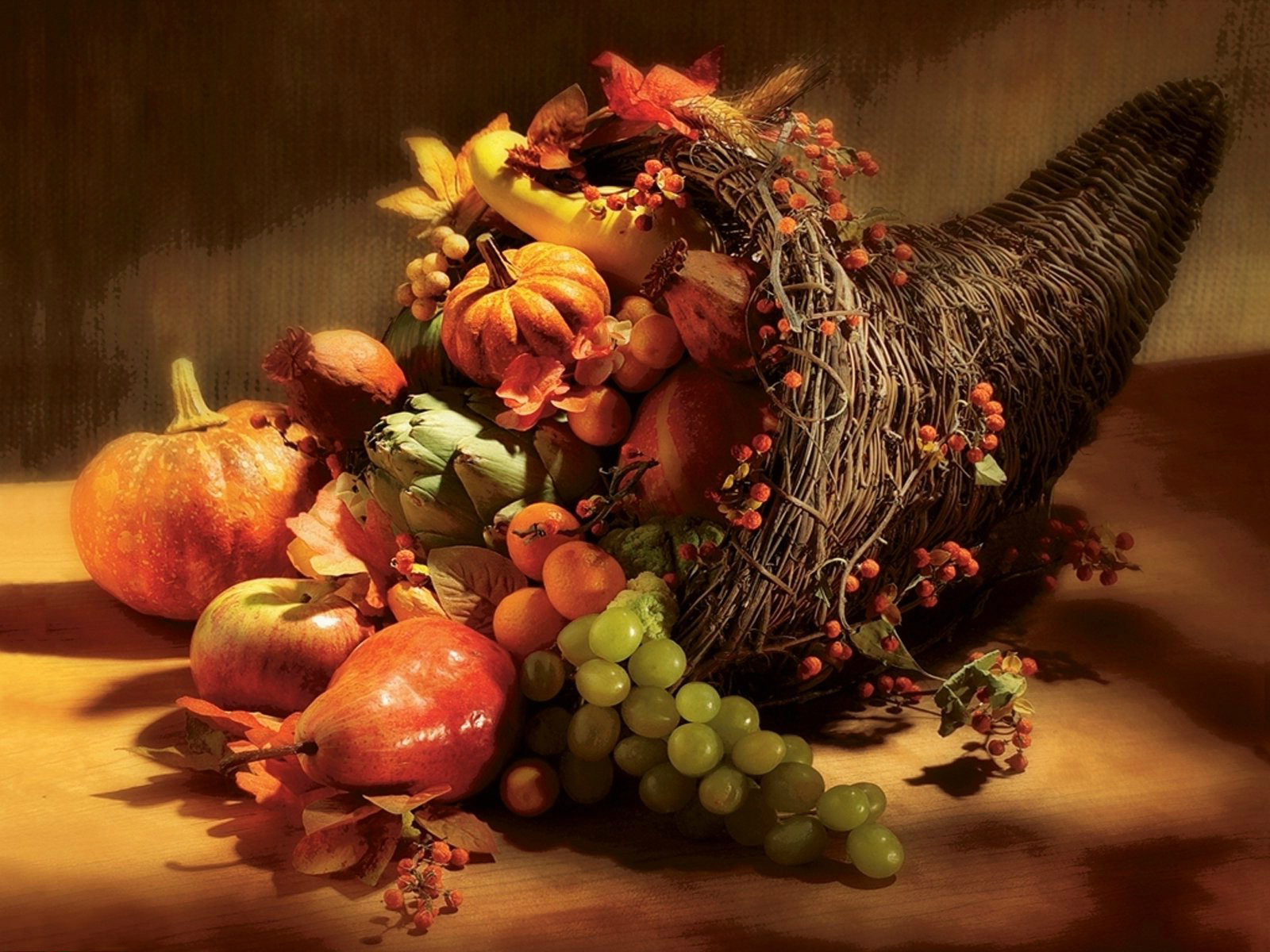
horn-of-plenty

In every thing give thanks: for this is the will of God in Christ Jesus concerning you. (1 Thessalonians 5:18)

In the “Jaywalking” segment of the “Tonight Show,” Jay Leno posed some Thanksgiving Day trivia questions to passersby, and the results were humorous and sad at the same time. Here is a sample of questions asked and the responses:

  1. What year was the first Thanks giving? 1966, 1492
  2. Pilgrims are often shown wearing what on their shoes and their hats? Moccasins
  3. What is a male turkey called? Fred, Richard
  4. 280 Million Americans will cook turkey on Thanksgiving. How many Americans are there in our country? 8 Million
  5. Where did the first Pilgrims land? Hawaii, the East Coast
  6. What President declared Thanksgiving a national holiday? Ronald Reagan, Theodore Roosevelt, Benjamin Franklin
  7. How many days did the first Thanksgiving last? Three: one day for breakfast, one day for lunch, and one day for dinner
  8. What is the name of the ship the Pilgrims came over on? the Nina
  9. Where did the Pilgrims come from? Spain

This may be good for a belly laugh, but it is really tragic that Americans today are so ignorant of our nation’s history and traditions. In today’s culture, Thanksgiving Day is just a good excuse to have a day (or two) off of work, indulge in gluttonous behavior, and worship before the luminous god of football followed by the giving of alms to the god of materialism the next day all the while in complete ignorance of the significance of the day.

It does not have to be that way. The psalmist said, “Therefore will I give thanks unto thee, O LORD, among the heathen, and sing praises unto thy name” (Psalm 18:49). The “heathen,” in this case, were the gôyim, Hebrew for the “nations” or the “Gentiles,” and by implication, the “godless.” Our attitude of thanksgiving should be a testimony to those that are without God not just on Thanksgiving Day, but everyday of our lives. In these “last days” we should live in contrast to those who are “lovers of their own selves, covetous, boasters, proud, blasphemers, disobedient to parents, unthankful, unholy (2 Timothy 3:2).

C. S. Lewis once said, “We ought to give thanks for all fortune: if it is ‘good,’ because it is good, if ‘bad’ because it works in us patience, humility and the contempt of this world and the hope of our eternal country.” Paul expressed this same idea when he said, “Not that I speak in respect of want: for I have learned, in whatsoever state I am, therewith to be content. I know both how to be abased, and I know how to abound: every where and in all things I am instructed both to be full and to be hungry, both to abound and to suffer need” (Philippians 4:11-12). We assimilate this attitude when “we know that all things work together for good to them that love God, to them who are the called according to his purpose” (Romans 8:28). “Them who are the called according to His purpose” do not live their lives like the “heathen” who are ungrateful or “unthankful” in their life conduct.

Perhaps the reason the “heathen” are unthankful is because they do not know to whom they should be thankful. That, of course, presupposes that in every other respect they are caring of others beyond themselves. If expressed at all, we often hear such empty platitudes as: I’m thankful for my job; I’m thankful for my family; I’m thankful for good friends, etc. That is fine, but thankful to whom?

When the Pilgrims landed at Plymouth in 1620, they arrived in the face of a harsh New England winter. They were without food and without shelter. Of the 121 souls that departed England to escape religious persecution and “for the Glory of God, and advancements of the Christian faith and honor of our King and Country,” only 47 of the original colonists survived that brutal winter. With the help of neighboring Indian tribes, the colonists learned to cultivate and enjoy the bounty of the land. At the harvest that followed, they celebrated a season of thanksgiving to God for His providence and protection. The third year after having landed, William Bradford officially proclaimed November 29, 1623 a day of thanksgiving.

In as much as the great Father has given us this year an abundant harvest … and in as much as He has protected us from the ravages of the savages, has spared us from pestilence and disease, has granted us freedom to worship God according to the dictates of our own conscience; now I, your magistrate, do proclaim that all ye Pilgrims, with your wives and ye little ones, do gather at ye meeting house on ye hill, between the hours of 9 and 12 in the day time, on Thursday, November ye 29th, of the year of our Lord one thousand six hundred and twenty-three … there to listen to ye pastor and render thanksgiving to ye Almighty God for all His blessings.

Our nation, from its beginning, has always set aside a special day to give thanks to God, but not always on a consistent basis. George Washington declared a national day of thanksgiving on November 26, 1789 with these words:

Whereas it is the duty of all nations to acknowledge the providence of Almighty God, to obey His will, to be grateful for his benefits, and humbly to implore His protection and favor … Now, therefore, I do recommend and assign Thursday, the twenty-sixth day of November next, to be devoted by the people of these United States to the service of that great and glorious Being, who is the beneficent Author of all the good that was, that is or that will be … that we may then unite in most humbly offering our prayers and supplications to the great Lord and Ruler of Nations, and beseech Him to pardon our national and other transgressions …

Would that our current national leaders adopt that attitude!

Finally, Thanksgiving Day was proclaimed an annual national holiday by President Abraham Lincoln in 1863. He said:

No human counsel hath devised, nor hath any mortal hand worked out these great things. They are the gracious gifts of the most high God, who, while dealing with us in anger for our sins, hath nevertheless remembered mercy … I do, therefore, invite my fellow citizens in every part of the United States, and those who are sojourning in foreign lands, to set apart and observe the last Thursday of November next as a day of Thanksgiving and Praise to our beneficent Father who dwelleth in the heavens … [it is] announced in the Holy Scriptures and proven by all history, that those nations are blessed whose God is the Lord … It has seemed fit to me and proper that God should be solemnly, reverently and gratefully acknowledged, as with one heart and one voice, by the whole American people.

This Thanksgiving Day, amid all the festivities and family gatherings, try to devote at least some time to “Sing unto the LORD, O ye saints of his, and give thanks at the remembrance of his holiness” (Psalm 30:4). “Praise God from whom all blessings flow.”


Comments Off on A Day to Give Thanks

Filed under Atheism, Christianity, Current Events, Holidays, Religion, Thanksgiving, Theology

Too Rich for Heaven

camel-needle

And when he heard this, he was very sorrowful: for he was very rich.  (Luke 18:23)

Let’s face it. With the possible exception of the homeless, many of whom are in that condition by choice, poverty – the third-world kind of poverty where people live on one bowl of rice a day, have only one change of clothes, no shoes and live in cardboard houses – in the United States does not exist. I have visited in homes of the “poor” here in America and found giant-screen TVs in their living rooms with play stations for their kids. They might not have the best food – usually as a result poor choices – but they are a long way from starvation. They may be “low income,” but they are not poor in comparison to third-world nations. They own several changes of clothes and shoes, and many of their vehicles sport shiny custom “rims.”

Affluence often erects an insurmountable obstacle to the Gospel here in America. Many people here in the U.S. are self-sufficient enough that they do not perceive their need for God. They get along fine without Him, so why should they give up their lifestyle to follow Christ who asks them to change their way of living?

Our verse above is taken from an account recorded in the three synoptic Gospels: Matthew 19:16-26, Mark 10:17-27, and Luke 18:18-27. Matthew points out that the man was young (Matthew 19:20, 22). Luke notes that he is a “ruler” (Luke 18:18), perhaps indicating that he significantly, or even solely supported the local synagogue. Such support would place him in a position of high leadership in the synagogue and in the local community. Jairus whose daughter Jesus raised from the dead is such an example (Matthew 9:23-26; Mark 5:35-43; Luke 8:49-56). Mark omits his youth and position, but focuses on his, perhaps, feigned homage in kneeling before Christ.

However, all three Gospel writers point out that the man was rich. In that culture, wealth indicated God’s favor, and was a source of false pride by those so blessed. Jesus often berated the religious leaders for overt exhibition of opulence in their giving of alms and offerings at the temple to be “seen of men” (Matthew 6:5; 23:5). No doubt this “rich young ruler” approached Jesus in a similar hypocritical, arrogant and prideful manner “saying, Good Master, what shall I do to inherit eternal life?” (Luke 18:18) Jesus saw right through him. By “good,” he meant “good like I am good.” “And Jesus said unto him, Why callest thou me good? none is good, save one, that is, God” (v. 19). In Texanese, what Jesus said was, “Boy, you ain’t so good. Only God is good.” Jesus went on to ask him if he “knew” the commandments (v. 20). “And he said, All these have I kept from my youth up” (v. 21, emphasis mine). He lied. No one can keep all of the commandments perfectly! James says, “For whosoever shall keep the whole law, and yet offend in one point, he is guilty of all” (James 2:10).

Jesus then gets to the heart of the matter. So, you really are good! “Yet lackest thou one thing: sell all that thou hast, and distribute unto the poor, and thou shalt have treasure in heaven: and come, follow me” (v. 22). The hidden sins kept the rich young ruler away from that which he sought – eternal life: the sin of pride, the sin of hypocrisy, the sin of selfishness, the sin of covetousness.  “But when the young man heard that saying, he went away sorrowful: for he had great possessions” (Matthew 19:22). He valued his stuff more than the riches of heaven.

In America, we suffer from the fatal disease of “affluenza.” “Fatal” because in many cases it resists the very source of eternal life. Affluenza blinds the victim from seeing “the way, the truth and the life” (John 14:6). Affluenza deafens the victim from hearing the Savior’s words, “I am come that they might have life, and that they might have it more abundantly” (John 10:10).

As Jesus watched the dejected young man walk away He said, “How hardly shall they that have riches enter into the kingdom of God! For it is easier for a camel to go through a needle’s eye, than for a rich man to enter into the kingdom of God” (Luke 18:24-25). Some suggest that a “needle’s eye” was a small opening in the bulwark of a city that would allow a camel to crawl through once the city gates were closed. I don’t think that is what Jesus meant here. If there were such openings in the in the city walls, a camel could enter even with difficulty, but so could attackers. No, I believe Jesus meant the eye of a “sewing” needle. That would indeed require a miracle for a camel to pass.

If your stuff matters more to you than following Jesus, then you are too rich for heaven.

Comments Off on Too Rich for Heaven

Filed under Apologetics, Bible, Christianity, Evangelism, Gospel, Heaven, Religion, Salvation

Who’s In Charge?

Yea, all kings shall fall down before him: all nations shall serve him.  (Psalm 72:11)

The 2014 elections are history now. The Republicans are celebrating the conquest of the Upper House and the ousting of the evil Majority Leader, Senator Harry Reid of Nevada. They are exuberant after gaining control over both houses of Congress. Now we can really get things done! Me? I am not so sure. I participated in “early voting,” and I do not mind admitting that I voted a straight Republican ticket. Not that I believe Republicans are the salve for all our ills, but I simply cannot bring myself to vote for a Democrat under any circumstances. As I drew near the entrance of the polling place, I was approached by a young woman holding a sign who petitioned me to vote for her. I asked, “R or D?” She answered, “D,” to which I responded, “That’s too bad.” I embarrassed my wife, who thought I had been rude, but I only spoke truth, and I wasn’t ugly or hateful about it, just matter of fact. “D” to me has become repugnant and synonymous with Demented, Deranged, Deluded, Dubious, Destructive, Deleterious, etc. I do not mean to offend my Democrat friends, but, if you are a “D,” you really should repent. (I say that with all due love and respect.)

Having said that, I do not place a lot of hope in the Republicans either. I like them only slightly better because, for the most part, they still support the First and Second Amendments and the Bill of Rights in general. They are largely pro-life, and they favor traditional (male/female) marriage and family values. But beyond that, the distinction between R and D begin to blur. In many ways they are indistinguishable from one another. Yes, I know that we have several solid conservatives in the Republican Party, and I am encouraged by them; but they are not in the majority, and are often disdained by the Establishment Republicans. Still, they give voice to conservative values, and that gives me a dull glimmer of hope. It will be interesting to see how this new Republican Congress will act and how President Obama will react. Time will tell.

The Bible teaches that it is God who establishes and dismantles governments. Paul tells us that “there is no power but of God: the powers that be are ordained of God” (Romans 13:1). “And [God] changeth the times and the seasons: he removeth kings, and setteth up kings” (Daniel 2:21, emphasis added).  To the Babylonian king, Daniel said, “Thou, O king [Nebuchadnezzar], art a king of kings: for the God of heaven hath given thee a kingdom, power, and strength, and glory” (Daniel 2:37, emphasis added). “The king answered unto Daniel, and said, Of a truth it is, that your God is a God of gods, and a Lord of kings, and a revealer of secrets, seeing thou couldest reveal this secret” (Daniel 2:47, emphasis added). “The king’s heart is in the hand of the LORD, as the rivers of water: he turneth it whithersoever he will” (Proverbs  21:1, emphasis added).

 We like to think we are in control, but the Bible is clear as to who is really in charge. “The LORD is King for ever and ever” (Psalm 10:16). However, that does not diminish our responsibility.  “I exhort therefore, that, first of all, supplications, prayers, intercessions, and giving of thanks, be made for all men; For kings, and for all that are in authority; that we may lead a quiet and peaceable life in all godliness and honesty” (1 Timothy 2:1-2, emphasis added). While God is ultimately in control, He has given the stewardship of our nation to “We the People.” In all of history, there has never existed a nation like the United States of America, whose government has been placed in the hands of its citizens. Therefore, while we still are able, we should continue to pray for our leaders and exercise our constitutional rights as citizens to elect leaders who hold and exercise godly principles. (By the way, one does not necessarily have to be a Christian to hold godly principles, but it certainly helps.) At the same time we should maintain our national motto – In God We Trust. Leaders will disappoint us. Our nation will ultimately fail, but God remains faithful forever. We can trust that God is in charge.

3 Comments

Filed under Christianity, Current Events, Politics, Theology

Don’t Pray For This People!

Therefore pray not thou for this people, neither lift up cry nor prayer for them, neither make intercession to me: for I will not hear thee. (Jeremiah 7:16)

The 238th anniversary of the birth of our nation quickly approaches, and I find my enthusiasm waning as the day draws near. Actually, it has been waning for quite some time now. Please do not misunderstand. I am about as patriotic as the next fellow, perhaps even more than most. Since the Obama Administration ascended to power, I have watched in amazement as the foundations of our nation crumble before our eyes and the Constitution systematically gets dismantled. Obama is not totally to blame. The foundations have been cracking for a long time now – removal of God’s Word and prayer from public schools, the wholesale ejection of God from the public square, the establishment of the Welfare State, the legalization of infanticide (abortion on demand legitimized by the pseudonym of Planned Parenthood and Pro-Choice), the dissolution of the traditional nuclear family (husband, wife, offspring), and the acceptance of homosexual unions as equal to heterosexual marriages. But the downward pull of the vortex has increased with the rise of the current administration.

I find little for which to celebrate. Some would be quick to remind me that we are to pray “For kings, and for all that are in authority; that we may lead a quiet and peaceable life in all godliness and honesty” (1 Timothy 2:2). That is true, and I believe we should, but even God has a limit as indicated by our starting verse. At that time, the people of Judah had fallen into idolatry. Whatever worship they did offer to God was substandard and merely rote ritualism. God was sick of it, and He told Jeremiah, “pray not thou for this people, neither lift up cry nor prayer for them, neither make intercession to me: for I will not hear thee” (Jeremiah 7:16). There comes a time when a people, as a nation, has so hardened their hearts against God that He will not even entertain an intercessory prayer for them. In fact to do so is to pray against God’s will. I think we have reached that point.

How can I be so sure about that? Romans 1:18-32 describes the downward spiral:

  1. They hold God’s truth in unrighteousness (v. 18)
  2. They reject the “clearly seen” natural revelation of God (vv. 19-20)
  3. They knew God but did not glorify Him as God (v. 21)
  4. Consequently their heart is darkened (v. 21)
  5. They profess themselves to be wise and become fools (v. 22, Psalm 14:1)
  6. They create gods of their own imagination (v. 23)
  7. God gives them over to physical perversions (v. 24)
  8. They turn God’s truth into a lie (v.25)
  9. They value the creation more than the Creator (v. 25)
  10. Consequently, God gives them over to sexual perversions – women with women and men with men (v. 26-27)
  11. As an additional consequence, God gives them over to “reprobate mind,” i.e. a mind that cannot think rationally (v. 28)
  12. They decline into a long list of increasing perversions (vv. 29-31)
  13. Finally they take joy in their perversion and encourage others accept their ways (v. 32)

Is that not the state of our nation? Think about our President praising a professional basketball player for “coming out” and expressing his homosexuality. Think about how he has stifled DOMA (the Defense of Marriage Act) and has removed all restrictions from homosexuals serving in the military. Think about the culture of lies he has engendered in his administration: the IRS scandal, the VA scandal, the Benghazi scandal, Fast and Furious, and on and on. Then we have the mainstream media that offers its support with silence and the entertainment industry that sings his praises as though there is something praiseworthy.

This Sunday morning, Todd Starnes, author of God Less America, spoke at our church. He points out many of the same things I have listed here, but he is far more optimistic than I. I do not believe there is any turning back for this nation. Someone will remind me that God said, “If my people, which are called by my name, shall humble themselves, and pray, and seek my face, and turn from their wicked ways; then will I hear from heaven, and will forgive their sin, and will heal their land” (2 Chronicles 7:14). Allow me to point out that the oft quoted verse is taken out of context. It is specific to the Jewish Temple, Jerusalem, and Israel, and it does not have a general application for the Church. The Church is NOT Israel even though some who preach “replacement theology” insist that it is. Let me also point out that God’s people, the Church, possess a heavenly citizenship, not an earthly one (Philippians 3:20 NASB). Our concern should not be for an earthly nation, but for a heavenly one. More often we are exhorted to be law-abiding citizens except for where a human law violates the Law of God (Acts 5:29). There is only one exhortation for us to pray for our leaders (cited above). Beyond that, may God’s “will be done in earth as it is in heaven” (Matthew 6:10). Our nation has been judged. Should we pray for its healing against God’s will? Although it grieves me to say it, I think not.

What then are we to do? We should remain true to the faith. We must be bold in our witness. And we should never put more faith in our government than we do in God. Our citizenship, our loyalty, and our devotion must be to Christ above all else. Jesus Christ is Lord and our King!

For what it’s worth, Happy Independence Day!

2 Comments

Filed under Apologetics, Christianity, Current Events, End Times, Holidays, Politics, Prayer, Religion, Theology

A Memorial

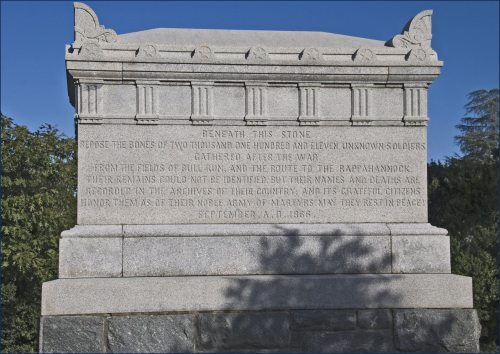
Near Arlington House, in what was once part of its famous rose garden, stands a monument dedicated to the unknown soldiers who died in the Civil War. This monument was the first memorial at Arlington to be dedicated to soldiers who had died in battle, and who later could not be identified.

Near Arlington House, in what was once part of its famous rose garden, stands a monument dedicated to the unknown soldiers who died in the Civil War. This monument was the first memorial at Arlington to be dedicated to soldiers who had died in battle, and who later could not be identified.

And this day shall be unto you for a memorial; and ye shall keep it a feast to the LORD throughout your generations; ye shall keep it a feast by an ordinance for ever. (Exodus 12:14)

Throughout Scripture God gave the children of Israel memorials as memory aids in keeping alive in their conscience His miraculous provision for them. His very name was to be a memorial. “I AM THAT I AM … this is my name for ever, and this is my memorial unto all generations” (Exodus 3:14-15, emphasis added). The celebration of the Passover reminded them of God’s deliverance from their bondage in Egypt. “And it shall be for a sign unto thee upon thine hand, and for a memorial between thine eyes, that the LORD’S law may be in thy mouth: for with a strong hand hath the LORD brought thee out of Egypt” (Exodus 13:9, emphasis added).

The written Word is a memorial. Not long after leaving Egypt, the Israelites faced their first adversary. Amalek, king of the Amalekites, came out in opposition to their progress in the land. The Israelites fought and won against the enemy, “And the LORD said unto Moses, Write this for a memorial in a book, and rehearse it in the ears of Joshua: for I will utterly put out the remembrance of Amalek from under heaven” (Exodus 17:14, emphasis added). Without the written Word, all “remembrance of Amalek from under heaven” would have been forgotten.

Monuments can also serve as memorials. When the children of Israel crossed the Jordan River – on dry ground – to take possession of the Promised Land, God instructed that the head of each of the twelve tribes should pick up a stone as they crossed the Jordan to be assembled on the other side. The purpose was so “That this may be a sign among you, that when your children ask their fathers in time to come, saying, What mean ye by these stones? Then ye shall answer them, That the waters of Jordan were cut off before the ark of the covenant of the LORD; when it passed over Jordan, the waters of Jordan were cut off: and these stones shall be for a memorial unto the children of Israel for ever” (Joshua 4:6-7, emphasis added).

The problem with memorials is that we become so familiar with them that they can be taken for granted. If not accompanied with the instruction and the history behind it, the memorial becomes just another day of festivities, just another book on a bookshelf, or just another pile of rocks. We celebrate Memorial Day this weekend. For many, it is just another three-day weekend suitable for a short getaway, or time spent with family and friends cooking steaks on a grill and just taking it easy without even a thought to the significance of the day.

This weekend is a memorial to all the men and women who have spilt their life’s blood on the battlefield defending this nation’s right to exist and to enjoy the unalienable rights of life, liberty and the pursuit of happiness that come to us from God alone. This is the time when we honor those who have fought and who have died to preserve the American way of life. This way of life is in danger of slipping through our fingers. One of the main reasons for this is that we have forgotten the meaning of our memorials. God help each one of us when that is finally gone.

1 Comment

Filed under Christianity, Current Events, Death, Holidays