Category Archives: Bible

What A Thing!

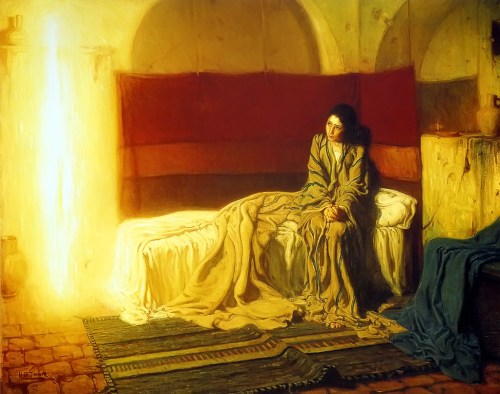
Annunciation by Henry Ossawa Tanner

… Christ Jesus: Who, being in the form of God, thought it not robbery to be equal with God: But made himself of no reputation, and took upon him the form of a servant, and was made in the likeness of men: (Philippians 2:5-7)

The Christmas season is upon us once again, and once more, I sense the dilemma of mixing the commercialization of the season by the world with the celebration of the First Advent. Any Christian well taught in Scripture recognizes that Jesus was not born on December 25, but thanks to the Catholics, we are stuck with that date. Regardless of how one feels about that, it is appropriate to set aside a special time to contemplate the magnitude of the miracle that is the Incarnation[1] – God becoming a man.

Consider our leading verse. No other religion[2] in the world makes the claim that their gods willingly depose themselves of all divine powers to assume the life of a human. Then, to top it off, offer themselves as a blood sacrifice in order to save the lowly human race. However, contemplate seriously the significance of these words of Scripture.

“Christ Jesus” – the anointed Savior (meaning of the name) – “who being in the form of God.” The Greek word translated “form” is morphē, and it means “shape” or “nature.” The Apostle John calls Jesus “the Word.” He wrote, “In the beginning was the Word, and the Word was with God, and the Word was God: (John 1:1, emphasis mine). In the Greek, the phrase “the Word was God” literally reads, “God was the Word” — θεος ην ο λογος. What a thing!

Though He was in every way, in very nature, God, He “Thought it not robbery to be equal with God.” Verse 8 clarifies this phrase when it explains that Jesus “humbled Himself.” He did not regard it robbery to lay aside His Divine nature and assume human form in order to redeem fallen humanity. What a Thing!

“He made Himself of no reputation.” This entire phrase is summed up in one Greek word, εκενωσεν (hekenoōsen), which means, “He emptied Himself” without any sense of deprivation. In exchange, “He took upon Himself the morphē (see above) of a servant” – doulos – a “slave.” He “was made in the likeness of men.” The Greek word translated “likeness” is homoiōma meaning “resemblance.” So, not only did He take on the “nature” of man, He “looked” like any other man. There was no halo around Him to distinguish Him from any other man. Of Him Isaiah the prophet said, “he hath no form nor comeliness; and when we shall see him, there is no beauty that we should desire him” (Isaiah 53:2, emphasis mine). The Hebrew word translated “comeliness” is hâdâr meaning “magnificence,” and “beauty” is the Hebrew word mar-eh’ meaning a “handsome appearance.” So much for those soft-faced images of Jesus, we are so used to seeing! It was not enough that He condescended from His Divine nature to assume the nature of an ordinary, common-looking man, but He took the form of the lowliest kind of man – a slave. Not only did He come as a slave, but He chose a peasant girl for a mother and a stable for His birthplace.[3] What a THING!

The passage goes on to say, “And being found in fashion as a man, he humbled himself, and became obedient unto death, even the death of the cross” (Philippians 2:8, emphasis mine). “Fashion” is the Greek word, schēma and it means the “mode, circumstance, or external condition.” The Bible tells us that “the wages of sin is death” (Romans 6:23). Man must die eternally to pay the penalty for sin. Unless some sinless one can be found to serve as a suitable sacrifice for all of mankind, every one of us must pay “the wages of sin.”[4] Who could qualify as a suitable sacrifice? “As it is written, There is none righteous, no, not one … For all have sinned, and come short of the glory of God” (Romans 3:10, 23). Therefore, God clad Himself in human flesh and took the penalty for universal sin upon Himself. However, His death was not enough. He conquered death when He rose from the grave on the third day. He paid the sin debt that we owe and broke the curse of death[5] with His resurrection. WHAT A THING!

This Christmas, regardless of the commercialization of the season and regardless of the fact that Jesus was not born on December 25, God’s gift of salvation freely offered to all who will accept it, is worthy of commemoration and celebration. “This is a faithful saying, and worthy of all acceptation, that Christ Jesus came into the world to save sinners; of whom I am chief” (1 Timothy 1:15, emphasis mine). WHAT A THING!!

Merry Christmas!

Notes:


[1] “Miracle of the Incarnation” – https://erniecarrasco.com/2012/12/24/miracle-of-the-incarnation/

[2]  “False Religion” – https://erniecarrasco.com/2014/07/27/false-religion/

[3]  “Extreme Measures” – https://erniecarrasco.com/2016/12/11/extreme-measures/

[4]  “Eternal Sacrifice” – https://erniecarrasco.com/2012/09/30/eternal-sacrifice/

[5]  “Why Jesus?” – https://erniecarrasco.com/2015/12/13/why-jesus/
5 Comments

Filed under Apologetics, Bible, Christianity, Christmas, Evangelism, Gospel, Holidays, Religion, Theology

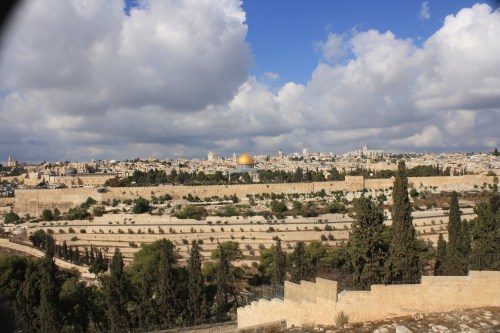
Jerusalem

Modern Jerusalem viewed from the Mount of Olives

And unto his son will I give one tribe, that David my servant may have a light alway before me in Jerusalem, the city which I have chosen me to put my name there. (1 Kings 11:36)

Emerging from the tunnel cut through the mountain from Jericho, I caught my first glimpse of the “Eternal City,” Jerusalem. I was completely unprepared for the overwhelming emotional “rush” I would get upon my first view of the city – God’s city. Although Jerusalem is in every way a modern city – nothing like it was in Jesus’ day – building codes imposed on new construction maintain the “old” appearance of the city. That probably contributed to my emotional response.

There are cities in the Middle East more ancient than Jerusalem. Damascus, Syria, for example, is first mentioned in Genesis 14:15.  In this account, a confederation of four kings from the area around Damascus came against the kings of the south, in the area around the Dead Sea. One of those cities was Sodom where Abram’s nephew Lot was living. The invading kings sacked the five cities including Sodom and carried off captives of which Lot was one. Abram mustered up a small army of his own servants, pursued the four kings, rescued Lot, and the other captives, and took back the booty taken by the marauding kings. On his return, he encountered Melchizedek, king of Salem (Genesis 14:17-20). Some have supposed that Salem was the same as Jerusalem, but I disagree for several reasons.[1]

Jerusalem[2] is built on the mountains in the land of Moriah. It was “upon one of the mountains” (Genesis 22:2) there that God instructed Abraham to sacrifice his only son Isaac. It is noteworthy that God did not instruct Abraham to go to Salem, Jerusalem, or Jebus (Judges 19:10-11; 1 Chronicles 11:4-5). Jebus was the “city of the Jebusites” and the Jebusites were in the land when Abram first arrived (Genesis 15:21), and it seems it would have been an excellent landmark if it existed at the time of Abraham. Instead, God instructed Abraham to go the “land of Moriah” and sacrifice Isaac on one of the mountains there. A normal reading of the text leads one to see this place as isolated and uninhabited. However, this would later become the site of Jerusalem, and the particular mountain on which Isaac was offered would become the site of the Temple “in the threshingfloor of Ornan the Jebusite.” (2 Chronicles 3:1). Eventually, God would sacrifice His own Son, on the mountains of Moriah.

This alone makes Jerusalem a special place. Geographically, Jerusalem is located near the center of earth’s total landmass.[3] More than this, God stamped His name on Jerusalem.[4] Jews associate the Hebrew letter “Shin” (ש) with the name of God. They derive this from the “Shama” (meaning “hear”) in Deuteronomy 6:4 – “Hear, O Israel: The LORD our God is one LORD.” Jerusalem – the “Old City” is situated on the mountains of Moriah, which are flanked by two valleys – the Kidron, and Tyropean – with a third, the Hinnom (Gehenna), that runs down the center to join the other two. The topography forms the letter “Shin” the symbol of God’s name. The land of Israel has a similar stamp where the three headwaters of the Jordon River join together to form the letter “Shin.”

The mountains of Moriah are made up of three mountain heads: Ophel, Moriah, and Zion. “Ophel” means “My Fortress” and represents God the Father. “Moriah” means “to see God” or “to be seen of God” and represents God the Son. “Zion” means “the Mark” and represents God the Holy Spirit who is the “seal” or the “mark” of all believers. One mountain range with three heads representing one God in three persons.

Jerusalem, as stated earlier, is the “Eternal City.” When Jesus returns to reign as King of Kings and Lord of Lords, He will come to Jerusalem. “And his feet shall stand in that day upon the mount of Olives, which is before Jerusalem on the east, and the mount of Olives shall cleave in the midst thereof toward the east and toward the west, and there shall be a very great valley; and half of the mountain shall remove toward the north, and half of it toward the south” (Zechariah 14:4, emphasis mine). Jesus will physically reign from His Temple in Jerusalem. A river will flow from his throne here and will run to the east and into the Dead Sea, which will be healed (Ezekiel 47:8-9).

At the end of the 1000-year reign of Christ on earth, God will create a “new heaven and a new earth,” and a “New Jerusalem” will descend from heaven to a recreated earth (Revelation 21:1-2) where those of us who are His children will reign forever with Him. As beautiful as Jerusalem is today, it will not compare to the New Jerusalem where not just God’s name will dwell, but God Himself will dwell with us!

Reader, if you are unsure where you will spend eternity, read my page on Heaven.

Notes:


[1]  “Is Salem Jerusalem?” – https://erniecarrasco.com/2015/08/16/is-salem-jerusalem/

[2]  “Hebrew Word Study – Jerusalem – Part I” – http://livingwordin3d.com/discovery/2016/12/18/hebrew-word-study-jerusalem-part-i/

[3]  “The Center of the Earth” – http://www.icr.org/article/50

[4]  “Jerusalem – I Will Put My Name There – Amazing Revelations” – https://www.youtube.com/watch?v=aZO_eRmR2ho

2 Comments

Filed under Bible, Christianity, End Times, Gospel, Heaven, Religion, Salvation, Second Coming of Christ, Theology

Is the Bible Allegory?

Thy word is a lamp unto my feet, and a light unto my path. (Psalm 119:105)

A young woman wrote me and claimed that God told her that the Bible is allegory. She claimed that people misinterpret the Bible when they take it literally. “The Lord” told her that the creation account recorded in Genesis represents later events in the Bible. I suppose, if she received a word from God, then it must be true. However, is she right, and did she really receive this instruction from God?

Volumes have been written and reams of paper spent defending the inspiration, infallibility, and inerrancy of the Bible. The problem of misinterpretation comes when people think they know what the Bible says, without really knowing what it says. The Bible is very clear and easily understood on its own without any kind of special interpretation. The problem is that people often do not like what it has to say, so they interpret it to say what they want it to say. As Mark Twain said, “It ain’t those parts of the Bible that I can’t understand that bother me, it is the parts that I do understand.”

That said, the Bible does employ allegory sometimes. For example, Ezekiel saw a valley of dry bones (Ezekiel 37), and God told Ezekiel to preach to the dry bones. When he did, the bones came together, and flesh and skin came on the bones. However, there was no breath in them (Ezekiel 37:8). God instructed Ezekiel to preach to them once more and breath came on them and they rose up “and stood up upon their feet, an exceeding great army” (Ezekiel 37:10). Then God explained what Ezekiel saw (vv. 11-14). The bones represent the nation of Israel, which God will gather from all over the world and restore to their land, but when they come, the Spirit of God will not be in them. God will then put His Spirit in them “that they may live” again. This prophecy is an allegory of Israel in the last days. That prophecy was fulfilled on May 14, 1948, when Israel was reborn as a nation. However, God’s Spirit is not yet in them – they are still spiritually dead. Many Jews in Israel are atheists. Those who are not, still look for the coming of their Messiah. My point, however, is that this is one good example of allegory in the Bible.

Not all of the Bible is allegory. When an allegory is presented, it is very clear that it is an allegory, and it usually comes with an explanation. When you understand that, and compare an allegory, as in the example above, to the creation narrative in Genesis, it should be obvious that the creation account is not an allegory, nor is it Hebrew poetry. Genesis records a matter-of-fact account of creation. It is a historical narrative. Now, what you do with that is up to you; you can choose to accept it, or you may choose to reject it, but you cannot call it an allegory.

This young woman said, “The Lord told me it represents later events in the Bible.” I cautioned her that it may not be “the Lord” speaking because He will not lead us to doubt any of His Word. The Bible says, “All scripture is given by inspiration of God, and is profitable for doctrine, for reproof, for correction, for instruction in righteousness” (2 Timothy 3:16). It cannot be “profitable” for doctrine, correction, or instruction if it is all allegorical. One can make of an allegory whatever one imagines, and not everybody imagines the same thing. In the example of Ezekiel’s dry bones above, it should be noted that God Himself explains the allegory. In the same way, Jesus always explained His parables to His disciples; He did not leave it up to them to determine the meaning of the allegory.

God’s Word is precise, not allegorical. Jesus said, “For verily I say unto you, Till heaven and earth pass, one jot or one tittle shall in no wise pass from the law, till all be fulfilled” (Matthew 5:18). The “jot” (Hebrew letter yod – י) is the smallest letter in the letter in the Hebrew alphabet. The “tittle” is the smallest marking on a Hebrew letter that distinguishes it from another similar looking letter, for example, the difference between the resh (ר) and the dalet (ד). Jesus was not speaking in allegory. He spoke matter-of-factly and authoritatively. Again He said, “And it is easier for heaven and earth to pass, than one tittle of the law to fail” (Luke 16:17). Such emphatic statements cannot be true of allegories because allegories by themselves are up for interpretation.

God would not make His Word ambiguous through allegory if He means for it to be fulfilled to the smallest mark of the text. However, I know who would – Satan. From the very beginning, his tactics remain the same. Consider carefully at the account of the Fall (Genesis 3:1-5). “Now the serpent was more subtil than any beast of the field which the LORD God had made. And he said unto the woman, Yea, hath God said, Ye shall not eat of every tree of the garden?” (Genesis 3:1), This is not written as an allegory; it is written as a matter-of-fact. Note that the first thing Satan does is to introduce doubt in God’s Word – “Yea, hath God said…?” To paraphrase: “Did God really say that or was it just allegorical?” His next step is to call God’s Word a lie. “And the serpent said unto the woman, Ye shall not surely die” (Genesis 3:4). God told Adam he would die (Genesis 2:17), if he ate from the tree of knowledge of good and evil, and here Satan says that is not true. Again, to paraphrase: “You are not going to die. That was just an allegory. God did not really mean you were going to die.” That set the stage for Satan’s third tactic – to charge God with dishonest and dishonorable motives. “For God doth know that in the day ye eat thereof, then your eyes shall be opened, and ye shall be as gods, knowing good and evil” (Genesis 3:5). To paraphrase once more: “God wants to keep something good from you. He knows that if you eat of the fruit, you will be like gods, and you will know as much as He does, and He does not want that for you.” King Solomon said, “The thing that hath been, it is that which shall be; and that which is done is that which shall be done: and there is no new thing under the sun” (Ecclesiastes 1:9). Satan has not changed from the beginning of time, and he still uses the same tactics to cast doubt on God’s Word.

No, the LORD God is not going to tell you that His Word is just an allegory and that you can interpret any way you think. God says, “Let the wicked forsake his way, and the unrighteous man his thoughts: and let him return unto the LORD, and he will have mercy upon him; and to our God, for he will abundantly pardon. For my thoughts are not your thoughts, neither are your ways my ways, saith the LORD. For as the heavens are higher than the earth, so are my ways higher than your ways, and my thoughts than your thoughts” (Isaiah 55:7-9).

The Bible is not allegory. God makes His Word abundantly clear. The Bible does “contain” allegory, but where allegory is given, the interpretation follows close behind. Certainly, there are some things that are difficult to understand, as Mark Twain noted, however, most of it is plain enough. “The secret things belong unto the LORD our God: but those things which are revealed belong unto us and to our children for ever, that we may do all the words of this law” (Deuteronomy 29:29). “Those things which are revealed” are plain enough for us to understand. They are not allegories that we must puzzle out. God reveals His Word to us clearly so that we can know Him intimately. He will not veil His Word in allegory so that every individual gets a different “insight” into what it says. God’s Word is precise. It is matter-of-fact. Our task is to accept God’s Word for what it says, not for what we think it says.


2 Comments

Filed under Apologetics, Bible, Christianity, Creation, Religion, Theology

One-Verse Theology

The foolish shall not stand in thy sight: thou hatest all workers of iniquity. (Psalm 5:5)

Sometimes people will take one verse out of the Bible and try to build an entire belief system from one verse without regard to what the rest of Scripture has to say about it. For example, “Judge not, that ye be not judged” (Matthew 7:1). Non-Christians and even many Christians use this verse to humiliate Christians into not making any judgments whatsoever. However, when read in context (Matthew 7:1-6) it becomes clear that what appears in isolation is not what is meant as a whole. Other examples could be cited, but this should do for the purpose of this writing.

Recently someone complained that the overused cliché – “hate the sin, but love the sinner” – is not biblical, and they used Psalm 5:5 (above) as their proof text. While the phrase itself is not found in the Bible, the concept is nevertheless both biblical and practical. Note that the cliché is not attributed to God, but rather it is intended for Christians.

The plaintiff claimed that the adage, “hate the sin, but love the sinner,” is not biblical because Psalm 5:5 says that God hates both the sin and the sinner. However, the challenger took one verse, Psalm 5:5, in isolation, and overlooked what the rest of the Bible teaches about God’s love – indeed, His love toward the sinner. Who of us can honestly say that we harbor no sin? If we are all sinners, even if saved by Grace, then by this assessment, God hates us. If we say we are not sinners, we have a surprise in store. “If we say that we have no sin, we deceive ourselves, and the truth is not in us … If we say that we have not sinned, we make him a liar, and his word is not in us.” (1 John 1:8, 10, emphasis mine). John was writing to Christians! Personally, I am grateful that God loves this sinner even though He still hates my sin. (By the way, the closer I get to Him, the more I hate my own sin.)

 So, let us examine the challenger’s one-verse defense in its entire context. Psalm 5 is an imprecatory psalm, i.e. a psalm that calls upon God to judge His or our enemies. It is written from a human perspective. Because of David’s understanding of God’s holy nature and His hatred for sin, he concludes that God hates the sinner equally. “For thou art not a God that hath pleasure in wickedness: neither shall evil dwell with thee” (Psalm 5:4). God cannot and will not abide sin. David continues: “The foolish shall not stand in thy sight: thou hatest all workers of iniquity” (Psalm 5:5, emphasis mine). As Hebrew poetry, the psalms are written in a parallel style, so that the thought in the first part of the verse repeats in a different way in the second. Strictly translated, the first part reads, “Not do stand the foolish before Thy sight,” or, better, “The foolish do not stand before Thy sight.” Comparatively speaking then, someone who “works iniquity” cannot stand in the presence of God, so that it appears that God hates the sinner. The Hebrew word translated “hate” is śânê’, and it means “to be in opposition to” or “to be an enemy or foe;” however, to be in opposition to someone does not necessarily require feelings of hatred.  Is it the sinner that God hates, or is it the sinner’s works of iniquity that God opposes? The Bible teaches the latter. The KJV includes the future “shall” (not found in the original Hebrew) indicating that the sinner will never be able to stand before the Lord. The unrepentant sinner does not now, nor shall ever stand in the presence of God. Their sin has separated them from God eternally. Does that mean that God hates them?

 “Thou shalt destroy them that speak leasing [falsehood]: the LORD will abhor the bloody and deceitful man” (Psalm 5:6, emphasis mine). The judgement is reserved for a future time. “And death and hell were cast into the lake of fire. This is the second death. And whosoever was not found written in the book of life was cast into the lake of fire” (Revelation 20:14-15). Does that mean that God did not love these sinners?

 The Bible teaches that God loves mankind. It teaches that from the very beginning. “But of the tree of the knowledge of good and evil, thou shalt not eat of it: for in the day that thou eatest thereof thou shalt surely die” (Genesis 2:17, emphasis mine). “And when the woman saw that the tree was good for food, and that it was pleasant to the eyes, and a tree to be desired to make one wise, she took of the fruit thereof, and did eat, and gave also unto her husband with her; and he did eat. (Genesis 3:6, emphasis mine). “And the LORD God said unto the serpent, Because thou hast done this, thou art cursed above all cattle, and above every beast of the field; upon thy belly shalt thou go, and dust shalt thou eat all the days of thy life: And I will put enmity between thee and the woman, and between thy seed and her seed; [He] shall bruise thy head, and thou shalt bruise his heel” (Genesis 3:14-15)

 Did God demonstrate hate for the sinner here, or did He show His love? By all rights, He should have killed them for their disobedience; after all, that is what He said He would do. Instead, God spared them, and He promised a Savior. Is that hate or love? One might rightly say, “Well, God was showing mercy.” Yes, that is true, but does mercy spring from hate or from love?

 David, a sinner himself, pleads with God to “Destroy thou them, O God; let them fall by their own counsels; cast them out in the multitude of their transgressions; for they have rebelled against thee” (Psalm 5:10). God will do that in due time, but because of His mercy and His love (yes, love for sinners), He gives them time to repent. “But let all those that put their trust in thee rejoice: let them ever shout for joy, because thou defendest them: let them also that love thy name be joyful in thee. For thou, LORD, wilt bless the righteous; with favour wilt thou compass [surround] him as with a shield” (Psalm 5:11-12, emphasis mine).

 “For all have sinned, and come short of the glory of God” (Romans 3:23, emphasis mine), “But God commendeth his love toward us, in that, while we were yet sinners, Christ died for us” (Romans 5:8, emphasis mine). “For God so loved the world [i.e. sinners], that he gave his only begotten Son, that whosoever believeth in him should not perish, but have everlasting life” (John 3:16, emphasis mine). If God hates sinners, then why did He go through all the trouble of making a way of salvation? “Beloved, if God so loved us, we ought also to love one another” (1 John 4:11, emphasis mine).

 “Hate the sin, but love the sinner.” It might be trite and overused, but it is biblical! It is also practical as it instructs us to love those who have offended us.

Reader, if you have not trusted in Jesus as your Savior, God does not hate you; He loves you, but He does hate your sin. You will never be able to stand before Him until that matter is settled. God loves you, and He sent Jesus to stand in your place and pay the price for your sins on the cross. Now He invites you to accept His free gift of salvation and eternal life. Acknowledge and confess your sinful condition to Him. Believe/trust that Jesus died for your sins. Ask Him to forgive you of your sin, and invite Him to be the Master of your life. “For whosoever shall call upon the name of the Lord shall be saved” (Romans 10:13). His gift of salvation is yours for the asking. Do it today!

3 Comments

Filed under Apologetics, Bible, Christianity, Evangelism, Gospel, Religion, Salvation, Theology

The Universe Is Young

For in six days the LORD made heaven and earth, the sea, and all that in them is, and rested the seventh day: wherefore the LORD blessed the sabbath day, and hallowed it. (Exodus 20:11)

I have heard it said that the universe is something like 13.8 Billion years old and that the earth is around 4.4 Billion years old. How they—those that make such claims—arrive at such astronomical numbers is beyond me. The earth does not have a manufacturer’s date stamp on it (or does it?). Those that make those claims are, for the most part, God-deniers along with some who, while not denying God, question the veracity of His Word.

The Bible says the universe, of which earth is a part, is young. Since God-deniers reject the notion of an all-powerful, all-knowing Creator God, they must invent some mechanism from which the entirety of the universe came. BANG! They invent a brilliant idea that all matter was compressed into an infinitesimally small “singularity” that got really hot and rapidly expanded into the universe that we know, which, by the way, continues to expand. You may recognize this hypothesis as the Big Bang theory, only it is not a very good hypothesis, much less a theory.[1] Many secular scientists recognize the problem with this hypothesis and continue to look for ways to make it better. Some have given up on it altogether and opted for other hypotheses like the “string theory” (Don’t ask; I don’t have a clue what that means.), or the “multiverse theory.” The latter is quite clever. Since parallel universes are unobservable, they are free to speculate to their heart’s content on what happens in those unseen realms. Who will prove them wrong? At least they generally agree that the universe had a beginning.

“In the beginning God created the heaven and the earth” (Genesis 1:1). There you have it—the universe—in the opening sentence of the Bible—just ten short words (seven in the original Hebrew). In that short sentence you find time, space, and matter/energy—the components of the universe. The biblical creation record begins with Genesis 1:1 and concludes with Genesis 2:3. (The reader should keep in mind that chapter and verse divisions are not inspired text, and they do not appear in the original manuscripts.) The biblical creation account records that the entirety of creation took six 24-hour days with a cessation of creative activity on the seventh day. Now, there are compromisers out there calling themselves Bible-believing Christians that attempt to accommodate the God-deniers by inserting long ages anywhere they can in the biblical record. I do not have space here to present or argue against their positions. For now, allow me to simply say, they are wrong—so wrong![2] [3]

According to the Bible, the universe is only one day older than the planet earth. I need to point out that the universe in the beginning contained all the elements in a disorganized mess (it wasn’t a mess for God). “And the earth [i.e., matter/energy, the elements] was without form, and void; and darkness was upon the face of the deep. And the Spirit of God moved upon the face of the waters” (Genesis 1:2). The “planet” Earth was formed and organized on the second day of creation (Genesis 1:6-8). On the third day (Genesis 1:9-13), God caused the waters to separate from the land. It was not until the fourth day (Genesis 1:14-19) that God created the sun, moon, stars, galaxies, and all other celestial bodies.

Genesis 5 gives a detailed accounting of the years from the creation of Adam and Eve (Genesis 1:24-31) to the global flood of Noah[4] which was about 1656 years.[5] Creation to the time of Abraham was about 2000 years, from Abraham to Jesus another 2000 years, and from Jesus to present about 2000 years—6000 years total. There you have it! It is now time for the seventh millennium of rest (Revelation 20)!

Of course, God-deniers and Bible-doubters want scientific proof. Anyone serious enough and ambitious enough can go to the Institute for Creation Research website and take advantage of the search engine there where they will find all kinds of scientific research proving a young earth and a young universe. Here are just some of the proofs they will find:

  • Magnetic fields on Uranus and Neptune that should not exist if the universe is billions of years old[6] [7] [8]
  • Jupiter expends more energy than it receives from the sun. It should have run out of gas by now, if it is billions of years old[9]
  • Blue stars use up their fuel very rapidly. None should exist, if the universe is billions of years old[10]
  • Spiral galaxies would be unrecognizable, if they were billions of years old[11]
  • Carbon-14 in diamonds proves a young earth[12]
  • Soft tissue in dinosaur fossils should not last 65 million years [13]
  • The improbability of evolution proves a young earth[14]
  • Scientists unwittingly confirm the Global Flood as recorded in Genesis 7, albeit attributing billions of years to it[15]

The resources provided in the End Notes below should suffice for anyone with ears to hear and eyes to see; however, the God-denier cannot be convinced by evidence. The God-denier has a problem with God. That is a spiritual problem, not an intellectual problem. “But the natural man receiveth not the things of the Spirit of God: for they are foolishness unto him: neither can he know them, because they are spiritually discerned” (1 Corinthians 2:14). The universe and the earth are young, just like the Bible says.

Notes:


[1]  “March For ‘Science’” http://www.icr.org/article/march-for-science

[2]  “A Day Is A Day” https://erniecarrasco.com/2015/10/25/a-day-is-a-day/

[3]  “No Gap” https://erniecarrasco.com/2015/10/18/no-gap/

[4]  “Age of the Earth” https://erniecarrasco.com/2014/02/23/age-of-the-earth/

[5]  “How Young Is the Earth? Applying Simple Math to Data Provided in Genesis” http://www.icr.org/article/how-young-earth-applying-simple-math-data-provided

[6]  “The Creation of Cosmic Magnetic Fields” http://www.icr.org/article/cosmic-magnetic-fields-creation

[7]  “The Solar System: Uranus” http://www.icr.org/article/solar-system-uranus

[8]  “The Solar System: Neptune” http://www.icr.org/article/solar-system-neptune

[9]  “The Solar System: Jupiter” http://www.icr.org/article/solar-system-jupiter

[10]  “Blue Stars Confirm Recent Creation” http://www.icr.org/article/blue-stars-confirm-recent-creation

[11]  Dr. Jason Lisle speaking on the topic “Astronomy Reveals 6,000 Year Old Earth” on YouTube at around minute 34:17, https://www.youtube.com/watch?v=bEejUyEyhhg

[12]  “Diamonds May Be a Creationist’s Best Friend” http://www.icr.org/article/diamonds-may-be-creationists-best-friend

[13]  Too many articles to list. Go to http://www.icr.org/home/search/ and search under “soft tissue”

[14]  “The Mathematical Impossibility Of Evolution” http://www.icr.org/article/mathematical-impossibility-evolution

[15]  “Early Earth was covered in a global ocean and had no mountains” New Scientist, May 8, 2017, https://www.newscientist.com/article/2130266-early-earth-was-covered-in-a-global-ocean-and-had-no-mountains/, accessed May 20, 2017.

4 Comments

Filed under Apologetics, Atheism, Bible, Christianity, Creation, Evolution, Origins, Religion, Science, Theology