Category Archives: Religion

Articles that deal with religions other than orthodox Christianity.

The Bethlehem Star

When they had heard the king, they departed; and, lo, the star, which they saw in the east, went before them, till it came and stood over where the young child was. (Matthew 2:9)

Once more the Christmas season arrived with all the usual pre-season hype of merchants competing for your hard-earned bucks by attempting to convince you that their product will bring you all the love an joy you deserve for “the holidays,” or that their product is the perfect gift to demonstrate your love for a loved one. As Christians, we know, or should know, that the celebration centers around the person of Jesus Christ – God’s gift to us.

Our church choir and orchestra performed our annual Christmas concert last Sunday. It was a program of beautiful Christmas music with a simple skit in the middle to give the choir a break. There was no pageantry; no live angles suspended in midair; no live animals herded down the aisles; no blinding laser lights flashing or smoke machines making fog. No, it was just good music meant to focus our attention on “the Reason for the season.”

This time of year should cause us to reflect on the significance of that incredible event when God came down to take on human flesh in the form of a baby. He came to a poor Nazarene couple. She was a virgin, pregnant out of wedlock.[1] He was a simple carpenter, an honorable man willing to fulfill his vow to his pregnant bride and to raise her child that was not his.[2]

Luke records the circumstances of their arrival to the little village of Bethlehem[3] and the birth of God-made-man in a stable – probably a grotto – meant for sheltering animals. It was a most malapropos place for the birth of the King of Kings and Lord of Lords. Yet, as Paul puts it, “[He] made himself of no reputation, and took upon him the form of a servant, and was made in the likeness of men” (Philippians 2:7).

In the fields outside of Bethlehem, shepherds kept the sheep destined for Temple sacrifice. Luke tells of an angel appearing to the shepherds to announce the birth of their Good Shepherd and how an army of angels illuminated the night sky and filled the air with their chorus of praise to God, “Glory to God in the highest, and on earth peace, good will toward men” (Luke 2:14). It must have been a spectacular sight to behold, and yet only shepherds witnessed it. It was their private invitation.

Matthew records a visitation by foreigners – gentiles – of high estate. These were the Magi[4] from somewhere in Mesopotamia, perhaps even from Babylon. They were not invited to the “presentation” as were the shepherds. In fact, they did not arrive until more than a year later. We conclude this by comparing the two accounts. Luke calls the child a “babe” – Greek brephos meaning “infant.”[5] Matthew’s record describes the baby Jesus as a “young child” – Greek paidion meaning a “little one” or “little boy,” perhaps a toddler. We can further infer this because of Herod’s edict to kill all the baby boys in Bethlehem that were two years old and younger.[6] Additionally, the shepherds found the child wrapped in swaddling clothes in a manger,[7] while the Magi found Him in a “house.”[8]

The Magi were not invited. They were looking for Him. Some Bible scholars suggest that these “Wise Men” were of the “School of Daniel,” and were familiar with the Hebrew Scriptures and the prophecies of the coming Messiah. God revealed to Daniel, “Know therefore and understand, that from the going forth of the commandment to restore and to build Jerusalem unto the Messiah the Prince shall be seven weeks, and threescore and two weeks: the street shall be built again, and the wall, even in troublous times” (Daniel 9:25, emphasis mine). “Weeks” are groups of seven years. “Threescore” is sixty (60). Applying simple math, we get (7×7)+(60×7)+(2×7) or 483 years. The Magi were “Wise Men,” and they could do the math. They knew the time was near. Not only that, but they were astronomers who carefully studied the stars, which God created for signs (i.e., a signal, flag, beacon, etc.) and seasons (i.e., appointment or festival).[9]

As the Magi studied the night sky, they observed an unusual pattern in the heavens that alerted them to the birth of a new king. But who was this new king and where was he to be born? They searched the source where all wise men should look; they searched the Scriptures. There, in the Hebrew Book of Numbers, they found this prophecy, “I shall see him, but not now: I shall behold him, but not nigh: there shall come a Star out of Jacob, and a Sceptre shall rise out of Israel, and shall smite the corners of Moab, and destroy all the children of Sheth” (Numbers 24:17, emphasis mine). Ah ha! The king (the “Sceptre”) was to come from Jacob, i.e., Judah and a star would “beacon” His arrival. Add to this, Daniel’s prophecy of 483 years suggested that the time was up.

The Magi assembled a caravan and headed west toward the only place where a Jewish king would be born – Jerusalem. When they arrived, they went to the king’s palace – the only suitable place for the birth of a king, “Saying, Where is he that is born King of the Jews? for we have seen his star in the east, and are come to worship him” (Matthew 2:2, emphasis mine). This announcement was unsettling for Herod, but after inquiring of those who should have known, the Wise Men were directed to Bethlehem. “And they said unto him, In Bethlehem of Judaea: for thus it is written by the prophet [Micah 5:2], And thou Bethlehem, in the land of Juda, art not the least among the princes of Juda: for out of thee shall come a Governor, that shall rule my people Israel” (Matthew 2:5-6, emphasis mine).

So off they went toward Bethlehem, and something very strange happened. “When they had heard the king, they departed; and, lo, the star, which they saw in the east, went before them, till it came and stood over where the young child was” (Matthew 2:9, emphasis mine). That last statement has caused much controversy. “Stars” do not behave in that way. All stars rise in the east (because of the earth’s rotation) and set in the west, just like the sun does. Bethlehem is south-southeast of Jerusalem. For the star to go “before them,” it would have to alter its normal course from east to west and travel north to south instead.

For this reason, many have suggested that the star was a comet – “Have you seen what I’ve seen? A star, a star shining in the night with a tail as big as a kite.” However, a comet will not go before you and then stop and hover over a house.

Some have suggested that the star was a conjunction of Jupiter (the King Planet) and Venus (the Mother Planet). Still, others have suggested that it was a conjunction of Jupiter and Regulus (the King Star), which is the major star in the constellation Leo (Jesus is the “Lion of Judah). This conjunction has some possibilities for the star the Magi saw “in the east,” while they were still in Mesopotamia. On September 11 (hmmm, 9-11), 3 BC, Jupiter joined Regulus (chief star in Leo), Royal Planet and Royal Star. The sun was in Virgo (Virgin Constellation), and the New Moon in Royal Constellation Leo (Judah). It was the first day of Jewish New Year – Rosh HaShannah.[10] This conjunction announced the Savior’s Birth.

However, that does not explain the strange movement of the star that led the wise men to Bethlehem. Besides, the conjunction that alerted the Magi would not remain in that configuration for the duration of time that it took them to arrive in Jerusalem. This “Bethlehem Star” must have been something else. Interestingly, there was another phenomena that occurred the following year, December 25, 2 BC. “Jupiter began to move westward, At its stationary point in Virgo Winter Solstace [sic], Daystar in Coma[11] Overhead at Bethlehem at Dawn?” [sic][12] Jesus at this time would have been 15 months old (provided He was born on September 11, 3 BC) – a “young child.” Obviously, this is not the same star the Magi saw originally, and Matthew seems to confirm this. When they arrived in Jerusalem, the Magi announced that they had “seen” (past tense) “His star in the east” (Matthew 2:2, emphasis mine). However, in verse 9, Matthew simply calls it “the star, which they saw in the east.” Perhaps that is a difference without a distinction, but this phenomena, except for the presence of Jupiter, does not seem to shout “King” as clearly. Again, all stars rise in the east, so seeing the star in the east to me merely suggests the direction from which they observed the star rise. That still does not explain the strange movement of the star.

Here is what I think – and I can speculate just as well as the next man. In the evening, as the Magi made their way to Bethlehem, they looked toward the east and observed a bright conjunction of stars – perhaps it was the December 25, 2 BC phenomena. There in the midst of this bright gathering of stars appeared an angel. Angels are sometimes referred to as “stars” in the Bible.[13] As the Magi observed the star, the angel (star) descended from the midst of the stellar conjunction and dropped down into the atmosphere where it could lead the Magi to where Jesus was. In case you are skeptical of my suggestion, let me remind you again of what the shepherds witnessed out in the field. “And, lo, the angel of the Lord came upon them, and the glory of the Lord shone round about them: and they were sore afraid” (Luke 2:9, emphasis mine). That must have been a pretty dazzling angel!

It might have happened that way, or maybe not. Perhaps it was a one-time, special occasion miracle of God. Whatever it was, the message was clear. “For unto you is born this day in the city of David a Saviour, which is Christ the Lord” (Luke 2:11).

Notes:


[1]  Luke 1:26-38

[2]  Matthew 1:18-25

[3]  Luke 2:1-20

[4]  “Who Were the Magi?” – https://erniecarrasco.com/2014/12/14/who-were-the-magi/

[5]  Luke 2:16

[6]  Matthew 2:16

[7]  Luke 2:12, 16

[8]  Matthew 2:11

[9]  Genesis 1:14

[10]  “Summary of Conjunctions of Planets (“wandering stars”), Constellations and Stars: Meanings, Interpretations, Timetable, Other Astronomical Events Near Time Of Christ’s Birth” – http://www.tccsa.tc/articles/star_dates.html

[11]  Ibid. “The Star in the Head of the Infant in “Coma” visible in daylight for 300 years.”

[12]  Ibid.

[13]  Job 38:7; Revelation 1:20; 6:13;12:4

3 Comments

Filed under Apologetics, Christianity, Christmas, Gospel, Holidays, Religion, Theology

Pride

Only by pride cometh contention: but with the well advised is wisdom. (Proverbs 13:10)

Pride is not all bad. There is nothing wrong with having a “dignified sense of what is due to oneself or one’s position or character,” i.e., “self-respect; self-esteem.”[1] It took almost five years to build, but I was proud of the 1/60th-scale model of Noah’s Ark that I built for ICR, and I get a sense of pride when people come by and admire it. There is nothing wrong with that kind of pride. If you think about it, God demonstrated that kind of pride at the end of each day of creation when He declared everything “good.” Then on the final day of creation, He declared it all “very good” (Genesis 1:31).

However, pride is wrong when it becomes “a high or inordinate opinion of one’s dignity, importance, merit, or superiority, whether as cherished in the mind or as displayed in bearing, conduct, etc.” [2] The Bible says, “The wicked, through the pride of his countenance, will not seek after God: God is not in all his thoughts” (Psalm 10:4).

Recently, I was saddened when this kind of pride was demonstrated in a very public way by one Christian against another. If I named the parties involved, many of my readers would know them both, as they are both well known in the “creationist” community. I personally know and love both of these men, so the fact that one is attacking the other is disappointing, to say the least. I have been disappointed by many people in my life, and I am certain this will not be the last time. That something like this should happen does not surprise me, but because I know both men so well, the attack of one upon the other is especially heartbreaking.

I will not detail the particulars of the attack otherwise, but I will invent fictitious names for ease of reading. The proud one I will call “Sky” and his victim I will name “Adam.” Both Sky and Adam are highly trained scientists albeit in very different disciplines. Both Sky and Adam are professing Christians, and both are excellent Bible scholars. Adam is “earthy” and humble in his demeanor. Although he is very well educated and experienced in his profession, he sees his achievements as gifts from God to be used in service to God. Sky tends to be full of himself and proud of his academic achievements. As a result, he holds tenaciously to his opinions which are always right in his own eyes. He also likes to associate himself with others holding similar views of themselves, who are, in other words, prideful.

Some of Sky’s “associates” boast degrees related to those in Adam’s field of training. They criticize Adam for attempting to alter some scientific language to give greater credit to the Creator rather than attributing creation to an act of nature. These associates prefer the language of evolutionists because they fear that adopting “Creator friendly” language will make them appear more “unscientific” to their secular peers even though creationists have little hope of being respected by secular scientists.

Sky’s star-status has dimmed of late, so, perhaps to bolster waning popularity, he verbally attacked Adam by name in a popular science journal to discredit him. His ad hominem attack made no sense considering he knows nothing of Adam’s field of expertise. Because Sky’s associates disagree with Adam’s “new language,” and because Sky fancies himself a peerless debater, he assumed the task of tearing down his friends’ nemesis – and this is a Christian brother.

I have seen this kind of pride in academic and church circles. Academians, especially those with doctoral degrees, spend years developing their ideas. It takes many long years of study and research to earn a doctoral degree. The challenge often involves coming up with a new, never-before-thought-of idea and develop that idea into a doctoral dissertation. When completed, the doctoral candidate must defend his/her dissertation before a panel of “doctors.” The challenge is not an easy one, so it easy to see why the successful candidate might become prideful. Getting a Ph.D. is a great achievement, and a certain amount of pride is well-deserved and understandable.

However, what happens later on when someone challenges that cherished idea with the possibility of being proven wrong? The wrong kind of pride will fight for that idea whether it be right or wrong. The right kind of pride that carries along with it a sense of humility accepts the challenge and the possibility of being proven wrong in order to learn an even better way.

I fear for my brother Sky and his associates. The Bible says, “Pride goeth before destruction, and an haughty spirit before a fall” (Proverbs 16:18). “A man’s pride shall bring him low: but honour shall uphold the humble in spirit” (Proverbs 29:23). The Lord “hath scattered the proud in the imagination of their hearts” (Luke 1:51b). “The LORD will destroy the house of the proud” (Proverbs 15:25a). “God resisteth the proud, but giveth grace unto the humble” (James 4:6; 1 Peter 5:5).

I know my brother Adam. He is a man of gentle spirit and a kind heart. I pray that God will grant him the wherewithal to absorb this attack without retaliation. (I know that in an honest debate, Adam can shred Sky to pieces.) “Better it is to be of an humble spirit with the lowly, than to divide the spoil with the proud” (Proverbs 16:19). It is a shame that things like this happen within a community of believers – very sad. “Behold, how good and how pleasant it is for brethren to dwell together in unity!” (Psalm 133:1) – if not in this life, for certain in the next. In that day all pride shall be consumed. “For, behold, the day cometh, that shall burn as an oven; and all the proud, yea, and all that do wickedly, shall be stubble: and the day that cometh shall burn them up, saith the LORD of hosts, that it shall leave them neither root nor branch” (Malachi 4:1).

Notes:


[1]  Definition of “pride” – https://www.dictionary.com/browse/pride

[2]  Ibid.


Comments Off on Pride

Filed under Christianity, Current Events, Religion

The Soul

Behold, all souls are mine; as the soul of the father, so also the soul of the son is mine: the soul that sinneth, it shall die. (Ezekiel 18:4)

My twice-brother and I engaged in a discussion a few nights ago concerning the meaning of “the soul.” What is the soul? Most people think of the soul as the spiritual essence of a person. The English dictionary seems to support that view:

noun

  1. the principle of life, feeling, thought, and action in humans, regarded as a distinct entity separate from the body, and commonly held to be separable in existence from the body; the spiritual part of humans as distinct from the physical part.
  2. the spiritual part of humans regarded in its moral aspect, or as believed to survive death and be subject to happiness or misery in a life to come: arguing the immortality of the soul.
  3. the disembodied spirit of a deceased personHe feared the soul of the deceased would haunt him.[1] et al. (emphasis mine)

Our English language (especially American English) has “evolved” considerably since the founding of the United States, so I thought it might be interesting to see how the 1828 Webster’s Dictionary defined “soul.” I found the following definition:

SOUL, n.

  1. The spiritual, rational and immortal substance in man, which distinguishes him from brutes; that part of man which enables him to think and reason, and which renders him a subject of moral government. The immortality of the soul is a fundamental article of the christian [sic] system. Such is the nature of the human soul that it must have a God, an object of supreme affection.
  2. The understanding; the intellectual principle. The eyes of our soul then only begin to see, when our bodily eye are closing.
  3. Vital principle. Thou son, of this great world both eye and soul.
  4. Spirit; essence; chief part; as charity, the soul of all the virtues. Emotion is the soul of eloquence.
  5. Life; animation principle or part; as, an able commander is the soul of an army.
  6. Internal power. There is some soul of goodness in things evil.
  7. A human being; a person. There was no a soul present. In Paris there are more than seven hundred thousand souls. London, Westminster, Southwark and the suburbs, are said to contain twelve hundred thousand souls.[2] et al. (emphasis mine)

The idea that the soul is the immaterial “substance” or “essence” that animates us enjoys a long history of support, but I think there is more to the soul than that. Normally, the first and second definition listed in a dictionary provides the general understanding of the word. However, in this case, I prefer the seventh definition provided by the 1828 Webster’s Dictionary. It basically says that “the soul” is a human being or a person, and I believe I can show scriptural support for that idea.

The best place to start is at the beginning. “In the beginning God created the heaven and the earth” (Genesis 1:1). “God,” ‘ĕlôhı̂ym, is a plural noun. We understand God as Triune being – Father, Son, and Holy Spirit – three persons (we say) in one “Godhead.” We simply say “God,” but we understand His Triune nature.

God created humans according to His image. “And God said, Let us make man in our image, after our likeness: … So God created man in his own image, in the image of God created he him; male and female created he them” (Genesis 1:26-27, emphasis mine). All humans bear the “image of God” and share many of His attributes albeit without the “Omni” prefix. It follows that we too possess a triune nature (more on that later).

As we examine the creation account, we see that God created all living creatures by divine fiat, i.e., He spoke them into being. However, He took special care in creating man. “And the LORD God formed man of the dust of the ground, and breathed into his nostrils the breath of life; and man became a living soul” (Genesis 2:7, emphasis mine).

Humans and air-breathing animals possess the “breath of life.” The Hebrew word neshâmâh is defined as: “a puff, that is, wind, angry or vital breath, divine inspiration, intellect or (concretely) an animal: – blast, (that) breath (-eth), inspiration, soul, spirit.”[3] We see in Genesis 7:22 that animals possess the “breath of life.” That phrase is also found in Genesis 6:13 and 7:15, but the Hebrew word for “breath” there is rûach, which means: “wind; by resemblance breath, that is, a sensible (or even violent) exhalation; figuratively life, anger, unsubstantiality; by extension a region of the sky; by resemblance spirit, but only of a rational being (including its expression and functions): – air, anger, blast, breath, X cool, courage, mind, X quarter, X side, spirit ([-ual]), tempest, X vain, ([whirl-]) wind (-y).”[4] Both neshâmâh and rûach are similar in meaning, but the latter includes the idea of a “spirit.”

To further confuse matters, Genesis 2:7 says that “man became a living soul.” The word “soul” is the Hebrew nephesh, which is defined as: “a breathing creature, that is, animal or (abstractly) vitality; used very widely in a literal, accommodated or figurative sense (bodily or mental): – any, appetite, beast, body, breath, creature, X dead (-ly), desire, X [dis-] contented, X fish, ghost, + greedy, he, heart (-y), (hath, X jeopardy of) life (X in jeopardy), lust, man, me, mind, mortality, one, own, person, pleasure, (her-, him-, my-, thy-) self, them (your) -selves, + slay, soul, + tablet, they, thing, (X she) will, X would have it.”  It is not difficult to see that nephesh is related to neshâmâh in that both carry the aspect of “breathing.” However, nephesh includes the physical aspect of the creature.

Both man and animals possess a nephesh. The Hebrew word first appears in Genesis 1:20. “And God said, Let the waters bring forth abundantly the moving creature that hath life, and fowl that may fly above the earth in the open firmament of heaven” (emphasis mine). The Hebrew words translated “hath life” are nephesh chay (life), or “soul life.” Also, the following verse reads, “And God created great whales, and every living creature that moveth, which the waters brought forth abundantly, after their kind, and every winged fowl after his kind: and God saw that it was good” (Genesis 1:21, emphasis mine). The Hebrew word translated “creature” is nephesh. I could give more examples, but I want you to stay with me on this.

We see that both man (humans) and animals have souls – nephesh. What differentiates a human soul from that of an animal is the way in which it was given. Recall earlier that God created animals by divine fiat. He also created them en masse. Man was unique. He created one human couple. He did not speak them into being as he did with the animals. He “formed” man – the Hebrew word yâtsar meaning to mold as a potter forms and shapes a clay vessel. Then God breathed into man His own breath “and man became a living soul” (Genesis 2:7).

Looking back at the 1828 Webster’s definition of “soul,” the seventh definition becomes clear here. The clay figure on the ground came to life when God breathed into it, and he became a human being, a person, a living soul – made in the image of God, with a triune nature like his Maker.

So, what is the triune nature of man? As I see it, just as God is Father, Son, and Holy Spirit, man is mind, body, and spirit. The Father, Son, and Holy Spirit is the God, or the Godhead if you prefer. The mind, body, and spirit is the soul. God has a physical body. That body is the Son, Jesus Christ. The other two “persons” of God are immaterial and invisible – the Father and the Holy Spirit. “No man hath seen God at any time; the only begotten Son, which is in the bosom of the Father, he hath declared him” (John 1:18, emphasis mine). Likewise, the mind and spirit of the soul are immaterial and invisible, but the body reveals the soul. We have all heard the expression, “The eyes are the windows to the soul;” the eyes are physical, but they often reveal what is “inside.” In summary, the soul is the entire being or person, mind, body, and spirit.

We can know that the soul is more than some nebulous ethereal, intangible animator of our being by the consideration given “the soul” in Scripture. For example, when God called Abraham (Abram) out of his homeland, we read, “And Abram took Sarai his wife, and Lot his brother’s son, and all their substance that they had gathered, and the souls that they had gotten in Haran; and they went forth to go into the land of Canaan; and into the land of Canaan they came” (Genesis 12:5, emphasis mine). Those “souls” (nephesh) were not disembodied spirits; they were people. When Abraham went down to Egypt he told Sarah (Sarai), “Say, I pray thee, thou art my sister: that it may be well with me for thy sake; and my soul shall live because of thee” (Genesis 12:13, emphasis mine). Abram was not thinking of his “spirit being;” he wanted to save his own skin! That nephesh refers to the whole person is clearly demonstrated when Abraham went to rescue his nephew Lot from the marauding kings of the north. “And the king of Sodom said unto Abram, Give me the persons, and take the goods to thyself” (Genesis 14:21, emphasis mine). The word translated “persons” is the Hebrew word nephesh.

Another part of the nephesh is the “mind.” We find that example when Sarah died, and Abraham negotiated for a plot of land in which to bury her. “And he communed with them, saying, If it be your mind that I should bury my dead out of my sight; hear me, and intreat for me to Ephron the son of Zohar” (Genesis 23:8, emphasis mine). The Hebrew word translated “mind” is nephesh.

I could cite many more examples, but these should suffice. The point is that we do not have souls; we are souls. Each soul made in the image of God is a triune being with mind, body, and spirit. For a soul to exist, all three must be present. Take away any one of the three, and the soul (at least in this present life) ceases to exist. A soul is immortal; it exists forever. However, because of Adam’s sin in the Garden, the physical part dies even though the mind and spirit continue; the soul is incomplete. At the end of time, the mind, body, and spirit will reunite for eternity, but not all souls will enjoy the same destiny. Some souls will live eternally in the presence of God; other souls will exist eternally separated from God in hell. Soul, where will you spend eternity? If you have doubts, please read my page on “Securing Eternal Life.”

Notes:


[1]  Dictionary.com – https://www.dictionary.com/browse/soul

[2]  1828.mshaffer.com – https://1828.mshaffer.com/d/word/soul

[3]   Strong’s Definitions: H5395

[4]   Strong’s Definitions: H7307

6 Comments

Filed under Apologetics, Bible, Christianity, Creation, Death, End Times, Heaven, Hell, Religion, Resurrection, Theology

A Nutshell History of the World

Remember the former things of old: for I am God, and there is none else; I am God, and there is none like me, Declaring the end from the beginning, and from ancient times the things that are not yet done, saying, My counsel shall stand, and I will do all my pleasure: (Isaiah 46:9-10)

World history can evenly be divided into three segments of 2,000 years each: from creation to Abraham; from Abraham to Jesus; and from Jesus to the present. I realize that academic historians and anthropologists with Ph.D. degrees will disagree, but they have earned the right to be wrong; so I will acknowledge their opposition and move on.

Beginning with Genesis 1, the Bible records the creation in just six 24-hour days. Genesis 2 details the creation of man – Adam and Eve. Genesis 3 records the Fall of man and the first promise of Messiah. This event probably took place less than a month after creation. I come to this conclusion because God instructed Adam and Eve to be fruitful, multiply, and fill the earth (Genesis 1:28). Considering God’s assessment of His “very good” creation (Genesis 1:31), Adam and Eve were perfect human specimens and should not have had any trouble reproducing.

Additionally, a woman’s menstrual cycle lasts about 28 days. It takes 14 days for the ovary to release a ripened egg (ovum).[1] The ovum has another week where it is ready for fertilization. If not fertilized within that week, it will be sluffed off in the menstrual period, and the cycle begins again. Considering this, the Fall may have been less than two weeks after creation.

Genesis 4 records the first murder – Cain killing his brother Abel – and the ungodly descendants of Cain. Genesis 5 records the Godly descendants of Seth (Adam’s son to replace Abel). That genealogy records a period of about 1,658 years.[2], [3] When reading the genealogies recorded in Genesis 5, one must keep in mind that these records are from event to event – the age of the father at the birth of that son. Furthermore, the birth of the named son does not demand that he be the firstborn as precluded by the common phrase “and he begat sons and daughters (Genesis 5:4, 7, 10, 13, 16, 19, 22, 26, 30). Therefore, one can employ simple addition to add up the ages of the father at the birth of the named son.[4]

Genesis 6-9 records the depravity of man that brought God’s judgment upon the Earth through the Global Flood. Only Noah, his family. and all the animals that God brought to the Ark were saved. The animals included dinosaurs, and the Bible does mention dinosaurs although not by that name. Sir Richard Owen first coined the word dinosaur in 1841. The King James Bible was published in 1611, more than 200 years before the word “dinosaur” was invented. Before that time, these creatures were collectively known as “dragons.” The Book of Job names two of these creatures, Behemoth and Leviathan (Job 40-41), whose description is unlike anything known to modern man.

The Flood lasted 370 days (Genesis 7:11; 8:14), based on a 360-day year. After the Flood, the Earth was still in turmoil with a lot of active volcanos and much warmer oceans. These factors contributed to the Ice Age that followed.[5] The Book of Job, considered by many Bible scholars as the oldest book in the Bible, speaks more about snow, ice, and cold than any other book of the Bible suggesting that the earth was experiencing the Ice Age at that time. Creation scientists believe the Ice Age lasted only about 200-400 years, but there was only one, not many as the secular scientists suggest.

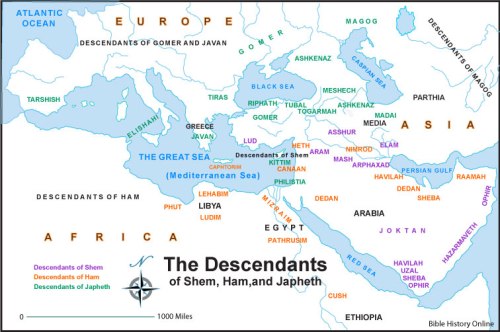
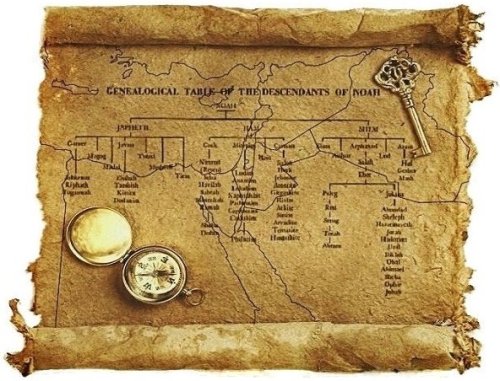
Genesis 10 is called the Table of Nations. It records the descendants of Noah’s sons, Shem, Ham, and Japheth and where they settled around the world after their dispersion at Babel. Shem’s descendants ultimately led to the Lord Jesus Christ (Luke 3:36).

Finally, Genesis 11 records the Tower of Babel and the confusion of tongues/languages. This event is the origin of all the ethnic groups (not “races”) in the world. Neanderthals were among those that scattered at Babel. Recent scientific discoveries show that Neanderthals are/were 100% human. Genesis 11 also records the genealogy of Abraham through whom God would bless all the nations of the earth 2,000 years later. The rest of the Old Testament deals with the history and the future history of Abraham’s descendants.

The future history concerns the coming of Messiah to rule all nations from His throne in Jerusalem. The Old Testament records future history in two parts. At His first coming/advent, “He came to His own, and His own received Him not” (John 1:11). He was crucified, buried, but He rose from the dead after three days and ascended to heaven (Acts 1:9-10; Ephesians 1:19-23). From there we await His return – His second coming (John 14:1-3; Acts 1:11). At that time, He will fulfill the future history recorded by the Old Testament prophets concerning His reign on earth. The time of His second advent draws near. As there were six days of creation and a Sabbath day of rest (Genesis 1:1-2:3), so have there been six millennia of history, and we await the seventh millennium (Revelation 20:1-7) of rest where Messiah will rule the nations with a “rod of iron” (Psalm 2:9; Revelation 2:27; 12:5; 19:15).

At the end of the millennial reign of Christ, world history ends and eternity, for us, begins. Are you ready? See my page on “Securing Eternal Life.”

Notes:


[1]  “Female Reproductive System” – https://tulsafertilitycenter.com/female-infertility/female-reproductive-cycle.php

[2]  “Age of the Earth” – https://erniecarrasco.com/2018/10/14/age-of-the-earth-2/

[3]  “Age of the Earth” – https://erniecarrasco.com/2014/02/23/age-of-the-earth/

[4]  James J. S. Johnson, J.D., TH.D, “How Young Is the Earth? Applying Simple Math to Data Provided in Genesis” – http://www.icr.org/article/how-young-earth-applying-simple-math-data-provided/

[5]  Jake Hebert, Ph.D., “Was There an Ice Age?” – http://www.icr.org/article/was-there-ice-age

2 Comments

Filed under Apologetics, Bible, Christianity, Creation, Evangelism, Origins, Religion, Salvation, Second Coming of Christ, Theology

Angels

There shall no evil befall thee, neither shall any plague come nigh thy dwelling. For he shall give his angels charge over thee, to keep thee in all thy ways. (Psalm 91:10-11)

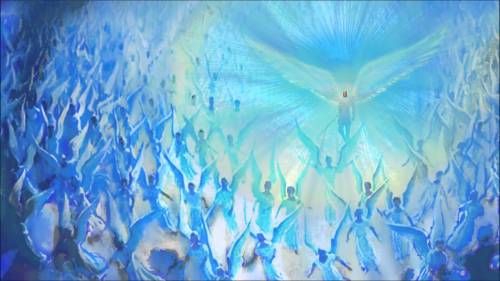
I often get asked, “When did God create angels?” That is an understandable question since the Bible often speaks of angels. The word “angel” in Hebrew is mal’âk and aggelos in the Greek. In either language, the word means “messenger.” The English word “angel” appears 203 times in the Bible, and that does not account for the plural form or other terms that describe them.

The Bible names only three angels, Lucifer, Michael, and Gabriel. In the Old Testament, we read of “the angel of the Lord,” who is God Himself, the pre-incarnate Jesus. We know this because, in context, the “angel” speaks “as God,” not “for God.” Regular angels always deliver a message “from” God and give credit to God for the message – “thus saith the Lord.” The “angel of the Lord” always speaks as God. For example, the first appearance of the “angel of the Lord” is in Genesis 16, when Sarah cast out Hagar, and the “angel of the Lord” appears to her in the wilderness. “And the angel of the LORD said unto her, I will multiply thy seed exceedingly, that it shall not be numbered for multitude” (Genesis 16:10, emphasis mine). A regular angel might have said, “The Lord will multiply thy seed,” but this angel assumes the responsibility. A regular angel cannot do that, but God can.

With all the mention of angels in the Bible – and if we believe the Bible is true – angels are real creatures. Since they are real, God created them, and if God created them, He must have created them some time during the creation week. The question is, when did He do that?

The Bible does not say when the angels were created. The Bible is “a love letter from God to man,” therefore it deals mostly with the relationship between God and His prized creation –mankind. While the Bible is accurate when it describes scientific facts (the water cycle, bird migration, cosmological phenomena, etc.) or records history, that is not its main purpose. Therefore not everything that God does is revealed to us. “The secret things belong unto the LORD our God: but those things which are revealed belong unto us and to our children for ever, that we may do all the words of this law” (Deuteronomy 29:29).

Angels were created to serve God’s purpose for man, and they mostly fight for us in “the unseen realm.” Only occasionally do they enter our dimension which is why the writer to the Hebrews encourages hospitality. “Be not forgetful to entertain strangers: for thereby some have entertained angels unawares” (Hebrews 13:2).

However, the Bible does not focus on them too much probably to discourage the worship of them. “Let no man beguile you of your reward in a voluntary humility and worshipping of angels, intruding into those things which he hath not seen, vainly puffed up by his fleshly mind” (Colossians 2:18). In addition, man was created superior to the angels. “Do ye not know that the saints shall judge the world? and if the world shall be judged by you, are ye unworthy to judge the smallest matters? Know ye not that we shall judge angels? how much more things that pertain to this life?” (1 Corinthians 6:2-3, emphasis mine).

Therefore, we can understand why God did not include the creation of angels in the creation account. The Bible says, “For thus saith the LORD that created the heavens; God himself that formed the earth and made it; he hath established it, he created it not in vain, he formed it to be inhabited: I am the LORD; and there is none else” (Isaiah 45:18). The earth was created for man, not for angels, and that is the focus of the creation account.

However, we can know that angels were created (they are immortal, not “eternal” in the same way as God is eternal) very early on in the creation. In God’s response to Job, He says, “Where wast thou when I laid the foundations of the earth? declare, if thou hast understanding. Who hath laid the measures thereof, if thou knowest? or who hath stretched the line upon it? Whereupon are the foundations thereof fastened? or who laid the corner stone thereof; When the morning stars sang together, and all the sons of God shouted for joy?” (Job 38:4-7, emphasis mine). The “morning stars” and the “sons of God” is speaking of the angels. They were there to witness God’s creation. Therefore we can surmise that they were probably created on Day One or no later than Day Two, but the Bible does not say for certain. We can also surmise that Satan[1] (Lucifer) was among those angels when we read Isaiah 14:12-15 and Ezekiel 28:11-19. I believe that the reason Satan hates humanity[2] so much is that he, having been created the greatest of the angels, observed God create man in His own image and give man dominion over all of His creation. In Texas, we would say, “That really chapped his hide.”

Man lost his former estate in the Garden of Eden, but the fact remains that God created man to be superior to the angels. His will is to redeem mankind from that fallen state, and He gave us His Word both in written form – the Bible – and in physical form – Jesus, the Word – to accomplish that end. Angels are not the main focus of the Bible.

Notes:


[1]  “Why Satan?” https://erniecarrasco.com/2014/11/02/why-satan/

[2]  “Marring the Image”  https://erniecarrasco.com/2015/05/24/marring-the-image/

1 Comment

Filed under Apologetics, Bible, Christianity, Creation, Religion, Satan, Theology