Tag Archives: Bible

Stiffnecked

And the LORD said unto Moses, I have seen this people, and, behold, it is a stiffnecked people: (Exodus 32:9)

Stiffnecked—now there’s a word seldom heard today outside of careful Bible study. The English word, which should be hyphenated in modern English, appears only eight times in the Old Testament of the King James Bible and is really a translation of two Hebrew words: qâsheh and ‛ôreph (the nape of the neck). The first word, qâsheh, means “churlish, cruel, severe, obstinate, or stubborn.” This goes beyond simple hard-headedness. It characterizes an incorrigible, rebellious person, and it is not an attribute one would desire. Yet, in God’s evaluation of His Chosen People, He defined them as “stiffnecked.”

This assessment was not a rush to judgment on God’s part. These people earned the moniker. Consider how God acted on their behalf to free them from Egyptian bondage. God sent ten plagues against the Egyptians that effected only the Egyptians and spared the Israelites.[1] The final plague brought death upon every firstborn of every Egyptian household including their livestock. At the end of that plague, the Egyptians were only too happy to get rid of the Israelites and even sent them off with rich booty.[2] “And the Egyptians were urgent upon the people, that they might send them out of the land in haste; for they said, We be all dead men” (Exodus 12:33). Not long after they departed, Pharaoh changed his mind and followed in pursuit to bring them back to Egypt. Penned between mountains on one side and the Red Sea on the other, the Israelites witnessed God part the waters so they could cross over on dry ground. Then He closed the waters behind them and drowned the pursuing Egyptian chariots.[3] “And Israel saw that great work which the LORD did upon the Egyptians: and the people feared the LORD, and believed the LORD, and his servant Moses” (Exodus 14:31).

Not long after this miraculous deliverance, the Israelites arrived at a watering hole with bitter water and immediately started complaining.[4] God had Moses cast a tree into the watering hole and the waters became sweet. Then God made a conditional promise. “If thou wilt diligently hearken to the voice of the LORD thy God, and wilt do that which is right in his sight, and wilt give ear to his commandments, and keep all his statutes, I will put none of these diseases upon thee, which I have brought upon the Egyptians: for I am the LORD that healeth thee” (Exodus 15:26, emphasis mine).

Further down the road, they came to Elim and began complaining about their perceived lack of food. So God sent them manna (what is it? bread from heaven) and quail to eat.[5] Further along the way, they once again complained about the lack of water, so God provided water out of a rock.[6] God then defeated Amalek, the first enemy they encountered.

Then they arrived at Sinai, the Mountain of God. There, in the hearing of all the people, God gave them the Ten Commandments. They all heard the voice of God and were terrified. “And they said unto Moses, Speak thou with us, and we will hear: but let not God speak with us, lest we die” (Exodus 20:19). Moses ascended the mountain and wrote down the rest of the Law.[7] (At this point one should note that this occurred prior to Moses’ first 40-day stent on the mountain.) “And Moses wrote all the words of the LORD, and rose up early in the morning, and builded an altar under the hill, and twelve pillars, according to the twelve tribes of Israel … And he took the book of the covenant, and read in the audience of the people: and they said, All that the LORD hath said will we do, and be obedient” (Exodus 24:4,7 emphasis mine).

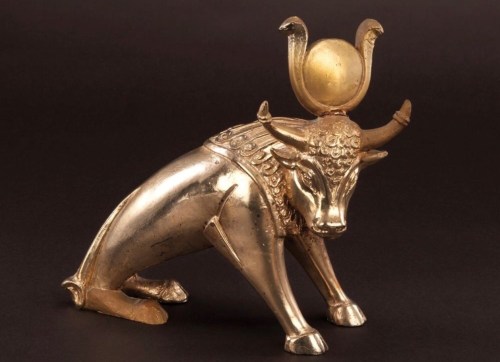
Hollywood movies have a way of distorting biblical accounts in ways that make them so memorable to the viewers that the Hollywood version supersedes the biblical narrative. In the movie, The Ten Commandments, Charlton Heston goes up the mountain to receive the Ten Commandments for the first time and returns to find the Children of Israel worshipping the golden calf. The movie plot kind of takes them off the hook a bit, because they did not know better; they did not have the Law. However, the biblical record shows that they were given the Law, written down by Moses, long before the golden calf incident, and they all agreed, “All that the LORD hath said will we do, and be obedient” (Exodus 24:7).

After all of Israel affirmed that they would abide by God’s Law, Moses ascended the mountain once more and received the Law written on stone tablets and was there 40 days and 40 nights.[8] “And he gave unto Moses, when he had made an end of communing with him upon mount Sinai, two tables of testimony, tables of stone, written with the finger of God” (Exodus 31:18, emphasis mine). These tables not only contained the Ten Commandments. They contained all the Law that the Children of Israel heard directly from God to which they agreed to obey. In addition, God gave Moses instructions for the construction of the Tabernacle and all of its furnishings. Great detail was given for consecrating the priests and the apparel they would wear, especially that of the high priest.

While Moses delayed, the people got antsy and went to Aaron, Moses’ brother and second in command, and asked Aaron, “make us gods, which shall go before us; for as for this Moses, the man that brought us up out of the land of Egypt, we wot [know] not what is become of him” (Exodus 32:1). As one reads the account, it becomes apparent that Aaron felt no coercion to comply with the request, nor did he hesitate. “And Aaron said unto them, Break off the golden earrings, which are in the ears of your wives, of your sons, and of your daughters, and bring them unto me” (Exodus 32:2). Aaron, who was intimately involved in the liberation of the Children of Israel, and heard the Ten Commandments directly from the voice of God, soon forgot the first two. “Thou shalt have no other gods before me. Thou shalt not make unto thee any graven image, or any likeness of any thing that is in heaven above, or that is in the earth beneath, or that is in the water under the earth” (Exodus 20:3-4).

Before Moses learned of the idolatrous act, God already knew. “And the LORD said unto Moses, I have seen this people, and, behold, it is a stiffnecked people” (Exodus 32:9). God threatened to destroy them all and start over with Moses, but Moses interceded on their behalf and the Lord relented from His anger.[9]

Moses descended the mountain and found a wild party going on around the golden calf. When Moses confronted Aaron about the idol, his answer was hilarious. “And I said unto them [the Israelites], Whosoever hath any gold, let them break it off. So they gave it me: then I cast it into the fire, and there came out this calf” (Exodus 32:24, emphasis mine). Imagine that!

This would not be the first exhibition of Israel’s stiffnecked behavior. Throughout their history, Israel chased after false gods. God would punish, Israel would repent, God would forgive, and Israel would sin again. This happened over and over. Once God banished them from the land for 70 years, and for a time, they appeared to learn their lesson. Then God sent their promised Messiah, and they rejected Him and nailed Him to a cross. Again, God banished them from the land for over 2000 years now. However, as God promised, He has restored them to the land; but the saga is not over. God is not finished with Israel.

The lesson we can learn from God’s dealings with Israel is that God is faithful. We can count on Him to do exactly what He says He will do. He keeps His promises. Before entering the Promised Land, Moses reminded the people, “The LORD did not set his love upon you, nor choose you, because ye were more in number than any people; for ye were the fewest of all people: But because the LORD loved you, and because he would keep the oath which he had sworn unto your fathers, hath the LORD brought you out with a mighty hand, and redeemed you out of the house of bondmen, from the hand of Pharaoh king of Egypt. Know therefore that the LORD thy God, he is God, the faithful God, which keepeth covenant and mercy with them that love him and keep his commandments to a thousand generations” (Deuteronomy 7:7-9, emphasis mine). Regardless of their stiffnecked character, God has kept and will keep His covenant with Israel. Knowing that gives us the assurance that God will be faithful in keeping His promise to us, “that whosoever believeth in him should not perish, but have everlasting life” (John 3:16). “For I am persuaded, that neither death, nor life, nor angels, nor principalities, nor powers, nor things present, nor things to come, Nor height, nor depth, nor any other creature, shall be able to separate us from the love of God, which is in Christ Jesus our Lord” (Romans 8:38-39). God is faithful even to the stiffnecked.

Notes:


[1]  Exodus 7-12

[2]  Exodus 12:36

[3]  Exodus 14:10-31

[4]  Exodus 15:22-27

[5]  Exodus 16

[6]  Exodus 17:1-7

[7]  Exodus 20:22-23:33

[8]  Exodus 24:12-18

[9]  Exodus 32:10-14

1 Comment

Filed under Bible, Gospel, Religion, Salvation, Theology

Imminent

He which testifieth these things saith, Surely I come quickly. Amen. Even so, come, Lord Jesus. (Revelation 22:20)

Secretary of State, Mike Pompeo, and Secretary of the Treasury, Steve Mnuchin, gave a press briefing on Friday, January 10, 2020,[1] concerning increased sanctions for Iran following Iran’s rocket attacks on US bases in Iraq. At the end of the briefing, they opened the floor for questions from the press corps. As has become common practice these days, the questions coming from the Press avoided the topic at hand, and rather addressed the irrelevant question of the killing of Iranian General Qasem Soleimani. Someone questioned the targeting of a “foreign diplomat,” and Pompeo pointed out that our intelligence found that Soleimani planned to strike our embassies in the area and that the threats were imminent. One genius fake news reporter challenged the Secretary, “What is your definition of ‘imminent’?” I had to laugh!

It comes as no surprise that the request for a definition of the word “imminent” should arise. The “left” in this country, and around the world, has become proficient in distorting the language so that words become whatever the user wants them to be. For example, “hate” means “to dislike intensely or passionately; feel extreme aversion for or extreme hostility toward [something or someone]; detest [something or someone].”[2] However, for the left, “hate” means opposition to anything they favor. The practice of redefining terms probably started much earlier than this, but my first vivid recollection of this practice came at the impeachment of William Jefferson Clinton. Remember his now infamous line? “It depends on what the meaning of the word ‘is’ is.”

Words used to have meaning. However, in a day when biology no longer determines the sex of a person, words can take on whatever meaning the user wants them to mean. Not so with God. He emphatically states, “For I am the LORD, I change not…” (Malachi 3:6). The writer to the Hebrews says of God the Son, “Jesus Christ the same yesterday, and to day, and for ever” (Hebrews 13:8). Of His Word, Jesus said, “For verily I say unto you, Till heaven and earth pass, one jot or one tittle shall in no wise pass from the law, till all be fulfilled” (Matthew 5:18).

The word “imminent” does not appear in the King James Bible; however, the concept is there. The word “imminent” means that something is “likely to occur at any moment.”[3] The precise moment of such an event cannot be known or determined. It could happen at any time. If one can know or determine the time of a future event, it is no longer “imminent” because it is now “expected.” The two words are synonymous, however with expectation comes the connotation of the precise timing and location of a future event. The expectation of an impending event allows for ample preparation. Jesus said, “But know this, that if the goodman of the house had known in what watch the thief would come, he would have watched, and would not have suffered his house to be broken up” (Matthew 24:43). If the man of the house had “known” when the thief would come, he would have been “expecting” him and made preparations. The implication here is that the coming of the thief was “imminent,” not “expected.”

The fake news reporter exhibited her ignorance by asking Pompeo what he meant by “imminent.” Our military intelligence could not predict where or when Soleimani would strike, only that his intention was to strike soon. That made it imminent.

Christ’s return for His Bride, the Church, is imminent. It has been imminent for over 2000 years. Before His crucifixion, Jesus promised, “And if I go and prepare a place for you, I will come again, and receive you unto myself; that where I am, there ye may be also” (John 14:3). Paul taught the imminency of the Lord’s return at “the last trump” when we would “not all sleep, but we will all be changed in a moment, in the twinkling of an eye,”[4] but he did not say when. It’s imminent. It could happen at any time. To the Thessalonians, Paul wrote, “But of the times and the seasons, brethren, ye have no need that I write unto you. For yourselves know perfectly that the day of the Lord so cometh as a thief in the night” (1 Thessalonians 5:1-2). His coming is imminent, like “a thief in the night.”

Unlike the “goodman of the house” in Jesus’ example who was unprepared for the imminency of the thief’s arrival, we have good reason to be expectant of the Lord’s imminent return. We cannot know the day nor the hour when the Lord will return.[5] It could be at any time. It is imminent. Therefore, we must watch expectantly, and make preparations.

We have waited for over 2000 years. How imminent can His return be? Many become discouraged at the delay, like the five virgins without extra oil for their lamps.[6] Such attitudes are to be expected. The Apostle Peter predicted, “Knowing this first, that there shall come in the last days scoffers, walking after their own lusts, And saying, Where is the promise of his coming? for since the fathers fell asleep, all things continue as they were from the beginning of the creation” (2 Peter 3:3-4).

Many prophecies concerning “the last days” address Jesus’ return to set up His thousand-year reign on earth. The Old Testament contains most of these prophecies. Jesus spoke of these times in His Olivet Discourse,[7] and most of the Book of Revelation focuses on the time of Great Tribulation just before He returns. These prophecies provide great detail of the events that will transpire in “the last days” during the seven years[8] before the Lord’s return. However, no signs detail the “Rapture”[9] of the Church. We are told that it will happen, but we are not told when or how; it’s imminent. The Rapture[10] must take place before the time of Tribulation “For God hath not appointed us [His Church] to wrath, but to obtain salvation by our Lord Jesus Christ” (1 Thessalonians 5:9).

So, although we have waited more than 2000 years for the Bridegroom[11] to come for His Bride (the Church), we can know the time is near. How? We can know because of the convergence of the end-time signs. Israel, because it is the focus of all end-time prophecy, and the events surrounding Israel, is our primary sign. None of the end-time prophecies can come to pass without Israel being in her place. Of the rebirth of Israel, God’s “fig tree,” Jesus said, “Verily I say unto you, This generation shall not pass, till all these things be fulfilled” (Matthew 24:34). We are that generation. It has been almost 72 years since Israel’s rebirth, and according to the psalmist, a man’s life is between 70 and 80 years (Psalm 90:10). There are too many signs to include in this article, but the fact that Israel is in place makes all the other signs that much more relevant. The signs tell us the end is near, so the Rapture of the Church is more imminent now than ever before. It could happen anytime now.

Notes:


[1]  Press Briefing with Secretary of State Mike Pompeo and Secretary of the Treasury Steve Mnuchin: https://www.youtube.com/watch?v=lTCErLFbu4Q

[2]  Hate: https://www.dictionary.com/browse/hate?s=t

[3]  Imminent: https://www.dictionary.com/browse/imminent?s=t

[4]  1 Corinthians 15:50-53

[5]  Matthew 25:13

[6]  Matthew 25:1-13

[7]  Matthew 24-25; Mark 13; Luke 21

[8]  Daniel 9:24-27

[9]  End-Times 101 – https://erniecarrasco.com/2018/06/10/end-times-101/

[10]  End-Times 102 – https://erniecarrasco.com/2018/06/17/end-times-102/

[11]  Matthew 25:1-13

Comments Off on Imminent

Filed under Apologetics, Christianity, Current Events, End Times, Religion, Second Coming of Christ, Theology

Believe the Bible

For the word of the LORD is right; and all his works are done in truth … By the word of the LORD were the heavens made; and all the host of them by the breath of his mouth. (Psalm 33:4, 6)

My father only completed the third grade in Mexico. He learned to read, write and do simple arithmetic. Education was not greatly valued in his youth. More highly prized were his skills at handling horses and cattle on the family ranch, so his education was good enough to get by. Later in life, he felt called of God to enter the ministry and become a pastor/church planter of Spanish-speaking churches. His third-grade education allowed him to enter the Mexican Bible Institute in San Antonio, TX where, after five years of difficult study, he left without earning his diploma. However, he gained valuable skills in sermon preparation, preaching and pastoring churches. His lack of education did not diminish his love for God’s Word nor discourage him from the constant study of it.

My father taught me many things, but the lesson I treasure most was his love for and trust in God’s Word. He taught me that God’s Word is true in all things and applicable in every situation. Even in those areas of Scripture that are difficult to understand, Dad taught me to trust the Bible simply because it is God’s Word. Dad provided no other apologetic than that.

I grew up with that firmly implanted in my mind, and when confronted with skeptics, my defense defaulted to, “the Bible says.” That answer satisfied me, but it did not impress my challengers. They were convinced that everything started with a Big Bang, that earth formed by itself more than 4.54 billion years ago, and that life sprang up from some mysterious chemical reaction 3.6 – 4.0 billion years ago. That story might make logical sense to some, but it does not line up with the biblical account very well especially when it comes to the topic of the evolution of life. Some “Christian” skeptics suggest that God used evolution to create life over millions of years. My response simply stated that God can do whatever He wants. He could have created slowly over millions or billions of years or He could have created instantly. However, the Bible says He did it in just six 24-hour days.

The arguments have not changed much over the years although the skeptics have gotten more hostile. Even “Christians” come against young-earth creationists charging that a young-earth stance is controversial and divisive. However, today I can offer a better defense besides “the Bible says so,” albeit, that really should be the only defense needed against a “Christian.”

A “mature” gentleman confronted me this week with the “old earth” challenge. He claimed to believe the Bible but he believed the earth was billions of years old, not 6000 years old as young-earth creationists believe. He pointed out that light from distant stars takes billions of years to get to earth and that radiometric dating proves that the earth is old. He excused his disbelief in a literal six 24-hour day creation by stating that we really do not know what the Bible means by “day.”

Given that I was not in an appropriate place to properly respond to his challenge, I gave him some simple answers. A light-year measures distance, not time. Just because a galaxy is 14 billion light-years from earth does not necessarily mean that the light from that galaxy took 14 billion years to arrive at earth. Science has yet to measure the one-way speed of light. For all we know, it could be instantaneous. The Bible also hints that God “gave” the light in place when He created the stars. “And God set [the stars] in the firmament of the heaven to give light upon the earth” (Genesis 1:17, emphasis mine). The Hebrew word translated “set” is nâthan and it means “to give.” Also, the phrase “to give light” is only one word in Hebrew – ‘ôr, i.e., “light.” The verse could be translated, “And God gave them [the stars] in the firmament of the heaven to light upon the earth.” This seems to say that light from distant stars took no time to arrive on earth; it was here from the start.

Then there is the matter of radiometric dating. Besides radiocarbon dating, there are several other methods of radiometric dating none of which are reliable. Dr. Vernon Cupps, a nuclear physicist at the Institute for Creation Research (ICR), recently wrote a book[1] that goes into great detail explaining the fallacies of radiometric dating. Indeed, all radiometric dating methods fail to prove that the earth is billions of years old.

The argument from Scripture that we do not have a clear understanding of what a “day” is in the creation account only betrays a lack of understanding of what Scripture really says. In this, the gentleman alluded to Peter’s statement that to God a day is as a 1000 years and 1000 years is as a day. Peter draws his comparison from the psalm of Moses. [2] In his statement, Peter does not make an equivalence between a day and a year but rather draws a simile. The use of the word “as” makes this clear. Peter’s point is that God is not fettered by time; He is timeless. God created time. He created in six 24-hour days and rested on the seventh for our benefit.[3] Furthermore, the word for day used in the creation account is defined by “evening and morning” and confirmed with the assignment of ordinal numbers to distinguish the days.[4]

I left the man with this final thought. We place too much confidence in scientists who are no more than fallen, fallible human beings rather than trusting God’s Word and believing that God did exactly what He told us He did. God is all-knowing and all-powerful and He can do whatever He chooses to do. He could have created the universe, the earth, and all life on earth over billions of years if He chose to do that, but that is not what He told us in His Word. He could have created everything in an instant if He chose to do that, but that is not what He recorded in His Word. What God tells us is that He created everything in six 24-hour days. It is clearly spelled out in His Word. Believe the Bible!

Notes:


[1]  Vernon R. Cupps, Rethinking Radio Metric Dating: Evidence for a Young Earth from a Nuclear Physicist, (Institute for Creation Research, Dallas, TX, 2019). Available from the ICR online bookstore at http://store.icr.org/.

[2]  2 Peter 3:8; Psalm 90:4

[3]  Exodus 20:10-11

[4]  “A Day Is A Day” – https://erniecarrasco.com/2015/10/25/a-day-is-a-day/

Comments Off on Believe the Bible

Filed under Apologetics, Bible, Christianity, Creation, Evolution, Science, Theology

What the Law Does

Therefore by the deeds of the law there shall no flesh be justified in his sight: for by the law is the knowledge of sin. (Romans 3:20)

Many Christians today adopt the attitude that the Old Testament Law no longer applies because we are not under the Law but under Grace. That is certainly true. However, the fact that we are under Grace does in no way render the Law irrelevant or make it of no effect.

The Law given in the Old Testament accomplished two things. It codified what God expected of His people, Israel, and it provided specific practices for God’s people to follow that set them apart from the pagan nations among whom they lived. They were to be “holy” as their God in heaven is holy, i.e., set apart, consecrated, distinct.

The Law provided a third way for the people to relate to God through the sacrificial system which provided a way to atone for or “cover” the sins of the people. However, the sacrificial system did not provide a permanent solution to the sin problem. Sacrifices were made for all kinds of infractions of the Law, and like sin, they were a perpetual practice. The continual offering of sacrifices illustrated the insufficiency of sacrifices to fully atone for the sin of the people. Even so, the sacrifices required faith in the offering otherwise they became a ritual practice akin to pagan practices. God rejected such sacrifices.

To what purpose is the multitude of your sacrifices unto me? saith the LORD: I am full of the burnt offerings of rams, and the fat of fed beasts; and I delight not in the blood of bullocks, or of lambs, or of he goats. (Isaiah 1:11)

To what purpose cometh there to me incense from Sheba, and the sweet cane from a far country? your burnt offerings are not acceptable, nor your sacrifices sweet unto me. (Jeremiah 6:20)

For it is not possible that the blood of bulls and of goats should take away sins. (Hebrews 10:4)

One thing we learn from the Old Testament is that it is impossible to keep the Law, and that it is insufficient to atone for sin. Our opening verse makes it clear, “by the deeds of the law there shall no flesh be justified in his sight” (Romans 3:20). The only sacrifice sufficient to atone for sin is the one offered by God Himself in the person of Jesus Christ and the blood He shed on the cross. Sin – all sin, for all time – was paid in full when Jesus exclaimed, “It is finished: and he bowed his head, and gave up the ghost” (John 19:30). However, Jesus did not remain dead. On the third day, He rose from the dead and conquered the “last enemy”[1] giving us access to eternal life by the simple act of believing. “And as Moses lifted up the serpent in the wilderness, even so must the Son of man be lifted up: That whosoever believeth in him should not perish, but have eternal life” (John 3:14-15).

Romans 3:23 says that “all have sinned, and come short of the glory of God.” The Old Testament teaches us that we are incapable of keeping God’s Law, therefore we are doomed by that standard. “For the wages of sin is death; but the gift of God is eternal life through Jesus Christ our Lord” (Romans 6:23, emphasis mine). Grace is God’s gift to us. Grace is “unmerited favor.” Grace cannot be earned through any human effort because “by the deeds of the law there shall no flesh be justified in his sight” (Romans 3:20). Grace is a gift, bought and paid for by Jesus’ sacrifice on the cross. “For by grace are ye saved through faith; and that not of yourselves: it is the gift of God: Not of works, lest any man should boast” (Ephesians 2:8-9). As with any gift, it must be accepted before it becomes one’s own possession.

What good, then, is the Old Testament Law, if one cannot gain salvation, i.e., eternal life, by keeping it (not that you could if you tried)? Paul provides the following affirmation: “Therefore we conclude that a man is justified by faith without the deeds of the law” (Romans 3:28). We are declared “just” when we place our “faith” in what Jesus did for us on the cross. That is a “done deal” outside the keeping (“the deeds”) of the law. Then Paul poses and responds to our question. “Do we then make void the law through faith? God forbid: yea, we establish the law” (Romans 3:31). The Greek word translated “establish” is histēmi, and it means “to cause to stand.”

The Law still stands. It is not required to gain eternal life nor is it needed to maintain our salvation. However, it does serve as our guide to holy living which God still requires of His children. “But as he which hath called you is holy, so be ye holy in all manner of conversation; Because it is written, Be ye holy; for I am holy” (1 Peter 1:15-16). Jesus tied our love for Him to the keeping of His commandments.[2] Jesus spoke these words 25-30 years before the first Gospel was written, so His commandments were the same commandments He gave to Moses, which are summarized in two great commandments: love the Lord your God with all your heart, soul, and mind (your whole being), and love your neighbor as yourself.[3]

But what does that look like? Our opening verse tells us: “for by the law is the knowledge of sin” (Romans 3:20). Granted, much of the Mosaic Law had direct application to the culture of that time, however, the principles therein apply to our modern time. Take for instance the laws given to dress. The reason for those laws served to make the children of Israel distinct from the people among whom they lived. God still wants the same for us today. We shouldn’t dress and look like the lost world around us. We should be distinct. We should be holy as our Father in heaven is holy – set apart from the world. Speaking of us, Jesus said, “They are not of the world, even as I am not of the world” (John 17:16). What the law does is show us how not to live like the world.

Notes:


[1]  1 Corinthians 15:26

[2]  John 14:15, 21; 15:10

[3]  Matthew 22:36-40

1 Comment

Filed under Apologetics, Bible, Christianity, Gospel, Religion, Salvation, Theology

Vegan Adam & Eve

And God said, Behold, I have given you every herb bearing seed, which is upon the face of all the earth, and every tree, in the which is the fruit of a tree yielding seed; to you it shall be for meat. And to every beast of the earth, and to every fowl of the air, and to every thing that creepeth upon the earth, wherein there is life, I have given every green herb for meat: and it was so. (Genesis 1:29-30)

This week a young woman that looked to be in her early to mid-thirties asked me if Adam and Eve were vegans. She was slender and attractive, giving me the impression that she wanted to justify her vegan lifestyle from Scripture. Personally, I do not care what one chooses to eat as long as they do not try to impose their diet on me.[1]

Veganism, like most belief systems, can get rather complicated. For starters, vegans are vegetarian, and one can be a vegetarian without being a vegan. Vegans go beyond simple vegetarianism. “Distinctions may be made between several categories of veganism. Dietary vegans (also known as strict vegetarians) refrain from consuming animal products, not only meat but also eggs, dairy products and other animal-derived substances. The term ethical vegan (also known as moral vegetarian) is often applied to those who not only follow a vegan diet but extend the philosophy into other areas of their lives, and oppose the use of animals for any purpose. Another term is environmental veganism, which refers to the avoidance of animal products on the premise that the industrial farming of animals is environmentally damaging and unsustainable”[2]

Whether or not Adam and Eve were vegans cannot be determined by the creation account recorded in Scripture. Certainly, Adam and Eve were vegetarians as were “every beast of the earth … every fowl of the air … [and] every thing that creepeth upon the earth, wherein there is life” (Genesis 1:30). God gave “every green herb for [food].”

However, were Adam and Eve required to abstain from drinking milk from cows or goats? Did they make cheese from the milk of other animals? Were they allowed to eat chicken eggs? One might argue that infertile eggs have no potential of producing a living bird, so maybe eggs would be allowed. Scripture is silent on the matter. Let us assume, however, that initially, they were strict vegetarians, i.e., vegans, and that they only ate vegetable matter and nothing from animals. We might assume so since they were naked in the Garden of Eden,[3] and they made clothes of fig leaves when they discovered their nakedness.

Their stay in the Garden was short-lived.[4] They soon sinned and their ethical veganism would have ended at that point. The shame of their nakedness and sin required the slaughter of an innocent animal for covering, and God Himself performed the sacrifice[5] to clothe them in animal skins. After that, the practice of animal sacrifice continued, as we find Abel offering an animal sacrifice in Genesis 4:4. However, it is hard to imagine that they would find domesticated animals useful only for sacrifice and not for any other purpose like wool, milk, cheese, eggs, etc. Scripture is silent on this, so we should not be dogmatic.

After the Flood, God sanctioned the eating of animal flesh. “Every moving thing that liveth shall be meat for you; even as the green herb have I given you all things” (Genesis 9:3). If humans were vegans before, all that ended after the Flood. The lady that raised the question was not satisfied with my answer, but since I had answered from Scripture, she could raise no further objection.

Notes:


[1]  Romans 14:16-23

[2]  “Veganism” – https://en.wikipedia.org/wiki/Veganism

[3]  Genesis 3:7

[4]  “A Nutshell History of the World” – https://erniecarrasco.com/2018/10/28/a-nutshell-history-of-the-world/

[5]  Genesis 3:21

3 Comments

Filed under Apologetics, Bible, Christianity, Creation, Origins, Religion, Theology