Tag Archives: Christ

No Harm Done

They shall take up serpents; and if they drink any deadly thing, it shall not hurt them; they shall lay hands on the sick, and they shall recover. (Mark 16:18)

The final verses of Mark’s Gospel instigate controversy among Bible “scholars,” and many modern translations preface the passage with a warning that “The most reliable early manuscripts and other ancient witnesses do not have Mark 16:9-20.[1] The NIV Study Bible further notes that “Serious doubt exists as to whether these verses belong to the Gospel of Mark. They are absent from important early manuscripts and display certain peculiarities of vocabulary, style and theological content that are unlike the rest of Mark. His Gospel probably ended at 16:8, or its original ending has been lost.”[2]

“Scholars” are the reason we have so many different translations and so much disagreement on which translation is best. I am not averse to higher education. Personally, I enjoy learning and research, especially on matters of the Bible. However, it seems to me that many that achieve the higher degrees lose their grip on reality and rely on the wisdom of man more than the wisdom of God.

When I consider Mark 16:9-20, after having ready Mark’s entire Gospel, I do find the ending somewhat abrupt. It is almost as if Mark completed his Gospel and needed to “wrap it up” in order to get if off to print. (I know. I know! There were no printers in those days.) Most scholars believe that Mark’s was the first Gospel in circulation. The church at the time of the writing was probably no more than 15-30 years old, growing and spreading throughout the Middle East, Asia Minor, and Europe, and there was no written record of the ministry of Christ. As we read Mark’s Gospel, we get the sense that he is moving from one event to the next in the ministry of Jesus. Mark’s is also the shortest of the four Gospels, so the abrupt ending does not surprise me.

The fact that the last 12 verses appear in the text tell me that “The Author,” the Holy Spirit, wanted them there – something the scholars seem to forget. When God says, “For as the rain cometh down, and the snow from heaven, and returneth not thither, but watereth the earth, and maketh it bring forth and bud, that it may give seed to the sower, and bread to the eater: So shall my word be that goeth forth out of my mouth: it shall not return unto me void, but it shall accomplish that which I please, and it shall prosper in the thing whereto I sent it” (Isaiah 55:10-11, emphasis mine). Similarly, Jesus said, “Heaven and earth shall pass away, but my words shall not pass away” (Matthew 24:35). And to answer those who might say that perhaps these were not God’s or Jesus’ words but added later by some human editor, consider the following: “Ye shall not add unto the word which I command you, neither shall ye diminish ought from it, that ye may keep the commandments of the LORD your God which I command you” (Deuteronomy 4:2, emphasis mine). Also, “What thing soever I command you, observe to do it: thou shalt not add thereto, nor diminish from it” (Deuteronomy 12:32) In addition we find, “For I testify unto every man that heareth the words of the prophecy of this book, If any man shall add unto these things, God shall add unto him the plagues that are written in this book: And if any man shall take away from the words of the book of this prophecy, God shall take away his part out of the book of life, and out of the holy city, and from the things which are written in this book” (Revelation 22:18-19, emphasis mine).

Considering God’s solemn charge not to tamper with His word, I find it difficult to conceive that a human editor, who reverences the Word of God, would take it upon himself to “enhance” it of his own volition. As for those “more reliable early manuscripts,” they come from texts that were rejected by the early church due to their Gnostic origins.[3] They were found in “very good” condition because they were not used.

I have a point to make in defending Mark 16:9-20 and specifically as it relates to verse 18, our opening verse. Concerning “them that believe in me” (v. 17) Jesus says (according to Mark), that “They shall take up serpents; and if they drink any deadly thing, it shall not hurt them” (emphasis mine). Paul proved this after his shipwreck on the island of Melita.[4] In gathering wood for a fire, a viper, attracted to the heat of the fire, attached itself to Paul’s hand. Paul shook the snake into the fire and suffered no harm from the snakebite to the astonishment of the inhabitants of Melita.

Based on Mark 16:18, I believe God protects His children from harm due to no act of their own. Even when we knowingly place ourselves in harmful positions, God will sometimes intervene to protect us, but all according to His purpose for our lives. I strongly advise against acting stupidly just to test God; He may just let you suffer the consequences.

Lately, for obvious reasons, I have been thinking about the hype surrounding the COVID-19 vaccines. I refuse to take the vaccine for several reasons. First of all, I believe God designed our bodies to fight of dangerous pathogens. I also believe that God has our days numbered, and we cannot die until our time comes for God to call us home. There are hundreds of ways to die that do not involve COVID-19, and it is up to God to choose which method He wants to use to take us home.

Those are the foremost reasons I have for not taking the vaccine. Another reason that rates highly is the fact that they are derived from a cell line that came from aborted human fetuses. Most Christians claim to be “pro-life” and are against abortion, and I believe that if they really understood the source of the vaccines, they would not take them. However, I can excuse them due to ignorance. Yet another reason that I will not take the vaccine is that it modifies the recipient’s DNA – God’s programming code that makes you who you are. I do not believe man has arrived at the level of intelligence required to modify God’s programming code.

The reader can investigate these things for himself, but many doctors, virologists, warn that the mRNA vaccine will “disable” a human’s natural immune system rendering them vulnerable to other diseases for which we were once immune. So, in effect, the vaccine is a poison. (Again, I realize my explanation is rather simplistic, but I do not have the space nor the desire to cover it in this article. The information is out there, if you want to look.) Many Christians are happily taking this poison through the ignorance induced by the propaganda put out by our government and the media. I believe, based on Mark 16:18, that Christians taking this poison through ignorance will not be harmed by it. However, those who take it with full knowledge of what it is may suffer the consequences later. Time will tell.

Notes:


[1]  The NIV Study Bible, (Zondervan Corporation, 1985), p. 1530.

[2]  Ibid.

[3]  “Thees, Thous, and Wot Nots” – https://erniecarrasco.com/2016/05/01/thees-thous-and-wot-nots/ (See especially my response to Dwayne Cartwright’s comment.


[4]  Acts 28:1-6

1 Comment

Filed under Apologetics, Bible, Christianity, Current Events, Gospel, Holy Spirit, Pro-life, Science, Theology

The Barley Harvest

Therefore they gathered them together, and filled twelve baskets with the fragments of the five barley loaves, which remained over and above unto them that had eaten. (John 6:13)

On the eve of this posting, May 16, 2021, Jews begin the observance of Shavu’ot, the Feast of Pentecost. The Christian calendar, which does not follow the Jewish calendar, observes Pentecost next Sunday, May 23, 2021.

Pentecost interests me, because of the possible prophetic implications associated with it. I wrote about this topic before, and I believe I gave explanation of its significance in an article titled “Pentecost,”[1] so I will not rehash that material here. Briefly, there are seven Feasts of the Lord,[2] three in the spring (Passover, Unleavened Bread, and First Fruits), three feasts in the fall (Trumpets, Atonement, and Tabernacles) with Pentecost in the middle, separated by a space of time between the others. Pentecost was one of three convocations where all males over the age of 20 were required to attend. The other two times were for the spring and fall feasts.

Pentecost celebrates the barley harvest. Some Bible teachers have mistakenly associated the Feast of First Fruits with the barley harvest, but barley, according to the sources I have checked say that barley does not ripen until around mid May – too late for First Fruits. Again, I explain this in the articles I have cited in the notes below.

Barley is often associated with gentile nations, probably because it is more coarse and less desirable than wheat. Wheat, on the other hand, because it is finer and more desirable represents Israel.

On Pentecost, following Jesus’ resurrection and ascension, The Holy Spirit fell upon the 120 disciples gathered in the upper room.[3] There were in Jerusalem on that day “Jews and proselytes” from many nations present for the required convocation, and they heard the disciples preaching in their own languages. That day, about three thousand souls were saved[4] giving birth to the Church. For this reason, Pentecost is associated with the Church, and because it is separated from the other Jewish feasts, many have seen this as the Feasts of the Lord specifically meant for the Church.

Looking at this prophetically, Jesus fulfilled the first three spring feasts by His death (Passover), His burial (Unleavened Bread – He was sinless), and His resurrection (First Fruits). He then ascended to heaven with the promise to send His Holy Spirit and physically return at some later time. So, the Holy Spirit came at Pentecost and gave birth to the Church. Then there is a long period of time before the fall feasts, which Jesus has yet to fulfill. The long period of time can be likened to the Church Age in which we have lived for the last 1,991 years. At a time known only to God, Jesus will return to earth, possibly on the Feast of Trumpets, fulfill the Atonement, and set up His Tabernacle here on earth. We know this as the “Second Coming.”

Prior to Jesus’ return, the world will experience the full wrath of God for seven years. This is known as the Tribulation. Now (just musing here), there is much support for the crucifixion occurring in 30 A.D. According to the Bible, Creation is about 6000 years old and biblical chronology can be roughly divided into three segments of 2000 years each. We can add the final 2000 years to 30 A.D. and come up with the year 2030. Subtract seven years from that and we arrive at the year 2023 to start the Tribulation.

However, the “wrath” of God is for the “world” not for His Church. The Church will be taken out of the world prior to the start of the Tribulation. “For this we say unto you by the word of the Lord, that we which are alive and remain unto the coming of the Lord shall not prevent them which are asleep. For the Lord himself shall descend from heaven with a shout, with the voice of the archangel, and with the trump of God: and the dead in Christ shall rise first: Then we which are alive and remain shall be caught up together with them in the clouds, to meet the Lord in the air: and so shall we ever be with the Lord” (1 Thessalonians 4:15-17).

We have many “signs” to prepare us for the Second Coming, but we have no signs to prepare the Church for the “catching up,” a.k.a. the “Rapture.” “Behold, I shew you a mystery; We shall not all sleep, but we shall all be changed, In a moment, in the twinkling of an eye, at the last trump: for the trumpet shall sound, and the dead shall be raised incorruptible, and we shall be changed” (1 Corinthians 15:51-52).

The event will be sudden, but it should not be unexpected for the Christian. The “signs” of His Second Coming are everywhere and becoming more pronounced and more frequent. Therefore, we know that His Second Coming is close, and if His Second Coming is close, the Rapture is closer. Jesus said, “All these are the beginning of sorrows … Watch therefore: for ye know not what hour your Lord doth come.” (Matthew 24:8, 42)

Just musing again, if we, the Church, are the barley, and the barley harvest is ready, could this be the day that the Lord harvests us into His barn? Just so you know, the start of the Tribulation does not depend on the Rapture of the Church. The Church could get taken out today and the Tribulation will not begin in earnest until the year 2023. Consider this; our world economy is in freefall. The globalists already have detailed plans for implementing a “one-world” government.[5] Consider the impact of millions of people, especially here in the US, disappearing instantly, all at once, from the face of the earth. Consider the added chaos that would bring to a world already reeling with social, economic and geopolitical trouble. In that event, the one-world system will be put in place and a great one-world leader will arise to bring “peace” to the earth, “And he shall confirm the covenant with many for one week [seven years]” (Daniel 9:27). That will kick off the Tribulation.

The barley harvest is ready. I hope this will be the day, but if not, we must occupy until He comes.[6] Are you ready? If not, please read my page on “Securing Eternal Life.”

Notes:


[1]  “Pentecost” — https://erniecarrasco.com/2017/05/28/pentecost/

[2]  “Rosh HaShanah” — https://erniecarrasco.com/2016/10/03/rosh-hashanah/

[3]  Acts 2:1-13

[4]  Acts 2:41

[5]  World Economic Forum — https://www.weforum.org/

[6]  Luke 19:13

Comments Off on The Barley Harvest

Filed under Apologetics, Christianity, Current Events, End Times, Eschatology, Feasts of the Lord, Heaven, Holy Spirit, Rapture, Resurrection, Salvation, Second Coming of Christ, Theology

God’s Devil

And the LORD said unto Satan, Behold, all that he hath is in thy power; only upon himself put not forth thine hand. So Satan went forth from the presence of the LORD. (Job 1:12)

Satan (the name means “adversary”) appears in many forms in the human imagination. He has been depicted as a grotesque angelic being with a goat’s head and goat’s legs and hooves. The Satanic Temple in Detroit houses an idol by the name of Baphomet that represents their god, Satan. At the other extreme is “Hot Stuff,” a fun-loving comic book character that enjoys playing pranks on people. Either extreme makes Satan an imaginary figure that can easily be dismissed along with any other fairy tale character.

However, Satan is very real. Ask any Satanist. While you are at it, ask the Satanist if Jesus is real. So, why do they worship Satan, rather than Jesus? It is because they have fallen for Satan’s lie that he will overcome the kingdom of Christ. Satan has seduced them with the power he possesses.

Satan does have a lot of power; however, his power is nowhere near the power of God. For example, Satan is not omnipresent like God is. He can only be in one place at one time, which means that we cannot blame the devil for every sin we commit; he is not always around to tempt us. However, he does have millions of demons doing his dirty work for him, but they are limited in their power too. Satan cannot read our minds or our hearts like God can, but he and his demons can observe our actions and listen to what we say. When they see our weaknesses, they know how to attack us.

Satan cannot act on his own initiative. He needs permission from God to carry out his deeds. Reading the first two chapters of the Old Testament Book of Job makes this very clear. It appears that God holds a heavenly council where all His angels, good and bad, come before Him. The psalmist says, “God standeth in the congregation of the mighty; he judgeth among the gods” (Psalm 82:1). The Hebrew word translated “might” is ‘êl which means “god, god-like, mighty one.” This verse shows God standing among “the gods” and judging among them.[1] At the opening of Job’s saga, we find that Job lives in the land of Uz.[2] By God’s standards, Job is a righteous man that shuns evil. God blesses Job with wealth and a large family for whom Job intercedes before God just in case his children have fallen into sin.

The scene then shifts to heaven and God’s council, where all of God’s angels come before Him.[3] Scripture points out that Satan was among them. So God asks Satan to report, and Satan says he has been wandering up and down the earth (remember, he is not omnipresent). The Apostle Peter says that Satan wanders the earth like a ravenous wolf seeking whom he may devour.[4] God then asks Satan if he has taken notice of Job, and God brags on Job. (Would it not be great if God could brag about you?) So Satan points out that Job only worships God because God has blessed him with a good life, a large family, and much wealth. Then Satan suggests that God test Job by taking away all of his blessings. God gives Satan permission to remove all of Job’s blessings, but He prohibits Satan from touching Job’s body.

Satan attacks Job by taking away all of Job’s blessings, but Job remains faithful to God. Next, in Chapter Two, at the following council of God, God asks Satan for a report on Job. Satan, knowing that he failed, suggests that Job remains faithful only because he still has his health. So, God gives Satan permission to touch Job’s body, but he is not allowed to take Job’s life.

The point in all of this is that Satan cannot do anything without God’s consent. At the end of the saga, we learn that Job remained faithful to God, and God restored all that Job lost and much more.[5]

Jesus demonstrated His authority over Satan every time He cast out demons. Luke records one of the most dramatic accounts of a man of the Gadarenes that was possessed by a “legion” of demons.[6] In this account, the demons recognized Jesus from a distance and started crying out begging Jesus not to send them to the abyss (the bottomless pit) before their time. They begged Jesus’ permission to go into a herd of hogs instead, and Jesus gave them permission.

On another occasion, Jesus informed Peter that Satan asked permission to sift him as wheat.[7] At the same time, Jesus assured Peter that He had prayed for him that his faith would not fail. Satan cannot do anything unless God gives him permission.

Satan is real. Satan has a lot of power. Satan can cause us a lot of misery. However, Satan is God’s Devil, and God has him on a short leash – but not for long. Soon, God will unleash Satan to terrorize the entire world, but His own He will spare from the Tribulation to come. For now, the only defense we have against Satan is to remain in the shadow of the Almighty. He hears us when we call out to Him. “Shew thy marvellous lovingkindness, O thou that savest by thy right hand them which put their trust in thee from those that rise up against them. Keep me as the apple of the eye, hide me under the shadow of thy wings, From the wicked that oppress me, from my deadly enemies, who compass me about” (Psalm 17:7-9)

If you are reading this and do not have the assurance of God’s protection on you, please read my page on “Securing Eternal Life.”

Notes:


[1]  I realize this concept may be foreign to most of my readers, but the Bible, when carefully studied does not deny the existence of other gods, but rather it clearly points out that they are “no gods” at all. In other words, even though they do exist and exercise power over humans, they do not approach the power of Yahweh, the God who created them. For an in-depth study on this topic, I recommend Michael S. Heiser’s book, The Unseen Realm.

[2]  Job 1:1

[3]  Job 1:6-12

[4]  1 Peter 5:8

[5]  Job 42:12-17

[6]  Luke 8:26-39

[7]  Luke 22:31-34

Comments Off on God’s Devil

Filed under Apologetics, Bible, Christianity, Satan, Second Coming of Christ, Theology

Eternal Hell

But he that shall blaspheme against the Holy Ghost hath never forgiveness, but is in danger of eternal damnation: (Mark 3:29)

Hell seldom comes up as a topic of interest. The notion of hell congers up unpleasant images of souls tortured by unquenchable flames and taunted by merciless devils with pitchforks. Heaven makes a more pleasant topic of conversation. I cannot wait to get there!

So, when a social media contact posted his take on a less-than-eternal nature of hell, I could not help (against my better judgment) to try and briefly correct his erroneous conclusions. I tried to keep it brief, but after his second response, I thought it best to conclude the discussion, and take Paul’s advice to “strive not about words to no profit, but to the subverting of the hearers” (2 Timothy 2:14). These kinds of discussions usually remain unresolved and provide a poor witness to bystanders. (On social media, one can never tell who is “listening.”)

Anyway, this gentleman (I’ll call him Aloysius (“famous warrior”) or Al for short) has apparently labored intensely on the subject of hell and arrived at the conclusion that hell is not eternal. He based his conclusion on the Hebrew word ‛ôlâm and the Greek word aiōnios, both of which are often translated as “forever” or “everlasting.” Al correctly pointed out that both of these words have several shades of meaning. Depending on the context, ‛ôlâm can mean “concealed, vanishing point, eternity, always, or perpetual,” according to Strong’s. Brown-Driver-Briggs’ defines it as “long duration, antiquity, forever, ever, everlasting, evermore, or perpetual.” As for  aiōnios, Strong’s defines it as “perpetual, eternal, everlasting, or forever.” Thayer’s Greek Definitions renders it, “without beginning, without end, never to cease, everlasting.”

Al failed to see the inconsistency in his argument. He defined ‛ôlâm and aiōnios as “eternal” when applied to God or heaven, but temporal when applied to hell. He did not reject the concept of hell, just the idea of an eternal hell. I did not pursue the question as to how he arrived at that conclusion, but perhaps his revulsion to the notion of an eternal damnation conflicted with his idea of a loving God. I understand why someone would feel that way, but we are not in a place to make that decision for God.

The Bible clearly teaches that heaven and hell are real places and they are eternal. All humans will end up in one place or the other for eternity. One verse from Jesus’ own lips easily exposes the contradiction in Al’s argument. In His discourse concerning the separation of the sheep and the goats,[1] Jesus sums up the destiny of both. “And these [goats] shall go away into everlasting punishment: but the righteous [sheep] into life eternal” (Matthew 25:46, emphasis mine). In this verse, aiōnios defines the duration of “punishment” (i.e., hell) and “life.” Seeing that the same word is applied to both, they must mean the same thing. If hell is not eternal then neither is life (i.e., heaven). If heaven is eternal, then so must be hell. Keep in mind that this verse is in the same context, so the word cannot have different meanings.

Related to aiōnios is the Greek word aiōn, which means “an age, perpetuity, continuing, or everlasting.” This word is often translated as “for ever” in the King James Version (KJV). When rendered as such, aiōn is usually preceded by the preposition eis, which means “to or into.” Together, eis aiōn could be translated “into the ages,” “into perpetuity,” or “to eternity.”

The Book of the Revelation explains the eternal nature of hell. In the Fourteenth Chapter, those that take the Mark of the Beast are condemned to eternal hell.[2] “And the smoke of their torment ascendeth up for ever and ever: and they have no rest day nor night, who worship the beast and his image, and whosoever receiveth the mark of his name” (Revelation 14:11, emphasis mine). The repletion is emphatic, εις αιωνας αιωνων – “into the ages of the ages.” Satan, the Beast (Antichrist), and the False Prophet earn the same reward. “And the devil that deceived them was cast into the lake of fire and brimstone, where the beast and the false prophet are, and shall be tormented day and night for ever and ever” (Revelation 20:10, emphasis mine). Again, the eternal nature of hell is described: εις αιωνας αιωνων – “into the ages of the ages.” Then those who reject Christ will be judged at the Great White Throne.[3] “And whosoever was not found written in the book of life was cast into the lake of fire” (Revelation 20:15, emphasis mine).

I understand Al’s desire that hell be temporary. That those who go there stay just long enough to pay their debt and get vaporized. I do not cherish the thought of anyone going to that place even for one minute. The Bible tells us that “God is love,”[4] and that “The Lord is not slack concerning his promise, as some men count slackness; but is longsuffering to us-ward, not willing that any should perish, but that all should come to repentance” (2 Peter 3:9, emphasis mine). However, God is eternal – without beginning and without end. Therefore, when we offend the eternal God, we offend Him eternally, and the punishment, therefore, must be of eternal consequences.

The Bible says that we have all offended God. “As it is written, There is none righteous, no, not one … For all have sinned, and come short of the glory of God” (Romans 3:10, 23). However, “For God so loved the world, that he gave his only begotten Son, that whosoever believeth in him should not perish, but have everlasting life” (John 3:16, emphasis mine). The eternal God took on human flesh[5] and shed His precious, perfect blood to cover our sins. His sacrifice provides for us the eternal atonement, covering, to satisfy our eternal offense against Eternal God. But we have the choice to believe or disbelieve, to accept or reject. “For whosoever shall call upon the name of the Lord shall be saved” (Romans 10:13).

Al is wrong. Hell is eternal. Please do not go there. Read my page on “Securing Eternal Life.”

Notes:


[1]  Matthew 25:31-46

[2]  Revelation 14:9-11

[3]  Revelation 20:11-15

[4]  1 John 4:8

[5]  John 1:14; Philippians 2:5-11

3 Comments

Filed under Apologetics, Bible, Christianity, Death, Gospel, Heaven, Hell

Victorious Entrance

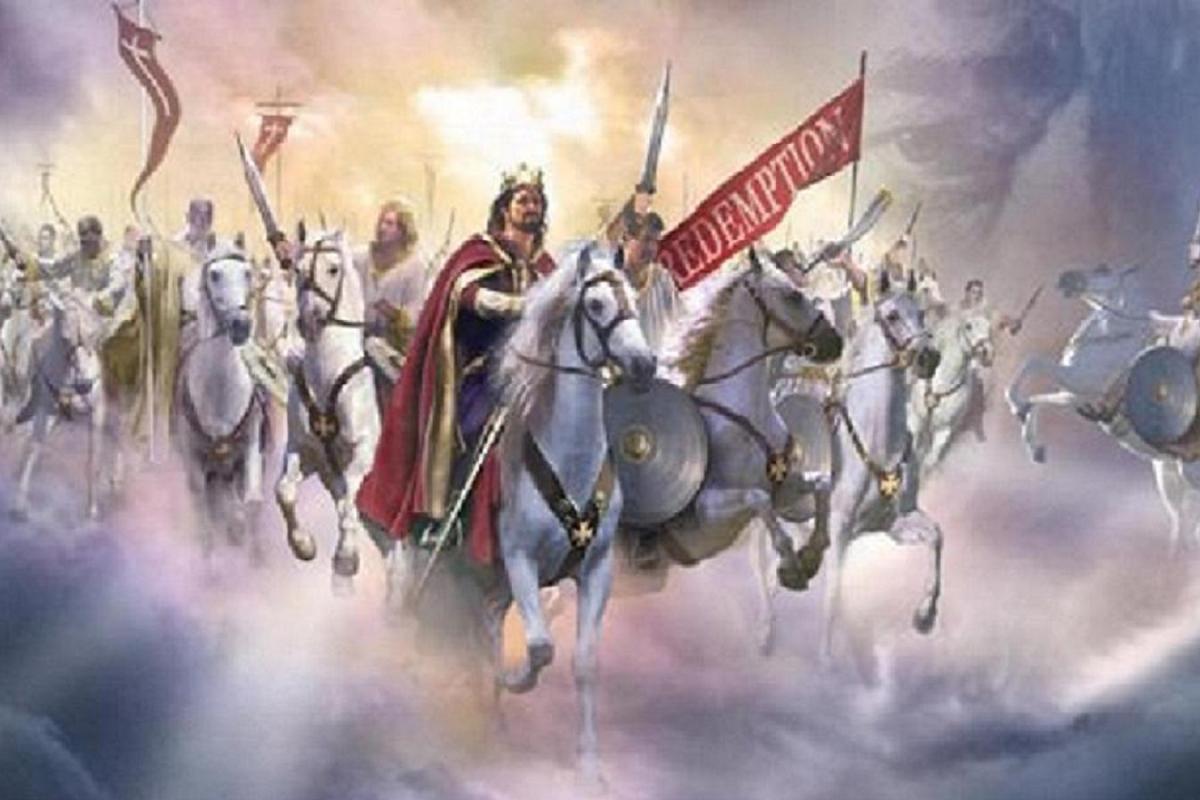
And I saw heaven opened, and behold a white horse; and he that sat upon him was called Faithful and True, and in righteousness he doth judge and make war. His eyes were as a flame of fire, and on his head were many crowns; and he had a name written, that no man knew, but he himself. And he was clothed with a vesture dipped in blood: and his name is called The Word of God. And the armies which were in heaven followed him upon white horses, clothed in fine linen, white and clean. And out of his mouth goeth a sharp sword, that with it he should smite the nations: and he shall rule them with a rod of iron: and he treadeth the winepress of the fierceness and wrath of Almighty God. And he hath on his vesture and on his thigh a name written, KING OF KINGS, AND LORD OF LORDS. (Revelation 19:11-16)

This Sunday, March 28, celebrates Palm Sunday when we commemorate Jesus’ entry into Jerusalem in the final week of His earthly ministry. We term this event as the “Triumphal Entry,” but in many respects, the term is a misnomer.

Daniel predicted the event to the very day of its occurrence. “Seventy weeks [70 x 7 years, or 490 years] are determined upon thy people [Israel or the Jews] and upon thy holy city [Jerusalem], to finish the transgression, and to make an end of sins, and to make reconciliation for iniquity, and to bring in everlasting righteousness [beginning with the Millennial reign of Messiah], and to seal up the vision and prophecy, and to anoint the most Holy [Messiah]. Know therefore and understand, that from the going forth of the commandment to restore and to build Jerusalem [decreed by Artaxerxes Longimanus, 444 BC] unto the Messiah the Prince shall be seven weeks [7 x 7 or 49 years], and [plus] threescore and two weeks [62 x 7 or 434 years; 49 + 434 = 483 years]: the street shall be built again, and the wall, even in troublous times. And after threescore and two weeks shall Messiah be cut off, but not for himself: and the people of the prince that shall come shall destroy the city and the sanctuary; and the end thereof shall be with a flood, and unto the end of the war desolations are determined” (Daniel 9:24-26, emphasis mine). Daniel divides the 490 years (70 weeks) into three segments of 49, 434, and 7 years. The first segment began when Artaxerxes Longimanus issued the fourth decree to rebuild Jerusalem with its walls in 444 BC, and ended in 395 BC when the project was completed – 49 years.[1] The next segment encompassed the 400+ “silent years” until Jesus, Messiah, entered into Jerusalem. Four hundred eighty three (483) years were fulfilled at that time and the final segment of seven years remains to be fulfilled. At the end of the 483 years, to the very day, Jesus, Messiah, was “cut off” at the cross.

The prophet, Zechariah, predicted that the Messiah would present Himself riding on a donkey. “Rejoice greatly, O daughter of Zion; shout, O daughter of Jerusalem: behold, thy King cometh unto thee: he is just, and having salvation; lowly, and riding upon an ass, and upon a colt the foal of an ass” (Zechariah 9:9, emphasis mine). All four Gospel writers record this event from their unique perspectives.[2] Most Bibles that use sub-title divisions of chapters title this event as the “Triumphal Entry.” However, Jesus did not enter Jerusalem as conquering king. He presented Himself as the Melek Shâlêm, the King of Peace. A conquering king would have presented himself with great pomp and ceremony,[3] riding on a white charger followed by his conquering armies, parading the spoils of his conquests.

Jesus entered humbly as the King of Peace. His week would end with a tortuous, humiliating death on a Roman cross. From a human perspective, that hardly qualifies as a triumph. However, the following Sunday, the earth shook[4] as Jesus ripped apart the chains of death and conquered man’s final enemy.[5] “O death, where is thy sting? O grave, where is thy victory? The sting of death is sin; and the strength of sin is the law. But thanks be to God, which giveth us the victory through our Lord Jesus Christ” (1 Corinthians 15:55-57). Yet, we still die physically, but our spirit lives on. “We are confident, I say, and willing rather to be absent from the body, and to be present with the Lord” (2 Corinthians 5:8). One day, even physical death will be lost even to the memory. “And death and hell were cast into the lake of fire. This is the second death” (Revelation 20:14). Our present bodies (whether alive or dead) will be transformed into eternal bodies like the body of the resurrected Christ. “Now this I say, brethren, that flesh and blood cannot inherit the kingdom of God; neither doth corruption inherit incorruption. Behold, I shew you a mystery; We shall not all sleep, but we shall all be changed, In a moment, in the twinkling of an eye, at the last trump: for the trumpet shall sound, and the dead shall be raised incorruptible, and we [who are living at the time] shall be changed. For this corruptible must put on incorruption, and this mortal must put on immortality” (1 Corinthians 15:50-53, emphasis mine).

Jesus conquered death at His resurrection, but He has yet to enter Jerusalem in triumph. Our starting verse above, Revelation 19:11-16, describes His real Triumphal Entry. He will enter Jerusalem from His departure point on the Mount of Olives riding on a white horse – not a donkey this time. He will be followed by His heavenly hosts (angelic armies) and by the spoils of His victory, His saints, all riding white horses and dressed in white robes – no weapons in hand. When His foot touches Earth, the Mount of Olives will split in two,[6] half to the north and half to the south. From there He will travel north to the Jezreel Valley, for the Battle of Armageddon. That too is a misnomer, because it will be no battle at all. “And out of his mouth goeth a sharp sword, that with it he should smite the nations: and he shall rule them with a rod of iron: and he treadeth the winepress of the fierceness and wrath of Almighty God” (Revelation 19:15, emphasis mine). That “sword” out of His mouth is His Word. He will speak and the “battle” will be over. “And the LORD shall be king over all the earth: in that day shall there be one LORD, and his name one” (Zechariah 14:9).

Now, that is a Triumphal Entry!

The current events of our world signal that the time of Jesus’ Victorious Entrance is soon approaching. He will come for His Bride, the Church, at any moment; although we do not know when. However, if the signs indicate that His return is near, that means the catching up of His Bride is even closer. Soon after that, Daniel’s final week, the last seven years known as the Tribulation, will begin. Those who are not snatched away by Jesus will remain on earth to suffer through the judgments of God like at no other time in world history. If you are not sure where you stand with Jesus, you can escape that awful time by putting your trust in Him as your Savior. Read my page on “Securing Eternal Life.”

Notes:


[1]  John F Walvoord and Roy B. Zuck, The Bible Knowledge Commentary- Old Testament, (SP Publications, 1985), p.1363.

[2]  Matthew 21:1-11; Mark 11:1-11; Luke 19:28-44; John 12:12-19

[3]  “The Triumphal Entry,” — https://erniecarrasco.com/2019/04/14/the-triumphal-entry/

[4]  Matthew 28:2

[5]  1 Corinthians 15:26

[6]  Zechariah 14:4

Comments Off on Victorious Entrance

Filed under Apologetics, Bible, Christianity, Current Events, Death, Easter, End Times, Evangelism, Gospel, Heaven, Hell, Holidays, Resurrection, Salvation, Second Coming of Christ, Theology