Tag Archives: God

Creator, Creation, and the Cross (Part 2)

In the beginning God created the heaven and the earth. (Genesis 1:1)

          Last week’s study, Part 1, focused on the Creator. Today we will take a closer look at the Creation.

Part 2, The Creation

The first verse of Genesis encapsulates the creation of the universe. The universe, as vast and complex as it is, is composed of three elements, anyone of which being absent render the universe non-existent. “In the beginning” is Time. “God created the heavens” (Space) “and the earth” (matter/energy). These three elements: time, space, and matter, make up the universe.

          Secular scientists who strive to explain the origin of the universe though natural causes, hypothesize that all existing matter at one time was densely compressed into a “singularity” that rapidly expanded to create the universe 14.7 billion years ago. This is a relatively recent hypothesis based on the notion rising out of the “enlightenment,” (17th and 18th centuries) proposing that the earth is much older than indicated in Scripture. Since “scientists” had “proven” that the earth was older than stated in the Bible, many theologians attempted to accommodate billions of years into the biblical record by proposing a “gap” of billions of years between Verse 1 and Verse 2 of Genesis 1.

          There is no “Gap”[1]  between verses 1 & 2. When simply read, Verse 1 flows smoothly into Verse 2. The Gap Theory is highly speculative and based on conjecture. The Gap Theory presupposes a prior creation which “became” void and formless due to Satan’s fall. Satan caused a race of pre-Adamic man to sin forcing God to destroy His first creation. This theory introduces sin and death before the fall of Adam and Eve and effectively nullifies the curse of death for sin. Although theologians who still hold to the Gap Theory try to support it with Scripture, it has no biblical support.

          With all the elements of the universe created, the Creator began the task of organizing the formless blob. The raw materials required energy. “And the Spirit of God [the Third Person of the Trinity] moved upon the face of the waters” (Genesis 1:2). “And God said, Let there be light: and there was light.” (Genesis 1:3). The creation of light only required the verbal command from the Word. The Hebrew word for light is ‘ôr (אוֹר), and I will point out something interesting about that word later on (in Part 3).

God declared His first day’s work “good.” “And the evening and the morning were the first day” (Genesis 1:5). The word “day” used here and throughout the creation account is important because many find it hard to believe that God created all there is in six 24-hour days.[2] The Hebrew word for “day” is yom. In the Old Testament, it almost always refers to a normal 24-hour day. It always refers to a normal 24-hour day when preceded by an ordinal number – first, second, third, etc. Furthermore, in order to remove any doubt, God further defines yom by “evening and morning,” which constitutes a normal 24-hour day. Some have attempted to stretch the length of each day by thousands and even millions of years.[3] To support their position they cite Psalm 90:4 and 2 Peter 3:8, but these verses use simile (“like,” “as”) to refer to God’s “timelessness”[4] not to how He counts days.[5] To God, one day is as a thousand years and a thousand years are as a day. God is not bound by time as we are. He created time; therefore He exists outside of the constraints of time.

On the second day, Genesis 1:6-8, God organizes the elements by separating the waters from Earth from the waters in space. The word “Firmament” means a “stretched-out thinness.” It is like a thin membrane separating the earth’s atmosphere from the coldness of space. Remember, at this point there are no other heavenly bodies. The day ended without God’s affirmation that it was “good.” There was work yet to be done.

On Day Three, Genesis 1:9-13, God separated the dry land from the water and called it “good.” The vegetation was created fully mature having its seed in itself and ready to reproduce “after its kind” – no evolution. God created plants with the genetic capability to vary within its own kind, but not to “evolve” from one kind into another. We can verify that is still true today.

On the fourth day, Genesis 1:14-19, God created the remaining celestial bodies. Unlike the evolutionary story, God’s account of creation begins with the planet Earth and all the other stars and planets come thereafter. That makes perfect sense when we consider that God made Earth with mankind in mind. “For thus saith the LORD that created the heavens; God himself that formed the earth and made it; he hath established it, he created it not in vain, he formed it to be inhabited: I am the LORD; and there is none else” (Isaiah 45:18).

“And God said, Let there be lights in the firmament of the heaven to divide the day from the night; and let them be for signs, and for seasons, and for days, and years” (Genesis 1:14). The “lights” (Hebrew mâ’ôr) are “lesser lights” or “luminaries.” They are “lesser” only compared to the original light He created on the first day. We also understand that many of these stars are hundreds of times larger than our own sun, but because of their great distance from the earth, they appear to be lesser. The mâ’ôr were created for signs and seasons, days and years. The word “signs” – ‘ôth means signal, banner, remembrance, omen, warning, and “seasons” – mô‛êd means an appointed time/place/meeting; a sacred season, set feast, appointed season. God used theses “signals” to announce the time of His Feasts.[6] The constellations were placed in the night sky for our benefit. God speaking to Job says, “Canst thou bring forth Mazzaroth [i.e., the Zodiac] in his season? or canst thou guide Arcturus with his sons? (Job 38:32). God made the sun and moon first and then, almost as an afterthought, he made the stars also – God called it “good”

On the fifth day, Genesis 1:20-23, God made marine and flying creatures. God spoke all of these creatures into existence. The “great whales” – the Hebrew word tannı̂yn means “a sea monster, serpent, or dragon” – not only included whales as we know them, but also the giant marine reptiles. God made them to bring “forth abundantly,” i.e., fully mature with the ability to reproduce “after their kind.” They cannot cross with others of another kind, however, they can vary within their own “kind.” And “God saw that it was good.”

On Day Six of creation, Genesis 1:24-25, the Creator spoke the land-dwelling creatures into existence. Like the marine animals and flying things, they are created fully mature and ready to reproduce “after their kind”

The pinnacle of God’s creation was man (mankind), Genesis 1:26-28. Man was created in God’s “image” – Hebrew tselem “resemblance” – like a mirror image or a photograph – that looks like but is not. Man was created in God’s “likeness” – Hebrew demûth “similitude” – having similar characteristics. We could make a long list of God’s attributes that humans also possess, but these are some of the most prominent. Man, like God is triune in nature – mind, body, and spirit as God is Father, Son, and Holy Spirit. Humans are moral beings (although in a fallen state) and God is a moral being. God is Creator; humans are creative. God is love; humans have the capacity to love. And many other comparisons could be made; the list is long.

God made humans “male and female” (He only made two – one pair).There is a procreative reason for the two genders and anything other than that violates God’s design. Jesus confirms only two sexes/genders. Matthew 19:4 “Have ye not read, that he which made them at the beginning made them male and female.” Mark 10:6 “But from the beginning of the creation God made them male and female.” God gave dominion of His creation to humans.

With the creation of man, God completed His creative work (Genesis 1:29-31). Herbs and fruits were “meat” for humans and animals. All were vegetarian, even the animals with big teeth. God declared His completed creation “very good” me’ôd ṭôb – exceedingly good! In God’s completed creation, there was no sin, no death, no sickness, no curse, etc. After sin entered the creation, all of that changed. However, one day, perhaps in the near future, all of that will be restored. “And I saw a new heaven and a new earth: for the first heaven and the first earth were passed away; and there was no more sea … And God shall wipe away all tears from their eyes; and there shall be no more death, neither sorrow, nor crying, neither shall there be any more pain: for the former things are passed away” (Revelation 21:1, 4).

On the seventh day, Genesis 2:1-3, God “rested.” The Hebrew word for “seventh” is shebı̂y‛ı̂y. The Hebrew word for “rested” is shâbath from which with get “Sabbath.” “Sabbath” means “rest” not “Saturday” or “seventh.” God was not tired nor did He need a break. He ceased His creative work because it was “ended (kâlâh)” or “completed.” There was nothing left to do – 1st Law of Thermodynamics – matter (except for the initial creation on Day One) can neither be created nor destroyed; it can only be changed.

He blessed the 7th Day, and He set it as an example for us, Exodus 20:9-11 “Six days shalt thou labour, and do all thy work:  But the seventh day is the sabbath of the LORD thy God: in it thou shalt not do any work, thou, nor thy son, nor thy daughter, thy manservant, nor thy maidservant, nor thy cattle, nor thy stranger that is within thy gates: For in six days the LORD made heaven and earth, the sea, and all that in them is, and rested the seventh day: wherefore the LORD blessed the sabbath day, and hallowed it.” Six days of creation with one day of rest was for our example to work six days and rest and honor God on the seventh. 

That was a good ending for the first week of creation, but that did not last long as we will see next week in Part 3.

If you are not sure of your eternal destiny, please read my page on “Securing Eternal Life.”

Notes:


[1]  “No Gap” — https://erniecarrasco.com/2015/10/18/no-gap/

[2]  “A Day Is A Day” — https://erniecarrasco.com/2015/10/25/a-day-is-a-day/

[3]  “A Thousand-Year Day” — https://erniecarrasco.com/2020/02/09/a-thousand-year-day/

[4]  “The Eternality of God” — https://erniecarrasco.com/2017/06/04/the-eternality-of-god/

[5]  “Time Confusion” — https://erniecarrasco.com/2016/07/31/time-confusion/

[6]  “Rosh HaShanah” — https://erniecarrasco.com/2016/10/03/rosh-hashanah/
Comments Off on Creator, Creation, and the Cross (Part 2)

Filed under Apologetics, Bible, Christianity, Creation, Evolution, Feasts of the Lord, Holy Spirit, Origins, Science, Theology

Creator, Creation, and the Cross (Part 1)

In the beginning God created the heaven and the earth. (Genesis 1:1)

          Upon entering any form of discourse, the best place to start is at the beginning. For one seeking God or desiring to know more about God, the Bible presents God and His relationship with His creation very succinctly in the first three chapters of the first book of the Bible. The Bible presents the matter so clearly and so simply that one must either accept it or reject it. There is no other choice.

Part 1, The Creator

          The opening verse makes a matter-of-fact statement: “In the beginning God created…” We need to stop right there for a moment and consider the significance of that phrase. “God” – Hebrew ‘ĕlôhı̂ym – is a plural noun followed by the singular verb “created” – Hebrew bârâ’. Combining a plural noun with a singular verb makes bad grammar in Hebrew as well as in English. The Author (God Himself) did not make a grammatical blunder here, but rather presented the first indication of the triune nature of God. God is three persons in a singular Godhead. Also important to note is that the word bârâ’ is only used of God in the Old Testament; only God can bârâ’.

          Later on in the New Testament we learn that the Creator is the Second Person of the Trinity, Jesus Christ. John in his Gospel identifies Jesus, the Creator, as “The Word.” “In the beginning was the Word, and the Word was with God, and the Word was God. The same was in the beginning with God. All things were made by him; and without him was not any thing made that was made” (John 1:1-3). A few verses later he clarifies who the Word is. “And the Word was made flesh, and dwelt among us” (John 1:14) referring to Jesus. The Apostle Paul confirms, “For by him [Jesus] were all things created, that are in heaven, and that are in earth, visible and invisible …  And he is before all things, and by him all things consist” i.e., “hold together” (Colossians 1:15-17). Not only is Jesus the Creator of all things, He is also the sustainer of all things.

          We see, then, that the agent of the creation was the Word, Jesus Christ, the Second Person of the Trinity. In the second verse, we see the Third Person of the Trinity involved in creation as He moves upon “the waters” to energize the created matter.

          See Part 2, The Creation next week for the continuation of this study.

If you are not sure of your eternal destiny, please read my page on “Securing Eternal Life.”

Comments Off on Creator, Creation, and the Cross (Part 1)

Filed under Apologetics, Bible, Christianity, Creation, Origins, Theology

God’s Devil

And the LORD said unto Satan, Behold, all that he hath is in thy power; only upon himself put not forth thine hand. So Satan went forth from the presence of the LORD. (Job 1:12)

Satan (the name means “adversary”) appears in many forms in the human imagination. He has been depicted as a grotesque angelic being with a goat’s head and goat’s legs and hooves. The Satanic Temple in Detroit houses an idol by the name of Baphomet that represents their god, Satan. At the other extreme is “Hot Stuff,” a fun-loving comic book character that enjoys playing pranks on people. Either extreme makes Satan an imaginary figure that can easily be dismissed along with any other fairy tale character.

However, Satan is very real. Ask any Satanist. While you are at it, ask the Satanist if Jesus is real. So, why do they worship Satan, rather than Jesus? It is because they have fallen for Satan’s lie that he will overcome the kingdom of Christ. Satan has seduced them with the power he possesses.

Satan does have a lot of power; however, his power is nowhere near the power of God. For example, Satan is not omnipresent like God is. He can only be in one place at one time, which means that we cannot blame the devil for every sin we commit; he is not always around to tempt us. However, he does have millions of demons doing his dirty work for him, but they are limited in their power too. Satan cannot read our minds or our hearts like God can, but he and his demons can observe our actions and listen to what we say. When they see our weaknesses, they know how to attack us.

Satan cannot act on his own initiative. He needs permission from God to carry out his deeds. Reading the first two chapters of the Old Testament Book of Job makes this very clear. It appears that God holds a heavenly council where all His angels, good and bad, come before Him. The psalmist says, “God standeth in the congregation of the mighty; he judgeth among the gods” (Psalm 82:1). The Hebrew word translated “might” is ‘êl which means “god, god-like, mighty one.” This verse shows God standing among “the gods” and judging among them.[1] At the opening of Job’s saga, we find that Job lives in the land of Uz.[2] By God’s standards, Job is a righteous man that shuns evil. God blesses Job with wealth and a large family for whom Job intercedes before God just in case his children have fallen into sin.

The scene then shifts to heaven and God’s council, where all of God’s angels come before Him.[3] Scripture points out that Satan was among them. So God asks Satan to report, and Satan says he has been wandering up and down the earth (remember, he is not omnipresent). The Apostle Peter says that Satan wanders the earth like a ravenous wolf seeking whom he may devour.[4] God then asks Satan if he has taken notice of Job, and God brags on Job. (Would it not be great if God could brag about you?) So Satan points out that Job only worships God because God has blessed him with a good life, a large family, and much wealth. Then Satan suggests that God test Job by taking away all of his blessings. God gives Satan permission to remove all of Job’s blessings, but He prohibits Satan from touching Job’s body.

Satan attacks Job by taking away all of Job’s blessings, but Job remains faithful to God. Next, in Chapter Two, at the following council of God, God asks Satan for a report on Job. Satan, knowing that he failed, suggests that Job remains faithful only because he still has his health. So, God gives Satan permission to touch Job’s body, but he is not allowed to take Job’s life.

The point in all of this is that Satan cannot do anything without God’s consent. At the end of the saga, we learn that Job remained faithful to God, and God restored all that Job lost and much more.[5]

Jesus demonstrated His authority over Satan every time He cast out demons. Luke records one of the most dramatic accounts of a man of the Gadarenes that was possessed by a “legion” of demons.[6] In this account, the demons recognized Jesus from a distance and started crying out begging Jesus not to send them to the abyss (the bottomless pit) before their time. They begged Jesus’ permission to go into a herd of hogs instead, and Jesus gave them permission.

On another occasion, Jesus informed Peter that Satan asked permission to sift him as wheat.[7] At the same time, Jesus assured Peter that He had prayed for him that his faith would not fail. Satan cannot do anything unless God gives him permission.

Satan is real. Satan has a lot of power. Satan can cause us a lot of misery. However, Satan is God’s Devil, and God has him on a short leash – but not for long. Soon, God will unleash Satan to terrorize the entire world, but His own He will spare from the Tribulation to come. For now, the only defense we have against Satan is to remain in the shadow of the Almighty. He hears us when we call out to Him. “Shew thy marvellous lovingkindness, O thou that savest by thy right hand them which put their trust in thee from those that rise up against them. Keep me as the apple of the eye, hide me under the shadow of thy wings, From the wicked that oppress me, from my deadly enemies, who compass me about” (Psalm 17:7-9)

If you are reading this and do not have the assurance of God’s protection on you, please read my page on “Securing Eternal Life.”

Notes:


[1]  I realize this concept may be foreign to most of my readers, but the Bible, when carefully studied does not deny the existence of other gods, but rather it clearly points out that they are “no gods” at all. In other words, even though they do exist and exercise power over humans, they do not approach the power of Yahweh, the God who created them. For an in-depth study on this topic, I recommend Michael S. Heiser’s book, The Unseen Realm.

[2]  Job 1:1

[3]  Job 1:6-12

[4]  1 Peter 5:8

[5]  Job 42:12-17

[6]  Luke 8:26-39

[7]  Luke 22:31-34

Comments Off on God’s Devil

Filed under Apologetics, Bible, Christianity, Satan, Second Coming of Christ, Theology

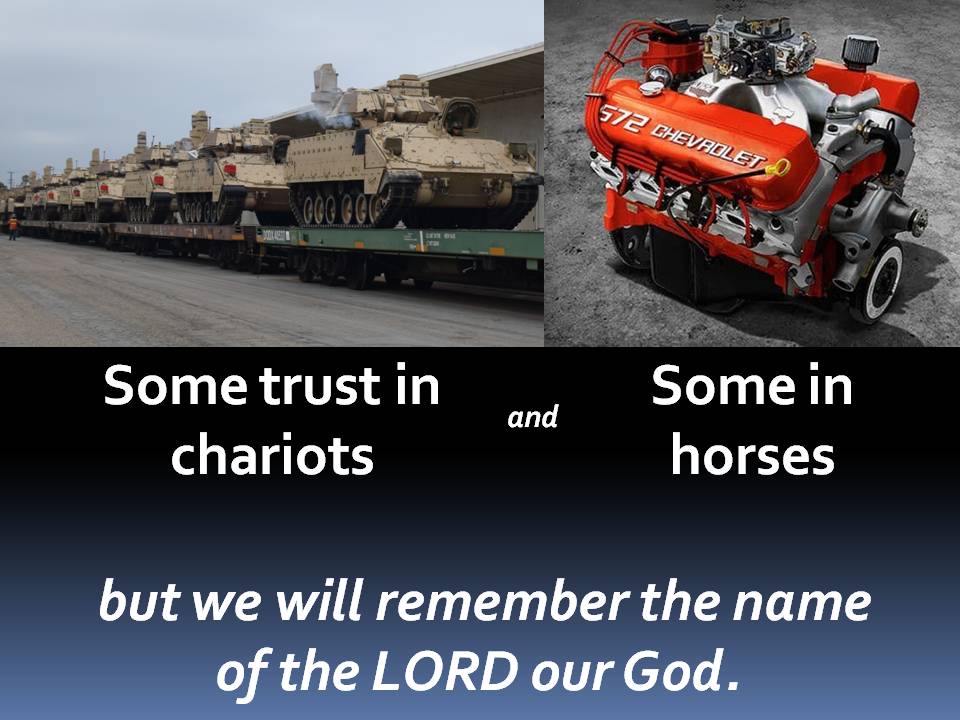
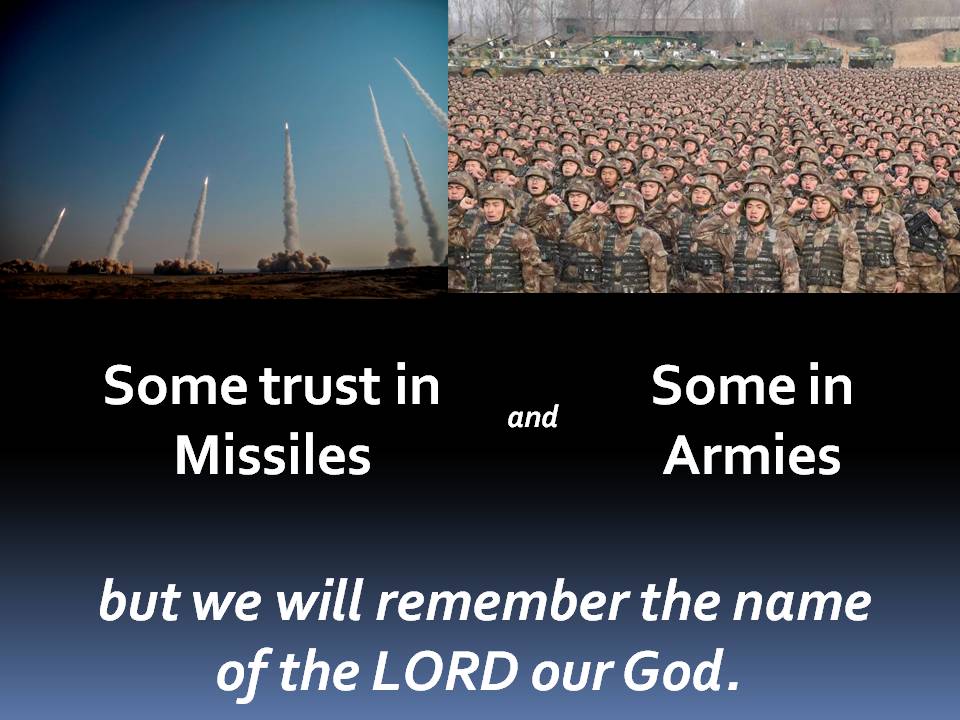
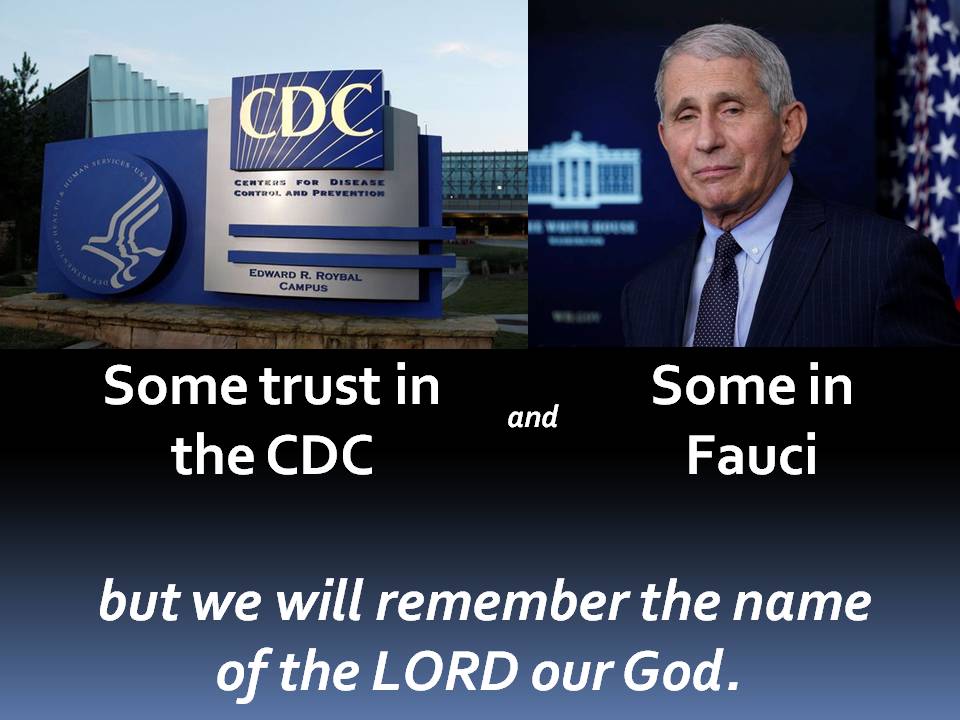
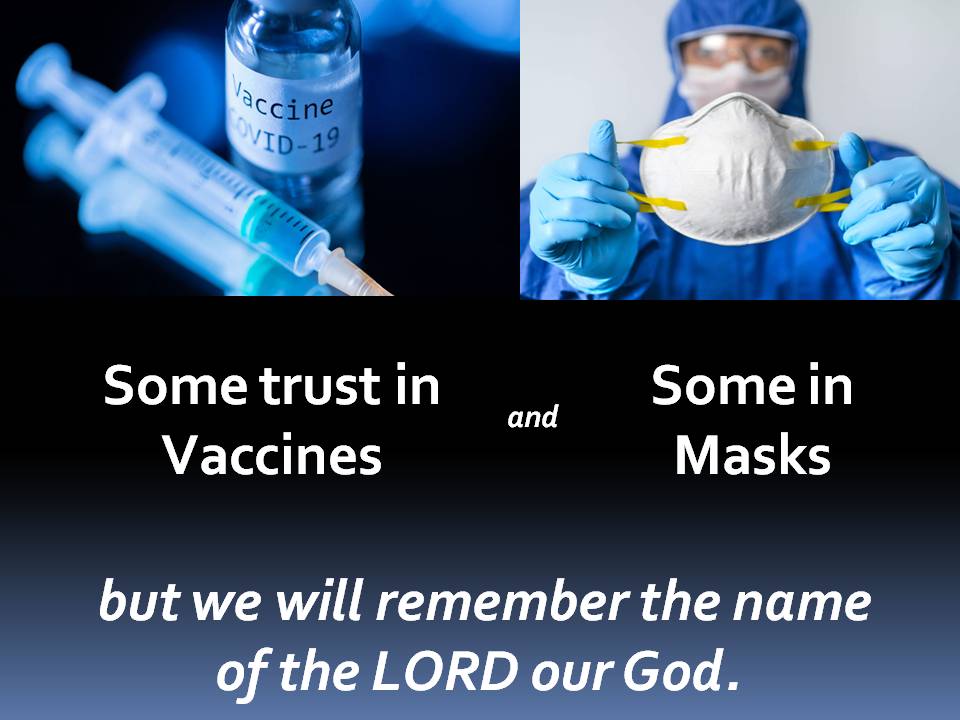
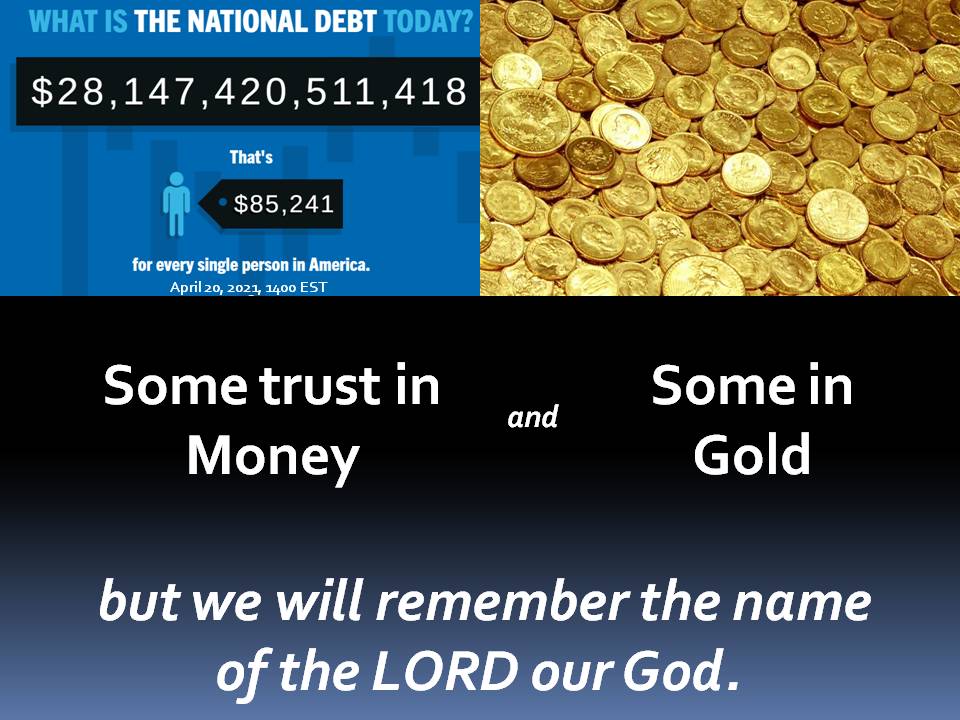
Remember

Some trust in chariots, and some in horses: but we will remember the name of the LORD our God. (Psalm 20:7)

The familiar rendition of Psalm 20:7 reads, “Some trust in chariots and some in horses, but we trust in the name of the Lord our God” (emphasis mine) as equivocated by the New International Version (NIV). The first “trust” in the verse does not appear in the original Hebrew, but has been supplied by English translators for ease of reading and understanding. The addition of the word is in keeping with the context of the entire psalm which looks to God for provision, protection and salvation.

The second word rendered “trust” is from the Hebrew root zâkar which means “to remember, recall, or call to mind.” Other versions translate zâkar as “boast, depend, honor, mention, praise, rely, remember, shall call, take pride in, and trust.” The literal translation of zâkar is “to remember.” The Hebrew verb is in the Hiphil imperfect stem, so literally it means “to cause to remember,” but that would give it an awkward rendition in English.

However, we could argue that “trust” is a valid rendering, but only by going through some mental gymnastics. As we go through trials in our lives, God provides, protects, and saves us from harm. We may not sense God’s presence while we are going through our troubles, but when we look back on our lives, we can “see” and “remember” how God’s hand has been upon us to guide, direct, protect, provide, and ultimately, to save us from those times. My favorite Bible verse says, “And we know that all things work together for good to them that love God, to them who are the called according to his purpose” (Romans 8:28). As we “remember” the working of God in our past, we can “trust” Him with whatever we face in the present, and we can “trust” Him with whatever may come to us in the future.

Reader, if you are feeling insecure about your future, please read my page on “Securing Eternal Life.”

Comments Off on Remember

Filed under Apologetics, Bible, Christianity, Random Musings, Theology

The Trumpet Shall Sound

Behold, I shew you a mystery; We shall not all sleep, but we shall all be changed, In a moment, in the twinkling of an eye, at the last trump: for the trumpet shall sound, and the dead shall be raised incorruptible, and we shall be changed. (1 Corinthians 15:51-52)

If you came to 2021 hoping for an improvement over 2020, you may be sorely disappointed. If you study Scripture, you know that the closer we get to Christ’s return, the worse things will become. However, for those who place their trust in Christ, this is cause for celebration rather than consternation. Before things get really bad, we have the expectation that Jesus will come and rescue His Church before the events described in the Book of the Apocalypse begin.

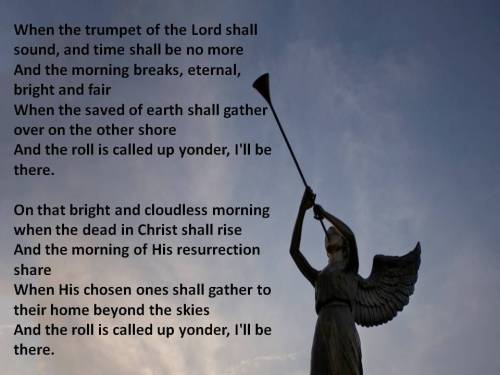
“When the Roll Is Called Up Yonder,” James M. Black, 1893 [1]

The Bible is clear that the Church, the body of true believers in Jesus Christ as Lord, and born again of the Spirit of God will be absent during the 7-year Tribulation period that the Bible calls the “Time of Jacob’s Trouble.”[2] Several of the Old Testament prophets spoke of the coming of the Messiah to set up an earthly kingdom. From their perspective, as if looking across time over a series of mountain peaks where the Messianic Kingdom is at the final peak, they did not see the “Church Age” in the valley between His first coming (the first peak) and His second coming (the last peak). They rightly prophesied about His first coming and even of His death and resurrection, but the next thing, from their perspective, was the setting up of the Messianic Kingdom.

The Apostle Paul explained that the Church, to the OT prophets, was a “mystery.”[3] All OT prophecy deals with Israel. God gave the Prophet Daniel a concise prophecy of the end times that precisely predicted the arrival of the Messiah at His first coming. The angel that delivered the message said, “Seventy weeks are determined upon thy people and upon thy holy city, to finish the transgression, and to make an end of sins, and to make reconciliation for iniquity, and to bring in everlasting righteousness, and to seal up the vision and prophecy, and to anoint the most Holy” (Daniel 9:24, emphasis mine). Notice that the time is determined for Daniel’s people. Who are Daniel’s people, if not Israel? The 70 weeks are 70 sevens of years (70 x 7) which come to 490 years. Four hundred eighty-three (483) years were accomplished with the crucifixion of the Messiah.[4] At that time, God stopped Israel’s time clock and seven years remain to complete the “seventy weeks determined for Daniel’s people.” In the meantime, the “mystery” of the Church is in effect.

In order for the final “week” of the seventy weeks to resume, the church must be taken out of the way. The reason for is that the Holy Spirit resides with every true believer. The Apostle Paul informs us that the Holy Spirit restrains Satan’s full control of the earth, so He must be removed before “prince,” aka, Antichrist, can be revealed. Paul said, “Let no man deceive you by any means: for that day shall not come, except there come a falling away first, and that man of sin [aka Antichrist] be revealed, the son of perdition … For the mystery of iniquity doth already work: only he who now letteth [restrains] will let [restrain], until he be taken out of the way” (2 Thessalonians 2:3, 7, emphasis mine). He that restrains (letteth) is the Holy Spirit. He must be “taken out of the way” before the Antichrist can be revealed, and where the Holy Spirit goes, the Church goes. This event is known as the Rapture.

There are no signs given in Scripture to prepare us for the Rapture. We can know the time is near when we see signs for the last days and the end of times falling into place. Jesus gave His disciples a detailed explanation of the last days prior to His second coming.[5] Jesus told them about wars, rumors of wars, earthquakes, pestilences, etc. in the latter days, but He cautioned that “All these are the beginning of sorrows” (Matthew 24:8). This ramp-up of signs that point to the Second Coming, which is the seven years after the Rapture of the Church, are things we can see taking place now. That lets us know that the Rapture of the Church is very near.

Can we believe in the Rapture? Before going to the cross, Jesus assured His disciples (and us), “Let not your heart be troubled: ye believe in God, believe also in me. In my Father’s house are many mansions: if it were not so, I would have told you. I go to prepare a place for you. And if I go and prepare a place for you, I will come again, and receive you unto myself; that where I am, there ye may be also” (John 14:1-3, emphasis mine). This is the promise that Jesus will come for us and take us to be with him. However, it does not tell us when this will take place.

Some of Paul’s first letters were written to the church in Thessaloniki. Much of what he wrote to this church dealt with the end of time. To them, he wrote, “For this we say unto you by the word of the Lord, that we which are alive and remain unto the coming of the Lord shall not prevent [precede] them which are asleep [dead]. For the Lord himself shall descend from heaven with a shout, with the voice of the archangel, and with the trump of God: and the dead in Christ shall rise first: Then we which are alive and remain shall be caught up together with them in the clouds, to meet the Lord in the air: and so shall we ever be with the Lord” (1 Thessalonians 4:15-17, emphasis mine). Notice that we meet Him “in the air;” He does not return to the earth at that time.

To the church in Corinth, Paul wrote, “Behold, I shew you a mystery; We shall not all sleep [die], but we shall all be changed, In a moment, in the twinkling of an eye, at the last trump: for the trumpet shall sound, and the dead shall be raised incorruptible, and we [who are alive] shall be changed” (1 Corinthians 15:51-52, emphasis mine). However, this still does not explain when that will take place.

The Thessalonians had the same question. To them, he explained that the Holy Spirit that restrains the evil one must be removed before Antichrist can come on the scene. We looked at that verse earlier. “Let no man deceive you by any means: for that day shall not come, except there come a falling away [from the faith, i.e., “apostasy”] first, and [Antichrist] be revealed, the son of perdition; Who opposeth and exalteth himself above all that is called God, or that is worshipped; so that he as God sitteth in the temple of God, shewing himself that he is God” (2 Thessalonians 2:3-4, edited and emphasized for clarity). “And now ye know [the Holy Spirit withholds] that [Antichrist] might be revealed in his time. For the mystery of iniquity [does] already work: only [the Holy Spirit] who now [restrains] will [restrain], until [the Holy Spirit] be taken out of the way. And then shall that [Antichrist] be revealed, whom the Lord shall consume with the spirit of his mouth, and shall destroy with the brightness of his [Second] coming: Even him [Antichrist], whose coming is after the working of Satan with all power and signs and lying wonders” (2 Thessalonians 2:6-9, edited and emphasized for clarity).

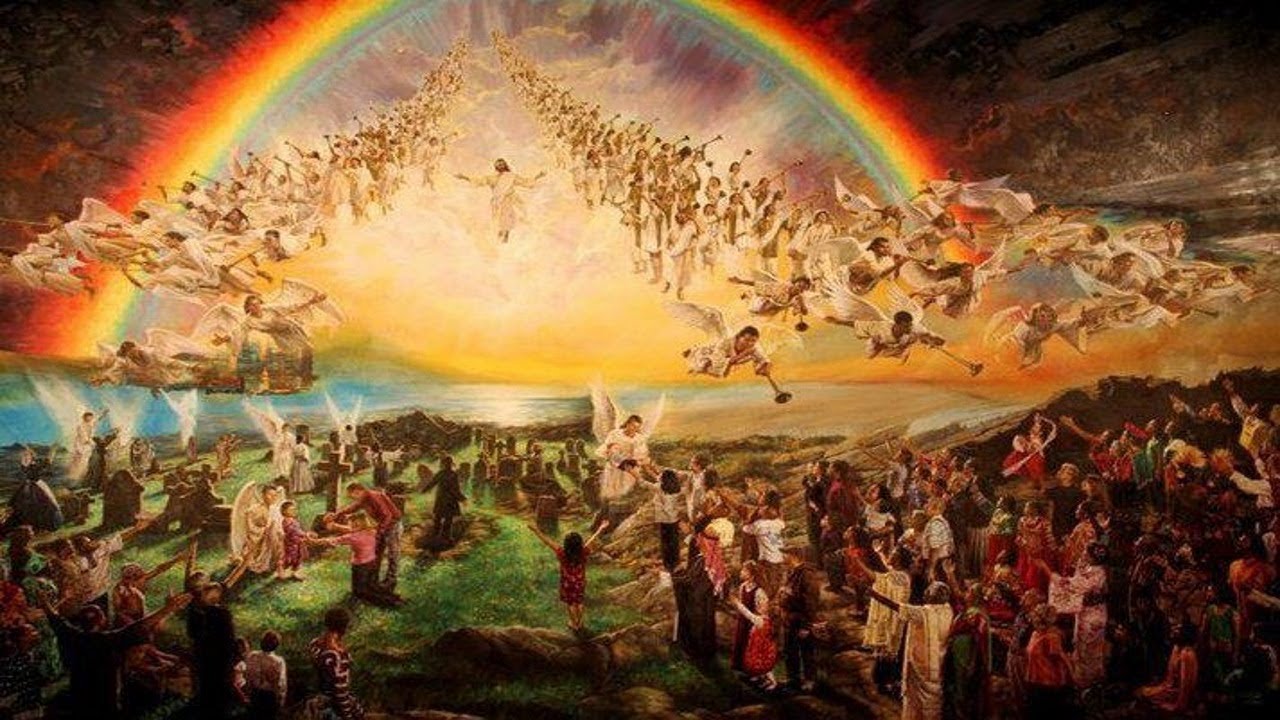
When the trumpet sounds, Jesus will come for His church. Christians who have died will rise from their graves, then Christians who are living will be changed in a moment, in the twinkling of an eye, and will meet with the risen dead together to meet Jesus in the air. Then we will all go together to be with Jesus for seven years. In the meantime, here on Earth, Antichrist will exercise dominion, and God will unleash the worst judgments the world has ever known. At the end of the seven years, Jesus will return with His Church to reign on Earth. “And I saw heaven opened, and behold a white horse; and he that sat upon him was called Faithful and True, and in righteousness he doth judge and make war … And the armies which were in heaven followed him upon white horses, clothed in fine linen, white and clean” (Revelation 19:11, 14). “And I saw thrones, and they sat upon them, and judgment was given unto them: and I saw the souls of them that were beheaded for the witness of Jesus, and for the word of God, and which had not worshipped the beast, neither his image, neither had received his mark upon their foreheads, or in their hands; and they lived and reigned with Christ a thousand years” (Revelation 20:4, emphasis mine).

The trumpet shall sound. Are you ready? If you are not sure, please visit my page on “Securing Eternal Life.”

Notes:


[1]  “When the Roll Is Called Up Yonder,” James M. Black, 1893

[2]  Jeremiah 30:7

[3]  Romans 16:25

[4]  Daniel 9:26

[5]  Matthew 24; Mark 13; Luke 21

Comments Off on The Trumpet Shall Sound

Filed under Apologetics, Christianity, End Times, Evangelism, Gospel, Heaven, Holy Spirit, Resurrection, Salvation, Second Coming of Christ, Theology