Tag Archives: Israel

A King In Israel

Rejoice greatly, O daughter of Zion; shout, O daughter of Jerusalem: behold, thy King cometh unto thee: he is just, and having salvation; lowly, and riding upon an ass, and upon a colt the foal of an ass. (Zechariah 9:9)

In my last article, I recounted the early history of Israel.[1] The period of the Judges lasted between 450 and 500 years (my estimation). The Book of Judges ends with this sad assessment: “In those days there was no king in Israel: every man did that which was right in his own eyes” (Judges 21:25). Israel finally got a king to rule over them. By popular consent, God allowed them to choose a king for themselves, Saul, a Benjamite.[2] But Saul was not the king God had in mind for them. From the time Israel entered Egypt and prior to their enslavement, God had already determined that the king would come from the tribe of Judah.[3] This king’s reign would be eternal. “The sceptre shall not depart from Judah, nor a lawgiver from between his feet, until Shiloh come; and unto him shall the gathering of the people be” (Genesis 49:10).

Saul was a miserable failure as king. Only two years into his reign, he disobeyed God by doing things his own way rather than waiting on God’s direction. God took the kingdom away from Saul, “For rebellion is as the sin of witchcraft, and stubbornness is as iniquity and idolatry. Because thou hast rejected the word of the LORD, he hath also rejected thee from being king” (1 Samuel 15:23).

Not long after, Samuel the prophet anointed God’s choice for Israel’s king, a young shepherd boy, a young man of the tribe of Judah and resident of Bethlehem, David, the son of Jesse.[4] During David’s reign, Israel followed the Lord and the Lord helped David conquer most of the land God had promised to Israel. After 40 years on the throne, David’s son Solomon became king, and the spiritual state of the nation slowly started to degenerate again, in part due to the king’s own practice of marrying pagan women and bringing their pagan worship into the land and even participating in their practices himself.[5] It is said of Solomon that he was the wisest man alive, but his behavior brings that into question. However, toward the end of his life, he finally did wise up. He wrote, “Vanity of vanities, saith the preacher; all is vanity … Let us hear the conclusion of the whole matter: Fear God, and keep his commandments: for this is the whole duty of man. For God shall bring every work into judgment, with every secret thing, whether it be good, or whether it be evil” (Ecclesiastes 12:8, 13-14).

Regardless, the damage was done. The leaven already permeated the loaf. Solomon’s son, Rehoboam, rejected the advice of his old advisors, listening rather to his young cronies. This ended up dividing the kingdom with ten tribes to the north and only Judah and Benjamin remaining of David’s kingdom.[6] Both kingdoms soon fell into idolatry once more, Israel (the Northern Kingdom) first followed by Judah (the Southern Kingdom) later. Israel was conquered by the Assyrians and displaced from the land never to return. Judah fell to the Babylonians and was carried away to Babylonian captivity. After 70 years in Babylonian captivity, the Medo-Persian Empire under Cyrus allowed the Jews to return to their land to rebuild Jerusalem and their Temple.[7] However, Israel never really became an independent state again. They were always under some other nation’s thumb. For over 400 years, they longed for their promised Messiah of whom Daniel foretold, “Know therefore and understand, that from the going forth of the commandment to restore and to build Jerusalem unto the Messiah the Prince shall be seven weeks, and threescore and two weeks: the street shall be built again, and the wall, even in troublous times” (Daniel 9:25). The day would come when their king would come and throw off the oppressive yoke of Gentile nations and make Israel great again, as in the days of David and Solomon.

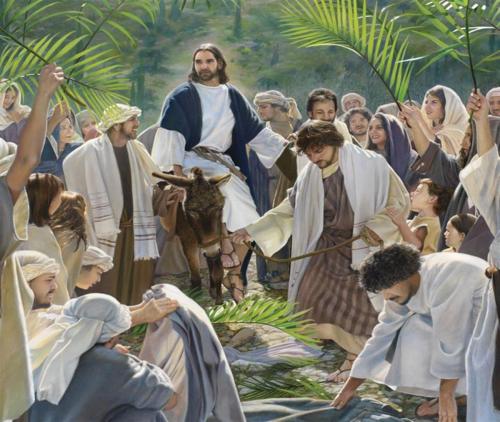
After 400 years, nothing had changed. Then one Sunday morning their long-awaited king made His entrance. However, they did not recognize Him. They were expecting a strong military general that would overthrow the Romans and set up a kingdom equal to or greater than that of Solomon. Perhaps the expected king would expand their borders to include all the lands God had promised.[8] But rather than ride in on a white stallion with a flashing sword and dazzling armor, Jesus rode in on an unbroken donkey’s colt.[9] Rather than the pomp and pageantry of a conqueror’s parade, Jesus was greeted by the cheers of the poor and downcast. “And the multitudes that went before, and that followed, cried, saying, Hosanna to the Son of David: Blessed is he that cometh in the name of the Lord; Hosanna in the highest” (Matthew 21:9); and “Saying, Blessed be the King that cometh in the name of the Lord: peace in heaven, and glory in the highest” (Luke 19:38). The religious leaders, those who should have recognized His presentation, considering the specificity of Daniel’s prophecy,[10] despised the thought of this lowly Galilean being king and rejected His claims to deity. “The Pharisees therefore said among themselves, Perceive ye how ye prevail nothing? behold, the world is gone after him” (John 12:19). “And some of the Pharisees from among the multitude said unto him, Master, rebuke thy disciples” (Luke 19:39). Had these kept silent, Jesus answered them, the very rocks would cry out in proclamation of His kingship.[11]

A few days later, their rejection would be complete as Pilate presented Jesus to them, “Behold your king!”[12] “But they cried out, Away with him, away with him, crucify him. Pilate saith unto them, Shall I crucify your King? The chief priests answered, We have no king but Caesar” (John 19:15, emphasis mine). Rejecting their true King, they preferred rather to remain under the thumb of their oppressors.

This came as no surprise to Jesus. Earlier He confided in His disciples, “Now is my soul troubled; and what shall I say? Father, save me from this hour: but for this cause came I unto this hour” (John 12:27, emphasis mine). His kingdom, at this time, was not an earthly one. His kingdom was not for the Jews alone, but “that whosoever believeth in him should not perish, but have everlasting life” (John 3:16). Before going to the cross, He made this promise. “Let not your heart be troubled: ye believe in God, believe also in me. In my Father’s house are many mansions: if it were not so, I would have told you. I go to prepare a place for you. And if I go and prepare a place for you, I will come again, and receive you unto myself; that where I am, there ye may be also” (John 14:1-3, emphasis mine).

His disciples were naturally curious as to when that time would be. “And as he sat upon the mount of Olives, the disciples came unto him privately, saying, Tell us, when shall these things be? and what shall be the sign of thy coming, and of the end of the world?” (Matthew 24:3, emphasis mine). Jesus gave many indicators of His return at “the end of the world,” but He cautioned, “All these are the beginning of sorrows” (Matthew 24:8). Jesus spoke of wars and rumors of wars, earthquakes in different places, famines, and pestilences.

All these things are taking place today. The naysayers point out that these things have occurred throughout history. Peter foresaw such “scoffers.” “Knowing this first, that there shall come in the last days scoffers, walking after their own lusts, And saying, Where is the promise of his coming? for since the fathers fell asleep, all things continue as they were from the beginning of the creation” (2 Peter 3:3-4). The truth is that these things have never occurred with such frequency and with such unity. The convergence of all of these signs is “unprecedented” (to borrow a term in frequent use these days). Consider the pestilence the world experiences today, the Wuhan virus. This bug has brought the world to a standstill and threatens not only the lives but the livelihoods of millions of people. The world’s economies are on the verge of collapse, and this is but one of the signs of which Jesus spoke.

The time is near. Soon there will be a King in Israel and His Kingdom is forever. Jesus will reign on earth for 1000 years.[13] The world seeks a one-world government ruled by fallible men. Jesus will bring a one-world government, “and he shall rule them with a rod of iron …” (Revelation 19:15). After that, in a recreated heaven and earth, He will reign forever in the “New Jerusalem.”[14]

Are you ready to live with King Jesus in His eternal kingdom? If you are not sure of your eternal destiny, read my page on “Securing Eternal Life.”

Notes:


[1]  “No King In Israel” – https://erniecarrasco.com/2020/04/01/no-king-in-israel/

[2]  1 Samuel 10

[3]  Genesis 49:8-12

[4]  1 Samuel 16

[5]  1 Kings 11:1-8

[6]  1 Kings 12

[7]  2 Chronicles 36:22-23

[8]  Genesis 15:18-21; Exodus 6:4; Numbers 34:1-15; Joshua 1:4

[9]  Mark 11:2

[10]  Daniel 9:24-26

[11]  Luke 19:40

[12]  John 19:14

[13]  Revelation 20

[14]  Revelation 21

Comments Off on A King In Israel

Filed under Christianity, Current Events, Easter, End Times, Gospel, Heaven, Holidays, Religion, Salvation, Second Coming of Christ, Theology

No King In Israel

In those days there was no king in Israel: every man did that which was right in his own eyes. (Judges 21:25)

Thirty years after entering the Promised Land, Joshua died[1] without having accomplished that task God assigned the children of Israel, i.e., to rid the land of all its inhabitants. Even though God promised, “Every place that the sole of your foot shall tread upon, that have I given unto you, as I said unto Moses. From the wilderness and this Lebanon even unto the great river, the river Euphrates, all the land of the Hittites, and unto the great sea toward the going down of the sun, shall be your coast” (Joshua 1:3-4). Before entering the Promised Land, Moses encouraged Joshua, “And the LORD, he it is that doth go before thee; he will be with thee, he will not fail thee, neither forsake thee: fear not, neither be dismayed” (Deuteronomy 31:8). Joshua further encouraged the people, “Remember the word which Moses the servant of the LORD commanded you, saying, The LORD your God hath given you rest, and hath given you this land” (Joshua 1:13). The land was theirs for that taking. God had given it to them. They had only to “be strong and of good courage; be not afraid, neither be dismayed: for the LORD thy God is with thee whithersoever thou goest” (Joshua 1:9).

Accounts differ about the time it took for the “conquest” of the land. Joshua 18-19 records the dividing of the “inheritance” which took place seven to eight years after they crossed the Jordan.[2] In the process of conquering the land, the children of Israel made some compromises that came back to bite them,[3] and they became battle-weary of fighting giants even though God did most of the fighting for them.

Joshua was getting old, and God told him so.[4] He was 40 years old when he first entered Canaan to spy out the land.[5] God punished the children of Israel for their rebellion and unbelief by making them wander in the desert for 40 years. So by the time he entered the Promised Land, Joshua was already 80 years old. At the end of his life, Joshua was 110 years old[6] making his time in the land 30 years. In all that time, Israel failed to take the land God had given them. In that time, they forgot God’s encouragement not to fear. Joshua’s own tribe, Ephraim, complained, “And the children of Joseph [Ephraim and Manasseh] said, The hill is not enough for us: and all the Canaanites that dwell in the land of the valley have chariots of iron, both they who are of Bethshean and her towns, and they who are of the valley of Jezreel” (Joshua 17:16). This was only seven or eight years after seeing all that God had done in the near past and now they feared the giants and their “chariots of iron”! And Joshua spake unto the house of Joseph, even to Ephraim and to Manasseh, saying, Thou art a great people, and hast great power: thou shalt not have one lot only: But the mountain shall be thine; for it is a wood, and thou shalt cut it down: and the outgoings of it shall be thine: for thou shalt drive out the Canaanites, though they have iron chariots, and though they be strong” (Joshua 17:17-18). However, they did not complete the task, choosing rather to live among the Canaanites.

Without taking inventory, much of the land God “gave” Israel remained unconquered and worse, they failed to dispel the Canaanites that lived in the land contented rather to dwell among the pagans, something God had warned against.[7]

Joshua died “And also all that generation were gathered unto their fathers: and there arose another generation after them, which knew not the LORD, nor yet the works which he had done for Israel. And the children of Israel did evil in the sight of the LORD, and served Baalim: And they forsook the LORD God of their fathers, which brought them out of the land of Egypt, and followed other gods, of the gods of the people that were round about them, and bowed themselves unto them, and provoked the LORD to anger” (Judges 2:10-12). It was not long, perhaps 40-70 years, and they forgot all about God.

By my estimation, the period of the Judges lasted about 467 years after the “conquest” of the land. In that time God would punish them for their idolatry by instigating their Canaanite neighbors against them. They would cry out to God, and God would send a “judge” to deliver them. Some of those “judges” were not all that upstanding. For example, Gideon, after defeating the Midianites, erected a golden ephod in his city, “and all Israel went thither a whoring after it: which thing became a snare unto Gideon, and to his house” (Judges 8:27). Then there was the womanizing Samson, a Nazarite,[8] who killed a lion with his bare hands and later ate honey out of the carcass of the animal and shared it with his parents.[9] Touching dead animals violated the Mosaic Law[10], especially for a Nazarite.

The Book of Judges is a tragic history of Israel’s constant fall into idolatry and their rejection of God. The history ends with a sad account of a Levite that traveled to Bethlehem to retrieve his concubine (not wife) that had been unfaithful to him.[11] The woman had fled to her father’s house and the father was happy to entertain the Levite for several days before dismissing him to return with his concubine. They left late in the afternoon arriving at Jebus (Jerusalem) as it was getting dark. A man offered them lodging for the night and while they were there, some “sons of Belial” (worthless fellows) of the tribe of Benjamin came asking for the traveler so they might have sex with him. The man of the house begged them not to do such a wicked thing and offered them rather his daughter and the Levite’s concubine. The men settled for the concubine and raped her all night long. In the morning, the Levite found her dead at the doorstep. In anger, he took up his concubine and carried her body home. When he got home, he cut her body up in twelve pieces and sent the dismembered body to all the tribes of Israel. That incited all the tribes of Israel to come against Benjamin to seek a settlement for the wrong done. However, Benjamin would not turn over the violators and refused to repent. The dispute ended in civil war and the near destruction of the tribe of Benjamin. Out of 25,100 fighting men of Benjamin, only 600 escaped alive. The rest of Israel mourned the desolation of Benjamin and the possibility of losing one of Israel’s tribes. The other tribes had sworn not to give any of their daughters to the Benjamites because of their wickedness, but their complete annihilation was inconceivable. Their resolution was to have something like a Sadie Hawkins dance where they permitted the Benjamites to come and kidnap their daughters. Sad, but true, and “In those days there was no king in Israel: every man did that which was right in his own eyes” (Judges 21:25).

Toward the end of the period of the Judges comes the account of Ruth, a young Moabitess that lost her husband, Malon (meaning “sickly”) and returned with her widowed mother-in-law, Naomi, to Bethlehem. There she met Boaz, who was Naomi’s “kinsman-redeemer.” By law and by custom, Boaz was obligated to marry Ruth and “raise up seed” to his deceased next of kin, Malon. This he willingly did. As we read the account, Boaz was smitten with Ruth when he first laid eyes on her. Anyway, Boaz married Ruth, and she became the great grandmother of King David.[12] More than that, she entered the lineage of King Jesus.

Israel’s history is one of constant rebellion against God, but it is also a tribute to God’s patience, faithfulness, and love in spite of our rebellion and rejection. Beginning with the Fall, God had a plan for man’s redemption.[13] I think about our nation. This year marks 400 years since the landing of the Pilgrims on Plymouth Rock. Are we any different than the Israelites? Think of all God has given us. Think of all His blessings to our nation, and think of how we have rejected Him. No, we are no different. The Wuhan bug that threatens our lives and our economy has us hiding in our dens afraid to come outside for fear of catching Covod-19. Some say this is a punishment from God. Some hope that it will bring revival to our land. However, I have serious doubts about that. Remember how church attendance spiked when many feared the end of the world from Y2K? Remember how church attendance jumped after 9-ll? Those “revivals” were short-lived. We cannot even attend church services now, yet I know attendance at “cyber church” is at an all-time high. Praise the Lord! Some are being saved, however, once this is all behind us, things will return to normal and our nation will return its own form of idolatry – professional sports, entertainment of all sorts, the worship of money and material things, etc.

We are no different than the children of Israel. However, our God, is the same God of Israel. He is patient, faithful, and loving, and His plan is nearing its completion. Consider the world-wide effect of this pestilence. Think about the increased number and intensity of earthquakes in different places on the planet. Have you heard about the swarms of locust devastating crops in Africa and moving north? These are just some of the signs Jesus gave concerning the “end of days.” Soon Jesus will return and Eden will be restored. Are you ready to meet King Jesus? If not, visit my page on “Securing Eternal Life.”

Notes:


[1]  Joshua 24:29

[2]  “The Conquest of Canaan” – https://www.thesacredcalendar.com/book-of-joshua-conquest-of-canaan/

[3]  Unsanctioned (by God) alliances (Joshua 9)

[4]  Joshua 13:1

[5]  Numbers 13:8,16

[6]  Joshua 24:29

[7]  Deuteronomy 7:2-4

[8]  Numbers 6:2

[9]  Judges 14:5-9

[10]  Leviticus 5:2

[11]  Judges 19-21

[12]  Ruth 4:17-22

[13]  Genesis 3:15

Comments Off on No King In Israel

Filed under Bible, Christianity, Current Events, End Times, Religion, Second Coming of Christ, Theology

A Thousand-Year Day

But, beloved, be not ignorant of this one thing, that one day is with the Lord as a thousand years, and a thousand years as one day. (2 Peter 3:8)

The retirement lifestyle is a new experience for me. So far, it feels like an extra-long vacation. I’m enjoying doing things in the middle of the week and in the middle of the day that were out of the question when I was tied to a nine-to-five job. I am also enjoying the absence of fighting rush-hour traffic.

On Friday of this week, I experienced an outing to the ICR Discovery Center for Science and Earth History, my former employer, with a group of senior adults from our church. Of course, I know the place inside and out, but it felt different to visit as a “guest.” Our visit was too short (only two and a half hours). After that, we boarded our bus bound for lunch at El Fenix, the oldest Tex-Mex restaurant chain in the Dallas-Fort Worth Metroplex. Our driver took us to the one in Irving, Texas, not far from the Discovery Center.

In the course of conversation over lunch, a lady sitting at the table across from me asked me how I would respond to someone who thinks the Genesis creation account is a myth and argues for an old earth based on 2 Peter 3:8 (our verse above). Of course, attempting to change someone’s mind who is convinced that the miracle accounts in the Bible are myths will take some doing. Their main problem is that they have a very small view of God. They usually also have an overinflated view of man. However, their support for long ages based on 2 Peter 3:8 can be easily debunked.

Many use this verse to argue for long ages in the Genesis creation account. They wrongly interpret 2 Peter 3:8 to say, “one day is with the Lord a thousand years, and a thousand years is one day.” The Day-Age Theory[1] uses this interpretation to argue that the days of creation were 1000 years each making the creation event last 6000 years. Giving credit where credit is due, at least they are not arguing for millions or billions of years for creation. By their reckoning, Creation is about 12,000 years old. However, that raises the question; why does God need that much time to create? Furthermore, the purpose of the Day-Age compromise is to allow for evolution to take place, which brings up another question. Evolution requires death and suffering. How then can death be the penalty for sin[2] if death had taken place for thousands of years before the fall of man? And, how could God declare His creation “very good”[3] when He calls death “the enemy”?[4] Some concede that God used evolution to create. This raises yet another question. Why would God need to “experiment” on His creation in order to improve on it over time? Is He not all-knowing and all-powerful? Can God not simply speak things into being as described in the Genesis account of creation? The notion that God used evolution to create serves only to undermine faith in the power of God!

The resolution to the problem of misinterpreting 2 Peter 3:18 comes down to one word – “as.” Peter employs simile to describe the infinite nature of God. God created time; therefore, He is not bound by time. “Of old hast thou laid the foundation of the earth: and the heavens are the work of thy hands…But thou art the same, and thy years shall have no end” (Psalm 102:25, 27). “For a thousand years in thy sight are but as yesterday when it is past, and as a watch in the night” (Psalm 90:4). What Peter is saying is that, to God, one day is like a thousand years and a thousand years is like a day. Peter is not attempting to define time for God, but rather he is expressing the timeless nature of God. Therefore, attempting to define the days of creation as 1000 years each based on 2 Peter 3:18, misrepresents both Peter’s message and the Genesis account of creation.

However, without being dogmatic, a parallel could be drawn between 2 Peter 3:18, the days of creation, and historical time. God created in six 24-hour days and rested on the seventh. According to biblical chronology, the earth (all of creation) is about 6000 years old, and we look forward to a final, seventh, 1000-year of rest with Christ’s reign over all the earth.

A visitor to the Discovery Center showed me something in the Prophet Hosea that I had missed although I had read that passage many times. It reads as follows. “I will go and return to my place, till they acknowledge their offence, and seek my face: in their affliction they will seek me early. Come [Israel speaking now], and let us return unto the LORD: for he hath torn, and he will heal us; he hath smitten, and he will bind us up. After two days will he revive us: in the third day he will raise us up, and we shall live in his sight” (Hosea 5:15-6:2, emphasis mine).[5]

In the previous verse, the Lord (Jesus) says[6] that He will destroy Ephraim [the Northern Kingdom, i.e., Israel] and Judah. Then He says that He will return to His place (heaven) until they acknowledge their offence (i.e., the rejection of their Messiah) and seek His face. For over 2000 years, the Jews were scattered all over the earth until recent times (1948), but they, for the most part, have failed to seek His face – they still reject Jesus as their Messiah. However, they will return to Him in the near future. Then in Verse 2 of Chapter 6, they (the Jews) say, “After two days he will revive us: in the third day he will raise us up…”

My friend, referring to 2 Peter 3:18, pointed out that Jesus was crucified around A.D. 30, which means that the year 2030 will be 2000 years – two days.  On the third day (1000 years), Jesus will restore Israel. Although we cannot be dogmatic about such things, my friend’s reasoning is sound and his conclusion logical. If his assessment proves correct, that means the seven-year Tribulation could begin in 2023. The Rapture of the Church can take place anytime between now and then. Again, we must be careful not to be dogmatic about these things, but as Christians, the Word instructs us that the return of the Bridegroom for His Bride is imminent[7] and we must be ready at all times, “and so much the more, as ye see the day approaching” (Hebrews 10:25).

Are you ready? If you are unsure, please read my page on “Securing Eternal Life.”

Notes:


[1]  “Age of the Earth” – https://erniecarrasco.com/2018/10/14/age-of-the-earth-2/

[2]  Genesis 2:16-17; Genesis 3

[3]  Genesis 1:31

[4]  1 Corinthians 15:26

[5]  This quotation spans two chapters. The reader must keep in mind that the original text did not have chapter and verse divisions.  The first English Bible to include chapter and verse divisions was the 1560 Geneva Bible.

[6]  Hosea 5:14

[7]  “Imminent” – https://erniecarrasco.com/2020/01/12/imminent/

6 Comments

Filed under Apologetics, Christianity, Creation, End Times, Evolution, Origins, Second Coming of Christ, Theology

Stiffnecked

And the LORD said unto Moses, I have seen this people, and, behold, it is a stiffnecked people: (Exodus 32:9)

Stiffnecked—now there’s a word seldom heard today outside of careful Bible study. The English word, which should be hyphenated in modern English, appears only eight times in the Old Testament of the King James Bible and is really a translation of two Hebrew words: qâsheh and ‛ôreph (the nape of the neck). The first word, qâsheh, means “churlish, cruel, severe, obstinate, or stubborn.” This goes beyond simple hard-headedness. It characterizes an incorrigible, rebellious person, and it is not an attribute one would desire. Yet, in God’s evaluation of His Chosen People, He defined them as “stiffnecked.”

This assessment was not a rush to judgment on God’s part. These people earned the moniker. Consider how God acted on their behalf to free them from Egyptian bondage. God sent ten plagues against the Egyptians that effected only the Egyptians and spared the Israelites.[1] The final plague brought death upon every firstborn of every Egyptian household including their livestock. At the end of that plague, the Egyptians were only too happy to get rid of the Israelites and even sent them off with rich booty.[2] “And the Egyptians were urgent upon the people, that they might send them out of the land in haste; for they said, We be all dead men” (Exodus 12:33). Not long after they departed, Pharaoh changed his mind and followed in pursuit to bring them back to Egypt. Penned between mountains on one side and the Red Sea on the other, the Israelites witnessed God part the waters so they could cross over on dry ground. Then He closed the waters behind them and drowned the pursuing Egyptian chariots.[3] “And Israel saw that great work which the LORD did upon the Egyptians: and the people feared the LORD, and believed the LORD, and his servant Moses” (Exodus 14:31).

Not long after this miraculous deliverance, the Israelites arrived at a watering hole with bitter water and immediately started complaining.[4] God had Moses cast a tree into the watering hole and the waters became sweet. Then God made a conditional promise. “If thou wilt diligently hearken to the voice of the LORD thy God, and wilt do that which is right in his sight, and wilt give ear to his commandments, and keep all his statutes, I will put none of these diseases upon thee, which I have brought upon the Egyptians: for I am the LORD that healeth thee” (Exodus 15:26, emphasis mine).

Further down the road, they came to Elim and began complaining about their perceived lack of food. So God sent them manna (what is it? bread from heaven) and quail to eat.[5] Further along the way, they once again complained about the lack of water, so God provided water out of a rock.[6] God then defeated Amalek, the first enemy they encountered.

Then they arrived at Sinai, the Mountain of God. There, in the hearing of all the people, God gave them the Ten Commandments. They all heard the voice of God and were terrified. “And they said unto Moses, Speak thou with us, and we will hear: but let not God speak with us, lest we die” (Exodus 20:19). Moses ascended the mountain and wrote down the rest of the Law.[7] (At this point one should note that this occurred prior to Moses’ first 40-day stent on the mountain.) “And Moses wrote all the words of the LORD, and rose up early in the morning, and builded an altar under the hill, and twelve pillars, according to the twelve tribes of Israel … And he took the book of the covenant, and read in the audience of the people: and they said, All that the LORD hath said will we do, and be obedient” (Exodus 24:4,7 emphasis mine).

Hollywood movies have a way of distorting biblical accounts in ways that make them so memorable to the viewers that the Hollywood version supersedes the biblical narrative. In the movie, The Ten Commandments, Charlton Heston goes up the mountain to receive the Ten Commandments for the first time and returns to find the Children of Israel worshipping the golden calf. The movie plot kind of takes them off the hook a bit, because they did not know better; they did not have the Law. However, the biblical record shows that they were given the Law, written down by Moses, long before the golden calf incident, and they all agreed, “All that the LORD hath said will we do, and be obedient” (Exodus 24:7).

After all of Israel affirmed that they would abide by God’s Law, Moses ascended the mountain once more and received the Law written on stone tablets and was there 40 days and 40 nights.[8] “And he gave unto Moses, when he had made an end of communing with him upon mount Sinai, two tables of testimony, tables of stone, written with the finger of God” (Exodus 31:18, emphasis mine). These tables not only contained the Ten Commandments. They contained all the Law that the Children of Israel heard directly from God to which they agreed to obey. In addition, God gave Moses instructions for the construction of the Tabernacle and all of its furnishings. Great detail was given for consecrating the priests and the apparel they would wear, especially that of the high priest.

While Moses delayed, the people got antsy and went to Aaron, Moses’ brother and second in command, and asked Aaron, “make us gods, which shall go before us; for as for this Moses, the man that brought us up out of the land of Egypt, we wot [know] not what is become of him” (Exodus 32:1). As one reads the account, it becomes apparent that Aaron felt no coercion to comply with the request, nor did he hesitate. “And Aaron said unto them, Break off the golden earrings, which are in the ears of your wives, of your sons, and of your daughters, and bring them unto me” (Exodus 32:2). Aaron, who was intimately involved in the liberation of the Children of Israel, and heard the Ten Commandments directly from the voice of God, soon forgot the first two. “Thou shalt have no other gods before me. Thou shalt not make unto thee any graven image, or any likeness of any thing that is in heaven above, or that is in the earth beneath, or that is in the water under the earth” (Exodus 20:3-4).

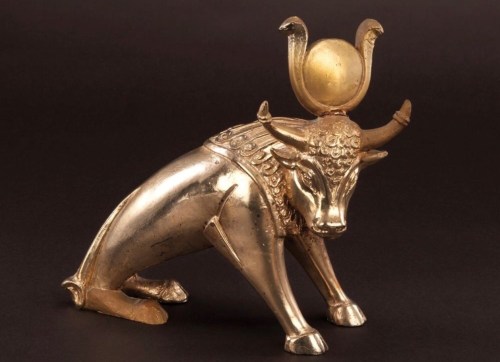
Before Moses learned of the idolatrous act, God already knew. “And the LORD said unto Moses, I have seen this people, and, behold, it is a stiffnecked people” (Exodus 32:9). God threatened to destroy them all and start over with Moses, but Moses interceded on their behalf and the Lord relented from His anger.[9]

Moses descended the mountain and found a wild party going on around the golden calf. When Moses confronted Aaron about the idol, his answer was hilarious. “And I said unto them [the Israelites], Whosoever hath any gold, let them break it off. So they gave it me: then I cast it into the fire, and there came out this calf” (Exodus 32:24, emphasis mine). Imagine that!

This would not be the first exhibition of Israel’s stiffnecked behavior. Throughout their history, Israel chased after false gods. God would punish, Israel would repent, God would forgive, and Israel would sin again. This happened over and over. Once God banished them from the land for 70 years, and for a time, they appeared to learn their lesson. Then God sent their promised Messiah, and they rejected Him and nailed Him to a cross. Again, God banished them from the land for over 2000 years now. However, as God promised, He has restored them to the land; but the saga is not over. God is not finished with Israel.

The lesson we can learn from God’s dealings with Israel is that God is faithful. We can count on Him to do exactly what He says He will do. He keeps His promises. Before entering the Promised Land, Moses reminded the people, “The LORD did not set his love upon you, nor choose you, because ye were more in number than any people; for ye were the fewest of all people: But because the LORD loved you, and because he would keep the oath which he had sworn unto your fathers, hath the LORD brought you out with a mighty hand, and redeemed you out of the house of bondmen, from the hand of Pharaoh king of Egypt. Know therefore that the LORD thy God, he is God, the faithful God, which keepeth covenant and mercy with them that love him and keep his commandments to a thousand generations” (Deuteronomy 7:7-9, emphasis mine). Regardless of their stiffnecked character, God has kept and will keep His covenant with Israel. Knowing that gives us the assurance that God will be faithful in keeping His promise to us, “that whosoever believeth in him should not perish, but have everlasting life” (John 3:16). “For I am persuaded, that neither death, nor life, nor angels, nor principalities, nor powers, nor things present, nor things to come, Nor height, nor depth, nor any other creature, shall be able to separate us from the love of God, which is in Christ Jesus our Lord” (Romans 8:38-39). God is faithful even to the stiffnecked.

Notes:


[1]  Exodus 7-12

[2]  Exodus 12:36

[3]  Exodus 14:10-31

[4]  Exodus 15:22-27

[5]  Exodus 16

[6]  Exodus 17:1-7

[7]  Exodus 20:22-23:33

[8]  Exodus 24:12-18

[9]  Exodus 32:10-14

1 Comment

Filed under Bible, Gospel, Religion, Salvation, Theology

Imminent

He which testifieth these things saith, Surely I come quickly. Amen. Even so, come, Lord Jesus. (Revelation 22:20)

Secretary of State, Mike Pompeo, and Secretary of the Treasury, Steve Mnuchin, gave a press briefing on Friday, January 10, 2020,[1] concerning increased sanctions for Iran following Iran’s rocket attacks on US bases in Iraq. At the end of the briefing, they opened the floor for questions from the press corps. As has become common practice these days, the questions coming from the Press avoided the topic at hand, and rather addressed the irrelevant question of the killing of Iranian General Qasem Soleimani. Someone questioned the targeting of a “foreign diplomat,” and Pompeo pointed out that our intelligence found that Soleimani planned to strike our embassies in the area and that the threats were imminent. One genius fake news reporter challenged the Secretary, “What is your definition of ‘imminent’?” I had to laugh!

It comes as no surprise that the request for a definition of the word “imminent” should arise. The “left” in this country, and around the world, has become proficient in distorting the language so that words become whatever the user wants them to be. For example, “hate” means “to dislike intensely or passionately; feel extreme aversion for or extreme hostility toward [something or someone]; detest [something or someone].”[2] However, for the left, “hate” means opposition to anything they favor. The practice of redefining terms probably started much earlier than this, but my first vivid recollection of this practice came at the impeachment of William Jefferson Clinton. Remember his now infamous line? “It depends on what the meaning of the word ‘is’ is.”

Words used to have meaning. However, in a day when biology no longer determines the sex of a person, words can take on whatever meaning the user wants them to mean. Not so with God. He emphatically states, “For I am the LORD, I change not…” (Malachi 3:6). The writer to the Hebrews says of God the Son, “Jesus Christ the same yesterday, and to day, and for ever” (Hebrews 13:8). Of His Word, Jesus said, “For verily I say unto you, Till heaven and earth pass, one jot or one tittle shall in no wise pass from the law, till all be fulfilled” (Matthew 5:18).

The word “imminent” does not appear in the King James Bible; however, the concept is there. The word “imminent” means that something is “likely to occur at any moment.”[3] The precise moment of such an event cannot be known or determined. It could happen at any time. If one can know or determine the time of a future event, it is no longer “imminent” because it is now “expected.” The two words are synonymous, however with expectation comes the connotation of the precise timing and location of a future event. The expectation of an impending event allows for ample preparation. Jesus said, “But know this, that if the goodman of the house had known in what watch the thief would come, he would have watched, and would not have suffered his house to be broken up” (Matthew 24:43). If the man of the house had “known” when the thief would come, he would have been “expecting” him and made preparations. The implication here is that the coming of the thief was “imminent,” not “expected.”

The fake news reporter exhibited her ignorance by asking Pompeo what he meant by “imminent.” Our military intelligence could not predict where or when Soleimani would strike, only that his intention was to strike soon. That made it imminent.

Christ’s return for His Bride, the Church, is imminent. It has been imminent for over 2000 years. Before His crucifixion, Jesus promised, “And if I go and prepare a place for you, I will come again, and receive you unto myself; that where I am, there ye may be also” (John 14:3). Paul taught the imminency of the Lord’s return at “the last trump” when we would “not all sleep, but we will all be changed in a moment, in the twinkling of an eye,”[4] but he did not say when. It’s imminent. It could happen at any time. To the Thessalonians, Paul wrote, “But of the times and the seasons, brethren, ye have no need that I write unto you. For yourselves know perfectly that the day of the Lord so cometh as a thief in the night” (1 Thessalonians 5:1-2). His coming is imminent, like “a thief in the night.”

Unlike the “goodman of the house” in Jesus’ example who was unprepared for the imminency of the thief’s arrival, we have good reason to be expectant of the Lord’s imminent return. We cannot know the day nor the hour when the Lord will return.[5] It could be at any time. It is imminent. Therefore, we must watch expectantly, and make preparations.

We have waited for over 2000 years. How imminent can His return be? Many become discouraged at the delay, like the five virgins without extra oil for their lamps.[6] Such attitudes are to be expected. The Apostle Peter predicted, “Knowing this first, that there shall come in the last days scoffers, walking after their own lusts, And saying, Where is the promise of his coming? for since the fathers fell asleep, all things continue as they were from the beginning of the creation” (2 Peter 3:3-4).

Many prophecies concerning “the last days” address Jesus’ return to set up His thousand-year reign on earth. The Old Testament contains most of these prophecies. Jesus spoke of these times in His Olivet Discourse,[7] and most of the Book of Revelation focuses on the time of Great Tribulation just before He returns. These prophecies provide great detail of the events that will transpire in “the last days” during the seven years[8] before the Lord’s return. However, no signs detail the “Rapture”[9] of the Church. We are told that it will happen, but we are not told when or how; it’s imminent. The Rapture[10] must take place before the time of Tribulation “For God hath not appointed us [His Church] to wrath, but to obtain salvation by our Lord Jesus Christ” (1 Thessalonians 5:9).

So, although we have waited more than 2000 years for the Bridegroom[11] to come for His Bride (the Church), we can know the time is near. How? We can know because of the convergence of the end-time signs. Israel, because it is the focus of all end-time prophecy, and the events surrounding Israel, is our primary sign. None of the end-time prophecies can come to pass without Israel being in her place. Of the rebirth of Israel, God’s “fig tree,” Jesus said, “Verily I say unto you, This generation shall not pass, till all these things be fulfilled” (Matthew 24:34). We are that generation. It has been almost 72 years since Israel’s rebirth, and according to the psalmist, a man’s life is between 70 and 80 years (Psalm 90:10). There are too many signs to include in this article, but the fact that Israel is in place makes all the other signs that much more relevant. The signs tell us the end is near, so the Rapture of the Church is more imminent now than ever before. It could happen anytime now.

Notes:


[1]  Press Briefing with Secretary of State Mike Pompeo and Secretary of the Treasury Steve Mnuchin: https://www.youtube.com/watch?v=lTCErLFbu4Q

[2]  Hate: https://www.dictionary.com/browse/hate?s=t

[3]  Imminent: https://www.dictionary.com/browse/imminent?s=t

[4]  1 Corinthians 15:50-53

[5]  Matthew 25:13

[6]  Matthew 25:1-13

[7]  Matthew 24-25; Mark 13; Luke 21

[8]  Daniel 9:24-27

[9]  End-Times 101 – https://erniecarrasco.com/2018/06/10/end-times-101/

[10]  End-Times 102 – https://erniecarrasco.com/2018/06/17/end-times-102/

[11]  Matthew 25:1-13

Comments Off on Imminent

Filed under Apologetics, Christianity, Current Events, End Times, Religion, Second Coming of Christ, Theology