Tag Archives: Bible

A Day Is A Day

Evening and Morning Was One Day

Evening and Morning Was One Day

For a thousand years in thy sight are but as yesterday when it is past, and as a watch in the night. (Psalm 90:4)

In a previous post, No Gap, I discussed the “Gap Theory” compromise of the biblical creation account.  The Gap Theory is only one of several compromises of theistic evolution.[1] Another popular compromise is the “Day-Age Theory.” This offshoot of theistic evolution maintains that God used long ages – billions of years – and evolution to create rather than the six literal days stated in the Bible. The Day-Age Theory attempts to stretch the days in Genesis 1into six long periods of undetermined time. “[The] ‘days’ of creation were interpreted figuratively as the ‘ages’ of geology.”[2]  In order to back up that assertion, the proponents of the Day-Age Theory will cite the psalm above or 2 Peter 3:8: “But, beloved, be not ignorant of this one thing, that one day is with the Lord as a thousand years, and a thousand years as one day.”

Besides the hermeneutical problems with this view, a logical dilemma arises that refutes any form of theistic evolution. To see this, one must have a clear understanding of who God is and what His attributes say about Him. To begin with, God is inconceivably great beyond anything the human mind can imagine. “For my thoughts are not your thoughts, neither are your ways my ways, saith the LORD. For as the heavens are higher than the earth, so are my ways higher than your ways, and my thoughts than your thoughts” (Isaiah 55:8-9, emphasis mine). Considering God’s “thoughts,” one of His attributes is that of omniscience; He is “all-knowing.” Hence, He innately knows all that can be known, and there is nothing He does not know. “Shall any teach God knowledge?” (Job 21:22). “Shall he that contendeth with the Almighty instruct him?” (Job 40:2). “For who hath known the mind of the Lord, that he may instruct him?” (1 Corinthians 2:16). Since that is so, why would God need to take billions of years to create by means of evolution, slowly developing from a single cell one thing, and then the next, and then the next, etc. until in the end He evolved man? That makes God out to be something of a mad scientist experimenting in a laboratory to see what He can come up with next. God does not need to experiment! God has nothing to learn; He has no need to practice. Besides all that, billions of years of evolution also involves billions of years of death. This is contrary to God’s nature. “In him was life; and the life was the light of men” (John 1:4, emphasis mine). God is concerned with life, not death. “The last enemy that shall be destroyed is death” (1 Corinthians 15:26, emphasis mine). If death existed before the completion of creation, God would have erred when He said that it was “very good” (Genesis 1:31). Besides that, death before the fall creates greater theological problems. (I deal with this issue in No Gap.)

In addition we must consider God’s omnipotence; He is “all-powerful.” There is nothing He cannot do. “Is any thing too hard for the LORD?” (Genesis 18:14). “Behold, I am the LORD, the God of all flesh: is there any thing too hard for me?” (Jeremiah 32:27). “With men this is impossible; but with God all things are possible” (Matthew 19:26). “The things which are impossible with men are possible with God” (Luke 18:27). “For with God nothing shall be impossible” (Luke 1:37).

Given that God is all-knowing and all-powerful, i.e., there is nothing impossible for Him, it is not unreasonable to believe the Genesis literal six-day account of creation. In fact, given His omniscience and omnipotence, He could certainly have created in an instant what He took six days to create.

Simple logic with a basic understanding of God’s nature refutes theistic evolution and the Day-Age Theory. Furthermore, these compromises fail when applying proper hermeneutical principals. A plain reading and understanding of the text of Genesis 1, as I explained in No Gap, precludes any possibility of long ages. The Hebrew word, yom, for day can only mean a normal 24-hour day. To further stress this point, God encapsulated the completion each creation day between the boundaries of “evening and morning.” There is no other way to interpret this narrative without pulling in from outside sources information not contained within the text. This system of hermeneutics is known as eisegesis – reading into the text what is not there.

The proponents of the Day-Age Theory in attempting to legitimize their compromise will cite 2 Peter 3:8 and Psalm 90:4, but when properly interpreted, in context, these passages speak of God’s eternal nature and have nothing to do with specifying time limits. God is not bound or limited by time; His transcendent nature places Him outside and inside of time simultaneously. Therefore, one day with Him is like one thousand years and one thousand years is like a day. Peter employs a literary device known as simile; otherwise he would have left off the “like.” Likewise Moses in his psalm says, “For a thousand years in thy sight are but as yesterday when it is past, and as a watch in the night” (Psalm 90:4, emphasis mine). But when God says He completed the work in one day, He means one day. So, why did He take six days to create rather than an instant? He created in six days and rested on the seventh day to set the pattern for our work week – six days of work, one day of rest. Have you noticed that the seven-day week is ubiquitous around the world? Furthermore, He wrote it in stone: “Remember the sabbath day, to keep it holy. Six days shalt thou labour, and do all thy work: But the seventh day is the sabbath of the LORD thy God: in it thou shalt not do any work, thou, nor thy son, nor thy daughter, thy manservant, nor thy maidservant, nor thy cattle, nor thy stranger that is within thy gates: For in six days the LORD made heaven and earth, the sea, and all that in them is, and rested the seventh day: wherefore the LORD blessed the sabbath day, and hallowed it” (Exodus 20:8-11, emphasis mine). The Hebrew word yom for “day” used here in the Fourth Commandment, is the same word yom used in Genesis 1. God was not talking about long ages when He gave this commandment, and He was not talking about long ages when He gave His creation account.

Another argument offered by the compromisers suggests that Genesis uses “poetic” language. This argument falls apart simply by comparing the narrative text of Genesis 1-4 with the literary style of parallelism employed in the Wisdom Books: Job, Psalms, Proverbs, Ecclesiastes and the Song of Songs (Song of Solomon). One does not even need knowledge of Hebrew to see the difference. So, claiming that Genesis 1 employs poetic language is a weak argument in support of a sad compromise.

No long ages fit into the narrative of Genesis 1. The Day-Age Theory compromises and weakens the Word of God. It is a diabolical instrument of Satan to create doubt for God’s Word, and disparage the very character and nature of God. There is no gap in Genesis 1, and there are no long ages. A day is a day, plain and simple.

Notes:


[1]  Henry M. Morris, “Evolution and the Bible,” http://www.icr.org/article/evolution-bible/, accessed 10/23/15.

[2]  Ibid.

4 Comments

Filed under Apologetics, Bible, Christianity, Creation, Death, Evolution, Origins, Religion, Satan

No Gap

earth-implosion

And the earth was without form, and void; and darkness was upon the face of the deep. And the Spirit of God moved upon the face of the waters. (Genesis 1:2)

Ever since Charles Darwin published his On the Origin of Species by Means of Natural Selection or the Preservation of Favored Races in the Struggle for Life, (in which, by the way, he never addresses the main thesis of his book) it seems that Christian theologians have been scrambling to defend the Genesis creation account and allow for millions of years of evolution. Even now with all the great research being done by creation scientists in the fields of biology, cosmology, geology, meteorology, paleontology, physics, and others, and by great organizations like Answers In Genesis, Creation Ministries International, the Creation Research Society, the Institute for Creation Research and others, still we have far too many Christian pastors and theologians that cower at the roar of atheists and evolutionists when it comes to the question of origins. They fear being labeled as ignorant and uneducated and likened to geocentric flat-earthers. Rather than defend the clear teaching of Scripture on this matter, they will either completely capitulate to the evolutionists, or they will find some compromise to accommodate evolutionary concepts. What really frustrates me is when some of these cowards claim to defend the infallible, inerrant, Word of God. If the Word of God is truly infallible and inerrant, then compromise is not an option.

One such compromise is known as the Gap Theory which proposes that there is a “gap” of long ages – billions of years – between the first two verses of Genesis 1. “According to this concept, Genesis 1:1 describes the initial creation of the universe. Following this, the standard events of cosmic evolution took place, which eventually produced our solar system about five billion years ago. Then, on the earth, the various geologic ages followed, as identified by their respective assemblages of fossils (trilobites, dinosaurs, etc.).”[1] Following this, some sort of global cataclysm takes place destroying all life and God must re-create the earth. Thus, Genesis 1:2 is describing the earth “becoming” without form and void. This idea was popularized by the Scofield Bible, and widely accepted for almost a century, but it was due more to fear of ridicule than solid Bible apologetics.

The first problem with this view begins with the first word of the second verse – “And.” We must first keep in mind that the original text did not include chapter and verse divisions. The text was a continuous reading. The “And” at the beginning of verse two is the Hebrew letter waw (pronounced “vav”). In Hebrew grammar, this construct is known as a “waw consecutive” indicating that there is no break between what precedes it and what follows. The text, then, is one continuous thought without any break: “In the beginning God created the heaven and the earth, and the earth was without form, and void.” By the way, punctuation marks were not part of the original Hebrew text; punctuations were added by the translators as they thought proper according to English grammar. The same is true for the remainder of verse two: “and darkness was upon the face of the deep. And the Spirit of God moved upon the face of the waters.” Each of those “ands” is a “waw consecutive” indicating no break in the action. Furthermore, verses 3-5 all begin with a “waw consecutive,” indicating no break in the action from the beginning of verse one to the end of verse five. Simply analyzing the Hebrew grammatical construction of these first five verses of Genesis destroys any notion of “gaps” in the creation account in Genesis. Attempting to insert a gap in the text is simply sloppy hermeneutics.

The second problem presents itself with the final statement in verse five: “And the evening and the morning were the first day.” “Evening and morning” define a normal 24-hour day. In addition, the Hebrew word translated “day” is yom, and it is normally understood to mean a single 24-hour day. Although it is rarely used to indicate an undetermined time as in “the day of the Lord” or “in that day” or “in those days”; it is never used to indicate an indefinite amount of time as in millions of years. There are other options for specifying longer periods of time. For example, in Daniel 9:24, the use of shâbûa‛ meaning “seven” and translated “weeks” in the King James Bible (KJV), is used to indicate a period of seven years. Later, in Daniel 12:7, the use of mô‛êd, meaning “an appointment” or a “fixed season” and translated “time” in the KJV, is used to indicate a year, although “year” in Hebrew is actually shâneh. Hebrew does have a word for an indefinite amount of time; that word is ‛ôlâm, which is often used in the sense of eternity. So, God had other word options to indicate eons of time, yet He chose to use the word for a normal 24-hour day.

Finally, God regards “death” as an enemy. “The last enemy that shall be destroyed is death” (1 Corinthians 15:26, emphasis mine). At the end of the sixth day, God assessed His work, “And God saw every thing that he had made, and, behold, it was very good. And the evening and the morning were the sixth day” (Genesis 1:31, emphasis mine). Think about this: God, who is incapable of any error whatsoever, declares His creation, not just “good,” but “very good.” The Hebrew word for “very” is mǝ‘ôd, and it is an adjective meaning “vehemence” or “vehemently.” That is a very strong word describing God’s assessment of His perfect creation. Now think about this: if God considers death the enemy, why would He allow billions of years of death inserted between Genesis 1:1 and 1:2 and then turn around and exuberantly declare His creation “very good”? That makes no sense! God does not contradict Himself like that. Furthermore, the enemy, death, entered through Adam’s sin (Romans 5:12), and the penalty for sin is death (Romans 6:23). That being true, then how could death have existed before Adam’s sin? And if death existed in “the gap” prior to Adam’s sin, then how could death be “the enemy” and the “penalty” for sin? So, the “Gap Theory” raises some serious theological issues.

If a preacher, pastor, theologian or layman professes to believe in the infallibility and inerrancy of Scripture, it is time to claim ALL of it, stand by ALL of it, defend ALL of it, and stop making excuses and compromising with the secularists that disregard both the Bible and the Creator. There is NO GAP in Genesis. The only gap that exists is the chasm of sin that separates man from God, and that gap cannot be bridged by compromising any part of God’s Word.

Notes:


[1]  Henry M. Morris, “Why the Gap Theory Won’t Work” (http://www.icr.org/article/why-gap-theory-wont-work), accessed October 16, 2015.

12 Comments

Filed under Apologetics, Atheism, Christianity, Creation, Evolution, Gospel, Origins, Religion, Salvation, Theology

Clothing

Fashion-And-Modern-Youth

Behold, I have caused thine iniquity to pass from thee, and I will clothe thee with change of raiment.   (Zechariah 3:4b)

Someone asked about clothing. How did it develop, and what does the Bible have to say about it? If you consult secular sources, you may learn that “Evidence suggests that human beings may have begun wearing clothing as far back as 100,000 to 500,000 years ago.”[1] Of course, those guesses find their basis in evolutionary thought, which is inconsistent with biblical chronology.  These same sources admit that “It is not known when humans began wearing clothes, but anthropologists believe that animal skins and vegetation were adapted into coverings as protection from cold, heat and rain…”[2] We can agree that clothing has been important in human history from the very beginning.  “The wearing of clothing is exclusively a human characteristic and is a feature of most human societies.”[3] I do not know this for a fact, but I would venture to say all human societies, even the most primitive, wear some type of clothing.

As for what the Bible has to say, Genesis 2:25 tells us that both the man and the woman were naked at the time of their creation. Genesis 3:7-8 tells us that after they sinned, they discovered that they were naked, and were ashamed. Why were they ashamed? I cannot be dogmatic about this, but I think that when they were first created (in the image of God), they had an aura (light) about them. I arrive at this conclusion from examples given in the Bible of individuals, like Moses, acquiring a glow or radiance about them from being in the presence of God. Angels are described as having this glow (Acts 10:30). Jesus had this glow at His transfiguration (Matthew 17:2), and He has it in the descriptions of Him given in Revelation 1:16. So, I believe Adam and Eve had this glow about them, and when they sinned, the light went out, and they saw that they were naked. More than that, they recognized that they had lost something of the image of the One in whose image they were made. They lost their identity with their Creator, and they were afraid (Genesis 3:10).

At the end, God (and I believe this was God in human form – the pre-incarnate Christ) sacrificed innocent animals (probably sheep or goats), and He made clothes to cover the fallen couple. There is an interesting but subtle play on words here with the Hebrew word for skins – ‛ôr. It is pronounced the same as the Hebrew word for light – ‘ôr – but it is spelled differently. The former is spelled with an aleph (א), and the latter is spelled with an ayin, (ע). Before the Fall, they were clothed in light, ‛ôr, and after the Fall they were clothed in skins, ‘ôr. That Jesus shed the blood of innocent animals in order to provide coverings for His fallen creatures, Adam and Eve, speaks of “atonement” – Hebrew kâphar meaning “to cover.” We see in this a representation of the Gospel: Jesus, the innocent Lamb of God, shedding His blood to cover our sins.

Our clothing, then, should serve as a reminder of our sinfulness and of God’s provision for covering that sin. Like the fig leaves Adam and Eve sewed together (Genesis 3:7), our clothing is inadequate to cover our sins. Clothes wear out, they get dirty, or they fall out of fashion. Daily we have to change one outfit for another. However, in heaven, our clothing will not wear out or have to be replaced.[4] “After this I beheld, and, lo, a great multitude, which no man could number, of all nations, and kindreds, and people, and tongues, stood before the throne, and before the Lamb, clothed with white robes, … These are they which came out of great tribulation, and have washed their robes, and made them white in the blood of the Lamb” (Revelation 7:9, 14). I do not know, but I think that our “robes” will be that same “light” which covered Adam and Eve before the Fall.

Do you have your heavenly wardrobe reserved? If you are not sure, here are some other articles that may help answer your questions:

No One Escapes Judgment

You Don’t Go to Hell Because You’re A Sinner

Only One Way In

Notes:


[1]  https://en.wikipedia.org/wiki/History_of_clothing_and_textiles accessed October 9, 2015.

[2]  Ibid.

[3]  Ibid.

[4]  See “Clothing In Heaven” https://erniecarrasco.com/2014/11/30/clothing-in-heaven/

3 Comments

Filed under Apologetics, Christianity, Creation, Current Events, End Times, Gospel, Heaven, Salvation, Second Coming of Christ, Theology

The Theocracy Fallacy

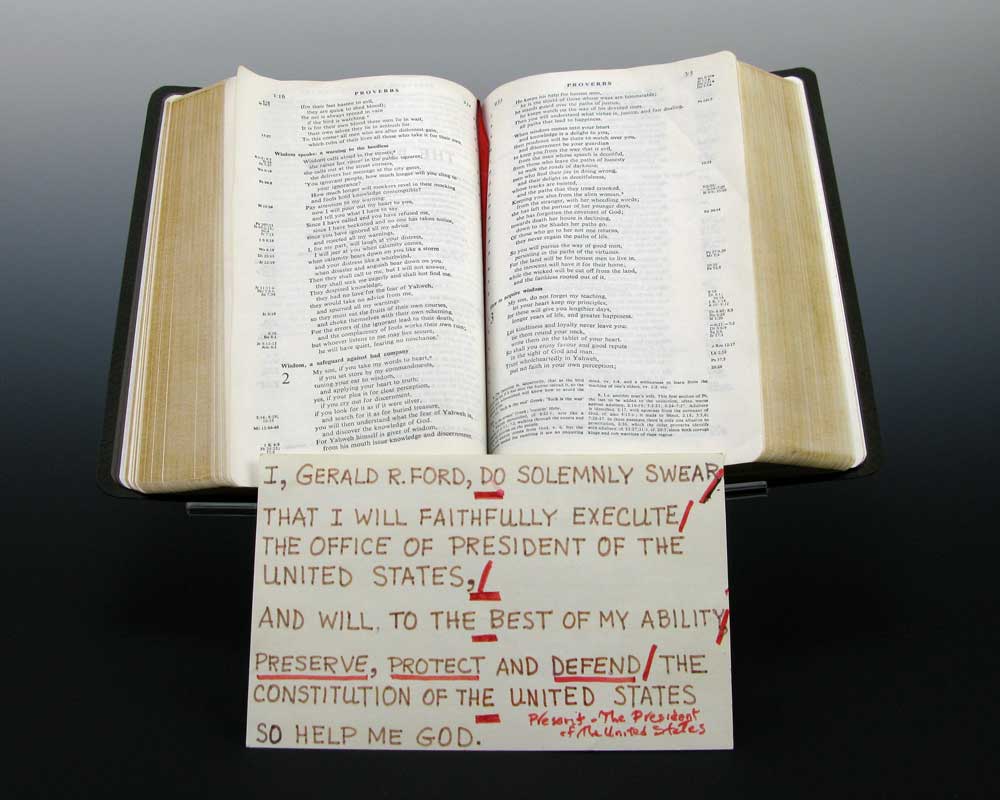
Bible and Cue Card Used by Gerald R. Ford When He Took the Oath of Office

Bible and Cue Card Used by Gerald R. Ford When He Took the Oath of Office

And she brought forth a man child, who was to rule all nations with a rod of iron: and her child was caught up unto God, and to his throne.   (Revelation 12:5)

Recently the liberal news media bushwhacked presidential candidate Dr. Ben Carson for his statement that a Muslim should not serve as President of the United States. The statement found great support among conservatives, but left-leaning Democrats and Republicans were self-righteously offended by his remarks. Attempting to do some damage control without really backing down, Carson explained that someone who would place Sharia Law above the Constitution of the United States cannot honestly swear to uphold and defend the Constitution. Carson rightly pointed out that Islam is a theocracy – god rule. A true follower of Islam cannot separate his religion from his politics; they are one and the same. The Muslim holy book and other Muslim sacred writings call for strict adherence to Islamic law. (“Islam” means “submission.”) Therefore, if a faithful Muslim were to become President of the United States, “he” (because a Muslim woman would not be permitted to hold such an office) would have to, out of obligation to his religion, invoke Sharia Law when it came in conflict with the Constitution.

In his defense, Carson qualified his stance by saying that he could indeed vote for a Muslim as President, if that Muslim denounced Sharia Law and swore to uphold the Constitution in all cases. (Of course, the Qur’an encourages Muslims to lie to “infidels,” so their integrity would be questionable.) Furthermore, said Carson, he would not vote for a Christian, if that Christian advocated for a Christian theocracy. Our nation is and always has been a nation of laws, and the Constitution is the law of the land.

I fully understand and agree with Dr. Carson’s stance. What I believe is missing here is a clear understanding of what a theocracy is. According to Dictionary.Com, a theocracy is “a form of government in which God or a deity is recognized as the supreme civil ruler, the God’s or deity’s laws being interpreted by the ecclesiastical authorities.” The problem with that definition is in the word “recognized” and in the phrase “laws being interpreted by the ecclesiastical authorities.” That renders the definition false because it is humanistic in nature. First of all, the deity has to be “recognized” by man as the “supreme civil ruler” which means that ultimately it is man that is defining the laws of the god. Secondly, the laws are interpreted by men who are either appointed by men or self-appointed as “ecclesiastical authorities.” Ultimately the “theocracy” becomes an “androcracy” – a rule by men, so the “god-rule” goes out the window.

When God brought the children of Israel into the Promised Land, they had no king other than God. God gave His law to Moses and set up a system of priests and judges to administer His law. Not long after they settled in the land, reliance on God and His law fell by the wayside and “every man did that which was right in his own eyes” (Judges 17:6; Judges 21:25). Therein lays the problem with a theocracy – man.

A true theocracy is absolute rule by God. Until Christ returns to set up His kingdom on earth, any man-initiated theocracy is doomed to fail. When Christ returns as King of Kings and Lord of Lords, His rule will be absolute. Speaking of Christ, the Messiah, the Lord says, “Thou shalt break them with a rod of iron; thou shalt dash them in pieces like a potter’s vessel” (Psalm 2:9). When He returns, He will share His administration with His saints “And [they] shall rule them with a rod of iron; as the vessels of a potter shall they be broken to shivers: even as I received of my Father” (Revelation 2:27). There will be no question of authority because His eternal law will not be violated. “And out of his mouth goeth a sharp sword, that with it he should smite the nations: and he shall rule them with a rod of iron: and he treadeth the winepress of the fierceness and wrath of Almighty God” (Revelation 19:15).  The “sharp sword” from His mouth is the Word of God: “For the word of God is quick [i.e., “alive”], and powerful, and sharper than any twoedged sword, piercing even to the dividing asunder of soul and spirit, and of the joints and marrow, and is a discerner of the thoughts and intents of the heart” (Hebrews 4:12).

Until Jesus returns, no true theocracy can exist. Any so called theocracy devised by fallen man is thereby flawed. Dr. Ben Carson is right. Anyone adhering to any human defined theocracy is unfit to hold the office of President of the United States. As it stands, the U.S. Constitution, because of its foundation on God’s Law, must be upheld as the supreme law of the land.

4 Comments

Filed under Apologetics, Current Events, End Times, Philosophy, Politics, Religion, Second Coming of Christ, Theology

The Last Trump

Shophar-739195

Behold, I shew you a mystery; We shall not all sleep, but we shall all be changed, In a moment, in the twinkling of an eye, at the last trump: for the trumpet shall sound, and the dead shall be raised incorruptible, and we shall be changed. (1 Corinthians 15:51-52)

For the past 20 years or more, I have anxiously awaited this time of year. Granted, the Lord is not obligated to comply with my speculations. The times are fully under His sovereign will and control, and I am more than happy to submit to His wisdom and direction. So whatever happens today, tomorrow or in the near future, I am fully trusting that God’s plan will be fulfilled in accordance with His perfect timing to which I am not, nor is anyone else, privy.

The reason for my excitement at this season, is that many years ago I learned that the Feasts of the Lord given to Israel in Exodus were given as a pattern for the future ministry of Christ. The first four feasts came in the spring and were fulfilled by Christ in His flesh. Jesus fulfilled Passover as the Lamb of God on the cross, followed by the Feast of Unleavened Bread. At this feast, all leaven, which represented sin, was to be removed and cast out of the house. Jesus fulfilled this by taking upon Himself our sin and being buried in the earth. Then followed the Feast of First Fruits, which celebrated new life. Jesus fulfilled this feast when He rose from the dead as the “first fruit” of the resurrection. After His resurrection, Jesus walked on the earth for 40 days and ascended into heaven. Ten days later, at the Feast of Pentecost, the Holy Spirit descended upon His followers fulfilling the spring harvest which continues to this day.

Three feasts remain to be fulfilled, and they are the fall feasts. The first is the Feast of Trumpets, or Rosh HaShanah, the beginning of the new civil year. Eight days later Yom Kippur, the Day of Atonement, follows, and then four days after that is Sukkot, or the Feast of Tabernacles (Booths), which is celebrated for eight days. The Feast of Trumpets was a holy convocation or gathering. On the Day of Atonement, sacrifices were offered for the sins of the nation. The high priest first had to offer a sacrifice for his own sins, and then he offered a sacrifice for the sins of the people. He carried the blood of the sacrifice into the temple, and only at this time could he enter into the Holy of Holies that housed the Ark of the Covenant where the presence of the Lord dwelt. As he entered into this most holy place, the chimes on the hem of his robe jingled gaving notice to those without that he was still alive and moving inside. A rope was tied to one of his ankles should the displeasure of the Lord strike him dead. Those outside would not be able to enter the most holy place to extract him, but they could drag him out by the rope. So, in he would go and take the blood of the sacrifice, and there upon the Mercy Seat (the covering of the Ark), he would pour out the blood of the sacrifice. Inside the Ark resided three elements that represented Israel’s sin against God. The tablets of the Ten Commandments represented God’s Law that had been violated. There was a sample of the manna that represented God’s provision that had been rejected. Finally there was Aaron’s staff that had budded representing God’s leadership against which they had rebelled. The contents of the Ark, therefore, represented Israel’s offences against God. These were covered by the sacrificial blood. This was indeed a most solemn and remorseful occasion. Four days later sorrow was followed by a joyous celebration as Israel commemorated their wanderings in the wilderness living in temporary housing – tents, i.e., tabernacles. During this time, God provided food and water for them, and their clothes and shoes did not wear out. More than that, God was always present with them in the form of a cloud by day and a pillar of fire by night. These last three feasts are yet to be fulfilled by the Lord Jesus Christ.

So how is that relevant to us? We are told in the Old Testament, and affirmed in the New Testament, that Christ will return and set up His kingdom on earth for 1000 years. (I have written about this in the past and so have many others, so I will skip the details for now.) Before that happens, seven years of “tribulation” will come upon the earth and mankind (Daniel 9:24-27). According to the pre-tribulation view of end-times, which I loosely hold, Christ will come for His Bride – the Church, the body of all true believers – and take her out of this world to save her from the wrath to come. This is what is known as the Rapture of the church (1 Thessalonians 4:14-18).  This event, we are told, will be preceded “with a shout, with the voice of the archangel, and with the trump of God” (1 Thessalonians 4:16, emphasis mine). Our leading verse says that it will be “at the last trump: for the trumpet shall sound, and the dead shall be raised incorruptible, and we shall be changed” (1 Corinthians 15:52, emphasis mine).

Today, September 13, 2015, is Elul 29 on the Jewish calendar. It is the last day of the Jewish civil year. I understand that every day during the month of Elul, the shofar (the trumpet) is sounded. The following day is Rosh HaShanah (the Feast of Trumpets) when the final trumpet is sounded calling all of Israel to gather at the temple. I believe that for the Church, the Bride of Christ, that will be the call to gather to Him, and thus fulfilling the first of the fall feasts. Tomorrow, September 14, 2015, Tishri 1 on the Jewish calendar, is that day.

There are many reasons to believe that the Rapture will occur tomorrow, although I will not presume upon God and make an emphatic or dogmatic statement. Today (Elul 29) concludes the Sabbatical Year – the Shemitah. Tomorrow, Tishri 1, announces the beginning of the 70th Year of Jubilee since the observance was given to Israel 3500 years ago. Seven, in biblical numerology is the number of completion. Many other “coincidental” events are also converging around this time as recorded in the last post I shared (http://www.ericbarger.com/focused.doom.htm).

I am not saying categorically that the Rapture will take place tomorrow. But I will say this: I will have my ear cocked toward the eastern sky listening for that last trump. I may be disappointed, but never disheartened or discouraged because the Lord promised that He would return (John 14:1-3), and I know that He will when HE is ready. I need to be ready too. Are you?

8 Comments

Filed under Apologetics, Bible, Christianity, Current Events, End Times, Religion, Resurrection, Second Coming of Christ, Theology